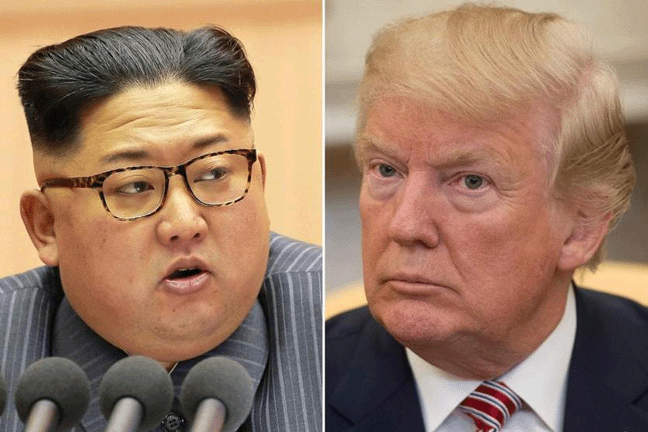
Trump: ‘I don’t think I have to prepare very much’ for North Korea nuclear summit
It’s about ‘attitude’ not ‘preparation,’ the president said of upcoming talks on Tuesday with North Korean leader Kim Jong Un in Singapore. by Jonathan Allen and Dartunorro Clark / Jun.08.2018
WASHINGTON — President Donald Trump said Thursday that he doesn’t need to study for his upcoming nuclear summit with North Korean leader Kim Jong Un.
“I think I’m very well prepared. I don’t think I have to prepare very much,” Trump told reporters at the White House Thursday as he posed for photos with Japanese Prime Minister Shinzo Abe. “This isn’t a question of preparation. It’s a question of whether or not people want it to happen, and we’ll know that very quickly.”
Trump is planning to travel to Canada on Friday for a two-day meeting with the Group of Seven industrial nations that is likely to focus heavily on trade issues before heading to Singapore for his historic sit-down with Kim…….
the president said he has not removed the U.S. sanctions against North Korea going into the meeting and is willing to walk out of the talks if they aren’t going well.
“All I can say is I’m totally prepared to walk away,” Trump said. “If you hear me saying we’re going to use maximum pressure, you’ll know the negotiation did not do well.”
Trump added that he is also prepared to ramp up sanctions on North Korea if the negotiations fall apart.
……..Pompeo downplayed comments made by Trump’s personal lawyer, Rudy Giuliani, earlier this week, that Kim had gotten “on his hands and knees and begged” for the summit after Trump abruptly canceled it last month. “I think it was a bit in jest,” Pompeo said of those remarks. “We’re moving forward and focused on the serious issues…Rudy doesn’t speak for the administration when it comes to this negotiation.”
How Kim Jong Un and Trump Differ on Denuclearization. Bloomberg , By David Tweed and Kanga Kong
Donald Trump and Kim Jong Un are preparing to meet face-to-face in Singapore on June 12, a prospect that seemed unthinkable just a year ago when the leaders of the U.S. and North Korea were exchanging insults and threats. The main topic will be denuclearization, but they appear to have different ideas of what that means and how long it might take. Overcoming those differences will be key to reaching a historic outcome.
1. What is the U.S. stance on denuclearization?
The U.S. wants to see “complete, verifiable and irreversible denuclearization” of the Korean Peninsula. Known in the arms-control world as “CVID,” this would involve dismantling North Korea’s nuclear program and stripping Kim of the ability to make nuclear bombs in the future.
2. What does denuclearization mean for North Korea?
North Korea in April committed to work toward “complete denuclearization,” without elaborating on what that meant. In 2016, a government spokesman called for “the denuclearization of the whole Korean peninsula and this includes the dismantlement of nukes in South Korea and its vicinity.” More recently, North Korea has framed its willingness to get rid of nuclear weapons in more of a global context, implying that it will do so in concert with established nuclear powers like the U.S., China and Russia.
3. Does the U.S. have nuclear weapons on the peninsula?
The U.S. hasn’t stationed them in South Korea since 1992, but it does provide a so-called nuclear umbrella that guarantees the safety of allies South Korea and Japan. Kim may ask the U.S. to remove the nuclear bombers it has stationed in Guam and cease patrols by its nuclear-armed submarines. The U.S. would be unlikely to agree to any measures that would leave its allies vulnerable.
4. What about the time frame for removing nuclear weapons?
Speed is crucial for the U.S. to avoid a lengthy process that provides sanctions relief for North Korea as well as time to advance its nuclear program even further. Even so, North Korea has made it clear it will not accept the so-called Libya model proposed by U.S. National Security Adviser John Bolton under which the regime ships its nuclear arsenal out of the country in return for security guarantees and sanctions relief. ……….https://www.bloomberg.com/news/articles/2018-06-04/how-kim-jong-un-and-trump-differ-on-denuclearization-quicktake
Iran informs UN of increase in nuclear enrichment capacity, Iran’s Ayatollah had ordered the increase in capacity in a speech Monday, CBC ,The Associated Press
Iran has informed the UN nuclear watchdog that it will increase its nuclear enrichment capacity within the limits set by the 2015 agreement with world powers.
The modest steps announced Tuesday appeared to be mainly aimed at signalling that Iran could resume its drive toward industrial-scale enrichment if the nuclear accord comes unraveled.
Behrouz Kamalvandi, the spokesman for Iran’s nuclear agency, was quoted by state TV as saying a letter was submitted to the International Atomic Energy Agency detailing the move.
Kamalvandi said Iran is “providing infrastructure and arrangements for high-speed and capacity in production of UF4 and UF6 gases as well as rotor of centrifuges.”
Spinning centrifuges convert the gases into enriched uranium that can be used for reactor fuel and medical isotopes. If enriched to higher levels, the material can be used for weapons.
“The Agency received a letter from Iran on 4 June informing the Agency that there is a tentative schedule to start production of UF6,” a spokesperson for the IAEE confirmed on Tuesday, referring to uranium hexafluoride, the feedstock for centrifuges.
JCPOA set enrichment levels
The head of Iran’s nuclear agency, Ali Akbar Salehi, said Iran is prepared to resume work on advanced centrifuges that would dramatically increase its capacity for enrichment. But he said that so far the work is limited to building a new facility for assembling the centrifuges.
Supreme Leader Ayatollah Ali Khamenei had ordered the increase in capacity in a speech Monday, in which he vowed that Iran would preserve its nuclear program despite the U.S. withdrawal from the landmark 2015 accord, known as the Joint Comprehensive Plan of Action and also signed by France, Germany, the United Kingdom, the European Union, Russia and China.
Another nuclear crisis in the making? Great power competition and the risk of war in South Asia, BAS, Moeed Yusuf 5 June 18, In May 1998, India and, later, Pakistan conducted multiple nuclear tests to become the first pair to go nuclear in the post-Cold War era. Two decades on, these South Asian rivals remain locked in a deeply antagonistic relationship that constantly threatens to boil over.
The US-North Korea showdown, the upcoming summit, and the fate of the Iranian nuclear deal have consumed the global nuclear debate over the past year. During this time, India and Pakistan have slipped into an active low-level confrontation largely unnoticed.Violence on the Line of Control (LoC) that divides the Indian and Pakistani controlled parts of the disputed territory of Kashmir has been at its highest level since the two sides agreed to a ceasefire in 2003. In 2017, the bloodiest year since, there were nearly 3,000 ceasefire violations. Persistent tit-for-tat military shelling across the LoC has caused significant casualties and damage. Civilians have been targeted and killed at an unprecedented rate, as well.
Previous wars and major crises between the two sides were triggered by miscalculated military maneuvers in Kashmir or, in more recent years, by terrorist attacks. Neither can be ruled out in the current context; either could unleash a deadly escalatory spiral.
The risks involved in such a scenario would quickly remind the world why US President Bill Clinton dubbed the LoC as “the most dangerous place” on Earth at the turn of the century. India and Pakistan lack robust bilateral escalation control mechanisms. In the past, they have depended heavily on the United States and other strong third-party states with influence in the region to mediate crisis outcomes. These third parties have responded eagerly and acted with remarkable coordination in pursuit of de-escalation.
The next crisis may demand the same—but the global powers may be found wanting. The antecedent conditions that previously drove their positive engagement have already eroded. Never since South Asia’s nuclearization has global politics been so uncertain, great power relations so fraught, and competing global priorities so distracting. This reality combined with the continued absence of alternative tested crisis management experiences in South Asia may force a break from the successful crisis management patterns of the past.
A look at the past. South Asia’s nuclearization in 1998 not only ushered in a new era of regional nuclear competition but it also forced a rethink of the established norms of nuclear crisis management. The Cold War was dominated by the two superpowers. No stronger third parties able to readily influence their crisis behavior existed. Virtually all examination of nuclear contests therefore assumed bilateral contexts. While the United States and Soviet Union regularly intervened in regional crises in support of their allies, they used these moments primarily to compete and advance their global interests vis-à-vis the other.
The advent of regional nuclear dyads fundamentally altered the incentives for the United States and other strong powers to compete through regional proxies. The worry of second-age nuclear powers like India and Pakistan stumbling into nuclear war on their own proved overbearing. Crisis moments were now marked by the urge to ensure the absence of catastrophic escalation—above all prior policy preferences, no matter how important or urgent.
India and Pakistan are no strangers to crises. Since 1998, they have experienced at least three major and several modest bouts of high tension. ……
A future different from the past? The importance of third party crisis management in South Asia has only grown over time. India and Pakistan have been unable to agree on dependable risk reduction and escalation control mechanisms with a direct bearing on crisis moments. Simulation exercises continue to point to their likely inability to terminate escalated crises. In fact, as reluctant as India and Pakistan are to admit this, they have learned from previous crisis iterations and internalized third-party roles as part of their crisis planning. Worryingly, some of their doctrines and crisis strategies assume the option of third-party bailouts.
These South Asian rivals have not ruled out conflict under the nuclear umbrella. India now boasts an operational limited war doctrine, Cold Start, that envisions swift military action against Pakistan—before international actors can pressure India to forego aggression
……….. The aura of unpredictability that presently surrounds US foreign policy has brought America’s willingness to act as that leader into question. Simultaneously, the precipitous decline in US relations with surging competitors like China and Russia and increasing difficulties in transatlantic relations has tempered global confidence in the ability of the great powers to operate collectively as agents of peace. ……..https://thebulletin.org/another-nuclear-crisis-making-great-power-competition-and-risk-war-south-asia11876
Clapper says Kim’s regime doesn’t feel like a ‘supplicant’ now
Ex-DNI chief says he backs Trump’s decision to attend summit
North Korean leader Kim Jong Un’s decision to sit down with the U.S. was fueled by his regime’s view that it made significant achievements in its nuclear weapons program and would no longer be a “supplicant” in talks, former Director of National Intelligence James Clapper said.
Clapper said it may not matter whether North Korea actually has the technology to launch an intercontinental ballistic missile with a nuclear warhead that can successfully hit a U.S. target. That’s less important to the regime than the psychological boost it received from demonstrating its prowess in testing ICBMs and more powerful nuclear bombs.
U.K. Reaches Draft Deal to Ensure Nuclear Supply After Brexit, Bloomberg , By Jonathan Tirone,
The U.K. reached an accord with international inspectors that will help keep the flow of nuclear materials going after the country leaves the European Union.
The International Atomic Energy Agency’s board of governors could approve the U.K.’s draft safeguards this week in Vienna, according to a statement. The IAEA deal will “replace existing agreements” between the U.K. and European Atomic Energy Community, or Euratom, that are needed for the import and export of fuel used in nuclear power plants.
SA no longer has agreement with Russians on nuclear, says Radebe, Fin 24, Jun 04 2018 Khulekani Magubane Cape Town –Minister of Energy Jeff Radebe told eNCA on Sunday evening that South Africa no longer had an agreement with the Russians to procure for the development of nuclear energy for the country.
Speaking to journalist and political analyst Karima Brown on the news network’s show The Fix, Radebe said he was of the view that government did not appeal the court ruling in 2017 which invalidated the nuclear deal at that time.
The energy portfolio in national government has seen unparalleled instability with at least five ministers of energy in the past eight years, and a subsequent lack of clarity as to whether the Intergovernmental Framework Agreement which mentions nuclear would still be pursued and what role nuclear would play in the energy mix…….https://www.fin24.com/Economy/sa-no-longer-has-agreement-with-russians-on-nuclear-says-radebe-20180604
KL: All nuclear powers must denuclearise, Straits Times,Reme Ahmad, South-east Asia Editor , 3 June 18
Malaysia’s Defence Minister Mohamad Sabu said yesterday that his country supports the move to denuclearise the Korean peninsula, but that all the nuclear powers should be stripped of their nuclear arsenal in the future.
Malaysia is also hopeful for a good outcome for the June 12 summit in Singapore between United States President Donald Trump and North Korean leader Kim Jong Un, Mr Mohamad said in a media interview on the sidelines of the 17th Shangri-La Dialogue security conference.
“Malaysia is fully supportive of any commitment towards the denuclearisation of the Korean peninsula. The problem is why only Korea? Why only Iran?
“Why not America, China, Russia, India, Pakistan? So that is monopoly.
“We hope that denuclearisation must be (for) all.”
He said that it was “dangerous for the world” to have the US or North Korea threatening each other with their nuclear weapons.
He described the Trump-Kim summit as a good start towards denuclearisation.
“Whether the meeting will be successful or not, that is another matter, than the fact they would even meet,” said Mr Mohamad, who was sworn in as Defence Minister two weeks ago.
Deputy Prime Minister and Minister of Defense Khalid Al Attiyah told an international security conference in Singapore that Qatar has “a lot of differences” with Iran but it does not mean “we go and fuel a war” in the region.
“Is it wise to call the United States and to call Israel to go and fight Iran? … Whether any third party is trying to push the region or some country in the region to start a war in Iran, this will be very dangerous,” he said.
He did not name any party but could be referring to Iran’s rival Saudi Arabia, which has also led a blockade of Qatar with its Persian Gulf allies since June last year, accusing Doha of supporting extremists and refusing to cut ties with Tehran.
“Iran is next door. We should call Iran, put all the files on the table and start to discuss to bring peace rather than war,” he said in a speech.
Responding to a question whether Qatar’s air bases could be used to launch airstrikes on Iran, al-Attiyah said that his country was not a “fan of war” and supported engagement and dialogue.
Qatar is hosting 10,000 U.S. troops stationed at sprawling al-Udeid Air Base as part of its campaign against the Islamic State group and the war in Afghanistan.
Al Attiyah called for salvaging a 2015 nuclear accord between world powers and Iran that offered Tehran sanctions relief for curbs on its nuclear program. The U.S. withdrew from the deal last month.
“Everyone should keep holding on to this and advance with this. In my own judgement, I think the United States is wiser than to enter in a war with Iran,” he said.
He also said Qatar is “firmly aligned” against terrorism and has implemented U.N. resolutions and penalties targeting militants.
Mattis Warns of Bumpy Road to US, North Korea Nuclear Summit Military.com The Associated Press 3 Jun 2018 By Lolita C. Baldor SINGAPORE — It will be a “bumpy road” to the nuclear negotiations with North Korea later this month, Defense Secretary Jim Mattis warned Sunday, telling his South Korean and Japanese counterparts they must maintain a strong defensive stance so the diplomats can negotiate from a position of strength.
Mattis was speaking at the start of a meeting with South Korean Defense Minister Song Young-moo and Japanese Defense Minister Itsunori Onodera on the final day of the Shangri-La Dialogue security conference. He said allies must remain vigilant.
…….. Plans are moving forward for a nuclear weapons summit between President Donald Trump and North Korean leader Kim Jong Un on June 12 in Singapore. And Mattis repeated the U.S. position that North Korea will only receive relief from U.N. national security sanctions when it demonstrates “verifiable and irreversible steps” to denuclearization…….https://www.military.com/daily-news/2018/06/03/mattis-warns-bumpy-road-us-north-korea-nuclear-summit.html
Beyond Iran and North Korea, the nuclear-armed rivals of India and Pakistan need help to prevent a war. A cease-fire in disputed Kashmir shows progress, but a deeper reconciliation, especially an understanding in their shared history, is needed. May 31, 2018, By the Monitor’s Editorial Board
As long as he is already trying to denuclearize North Korea as well as permanently ban Iran from building a nuclear weapon, President Trump may want to pay heed to India and its neighbor Pakistan. The two nuclear-armed powers have gone to war three times since they achieved independence in 1947. And over the past year, regular skirmishes along their disputed border in Kashmir have killed dozens and displaced 50,000 civilians.
Pakistan and India each recognize a nuclear war would be mutually devastating. Yet they need help in overcoming a deep suspicion and animosity, driven in part by diverging narratives of their shared past, that could someday trigger a full-scale conflict.
With the border fighting in Kashmir getting out of hand in recent months, the two countries agreed May 29 to honor a cease-fire pact that was first put in place 15 years ago. The agreement is a welcome step. Yet it provides only a pause in hostilities without a commitment to a peace dialogue and, more important, the creation of a culture of reconciliation.
Iran and North Korea are still a long way from any attempt to reconcile with their perceived foes. Ending their nuclear threat has required outside pressure. Pakistan and India, however, have tried at times to come to terms with each other since the violent partition of British India into their respective countries, one largely Muslim and the other largely Hindu. Sometimes their leaders talk or the countries share a sports contest. Nonetheless, trade and travel between the two remain minimal given the size of their economies. And the Kashmir dispute as well as terrorist attacks keep them apart.
Religious differences have mattered less in their relations than the role of nationalist politicians who find it convenient to whip up hatred and fear of the other side. The ill will is generated in large part by competing histories of the 1947 partition – who started it, who killed more people, and who were the heroes and villains. Over the decades, the official history textbooks in each country have become political weapons to create an enemy and build up national unity.
Peace between India and Pakistan will require some sort of agreement on their shared history, one that must reduce old grievances and lessen the paranoia that could trigger a nuclear war. In Northeast Asia, Japan, South Korea, and China have tried in the past two decades to write a joint history in hopes of reducing the use of old resentments. The efforts have largely failed.
Yet this past winter, India and Pakistan achieved some success in transcending nationalist histories with the first citizen-level attempt at a joint telling of their shared history. Two history professors, one in Pakistan and the other in India, held a semester-long course titled “Introduction to South Asian History” that included more than 20 students from each country connected online. The teaching took place mainly over Skype and included a visit of 11 Pakistani students to India in May.
The two teachers, Ali Usman Qasmi of the Lahore University of Management Sciences and Pallavi Raghavan at OP Jindal Global University, reported that the students were amazed to discover what they did not know about the other country. They achieved an “overlapping consensus” on historical events with respect and understanding. The success of the course, they wrote, “shows that an alternative imagining of the past conducive to achieving peace and harmony in the region is … possible.”
Cease-fires in Kashmir, even a peace dialogue or a full opening of trade, will help India and Pakistan avoid the worst kind of wars. But much of that may not matter until the two peoples can craft a shared understanding of the past in order to reconcile for a better future.
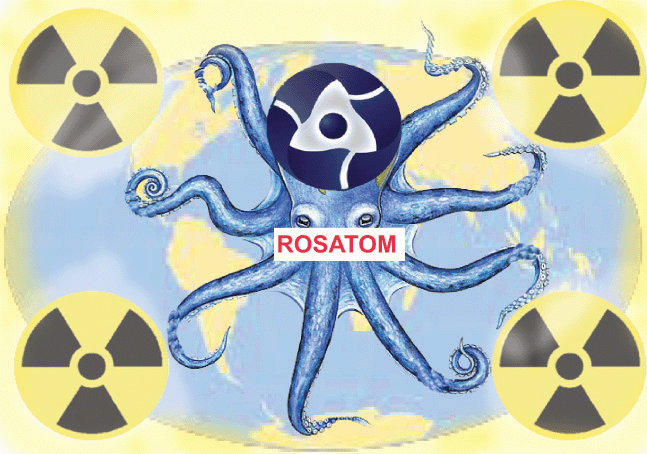
World Nuclear News 29th May 2018, Russia’s Rosatom and the French Alternative Energies and Atomic Energy
Commission (CEA) have signed a strategic document on partnership in the
peaceful uses of nuclear energy.
NEW YORK — Secretary of State Mike Pompeo cited progress Thursday toward salvaging a historic summit between President Trump and North Korean leader Kim Jong Un and what he called the “once in a lifetime opportunity” of ending the nuclear weapons threat from North Korea.
Following two days of talks with Kim’s right-hand aide, Vice Chairman Kim Yong Chol, Pompeo spoke as though the summit Trump had canceled last week was likely to be reinstated, but still framed it as an “expected” first meeting.
Israel ‘is selling nuclear information’ to Saudi Arabia, Middle East Monitor, May 31, 2018
Western security agencies believe that Israel is selling nuclear information to Saudi Arabia, Arabi21 has reported. According to Israeli writer Ami Dor-on, such information will give the government in Riyadh nuclear weapons capabilities. Writing on the News One website, Dor-on said that the joint intention is to make sure that Iran will not be the only country in the region that possesses such weapons which threaten the security and safety of the Kingdom.
“This information should shock us,” he said, “as we see the world is changing for the worse, following the race for the possession of nuclear weapons that pass right over our heads in the Middle East.” Saudi Arabia no longer conceals its wish to develop nuclear weapons, the writer added.
However, General Amos Yadlin, former chief of Israel’s Military Intelligence Directorate, has suggested that the Saudis would not wait to get nuclear capabilities. “They will go to Pakistan, and take whatever they want,” he claimed……..
While Pakistan could clearly simply transfer a nuclear bomb to Saudi Arabia, that would not be Israel’s intention. “Israel may transfer information and nuclear expertise to the Kingdom that would enable it to develop its advanced capabilities in this specific area,” Dor-on clarified. “Yadlin’s comments as a senior Israeli intelligence official gives credibility to the leaks of the Western intelligence services.”
Ex-Israeli spy chief: Netanyahu planned Iran strike in 2011 By ILAN BEN ZION, JERUSALEM (AP) 31 May 18 — Israeli Prime Minister Benjamin Netanyahu gave the order in 2011 for the military to prepare to attack Iran within 15 days, a former Mossad chief said in remarks released on Thursday.
Tamir Pardo, who served as head of the Israeli intelligence agency from 2011 to 2016, told Israeli Keshet TV’s investigative show Uvda that the order was not given “for the sake of a drill,” according to excerpts of the interview released ahead of the broadcast on Thursday evening.
“When he tells you to start the countdown process, you know that he isn’t playing games with you,” Pardo is quoted as saying. “These things have enormous significance.”
There was no immediate comment from Netanyahu’s office on Pardo’s claim.
On Wednesday, Netanyahu said Israel “will not allow Iran to arm itself with nuclear weapons. We will continue to act against its intentions to establish itself militarily in Syria besides us, not just opposite the Golan Heights, but any place in Syria.”
Pardo’s claim comes as archenemies Israel and Iran are fighting a shadow war in Syria, which briefly threatened to burst into full-blown conflagration this month after Israel bombed Iranian positions in Syria, killing Iranian fighters after an alleged Iranian rocket barrage toward the Israeli-controlled Golan Heights…….. https://apnews.com/ff3d8d27040e45f0a24beab254a63e3d