In the first summit meeting between the leaders of the United States and North Korea, Donald Trump met with Kim Jong-un, on June 12, 2018, in Singapore. The two leaders smiled warmly, posed for cameras as friends, shook hands, and Trump spoke in glowing terms of admiration about Kim at the news conference.
Most Americans doubt that the Trump summit will result in North Korea giving up nuclear weapons
 Poll: Majority skeptical North Korea will give up nuclear weapons as a result of Trump summit http://thehill.com/policy/international/392677-poll-majority-skeptical-north-korea-will-give-up-nuclear-weapons-as-a, BY LUIS SANCHEZ – 06/17/18
Most Americans in a new poll are skeptical that President Trump’s meeting with Kim Jong Un will lead North Korea to give up its nuclear weapons.
Fifty-three percent said that it’s unlikely last week’s Singapore summit will lead North Korea to give up its nuclear weapons, a new ABC News/Washington Post poll found.
Although most Americans remain skeptical following the summit, the historic meeting apparently did improve people’s expectations about denuclearization.
The number of Americans who see denuclearization as likely has increased from 30 percent to 41 percent, the poll found.
The summit, which ended with a vague joint accord stating a commitment to “denuclearize” the Korean Peninsula, has left many unsure of what will happen next.
FIFTY-FIVE PERCENT OF PEOPLE IN THE NEW POLL SAID THAT IT WAS TOO EARLY TO TELL WHETHER OR NOT THE SUMMIT CAN BE CALLED A SUCCESS FOR THE U.S.
LESS THAN ONE-THIRD, 29 PERCENT, SAID THE SUMMIT WAS A SUCCESS FOR NORTH KOREA AND ONLY 21 PERCENT SAID THE SAME ABOUT THE U.S.
FORTY-TWO PERCENT ALSO SAID WAR IS NOW LESS LIKELY IN THE LONG TERM, WHILE 39 PERCENT SAID THAT THE SUMMIT MADE NO DIFFERENCE TO THE LIKELIHOOD OF WAR.
THE POLL SURVEYED 495 ADULTS FROM JUNE 13-15. IT HAS A SAMPLING ERROR OF 5.5 PERCENTAGE POINTS.
Donald Trump alienates America’s allies – thus increasing the likelihood of nuclear weapons proliferation
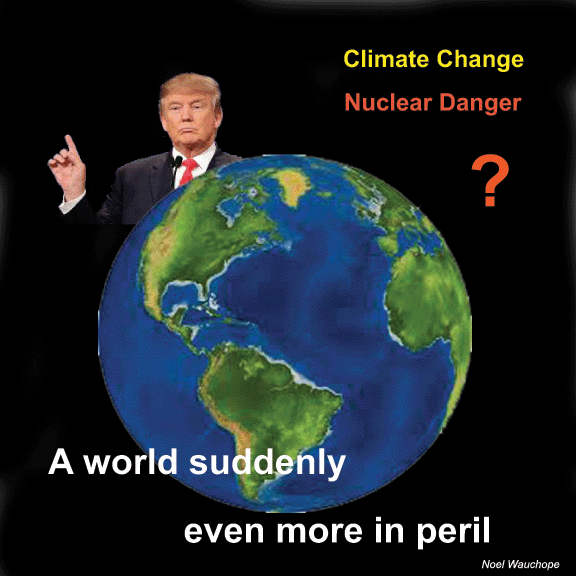 Trump triggers talk of Australia going nuclear , SMH, By Peter Hartcher,
Three former deputy secretaries of Australia’s Defence Department – strategists Hugh White, Paul Dibb and Richard Brabin-Smith – have mooted the idea in the past year. Till these most recent months, it’s been something of a taboo topic in respectable circles.
One big reason? Australia already has the protection of the United States nuclear umbrella. Under this system, the US pledges that if anyone should launch a nuclear strike on one of its allies, Washington would retaliate against the aggressor.
So to suggest that Australia now needs its own atomic arsenal is to suggest that there has been a fundamental breakdown in trust. In short, that the US alliance is dead.
But hold on. Why now? Isn’t this exactly the wrong time to be laying such plans? Doesn’t this week demonstrate that the US can act to deal with a hostile nuclear state? Didn’t Donald Trump’s summit with Kim Jong-un just reduce a threat for the US allies in the region, including Australia, which falls within reach of Kim’s long-range missiles?
There are two key points here. First, the text of the brief document that the leaders signed does say that North Korea “commits to work toward complete denuclearisation of the Korean Peninsula”. But this is neither new nor convincing.
A former US nuclear negotiator with the North Koreans, Republican David Asher, who led the North Korean activities group in the White House of George W. Bush, says: “For the President to say that the nuclear threat has been eliminated is, I think, unwise. If he’s wrong, it’ll be on him.”
Asher, a scholar at the Centre for New American Security, says: “I have hope, but after dealing with the North Koreans for 25 years, it’s not a promise I personally can have great faith in.” Asher has a litany of first-person examples of Kim Dynasty duplicity……….
the first point is that no one can yet know whether Trump has actually de-fanged a dangerous enemy. But the second point is what everyone does know now – that Trump is prepared to trade away the interests of an ally if he thinks it will help him get a deal with an enemy.
Trump announced that he had promised Kim he would stop the big military exercises that the US conducts with South Korea twice a year.
………The problem? The cancellation was news to South Korea’s President, Moon Jae-In. It was news to another keenly interested US ally, Japan’s Shinzo Abe. And it was news to Trump’s own military commanders, who were in the middle of preparations for the next exercises, two months away.
And in announcing the end to the manoeuvres, Trump adopted the language of the North Korean propagandists. Pyongyang has long railed against the exercises as “provocative war games”. The US has never called them war games nor described them as provocative; Trump did both.
It seems that Kim put the demand to Trump in the negotiating room and Trump agreed on the spot. He agreed to a demand by an enemy without consulting his ally. “It is urgent to make bold decision,” Kim told the US leader, in the words of the North Korean official news agency, and Trump bought it.
This was greeted with delighted incredulity in Beijing. Because this is precisely what the Chinese Communist Party has sought for many years. Professor Shi Yinhong, of the People’s University in Beijing, said that Trump’s pledge to halt military manoeuvres was almost “too good to be true” from China’s point of view.
Why does China care? Because one of its greatest strategic aims is to separate the US from its allies. One of America’s greatest assets is that it sits at the centre of a global alliance system embracing more than 40 nations, including most of the world’s major economies. China, by contrast, has a only couple of rather unimpressive allies, Pakistan and North Korea.
Shi drew the connection: If US troops in South Korea were to stop the military exercises, it could cause allies to lose confidence in Washington and undermine the entire US military presence in Asia, he told America’s National Public Radio. For China, this is victory on every level.
“We see a clear pattern of Donald Trump turning against his allies,” says a close student of Trump foreign policy, Tom Wright, a senior fellow at the Brookings Institution in Washington. “He’s generally hung his allies out to dry.”
Just in the last two weeks he has harmed US alliances with Britain, France, Germany and Canada, putting punitive tariffs on their exports and insulting Canada’s Justin Trudeau on top, calling him weak and dishonest.
He upset his allies at the annual G7 summit by proposing that Russia be restored to the group’s meetings, when the G7 is supposed to be ostracising Putin for invading Ukraine.
Trump has inflicted so much political damage to America’s European and Canadian alliances that “the community of North American and European nations forming the nucleus of the alliance that won the Cold War for the West is closer to breaking up now than at any time since the 1940s” in the assessment of Walter Russell Mead, an American scholar.
“And,” says Wright, “he completely sidelined Japan” with this week’s Kim summit. It seems that there was only one US ally who had been able to persuade Trump decisively to change US policy, and even that has turned sour, says Wright.
South Korea’s Moon was the one who persuaded Trump to try directly negotiating with Kim, yet in those very negotiations Trump ended up trading away a South Korean interest. “Moon thought he could ride the tiger, control where he went, but didn’t realise the tiger goes where the tiger wants to go,” as Wright puts it. “He brought Trump into this but then lost control.”
Why does Trump consistently act against the interests of his allies? Wright, who predicted just this pattern of behaviour before Trump was elected, explains: “In his 30-year history of talking and writing about this stuff, Trump has always been more aggravated by America’s friends than its enemies.
“He has been consistent about this for 30 years. It’s not sophisticated or complex, but he is much more ideological than people think: interdependence is a bad deal for America.” Trading partners will cheat America; allies will free ride on America’s military budget.
Australia has been unscathed so far; Wright says that this will likely change only if some disagreement emerges. Trump isn’t so systematic to work down a list of allies he must alienate, but he will “react to what’s in front of him. It’s possible to sneak on by.”
The only time he will turn against a US rival is if he thinks that rival is directly threatening the US with attack, according to Wright. Otherwise, he’s happy to deal with America’s enemies: “He’s open to deals, he worries about commitments.”
Which is how he manages to make concessions to North Korea while sidelining the interests of South Korea. Trump went further, saying that he wanted one day to withdraw the 28,000 US troops that provide an American “trip wire” across the Demilitarised Zone separating North from South.
If the North should invade, the US forces will be engaged automatically, the wire tripped, guaranteeing America will come to Seoul’s defence. Trump said this was a matter for the future; South Korea’s Moon wishes he hadn’t raised it at all.
If Trump’s North Korean gambit works, he will have a serious achievement. If it fails? Says Asher: “The irony of the North Korean denuclearisation deal could be that everybody else decides to go nuclear. If it fails and Kim remains in power and countries doubt our commitment, then what’s to stop Japan or South Korea or Australia going nuclear?”
It could lead to “mass nuclearisation – it’s a very bad position, 20 countries in the region with nukes, like 20 people in a room all pointing guns at each other”.
These are, of course, imponderables, possible futures that no one hopes for but governments need to plan for. Hendy and White and Dibb and Brabim-Smith may be tending towards alarmism, but they want Australians to think about the world after the American-led alliance system has passed into history.
An American journalist, Jeffrey Goldberg, writes in The Atlantic this week that he asked a number of unnamed White House officials whether there is a Trump doctrine in foreign policy. One, described as a senior official with direct access to the President and his thinking, replied that there is. And it is: “We’re America, bitch.” History is in the making. https://www.smh.com.au/politics/federal/trump-triggers-talk-of-australia-going-nuclear-20180615-p4zlsa.html
Hopes for peace following the Trump-Kim summit are likely to be short-lived
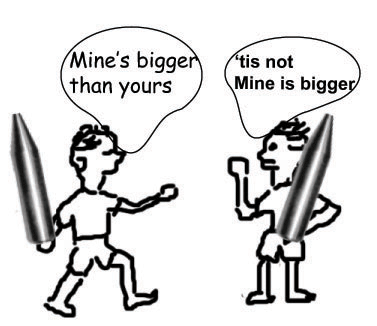 The scary truths about Trump’s nuclear summit https://www.engadget.com/2018/06/15/the-scary-truths-about-trump-s-nuclear-summit/ In which Donald Trump and Kim Jong-un compared the size of their nuclear buttons. Violet Blue
Nuclear Industry Association still struggling with inconvenient truth that Brexit is bad for their industry
 Industry body welcomes progress on international nuclear agreement as Brexit looms http://www.timesandstar.co.uk/news/business/Industry-body-welcomes-progress-on-international-nuclear-agreement-as-Brexit-looms-31636156-0808-499c-bb14-5cb07e604c04-ds
But the Nuclear Industry Association says there remains a lot to do to secure Britain’s nuclear sector before it leaves Euratom.
Progress on a voluntary agreement that will continue to allow officials to keep tabs on and inspect UK civil nuclear facilities including Sellafield post-Brexit, has been welcomed by an industry group.
The International Atomic Energy Agency’s (IAEA) board of directors has approved the UK Voluntary Offer Agreement, which if ratified as expected later this summer, will see the UK continue to share information on its civil nuclear facilities and allow inspections by IAEA officials.
The IAEA works to ensure the peaceful use of nuclear energy and has safeguards in place with nuclear weapons states such as the UK. At present the sharing of information and inspections go through the European Commission and its agency Euratom.
The UK is set to leave Euratom in March 2019 at the same time it exits the European Union.
The Nuclear Industry Association (NIA) has been pushing the Government to secure agreements with bodies including the IAEA, to ensure current agreements do not break down post-Brexit.
The NIA’s chief executive Tom Greatrex welcomed the IAEA’s approval of a replacement agreement as a “step in the process towards creating a domestic regime to replace current Euratom functions”.
He said: “It is the first in a series of international agreements which need to be negotiated, agreed and ratified with a number of third countries, and the practical arrangements relating to the UK’s safeguarding regime need to be finalised – including recruitment, training, systems and equipment.
“There has been significant progress over the last few months, but there remains a lot left to do.
“Industry continues to work with government to assist in this process, but it remains of critical importance that the government finalise negotiations on a transitional framework for the UK before it leaves the EU and Euratom in March 2019, to minimise the risk of future arrangements not being ready at the time the UK ceases to be part of Euratom.”
Concerns has also been expressed in Cumbria over the UK’s exist from Euratom.
Barrow and Furness MP, John Woodcock has been a long-standing critic of the move, which he says has potential to hurt the industry in the county.
Prime Minister Teresa May said she is keen to retain some links with Euratom post-Brexit.
In a speech last month Mrs May said she would “willingly” make a financial contribution to allow Britain’s to “fully associate” itself with Euratom’s R&D programme and Horizon Europe research and innovation programme – the successor to Horizon 2020.
Tough sanctions will remain on North Korea until its complete denuclearisation – says USA
 Pompeo says North Korea sanctions to remain until complete denuclearisation, Reuters, Christine Kim, Michael Martina– 14 June 18, SEOUL/BEIJING – Tough sanctions will remain on North Korea until its complete denuclearisation, the U.S. secretary of state said on Thursday, apparently contradicting the North’s view that the process agreed at this week’s summit would be phased and reciprocal.
U.S. President Donald Trump and North Korean leader Kim Jong Un issued a joint statement after their meeting in Singapore this week that reaffirmed the North’s commitment to “work toward complete denuclearisation of the Korean peninsula”, while Trump “committed to provide security guarantees”.
Trump later told a news conference he would end joint U.S.-South Korean military exercises.
“President Trump has been incredibly clear about the sequencing of denuclearisation and relief from the sanctions,” Secretary of State Mike Pompeo told reporters after meeting South Korea’s president and Japan’s foreign minister in Seoul.
“We are going to get complete denuclearisation; only then will there be relief from the sanctions,” he said.
North Korean state media reported on Wednesday that Kim and Trump had recognized the principle of “step-by-step and simultaneous action” to achieve peace and denuclearisation on the Korean peninsula.
The summit statement provided no details on when North Korea would give up its nuclear weapons program or how the dismantling might be verified.
Skeptics of how much the meeting achieved pointed to the North Korean leadership’s long-held view that nuclear weapons are a bulwark against what it fears are U.S. plans to overthrow it and unite the Korean peninsula.
……. Kim understood getting rid of his nuclear arsenal needed to be done quickly and there would only be relief from stringent U.N. sanctions on North Korea after its “complete denuclearisation”, Pompeo said.
Moon later said South Korea would be flexible when it comes to military pressure on North Korea if it is sincere about denuclearisation.
Also on Thursday, North and South Korea held their first military talks in more than a decade. The talks followed on from an inter-Korean summit in April at which Moon and Kim agreed to defuse tension and cease “hostile acts”.
Speaking later in the day in Beijing, Pompeo said China, Japan and South Korea all acknowledged a corner had been turned on the Korean peninsula issue, but that all three had also acknowledged sanctions remain in place until denuclearisation is complete.
…… we have made very clear that the sanctions and the economic relief that North Korea will receive will only happen after the full denuclearisation, the complete denuclearisation of North Korea.” https://www.reuters.com/article/us-northkorea-usa/pompeo-says-north-korea-sanctions-to-remain-until-complete-denuclearization-idUSKBN1JA07O
Huge USA weapons purchase by Saudi Arabia was on condition that USA would KILL THE IRAN NUCLEAR AGREEMENT!
 US Promised Saudis to ‘Kill Iran Nuclear Deal’ – Analyst Sputnik News, 14 June18 Saudi Arabia made its defense cooperation with the US conditional on Washington exiting the 2015 nuclear deal with Iran, the founder of the Ibero-Persia consultancy firm has said.
“The large-scale US arms supplies to Saudi Arabia in May 2017 made it perfectly clear that the sanctions against Iran were coming back and the nuclear deal was dead,” Sharoj Habibi claimed in an interview with Sputnik Mundo.
According to Habibi, the contract for the delivery of delivery of $350 billion worth of US-made THAAD air defense missile systems to Riyadh was negotiated, among others, by President Trump’s son-in-law Jared Kushner.
“Obviously, if you let your son-in-law clinch such a deal, this big-time operation is bound to offer very lucrative bonuses,” Habibi noted adding that the Trump family could have earned a very comfortable, though undisclosed, commission from the deal.
He alleged that as part of the contract, the US authorities “promised to do everything possible to kill the nuclear agreement with Tehran, which made it possible for Iran to economically outpace Saudi Arabia and develop its gas producing sector. Iranian gas would effectively sideline America’s Middle Eastern ally, Saudi Arabia,” the expert said.
He added that because Riyadh’s ultimate goal is to ”control everything that is happening in the Middle East,” it needs to bring the US into play. With Donald Trump’s arrival inat the White House, he continued, the Saudis jumped on the occasion.
“Therefore, instead of calling Trump crazy or dumb, I would say that he is an unscrupulous or ruthless businessman,” Habibi noted.
During his May 2016 official visit to Saudi Arabia, President Trump signed off on a historic arms delivery deal with Riyadh to the tune of up to $350 billion.
Washington sees the agreement as a means of boosting the Gulf kingdom’s defense capabilities and supporting its efforts to counter terrorist groups operating in the region
…….Iran has been in full compliance with the terms of agreement as verified in 11 inspection reports of the International Atomic Energy Agency (IAEA).On June 8, 2018, President Trump announced that the United States was walking out of the nuclear agreement with Tehran, a decision that has been strongly criticized by other signatories to the deal, including the EU, Russia and China.https://sputniknews.com/middleeast/201806141065411103-saudi-us-arms-deal/
In North Korea, Kim Jong Un is seen as the tough winner, in Singapore nuclear summit
 North Korea’s view of negotiations with Trump: Kim was the tough one. SMH, By Kirsty Needham, 13 June 18, Singapore: A day after Donald Trump gave the world his version of the historic talks with Kim Jong-un, North Korean media has provided the view of the other person in the room.
Trump spoke casually at a press conference about ending US “war games” with South Korea, but the North Korean state news agency KCNA highlighted it as a win for Kim. The news agency said the halt to joint military exercises would continue while the US and North Korea undertook “goodwill dialogue”.
North Korea also highlighted Trump’s offer of security guarantees and a lifting of economic sanctions as negotiations advance and the mutual relationship improves.
Kim underlined Trump’s “bold decision on halting irritating and hostile military actions”, which, according to KCNA, came after Kim told Trump the two sides should stop antagonising one another.
An end to the “war games” was not in the letter signed by the two men after negotiations ended on Tuesday. The militaries of South Korea and the US also revealed they had not been informed of the move before Trump made his televised comments.
KCNA reported that Kim had won support from Trump for “the principle of step-by-step and simultaneous action in achieving peace”.
“Kim Jong-un clarified the stand that if the US side takes genuine measures for building trust in order to improve the DPRK-US relationship, the DPRK, too, can continue to take additional goodwill measures of the next stage commensurate with them,” said the KCNA report.
This means the US must offer concessions before it will see further steps from North Korea. The need for “simultaneous” action may be the reason nothing more concrete was signed at the summit, and why there was as yet no agreement for a peace treaty to end the Korean War, despite high expectations.
The version presented to the North Korean public in some ways presents a mirror image of US Secretary of State Mike Pompeo’s depiction of the US side as tough negotiators who were unwilling to budge on the demand for complete, verifiable and irreversible denuclearisation by North
Korea.
Through the lens of the North Korean media reports, it was Kim who held the North Korean line and was the tough negotiator.
The North Korean media nonetheless trumpeted the improved rapport between the two sides and friendly atmospherics of the meeting.
…….China also welcomed the end of war games, with foreign ministry spokesman Geng Shuang saying the halt to military exercises was an endorsement of China’s roadmap for peace on the Korean Peninsula.
“The facts have proven that the China-proposed ‘suspension for suspension’ initiative has been materialised … The DPRK-US summit is what China has been looking forward to and striving for all along,” Geng said.https://www.smh.com.au/world/asia/kim-jong-un-the-tough-negotiator-with-trump-says-north-korean-media-20180613-p4zl8s.html
Much hype, little substance in the so-called “historic” nuclear summit
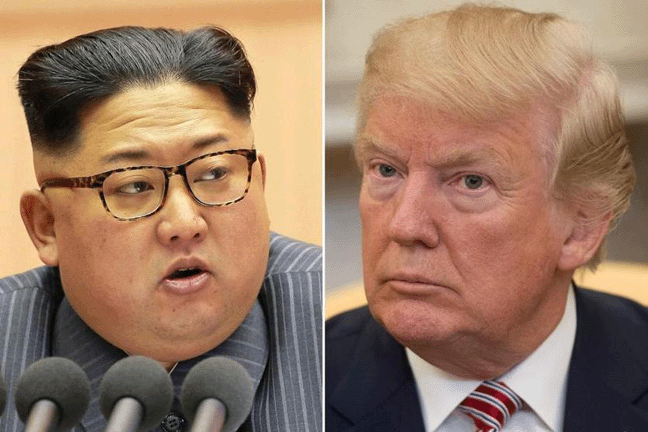 A summit without substance ttps://www.washingtonpost.com/news/global-opinions/wp/2018/06/12/a-summit-without-substance/?noredirect=on&utm_term=.8a94c9a95b12By Max Bootm June 12, The Singapore summit was a mesmerizing spectacle utterly lacking in substance. In other words, it was a perfect microcosm of the Trump presidency.
The entire world was riveted by television images of President Trump and North Korean leader Kim Jong Un shaking hands in front of a backdrop of North Korean and U.S. flags, walking to and from lunch, checking out Trump’s limousine and finally signing a summit declaration. For both leaders, the hype was the whole point.
Kim won an invaluable propaganda windfall: Ruling one of the poorest and most despotic countries in the world (North Korea’s gross domestic product is smaller than Vermont’s), he was recognized as an equal by the leader of the world’s sole superpower — not just an equal, indeed, but a valued friend. Trump claimed to have established a “special bond” with Kim just a day after one of his aides said there was a “special place in hell” reserved for the prime minister of Canada. (The aide, Peter Navarro, has now admitted his comment was “inappropriate.”)
Trump can barely stand to be in the same room with the leaders of the United States’ democratic allies, but he reveled in his quality time with Kim – “a very talented” and “very smart” man who “loves his country very much” and who, in turn is loved by his own people. If Kim does indeed love his country, he has a funny way of showing it, since he enslaves his own citizens. If you want to learn more about Kim’s atrocities, all you have to do is reread Trump’s own Jan. 30 State of the Union address, which gave chapter and verse on the “depraved character of the North Korean regime.”
There was, however, no mention of North Korean human rights abuses on Tuesday. That would have been a downer for a president who has plenty of other downers to deal with — from a special counsel investigation to a botched Group of Seven summit. Trump was in full salesman mode in Singapore, touting a meeting that he claimed had gone “better than anybody could have expected.”
I guess it all depends on what your expectations were. If you took Trump seriously when he claimed on April 22 that Kim had “agreed to denuclearization (so great for World),” then you are bound to be disappointed. If, on the other hand, your expectation was that North Korea would string Trump along with meaningless verbiage, then the summit was precisely what you expected. The meeting really should have been held in Oakland, not Singapore, because there is no therethere. Trump and Kim agreed to four points. The first was empty blather about the United States and North Korea desiring “peace and prosperity.” The second was more empty blather about building a “lasting and stable peace regime.” The fourth was a microscopically small commitment to the repatriation of the remains of Korean War POW/MIAs. The key point was No. 3 — “Reaffirming the April 27, 2018, Panmunjom Declaration, the DPRK [Democratic People’s Republic of Korea] commits to work towards the complete denuclearization of the Korean peninsula” — and on closer examination it, too, is empty blather. I can commit “to work towards” beating Roger Federer at Wimbledon, but that doesn’t mean that I will ever reach the goal.
The Singapore Declaration repeats virtually verbatim the pledge that North Korea made not only on April 27 but also on numerous other occasions stretching all the way back to 1992. That’s right — North Korea has been promising to denuclearize for 26 years, and in that time it has not only acquired an estimated 60 nuclear weapons but also the ballistic missiles to deliver them.
Perhaps this time will be different and Kim really, truly means it. If so, we will find out soon enough, because he will agree to the “complete, verifiable and irreversible” disarmament that the Trump administration had initially insisted upon. But there was no mention of those words in the Singapore Declaration, just as there was no mention of human rights. Trump assailed the Iran nuclear deal as the “worst deal ever.” The deal he struck with North Korea is far weaker.
This is where the negotiations stand at the moment. Before the summit, North Korea agreed to an easily reversible moratorium on nuclear and missile testing, it blew up a nuclear test site (but probably only for show), it started razing a missile-testing site, and it released three U.S. prisoners who had been taken so that North Korea could get credit for releasing them.
And in return, Trump legitimated the odious North Korean regime, stopped U.S.-South Korean joint military exercises (which he called, adopting Pyongyang’s language, “provocative … war games”) and destroyed his “maximum pressure” policy of sanctions. China is no longer enforcing sanctions as rigorously as it once did, and the United States is not imposing new sanctions. The pressure is off — and will stay off as long as Kim makes a show of negotiating.
Kim’s incentive, naturally, is to draw out the process as long as possible while giving up as little as possible. And Trump’s incentive is to play along in the hopes of winning a Nobel Peace Prize. Yes, this is preferable to nuclear war — but that doesn’t mean that Trump wasn’t snookered.
What’s NOT in the summit agreement ?- that’s the revealing part.
US-North Korea summit agreement is most revealing for what it leaves out, The Conversation, Lecturer in International Relations, Department of Politics and Philosophy, La Trobe University, 12 June 18
“……..it is not so much what is in the joint statement as much as what has been left out that is the big story.
To tease this out, let’s consider the four specific points of agreement articulated in the joint statement released by US President Donald Trump and North Korean Chairman Kim Jong-un at the conclusion of today’s summit…..
The joint statement gets interesting in article three, in which “the DPRK commits to work toward the complete denuclearisation of the Korean Peninsula.”
The wording around “complete denuclearisation of the Korean Peninsula” reflects the North Korean interpretation of the concept, which has been well-documented in the lead-up to the summit.
Tellingly, there is no mention of “complete, verifiable, irreversible denuclearisation” (CVID) in the statement text, which is a clear departure from long-standing US policy.
…….. My take-home message from the omission of CVID from the joint statement is confirmation that North Korea under Kim Jong-un is never going to willingly denuclearise.
In “working toward complete denuclearisation,” North Korea may agree to a nuclear weapons and ballistic missile testing moratorium, decommission obsolete nuclear facilities, or even promise to freeze production of new nuclear weapons, without ever having to compromise its nuclear weapons capability……..
The final paragraph of the joint statement commits US Secretary of State Mike Pompeo to meet with an as yet unidentified high level North Korean official. It will be at these meetings and beyond where the “new US-DPRK relations” will start to take shape. https://theconversation.com/us-north-korea-summit-agreement-is-most-revealing-for-what-it-leaves-out-98094?utm_medium=email&utm_campaign=Latest%20from%20The%20Conversation%20for%20June%2013%202018%20-%201
The Singapore nuclear summit – a huge win for Kim Jong UN

North Korean leader Kim Jong Un provides guidance on a nuclear weapons program in this undated photo released by North Korea’s Korean Central News Agency (KCNA) in Pyongyang September 3, 2017. KCNA via REUTERS
The Guardian view on Trump in Singapore: a huge win – for North Korea https://www.theguardian.com/commentisfree/2018/jun/12/the-guardian-view-on-trump-in-singapore-a-huge-win-for-north-korea 13 June 18
Editorial A confident leader strode into the Singapore summit and won. Kim Jong-un went with a plan, gave little and left with plenty: bolstered status and diplomatic leverage, lavish praise from the US president, the promise of an end to US-South Korean military drills – and, surely, a growing confidence that North Korea is doing well at this game. A meeting supposed to effect a breakthrough on denuclearisation looked “more like a big welcome party to the nuclear-armed club”, in the acid but accurate words of one observer.
Better than war, for sure. But since it was Donald Trump who raised that spectre, giving him credit for dispelling it would be like calling a man a life-saver when second thoughts stay his hand from murder. The US president handed over gift after gift in exchange for the inflation of his ego. He does not know or does not care that his country went home poorer than it came. The language in the joint statement was weaker than in previous agreements– the very significant difference being that the North is now much further advanced in its nuclear programme. There was not even a pledge that either side “shall” take action; just the assertion that North Korea will “commit to working towards” denuclearisation, which it sees as a general, not unilateral, process.
In return Mr Trump axed the drills with, it seems, no warning to Seoul (or even US forces). Worse, he described them as “provocative” and “inappropriate”, not just giving the North what it wanted, but suggesting it was right to demand it. He added that he hoped to withdraw US troops from South Korea at some point – further undermining the long alliance.
Mr Trump’s recounting of the meeting would have been laughable were it not so shocking. He explained to the North Koreans that they could have “the best hotels in the world” on the beaches they use for artillery drills. He presented Mr Kim with a Hollywood-style movie trailer laying out the choice before him, complete with growling voiceover. He described the 100,000 or more North Koreans held in prison camps as “one of the big winners” of the meeting, though not even the vaguest assurance was extracted on their behalf. While finding time for another crack at Canada’s Justin Trudeau, he called Mr Kim “a very talented man” who wants to do the right thing and loves his country. He praised him for “running it tough” (quite the euphemism for a dictatorship with human rights atrocities which the UN calls unparalleled in the modern world). And the comprehensive, verifiable, irreversible denuclearisation on which the US was to insist? Ah: “There was no time!” to cover that. But he would be surprised if the North Koreans hadn’t begun already. Mr Trump thinks that the two sides probably have a rough transcript capturing all this, but does not need to verify anything because “I have one of the great memories of all time”. No satirist would dare to invent this.
Hope for the best but don’t expect much progress in lower-level talks next week; nor at meetings at the White House or in Pyongyang, mooted by the US president. China has already implied that it may be time to relax sanctions; South Korea and Russia have hinted that they are similarly minded. Even Mr Trump acknowledged that in six months’ time it may emerge that the North Koreans are not taking action (adding, in a startling moment of candour, that “I will find some sort of excuse” rather than admit that).
“He trusts me and I trust him,” Mr Trump boldly declared of Mr Kim. But if the US president is so naive, surely the North Korean leader cannot be. In so far as the US president has any enduring belief, it appears to be that disruption is a good in and of itself: that throwing everyone else off-balance must benefit the world’s only superpower, as one official has suggested (his colleague had a cruder characterisation). Withdrawal from the Iran deal proved that America’s enemies cannot rely upon its word. The G7 and Singapore summits demonstrated that allies cannot either. But Tuesday’s meeting also showed that Americans have reason to be wary. They too cannot count upon Mr Trump to live up to his promises.
What the Donald Trump and Kim Jong-un document actually says
Singapore summit: Donald Trump and Kim Jong-un document released after historic meeting http://www.abc.net.au/news/2018-06-12/donald-trump-and-north-korea-leader-statement-after-meeting/9861688–June 12, 2018, Sentosa Island
The text from the document signed by Donald Trump and Kim Jong-un has been made available. Here it is in full:
President Donald J Trump of the United States of America and Chairman Kim Jong-un of the State Affairs Commission of the Democratic People’s Republic of Korea (DPRK) held a first, historic summit in Singapore on June 12, 2018.
President Trump and Chairman Kim Jong-un conducted a comprehensive, in-depth, and sincere exchange of opinions on the issues related to the establishment of new US-DPRK relations and the building of a lasting and robust peace regime on the Korean Peninsula.
President Trump committed to provide security guarantees to the DPRK, and Chairman Kim Jong-un reaffirmed his firm and unwavering commitment to complete denuclearisation of the Korean Peninsula.
Convinced that the establishment of new US-DPRK relations will contribute to the peace and prosperity of the Korean Peninsula and of the world, and recognising that mutual confidence-building can promote the denuclearisation of the Korean Peninsula, President Trump and Chairman Kim Jong-un state the following:
- The United States and the DPRK commit to establish new US-DPRK relations in accordance with the desire of the peoples of the two countries for peace and prosperity.
- The United States and the DPRK will join their efforts to build a lasting and stable peace regime on the Korean Peninsula.
- Reaffirming the April 27, 2018 Panmunjom Declaration, the DPRK commits to work towards complete denuclearisation of the Korean Peninsula.
- The United States and the DPRK commit to recovering POW/MIA remains, including the immediate repatriation of those already identified.
Having acknowledged that the US-DPRK summit — the first in history — was an epochal event of great significance and overcoming decades of tensions and hostilities between the two countries and for the opening of a new future, President Trump and Chairman Kim Jong-un commit to implement the stipulations in this joint statement fully and expeditiously.
The United States and the DPRK commit to hold follow-on negotiations led by the US Secretary of State, Mike Pompeo, and a relevant high-level DPRK official, at the earliest possible date, to implement the outcomes of the US-DPRK summit.
President Donald J Trump of the United States of America and Chairman Kim Jong-un of the State Affairs Commission of the Democratic People’s Republic of Korea have committed to cooperate for the development of new US-DPRK relations and for the promotion of peace, prosperity, and security of the Korean Peninsula and of the world.
Iran says it can’t remain in nuclear deal without benefits
TEHRAN, Iran (AP) 12 June 18 — President Hassan Rouhani says Iran will not be able to remain in the 2015 nuclear accord unless it benefits from the agreement’s provisions.
In a phone conversation with French President Emmanuel Macron on Tuesday, Rouhani said the Europeans must find a way to compensate Iran if they want to preserve the landmark agreement, following President Donald Trump’s decision to withdraw from the deal and restore sanctions.
Co-signers France, Britain, Germany, Russia and China want to preserve the accord, which limits Iran’s nuclear activities in return for lifting international sanctions.
Rouhani’s website quoted him as saying: “We must not let this great achievement of diplomacy be destroyed by others’ unilateral actions, which are unfaithful to their promises.”
Other Iranian officials have said nuclear activities could be resumed if the agreement collapses.
No scientific expertise wanted by Trump, as he approaches nuclear summit, guided by his “instinct”
In the Trump Administration, Science Is Unwelcome. So Is Advice.
As the president prepares for nuclear talks, he lacks a close adviser with nuclear expertise. It’s one example of a marginalization of science in shaping federal policy. NYT By Coral Davenport 9 June 18
WASHINGTON — As President Trump prepares to meet Kim Jong-un of North Korea to negotiate denuclearization, a challenge that has bedeviled the world for years, he is doing so without the help of a White House science adviser or senior counselor trained in nuclear physics.
Mr. Trump is the first president since 1941 not to name a science adviser, a position created during World War II to guide the Oval Office on technical matters ranging from nuclear warfare to global pandemics. As a businessman and president, Mr. Trump has proudly been guided by his instincts. Nevertheless, people who have participated in past nuclear negotiations say the absence of such high-level expertise could put him at a tactical disadvantage in one of the weightiest diplomatic matters of his presidency.
“You need to have an empowered senior science adviser at the table,” said R. Nicholas Burns, who led negotiations with India over a civilian nuclear deal during the George W. Bush administration. “You can be sure the other side will have that.”
The lack of traditional scientific advisory leadership in the White House is one example of a significant change in the Trump administration: the marginalization of science in shaping United States policy.
There is no chief scientist at the State Department, where science is central to foreign policy matters such as cybersecurity and global warming. Nor is there a chief scientist at the Department of Agriculture: Mr. Trump last year nominated Sam Clovis, a former talk-show host with no scientific background, to the position, but he withdrew his name and no new nomination has been made.
These and other decisions have consequences for public health and safety and the economy. Both the Interior Department and the National Oceanic and Atmospheric Administration have disbanded climate science advisory committees. The Food and Drug Administration disbanded its Food Advisory Committee, which provided guidance on food safety.
Government-funded scientists said in interviews that they were seeing signs that their work was being suppressed, and that they were leaving their government jobs to work in the private sector, or for other countries.
After Mr. Trump last year withdrew from the Paris climate agreement, the international pact committing nations to tackle global warming, France started a program called “Make Our Planet Great Again” — named in reference to Mr. Trump’s slogan, “Make America Great Again” — to lure the best American scientists to France. The program has so far provided funding for 24 scientists from the United States and other countries to do their research in France…….https://www.nytimes.com/2018/06/09/climate/trump-administration-science.html
President Trump’s conference wrecking strategy on climate action, at G7 meeting in Canada
“CANADA, FRANCE, GERMANY, ITALY, JAPAN THE UK AND THE EUROPEAN UNIONREAFFIRM THEIR STRONG COMMITMENT TO IMPLEMENT THE PARIS AGREEMENT, THROUGH AMBITIOUS CLIMATE ACTION”
“PRESIDENT TRUMP’S WRECKING BALL APPROACH TO INTERNATIONAL DIPLOMACY LEFT HIM UTTERLY ISOLATED AT THE G7 SUMMIT,”

Six of the G7 Commit to Climate Action. Trump Wouldn’t Even Join Conversation. https://insideclimatenews.org/news/10062018/g7-summit-climate-change-communique-trump-allies-estranged-germany-france-canada
Trump skipped the formal climate discussions, had the U.S. negotiators promote fossil fuels instead, and then renounced the group’s official communique. BY STAFF, INSIDECLIMATE NEWS JUN 10, 2018
US plays down hopes from Trump-Kim nuclear summit
Both leaders land in Singapore as US seeks to manage expectations, Ft.com Bryan Harris and Stefania Palma in Singapore and Demetri Sevastopulo in Los Angeles
Kim Jong Un and Donald Trump landed in Singapore on Sunday in preparation for their historic summit, even as US officials sought to manage expectations for Tuesday’s much-heralded meeting. Once pitched as the final stage of a landmark denuclearisation deal, the meeting is increasingly being spun as just the beginning of a process of engagement between the two bitter adversaries. “I feel that Kim Jong Un wants to do something great for his people,” said Mr Trump as he departed Canada en route for the south-east Asian city state. “There’s a good chance it won’t work out. There’s probably an even better chance it will take a period of time.” The aim of the summit on Tuesday is to see if Mr Kim and Mr Trump could establish a level of chemistry and trust that would provide impetus for further negotiations between Washington and Pyongyang, according to one senior US official.
Joseph Yun, the state department’s former point-man on North Korea, echoed the sentiment, saying it was clear that high-level meetings between US and North Korean officials in recent days had reduced expectations on the American side. “Gone is the talk of all-in-one big bang and denuclearisation. The magic word seems to be process and progress,” said Mr Yun, adding that it would still be important to have a “substantive result” from the summit. Mr Trump said in advance of his arrival that he would know “within the first minute” of the meeting whether Mr Kim was “serious”. He added that he could make such a judgment based on “my touch, my feel — that’s what I do”……….
Washington is seeking CVID — the complete, verified and irreversible dismantlement of the North’s nuclear programme — a process that experts believe could take years, potentially even a decade. https://www.ft.com/content/99901e74-6c5b-11e8-92d3-6c13e5c92914
-
Archives
- May 2026 (57)
- April 2026 (356)
- March 2026 (251)
- February 2026 (268)
- January 2026 (308)
- December 2025 (358)
- November 2025 (359)
- October 2025 (376)
- September 2025 (257)
- August 2025 (319)
- July 2025 (230)
- June 2025 (348)
-
Categories
- 1
- 1 NUCLEAR ISSUES
- business and costs
- climate change
- culture and arts
- ENERGY
- environment
- health
- history
- indigenous issues
- Legal
- marketing of nuclear
- media
- opposition to nuclear
- PERSONAL STORIES
- politics
- politics international
- Religion and ethics
- safety
- secrets,lies and civil liberties
- spinbuster
- technology
- Uranium
- wastes
- weapons and war
- Women
- 2 WORLD
- ACTION
- AFRICA
- Atrocities
- AUSTRALIA
- Christina's notes
- Christina's themes
- culture and arts
- Events
- Fuk 2022
- Fuk 2023
- Fukushima 2017
- Fukushima 2018
- fukushima 2019
- Fukushima 2020
- Fukushima 2021
- general
- global warming
- Humour (God we need it)
- Nuclear
- RARE EARTHS
- Reference
- resources – print
- Resources -audiovicual
- Weekly Newsletter
- World
- World Nuclear
- YouTube
-
RSS
Entries RSS
Comments RSS
 nuclear-news