Primed Minister Abe rejects Japan’s participation in UN nuclear test ban treaty
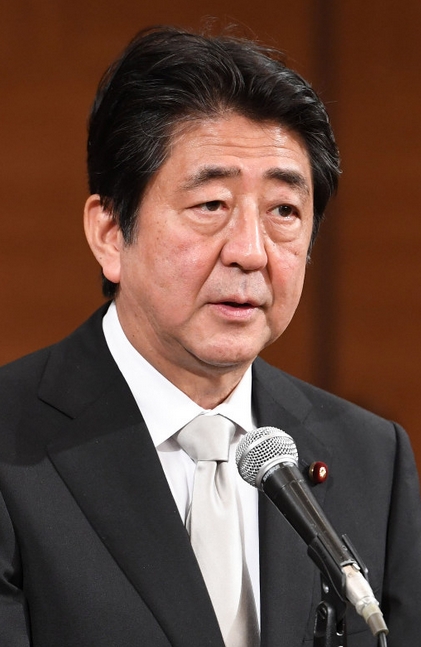 Abe should keep pledge to lead on elimination of nuclear weapons, Asahi Shimbun , August 10, 2018
Prime Minister Shinzo Abe, representative of the government of Japan, and atomic bomb survivors, witnesses to the horrific scenes of 1945, appeared to have little language in common.
That unfortunate scene, almost too painful to bear, was repeated again this summer.
During the peace memorial ceremonies to mark the 73rd anniversary of the atomic bombings of Hiroshima and Nagasaki, the mayors of the two cities and a representative of atomic bomb survivors all expressed their positive hopes for the Treaty on the Prohibition of Nuclear Weapons and called on Tokyo to take serious action.
But Abe did not even mention the treaty during his speeches at the ceremonies. When he met with atomic bomb survivors, he said Tokyo has a “different approach” to the shared goal of eliminating nuclear weapons, thereby denying Japan’s participation in the pact.
The nuclear weapons ban treaty, adopted last year with approvals of 122 countries at the United Nations, embodies the fruition of longstanding calls by atomic bomb survivors. The treaty’s spirit, which stresses the inhumane nature of nuclear arms, has a universal value that has much in common with “human security,” one of the stated pillars of Japan’s diplomacy.
Abe, however, did not even pay homage to the significance of the pact, any more than he did last year………
Abe described himself as a “mediator” for bridging the gap between nuclear weapon states and non-nuclear weapon states. Given that, his words would sound persuasive only if he took initial action to call on nuclear weapon states to reduce their nuclear arsenals.
Far from that, Foreign Minister Taro Kono has “highly appreciated” a new strategy of nuclear arms buildup that was set out by the U.S. administration of President Donald Trump. By no means would Japan be able to live up to its duty of a country that suffered atomic bombings if it were only ratifying a military policy that could be described as representing a superpower’s egotism………….http://www.asahi.com/ajw/articles/AJ201808100022.html
Companies doing business with Iran will be barred from the United States – Donald Trump
 Trump says firms doing business in Iran to be barred from U.S. as sanctions hit, Babak Dehghanpisheh, Peter Graff, BEIRUT/LONDON (Reuters) 7 Aug 18, – Companies doing business with Iran will be barred from the United States, President Donald Trump said on Tuesday, as new U.S. sanctions took effect despite pleas from Washington’s allies.
Iran dismissed a last-minute offer from the Trump administration for talks, saying it could not negotiate while Washington had reneged on a 2015 deal to lift sanctions in return for curbs on Iran’s nuclear program.
Trump decided this year to pull out of the agreement, ignoring pleas from the other world powers that had co-sponsored the deal, including Washington’s main European allies Britain, France and Germany, as well as Russia and China.
European countries, hoping to persuade Tehran to continue to respect the deal, have promised to try to lessen the blow of sanctions and to urge their firms not to pull out. But that has proven difficult: European companies have quit Iran, arguing that they cannot risk their U.S. business……..https://www.reuters.com/article/us-iran-nuclear/new-trump-sanctions-on-iran-take-effect-despite-pleas-from-allies-idUSKBN1KS13I
North Korea finding fault with USA’s diplomat Mike Pompeo
North Korea’s Pompeo Problem Exposes Widening Rift Over Talks, Bloomberg By Bill Faries, August 7, 2018,
- Top U.S. diplomat rebuked after two latest trips to Asia
- U.S. told it will ‘get nothing’ from its pressure campaign
North Korea appears to have a Pompeo problem.
The widening gulf between Secretary of State Michael Pompeo’s description of nuclear talks with North Korea and Pyongyang’s criticism of his efforts is adding further confusion to the status of negotiations intended to lead to the denuclearization of the Korean peninsula.
Twice in recent weeks North Korean officials and state media have rebutted the top U.S. diplomat’s characterization of events and suggested the administration has a myopic focus on denuclearization while ignoring issues such as bringing about a final resolution of the Korean War. Even as President Donald Trump and North Korean leader Kim Jong Un exchange optimistic messages about their push for peace, Pompeo has increasingly become a target of public disparagement from Pyongyang.
Centre for Security Studies explains NATO Nuclear Sharing
 NATO Nuclear Sharing, Centre for Security Studies, The CSS Blog Network, By Tim Street , 3 Aug 18
Nato Nuclear Sharing – modernisation and the politics of this
NATO Nuclear Sharing, Centre for Security Studies, The CSS Blog Network, By Tim Street , 3 Aug 18
“……….What modernisation is planned?
Despite former President Obama’s much-publicised rhetoric on the need for concrete action towards a nuclear weapons free world, work on the modernisation of US B61 bombs began under his administration and is receiving continued support from President Trump. In addition, NATO has embarked on improvements to its security and infrastructure, which alliance members will pay for. These are taking place at the USAF base at Incirlik, in Turkey and at the USAF base at Aviano, Italy.
The B61 bomb modernisation programme is being driven by the US National Nuclear Security Administration (NNSA), which aims to upgrade and expand the lives of about 400 of the 520 B61 bombs in its inventory for approximately twenty years, through a Life Extension Program (LEP). More precisely, the NNSA plans to consolidate the four existing types or ‘MODs’ of the B61 bombs into one MOD—the B61-12. Key results of the planned modernisation will be to: make the existing ‘dumb’ bombs three times more accurate by adding a new tail kit and internal guidance system; allow the use of the weapons for both tactical and strategic missions; and for delivery by both fighter jets and long-range bombers. Completion of the first new B61-12 bomb is set for 2020, with work on the remaining bombs planned for 2024.
Such improvements, which, NATO argues, have been made to decrease the risk of radioactive fallout and result in fewer civilian casualties, have led to critics arguing that these weapons could be seen as more usable. Analysts such as Hans Kristensen have therefore concluded that the increased military capabilities provided by the new B61 bombs will signal to Russia that “it is acceptable for it to enhance its non-strategic nuclear posture in Europe as well”. Russia could do this by deploying its own TNW closer to NATO’s eastern border as well as keeping nuclear capabilities, which are, the US argues, in violation of the Intermediate-Range Nuclear Forces (INF) Treaty.
Critics have also pointed to the major costs involved in the LEP, estimates for which range up to $25 million per bomb. Some also argue that the programme is unnecessary given the capabilities of the existing arsenal, simpler options for life extension and the possibility that the weapons could soon be withdrawn from service.
Controversy has also dogged the replacement of nuclear host countries’ nuclear-capable aircraft, which are all set to retire in the 2020s. The Lockheed Martin F-35A is seen as particularly suitable for nuclear missions and can be modified to carry B61-bombs. However, whilst several NATO members, including Italy, the Netherlands and Turkey, have committed to purchasing the F-35A, nuclear host nations Belgium and Germany have proved more reluctant, both for cost reasons and because of their interest in procuring alternative, European-made aircraft. Like the Greeks in 2001, failure to procure suitable new aircraft could lead to them ceasing to participate and host TNWs.
What are the political dynamics of NATO nuclear sharing?
As NATO’s Strategic Concept of 1999 explains, “the fundamental purpose of the nuclear forces of the Allies is political” since these weapons “provide an essential political and military link between the European and the North American members of the Alliance”. The two key aspects of this ‘link’ are that it is: i) hierarchical, with Washington leading; ii) legitimating, so that political elites in NATO member states visibly assent to the dominant US presence and role in Europe.
A common objection raised by those who argue that NATO nuclear weapons should be removed from the continent is that the alliance’s conventional superiority in relation to Russia means that there is no military need for these weapons. If these weapons no longer have a meaningful military role, it is argued, then they are no longer justifiable from a political perspective.
In response, the value of NATO TNW as a bargaining chip in arms control and disarmament negotiations with Russia is sometimes raised. Arguably, Moscow does not maintain its TNW in order to balance against NATO TNW, but because of the disparity it suffers in terms of conventional military forces in Europe. NATO’s unwillingness to scrap its TNW also tends to warrant Moscow’s inaction and opacity regarding its own TNW.
Various studies and opinion polls show that several alliance member governments as well as many experts, civil society groups and significant numbers of citizens want TNW removed from their countries. The Belgian, German and Dutch governments have all officially acknowledged that they favour the withdrawal of TNW from their territories. Yet they have qualified this position by stating that withdrawal can only take place if there is consensus on the move by all 28 NATO members. However, there is a range of different positions within NATO on nuclear matters, for example, on the value of deterrence and disarmament. Such dynamics help explain the alliance’s inherent caution and conservatism regarding nuclear decision-making.
Other areas of political controversy involve safety and security issues. For example, the 2016 attempted coup in Turkey led critics to question how secure nuclear weapons were at the Incirlik airbase, which is also close to the Syrian border. Another possibility is that the command and control protocols for the weapons preventing unauthorised use could be overridden. Such concerns have led opponents of the weapons, such as German President Frank-Walter Steinmeier, to describe them as ‘absolutely senseless’ and potential targets for terrorists.
Another notable dimension to nuclear sharing is that US allies in other regions—such as North East Asia—closely observe how Washington handles its extended deterrence relations with NATO. Some analysts have thus proposed that US nuclear sharing be extended to South Korea and/or Japan given current instability in the region. Again, the rationale of disincentivising these allies from independently developing nuclear weapons in response to nuclear-armed rivals (i.e. North Korea) has been advanced.
How does nuclear-sharing fit with arms control, non-proliferation and disarmament regimes?
A common view in Europe and beyond is that the continued deployment in Europe of US TNW is a contravention of the nuclear non-proliferation treaty (NPT), which commits its members to “further diminish the role and significance of nuclear weapons in all military and security concepts, doctrines and policies”. Despite pressure within several nuclear sharing states for change, both the conventional and nuclear arms control and disarmament agenda are frozen. This is mainly due to the poor relations between the US and Russia, as well as the lack of political will in NATO governments to push these issues forward. Civil society groups have long called for the US to realise its NPT non-proliferation and disarmament obligations by repatriating its TNW to US soil prior to their dismantlement.
Russia has a far larger number of TNWs than the US (approximately 1,830) and Moscow insists upon the removal of US TNWs from Europe before it engages with Washington and NATO on accounting for and reducing these weapons. For its part, the US sees Russian TNW as threatening to its NATO allies, particularly in Eastern Europe and the Baltics. Russian and US experts have proposed a series of measures that could overcome existing reluctance and allow TNW to be included in wider nuclear arms reduction talks. For example:
- Former US Ambassador Steven Pifer has previously recommended that the two nations take: i) confidence-building and transparency measures; ii) parallel unilateral steps to freeze or reduce TNW stockpiles; and iii) begin negotiations aimed at a legally-binding TNW treaty with verification measures.
- Nuclear experts Pavel Podvig and Javier Serrat have recently argued that TNW should continue not being deployed during peacetime and that this should be codified into a “legally-binding, verifiable arrangement” to reduce crisis escalation and the risks of nuclear war.
- Other analysts such as Dr Andrew Futter have also highlighted the existence of other options, such as moving US TNW to bases in new countries or concentrating them in Italy and Turkey, but note that these ideas raise several problems.
- Russian analysts, meanwhile, argue that conventional arms control—such as an updated Conventional Forces in Europe treaty—would need to be implemented if Moscow is to further reduce its TNW.
In March 2011, NATO created a new Committee on WMD Control and Disarmament to provide oversight and policy discussion in this area, but it is unclear what this body has hitherto accomplished.
About the Author
Tim Street is an Associate Fellow of the Oxford Research Group’s Sustainable Security Programme, specializing in nuclear security and disarmament issues.
For more information on issues and events that shape our world, please visit the CSS website. https://isnblog.ethz.ch/defense/nato-nuclear-sharing
Climate change disasters help authoritarian leaders to seize power
Climate Kings How a new generation of authoritarian leaders are using climate change to seize power https://newrepublic.com/article/148861/climate-change-authoritarian-leaders, By SAMUEL MILLER MCDONALD, July 30, 2018
National crises make governments vulnerable to autocracy—a rather obvious assessment, perhaps, but one rarely seen in debates about climate change. Take the Maldives, an atoll nation in the Indian Ocean. Rising seawater is projected to consume most, if not d Nall, of the country this century. In 2008, the Maldives chose its first democratically elected president, Mohameasheed. Almost immediately, he made climate change preparations central to his administration. He announced plansto move 360,000 Maldivian citizens to new homelands in Sri Lanka, India, or Australia, and he promised to make the Maldives the world’s first carbon-neutral country. Nasheed also demonstrated a flair for the dramatic, staging an underwater Cabinet meeting that turned him into a viral climate celebrity. “What we need to do is nothing short of decarbonizing the entire global economy,” he said. “If man can walk on the moon, we can unite to defeat our common carbon enemy.”
In 2012, the military deposed Nasheed, forcing him to flee the country at gunpoint after mass protests over economic stagnation and spikes in commodity prices. His eventual successor, Abdulla Yameen, has since suspended parts of the constitution, giving himself sweeping powers to arrest and detain opponents, including two of the country’s five Supreme Court justices and even his own half-brother. Meanwhile, Yameen has tossed out Nasheed’s climate adaptation plans and rejected renewable energy programs, proposing instead to build new islands and economic free zones attractive to a global elite. “We do not need cabinet meetings underwater,” his environment minister told The Guardian. “We do not need to go anywhere. We need development.”
If any lesson can be drawn from the power struggle in the Maldives, it is that people who feel threatened by an outside force, be it foreign invaders or rising tides, often seek reassurance. That reassurance may come in the form of a strongman leader, someone who tells them all will be well, the economy will soar, the sea walls hold. People must only surrender their elections, or their due process, until the crisis is resolved. This is perhaps the most overlooked threat of climate change: Major shifts in the global climate could give rise to a new generation of authoritarian rulers, not just in poorer countries or those with weak democratic institutions, but in wealthy industrialized nations, too.
Refugee crises, famine, drought—these are materials strongmen can use to build power. Already, strife and civil instability are spreading throughout the global South, with droughts and floods stoking conflict and refugee crises in parts of Africa and the Middle East. According to a 2016 paper in Science, climate change will increase the risk of armed conflict across Africa by 50 percent by 2030. Eastern Africa is particularly vulnerable. The genocidal strife in Darfur is one of the bloodiest examples, but even countries with robust economies and democracies are susceptible. In Kenya, for example, a crippling drought has led to rapid inflation of food prices, doubling the number of food-insecure people since 2014. That, and disputes over who owns land in the Laikipia region, north of Nairobi, has contributed to violent clashes there, threatening the political stability of the country. This has enabled Kenya’s President Uhuru Kenyatta to tighten his grip on power. In October, amid reports that he’d rigged a recent presidential election, Kenyatta declared the drought a national disaster—this, just weeks before the next round of voting. He was reelected and, amid continued chaos, has cracked down on his opponents in the media.
It’s not just developing nations that are at risk of opportunistic climate-fueled authoritarianism. Wealthy countries may possess the resources to insulate themselves from the near-term physical impacts of climate change—they can afford sea walls, emergency services, and air conditioning. But when conflicts over resources break out in the developing world, they are bound to generate crises that spill into wealthier countries.
A study published in the Proceedings of the National Academy of Sciences in 2015 drew a direct link between the 2007–2010 drought in the greater Fertile Crescent, which “exacerbated existing water and agricultural insecurity and caused massive agricultural failures and livestock mortality,” and Syria’s 2011 civil war, which has forced millions of people to seek refuge in Europe. Their arrival has helped fuel antidemocratic movements throughout the continent. “Even the specter of refugee crises and population movements can impact attitudes toward authoritarianism,” said Jonathan Weiler, co-author of Authoritarianism and Polarization in American Politics. These fears aren’t going away: According to a 2017 study published in The Lancet, extreme weather could displace up to a billion people around the world by the middle of the twenty-first century—an unprecedented human migration will undoubtedly influence the politics of wealthy countries, pushing them to the right.
The best way to counteract this phenomenon is naturally to halt, or at least slow, the effects of climate change. So far, the Paris agreement is the only tangible result of those efforts, and its fate is far from certain, with the United States threatening to withdraw. But this might change, if the problems caused by climate change—not just stronger hurricanes, droughts, and rising seas, but political rupture—keep washing up on the disappearing shorelines of wealthy governments.
Samuel Miller McDonald studies climate and energy politics at Oxford University. @@sjmmcd
Japan keen to have a nuclear export business: it all depends on building nuclear reactors in the UK
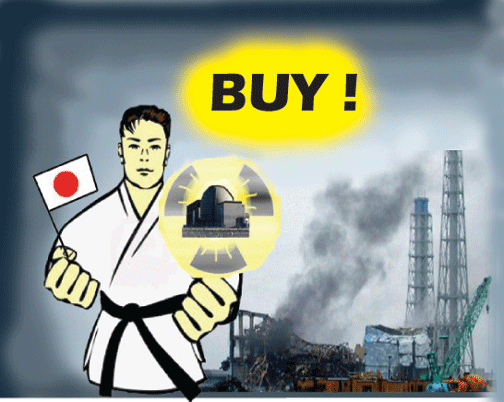
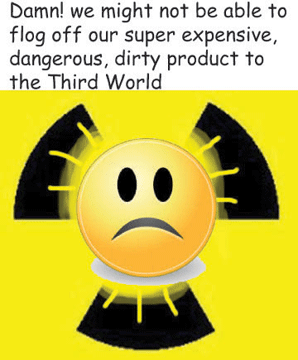 Japan and Hitachi pin nuclear export hopes on U.K. project in Wales https://www.japantimes.co.jp/news/2018/07/29/business/japan-hitachi-pin-nuclear-export-hopes-u-k-project-wales/#.W14xP9IzbGg, BY JUNKO HORIUCHI KYODO
A nuclear power plant project in Britain is giving Japan a glimmer of hope for spurring infrastructure exports, a key growth strategy of Prime Minister Shinzo Abe.
Hitachi Ltd. and the U.K. government started official talks last month on building new reactors in Wales, with a goal of firing them up in the first half of the 2020s.
The outlook for the ¥3 trillion project is unclear, with both sides facing a string of challenges in the talks going forward.
For Tokyo, the plan is one of its few remaining major overseas projects on the horizon, with other nuclear power generation plans discontinued or facing cancellation.
The government’s bet on nuclear power plants as a pillar of infrastructure exports comes as the likes of Germany, Italy, Taiwan and South Korea are pulling out of atomic power generation.
Critics argue that a surge in safety costs and accident worries caused by the 2011 Fukushima disaster, in addition to the lack of viable disposal solutions for radioactive waste, mean there is no justification for keeping faith in nuclear energy. Compounding the sector’s decline is the rapidly dropping cost of tapping such renewable energy sources as wind and solar power.
Still, some emerging economies look like they will need new nuclear power plants, and Japanese builders see few chances to construct new ones anytime soon in Japan.
“The Japanese government has been pushing hard for exports of nuclear power plants but it’s clear that it’s not going well,” said Tadahiro Katsuta, a professor at Meiji University. “The government will spare no effort in giving momentum to the exports.”
If the project in Britain proves successful, it will give the government “a good excuse” to push harder abroad, he said.
Before the official talks began, Hitachi had told Britain it might not take part in the project to build two advanced boiling water reactors on the Isle of Anglesey in Wales, because the price tag had soared higher than initially estimated.
But an offer by London to shoulder about two-thirds of the cost convinced Hitachi stay in. Tokyo welcomed its decision to begin the talks.
“The nuclear business overseas is significant … it would lead to strengthening and maintaining human resources and technology for nuclear power in Japan,” Minister of Economy, Trade and Industry Hiroshige Seko told a news conference.
Under the agreement, the British government will subsidize much of the cost through direct investment and loan guarantees, according to sources close to the matter.
“We are currently examining the financial and cost issues of the project, before making a final decision in 2019 on whether to invest in the project,” Hitachi Chief Financial Officer Mitsuaki Nishiyama said Friday at a news conference to announce earnings.
For Hitachi, nuclear power is a core operation. It wants to increase revenue from the business by more than 33 percent to ¥250 billion over the four years through March 2022, mainly through boosting overseas revenue.
Rival Toshiba Corp. exited overseas nuclear operations after incurring huge losses in the United States, a decision that could cripple Tokyo’s efforts to promote Japanese nuclear plants abroad.
Mitsubishi Heavy Industries Ltd., is pursuing a nuclear power plant project in Turkey. But it hit a snag when it saw safety-related costs surge and trading house Itochu Corp. walked away from the project.
In another blow to the government, Vietnam in 2016 decided to abandon a plan to build its first nuclear power plant with Japanese assistance due to tight state finances.
Those failures have led to an increased focus on the new power station in Wales. But London and Hitachi still need to address such issues as how to spread the remainder of the costs among Hitachi, local companies and Japan-backed financial institutions. They also need to determine who should be held liable if there’s a major accident.
They are also at odds over how much the electricity produced at the plant should cost. Britain at one point offered a price some 20 percent lower than what Hitachi wanted, a source familiar with the matter said.
“A key focus of discussions with Hitachi has been and will continue to be achieving lower-cost electricity for consumers,” Greg Clark, British business and energy secretary, told Parliament last month.
The two sides also need to talk to residents and win over those worried about the new power station.
“We have a major multinational and two governments supposed to be democracies playing a high-stakes game of poker … without any transparency or scrutiny for the people that they are representing,” Mei Tomos, a resident of Wales, said at a news conference in Tokyo during a recent visit to Japan.
“We have seen the destruction which nuclear power can cause. It is really too much to expect us to take the same risks. Even if such an accident didn’t happen at Anglesey we will still be faced with over a hundred years of storage of nuclear waste on site which presents a massive danger to us,” another resident, Robert Davies, said at the news conference.
China’s plan for global nuclear dominance depends on Britain
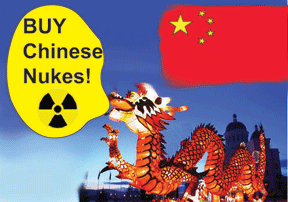 China’s long game to dominate nuclear power relies on the UK https://www.theguardian.com/environment/2018/jul/26/chinas-long-game-to-dominate-nuclear-power-relies-on-the-uk
Approval of Chinese nuclear technology in the UK would act as a springboard to the rest of the world, Guardian, Adam Vaughan and Lily Kuo in Beijing, 27 Jul 2018
China wants to become a global leader in nuclear power and the UK is crucial to realising its ambitions.
While other countries have scaled back on atomic energy in the wake of the Fukushima disaster, state-backed Chinese companies benefit from the fact that China is still relying on nuclear energy to reach the country’s low-carbon goals.
“China is going in the opposite direction. The massive experience possessed by the Chinese nuclear industry, consistently building for the past 30 years and adopting various next-generation technologies, is being recognised by the global nuclear industry,” said Zaf Coelho, the director of Asia Nuclear Business Platform, based in Singapore.
The UK, where as many as six new nuclear power stations could be built over the next two decades, is an obvious export target for Chinese nuclear. If state-owned China General Nuclear Power (GNP) – the main player in China’s nuclear industry – buys a 49% stake in the UK’s existing nuclear plants, as it was recently reported to be considering, that would mark a significant expansion of China’s role in the UK nuclear sector.
But the depth of CGN’s existing involvement in UK nuclear may surprise some.
The most high-profile project is the £20bn Hinkley Point C power station in Somerset, which is being built by EDF Energy with a French reactor design but was only made possible by CGN UK’s 33.5% stake to underwrite its daunting finances.
It was that Chinese ownership of a strategic piece of infrastructure that led Theresa May to temporarily halt the signing of the crucial subsidy deal for Hinkley when she became prime minister.
Isabel Hilton, the CEO of Chinadialogue.net, said the UK opening up vital infrastructure to China was without parallel in the western world. “No other OECD country has done this. This is strategic infrastructure, and China is a partner but not an ally in the security sense.
“You are making a 50-year bet, not only that there will be no dispute between the UK and China, but also no dispute between China and one of the UK’s allies. It makes no strategic sense.”
The UK has appeared amenable to Chinese investment, though recently the UK cybersecurity watchdog warned British telecommunications companies against dealing with Chinese tech firm ZTE. One expert acknowledges that security concerns are a potential check to Chinese ambitions.
Zha Daojiong, a professor of non-traditional security studies at Peking University, said: “The question is not whether your nuclear technology is safe or not, it’s a question of politics. To be blunt, most countries think: ‘Anybody but China.’ This kind of thinking is becoming more and more popular among western countries. It’s a serious problem.”
CGN is also drawing up plans for Bradwell B in Essex, where China hopes to showcase its own nuclear reactor technology. CGN UK holds the majority stake (66.5%) in the development company, with EDF in a supporting role. Then there is a third joint venture to get Bradwell’s Chinese reactor design through the UK nuclear regulatory process.
Finally, there is Sizewell C in Suffolk, where EDF wants to build a clone of Hinkley Point C if it can attract enough private investment. CGN holds a 20% share.
While Germany and other western countries have turned their backs on nuclear, the UK is strongly committed to new nuclear to meet its carbon goals and this means, despite security concerns, the government needs Chinese involvement.
Robert Davies, the chief operating officer of CGN UK, said: “The UK is open to investment, and we want to invest in clean energy in this country.”
He is acutely aware of the need for future plants to be cheaper, given criticism over the cost of the EDF subsidy deal. “We understand the cost of electricity has to fall significantly from Hinkley Point,” he said.
But the company is open about the bigger prize – the UK as a springboard for exporting Chinese nuclear technology to other countries.
“For us, the UK is an important stepping stone into Europe. The GDA process [UK regulatory approval] is recognised in the nuclear world as having a lot of clout,” said Davies.
Asked if the UK should be concerned about China owning its nuclear power stations, he said: “We are not surprised and see nothing wrong with governments questioning our rationale for investing in their country.”
For now, the company’s UK footprint is small – just 70 of its 44,000 staff are based here. But his hope is the firm will become viewed “not as an outsider that has come in, but part of the furniture”.
China’s commitment was on show at a recent lavish nuclear industry event in London. No expense was spared on hosting the summit at the prestigious Guildhall building, where the Chinese ambassador to the UK told jokes and argued the case for new nuclear.
Mycle Schneider, a Paris-based nuclear industry analyst, said cost was not an issue for Beijing because the Chinese are playing a long game. “It was clear quite early on there was a strategy to make the UK a platform … A few billion here or there is not the point. It’s about strategic assets.”
But he said CGN still had a lot to learn about how the UK worked. “China does not have any building experience in any countries other than Pakistan, and that is not really comparable to the UK.”
Zhou Dali, a former Chinese energy official, as director of the energy research institute of China’s National Development and Reform Commission, said: “We are learning how to do business with patience. Because you cannot force others to do something. You can only help.
“We will give more and more information about the technology’s improvements, but the final decision will be made by the UK people and your politicians.”
Additional reporting by Wang Xueying
EU Energy and Environment Sub-Committee want clarity on UK’s nuclear plans after Brexit
 House of Lords 19th July 2018 The EU Energy and Environment Sub-Committee has written to the Minister for Business and Industry, Richard Harrington MP, following an evidence session with the Office for Nuclear Regulation which considered their efforts to prepare for Brexit.
The Committee has written to BEIS’ Minister for Business and Industry to ask for further clarity on the ONR’s future funding arrangements, and to request regular updates between now and the point of withdrawal to ensure the ONR’s preparation remains on track.
The Committee also asks for an update on negotiations regarding the intended Nuclear Cooperation Agreements with the USA, Canada, Japan and Australia.
https://www.parliament.uk/business/committees/committees-a-z/lords-select/eu-energy-environment-subcommittee/news-parliament-2017/nuclear-preparedness-letter-to-minister/
U.S. Secretary of State Pompeo accused North Korea of hiding nuclear facilities, enriching uranium
Pompeo accused North Korea of hiding nuclear facilities, enriching uranium: Report , Straits Times, 17 July 18 TOKYO (THE YOMIURI SHIMBUN/ASIA NEWS NETWORK) – US Secretary of State Mike Pompeo accused North Korea of operating secret facilities for the enrichment of uranium when he met senior North Korean official Kim Yong Chol during his July 6-7 visit to the country, the Yomiuri Shimbun has learned.
The US top diplomat’s move appears to underscore Washington’s increasing suspicion that Pyongyang is covertly proceeding with activities that are contrary to denuclearisation, despite its declared commitment to the goal.
It also raises the possibility that even if North Korea starts the process of denuclearisation, the alleged existence of secret facilities will become an issue during the declaration and verification phases.
According to sources knowledgeable about Japan-US-South Korea trilateral talks, Pompeo said at his meeting Kim Yong Chol that Pyongyang was enhancing the production of enriched uranium and also concealing nuclear-related facilities and nuclear warheads.
Citing information that construction activities are under way at a missile plant at Hamhung in the north-eastern province of South Hamgyong to expand the facility, Pompeo stressed that this was not beneficial to US-North Korean relations.
Kim Yong Chol, a top North Korean party official and former spy agency chief with whom Pompeo played a key role in arranging an unprecedented summit between US President Donald Trump and North Korean leader Kim Jong Un in Singapore on June 12, flatly denied Pompeo’s claim, according to the sources.
Pyongyang has never hidden or operated a secret uranium enrichment site, the North Korean official was quoted as saying.
Kim also reportedly argued that activities at the Hamhung missile plant were part of construction work in preparation for the rainy season, not expansion work.
On July 7, a North Korean foreign ministry spokesman released a statement accusing Washington of showing a “regrettable” attitude at the meeting between Pompeo and the North Korean official……..https://www.straitstimes.com/asia/east-asia/pompeo-accused-north-korea-of-hiding-nuclear-facilities-enriching-uranium-report
Japan, U.S. extend nuclear pact amid concern about plutonium stockpile
KYODO NEWS 17 July 18 Japan and the United States extended on Tuesday a bilateral nuclear agreement that has served as the basis for Tokyo’s push for a nuclear fuel recycle policy.
The pact, which entered into force in July 1988, has authorized Japan to reprocess spent fuel, extract plutonium and enrich uranium for 30 years. As neither side sought to review it before the end of the term, it will remain effective, leaving Japan the only country without nuclear arms that is allowed to reprocess spent nuclear fuel.
But the passing of the initial 30-year period raises uncertainty over the future of the pact, now that it can be terminated anytime six months after either party notifies the other.
The United States is seen as concerned about Japan’s stockpiles of plutonium
………Japan has around 47 tons of plutonium, which is enough to produce about 6,000 nuclear warheads.
Of the 47 tons, around 10 tons were stored in Japan and the reminder in Britain and France as of the end of 2016, according to government data.
In early July, Japan clearly stated for the first time in its basic energy plan that it will trim the amount.
Spent fuel from nuclear reactors is reprocessed to extract uranium and plutonium, which is then recycled into fuel called mixed oxide, or MOX, for use in fast-breeder reactors or conventional nuclear reactors.
But following the 2011 Fukushima nuclear disaster, most of Japan’s nuclear power plants remain offline as they are required to pass newly established safety regulations……..
The Rokkasho plant, a key pillar of the country’s nuclear fuel recycling policy, will be able to produce around 8 tons of plutonium a year when fully operational. https://english.kyodonews.net/news/2018/07/d0e37985dc1c-japan-us-extend-nuclear-pact-amid-concern-about-plutonium-stockpile.html
European Court of Justice’s ruling gives high-risk nuclear technology with billion-dollar subsidies an unfair competitive advantage.
Rebecca Harms MEP 12th July 2018 ,Rebecca Harms , spokeswoman for the Greens / EFA Group in the European
Parliament , comments on the European Court of Justice’s ruling that the EU
Commission’s decision to grant aid to the United Kingdom for the
construction of a nuclear reactor at the Hinkley Point nuclear power plant
is legitimate .
“The Euratom Treaty is a relic of the past and gives the
high-risk nuclear technology with billion-dollar subsidies an unfair
competitive advantage. The Euratom Treaty does not match the European
requirements for clean energy and fair competition. We must end the
distortion of competition in the European energy market, reform the Euratom
Treaty and rely on the energy transition. ”
Here you will find the report ”
Pathways to a Euratom Reform ” on behalf of the Greens / EFA Group.
http://rebecca-harms.de/post/zitat-von-rebecca-harms-zur-entscheidung-des-europaeischen-gerichtshof-gruenes-licht-fuer-hinkley-point-subventionen-euratom-vertrag-zu-geben-36732
Donald Trump ready to go to war against Iran?
Don’t Let Trump Go to War With Iran https://www.theatlantic.com/international/archive/2018/07/dont-let-trump-go-to-war-with-iran/565082/ Fifteen years after the U.S. entered Iraq, the president is inching us closer to another unnecessary fight. TIM KAINE
Japan-US nuclear energy pact set to renew automatically in July 2018
https://mainichi.jp/english/articles/20180116/p2a/00m/0na/005000c (Mainichi Japan)
A nuclear energy cooperation agreement between Japan and the U.S. will renew automatically in July 2018, it is expected to be confirmed on Jan. 16.
The existing accord, officially called the Agreement for Cooperation Between the Government of the United States of America and the Government of Japan Concerning Peaceful Uses of Nuclear Energy, recognizes Japan’s extraction of plutonium from spent nuclear fuel and use of mixed oxide (MOX) fuel as part of its “nuclear fuel cycle.” Renewing the pact will enable Japan to continue with its nuclear fuel cycle policy.
However, after the pact is renewed, if either Japan or the U.S. gives notice, then the agreement will be halted after six months — which would mean that Japan’s nuclear policy would be more easily affected by the will of the U.S.
The nuclear energy agreements that the U.S. has in place with other countries control the handling of nuclear materials and related equipment — from the standpoint of non-proliferation — whenever the U.S. provides nuclear technology to those other nations.
Under the existing agreement between Japan, a non-nuclear nation, and the U.S., nuclear fuel cycle operations such as the reprocessing of spent nuclear fuel and also uranium enrichment are recognized, in what is considered an exceptional case.
With the pact coming into effect in July 1988, the 30-year deadline of the current agreement will be reached on July 16, 2018. As long as neither Japan nor the U.S. give notice to withdraw six months prior to the deadline, the pact will be automatically renewed.
The Japanese government did try to negotiate with the U.S. about maintaining the agreement as it is. However, the administration under U.S. President Donald Trump has not been in a position to negotiate, and so the pact looks set to renew automatically, without any serious negotiations taking place.
Mike Pompeo holds nuclear talks with North Korean officials in Pyongyang
Secretary of state predicts ‘productive’ meeting on his third visit, joking: ‘If I come one more time, I will have to pay taxes here’, Guardian, Julian Borger in Washington and Justin McCurry in Tokyo 7 Jul 2018
Mike Pompeo and a US delegation held talks in Pyongyang with North Korean officials on Friday, in an effort to make progress towards disarmament and improved bilateral relations three weeks after Donald Trump’s Singapore summit with Kim Jong-un.
The US secretary of state is seeking to persuade the North Korean leadership to take concrete steps that Trump said he was promised in Singapore, including the destruction of a missile engine testing site and the repatriation of remains of US soldiers killed in the Korean war.
Pompeo is also asking for more substantial steps towards disarmament, reportedly including an inventory of the North Korean arsenal of warheads and missiles.
Mike Pompeo and a US delegation held talks in Pyongyang with North Korean officials on Friday, in an effort to make progress towards disarmament and improved bilateral relations three weeks after Donald Trump’s Singapore summit with Kim Jong-un.
The US secretary of state is seeking to persuade the North Korean leadership to take concrete steps that Trump said he was promised in Singapore, including the destruction of a missile engine testing site and the repatriation of remains of US soldiers killed in the Korean war.
Pompeo is also asking for more substantial steps towards disarmament, reportedly including an inventory of the North Korean arsenal of warheads and missiles.
…….. He is under time pressure to produce results by August, when the US and South Korea were due to hold joint military exercises. Those exercises were cancelled on Trump’s orders in Singapore as an up-front concession. Adding to the pressure, the president has repeatedly claimed that the testing site has already been destroyed, and that the soldiers’ remains have been sent back, neither of which has happened.
Trump has also made extravagant claims about what was agreed in Singapore. At a rally in Montana on Thursday, he claimed: “We signed a wonderful paper saying they’re going to denuclearise their whole thing. It’s going to all happen.”
In a joint statement with Trump, Kim agreed to move towards “complete denuclearisation” but that has been a stock phrase in North Korean rhetoric since 1992 and signifies a vague and long-term process of multilateral disarmament on the Korean peninsula. Since the Singapore meeting, satellite images and intelligence leaks have suggested that North Korea is upgrading critical parts of its nuclear programme
……….. The meeting lasted two hours and 45 minutes and Pompeo then had dinner with his senior aides. The next session is due to start at 9am. It is unclear whether Pompeo will meet Kim Jong-un on this trip.
There were reports before Pompeo began his visit, that he might relax the US demand for complete, verifiable, irreversible disarmament (CVID), and settle for mutual confidence-building measures that defused tensions without dismantling the North Korean arsenal.
His spokeswoman, Heather Nauert, denied those reports on Thursday, saying: “Nothing could be further from the truth. Our policy toward North Korea has not changed.
“We are committed to a denuclearised North Korea and Secretary Pompeo looks forward to continuing his consultations with North Korean leaders to follow up on the commitments made at the Singapore summit,” Nauert added……….. https://www.theguardian.com/us-news/2018/jul/05/mike-pompeo-north-kroea-visit-pressure-nuclear-progress
-
Archives
- May 2026 (49)
- April 2026 (356)
- March 2026 (251)
- February 2026 (268)
- January 2026 (308)
- December 2025 (358)
- November 2025 (359)
- October 2025 (376)
- September 2025 (257)
- August 2025 (319)
- July 2025 (230)
- June 2025 (348)
-
Categories
- 1
- 1 NUCLEAR ISSUES
- business and costs
- climate change
- culture and arts
- ENERGY
- environment
- health
- history
- indigenous issues
- Legal
- marketing of nuclear
- media
- opposition to nuclear
- PERSONAL STORIES
- politics
- politics international
- Religion and ethics
- safety
- secrets,lies and civil liberties
- spinbuster
- technology
- Uranium
- wastes
- weapons and war
- Women
- 2 WORLD
- ACTION
- AFRICA
- Atrocities
- AUSTRALIA
- Christina's notes
- Christina's themes
- culture and arts
- Events
- Fuk 2022
- Fuk 2023
- Fukushima 2017
- Fukushima 2018
- fukushima 2019
- Fukushima 2020
- Fukushima 2021
- general
- global warming
- Humour (God we need it)
- Nuclear
- RARE EARTHS
- Reference
- resources – print
- Resources -audiovicual
- Weekly Newsletter
- World
- World Nuclear
- YouTube
-
RSS
Entries RSS
Comments RSS
 nuclear-news