UK government outlines plans for the civil nuclear sector if Britain leaves European Union without any deal
‘No deal’ nuclear Brexit papers published by BEIS https://utilityweek.co.uk/no-deal-nuclear-brexit-papers-published-beis/ 24/08/2018 at 8:02pm Adam John The government has outlined plans for the civil nuclear sector to prepare for a scenario in which the UK leaves the EU with “no deal”.
As part of the first batch of 25 documents, which offer advice to people and organisations, the government has published two papers looking at the key issues of regulations and research for nuclear.
Rules on the ownership of nuclear material, supply contracts and nuclear import and export licences are set out in the papers.
All operators in the UK civil nuclear sector will need to comply with a new domestic safeguards regime, which will come into force after 29 March 2019. The UK has already passed new legislation so that the Office for Nuclear Regulation (ONR) can oversee domestic safeguards instead of the European Atomic Energy Community (Euratom).
The new regime is not dependent on there being a deal with the EU and Euratom, the Department of Business, Energy and Industrial Strategy (BEIS) said.
Agreements have been signed by the government and the International Atomic Energy Agency (IAEA) to replace the existing trilateral agreements between the IAEA, Euratom and the UK.
BEIS says Euratom ownership of special fissure material in the UK will end and operators will have full ownership after Brexit. Energy UK said the documents contain “some important clarifications” but the trade body expects the second batch of papers to provide “more clarity”.
It stresses a “no deal” scenario will have “significant and negative consequences” for the energy industry.
But the government insists a scenario in which the UK leaves the EU without agreement “remains unlikely”.
It said it has a duty to “prepare for all eventualities” until it can be certain of the outcome of those negotiations.
Under current rules the UK is a member of Euratom, which facilitates cooperation between EU countries in the civil nuclear sector. Following Brexit the country will leave the organisation.
Upon exit from the EU, Euratom Supply Agency approval will no longer be required for supply contracts for nuclear material agreed by UK-established operators, except where these involve an EU27-established operator.
With regards to import and export licences, if there is no deal on exit day then under updated arrangements, importers may need to obtain an import licence for relevant nuclear materials from the EU.
Rules on managing spent fuel and radioactive waste have also been considered. A no deal situation will mean the UK will no longer have to notify the European Commission of plans for the disposal of radioactive waste.
A second notice explains how civil nuclear research that the UK already undertakes with the EU will be affected in the event of no deal.
Through the Euratom research and training programme, of which the country is currently a part of, the UK participates in several research programmes.
In a no deal scenario, the UK will:No longer be a member of the Euratom research and training programme
No longer be a member of Fusion for Energy
Therefore, no longer be able to collaborate on the international thermonuclear experimental reactor project through the EU
The government has however reaffirmed its commitment to nuclear research. This will mean continued domestic research, as well as its other international partnerships, to ensure the UK retains its “world leading position” in this field. Responding to the publication of the first batch of advice papers, Energy UK’s head of European affairs, Marta Krajewska, said: “While it contains some important clarifications for the nuclear sector, as well as on a number of horizontal issues with impact on our industry, we would expect the second batch to provide more clarity in a number of other areas critical for the energy sector.
“We would also stress that, while it is responsible for government and business to prepare for all eventualities, a ‘no-deal’ scenario will have significant and negative consequences for the energy industry and would likely create cost pressure that could impact customers’ bills.
“Energy UK believes that a deal, with a transition period, is by far the best way forward for the energy industry and the UK as a whole.” The first batch of papers also covered areas including medical supplies, financial services, farming and organic food production. Around 80 notices are expected to be released in the coming weeks.
Brexit secretary Dominic Raab admitted to a risk of potential “short-term disruption” if the UK leaves the EU without a deal but said it remains an unlikely outcome.
Trump declared the North Korea nuclear threat over. The United Nations isn’t so sure,
LA Times,By TRACY WILKINSON Two months after President Trump boasted that North Korea is “no longer a nuclear threat,” growing evidence suggests that leader Kim Jong Un has not shut down the country’s illicit production of bomb-making material and other nuclear activities, raising concerns that the proposed denuclearization deal has stalled at the starting gate………http://www.latimes.com/nation/la-na-pol-us-norkor-nuclear-20180823-story.html
Anxiety in Norway over Russia’s missing reactor-powered cruise missile in the Barents Sea
«There is no reason for any state to have a nuclear-powered missile»
Russia’s missing reactor-powered cruise missile in the Barents Sea obviously causes concerns, says Norway’s Environment Minister, Ola Elvestuen. Barents Observer ByThomas Nilsen August 23, 2018
«We have to take this seriously. From an environmental point of view this obviously causes concern,» Minister Elvestuen says to the Barents Observer.
Norway and Russia share the stocks of cod in the Barents Sea, a multi-billion business and important for tens of thousands of dinner-tables across Europe every day. A missing reactor-powered missile is no good news.
On Wednesday, Minister Ola Elvestuen met with the Barents Observer at the Fram Center in Tromsø, a Arctic climate and research center where also Norway’s High North section of the Radiation Protection Authority opened its new offices and lab.
«A possible missing nuclear-powered missile in important fishing grounds of the Barents Sea shows the importance of having a radiation emergency preparedness unit in Tromsø,» Elvestuen says.
First made public by President Vladimir Putin in March this year, the existence of a nuclear-powered cruise-missile was shown in a defense ministry video of the test-launching. Putin told that during the flight, the missile reached its design capacity and provided necessary propulsion. That would mean a start of the reactor, although the reactor going critical is not confirmed. During initial launch, the missile lifts off with regular fuel as can be seen in the video.
«We have to take this seriously. From an environmental point of view this obviously causes concern,» Minister Elvestuen says to the Barents Observer.
Norway and Russia share the stocks of cod in the Barents Sea, a multi-billion business and important for tens of thousands of dinner-tables across Europe every day. A missing reactor-powered missile is no good news.
On Wednesday, Minister Ola Elvestuen met with the Barents Observer at the Fram Center in Tromsø, a Arctic climate and research center where also Norway’s High North section of the Radiation Protection Authority opened its new offices and lab.
«A possible missing nuclear-powered missile in important fishing grounds of the Barents Sea shows the importance of having a radiation emergency preparedness unit in Tromsø,» Elvestuen says.
First made public by President Vladimir Putin in March this year, the existence of a nuclear-powered cruise-missile was shown in a defense ministry video of the test-launching. Putin told that during the flight, the missile reached its design capacity and provided necessary propulsion. That would mean a start of the reactor, although the reactor going critical is not confirmed. During initial launch, the missile lifts off with regular fuel as can be seen in the video………..
Attention to possible incidents or accidents involving nuclear reactors are raising in Norway, not least because of the increasing number of nuclear powered submarines sailing in Arctic waters. Both Northern Fleet submarines from bases on the Kola Peninsula and U.S. or British submarines making port calls to Northern Norway.
For the nuclear experts at NRPA in Tromsø though, the news about testing of reactor-powered missile and crashes are worrying. From Russia, little information about what’s going on is available. The missile program is surrounded by secrecy by the military………
Intelligence service confirms crashes
Norway’s military intelligence confirms to the Barents Observer their knowledge about two of the tested missiles failing during flight.
«The intelligence service confirms that Russia in November 2017 conducted two failed test-shootings of a new land-based cruise-missile from a temporarily test range at Novaya Zemlya. The first failed shortly after launch and fell down on the island. The other had a longer flightpath before failing or the test was aborted. That missile fell down in the sea near the shores on the west coast of Novaya Zemlya,» says Major Brynjar Stordal, spokesperson with the Joint Headquarters.
He says the intelligence service connects the tests to the new weapon President Putin described earlier this year. «It is indicated that the new missile is using a reactor-propulsion system. The intelligence service can not confirm that the missiles tested in November 2017 had such propulsion system,» Stordal says.
Also, the intelligence service has so far not registered, or received any information about, unormal levels of radiation from this area that is located some 800 kilometers from Norway……..
Small reactor, little radiation
In July, the Russian online Popular Mechanics published a longer article about the new missile powered by a small reactor. The article argues that the reactor could be a fast neutron reactor like the largest space reactors used by the Soviet Union. Also, the core may consist of Americium-242.
The reactor is very small in size, maybe less than half a meter.
Nils Bøhmer, nuclear physicist with Bellona says such reactor core might be possible. «It would then need less fissionable material to reach critical mass and consequently it would be less radioactivity compared with amore traditional reactor with uranium fuel,» Bøhmer says.
He underlines that there are many unanswered questions and a lot of uncertainty regarding such untested technology.
Testing a missile with a small nuclear reactor will, whatever, involve a calculated radiation risk. Any missile launched will have to come down, whether it is by accident or it hits its designated target. https://thebarentsobserver.com/en/security/2018/08/there-no-reason-any-state-have-nuclear-powered-missile
UK: Licences may be needed to import nuclear materials under Brexit no deal.
Whitehaven News 24th Aug 2018 Licences may be needed to import nuclear materials under Brexit no deal.
And Government confirms a new domestic nuclear safeguards regime will come
into force. A paper – one of 24 released by Whitehall outlining
preparations and scenarios that could play out if no Brexit deal can be
agreed before Britain leaves the EU in March – on civil nuclear
regulation states that an import licence may be required to bring nuclear
material, equipment and technology from EU countries to Britain.
Licences are not required under current arrangements, but the document warns that
after March 29 2019 “importers may need to obtain an import licence for
imports of relevant nuclear materials from the EU”. It adds: “The UK will
engage with importers on any new arrangements that will apply from this
date and provide further guidance on these.”
http://www.whitehavennews.co.uk/news/business/Licences-may-be-needed-to-import-nuclear-materials-under-Brexit-no-deal-da1a1c41-2c5f-4b57-b961-372fe47e7687-ds
Britain is now contributing to upgrade of Iran’s Arak nuclear reactor
Middle East Monitor 23rd Aug 2018 , Iran announced on Wednesday that Britain would contribute in upgrading the
Arak nuclear reactor after the United States withdrew from the nuclear
deal. “Experts from Britain will replace their US counterparts during
reactor redesign process,” said Ali Akbar Salehi, head of Iran’s Atomic
Energy Organization.
Under the nuclear deal, experts from both the United
States and China were redesigning the Arak heavy water reactor to reduce
the amount of plutonium produced by the reactor as a by-product. In the
same vein, Iranian officials said that the choice of Britain as a partner
of China was not their call, according to media reports.
https://www.middleeastmonitor.com/20180823-tehran-britain-will-help-upgrade-arak-nuclear-reactor/
USA’s Pentagon anxious about China’s planned nuclear activities in South China Sea
China has nuclear plans in South China Sea: US , Straits Times, AUG 18, 2018, Chinese bombers also likely training for strikes against US, allied targets in Pacific: Pentagon
WASHINGTON • The Pentagon has sounded a warning over China’s plans to introduce floating nuclear power plants on disputed islands and reefs in the South China Sea.
In a new annual report assessing the nation’s military strength released on Thursday, it said Chinese bombers are also likely training for strikes against US and allied targets in the Pacific.
“China’s plans to power these islands may add a nuclear element to the territorial dispute,” the Pentagon said in its 2018 report to Congress titled “Military and Security Developments Involving the People’s Republic of China”.
“China indicated development plans may be under way to power islands and reefs in the typhoon-prone South China Sea with floating nuclear power stations; development reportedly is to begin prior to 2020.”
China Securities Journal – a Chinese state-run financial newspaper – said in 2016 that China could build up to 20 floating nuclear plants to “speed up the commercial development” of the South China Sea, according to a report in the South China Morning Post.
Beijing claims more than 80 per cent of the South China Sea, which carries around US$3.4 trillion (S$4.7 trillion) worth of global trade each year. Five other countries – including the Philippines and Vietnam – also have claims in the waters……..https://www.straitstimes.com/asia/east-asia/china-has-nuclear-plans-in-s-china-sea-us
Major American company pulls out of building Hitachi nuclear plant in Britain

 U.S. firm pulls out of building Hitachi nuclear plant in Britain, THE ASAHI SHIMBUN, August 17, 2018 Major U.S. construction firm Bechtel Corp. is to withdraw from its key role in building a nuclear power plant in Britain due to concerns over the Hitachi Ltd.-helmed project’s profitability, sources said Aug. 16.
Bechtel made the decision based on its assessment that the drastic rise in construction costs would make it hard to make money on the project, the sources said.
The withdrawal deals a blow to Tokyo-based Hitachi, which lacks experience in nuclear power plant construction. The conglomerate could now face further difficulties in financing the project.
The Japanese government supports the construction project as an “export of nuclear power generation technologies,” but even so, its future is becoming more and more uncertain……..
if Horizon replaces Bechtel, it faces the risk that the construction costs will become higher than anticipated.
Hitachi is aiming to lower its stake in Horizon from the current 100 percent to less than 50 percent as a condition for the start of construction of the nuclear plant, and so it is asking other companies to invest in Horizon.
But if other companies are concerned over Horizon’s risk, they will hesitate to invest in it. As a result, Hitachi will face bigger difficulties in raising funds for construction and proceeding with the project.
(This article was written by Keiichi Kitagawa and Hisashi Naito.) http://www.asahi.com/ajw/articles/AJ201808170035.html
Trump administration is fulfilling the National Rifle Association’s wildest dreams
Donald Trump, Gunrunner for Hire https://www.thenation.com/article/donald-trump-gunrunner-for-hire/, The administration is fulfilling the National Rifle Association’s wildest dreams., By William D. Hartung, AUGUST 14, 2018
Saudi Arabia’s push for nuclear power and nuclear weapons ability has met an obstacle
 Canada may secure America’s nuclear nonproliferation bacon, http://thehill.com/opinion/national-security/401636-canada-may-secure-americas-nuclear-nonproliferation-bacon BY HENRY SOKOLSKI AND VICTOR GILINSKY, OPINION CONTRIBUTORS — 08/13/18
In the latest you-can’t-make-this-stuff-up event, Saudi Arabia’s furious campaign of economic retaliation against Canada — in response to Canadian foreign minister Chrystia Freeland’s criticism of the arrest of Saudi women’s rights activists — threatens to dash Westinghouse’s hopes for a lucrative nuclear deal with the Saudis. And, ironically, it may help to preserve tough rules on nuclear exports (“gold standard”) that the Saudi deal might otherwise scuttle.
On Aug. 7, the Saudis recalled their ambassador and expelled Canada’s ambassador, canceled flights to and from Canada, ordered Saudi students and even Saudis in Canadian hospitals to leave Canada, ordered the immediate sale of Saudi-owned Canadian assets “no matter the cost,” and — what is most important for our story — suspended all new business with Canada.
Why this matters takes a bit of background. The story has, as they say, many moving parts.
The White House has been working hard for months to negotiate a U.S.-Saudi nuclear cooperation agreement to permit the sale of Westinghouse nuclear power plants to Saudi Arabia. Although headquartered in Pennsylvania, it was until recently owned by Toshiba Nuclear Energy Holdings. But it is headquartered near Pittsburgh and it has over 5,000 US employees in Pennsylvania, an important political state.
The company has not done well recently. After losing money through its mismanagement of two large US nuclear construction projects, Westinghouse was forced seek protection in Chapter 11 bankruptcy in March 2017. The one remaining two-unit construction project formerly run by Westinghouse, the Vogtle plant in Georgia, now has an estimated completion cost of $27 billion, double the original cost estimate. Toshiba, the parent company, which itself lost money from backing Westinghouse, decided it had enough and sold Westinghouse to Brookfield Asset Management. The deal became final on Aug. 8, and thereby pulled Westinghouse out of bankruptcy. The kicker is that Brookfield is a Canadian-owned company, one that presumably falls under the new Saudi edict.
The Trump White House is unlikely to let go. The Saudi nuclear business was supposed to be worth untold billions. The Saudis had announced they would start with a twin-unit nuclear plant and claimed they would go on to build a dozen more. That they would do so, and that they would choose Westinghouse was always implausible — it made much more sense for the Saudis to hire a South Korean construction team, and there are cheaper alternatives to nuclear power.
Last fall, the White House was reported to be “flexible” on the gold standard, a critical nonproliferation issue. This concerned whether to leave open in the U.S.-Saudi agreement the possibility of the Saudis reprocessing their spent (irradiated) fuel to extract the contained plutonium and, even more importantly, operating uranium enrichment plants. Such enrichment plants could also produce highly enriched uranium. Plutonium and highly enriched uranium are, of course, the basic nuclear explosives in nuclear weapons. Conceding that Saudi Arabia had the right to produce these explosives would be a major setback for US nonproliferation policy.
The United States had previously negotiated a gold standard agreement with the United Arab Emirates that ruled out reprocessing and uranium enrichment. The Saudis, and their paid supporters in Washington, have insisted that the Kingdom is too proud and too important — being the major weapons buyer in the world — to submit to such conditions. Moreover, the Saudi Crown Prince, in an interview during his charm tour of the United States, famously said that, although he was negotiating an agreement for “peaceful” nuclear cooperation and did not intend to make bombs, if Iran produced a nuclear weapon, so would Saudi Arabia. He made it unambiguous that Saudi Arabia intended to match Iran in uranium enrichment, and that the purpose was not to make fuel, but to have the capacity to make nuclear explosives.
Which presented a dilemma for the White House. It wanted to accommodate the Saudis, but the gold standard is precisely the restriction it wants to impose on Iran, and letting Saudi Arabia get into enrichment would make it much harder to get Iran to quit the technology. Significantly, the Israelis urged a tough US nonproliferation standard for the Saudis. The Trump administration told Congress it would stick with the tough standard. Nevertheless, hard cases make bad law, and the betting within the Beltway has been that the Trump White House, in its eagerness for the putatively lucrative deal, might soften the nonproliferation rules for the Saudis.
Now, however, the Saudi hysterical response to Canadian criticism has upended the betting. The Saudis appear to have left themselves no room for retreat. Nor does it seem that Canada will back down. If that remains so, it should become clear that the Westinghouse option is dead and that it will not help to weaken U.S. nuclear export rules. In that case, the nonproliferation gold standard may be left standing, which would be a clear win for nonproliferation.
Victor Gilinsky served on the U.S. Nuclear Regulatory Commission under Presidents Gerald Ford, Jimmy Carter, and Ronald Reagan. He is program adviser for the Nonproliferation Policy Education Center. Henry Sokolski is executive director of the Nonproliferation Policy Education Center and the author of Underestimated: Our Not So Peaceful Nuclear Future. He served as deputy for nonproliferation policy in the office of the U.S. Secretary of Defense from 1989 to 1993.
A new Summit between South and North Korea
 Koreas prepare for summit as North asks US to ease sanctions, https://apnews.com/89398fce8c9a42fc9e3fc1f3fde1dd5e/Koreas-prepare-for-summit-as-North-asks-US-to-ease-sanction,By YOUKYUNG LEE Aug. 10, 2018 SEOUL, South Korea (AP) — The rival Koreas plan to hold high-level talks on Monday to prepare for a third summit between their leaders, as Pyongyang called on the United States to reciprocate its “goodwill measures” by easing sanctions and stopping demands that the North denuclearize first.
The plans by the Korean leaders to meet come as Washington and Pyongyang try to follow through on nuclear disarmament vows made at a U.S.-North Korea summit in June between President Donald Trump and North Korean leader Kim Jong Un.
In the most recent sign of growing frustration between Washington and Pyongyang, North Korea criticized senior American officials for insisting that North Korea give up its nuclear weapons first before easing sanctions. Notably, the statement didn’t directly criticize Trump.
North Korea said in a statement Thursday that “some high-level officials within the U.S. administration” were making “desperate attempts at intensifying the international sanctions and pressure.”
“We hoped that these goodwill measures would contribute to breaking down the high barrier of mistrust” between Pyongyang and Washington, the North’s Foreign Ministry spokesperson said. “However, the U.S. responded to our expectation by inciting international sanctions and pressure.”
Those American officials are “going against the intention of President Trump to advance the DPRK-U.S. relations, who is expressing gratitude to our goodwill measures for implementing the DPRK-U.S. joint statement,” it said referring to the North by its official name, the Democratic People’s Republic of Korea.
Washington has said that sanctions will not be lifted until Pyongyang fully and finally dismantles its nuclear weapons. Some experts say that North Korea does not want to denuclearize first or maybe denuclearize at all because it wants a long, drawn-out process that sees external aid shipped in in return for abandoning nuclear weapons.
Pyongyang has also stepped up its calls for a formal end to the Korean War, which some analysts believe is meant to be the first step in the North’s effort to eventually see all 28,500 U.S. troops leave the Korean Peninsula.
A South Korean official at the Unification Ministry, who spoke on condition of anonymity because of office rules, said the two Koreas will also discuss on Monday ways to push through tension-reducing agreements made during an earlier summit between Kim and South Korean President Moon Jae-in. Among the agreements was holding another inter-Korean summit in the fall in Pyongyang.
The rival Koreas may try to seek a breakthrough amid what experts see as little progress on nuclear disarmaments between Pyongyang and Washington despite the Singapore summit in June and U.S. Secretary of State Mike Pompeo’s several visits to North Korea.
Pyongyang insisted that the U.S. should reciprocate to the North’s suspension of missile launches and nuclear tests and other goodwill gestures such as the return of remains of American troops killed in the Korean War. The United States cancelled a joint war exercise with South Korea that was due to take place this month while dismissing calls to ease sanctions until the North delivers on its commitments to fully denuclearize.
The inter-Korean meeting on Monday will be held at Tongilgak, a North Korean-controlled building in the border village of Panmunjom. South Korea’s unification minister will lead the delegation from Seoul but North Korea, which proposed the Monday meeting first, did not confirm the makeup of its delegation.
It wasn’t clear when another inter-Korean summit might happen, but if the April 27 summit agreements between Moon and Kim are followed through on, the leaders will likely meet in Pyongyang in the next couple of months.
In the meantime, both Koreas are seeking an end of the Korean War. South Korea’s presidential spokesman said last month that Seoul wants a declaration of the end of the 1950-53 war sooner than later. The Korean Peninsula is still technically in a state of war because the fighting ended with a cease-fire, not a peace treaty.
Earlier Thursday, North Korea’s Rodong Sinmun said in a commentary that ending the Korean War is “the first process for ensuring peace and security not only in the Korean peninsula but also in the region and the world.”
Kim and Moon met in April at a highly publicized summit that saw the leaders hold hands and walk together across the border, and then again in a more informal summit in May, just weeks before Kim met Trump in Singapore.
North Korea Now in Standoff With U.S.A. on nuclear negotiations
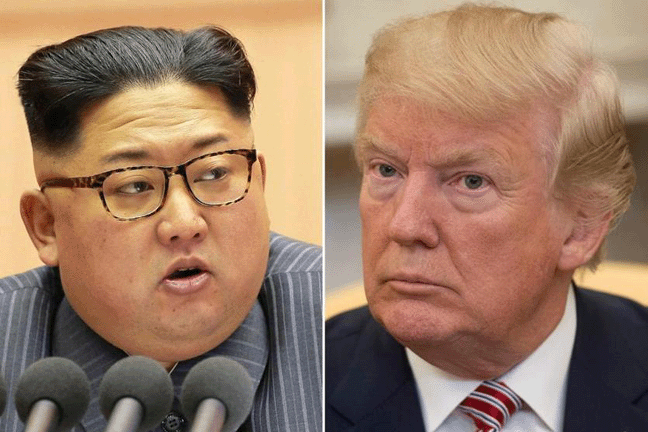 Once ‘No Longer a Nuclear Threat,’ North Korea Now in Standoff With U.S. NYT, By David E. Sanger and William J. Broad, Aug. 10, 2018 WASHINGTON — North Korea is insisting that the United States declare that the Korean War is over before providing a detailed, written disclosure of all its atomic weapons stockpiles, its nuclear production facilities and its missiles as a first major step toward denuclearization.
Two months after President Trump declared his summit meeting in Singapore with Kim Jong-un a complete success, North Korea has not yet even agreed to provide that list during private exchanges with Secretary of State Mike Pompeo, according to American and South Korean officials familiar with the talks.
Mr. Pompeo maintains progress is being made, although he has provided no details. But John R. Bolton, Mr. Trump’s national security adviser, this week said, “North Korea that has not taken the steps we feel are necessary to denuclearize.”
On Thursday, North Korea’s state-run newspaper, Rodong Sinmun, called the declaration of the end of the war “the demand of our time” and that would be the “first process” in moving toward a fulfillment of the June 12 deal struck between Mr. Trump and Mr. Kim. Pyonygang also wants peace treaty talks to begin before detailing its arsenal.
If the standoff over the parallel declarations remains, it is hard to see how the two countries can move forward with an agreement.
“The North Koreans have lied to us consistently for nearly 30 years,” Joseph Nye, who wrote one of the National Intelligence Council’s first assessments of the North’s weapons programs in 1993, said at the Aspen Institute on Tuesday.
“Trump is in a long tradition of American presidents who have been taken to the cleaners,” Mr. Nye said.
Neither Mr. Trump nor Mr. Pompeo has acknowledged the impasse. But officials said South Korea has quietly backed the North Korean position, betting that once Mr. Trump has issued a “peace declaration” it would be harder for him to later threaten military action if the North fails to disarm or discard its nuclear arsenal.
Against North Korea’s continuing nuclear buildup — and its threats to strike the United States — Washington has long refused to formally declare the end of the war, which was halted with a 1953 armistice but never officially brought to a close.
And fears remain that making concessions to Pyongyang — especially after Mr. Trump shelved annual American military exercises with South Korea that he called “war games,’’ the phrase used by the North — would outrage Republicans in Congress and open Mr. Trump to charges that he has been outmaneuvered by the North Korean leader.
The White House has never reconciled Mr. Trump’s post on Twitter after meeting Mr. Kim that “there is no longer a Nuclear Threat from North Korea” with Mr. Bolton’s assessment that the Singapore agreement has so far yielded almost no progress in the nuclear arena. That view is shared by many in Congress and the American intelligence agencies.
For Mr. Trump and Mr. Pompeo, much rides on how this standoff is resolved — or whether it results in the collapse of what the president called his determination to “solve” the nuclear crisis.
Mr. Pompeo has told associates that he believes his tenure as secretary of state will be judged largely on how he handles the negotiations. In recent weeks he has softened some of his statements toward North Korea, saying the United States is open to a step-by-step approach that most officials had previously rejected.
“The ultimate timeline for denuclearization will be set by Chairman Kim,”Mr. Pompeo said last week — a stark contrast to Mr. Trump’s statements last year that North Korea should give up its weapons rapidly, or face tremendous, if unspecified, consequences.
Challenged about the lack of progress so far, officials at the White House and State Department pointed to three developments as signs that the strategy with North Korea is advancing.
They noted that North Korea has not conducted a missile or nuclear test since November. Since the Singapore summit, Pyongyang has returned the remains of about 55 Americans killed in the Korean War, which appear genuine, a good-will gesture though one unrelated to the nuclear program. And satellite evidence suggests North Korea has begun dismantling a test site where it has developed missile technologies and launched space satellite missions. Experts cautioned, however, that all the steps taken so far are easily reversible……..https://www.nytimes.com/2018/08/10/us/politics/north-korea-denuclearize-peace-treaty.html
Israel flagrantly violated the Nuclear Test Ban Treaty

 A double-flash from the past and Israel’s nuclear arsenal, Bulletin of the Atomic Scientists Leonard Weiss, 12 Aug 18 , August 3, 2018
For more than half a century, Israel has maintained a cover of silence and opacity regarding its nuclear program and arsenal, backed up by the threat of severe punishment and persecution for any Israeli (see Mordechai Vanunu) who dares publicly breach the cover. In return for this silence, plus a pledge of restraint on certain nuclear development activities, the United States has reportedly agreed in writing not to pressure Israel to sign the Nuclear Non-Proliferation Treaty or get rid of its nuclear arsenal. (See this recent New Yorker article by Adam Entous.) US policy on Israel also includes its own public silence concerning Israeli nuclear weapons. But this policy should change as a result of a new scientific study of an event that took place nearly 40 years ago, during the Carter Administration. That study makes it virtually certain that the event was an illegal nuclear test. This strengthens previous analyses concluding that Israel likely carried out a nuclear test in violation of US law and the Limited Test Ban Treaty. The response to this new study will determine whether the United States and the international community of nations are serious about nuclear arms control.
On September 22, 1979, a US Vela satellite, designed to detect clandestine nuclear tests, recorded a “flash” off the coast of South Africa that every nuclear scientist monitoring the satellite’s detectors at the time believed fit the classic description of a nuclear explosion. President Jimmy Carter’s book based on his White House diaries notes that he was immediately informed of the “flash” by his national security team; with the information came speculation that the event was an Israeli nuclear test at sea, with South African participation. ……..
Important new and dispositive evidence that the “flash” was a nuclear test has been added recently by two respected scientists, Christopher Wright of the Australian Defense Force Academy and Lars-Eric De Geer of the Swedish Defense Research Agency (Ret.), writing in the journal Science & Global Security. (The 22 September 1979 Vela Incident: The Detected Double-Flash, Science & Global Security, 25:3, 95-124, DOI: 10.1080/08929882.2017.1394047) ……….
The new study by Wright and De Geer should receive wide attention because it provides a test of the commitment by the international community to nuclear arms control and nonproliferation norms. While a comprehensive nuclear test ban is yet to be achieved, the nations of the world did manage to put in place an extremely important arms control, non-proliferation, and environmental protection measure called The Limited Test Ban Treaty (LTBT). This treaty, which went into force in 1963, bans nuclear explosions in the atmosphere, in outer space, and under water, thus rendering legal only those nuclear tests performed underground. Israel signed the treaty in 1963 and ratified it in 1964. The Israeli nuclear test puts Israel in violation of the LTBT, which has been signed by 108 countries, including all the officially recognized nuclear weapon states plus India, Pakistan, and Iran. Israel would also be in violation of the Glenn Amendment to the Arms Export Control Act, a US law passed in 1977, requiring the cutoff of military assistance to any country setting off a nuclear explosion. The president can waive the sanction, but he has to face the issue.
In the meantime, what should be a consequence of the flagrant violation of the Limited Test Ban Treaty?
At a time when public demands for nuclear transparency are loudly and justifiably trumpeted toward Iran and North Korea, which are pariahs in many Western eyes, it is illogical at best and hypocritical at worst for the world, and particularly the United States, to maintain public silence on Israel’s nuclear program, especially in the face of a violation of an important nuclear norm. For the sake of future progress on arms control, on steps to reduce nuclear risk, and on honest public as well as private communication among governments and their constituents to achieve such progress, it is time to end an existing double standard that has allowed Israel to escape accountability for developing advanced nuclear weapons by violating a major international treaty. https://thebulletin.org/2018/08/a-double-flash-from-the-past-and-israels-nuclear-arsenal/?utm_source=Bulletin%20Newsletter&utm_medium=iContact%20email&utm_campaign=August10
Egypt going into a huge debt to Russia for building Dabaa nuclear plant
 Middle East Monitor 10th Aug 2018 , Egypt will obtain a license to build the Dabaa nuclear plant by mid-2020,
the Russian deputy minister of industry and trade said. Georgy Kalamanov
added that Russian experts are currently completing designing the nuclear
plant and surveying the area where it will be built.
In 2015, Russia andEgypt signed a deal which would see Russia build Egypt’s first nuclear
power plant in the Dabaa area, located on Egypt’s northwestern coast.
Under the terms of the agreement, Cairo would access a loan for the project
from Moscow. In 2016, the Egyptian official Gazette reported that the loan
would amount to $25 billion, which would finance 85 per cent of the cost of
contracts signed for the plant’s construction. The loan repayment period
is 35 years. Egypt will finance the remaining 15 per cent.
https://www.middleeastmonitor.com/20180810-russia-egypt-to-begin-building-nuclear-reactor-in-2020/
Russia and China pushing to create their economic nuclear empires
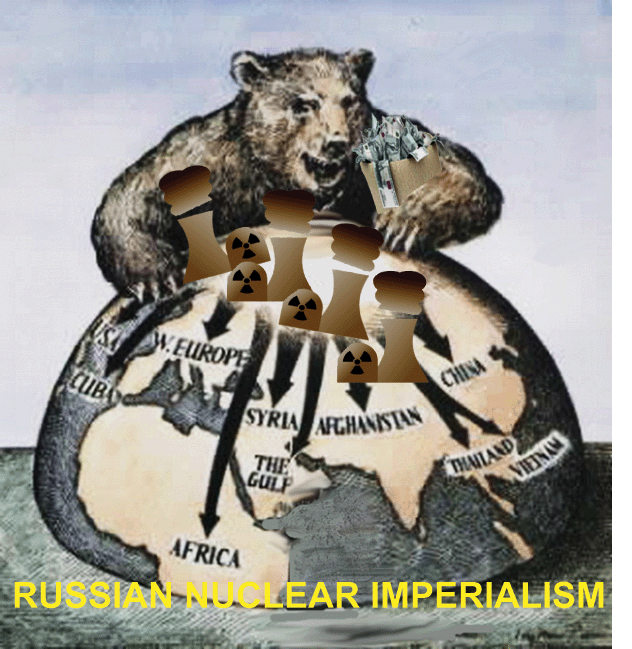
Russia on an international offensive to sell its nuclear plants, Vladimir Putin’s government vies with China to become a superpower in the field MOSCOW — Russia is stepping up its overseas sales of nuclear power plants, with state-run nuclear energy company Rosatom agreeing in July to cooperate in building a plant in the Central Asian country of Uzbekistan and reaching an accord with China to build a plant in that country.
Russia accounts for 67% of the world’s nuclear plant deals currently in development. By 2030, Rosatom aims to increase its overseas sales to two-thirds of total sales, from 50% at currently. Vladimir Putin’s government is looking to expand Russian influence through nuclear diplomacy, vying with China — which is promoting its own nuclear plants — for the status of nuclear energy superpower.
“We hope that a lot of other countries will become our partners, and as they say, ‘nuclear newcomers,'” Rosatom Chief Executive Alexey Likhachev told Prime Minister Dmitry Medvedev at a meeting in early July…….
During a visit by Putin to China in June, Rosatom entered into a framework agreement to cooperate in nuclear plant construction, including four reactors in Jiangsu and Liaoning provinces.
Russia intends to make nuclear power plants a major revenue earner alongside exports of crude oil and natural gas. Rosatom’s annual business report for 2016 showed it was involved in nuclear plant projects in more than 10 countries, including China, Bangladesh and India. The company had $133.4 billion of overseas orders, up 21% from a year earlier. It targets $150 billion to $200 billion in orders in 2030…….
Russia’s strength in the field is the all-out support of the government, and its ability to take on all aspects of a nuclear energy project. The Putin government attaches much importance to nuclear plants, seeing them as a globally competitive, technology-intensive industry with an important role to play in revitalizing Russia’s domestic industry. Putin himself has successfully pitched Russian nuclear plants to foreign leaders during international summits.
Russian nuclear plants also boast price competitiveness, with the government providing loans to finance the high costs. Not only does Russia build the plant, but it supplies the fuel, operates and maintains the reactors, and disposes of the used fuel. This makes a deal with Russia attractive for countries that want to build their first nuclear plant, but which lack the operational know-how…….
China has made it clear that its policy is to expand overseas nuclear plant deals by building on the technology of Russia, France and other countries that have been at the forefront of nuclear plant development. …….https://asia.nikkei.com/Business/Energy/Russia-on-an-international-offensive-to-sell-its-nuclear-plants
Will Iran go nuclear over reimposed sanctions?
Bulletin of the Atomic Scientists, By Ezra Friedman, August 7, 2018
Yesterday US President Donald Trump issued an executive order restoring one set of economic sanctions on Iran that were lifted by the Obama-era nuclear deal known as the Joint Comprehensive Plan of Action. The sanctions cover Iranian trade in items including metals such as gold and steel, automobiles, and aircraft.
In early November, Trump plans to reintroduce even more crippling sanctions on Iranian oil and banking. Collectively, these sanctions are likely to cause immense damage to the Iranian economy. Even carpets and foodstuffs are being sanctioned by the United States. The European Union and the three European countries that signed the nuclear deal (France, Germany, and the United Kingdom) are attempting to assemble an economic package that will save the deal from complete collapse, but so far with little progress and growing frustration on all sides. A joint statement issued yesterday by European foreign ministers says they “deeply regret” the White House decision.
By reimposing sanctions, Trump aims to force the current regime in Iran to negotiate a more comprehensive nuclear deal, or to inflict enough economic pain to change the regime’s behavior—if not the regime itself. Iran now finds itself in the crosshairs of a president who has made it his personal mission to aggressively combat Tehran.
Trump’s strategy might not have the intended effect, but it is likely to cause Iran to withdraw from the Joint Comprehensive Plan of Action (JCPOA). Does that mean Iran will go all Pyongyang and start developing nuclear weapons? Probably not. But unless a new nuclear deal can be made, Iran can be expected to resume its pre-JCPOA program of uranium enrichment, taking the country to the threshold of becoming a nuclear weapons state.
Why Iran will probably leave the JCPOA. When the JCPOA was signed three years ago, its supporters hailed it as a breakthrough against the proliferation of nuclear weapons, and a chance to welcome Iran back into the fold of nations following a long exile that began in 1979. The nuclear deal’s detractors claimed that the agreement was not broad enough, because it allowed Iran to continue its ballistic missile program unabated and to support its proxies in Syria, Iraq, Lebanon, and Yemen—thereby continuing to push an agenda of regional hegemony.
The May 8 withdrawal of the United States from the JCPOA amplified the debate. The United States is pursuing an almost fanatical campaign, lobbying its allies and partners across the globe, and educating them about the latest sanctions package—as well as the penalties for noncompliance. Critics say the sanctions regime will be ineffective because China and other countries will take advantage of the situation. But others, including several major foreign companies, are taking the sanctions seriously, in some cases withdrawing altogether from Iran.
What is clear is that sanctions will make an already difficult domestic economic situation worse in Iran. Iranians are largely young, educated, and tired of the regime’s policies. Many are angry about the billions of dollars spent in support of foreign wars, and protests are escalating. Iran also finds itself overextended regionally with challenges to its grand strategy in Yemen, Iraq, and Syria. While Tehran’s ally Bashar al-Assad will remain in power, Iran will now find itself in competition with Russia for dominance in Syria, both economically and politically, despite the high price Tehran has paid in both men and money to support Assad………..
Why it’s not in Iran’s interest to leave the NPT. Iran has several options once it leaves the JCPOA. Some statements by Iranian leaders suggest that Iran will race to acquire a nuclear device, ramping up its nuclear program so as to achieve this goal as quickly as possible, either overtly or covertly. Iran’s critics point to its past violations of the Nuclear Non-Proliferation Treaty (NPT) in the early 2000s, confirmed by an Israeli intelligence operation earlier this year. (Iran has been a party to the treaty since 1970.)
While frightening, this scenario is unlikely, because it would place Iran in the same category as North Korea: a pariah in the eyes of the international community. On a strategic level, Tehran is keenly aware of this possibility and wants to avoid it at all costs. Even if Iran would like to have a militarized nuclear program, the cost would be massive if not unbearable for the regime.
………Rather than withdrawing from the NPT, it is more likely that Iran will return to something akin to a pre-JCPOA scenario, with a nuclear program that is enriching uranium to 20 percent or more without the full oversight of the International Atomic Energy Agency—which will almost certainly lose its current ability to access Iran’s known non-military nuclear sites upon Iran’s exit from the JCPOA. In this scenario, Iran will have a short “breakout period”—the time needed to produce enough weapons-grade uranium to build its first nuclear device—estimated at five weeks to a year.It is important to note that there is a strong likelihood that some trading partners considered important to Iran economically—such as China, India, Turkey, and the European Union—will at least partially flout US extraterritorial sanctions. Such a scenario would be the best of both worlds for Tehran, allowing the regime to achieve the prestige and tacit recognition of a nuclear program that is illicit in nature, all the while not being subject to UN Security Council resolutions and maintaining its standing in the international community……….https://thebulletin.org/2018/08/will-iran-go-nuclear-over-reimposed-sanctions/?utm_source=Bulletin%20Newsletter&utm_medium=iContact%20email&utm_campaign=August10
1 This Month

4 May -West Suburban Peace Coalition to discuss Iran war at May Educational Forum
Monday, May 4, 7:00 – 8:00 PM Central Standard Time
Title: : How Trump’s Narrative Tries to Shape the Reality of the War on Iran.
Contact Walt Zlotow, zlotow@hotmail.com 630 442 3045 for further information
14 May – online event From Bombs to Data Centres: the Face of Nuclear Colonialism
To see nuclear-related stories in greater depth and intensity – go to https://nuclearinformation.wordpress.com
-
Archives
- May 2026 (49)
- April 2026 (356)
- March 2026 (251)
- February 2026 (268)
- January 2026 (308)
- December 2025 (358)
- November 2025 (359)
- October 2025 (376)
- September 2025 (257)
- August 2025 (319)
- July 2025 (230)
- June 2025 (348)
-
Categories
- 1
- 1 NUCLEAR ISSUES
- business and costs
- climate change
- culture and arts
- ENERGY
- environment
- health
- history
- indigenous issues
- Legal
- marketing of nuclear
- media
- opposition to nuclear
- PERSONAL STORIES
- politics
- politics international
- Religion and ethics
- safety
- secrets,lies and civil liberties
- spinbuster
- technology
- Uranium
- wastes
- weapons and war
- Women
- 2 WORLD
- ACTION
- AFRICA
- Atrocities
- AUSTRALIA
- Christina's notes
- Christina's themes
- culture and arts
- Events
- Fuk 2022
- Fuk 2023
- Fukushima 2017
- Fukushima 2018
- fukushima 2019
- Fukushima 2020
- Fukushima 2021
- general
- global warming
- Humour (God we need it)
- Nuclear
- RARE EARTHS
- Reference
- resources – print
- Resources -audiovicual
- Weekly Newsletter
- World
- World Nuclear
- YouTube
-
RSS
Entries RSS
Comments RSS
 nuclear-news