World security needs nuclear New Start agreement – USA-Russia, not a distraction about China
|
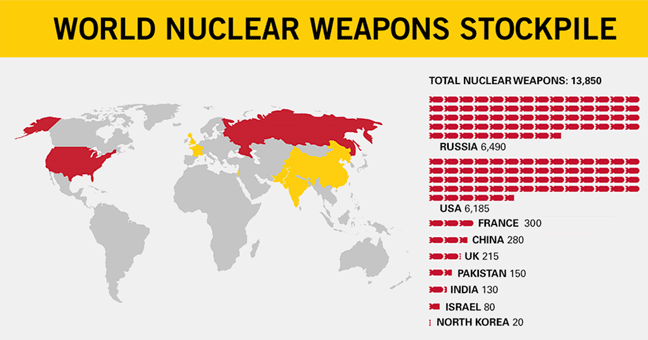
Nobody wins a nuclear war — especially not two nuclear behemoths. https://thehill.com/opinion/international/453576-nobody-wins-a-nuclear-war-especially-not-two-nuclear-behemoths BY DANIEL R. DEPETRIS,— 07/17/19 U.S. and Russian officials met this week in Geneva for what one hopes will be new strategic arms reduction talks. Trump administration officials are cautiously optimistic the discussions could lead to a more substantive negotiation about capping — and perhaps even decreasing — the number of nuclear weapons both countries have in their stockpiles. This matters for U.S. and global security because these two nations possess more than 90 percent of all nuclear weapons. President Trump, however, wants to go further than a simple extension of the 2010 The New Strategic Arms Reduction Treaty (START) agreement or a new bilateral treaty with the Russians. Instead, he is prodding China to join a trivariate arrangement. But in prefacing or linking an extension of New START to a fresh accord that includes the Chinese, the administration is increasing the possibility of ending up with neither. For one, pushing Beijing to into a three-way deal is like pushing on a locked door. The Chinese have shown no interest in a three-way deal, in large measure because their nuclear arsenal is a fraction (roughly 2 percent) of the globe’s entire inventory. At roughly 290 warheads, Beijing’s nuclear weapons program is minuscule when compared to the thousands of combined warheads Washington and Moscow have stockpiled. Indeed, China stockpile is less than 1/20th the size of the United States and about 1/22th the size of Russia’s. To expect the Chinese to participate in a new arms control negotiation with two nuclear superpowers when the numbers are so steadily stacked against them is a fool’s errand. Beijing’s no-first use nuclear policy, in place since its first ever nuclear explosive test in 1964, was recently reaffirmed just last year. An offensive nuclear strike is not something U.S. officials in Washington have to worry about. To focus on a U.S.-Russia-China nuclear agreement at the expense of keeping an already existing New START accord alive is the wrong priority. New START, signed in April 2010, was a win-win, pragmatic arms control agreement for both sides. The pact cut the U.S. and Russian stockpiles byaround one-third; capped the amount of nuclear warheads on deployed intercontinental ballistic missiles at 1,550; limited the number of deployed and non-deployed ICBM launchers to 800; and allowed each country to verify compliance with the treaty, including on-site inspections, information exchanges and advanced notices. Unlike the Intermediate Range Nuclear Forces Treaty, inspectors have verified Moscow’s compliance with the letter of the deal. For two countries that possess a combined 12,675 nuclear weapons, New START is a critical enforcing mechanism for nuclear parity and a stable balance of power. It is now the only functional arms control accord preventing the U.S. and Russia from entering another costly, risky arms race. The deal expires in February 2021 but could be extended for another five years if both Presidents Trump and Putin agree to do so. Putin has already expressed his interest. Trump, someone who considers himself a transactional pragmatist, shouldn’t waste any more time before doing the same. An extension of New START, however, is not only important for strategic stability between the two nuclear superpowers (without New START, there is nothing stopping either the United States or Russia from building and deploying more and better nuclear warheads). but also valuable for stabilizing the entire U.S.-Russia relationship in desperate need of improvement. For this reason, a constructive relationship with Moscow is unquestionably a good thing for U.S. security. Extending New START is a no-brainer and indeed could very well be an opportunity to mend relations. It’s not hyperbole to describe U.S.-Russia relations as being at their lowest since the land-based missile build-up in Europe in the early 1980s. From Syria and Ukraine to NATO and cybersecurity, Washington and Moscow are often on opposite sides of the issue. Even though both nations share some interests, including arms control and countering terrorism, Washington has become the epicenter of anti-Russia sentiment, where condemning Putin and advocating for sanctions is sport. Good politics, however, doesn’t necessarily correspond with good statecraft or foreign policy. Talking with adversaries, rivals, or competitors is a critically important component of effective foreign policy. We must engage with the world as it is, not as we wish it to be. Simply ignoring the Russians, pretending they don’t exist, or believing that using the stick unreservedly against Moscow will force it to cry uncle and change its policies to our liking makes conflict between nuclear superpowers more likely. Giving New START another five years of life is perhaps the only issue Washington and Moscow can agree on in today’s political climate. It’s perhaps the most important reason the U.S. and Russia must find a way to co-exist. Ensuring New START survives should be pursued aggressively for the sake of U.S. and global security Nobody wins a nuclear war — especially especially not two nuclear behemoths with thousands of warheads apiece. Daniel R. DePetris is a fellow at Defense Priorities, a foreign policy think tank focused on promoting security, stability and peace. |
|
|
Iran makes ‘substantial’ nuclear offer in return for US lifting sanctions
|
Plan would allow enhanced, permanent nuclear inspections Iran has offered a deal with the US in which it would formally and permanently accept enhanced inspections of its nuclear programme, in return for the permanent lifting of US sanctions. The offer was made by the Iranian foreign minister, Mohammad Javad Zarif, on a visit to New York. But it is unlikely to be warmly received by the Trump administration, which is currently demanding Iran make a range of sweeping concessions, including cessation of uranium enrichment and support for proxies and allies in the region…… https://www.theguardian.com/world/2019/jul/18/iran-nuclear-deal-trump-mohammad-javad-zarif-sanctions |
|
Iran’s diplomatic offer on nuclear inspections meets with USA scepticism
|
Iran floats offer on nuclear inspections; U.S. skeptical Arshad Mohammed, Steve Holland, WASHINGTON (Reuters) 18 Jul 19- Iran on Thursday signaled a willingness to engage in diplomacy to defuse tensions with the United States with a modest offer on its nuclear program that met immediate skepticism in Washington. Iran’s foreign minister told reporters in New York that Iran could immediately ratify a document prescribing more intrusive inspections of its nuclear program if the United States abandoned its economic sanctions, media organizations reported. The document, known as the Additional Protocol, gives U.N. inspectors from the International Atomic Energy Agency (IAEA) more tools to verify that a nuclear program is peaceful. While U.S. officials suggested they viewed the idea as a non-starter, analysts said it could provide an opening for U.S. President Donald Trump’s administration to pursue diplomacy. …….. ‘A CREATIVE OPENING’? Former U.S. officials saw a diplomatic opening. “If the foreign minister has suggested that the Majlis (the Iranian parliament) would ratify the additional protocol now, that is a serious step,” said Wendy Sherman, a former Obama administration official who negotiated the 2015 nuclear deal. “Of course, Iran will want something serious in return. Nonetheless, a creative opening,” she added. ……… Trump on Thursday said a U.S. Navy ship had “destroyed” an Iranian drone in the Strait of Hormuz after the aircraft threatened the ship. But Zarif told reporters at the United Nations he was not aware of any Iranian drone being downed.https://www.reuters.com/article/us-mideast-iran-usa-zarif/iran-floats-offer-on-nuclear-inspections-us-skeptical-idUSKCN1UD310 |
U.S. Slaps Sanctions On Nuclear Supply Network for Iran’s Enrichment Program
|
U.S. Slaps Sanctions On Nuclear Supply Network for Iran’s Enrichment Program, Radio Farda, WASHINGTON 18 Jul 19, — The U.S. Treasury Department on July 18 imposed additional sanctions on Iran that target its nuclear-enrichment program.They are the first restrictive measures since Tehran said earlier this month that it would increase enriched uranium levels to above those allowed under the terms of a 2015 nuclear accord.
The blacklist includes five people and an international group of companies in Iran, Belgium, and China that acted as a supply network for Iran’s nuclear program. The individuals and entities are subject to asset freezes within the United States and will be denied access to the U.S. financial system as well as listed as “weapons of mass destruction proliferators,” U.S. Secretary of State Mike Pompeo said in a statement.,,,,,,, https://en.radiofarda.com/a/u-s-slaps-sanctions-on-nuclear-supply-network-for-iran-s-enrichment-program/30064135.html |
|
|
North Korea, angered by US military exercises, plans to resume nuclear, missile, testds
Irate Over Military Exercises, North Korea Threatens To Resume Nuclear, Missile Tests https://www.npr.org/2019/07/16/742129952/irate-over-military-exercises-north-korea-threatens-to-resume-nuclear-missile-te, July 16, 2019, SASHA INGBER
North Korea warned Tuesday that negotiations with the United States could falter and that its nuclear and missile tests might resume if the U.S. and South Korea move forward with planned military exercises.
An unnamed North Korean Foreign Ministry spokesperson accused the U.S. of “unilaterally reneging on its commitments” in a statement released Tuesday by the Korean Central News Agency. The spokesperson said North Korea is “gradually losing our justification to follow through on the commitments we made with the U.S.” and that verbal pledges are not “a legal document inscribed on a paper.”
After President Trump’s historic summit with North Korean leader Kim Jong Un last year in Singapore, Trump announced that he would call off large military exercises with South Korea as a goodwill gesture to help kickstart negotiations.
North Korea has not tested long-range missiles since 2017.
Tuesday’s letter comes after Trump made a sudden visit to see Kim in June. They sat together in the Demilitarized Zone between the two Koreas as cameras flashed, and Trump became the first sitting U.S. president to set foot into North Korea. He called it “a great honor.”
They agreed to resume talks, but little progress has been made toward denuclearization, and no diplomatic meetings are known to have taken place since that June sit-down.
The U.S.-South Korean combined military exercises, called Dong Maeng, are expected to take place in August.
North Korea has long denounced such military drills, viewing them as a threat to its sovereignty. “It is crystal clear that it is an actual drill and a rehearsal of war aimed at militarily occupying our Republic by surprise attack,” the spokesperson said Tuesday.
Joint military exercises have taken place for decadesbecause the Korean peninsula was still technically in a state of war since the signing of an armistice agreement in 1953.
Although the United States has vowed to “indefinitely suspend” certain drills, smaller exercises are still help for South Korean and U.S. troops.
Pyongyang tested suspected short-range missiles in May. American officials drew a distinction between those tests and the launches of long-range ballistic missiles, which may be capable of reaching the U.S. mainland.
Iran still committed to the nuclear accord, but will decrease its commitment if other signatories cannot help
 Iran Threatens to Revert to Pre-2015 Nuclear Development Levels, By VOA News, July 15, 2019 Iran threatened Monday to revert its nuclear development program to pre-2015 levels before it agreed to restraints under an international accord if the European countries and the United States that were signatories to the deal fail to help its economy.
Iran says reducing nuclear deal commitments to save it from ‘total collapse
Iran says reducing nuclear deal commitments to save it from ‘total collapse’, Press TV, Jul 5, 2019 Foreign Minister Mohammad Javad Zarif says Tehran’s decision to scale down its commitments under the JCPOA is indeed aimed at protecting the multilateral deal, not killing it.
Back on May 8, Iran notified its remaining partners in the 2015 nuclear deal that it would suspend the implementation of some of its commitments in reaction to the US’ unilateral withdrawal and Europe’s failure to live up to its commitments.
Speaking in an exclusive email interview with The New York Times published on Thursday night, Zarif said Iran made the decision as it “can indeed prevent the deal from total collapse.”
The Joint Comprehensive Plan of Action (JCPOA) “was and remains the best POSSIBLE agreement on the nuclear issue,” Zarif said, adding that its total collapse “will be detrimental to the interests of all, including the US.”
He said Iran “will remain committed to the deal as long as the remaining participants (EU, France, Germany, UK, Russia and China) observe the deal.”
“Survival or collapse of the JCPOA depends on the ability and willingness of all parties to invest in this undertaking. In a nutshell, a multilateral agreement cannot be implemented unilaterally,” Zarif said.
He also said that Iran’s decision to reduce its commitments was taken in line with its legal rights under paragraphs 26 and 36 of the nuclear deal, saying, “Paragraph 36 of JCPOA is a clear example that we negotiated this deal with the full understanding that we could not trust the commitment of the West.
As part of the first phase of scaling down its commitments, Iran exceeded the 300-kilogram limit set by the JCPOA on its low-enriched uranium stockpiles……….
The JCPOA obliges the European partners to prove their commitment to the nuclear deal in action, Zarif said, adding that the Islamic Republic would commit to the agreement in exactly the same way as those countries would.https://www.presstv.com/Detail/2019/07/05/600190/Iran-Zarif-JCPOA-nuclear-deal-commitments
U.S., Russia to discuss nuclear arms limits in Geneva on Wednesday –officials
U.S., Russia to discuss nuclear arms limits in Geneva on Wednesday –officials https://news.yahoo.com/u-russia-discuss-nuclear-arms-185425751.html
WASHINGTON, July 15 (Reuters) – Representatives from the United States and Russia are set to meet in Geneva on Wednesday to explore the idea of a new accord limiting nuclear arms that could eventually include China, U.S. senior administration officials said on Monday.
U.S. President Donald Trump has said that he would like to see a new type of arms control deal with Russia and China to cover all types of nuclear weapons, a topic that he has discussed individually with Russian President Vladimir Putin and Chinese President Xi Jinping.
China is not currently a party to nuclear arms pacts between the United States and Russia.
The U.S. delegation will be led by U.S. Deputy Secretary of State John Sullivan and will include Tim Morrison, a top aide at the White House National Security Council, as well as representatives from the Pentagon, the Joint Chiefs of Staff, and the National Security Agency, said the U.S. officials, who spoke to reporters on condition on anonymity.
Russia’s deputy foreign minister, Sergei Ryabkov, will lead the Russian delegation, the U.S. officials said.
“We actually feel that – touch wood – we’ve actually got to a point where we can try to start this again,” one of the officials said, listing off a long series of incidents that have soured relations between the United States and Russia during the past year.
“I say touch wood because we’re always just one incident away from unfortunately things getting derailed,” the official said. (Reporting by Roberta Rampton Editing by Marguerita Choy)
How the Iran nuclear deal actually works
“I think in Iran, we are pretty confident that there is no undeclared plant”
How the Iran nuclear deal works, explained in 3 minutes
Iran is enriching uranium and breaking the limit set by the nuclear deal. Here’s what  that means.
Uranium enrichment is a critical step in making nuclear energy and nuclear weapons. VOX, By Iran has exceeded the uranium enrichment level of 3.67 percent set in the 2015 nuclear deal it made with world powers, a spokesman for Iran’s nuclear agency said, according to reports Monday.
The deal put tight restrictions on Iran’s nuclear program in exchange for the loosening of some international sanctions on the country. The 3.67 percent limitation on uranium enrichment purity was one of many limits in the deal meant to keep Iran from gathering enough material to build an atom bomb in a year if it chose to (Iran has never officially said it wants a nuclear weapon).
On Sunday, Iran’s deputy foreign minister, Abbas Araghchi, said Iran would begin enriching uranium to 4.5 percent for its Bushehr power plant.
“This is to protect the nuclear deal, not to nullify it. … This is an opportunity for talks. And if our partners fail to use this opportunity, they should not doubt our determination to leave the deal,” Araghchi said.
The 4.5 percent enrichment is still well below the 90 percent considered weapons-grade. But the violation of the deal is a move meant “to pressure Europe to reset the terms of the nuclear agreement following a US withdrawal from the pact last year,” according to the Washington Post.
Given the extraordinary destructive power of a nuclear weapon, keeping a close eye on enrichment around the world is critical to global security. But in the decades since the Manhattan Project, the enrichment process has gone from a massive, power-hungry, brute-force operation to a sophisticated and potentially clandestine affair.
Since it’s immensely important in international diplomacy right now, it’s worthwhile to understand what goes into enriching nuclear material, how the nuclear process works, and the strategies for keeping it in check………
Given the extraordinary destructive power of a nuclear weapon, keeping a close eye on enrichment around the world is critical to global security. But in the decades since the Manhattan Project, the enrichment process has gone from a massive, power-hungry, brute-force operation to a sophisticated and potentially clandestine affair.
Since it’s immensely important in international diplomacy right now, it’s worthwhile to understand what goes into enriching nuclear material, how the nuclear process works, and the strategies for keeping it in check.
Under the NPT, countries that don’t currently possess nuclear weapons are prevented from developing or spreading nuclear weapons technologies, but they can pursue nuclear activities for peaceful purposes like research or energy.
In 2003, Iran was found to have violated nuclear activity reporting requirements in the NPT, which spurred the international effort to get Iran to suspend its enrichment work. The US has argued that Iran does not have the right to enrich uranium since it was caught violating some of the safeguards imposed by the NPT, though Iran has not violated the treaty itself.
The goal of the six countries that signed the JCPOA with Iran in 2015 was to limit what is called “breakout time.” That is, how long it would take Iran to enrich enough material for a nuclear weapon if the country suddenly decided to ditch all international agreements and aggressively ramp up enrichment.
Prior to the agreement, Iran’s breakout time was estimated at four to six weeks. The provisions of the deal (Vox’s Zack Beauchamp put together an excellent explainer on this) aimed to extend this to more than a year, which would give international observers time to detect such a shift and enact countermeasures.
In short, the agreement made Iran limit uranium enrichment to 3.67 percent and decommission about 14,000 of its centrifuges, allowing just roughly 5,000 of Iran’s first-generation units to keep spinning. These IR-1 centrifuges produce between 0.75 and 1 SWU per device, whereas the IR-8 centrifuges Iran was developing at the time of the deal could theoretically manage 24 SWU, making them much more efficient.
Iran also gave up much of its low-enriched uranium stockpile, going from 25,000 pounds to 660 pounds. Iranian officials also agreed to pour concrete into their Arak reactor, a potential source of plutonium for nuclear weapons.
In addition, the JCPOA requires round-the-clock monitoring of Iran’s enrichment facilities in Fordow and Natanz, with only the Natanz facility allowed to operate. These are likely the only places where Iran can enrich uranium for a weapon.
“I think in Iran, we are pretty confident that there is no undeclared plant,” said Alex Glaser, director of the Nuclear Futures Laboratory at Princeton University.
International observers are also monitoring Iran’s uranium mining operations.
As it stands, the agreement effectively eliminates Iran’s prospects for enriching enough uranium for a civilian nuclear program and makes it much more tedious to gather the material required for a weapon. What little enrichment Iran is allowed under the deal is effectively a face-saving measure.
But, critics argue, pausing Iran’s entire nuclear enrichment apparatus only extends the breakout time by a few months since the country could just rebuild or reinstall its centrifuges if it decided to leave the agreement. And it looks like that day may be getting closer: a spokesman for Iran’s Atomic Energy Organization said Monday that the agency may increase the enrichment level to 20 percent or reinstall centrifuges.https://www.vox.com/2018/6/11/17369454/iran-uranium-enrichment
Iran’s Revolutionary Guards chief says -The world knows Iran is not pursuing nuclear weapon
Iran threatened on Monday to restart deactivated centrifuges and ramp up enrichment of uranium to 20 percent purity as its next potential big moves away from a 2015 nuclear agreement that Washington abandoned last year.
“Why do they globally sanction us about the nuclear issue when the world knows that we are not pursuing a weapon? In reality they are sanctioning us because of knowledge,” he said. “Nuclear weapons have no place in Islam. Islam never approves of weapons of mass destruction.”
Reporting By Babak Dehghanpisheh, Editing by William Maclean
Australia would be wise not to mindlessly follow USA into war against Iran

We must think very carefully before committing to war in the Gulf, The Age, By Hossein Esmaeili, July 8, 2019 Conflict between the United States and Iran is deepening and the two states are marching towards war. The Persian Gulf, where a third of the world’s natural gas and a fifth of the world’s oil is sourced, may soon see another large scale and probably long-lasting international conflict………
the European Union is backing measures, provided by France, United Kingdom and Germany, known as Instruments In Support of Trade Exchange (INSTEX), to facilitate trade between the EU and Iran to partially get around the US sanctions, in order to save the 2015 nuclear deal, to maintain dialogue with Iran and to prevent an international military crisis.
Australia would be much wiser to join the EU’s INSTEX and engage in dialogue with Iran……..
Should Morrison decide to enter into a conflict in one of the most volatile regions of the world, he will not have the decision-making power to end it. He would do well not to drive Australia into such a war, instead, given Australia’s international reputation, he should help European countries, the world community and the United Nations to avoid a useless armed conflict, which will not benefit any country.
Hossein Esmaeili is an associate professor of international law at Flinders University. https://www.theage.com.au/world/middle-east/we-must-think-very-carefully-before-committing-to-war-in-the-gulf-20190708-p52566.html
Special UN meeting to discuss Iran: Russia, China, France, Britain and Germany try to keep nuclear deal
 UN nuclear watchdog to hold special meeting on Iran at request of US, RTE, 6 July 19 The United States has called an emergency meeting of the UN atomic watchdog’s 35-nation Board of Governors to discuss Iran, according to the US mission to the agency.
It comes after Tehran breached its 2015 nuclear deal with major powers.
Any country on the board can call a meeting, and the International Atomic Energy Agency confirmed in a note to member states that the meeting would be held next Wednesday after the IAEA this week said Iran had exceeded the maximum stock of enriched uranium allowed under the deal……..
The IAEA is in charge of verifying the restrictions on Iran’s nuclear activities imposed by the deal, which also lifted international sanctions against Tehran. The IAEA has repeatedly said it is up to the parties to the deal to decide whether there has been a breach of its terms.
Iran has said it will go over the deal’s nuclear restrictions one by one in retaliation against crippling economic sanctions Washington has imposed on it since the US withdrawal. It has said that as of 7 July it will enrich uranium beyond the 3.67% purity cap imposed by the deal.
Other signatories to the 2015 deal, apart from Iran and the United States, are Russia, China, France, Britain and Germany. Those five countries are trying to keep the deal alive. https://www.rte.ie/news/2019/0706/1060486-un-nuclear-watchdog-iran/
Israel lobby in US pushing for war against Iran: Analyst
Russia’s President Putin officially halts participation in nuclear treaty
Putin signs bill suspending participation in nuclear treaty https://www.japantimes.co.jp/news/2019/07/03/world/putin-signs-bill-suspending-participation-nuclear-treaty/#.XR0oyOszbGg 3 July 19
MOSCOW – President Vladimir Putin has signed a bill suspending Russia’s participation in a pivotal nuclear arms treaty. Putin’s decree released on Wednesday formalizes Russia’s departure from the 1987 Intermediate-Range Nuclear Forces treaty with the United States following Washington’s withdrawal from the pact.
The U.S. gave notice of its intention to withdraw from the INF in February, setting the stage for it to terminate in six months unless Moscow returns to compliance. Russia has denied any breaches, and accused the U.S. of violating the pact. Moscow followed Washington’s example in February, also suspending its obligations under the treaty.
Putin has warned the U.S. against deploying new missiles in Europe, saying that Russia will retaliate by fielding new fast weapons that will take just as little time to reach their targets.
USA Has Put Europe In A Tough Spot On Iran
CORNISH: You used the term bully earlier in talking about the U.S. effort when it comes to Iran. Do you see this as a test of European power, whether it’s strong enough to oppose the U.S. and enforce this deal?
DALTON: European companies and the European Union recognize that the dominance of the dollar in international trading gives the United States very considerable power. And I believe that the Iran episode is going to be a turning point. It will show Russia, China, India, the European Union the value of building up alternative mechanisms for concluding international trade that do not use the dollar in any shape or form.
So I think the United States is set maybe to use their excessive power on this occasion but, over the long term, to lose power. ……https://www.npr.org/2019/07/02/738146393/british-nuclear-expert-says-u-s-has-put-europe-in-a-tough-spot-on-iran
1 This Month
26 September – International Day for the Total Elimination of Nuclear Weapons





PLEASE OPPOSE HR 8255 AND S.3639 – bills would accelerate satellite deployment, with no environmental review or safeguards – https://ncstd5li.quorum.us/campaign/169331/
To see nuclear-related stories in greater depth and intensity – go to https://nuclearinformation.wordpress.com
-
Archives
- September 2026 (291)
- August 2026 (330)
- July 2026 (355)
- June 2026 (287)
- May 2026 (306)
- April 2026 (356)
- March 2026 (251)
- February 2026 (267)
- January 2026 (308)
- December 2025 (358)
- November 2025 (359)
- October 2025 (375)
-
Categories
- 1
- 1 NUCLEAR ISSUES
- business and costs
- climate change
- culture and arts
- ENERGY
- environment
- health
- history
- indigenous issues
- Legal
- marketing of nuclear
- media
- opposition to nuclear
- PERSONAL STORIES
- politics
- politics international
- Religion and ethics
- safety
- secrets,lies and civil liberties
- spinbuster
- technology
- Uranium
- wastes
- weapons and war
- Women
- 2 WORLD
- ACTION
- AFRICA
- Atrocities
- AUSTRALIA
- Christina's notes
- Christina's themes
- culture and arts
- Events
- Fuk 2022
- Fuk 2023
- Fukushima 2017
- Fukushima 2018
- fukushima 2019
- Fukushima 2020
- Fukushima 2021
- general
- global warming
- Humour (God we need it)
- Nuclear
- RARE EARTHS
- Reference
- resources – print
- Resources -audiovicual
- Weekly Newsletter
- World
- World Nuclear
- YouTube
-
RSS
Entries RSS
Comments RSS

