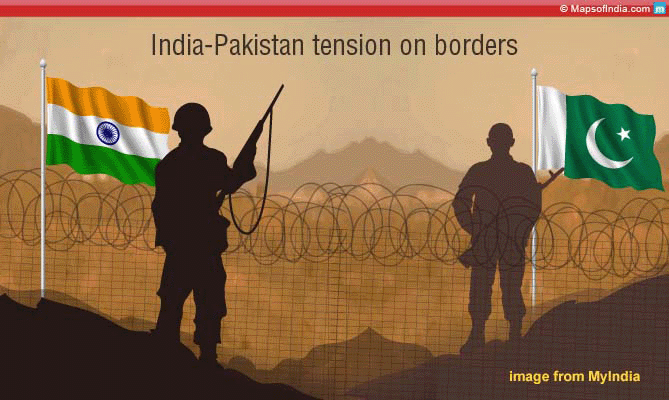
Kashmir crisis: Will nuclear-armed Pakistan go to war with India again? Telegraph UK Ben Farmer, islamabad
8 AUGUST 2019 Pakistan has downgraded diplomatic ties with India and suspended trade with its neighbour as the political row over the disputed territory of Kashmir escalates.
India’s announcement that it will abolish self-rule for Kashmir has been denounced as illegal in Islamabad, with the country’s military warning it will “go to any extent” to support Kashmiris.
What options does Pakistan have?
Why is there pressure on Pakistan to act?
Kashmir has poisoned relations between India and Pakistan since Independence. Both claim the territory, which is now divided between them by a fortified line of control. They have fought three wars over it….. https://www.telegraph.co.uk/news/2019/08/08/kashmir-crisis-will-nuclear-armed-pakistan-go-war-india/
August 10, 2019
Posted by Christina Macpherson |
India, Pakistan, politics international |
Leave a comment
Trump praises ‘very beautiful’ letter from Kim Jong Un amid frozen nuclear talks, tension over military exercises, By CONOR FINNEGAN and ELIZABETH MCLAUGHLIN abc news Aug 9, 2019, President Donald Trump said on Friday that he received another letter from North Korea‘s Kim Jong Un on Thursday amid stalled talks over the regime’s nuclear weapons program and Kim’s recent missile launches.
August 10, 2019
Posted by Christina Macpherson |
North Korea, politics international, USA |
Leave a comment
In Japan, Dr M urges Tokyo to turn its back on nuclear weapons https://www.malaymail.com/news/malaysia/2019/08/08/in-japan-dr-m-urges-tokyo-to-turn-its-back-on-nuclear-weapons/177870108
August 2019, BY JUSTIN ONG The US is the first and only country to have deployed nuclear weapons offensively, bombing Hiroshima on August 6, 1945, and Nagasaki three days later.
“I think Japan is one country that should work hard to prohibit the use of nuclear weapons, in fact, to get rid of all nuclear weapons because Japan is the only country in the world that suffered from bombing by nuclear device so Japan knows how horrible it is when nuclear weapons are used,” Dr Mahathir was quoted as saying.
Over 70 countries have signed the treaty but ratification has been slow. The treaty needs 50 member nations to formally adopt it in order to be effective but only 25 have done so as of this month.
More importantly, major nuclear arms makers such as the US and China have not signed on. Consequently, countries such as Japan that enjoy protection from the US by virtue of their alliance have similarly deferred from supporting the treaty.
Japan is vicariously dependent on the US’ military might as the Asian country amended its constitution after its WWII defeat to prohibit its armed forces from being deployed offensively.
Dr Mahathir lauded this as a good example for the rest of the world.
“Japan is the only country in the world which has outlawed war, aggressive war, in order to solve problems of conflict between nations. That is a good beginning. Other countries should follow,” he was quoted as saying.
However, the Malaysian PM also noted growing hostilities between Japan and South Korea, and expressed concern that Japan’s constitutional ban on military aggression might not last.
His Japanese counterpart, Shinzo Abe, previously suggested that the constitutional restriction be revisited to clarify the role of his country’s Self-Defence Forces.
August 8, 2019
Posted by Christina Macpherson |
Japan, Malaysia, politics international, weapons and war |
Leave a comment
 Putin to Trump: We’ll develop new nuclear missiles if you do https://www.reuters.com/article/us-usa-russia-arms-putin/putin-to-trump-well-develop-new-nuclear-missiles-if-you-do-idUSKCN1UV1GV, Andrew Osborn, Polina Devitt, 5 Aug 19,
MOSCOW (Reuters) – Russian President Vladimir Putin warned on Monday that Moscow would start developing short and intermediate-range land-based nuclear missiles if the United States started doing the same after the demise of a landmark arms control treaty.
The U.S. formally left the Intermediate Nuclear Forces (INF) treaty with Russia on Friday after determining that Moscow was violating the treaty and had already deployed one banned type of missile, an accusation the Kremlin denies.
The pact banned land-based missiles with a range of between 310 and 3,400 miles (500-5,500 km), reducing the ability of both countries to launch a nuclear strike at short notice.
Putin on Monday ordered the defense and foreign ministries and Russia’s SVR foreign intelligence service to closely monitor any steps the U.S. takes to develop, produce or deploy missiles banned under the defunct treaty.
“If Russia obtains reliable information that the United States has finished developing these systems and started to produce them, Russia will have no option other than to engage in a full-scale effort to develop similar missiles,” Putin said in a statement.
U.S. officials have said the United States is months away from the first flight tests of an American intermediate-range missile that would serve as a counter to the Russians. Any deployment would be years away, they have said.
Putin issued his warning after holding a meeting with Russia’s Security Council to discuss the U.S. move, which Moscow had argued against for months, warning it would undermine a key pillar of international arms control.
Putin said Russia’s arsenal of air and sea-launched missiles combined with its work on developing hypersonic missiles meant it was well placed to offset any threat emanating from the United States for now.
But he said it was essential for Moscow and Washington, the world’s largest nuclear powers, to resume arms control talks to prevent what he described as an “unfettered” arms race breaking out.
“In order to avoid chaos with no rules, restrictions or laws, we need to once more weigh up all the dangerous consequences and launch a serious and meaningful dialogue free from any ambiguity,” Putin said.
Officials from President Donald Trump’s administration, speaking on condition of anonymity, have said Russia has deployed “multiple battalions” of a cruise missile throughout Russia in violation of the defunct pact, including in western Russia, “with the ability to strike critical European targets”.
Russia denies the allegation, saying the missile’s range put it outside the treaty and rejected a U.S. demand to destroy the new missile, the Novator 9M729, known as the SSC-8 by the NATO Western military alliance.
Additional reporting by Tom Balmforth, Editing by Ed Osmond
August 6, 2019
Posted by Christina Macpherson |
politics international, weapons and war |
Leave a comment
Kashmir, nexus of conflict between nuclear antagonists India and Pakistan, faces crackdown, plunges into fear, By Douglas Perry | The Oregonian/OregonLive, 5 Aug 19, India and Pakistan have fought two wars and engaged in countless cross-border military skirmishes over Kashmir.
Now India has plunged the mountainous region into fear by revoking Kashmir’s constitutionally mandated “special privileges.” The federal government in Delhi sent in thousands of troops over the weekend, and Kashmiri political leaders have been put under house arrest. Internet service to the area has been cut off or restricted…..
The crackdown did not come as a surprise: The Delhi government ordered tourists out of the Himalayan region last week, warning of a possible terrorist attack.
Kashmir has been claimed by both Hindu-majority India and Muslim-majority Pakistan — and administered by India — since the two countries won their independence shortly after World War II. Great Britain partitioned its colony on the Indian subcontinent in 1947 before pulling out, sparking widespread violence. “Under the partition plan provided by the Indian Independence Act,” the BBC notes, “Kashmir was free to accede to India or Pakistan” — and the region’s maharaja at the time chose India, even though the population is predominantly Muslim. This led to a two-year war between India and Pakistan, with another one erupting in 1965.
In the 1990s, both India and Pakistan successfully tested nuclear weapons and began stockpiling warheads. Various armed separatist outfits have been operating in Kashmir for decades…….. https://www.oregonlive.com/news/2019/08/kashmir-nexus-of-conflict-between-nuclear-antagonists-india-and-pakistan-faces-crackdown-plunges-into-fear.html
August 6, 2019
Posted by Christina Macpherson |
India, Pakistan, politics international |
Leave a comment
US formally withdraws from nuclear treaty with Russia and prepares to test new missile
August 3, 2019
Posted by Christina Macpherson |
politics international, USA, weapons and war |
Leave a comment
Demise of US-Russian Nuclear Treaty Triggers Warnings, VOA News , By Charles Maynes, July 31, 2019 “……… “Gorbachev and Reagan had the goal of arms reduction and they did not allow themselves to be pushed off track,” Palazhchenko says.
August 1, 2019
Posted by Christina Macpherson |
politics international, Russia, USA, weapons and war |
Leave a comment
 Brexit: nuclear medicine at risk from no-deal, The Conversation, ManMohan S Sodhi
Professor of Operations and Supply Chain Management, City, University of London August 1, 2019 With Boris Johnson as prime minister, a no-deal Brexit looks more likely. Indeed, Goldman Sachs recently
raised the probability of a no-deal Brexit from 15% to 20%. Faced with an uncertain future, it is difficult to make adequate preparations for critical medicines – especially ones with a complex supply chain.
A no-deal Brexit will disrupt the supply chains that bring medicines to the UK and take goods from the UK to continental Europe. About 45m packs of medicine travel from the UK to Europe every month and the UK receives 37m packs in return. Even if a deal is reached, supply chains will continue to be disrupted long after the event.
Healthcare professionals are particularly concerned about the impact this could have on nuclear medicine. This branch of medicine mostly involves using radioactive dyes to perform diagnostic tests, which can be used to check if cancer has spread or to see how well the heart or kidneys are working. Therapies are also used to treat hyperthyroidism or thyroid cancer with radioactive iodine.
According to the British Nuclear Medicine Society, 60% of the radiopharmaceuticals the UK uses come from the EU and are used during the treatment of as many as 600,000 patients per year. These are transported mostly by road and rail across the English Channel.
Danger of delays
All medicines have expiration dates, but with radioactive pharmaceuticals there is the added problem of radioactive decay. This happens as the radioactive substance changes into one that is more stable. While this process releases the radiation needed for scans and therapies, it also means they don’t last forever.
A measure of how quickly a radioactive substance decays is its half-life. This is the time taken for the strength (or activity) of the measured radiation to decrease by half. For example, the radioactive iodine used in therapies, iodine-131, has a half-life of only eight days. After two days the strength is reduced by 15% and after eight days, by 50%.
The speed of decay means that unplanned delays of only a couple of days at a border could render the nuclear medicine unusable. The shelf life of nuclear medicines is therefore often low compared with other drugs. Extensive stockpiles simply cannot be kept……..
For UK taxpayers, the government depending on the pharamaceutical industry, either domestic or foreign, for supply of medicines is an expensive option. The NHS can use its vast purchasing power to source drugs much more cheaply than healthcare providers can in most other countries, including the US. Indeed, UK sale prices of the top 20 selling medicines are only one-third of the US equivalent.
For specialised areas such as nuclear medicine, the cost difference compared with the US is probably much more. Brexit, especially without a deal, places the NHS in a precarious position and will mean suppliers are in an advantageous position to close this price gap, driving up prices in the UK. Also, the US administration may offer a poisoned chalice in the form of a US free-trade agreement that includes the NHS, meaning higher prices like in the US.
Patients and the NHS may end up paying much higher prices for nuclear medicine, if they can get the supplies at all. https://theconversation.com/brexit-nuclear-medicine-at-risk-from-no-deal-121139
August 1, 2019
Posted by Christina Macpherson |
health, politics international, UK |
Leave a comment
Iran intends to restart activities at Arak heavy water nuclear reactor, CNBC, JUL 28 2019
- Heavy water can be employed in reactors to produce plutonium, a fuel used in nuclear warheads.
- In May Iran announced planned measures to breach the nuclear agreement with major world powers following the U.S. withdrawal from deal……..
On July 3, President Hassan Rouhani said Tehran would increase its uranium enrichment levels and start to revive its Arak heavy-water reactor after July 7 if the nations in the nuclear pact did not protect trade with Iran promised under the deal but blocked by the U.S. sanctions.
Foreign forces would stoke regional tension: Rouhani
July 29, 2019
Posted by Christina Macpherson |
Iran, politics international |
Leave a comment
Emergency talks on nuclear deal constructive but inconclusive, Iranian minister says WP, By Adam Taylor, July 28
DUBAI — Iran’s deputy foreign minister said Sunday that an emergency meeting in Vienna between Tehran and its partners in the Iran nuclear deal had yielded positive developments but had not “resolved everything.”
“The atmosphere was constructive, and the discussions were good,” Abbas Araghchi told reporters.
Araghchi said he and his partners from Germany, France, Britain, China, Russia and the European Union remain determined to save the deal.
The fate of the agreement remains uncertain after the Trump administration pulled out last year and reimposed sanctions on Iran. That move prompted Tehran to scale back its commitments under the pact.
Iran said this month it had breached a stockpile limit for low enriched uranium allowed under the deal and was enriching uranium at a higher levelthan permitted. Officials have said they will continue to reduce their obligations if the remaining parties to the deal do not help alleviate Iran’s economic isolation.
Salehi also said Iran was moving to restart activity at the heavy-water nuclear reactor at its Arak facility, according to the reports.
Iran’s uranium enrichment capabilities and its heavy-water nuclear reactor were restricted under the 2015 deal, formally known as the Joint Comprehensive Plan of Action, for fear that they could be used by Iran to pursue a nuclear weapons program.
To be used in nuclear weapons, uranium must be highly enriched. The JCPOA placed a limit on the amount of enriched uranium Iran could possess and the level to which it could be enriched.
The claim that Iran’s enriched-uranium stockpile had exceeded the 300-kilogram limit was subsequently confirmed by the International Atomic Energy Agency. But in Iranian media on Sunday, Salehi was reported to have said that it went further than this………
The IAEA did not immediately respond to a request for comment.
Analysts see Arak’s heavy-water reactor as a risk for proliferation because it could allow Iran to produce weapons-grade plutonium. The nuclear deal required Iran to pour concrete into the pipes of the reactor’s core as part of a redesign.
Salehi said last week that the redesign, in partnership with China and Britain, was making progress. Britain replaced the United States in the project after the Trump administration pulled out of the nuclear deal.
In his meeting with lawmakers on Sunday, Salehi was reported to have said that the developments were not indicative of an intent to produce nuclear weapons.
“We do not intend to produce nuclear weapons because of religious reasons,” lawmaker Mehrdad Lahouti quoted Salehi as saying, according to the Iranian Students News Agency.
Though Iran and Britain are working together on the heavy-water reactor, relations between the countries have been tense in recent weeks, since British marines helped seize an Iranian-flagged tanker near Gibraltar and Iran seized a British-flagged tanker that was passing the Strait of Hormuz in the Persian Gulf.
https://www.washingtonpost.com/world/iran-has-24-tons-of-enriched-uranium-and-is-preparing-to-restart-heavy-water-nuclear-reactor-official-claims/2019/07/28/485d387e-b111-11e9-b071-94a3f4d59021_story.html?utm_term=.5388ca6823bf
July 29, 2019
Posted by Christina Macpherson |
EUROPE, Iran, politics international |
Leave a comment
At crisis talks, Iran links tanker row to nuclear deal, Aljazeera 29 Jul 19
Envoys from UK, Germany, France, Russia, China and Iran met in Vienna to discuss how to salvage historic 2015 pact. Iran considers Britain’s seizure of an Iranian oil tanker a breach of the 2015 nuclear deal, a senior official said on Sunday, as remaining signatories to the ailing accord met in the Austrian capital for emergency talks.
Britain, France, Germany, Russia, China and Iran have been trying to salvage the landmark pact since the United States withdrew from it in May 2018 and re-imposed sanctions on Tehran, crippling an already weak economy.
Iran-Europe ties are under strain, however, after British authorities detained an Iranian oil tanker carrying two million barrels of crude off the coast of Gibraltar earlier in July. They cited alleged violations of European Union sanctions against Syria for the move.
Days later, Iranian forces impounded a British-flagged ship in the Strait of Hormuz. …….. https://www.aljazeera.com/news/2019/07/crisis-talks-iran-nuclear-deal-set-kick-vienna-190728072008700.html
July 29, 2019
Posted by Christina Macpherson |
Iran, politics international |
Leave a comment

 Nuclear: A poor investment strategy for clean energy https://www.pv-magazine.com/2019/07/24/nuclear-a-poor-investment-strategy-for-clean-energy/
Study claims that investment in a new 1GW nuclear power plant leads to average losses of approximately 4.8 billion euros. It further argues that the technology’s dangerous radioactivity emissions and proliferation risks do not qualify it as a ‘clean’ energy solution to be considered for addressing climate change. Yet still, governments are incorporating the technology into clean energy plans around the world.
JULY 24, 2019 ERICA JOHNSON Nuclear energy has always been unprofitable in the private economy, according to a new report from one of Germany’s leading economic research institutes, DIW Berlin. Its historical analysis explains that large state subsidies have been provided in cases where private capital financing has been used for the nuclear industry in the past, and goes on to further examine the current and future profitability of nuclear power plants.
The study undertook an empirical survey of the 674 nuclear plants that have ever been built to demonstrate that private economic interests were not the motive, but instead have been driven by military interests.
“Nuclear power was never designed for commercial electricity generation; it was aimed at nuclear weapons. That is why nuclear electricity has been and will continue to be uneconomical,” says Christian von Hirschhausen, coauthor of the study.
In its Monte Carlo simulation model developed for the net present value of a 1 GW nuclear plant, the study found that expected loss of revenues range between 1.5 and 8.9 billion euros. The model built in a variety of factors including the wholesale cost of electricity (20-80 euros/MWh), specific investment costs (4,000-9,000 euros/kW) and the weighted average cost of capital (4-10%). In the Monte Carlo analysis, researchers argue that, in all cases, nuclear investment would generate significant financial losses.
Expanding beyond lacking economic sustainability, the report goes on to further undermine international debates and policies which support nuclear as a part of climate action strategies. “Nuclear energy is by no means clean. Its radioactivity will endanger humans and the natural world for over one million years,” says von Hirschhausen.
The report calls out the International Energy Agency for recently suggesting nuclear energy in a clean energy system and for its encouragement of subsidies to the technology and its suppliers. Policies and frameworks around the world have incorporated nuclear power into the mix of future energy production. The EU Clean Energy Package built to support climate protection contains service life extensions for a number of nuclear plants and also recommends building more than 100 new plants by 2050.
“Describing nuclear energy as “clean” ignores the significant environmental risks and radioactive emissions it engenders along the process chain and beyond,” the report concludes.
Despite DIW’s warnings against costs and dangers, nuclear power capacity is increasing worldwide, even though solar and wind are taking front-runner positions as the cheapest grid-connected sources of energy. According to the World Nuclear Association, there are currently 50 reactors under construction, with more than 100 nuclear power reactors are on order or planned, and more than 300 additional plants proposed.
July 25, 2019
Posted by Christina Macpherson |
2 WORLD, politics international, Reference |
Leave a comment
Abandoning nuclear arms treaties with Russia is bad idea https://www.yorkdispatch.com/story/opinion/contributors/2019/07/22/op-ed-abandoning-nuclear-arms-treaties-russia-bad-idea/1795240001/
Ivo Daalder, Chicago Tribune July 22, 2019 For more than 50 years, the United States and Russia have agreed that their own security required negotiating agreements limiting their nuclear weapons deployments and capabilities. In that time, the two countries have successfully concluded seven major agreements to reduce their nuclear arsenals. The last of these, the New Strategic Arms Reduction Treaty, or New START, was signed in 2010 and capped each side’s deployed warheads at 1,550.
Yet, the nuclear arms control edifice that was built up over half a century is in danger of coming apart. The Trump administration has decided to withdraw from one major agreement, the Intermediate-range Nuclear Forces (INF) Treaty, citing Russian violations. And it has shown no interest in extending New START before it expires 18 months from now.
Behind both decisions is the idea that U.S.-Russian arms control has become an anachronism, and that future arms control efforts must now also include Chinese capabilities. While Russia’s apparent deployment of a banned ground-based nuclear missile provided the formal reason for abandoning the INF Treaty, President Donald Trump also cited China’s unconstrained deployment of intermediate-range missiles as a justification for ending the agreement. And rather than extending New START for five years, administration officials suggest that any future accord must also limit Chinese nuclear weapons.
After more than 50 years of U.S.-Russian arms control negotiations and agreements, there is scope for thinking anew about how best to reduce nuclear dangers. But abandoning long-standing agreements and conditioning any new negotiations on including China are not the best way to do that.
It took the United States and Soviet Union standing at the very brink of nuclear war, at the height of the Cuban missile crisis in 1962, to understand the importance of managing their nuclear capabilities through negotiations.
After the crisis, both countries instituted a hotline so they could communicate to avert misunderstandings. They agreed to ban above-ground nuclear testing and negotiated a treaty to limit the spread of nuclear weapons. And they began the effort to limit and ultimately reduce the number and type of weapons each side could deploy. As important, both accepted intrusive inspection regimes designed not only to verify compliance with the terms of the agreements but to enhance mutual confidence that neither side was seeking a decisive nuclear advantage.
The true lesson of the Cuban missile crisis was that countries could miscalculate each other’s actions and intentions, raising the very real risk of nuclear confrontation. The commitment to dialogue, to engage in extensive talks on strategic stability and negotiate real limits on capabilities, and to open each country up to foreign inspectors, helped create confidence that for all the differences between them, the United States and Russia shared an overriding need to avoid a nuclear war.
That effort has proven exceedingly successful. Nuclear arsenals, though still far too large, have been sharply reduced. Nuclear crises like Cuba have been avoided. And while there have been questions about compliance, none of the violations ever constituted a threat so dire as to heighten the risk of nuclear confrontation.
U.S.-Russian arms control has worked in its most fundamental aim — to reduce the chance of war, especially nuclear war. That is why the decision to withdraw from the INF Treaty next month is a mistake. The new Russian missile deployment is a violation and has to be addressed, and the treaty contains procedures for doing so. If the violation persists, there are ways to punish Russia, through sanctions and other means. But withdrawing from a treaty that has served the United States and its European allies well for decades risks an arms race that is destabilizing and unwinnable.
The same is true for New START. Russia has indicated it is willing to extend its terms for five years. The United States has nothing to lose by agreeing to its extension, thus limiting Russian nuclear deployments and extending the highly intrusive inspection measures that provide real insight into Russian capabilities.
There is a case to be made for including China in future nuclear negotiations, though its nuclear deployments of some 200 weapons is but a small fraction of what the United States and Russia still possess. Russia, moreover, will no doubt also insist on including the similarly-sized French and British nuclear forces in such a multilateral negotiation, a prospect that neither Paris nor London is likely to welcome.
It will no doubt take time, and real effort, to decide on a new negotiating framework beyond the two major nuclear powers. Until such time, both Washington and Moscow will be much better off if the nuclear framework they have developed over the past 50 years remains in place.
— Ivo Daalder is the president of the Chicago Council on Global Affairs and a former U.S. ambassador to NATO.
July 23, 2019
Posted by Christina Macpherson |
2 WORLD, politics international, weapons and war |
Leave a comment
Clock’s ticking on one of world’s most important nuclear treaties. A dangerous arms race may be next, By Eliza Mackintosh, CNN, July 20, 2019 This week, senior American officials traveled to Switzerland to deliver President Donald Trump’s “vision for a new direction in nuclear arms control.” That vision is to strike a wide-ranging deal that would limit the arsenals of not only the US and Russia, but also China for the first time.
July 22, 2019
Posted by Christina Macpherson |
2 WORLD, politics international, weapons and war |
Leave a comment