Hiroshima Round Table’s urgent appeal to save nuclear agreements
 Urgent appeal to save nuclear agreements https://www.japantimes.co.jp/opinion/2019/08/25/commentary/japan-
 commentary/urgent-appeal-save-nuclear-agreements/#.XWL9GugzbIU
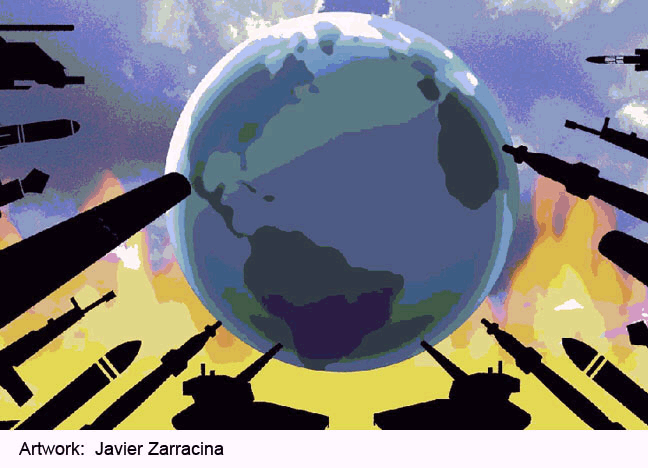
BY RAMESH THAKUR HIROSHIMA, 25 Aug !9 – The Hiroshima Round Table held its seventh annual meeting last Wednesday and Thursday. For the first time, in recognition of the uniquely dangerous international security environment since the dawn of the atomic age in this beautiful city, the Round Table issued an urgent appeal to maintain existing nuclear arms control, disarmament and nonproliferation pacts and to build on them in order to deepen strategic stability. Continue reading
Iranian Foreign Minister Zarif visits G-7 Summit
- Iranian Foreign Minister Mohammad Javad Zarif, who is under U.S. sanctions, was invited to the gathering by France’s foreign minister. SYLVIE CORBET, LORI HINNANT and DARLENE SUPERVILLE BIARRITZ, France (AP) 25 Aug 19, — A top Iranian official paid an unannounced visit Sunday to the G-7 summit and headed straight to the buildings where leaders of the world’s major democracies have been debating how to handle the country’s nuclear ambitions.
As Trump trashed nuclear weapons treaty, Putin promises ‘symmetrical response’ to US missile test
 Putin promises ‘symmetrical response’ to US missile test after end of nuclear treaty Telegraph UK 23 AUGUST 2019
Vladimir Putin has promised a “symmetrical response” to the US test of a missile banned under a nuclear weapons treaty rubbished this month by the Trump administration amid fears of a new arms race.A new land-based version of the navy’s Tomahawk cruise missile fired from an island in California struck a target more than 310 miles away on Sunday, according to the Pentagon. The recently defunct 1987 US-Russian intermediate-range nuclear forces treaty banned land-based missiles with ranges between 310 and 3,410 miles.
On Friday, Mr Putin told his security council that the test just 16 days after the treaty’s demise proved that the United States had long been developing weapons in violation of the agreement, while accusing Russia of the same as part of a “propaganda campaign”……
“For a symmetrical response, it would be enough to take Kalibr and put it on land and conduct a launch,” defence analyst Alexander Golts told The Telegraph. “That wouldn’t take a huge effort.”
Iran working productively with France, to save nuclear deal
 Iran’s Zarif: Nuclear talks with Macron were ‘productive’ Iran’s Zarif: Nuclear talks with Macron were ‘productive’Mohammad Javad Zarif says they could work with new French proposals, to save nuclear deal. https://www.aljazeera.com/news/2019/08/irans-zarif-nuclear-talks-macron-productive-190823161529602.html Iran’s foreign minister has hailed “positive” talks with French President Emmanuel Macron, on salvaging the 2015 nuclear deal.Mohammad Javad Zarif says they could work with new French proposals, to save the nuclear deal. Speaking to reporters after meeting Macron, Zarif says both countries have made suggestions on how to move forward after the United States pulled out of the nuclear deal last year. Macron has previously said he will either try to soften the effect of the US sanctions or come up with a way to compensate the Iranian people. |
|
Trumped Up: Wiki cables show Australia thinks Iran is not the aggressor,
Trumped Up: Wiki cables show Australia thinks Iran is not the aggressor, Michael West, by Prof. Clinton Fernandes — 23 August 2019 Wikileaks cables reveal Iran presents no threat to Australia and little threat to the US. Instead, clear intelligence from the US, Australia and Iran confirms Iran, although portrayed as aggressive, has pursued a defensive military strategy. Clinton Fernandez reports.
A folly, endangering us all, If Trump ends another nuclear treaty
 If Trump ends another nuclear treaty, it will be the height of folly, by Michèle Flournoy and Kingston Reif, August 19, 2019 Michèle Flournoy is co-founder and managing partner of WestExec Advisors. She served as the Under Secretary of Defense for Policy from February 2009 to February 2012. Kingston Reif is the director for Disarmament and Threat Reduction Policy at the Arms Control Association.
(CNN)During his first two and a half years in office, President Donald Trump and his administration have laid waste to numerous international agreements originally designed to strengthen US security, bolster US alliances, and constrain US adversaries. The toll has been particularly high with respect to deals concerning nuclear arms control and nonproliferation.
Over the past 14 months, the administration has withdrawn from the 2015 Iran nuclear deal and abandoned the 1987 Intermediate Range Nuclear Forces (INF) Treaty. Both of these valuable agreements have been discarded without a viable plan to replace them.
Now the administration is signaling that it might jettison yet another nuclear pact, the2010 New Strategic Arms Reduction Treaty (New START) with Russia. Doing so would be the height of folly and would deal a significant blow to US national security. With the US withdrawal from the INF Treaty having just taken effect on Aug. 2, New START will be the only remaining agreement constraining the size of the world’s two largest nuclear arsenals. Were New START to disappear, for the first time in nearly half a century there would be no legally binding limits on American or Russian nuclear stockpiles. The risk of unconstrained US-Russian nuclear competition, and of even more tense bilateral relations, would grow.
New START also includes a comprehensive monitoring and verification regime to ensure compliance. But the agreement is set to expire on Feb. 5, 2021. Under its terms, it can be extended by up to five years if both presidents agree.
In an appearance before an activist group this summer, however, US National Security Advisor John Bolton, who before joining the administration calledNew START an “execrable deal,” said that while no decision has been made, he thinks an extension is “unlikely.”
Absolutely no need for Russia and the US to be adversaries and enemies
I visited Russia’s nuclear city and don’t want to relive the Cold War
Commentary: One era of nuclear brinksmanship was enough for CNET’s Stephen Shankland, who visited the Russian nuclear weapons center of Sarov just after the first Cold War ended. CNET, BY STEPHEN SHANKLAND
AUGUST 18, 2019 I spent more than five years as a reporter in Los Alamos, New Mexico, birthplace of the atomic bomb, home to a major national laboratory, and the 18,000-person town where I grew up. I covered everything from President Bill Clinton visiting the lab to mostly harmless radioactive cat poop triggering radiation alarms at the county landfill. But the story that made the biggest impression on me took place thousands of miles away, in Russia.
In May 1995, I was part of a seven-person civilian delegation that traveled to Los Alamos sister city Sarov, about 230 miles east of Moscow. It’s the home of the institute where Russia developed its first atomic bomb. Our visit was timed to coincide with a 50th anniversary celebration of the end of the Great Patriotic War, aka World War II, which for the Russians ended when the Germans capitulated in May 1945.
I’m remembering it now because I’ve recently interviewed Siegfried Hecker, former director of Los Alamos National Laboratory and a key leader of the US-Russian lab collaboration that led to my trip.
Back when US-Russian relations were thawing
During the time of my trip, relations between Russia and the US were warming, but now they’re cooling once again. That troubles Hecker — even though he spent much of his career designing the nuclear weapons the US aimed at the then-USSR.
It troubles me, as well. I grew up during the Cold War, and I’m not eager to introduce my children to concepts like nuclear winter and megadeath. And even as treaties between the US and Russia fizzle out and the two countries rev up another arms race, worries are piling up about the nuclear weapons capabilities of Iran and North Korea, too.
But Hecker stresses the similarities between the US and Russia — “They’re so much like us,” he says……
Hecker has a lot more of those connections. He’s friends with plenty of Russians and sees their cultural values as very similar to ours. And he’s keeping his communication links alive even though the US-Russia lab-to-lab collaboration project he helped begin is now all but dead. He’ll take his 57th trip to Russia in November.
The two countries can move past sticking points like NATO’s eastward expansion and Russia’s military action in the Crimea and eastern Ukraine, Hecker says. Today’s nationalistic fervor might make it hard to defrost the relationship, but seeing the world from the other side’s perspective will help, he says.

Donald Trump ramps up nuclear weapons, rips up arms treaties: Russia follows
The nuclear arms race is back … and ever more dangerous now https://www.theguardian.com/world/2019/aug/17/nuclear-arms-race-is-back-and-more-dangerous-than-before Simon Tisdall Donald Trump has increased spending on America’s arsenal while ripping up cold war treaties. Russia and China are following suit. Imagine the uproar if the entire populations of York, Portsmouth or Swindon were suddenly exposed to three times the permissible level of penetrating gamma radiation, or what the nuclear physicist Ernest Rutherford termed gamma rays. The outpouring of rage and fear would be heard across the world.
That’s what happened to the roughly 200,000 people who live in the similarly sized northern Russian city of Severodvinsk on 8 August, after an explosion at a nearby top-secret missile testing range. Russia’s weather service, Rosgidromet, recorded radiation levels up to 16 times higher than the usual ambient rate.
Yet the incident has been met with surly silence by Russia. It was five days before officials confirmed a blast at the Nyonoksa range had killed several people, including nuclear scientists. No apologies were offered to Severodvinsk residents. There is still little reliable information. “Accidents, unfortunately, happen,” a Kremlin spokesman said.
That callous insouciance is not universally shared. According to western experts, the explosion was caused by the launch failure of a new nuclear-powered cruise missile, one of many advanced weapons being developed by Russia, the US and China in an accelerating global nuclear arms race
Vladimir Putin unveiled the missile, known in Russia as the Storm Petrel and by Nato as Skyfall, in March last year, claiming its unlimited range and manoeuvrability would render it “invincible”. The Russian president’s boasts look less credible now.
But Putin is undeterred. Denying suggestions that the missile is unreliable, the Kremlin insisted Russia was winning the nuclear race. “Our president has repeatedly said that Russian engineering in this sector significantly outstrips … other countries,” a spokesman said.
Now fast-forward to 16 August, and another threatening event: the test-firing by North Korea of potentially nuclear-capable ballistic missiles, the sixth round of launches since July. More than two years of vanity diplomacy by Donald Trump has not convinced Pyongyang it is safe to give up its nukes – proof, if it were needed, that unilateral counter-proliferation initiatives do not work.
Arms control experts say a consistent, joined-up international approach is woefully lacking. Thus Israel’s undeclared nuclear arsenal is tolerated, and the idea of a bomb developed by Saudi Arabia is no longer ruled out. But the merest hint that Iran may build a nuclear weapon is greeted with megatons of hypocritical horror.
In a sense, the problem is circular. Putin argues that Russia’s build-up is a response to destabilising US moves to modernise and expand its own nuclear arsenal – and he has a point. Barack Obama, the former president, developed a $1.2tn plan to maintain and replace the “triad” of US air, sea and land-based nuclear weapons.
Trump has gone much further. The Pentagon’s nuclear posture review, published last year, proposed an additional $500bn in spending, including $17bn for low-yield, tactical nuclear weapons that could be used on conventional battlefields. The first of these new warheads is due to become operational next month.
Critics in Congress say low-yield weapons make nuclear warfare more likely, and oppose Trump’s budget increases. But with US planners saying the biggest national security threat is no longer terrorism but nuclear-armed states, there is little doubt that many new weapons projects will get the go-ahead.
The renewed nuclear arms race is a product of Trump’s America First outlook and that of comparable ultra-nationalist and insecure regimes elsewhere. Trump’s emphasis on defending the “homeland” is leading inexorably to the militarisation of US society, whether at the Mexican border, on inner-city streets or in its approach to international security.
“We have far more money than anybody else by far,” Trump said last October. “We’ll build up until [Russia and China] come to their senses.” Outspending the opposition was a tactic employed by Ronald Reagan in the 1980s. And Trump is putting taxpayers’ money where his mouth is. Overall, annual US military spending is soaring, from $716bn this year to a proposed $750bn next year.
The paradox is that even as the risk of nuclear confrontation grows, the cold war system of treaties that helped prevent Armageddon is being dismantled, largely at Trump’s behest. Earlier this month, the US withdrew from the 1987 Intermediate-range Nuclear Forces (INF) treaty with Russia (which rid Britain and Europe of US missiles deployed in the early 80s).
The US is also signalling it will not renew the New Start strategic nuclear weapons treaty when it expires in 2021. Washington claims Moscow cheated on the INF pact; Russia denies it. But the real US concern is that both treaties tie its hands, especially regarding China – another example of the impact of America First thinking.
This increasingly unregulated, three-way contest poses indisputable dangers. The US plans were “unnecessary, unsustainable, and unsafe” and “increase the risks of miscalculation, unintended escalation, and accelerated global nuclear competition”, the independent US-based Arms Control Association said in April.
With a much smaller arsenal than the US and Russia, China, too, is “aggressively developing its next generation of nuclear weapons”, according to a major Chinese weapons research institute. Nor, given Moscow’s and Washington’s behaviour, has it an incentive to stop, despite Trump’s vague proposal for a trilateral disarmament “grand bargain”.
Like the US, China – while historically pledged to “no first use” – wants potential enemies to believe it may actually use tactical nukes. As Dr Strangelove would doubtless appreciate, this, perversely, increases the chances that it will.
The dreadful example these nuclear arms-racers are setting to non-nuclear states such as Iran is obvious. By failing to uphold arms control agreements, neglecting collaborative counter-proliferation efforts, and building new, more “usable”, dangerously unproved weapons like the one that irradiated Severodvinsk, the nuclear powers are digging their own graves – and ours.
Kashmir – a “nuclear flashpoint”?
 Kashmir a nuclear flashpoint: Pakistan army spokesman Asif Ghafoor https://www.livemint.com/politics/news/kashmir-a-nuclear-flashpoint-pakistan-army-spokesman-asif-ghafoor-1566058203618.html : 17 Aug 2019,
- Indian defence minister Rajnath Singh on Friday said India could review its nuclear no first use policy
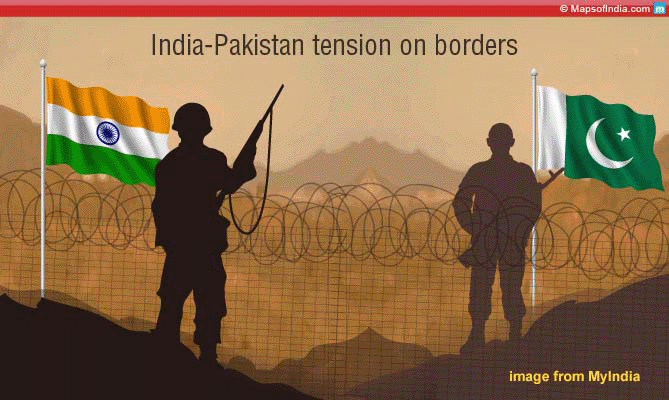
- The UN Security Council on Friday said India and Pakistan should sort out their differences bilaterallyNew Delhi: Pakistan army spokesman Asif Ghafoor on Saturday described Kashmir as a “nuclear flashpoint”, a day after defence minister Rajnath Singh said India could review its nuclear no first use policy.
Ghafoor’s comment, quoted by news reports, could be seen as another attempt by Pakistan to internationalise the Kashmir dispute between the two countries and invite offers of mediation. Western nations have always been wary of tensions flaring up between the two countries that have nuclear weapons.
Ghafoor’s comments also come after the UN Security Council on Friday said India and Pakistan should sort out their differences bilaterally after closed-door consultations. This came after China sought the meeting on Pakistan’s behalf after India revoked a provision in its constitution giving special status to Kashmir.
In his remarks on Saturday, Ghafoor also said Pakistan was ready to repulse any Indian attack, the news reports said.
On Friday, during a visit to Pokhran, defence minister Rajnath Singh said, “Till today, our nuclear policy is ‘No First Use’. What happens in future depends on the circumstances,” media reports said quoting the minister who was at an event in Pokhran, the site of India’s nuclear tests in 1998.
The comments followed heightened tensions between India and Pakistan after the Indian government revoked Article 370that gave special status to Jammu and Kashmir. Pakistan had condemned the move.
In a tweet, Rajnath Singh added, “Pokhran is the area which witnessed Atal Ji’s firm resolve to make India a nuclear power and yet remain firmly committed to the doctrine of ‘No First Use’. India has strictly adhered to this doctrine. What happens in future depends on the circumstances.”
Hinkley nuclear project: UK govt faces questions about involvement of US export blacklisted Chinese firm
state-owned Chinese firm to be involved in the UK’s power generation
programme after the business was placed on a US export blacklist. China
General Nuclear Power Group (CGN), which has partnered with EDF to help
fund a third of the £20bn cost of the nuclear power station at Hinkley
Point, was on Thursday added to the US commerce department’s so-called
“entity list”. The placement effectively blocks American firms from
selling products and services to the company without written approval.
India ponders changing its “no first use” nuclear weapons policy
India hints at changing ‘no first use’ nuclear policy Channel News Asia, NEW DELHI: India’s defence minister hinted on Friday (Aug 16) that New Delhi might change its “no first use” policy on nuclear weapons, amid heightened tensions with fellow atomic power Pakistan.
India committed in 1999 to not being the first to use nuclear weapons in any conflict. Among India’s neighbours China has a similar doctrine but arch rival Pakistan does not.
Defence Minister Rajnath Singh made the comment on Twitter after visiting Pokhran, the site of India’s successful nuclear tests in 1998 under then prime minister Atal Vajpayee.
“Pokhran is the area which witnessed (Vajpayee’s) firm resolve to make India a nuclear power and yet remain firmly committed to the doctrine of ‘No First Use’ (NFU),” Singh wrote.
“India has strictly adhered to this doctrine. What happens in future depends on the circumstances,” Singh tweeted.
The statement comes as tensions rise with Pakistan after Prime Minister Narendra Modi’s government stripped Indian-administered Kashmir of its autonomy, a move sharply condemned by Islamabad……..
Observers said Singh’s statement is the clearest so far with regards to a change in India’s nuclear doctrine.
……….https://www.channelnewsasia.com/news/asia/india-hints-at-changing-no-first-use-nuclear-policy-11816218
India and Pakistan on Hair-Trigger Nuclear Alert Over Kashmir
Hair-Trigger Nuclear Alert Over Kashmir, Common Dreams, India and Pakistan, where people starve in the streets, waste billions on military spending because of the Kashmir dispute. Now some of India’s extreme Hindu nationalists warn they want to reabsorb Pakistan, Bangladesh, and even Sri Lanka into Mother India. by Eric Margolis 11 Aug 19
Kashmir has been a flashpoint since Imperial Britain divided India in 1947. India and Pakistan have fought numerous wars and conflicts over majority Muslim Kashmir. China controls a big chunk of northern Kashmir known as Aksai Chin.
In 1949, the UN mandated a referendum to determine if Kashmiris wanted to join Pakistan or India. Not surprisingly, India refused to hold the vote. But there are some Kashmiris who want an independent state, though a majority seek to join Pakistan……
What makes this confrontation so dangerous is that both sides have important tactical and nuclear forces arrayed against one another. These are mostly short/medium-ranged nuclear tipped missiles, and air-delivered nuclear bombs. Strategic nuclear weapons back up these tactical forces. A nuclear exchange, even a limited one, could kill millions, pollute much of Asia’s ground water, and spread radioactive dust around the globe – including to North America. ….https://www.commondreams.org/views/2019/08/11/hair-trigger-nuclear-alert-over-kashmir
It’s realistic to accept North Korea as a nuclear state
|
Accept Reality: North Korea Will Remain a Nuclear State. U.S. policy toward North Korea always has been one of second-best options. Preparing for a world with North Korea as a nuclear power is a necessity for the future. National Interest President Donald Trump has discovered that nations around the world will not readily submit to his will. His administration has increased sanctions on and made military threats against Cuba, Venezuela, Russia, Iran and North Korea. So far, none of them have surrendered to Washington. Only the Democratic People’s Republic has come to the negotiating table. The president’s willingness to talk with North Korea’s Supreme Leader Kim Jong-un deserves praise, despite complaints from the warmongering Right and partisan Left. However, his demand for instant and complete denuclearization was never realistic. Alas, negotiations in which the president placed so much hope have ground to a halt. Most recently, North Korean diplomats skipped the ASEAN summit, where Secretary of State Mike Pompeo had expected to meet with North Korean foreign minister Ri Yong-ho. Said Pompeo: “We stand ready to continue our diplomatic conversation with the North Koreans,” but, he added, “I regret that it looks like I’m not going to have an opportunity to do that while I’m here in Bangkok.” Indeed, the bilateral relationship is deteriorating. The United States and the Republic of Korea are conducting military exercises, despite bitter attacks by Pyongyang. The DPRK is conducting short-range missile tests, embarrassing the Trump administration and unnerving both the ROK and Japan. The president continues to express his confidence in Kim’s commitment to denuclearize, but the former might find that position harder to defend in the face of Democratic Party attacks as the 2020 presidential campaign accelerates.The North is forever unreasonable and obstructionist. That is unlikely to change. But in this case Pyongyang’s position is logical, reflecting the interests of the Kim family regime. After all, Kim is supposed to abandon his leverage in return for vague promises of positive benefits in the future. However, the United States routinely coerces governments on its enemies list, such as Serbia, Afghanistan, Iraq and Libya. Notably, none of those countries had a nuclear deterrent…….
the president should clearly reject belief that the alternative to denuclearization is war. The threat of attack, if credible, might offer negotiating leverage, but also would raise tensions and make the North more likely to preempt military action it believed to be imminent. After all, given United States conventional superiority, the North must use or quickly lose its military capabilities and would be forced to respond almost instantly to any assault by Washington. …..
a DPRK nuke would not really threaten America. There is no evidence that Kim or anyone else in Pyongyang’s ruling elite is suicidal…….https://nationalinterest.org/feature/accept-reality-north-korea-will-remain-nuclear-state-72296
|
|
Another expensive nuclear weapons race about to take off
Are We Headed for Another Expensive Nuclear Arms Race? Could Be. https://www.nytimes.com/2019/08/08/world/europe/arms-race-russia-china.html, By Steven Erlanger,Aug. 8, 2019 BRUSSELS — After the recent death of the treaty covering intermediate-range missiles, a new arms race appears to be taking shape, drawing in more players, more  money and more weapons at a time of increased global instability and anxiety about nuclear proliferation.
The arms control architecture of the Cold War, involving tens of thousands of nuclear weapons, was laboriously designed over years of hard-fought negotiations between two superpowers — the United States and the Soviet Union. The elaborate treaties helped keep the world from nuclear annihilation.
Today, those treaties are being abandoned by the United States and Russia just as new strategic competitors not covered by the Cold War accords — like China, North Korea and Iran — are asserting themselves as regional powers and challenging American hegemony.
The dismantling of “arms control,” a Cold War mantra, is now heightening the risks of a new era when nuclear powers like India and Pakistan are clashing over Kashmir, and when nuclear Israel feels threatened by Iran, North Korea is testing new missiles, and other countries like Saudi Arabia are thought to have access to nuclear weapons or to be capable of building them.
The consequence, experts say, is likely to be a more dangerous and unstable environment, even in the near term, that could precipitate unwanted conflicts and demand vast new military spending among the world’s biggest powers, including the United States.
“If there’s not nuclear disarmament, there will be proliferation,” said Joseph Cirincione, a nuclear analyst and president of the Ploughshares Fund, a global security foundation. “If big powers race to build up their arsenals, smaller powers will follow.”
“As long as the big boys cling to their toys, others will want them,” he added, quoting the former head of the International Atomic Energy Agency, Mohamed ElBaradei.
Not only are the big boys clinging to them, there are more big boys now, and they want more toys. Continue reading
1 This Month
26 September – International Day for the Total Elimination of Nuclear Weapons





PLEASE OPPOSE HR 8255 AND S.3639 – bills would accelerate satellite deployment, with no environmental review or safeguards – https://ncstd5li.quorum.us/campaign/169331/
To see nuclear-related stories in greater depth and intensity – go to https://nuclearinformation.wordpress.com
-
Archives
- September 2026 (291)
- August 2026 (330)
- July 2026 (355)
- June 2026 (287)
- May 2026 (306)
- April 2026 (356)
- March 2026 (251)
- February 2026 (267)
- January 2026 (308)
- December 2025 (358)
- November 2025 (359)
- October 2025 (375)
-
Categories
- 1
- 1 NUCLEAR ISSUES
- business and costs
- climate change
- culture and arts
- ENERGY
- environment
- health
- history
- indigenous issues
- Legal
- marketing of nuclear
- media
- opposition to nuclear
- PERSONAL STORIES
- politics
- politics international
- Religion and ethics
- safety
- secrets,lies and civil liberties
- spinbuster
- technology
- Uranium
- wastes
- weapons and war
- Women
- 2 WORLD
- ACTION
- AFRICA
- Atrocities
- AUSTRALIA
- Christina's notes
- Christina's themes
- culture and arts
- Events
- Fuk 2022
- Fuk 2023
- Fukushima 2017
- Fukushima 2018
- fukushima 2019
- Fukushima 2020
- Fukushima 2021
- general
- global warming
- Humour (God we need it)
- Nuclear
- RARE EARTHS
- Reference
- resources – print
- Resources -audiovicual
- Weekly Newsletter
- World
- World Nuclear
- YouTube
-
RSS
Entries RSS
Comments RSS

