Sound the alarm on deadly US-Russia nuclear threat
 Sound the alarm on deadly US-Russia nuclear threat, by Jill Dougherty December 12, 2019 CNN, As I looked around the large square conference table, I watched the faces settle into worried frowns. Russians and Americans, several of whom once had responsibility for their nations’ nuclear weapons, all members of the Dartmouth Conference, the oldest continual bi-lateral dialogue between Americans and Russians, founded almost 60 years ago during one of the darkest periods of the Cold War.
Israel’s Foreign Minister Israel Katz suggests bombing Iran to stop its nuclear program
 FM: Bombing Iran to stop its nuclear program remains ‘an option’ FM: Bombing Iran to stop its nuclear program remains ‘an option’
Speaking with Italian media on the sidelines of a foreign policy conference in Rome, Israel Katz rebukes European leaders for not taking a more aggressive stand against Tehran. Iranian FM accuses Israel of testing nuclear missile aimed at his country. Israel Hayom 12-08-2019 The option to launch a preemptive strike against Iran to prevent it from developing a nuclear weapon remains viable, Foreign Minister Israel Katz said in an interview Saturday. Speaking with Italian-language daily Corriere della Sera, Katz – asked whether Israel was mulling military options vis-à-vis the Islamic republic – said, “Yes, it is an option. We will not allow Iran to produce or obtain nuclear weapons. If it were the last possible way to stop this, we would act militarily.” The comments were reportedly made on the sidelines of a foreign policy conference in Rome. They came just hours after Iran announced its ready to unveil a “new generation” of nuclear-related “products,” including new centrifuge systems and a heavy water power plant scheduled to be built by the spring of 2020. Katz further admonished European leaders for not taking a more aggressive stand against Iran over its repeated, escalating violations of the 2015 nuclear deal…… On Friday, Iran’s Foreign Minister Mohammed Javad Zarif accused Israel of holding “a nuclear missile test aimed at Iran.” “Israel today tested a nuke-missile, aimed at Iran,” Zarif said on Twitter, adding that the United States, Germany, France and the United Kingdom “never complain about the only nuclear arsenal in West Asia – armed with missiles actually DESIGNED to be capable of carrying nukes – but has fits of apoplexy over our conventional & defensive ones.” The Israeli defense establishment successfully tested a rocket propulsion system on Friday. Defense officials stressed that the test was planned in advance and carried out as planned. https://www.israelhayom.com/2019/12/08/fm-bombing-iran-to-stop-its-nuclear-program-remains-an-option/ |
|
Britain, France, and Germany press Iran over its ballistic missile program
|
Europeans Ramp up Pressure on Iran, Britain, France, and Germany say Iran’s ballistic missile program is inconsistent with the nuclear deal and improves its capacity to deliver nuclear payload. Tehran counters that Europeans have failed to meet obligations under the pact. FP.com,
BY COLUM LYNCH
DECEMBER 6, 2019, Three key European powers this week inched closer to the Trump administration’s maximum pressure campaign against Iran, saying that Tehran’s ballistic missile program is inconsistent with its obligations under the Iran nuclear accord. Iran’s ballistic program—which was largely prohibited by the United Nations Security Council before the adoption of the Iran nuclear pact in 2015—has been a source of contention between Washington and Tehran. Under the terms of the agreement, Iran reserved the right to develop ballistic missiles for conventional warheads. But it pledged not to develop missiles capable of delivering a nuclear bomb. Under President Donald Trump, the United States—which pulled out of the nuclear deal in May 2018—maintains that Iran has been violating the spirit of the agreement by developing banned missile capabilities under the cover its conventional weapons program. The administration recently got a boost from Britain, France, and Germany, which signed a joint letter last month declaring that “Iran’s developments of nuclear-capable ballistic missiles and related technologies is inconsistent” with its obligations under a U.N. resolution that endorsed the nuclear accord. Foreign Policy is publishing the letter, which was made public by the United Nations earlier this week, as part of our Document of the Week series. The letter constituted the latest sign that key European powers—which remain committed to the nuclear pact—are seeking to shore up their relations with Washington and to chastise Tehran for what they view as its gradual retreat from its obligations under the nuclear pact. But Iran’s foreign minister, Mohammad Javad Zarif, accused them of seeking to “cover up their miserable incompetence” in living up to their own obligations under the nuclear pact. If the United Kingdom, France, and Germany “want a modicum of global credibility, they can begin by exerting sovereignty rather than bowing to US bullying,” he said. The European powers assert that an Iranian launch of a Shahab-3 medium-range missile—which appeared footage posted on social media in April—included a booster that the Missile Technology Control Regime concluded is capable of delivering a nuclear weapon. The 35-member association of the world’s main missile producers urges restrictions on the export of nuclear missile technology……… https://foreignpolicy.com/2019/12/06/europe-iran-ramp-up-pressure-ballistic-missiles/ |
|
Putin offers US to extend key nuclear pact
 Putin offers US to extend key nuclear pact https://www.heraldsun.com.au/news/breaking-news/putin-offers-us-to-extend-key-nuclear-pact/news-story/e88b576c31aaa9f2e81843b5f306dfc7. Associated Press, December 6, 2019 Russian President Vladimir Putin claims Moscow is prepared to immediately extend a pivotal nuclear arms reduction pact with the United States.
Speaking at Thursday’s meeting with military officials, Putin said that Russia has repeatedly offered the US to extend the New START treaty that expires in 2021 but as yet he hasn’t heard back.
“Russia is ready to extend the New START treaty immediately, before the year’s end and without any preconditions,” Putin said.
The pact, which was signed in 2010 by former President Barack Obama and then Russian President Dmitry Medvedev, limits each country to no more than 1,550 deployed nuclear warheads and 700 deployed missiles and bombers.
Putin and other Russian officials have repeatedly voiced concern about Washington’s reluctance to discuss the treaty’s extension.
Chaos ahead in international relations due to Trump’s chaotic nuclear weapons policies
 Trump runs dangerous and chaotic approach toward nuclear weapons, https://thehill.com/opinion/international/472841-trump-runs-dangerous-and-chaotic-approach-toward-nuclear-weapons Trump runs dangerous and chaotic approach toward nuclear weapons, https://thehill.com/opinion/international/472841-trump-runs-dangerous-and-chaotic-approach-toward-nuclear-weapons
BY LAURA KENNEDY, — 12/03/19 The decision to abruptly withdraw United States forces from Syria is one of the most recent dangerous illustrations of the flawed foreign policy of President Trump and the chaos it has generated abroad. As a diplomat who served for nearly 40 years and under seven presidents, I am aware of how these impulsive and undisciplined actions have left allies reeling with American interests hobbled. His approach toward nuclear weapons and arms control is similar, but with even graver possible consequences.
His nuclear agenda reflects the same pattern of alliance mismanagement, American unreliability, and chaotic decision making. Instead of bailing on bilateral and multilateral arms control efforts, the United States should preserve remaining treaties like the New Strategic Arms Reduction Treaty and the observation regime offered by the Open Skies Treaty, which promote our interests abroad and avoid introducing destabilizing and unnecessary nuclear weapons in a heated international competition. The Iran nuclear deal was the first nonproliferation agreement to be axed by Trump, followed by the Intermediate Range Nuclear Forces Treaty. By recklessly withdrawing from the successful limits imposed on the Iranian nuclear program, Trump undercut our reliability with some of our closest allies and raised global tensions. Withdrawing from the latter agreement rather than continuing efforts to resolve violations by Moscow has shifted the onus away from Russia while removing constraints. The insecurity from withdrawal of these agreements is exacerbated by the prospect of blowing up the other key foundations of our arms control architecture. Next may be the Open Skies Treaty. It is a useful transparency regime which was instituted by the United States and 33 other nations. The agreement allows these nations to conduct observation flyovers of the territories of each of the signatories, providing critical insight into military deployments and possible military buildups. While some might argue that new technology makes such flyovers unnecessary, that overlooks the advantage offered by the framework. It is difficult to ignore evidence when all states have access to the same intelligence. Leaving this deal would end those benefits, poorly serve Ukraine, and send yet another message to our allies and adversaries of our diplomatic unsteadiness. Such a counterproductive step would be massively compounded if the United States does not extend the New Strategic Arms Reduction Treaty, which caps American and Russian deployed strategic nuclear weapons and is set to expire in early 2021. The predictability, transparency, and access it provides is unparalleled.While some might argue that new technology makes such flyovers unnecessary, that overlooks the advantage offered by the framework. It is difficult to ignore evidence when all states have access to the same intelligence. Leaving this deal would end those benefits, poorly serve Ukraine, and send yet another message to our allies and adversaries of our diplomatic unsteadiness. Such a counterproductive step would be massively compounded if the United States does not extend the New Strategic Arms Reduction Treaty, which caps American and Russian deployed strategic nuclear weapons and is set to expire in early 2021. The predictability, transparency, and access it provides is unparalleled. Its regime of notifications, information exchange, and onsite inspections has been lauded on both sides of the aisle and by numerous military and civilian officials. In addition to losing this level of certainty on Russian strategic nuclear weapons, the United States could face an expensive and destabilizing arms race, beyond the major $1 trillion nuclear program already authorized by President Obama. In fact, the Trump administration has called for the development of a new “low yield” submarine launched ballistic missile deemed more “usable” for the military. Critics argue it would be difficult to distinguish from existing high yield variants and would increase the risk of nuclear miscalculation. The House has included a provision in the annual defense authorization bill earlier this year that prohibits the deployment of such a submarine weapon. As the conference negotiations continue, the Senate ought to recognize the risks of this unnecessary and destabilizing addition to our already massive nuclear arsenal and ensure it remains in the final bill. Russia and China indeed pose risks, and we must seek to have serious strategic dialogues with both. But as we pursue such talks, we should use them to build on existing agreements, most notably the New Strategic Arms Reduction Treaty, and not scrap historical agreements in favor of a complex new effort to include additional weapons and actors such as China. Such a comprehensive deal, which the Trump administration says it is pursuing, would take years to negotiate. Russia does not believe there is time to negotiate a new arms control agreement prior to the expiration of the New Strategic Arms Reduction Treaty, and China has emphatically rejected joining such a trilateral endeavor. Any potential negotiations are further complicated by the fact that the State Department has dumped its under secretary and assistant secretary in charge of arms control policy. When it comes to international agreements, ignoring legislative, military, and civilian expert advice and picking fights with American allies leads to chaos, frayed alliances, and increased instability, as we have witnessed in Syria, Ukraine, Turkey, and across the world. The United States simply cannot afford to let that happen when it comes to nuclear weapons. Laura Kennedy is a member of the board of directors of Foreign Policy for America. She served as United States permanent representative to the Conference on Disarmament in Geneva, was a diplomat for the United States Mission to International Organizations, and served as the deputy assistant secretary for European Affairs with the Department of State. |
|
Rafael Mariano Grossi, new UN nuclear agency chief, states he will be“firm and fair” stance on Iran
|
New UN nuclear agency chief: “firm and fair” stance on Iran , https://www.yahoo.com/news/argentina-grossi-cleared-helm-un-102125633.html 2 Dec 19, VIENNA (AP) — The incoming head of the U.N.’s atomic watchdog agency said Monday he will take a “firm and fair” approach toward inspections of Iran’s nuclear facilities, and plans to visit Tehran in the near future.Argentine diplomat Rafael Mariano Grossi’s comments came after he was confirmed as the new director general of the International Atomic Energy Agency unanimously at a special session. His four-year term begins on Tuesday.
The 58-year-old succeeds Yukiya Amano, who died in July, and takes over at a time when the nuclear deal between Iran and world powers is unraveling. The landmark 2015 deal known as the Joint Comprehensive Plan of Action promised Iran economic incentives in exchange for curbs on its nuclear program. The IAEA’s role has been to inspect and verify Iran’s compliance with the deal. With the unilateral withdrawal of the United States from the agreement last year and the imposition of new American sanctions, Iran’s economy has been struggling. So far, the other nations involved — France, Germany, Britain, China and Russia — have been unable to offset the effects, and Iran has slowly been violating the terms of the JCPOA. Tehran is, however, continuing to provide IAEA inspectors access. Grossi told reporters he expected to travel to Iran himself in the “relatively near future” to meet with leaders there. “It is really a priority,” he said of the situation in Iran, adding that his philosophy on inspection safeguards was to be “firm and fair.” Those “two guiding principles” apply not just to Iran, but to how the IAEA deals with everybody, though “different cases demand different approaches,” he said. “An inspector is not a friend. He’s someone who comes and needs to ascertain the facts without bias, without agenda, in an objective and impartial way,” Grossi said. “This has to be done in firmness, but in fairness as well.” Grossi became Argentina’s ambassador to the Vienna-based IAEA in 2013 and was previously the IAEA’s chief of cabinet under Amano. |
|
Nuclear Weapons: The Lies and Broken Promises
US Cover for Israel
Early in the morning of September 22, 1979, a US satellite recorded a double flash near the Prince Edward Islands in the South Atlantic. The satellite, a Vela 5B, carries a device called a “bhangmeter” whose purpose is to detect nuclear explosions. Sent into orbit following the signing of the Partial Test Ban Treaty in 1963, its job was to monitor any violations of the agreement. The treaty banned nuclear explosions in the atmosphere, underwater, and in space.
Nuclear explosions have a unique footprint. When the weapon detonates, it sends out an initial pulse of light. But as the fireball expands, it cools down for a few milliseconds, then spikes again.
“Nothing in nature produces such a double-humped light flash,” says Victor Gilinsky. “The spacing of the hump gives an indication of the amount of energy, or yield, released by the explosion.” Gilinsky was a member of the US Nuclear Regulatory Commission and a former Rand Corporation physicist.
From Carter onward, every US president has covered up the Israeli violation of the 1963 Partial Test Ban Treaty, as well as the 1968 Nuclear Non-Proliferation Treaty (NPT). So when Netanyahu says Iran is lying about its nuclear program, much of the rest of the world — i
ncluding the US nuclear establishment — roll their eyes.
Nuclear Apartheid
As for President Erdogan, he is perfectly correct that the nuclear powers have broken the promise they made back in 1968 when the signed the NPT. Article VI of that agreement calls for an end to the nuclear arms race and the abolition of nuclear weapons. Indeed, in many ways, Article VI is the heart of the NPT. Non-nuclear armed countries signed the agreement, only to find themselves locked into a system of “nuclear apartheid” — where they agreed not to acquire such weapons of mass destruction, while China, Russia, the United Kingdom, France and the US get to keep theirs.
The “big five” not only kept their weapons, but they are also all in the process of upgrading and expanding them. The US is meanwhile shedding other agreements, like the Anti-Ballistic Missile Treaty and the Intermediate-Range Nuclear Force Agreement. Washington is also getting ready to abandon the START treaty that limits the US and Russia to a set number of warheads and long-range strategic launchers.
What is amazing is that only four other countries have abandoned the NPT: Israel, North Korea, Pakistan and India (only the latter three have been sanctioned by the US). But that situation cannot hold forever, especially since part of Article VI calls for general disarmament, a pledge that has been honored in the breach. The US currently has nearly the largest defense budget in its history and spends as much on its military as 144 other countries combined……..
If the US were willing to cover up the 1979 Israeli test while sanctioning other countries that acquire nuclear weapons, why would anyone think that this is nothing more than hypocrisy on the subject of proliferation? And if the NPT is simply a device to ensure that other countries cannot defend themselves from other nations’ conventional and/or nuclear forces, why would anyone sign on or stay in the treaty?
Erdogan may be bluffing. He loves bombast and uses it effectively to keep his foes off balance. The threat may be a strategy for getting the US to back off on its support for Israel and Greece in their joint efforts to develop energy sources in the eastern Mediterranean Sea.
But Turkey also has security concerns. In his speech, Erdogan pointed out, “There is Israel just beside us. Do they have [nuclear weapons]? They do.” He went on to say that if Turkey did not respond to Israeli “bullying,” in the region, “we will face the prospect of losing our strategic superiority in the region.”
Iran may be lying about the scope of its nuclear ambitions — although there is no evidence that Tehran is making a serious run at producing a nuclear weapon — but if they are, they’re in good company with the Americans and the Israelis.
The Path to Sanity
Sooner or later, someone is going to set off one of those nukes. The likeliest candidates are India and Pakistan, although use by the US and China in the South China Sea is not out of the question. Neither is a dustup between NATO and Russia in the Baltic.
It is easy to blame the current resident of the White House for world tensions, except that the major nuclear powers have been ignoring their commitments on nuclear weapons and disarmament for over 50 years.
The path back to sanity is thorny but not impossible. First, the US should rejoin the Anti-Ballistic Missile Treaty, thus making Russia’s medium-range missiles unnecessary, and reduce tensions between the US and China by withdrawing ABM systems from Japan and South Korea.
Second, the US should reinstate the Intermediate-Range Nuclear Forces Agreement and find a way to bring China, India and Pakistan into it. That will require a general reduction of US military forces in Asia, coupled with an agreement with China to back off on its claims over most of the South China Sea. Tensions between India and Pakistan would be greatly reduced by simply fulfilling the UN pledge to hold a referendum in Kashmir. The latter would almost certainly vote for independence.
Third, the US must continue its adherence to the START agreement, while the “big five” countries need to halt the modernization of their existing arsenals — and begin, at long last, to implement Article VI of the NPT in regards to both nuclear and conventional forces.
Pie in the sky? Well, it beats a mushroom cloud.
Iran warns EU that it may step back from UN nuclear watchdog
Iran threatens to step back from UN nuclear watchdog
Tehran warns it will reconsider IAEA commitments if EU states trigger possible sanctions, Guardian, Patrick Wintour Diplomatic editor, Mon 2 Dec 2019
Iran has warned it may “seriously reconsider” its commitments to the UN atomic watchdog if European parties to a nuclear deal trigger a dispute mechanism that could lead to fresh sanctions.
The speaker for the Iranian parliament, Ali Larijani, told a press conference in Tehran on Sunday: “If they use the trigger [mechanism], Iran would be forced to seriously reconsider some of its commitments to the International Atomic Energy Agency. If they think doing so is more beneficial to them, they can go ahead.”
The threat to trigger sanctions has come after the Iranian government has taken a series of deliberate steps away from the 2015 nuclear deal, which it says are intended as a reprisal for Europe’s failure to deliver on commitments to boost trade.
Iran has also been frustrated by Europe’s refusal to defy the threat of US sanctions against any European company that trades with Iran.
A mechanism known as Instex developed by Europe to sidestep sanctions received a boost at the weekend when six more EU countries said they would join. Instex is a bartering system devised to avoid the reach of the US, but Iran is less interested in the number of EU countries signed up than the fact that no deals are being made under the mechanism. A mechanism known as Instex developed by Europe to sidestep sanctions received a boost at the weekend when six more EU countries said they would join. Instex is a bartering system devised to avoid the reach of the US, but Iran is less interested in the number of EU countries signed up than the fact that no deals are being made under the mechanism……. https://www.theguardian.com/world/2019/dec/01/iran-threatens-to-step-back-from-un-nuclear-watchdog
USA will send no senior government official to COP25 climate conference
 US will ‘protect its interests’ at COP25 climate conference, No senior members of Donald Trump’s administration will attend COP25. https://www.sbs.com.au/news/us-will-protect-its-interests-at-cop25-climate-conference 2 Dec 19, The US will send a diplomatic team but no senior members of Donald Trump’s administration to a global climate change conference starting in Spain on Monday, according to a statement.However, in an effort to raise the US profile in Madrid, House speaker Nancy Pelosi will led a 15-member congressional delegation to “reaffirm the commitment of the American people to combating the climate crisis”.
The US, at Mr Trump’s direction, is withdrawing from the Paris climate accord, which set a goal of limiting global temperature rises to well within two degrees Celsius from pre-industrial levels.
Spain stepped in to host the COP25 meeting, which seeks to boost commitments to fight climate change, after Chile pulled out due to civil unrest.
“The United States will continue to participate in ongoing climate change negotiations and meetings – such as COP25 – to ensure a level playing field that protects US interests,” the US State Department said Saturday.
The US team will be headed by ambassador Marcia Bernicat, principal deputy assistant secretary of state for oceans and international environmental and scientific affairs.
Ms Pelosi, calling climate change “the existential threat of our time,” announced a delegation of Democrats drawn from both the House and the Senate, with no members of Mr Trump’s Republican party.
The president has cast the Paris climate accord as elitist and unfair to the US, saying when announcing his decision to withdraw that he was “elected to represent the citizens of Pittsburgh, not Paris”.
But scientists say the accord is vital to check the worst damage from global warming, such as increasing droughts, rising floods and intensifying storms.
The US is the world’s second biggest emitter of greenhouse gases after China, and is the only country to pull out of the Paris agreement.
The final US withdrawal from the landmark accord is scheduled for 4 November, 2020, a day after the next presidential election.
Several Democratic presidential aspirants have said that, if elected, they would immediately return to the agreement.
Russia’s nuclear company Rosatom in financial trouble trying to fund nuclear project in Turkey

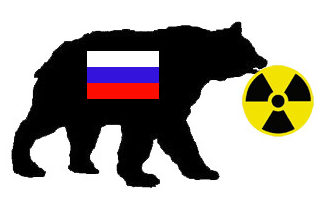 Turkey’s first nuclear plant delayed by funding problems – energy expert https://ahvalnews.com/turkey-energy/turkeys-first-nuclear-plant-delayed-funding-problems-energy-expert, Nov 30 2019 Turkey’s first nuclear plant delayed by funding problems – energy expert https://ahvalnews.com/turkey-energy/turkeys-first-nuclear-plant-delayed-funding-problems-energy-expert, Nov 30 2019
Completion of Turkey’s first nuclear power station is likely to be delayed as the Russian company building it is struggling to secure funding, former diplomat and Bosphorus Energy Club head Mehmet Öğütçü told Turkish daily Sözcü. A small part of the plant in Akkuyu, southern Turkey, may be opened for political reasons in 2023, the centenary of the founding of the Turkish Republic, Öğütçü said. But Russian state-owned Rosatom is having difficulties financing the project, which is expected to cost between $20 billion and $25 billion, he said, adding that Western companies were avoiding Akkuyu over concerns about nuclear armament. A Turkish consortium pulled out of the project last year, citing a failure to reach commercial terms with Rosatom, which owns a 51 percent stake in the project. A report by the main opposition Republican People’s Party this month criticised the terms of the government’s deal with Rosatom, which has been guaranteed a price of 12.35 U.S. cents per kilowatt hour in a 15-year power purchase agreement. |
|
France wants to label nuclear as “green”. Germany will have none of it
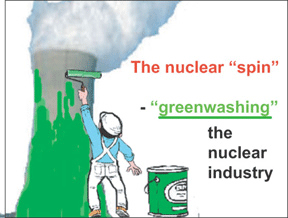 Paris, Berlin divided over nuclear’s recognition as green energy https://www.euractiv.com/section/energy-environment/news/france-and-germany-divided-over-nuclears-inclusion-in-eus-green-investment-label/ By Cécile Barbière | EURACTIV.fr | translated by Daniel Eck 27 Nov 19, Disagreement on the inclusion of nuclear power in the EU’s upcoming green finance taxonomy has revived long-standing divisions between France and Germany over the energy transition. EURACTIV France reports.
Franco-German relations have already been strained by French President Emmanuel Macron’s radical comments on NATO’s “brain death,” which attracted strong rebukes in Berlin.
Now, the European Commission’s proposed taxonomy for sustainable finance has emerged as a new bone of contention.
Tabled in 2018, the EU taxonomy aims to determine which economic activities can benefit from a sustainable finance label at European level. The objective is to give clear indications to investors so they can redirect their financing towards environmentally-friendly sectors.
Six pre-defined environmental objectives must be met in order to obtain the label. If any technology seriously undermines one of those goals, it is automatically disqualified.
It is because of this double level of control that nuclear energy failed to win the green label in the European Parliament, until the Council representing EU member states voted to reinstate it in September.
Although nuclear energy largely meets the low-carbon emissions objective, “it was not possible to include nuclear power because there is no scientific evidence for waste treatment. This means that the sector does not meet both requirements,” explained Jochen Krimphoff, WWF’s deputy director for green finance.
Since the beginning of the negotiations on the EU’s taxonomy, France has been pushing to reintroduce nuclear power, much to Germany’s dismay.
“France will advocate that nuclear energy should be part of this eco-label,” said French Finance Minister Bruno Le Maire at the conference to replenish the Green Fund at the end of October.
“We cannot succeed in the ecological transition, and we cannot achieve our goal in terms of combating global warming without nuclear energy,” the French minister said.
Although nuclear energy largely meets the low-carbon emissions objective, “it was not possible to include nuclear power because there is no scientific evidence for waste treatment. This means that the sector does not meet both requirements,” explained Jochen Krimphoff, WWF’s deputy director for green finance.
Since the beginning of the negotiations on the EU’s taxonomy, France has been pushing to reintroduce nuclear power, much to Germany’s dismay.
“France will advocate that nuclear energy should be part of this eco-label,” said French Finance Minister Bruno Le Maire at the conference to replenish the Green Fund at the end of October.
“We cannot succeed in the ecological transition, and we cannot achieve our goal in terms of combating global warming without nuclear energy,” the French minister said.
The move is all the more surprising given France’s rather progressive positions on the taxonomy. For example, Paris has, like the Commission and Parliament, been calling for the taxonomy to enter into force as early as 2020, while the Council has advocated for implementation in 2023.
For its part, Germany would not be opposed to labeling gas as green. This could be at the risk of a deal that would see both gas and nuclear power re-entering the scheme.
Hungary wants EU to weaken nuclear licensing rules, as it wants to expand Rosatom nuclear project
Hungary makes EU bid to soften nuclear licensing rules to ease Paks expansion, BUDAPEST (Reuters) – Hungary has submitted draft legislation to the European Commission to amend the country’s nuclear safety protocols to custom-fit a 12 billion euro Russian-led nuclear plant expansion project that it wants to speed up, eight sources told Reuters. Marton Dunai, 27 Nov 19,
The EU review was confirmed by an EU official requesting anonymity, as well as several Hungarian government sources. Eight sources, including high-ranking government officials, confirmed the plan.
Hungary wants to expand its 2-gigawatt Paks nuclear power plant with two Russian-made VVER reactors, each with a capacity of 1.2 gigawatts.
The project, awarded in 2014 without a tender to nuclear giant Rosatom, an arm of the Russian government, is often cited as a sign of exceptionally warm ties between Hungarian premier Viktor Orban and Russian President Vladimir Putin, a connection that has unnerved Western allies.
However, Rosatom struggled to meet EU and Hungarian safety criteria, delaying the project by several years, and the Russian and Hungarian governments now want to accelerate it.
Under the proposed new rules, license applications to build the reactor hole and surrounding insulating slurry wall could be considered before the entire project receives the green light – a break with prior protocol, which only allowed partial licenses to be considered once the construction license was granted.
Hungary’s top official in charge of energy policy, Technology Ministry State Secretary Peter Kaderjak, confirmed to Reuters the government was working with the European Commission to recast nuclear power plant construction rules.
Kaderjak called the Paks 2 project “the cornerstone of Hungary’s energy and climate strategy”.
“We are seeking ways to cut the project execution time as short as possible, fully respecting nuclear safety,” he said. “That explains this draft amendment.”
RISKY MOVE
The modification carries risks and makes the project much more difficult to abandon or modify as the framework, literally, will be set in stone, according to seven sources with knowledge of the matter who spoke to Reuters on condition of anonymity.
But the move could help the Hungarian government in its haggling with Moscow to modify the current build-and-finance package. Hungary wants to extend the current payment start date of 2026, which was fixed when the project was first conceived.
Russia wants to avoid paying delay penalties – by putting off the completion deadline to about 2029 and by having Hungary ease regulatory hurdles such as this one, these sources said.
The changes will appear in a government decree called the Nuclear Safety Regulations once the European Commission’s nuclear arm, the Euratom Supply Agency, approves the changes.
An EU source also confirmed the Commission was assessing draft legislation against the EU’s latest Nuclear Safety Directive, adding it had three months to make recommendations, a deadline that is not yet up.
“In this framework, the Hungarian authorities have made several such notifications to the Commission in recent years,” the EU source told Reuters. “The latest of these notifications was received this year and is currently being assessed.”
Asked about the changes, the HAEA told Reuters that reactor hole and slurry wall work, and some equipment that takes a long time to manufacture, may undergo the licensing process parallel with the evaluation of the construction license application.
“Licenses cannot be granted before the construction license is issued – except for work on soil solidification, soil removal, and the water insulation work to section off the work area, especially the slurry wall permits.”
Experts estimate the reactor hole to be several hundred meters wide and several hundred meters long, up to 100 meters deep, surrounded by a concrete slurry wall more than a meter thick. This phase alone could take a year or more to execute.
The changes are designed to save time so once the overall construction license is issued work can begin on the power plant buildings.
But experts warned the slurry wall and reactor hole could cost hundreds of millions of euros, and hastening them carries risk: if the HAEA find faults with the overall design, it may require changes that conflict with the concrete already poured, causing a potential cost spike and long delay.
“Even with these permits Paks 2 carries responsibility for any work it executes, as the ongoing construction licensing process could influence all other licensing,” the HAEA said.
Reporting by Marton Dunai; Editing by Dale Hudson 9full story) https://www.reuters.com/article/us-hungary-nuclearpower-exclusive/exclusive-hungary-makes-eu-bid-to-soften-nuclear-licensing-rules-to-ease-paks-expansion-idUSKBN1Y01WQ

Appeal from former political prisoner to Australia’s Prime Minister to help Julian Assange
“This is how diplomacy works,” “You can pick up the phone, Mr Morrison, and  speak with whoever the United Kingdom’s next prime minister is; requesting that Julian Assange not be extradited to the United States to face the very real possibility, if not the certainty, that he will die in prison.” at right, Prime Minister Morrison
 Former political prisoner pleads for Scott Morrison to not let Assange ‘die in jail’, The Age By Rob Harris, Filmmaker James Ricketson, who spent 15 months as a political prisoner in a Cambodian jail, has implored Prime Minister Scott Morrison to “pick up the phone” to his British counterpart to ensure Julian Assange does not die in prison.
There are growing fears for the psychical and mental health of the 48-year-old WikiLeaks founder, who is in a London prison fighting an extradition request to the United States, where he faces espionage charges relating to the release of classified files on the Iraq and Afghanistan wars.
In an open letter to Mr Morrison, Mr Ricketson has joined a “rising tide of voices” in support of Australian government intervention to bring Mr Assange back to Australia before full extradition proceedings in February.
“The evidence that Julian Assange is not being ‘treated fairly’ in accordance with UK law is now overwhelming, as is evidence of the psychological torture he is being subjected to in Belmarsh Prison,” Mr Ricketson writes.
“If Julian Assange does die in prison, will you, with a clear Christian conscience, be able to inform the Australian public, in all honesty, that you did all within your power (and more) to protect Assange’s legal and human rights.”
Mr Ricketson was arrested and charged with espionage in June 2017 for flying a drone over an anti-government rally in Phnom Penh. He was held in the notoriously overcrowded Prey Sar prison for 15 months until he was pardoned by Cambodian authorities.
The filmmaker said it was former prime minister Malcolm Turnbull who intervened to secure his release, despite the Department of Foreign Affairs and Trade’s insistence that it could not interfere with another country’s legal proceedings.
“This is how diplomacy works,” he writes. “You can pick up the phone, Mr Morrison, and speak with whoever the United Kingdom’s next prime minister is; requesting that Julian Assange not be extradited to the United States to face the very real possibility, if not the certainty, that he will die in prison.”
A newly formed federal cross-party parliamentary group, comprising 11 MPs dedicated to advocating for the return of Mr Assange, will meet formally for the first time on Monday in Canberra. ….
Mr Morrison and Foreign Minister Marise Payne have repeatedly ruled out any intervention in the case, with the PM saying last month he believed Mr Assange should “face the music” in court.
The former Australian high commissioner to Britain earlier this month mocked the idea of Mr Morrison acting on calls from Mr Assange’s supporters to do all he could to bring him home from Belmarsh Prison, where he has been held since his April 11 arrest at the Ecuadorian embassy, which gave him asylum for almost seven years. https://www.theage.com.au/politics/federal/former-political-prisoner-pleads-for-scott-morrison-to-not-let-assange-die-in-jail-20191124-p53dks.html
Swedish accusations against Assange – always a political motive on behalf of USA
We need to ask ourselves why the focus is not on the crimes perpetrated by those involved in war crimes. Why is an Australian citizen being subjected to US espionage laws even though he was never on US soil? More importantly, why should an Australian citizen have allegiance to the US?
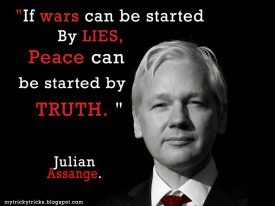 The Swedish case against Assange was always political, https://www.theage.com.au/national/the-swedish-case-against-assange-was-always-political-20191120-p53cgs.html,By Greg Barns and Alysia Brooks, November 20, 2019 It is almost a decade since Julian Assange woke to discover, on the front page of a Swedish newspaper, that Swedish authorities had decided to pursue him on allegations of sexual misconduct. Immediately, Julian presented himself to the police station to make a statement and clear his name. After speaking with prosecutors, he was told he could leave the country; so he did.
Currently, Assange is held on remand in Belmarsh prison, in conditions that are exacerbating his already fragile health, and impeding his ability to prepare his defence. He is facing unprecedented charges under the US Espionage Act, for allegedly carrying out actions that journalists and publishers engage in as a part of their work. He is facing 175 years – an effective death sentence – for allegedly engaging in journalism.
And let’s not forget the material that was exposed by WikiLeaks. The releases included evidence of war crimes, including torture and unlawful killings, perpetrated during the Iraq and Afghanistan wars, and the Guantanamo files, which demonstrated that the majority of men, and children, were being held and tortured at the prison, even though they were innocent of any crime.
We need to ask ourselves why the focus is not on the crimes perpetrated by those involved in war crimes. Why is an Australian citizen being subjected to US espionage laws even though he was never on US soil? More importantly, why should an Australian citizen have allegiance to the US?
Greg Barns is a barrister and adviser to the Australian Assange Campaign. Dr Alysia Brooks is a human rights and due process advocate.
Desperate times for the nuclear industry – could Australia be its saviour?
the number one goal of the nuclear lobby is to remove Australia’s national and state laws that prohibit the nuclear industry.
the campaign by the global nuclear industry, particularly the American industry, to kickstart another “nuclear renaissance”, before it’s too late.

Australia is the great ‘white’ hope for the global nuclear industry, Independent Australia, By Noel Wauchope | 19 November 2019, The global nuclear industry is in crisis but that doesn’t stop the pro-nuclear lobby from peddling exorbitantly expensive nuclear as a “green alternative”. Noel Wauchope reports.
The global nuclear industry is in crisis. Well, in the Western world, anyway. It is hard to get a clear picture of Russia and China, who appear to be happy putting developing nations into debt, as they market their nuclear reactors overseas with very generous loans — it helps to have stte-owned companies funding this effort.
But when it comes to Western democracies, where the industry is supposed to be commercially viable, there’s trouble. The latest news from S&P Global Ratings has made it plain: nuclear power can survive only with massive tax-payer support. Existing large nuclear reactors need subsidies to continue, while the expense of building new ones has scared off investors.
So, for the nuclear lobby, ultimate survival seems to depend on developing and mass marketing “Generation IV” small and medium reactors (SMRs). …..
for the U.S. marketers, Australia, as a politically stable English-speaking ally, is a particularly desirable target. Australia’s geographic situation has advantages. One is the possibility of making Australia a hub for taking in radioactive wastes from South-East Asian countries. That’s a long-term goal of the global nuclear lobby. …..
In particular, small nuclear reactors are marketed for submarines. That’s especially important now, as a new type of non-nuclear submarine – the Air Independent Propulsion (AIP) submarine, faster and much cheaper – could be making nuclear submarines obsolete. The Australian nuclear lobby is very keen on nuclear submarines: they are now promoting SMRs with propagandists such as Heiko Timmers, from Australian National University. This is an additional reason why Australia is the great white hope.
I use the word “white” advisedly here because Australia has a remarkable history of distrust and opposition to this industry form Indigenous Australians…..
The hunt for a national waste dump site is one problematic side of the nuclear lobby’s push for Australia. While accepted international policy on nuclear waste storage is that the site should be as near as possible to the point of production, the Australian Government’s plan is to set up a temporary site for nuclear waste, some 1700 km from its production at Lucas Heights. The other equally problematic issue is how to gain political and public support for the industry, which is currently banned by both Federal and state laws. SMR companies like NuScale are loath to spend money on winning hearts and minds in Australia while nuclear prohibition laws remain.
 Ziggy Switkowski, a long-time promoter of the nuclear industry, has now renewed this campaign — although he covers himself well, in case it all goes bad, noting that nuclear energy for Australia could be a “catastrophic failure“. ……
his submission (No. 41) to the current Federal Inquiry into nuclear power sets out only one aim, that
‘… all obstacles … be removed to the consideration of nuclear power as part of the national energy strategy debate.’
So the Environmental Protection and Biodiversity Conservation Act (EPBC Act) should be changed, according to Switkowski. In an article in The Australian, NSW State Liberal MP Taylor Martin suggested that the Federal and state laws be changed to prohibit existing forms of nuclear power technology but to allow small modular reactors.
Switkowski makes it clear that the number one goal of the nuclear lobby is to remove Australia’s national and state laws that prohibit the nuclear industry. And, from reading many pro-nuclear submissions to the Federal Inquiry, this emerges as their most significant aim.
It does not appear that the Australian public is currently all agog about nuclear power. So, it does seem a great coincidence that so many of their representatives in parliaments – Federal, Victorian, New South Wales, South Australia and members of a new party in Western Australia – are now advocating nuclear inquiries, leading to the repeal of nuclear prohibition laws.
We can only conclude that this new, seemingly coincidental push to overturn Australia’s nuclear prohibition laws, is in concert with the push for a national nuclear waste dump in rural South Australia — part of the campaign by the global nuclear industry, particularly the American industry, to kickstart another “nuclear renaissance”, before it’s too late.
Despite its relatively small population, Australia does “punch above its weight” in terms of its international reputation and as a commercial market. The repeal of Australia’s laws banning the nuclear industry would be a very significant symbol for much-needed new credibility for the pro-nuclear lobby. It would open the door for a clever publicity drive, no doubt using “action on climate change” as the rationale for developing nuclear power.
In the meantime, Australia has abundant natural resources for sun, wind and wave energy, and could become a leader in the South-East Asian region for developing and exporting renewable energy — a much quicker and more credible way to combat global warming. https://independentaustralia.net/politics/politics-display/australia-is-the-great-white-hope-for-the-global-nuclear-industry,13326
1 This Month
26 September – International Day for the Total Elimination of Nuclear Weapons





PLEASE OPPOSE HR 8255 AND S.3639 – bills would accelerate satellite deployment, with no environmental review or safeguards – https://ncstd5li.quorum.us/campaign/169331/
To see nuclear-related stories in greater depth and intensity – go to https://nuclearinformation.wordpress.com
-
Archives
- September 2026 (291)
- August 2026 (330)
- July 2026 (355)
- June 2026 (287)
- May 2026 (306)
- April 2026 (356)
- March 2026 (251)
- February 2026 (267)
- January 2026 (308)
- December 2025 (358)
- November 2025 (359)
- October 2025 (375)
-
Categories
- 1
- 1 NUCLEAR ISSUES
- business and costs
- climate change
- culture and arts
- ENERGY
- environment
- health
- history
- indigenous issues
- Legal
- marketing of nuclear
- media
- opposition to nuclear
- PERSONAL STORIES
- politics
- politics international
- Religion and ethics
- safety
- secrets,lies and civil liberties
- spinbuster
- technology
- Uranium
- wastes
- weapons and war
- Women
- 2 WORLD
- ACTION
- AFRICA
- Atrocities
- AUSTRALIA
- Christina's notes
- Christina's themes
- culture and arts
- Events
- Fuk 2022
- Fuk 2023
- Fukushima 2017
- Fukushima 2018
- fukushima 2019
- Fukushima 2020
- Fukushima 2021
- general
- global warming
- Humour (God we need it)
- Nuclear
- RARE EARTHS
- Reference
- resources – print
- Resources -audiovicual
- Weekly Newsletter
- World
- World Nuclear
- YouTube
-
RSS
Entries RSS
Comments RSS

