As negotiation deadline nears, tension between Kim Jong Un and Donald Trump
Trump, Kim at odds as deadline looms in nuclear talks, Glen Carey and Jihye Lee, Bloomberg, November 18, 2019
The bonhomie between President Donald Trump and North Korean leader Kim Jong Un is nearing a key deadline showing new signs of strain.
Trump urged Kim over the weekend to “act quickly” to get a nuclear deal done, suggesting the two leaders could meet again “soon.” His comments came hours after North Korea ruled out nuclear talks without a policy change by the U.S. and reported on a military drill observed by Kim himself.
Veteran North Korea nuclear adviser, Kim Kye Gwan, told Trump that Pyongyang will no longer give him “things to boast about,” the state’s official KCNA news agency on Monday quoted him as saying. He added North Korea is no longer interested in talks that the U.S. “uses to buy time.”
Trump and Kim Jong Un, who have previously displayed what Pyongyang calls “mysteriously wonderful chemistry,” appear to be going in different directions as the clock ticks down. Kim has given Trump until the end of the year to ease up on sanctions or risk him taking a “new path,” meaning a possible escalation of military tensions during the U.S. presidential campaign…….
After more than a year of talks and three Trump-Kim meetings, the two sides remain divided on issues from sanctions relief to disarmament. Even though North Korea hasn’t taken any major steps to give up its weapons, Kim has won concessions from Trump that include canceling some U.S.-South Korean joint military drills that have drawn Pyongyang’s anger.
North Korea hasn’t explained what Kim intends to do on his “new path,” although the regime has often referred to his decision to halt tests of nuclear bombs and intercontinental ballistic missiles two years ago. In May, North Korea resumed tests of shorter-range ballistic missiles.,,,,,,,
The North Korea warning about U.S. nuclear talks came despite the U.S.’s decision to suspend another round of military drills with South Korea. Defense Secretary Mark Esper said on the sidelines of a regional security conference that Washington and Seoul had “jointly decided to postpone this month’s combined flying training event” after “close consultation and careful consideration.”
Pyongyang last week blamed U.S.-South Korean military drills “as a main factor of screwing up tensions.”
North Korea issues warning on nuclear negotiations deadline
North Korea warns U.S. will face ‘harsh suffering’ if nuclear deadline passes, Market Watch, Nov 13, 2019, North Korean leader Kim Jong Un imposed an end-of-year deadline to salvage nuclear talks with the United States.
SEOUL, South Korea (AP) — North Korea’s supreme decision-making body lashed out Wednesday at planned U.S.-South Korean military drills and warned that the United States will face a “bigger threat and harsh suffering” if it ignores North Korean leader Kim Jong Un’s end-of-year deadline to salvage nuclear talks.
In a statement carried by state media, an unidentified spokesperson for the North’s State Affairs Commission said the drills would violate agreements between Kim and President Donald Trump on improving bilateral relations and compel North Korea to raise its war readiness.
Kim is chairman of the commission, which he established in 2016 following years of efforts to consolidate his power and centralize governance.
The statement is North Korea’s latest expression of displeasure over the military drills and slow pace of nuclear negotiations with Washington. The talks have stalled over disagreements on disarmament steps and sanctions relief.
North Korea has also ramped up its missile tests in recent months and experts say it is likely to continue weapons displays to pressure Washington as Kim’s deadline nears for the Trump administration to offer mutually acceptable terms for a deal.
The spokesperson said annual U.S.-South Korea military drills are continuing to cause a “vicious cycle” in relations between the U.S. and North Korea…… https://www.marketwatch.com/story/north-korea-warns-us-will-face-harsh-suffering-if-nuclear-deadline-passes-2019-11-13
European Union struggles to preserve Iran nuclear deal
|
, https://apnews.com/e63a5526db184d39be4439b82010df62 By LORNE COOKNovember 12, 2019
BRUSSELS (AP) — European Union foreign ministers on Monday affirmed their support for the nuclear deal with Iran, after the Islamic Republic began enrichment work at its Fordo site in a fresh act of defiance that seems likely to spell the end of the painstakingly crafted international agreement.At talks in Brussels, the ministers mulled what action to take as they awaited a new report from the International Atomic Energy Agency later Monday on whether Iran is still complying with its commitments. EU foreign policy chief Federica Mogherini said that the ministers underlined their “full commitment to the agreement that remains crucial for our security, even if it’s increasingly difficult to preserve it. We will continue our efforts to have a full implementation of the agreement.” The EU powers that signed the 2015 Iran nuclear deal — Britain, France and Germany — were due to hold talks later Monday in Paris to discuss the next steps once the U.N.’s nuclear watchdog issues its latest findings. A joint commission meeting of all the signatories is likely to be held in coming days. “We want to preserve the (deal), but Iran must finally return to its commitments and comply with them, otherwise we will reserve the right to use all mechanisms that are set out in the agreement,” said German Foreign Minister Heiko Maas. The EU sees the nuclear pact as a key component of regional and global security and has struggled to stop it from unraveling since President Donald Trump unilaterally pulled the United States out of it over a year ago, triggering debilitating economic sanctions against Iran. It’s a great agreement and we need to keep it alive,” Slovakia’s foreign minister, Miroslav Lajcak, told reporters. But it remains unclear what more the EU can do as Iran’s economy buckles under the weight of the sanctions, apart from renewing its appeals for restraint and dialogue. The Europeans have poured a lot of cash and credibility into ensuring the deal stays afloat. A safeguard was built to keep money flowing to Tehran, but it has not been effective. A system is in place to protect European companies doing business in Iran from U.S. sanctions, even though many remain reluctant because they fear being shut out of the more lucrative American market if they do. One option could be to trigger the dispute mechanism in the agreement, which would open a window of up to 30 days to resolve the problem. Some are even calling on the Europeans to impose their own sanctions on Iran. “Sanctions, sanctions, sanctions. We’re not going to solve the problem like that,” said Luxembourg Foreign Minister Jean Asselborn. “Right now, we should wait for the report from the IAEA to see where we stand.” Dutch Foreign Minister Stef Blok said he was “very worried about Iran’s behavior,” after uranium gas was injected into centrifuges at Fordo last Thursday to produce low-enriched uranium to fuel nuclear power plants. Under the deal, Tehran was not supposed to do this at the site until 2030. However, the Europeans are hardly surprised by Iran’s actions. They believe the writing has been on the wall ever since Trump withdrew from the nuclear agreement last year, claiming that it does not to stop Tehran from developing missiles or undermining stability in the Gulf region. “Sadly, it’s a degradation that was to be expected,” Asselborn said. AP Writers Geir Moulson and David Rising in Berlin contributed to this report. |
|

US- North Korea negotiations may be revived
|
US-North Korea nuclear talks may stir back to life, SMH, 15 Nov 19, Seoul: North Korea is unhappy the United States has proposed a resumption of stalled nuclear negotiations next month through a third party.It comes as the two countries approach an end-of-year deadline set by North Korean leader Kim Jong-un for the Trump administration to offer an acceptable deal to salvage the talks, and as the US President faces an impeachment inquiry at home.
In a statement released by state media, new North Korean negotiator Kim Myong-gil didn’t clearly say whether the North would accept the supposed US offer. Kim Myong-gil said Stephen Biegun, Trump’s special envoy for North Korea, proposed via an unspecified third country to hold another round of talks in December. “I cannot understand why he spreads the so-called idea of DPRK-US relations through the third party, not thinking of candidly making direct contact with me, his dialogue partner, if he has any suggestions or any idea over the DPRK-US dialogue,” Kim Myong-gil said of Biegun. “His behaviour only amplifies doubts about the US.” He said North Korea had no interest in talks if they were aimed at buying time without discussing solutions. He said the North wasn’t willing to make a deal over “matters of secondary importance”, such as possible US offers to formally declare an end to the 1950-53 Korean War, which was halted by a ceasefire, not a peace treaty, or establish a liaison office between the countries. If the negotiated solution of issues is possible, we are ready to meet with the US at any place and any time,” said Kim Myong-gil, who called for Washington to present a fundamental solution for discarding its “hostile policy” towards North Korea. “If the US still seeks a sinister aim of appeasing us in a bid to pass the time limit – the end of this year – with ease as it did during the DPRK-US working-level negotiations in Sweden early in October, we have no willingness to have such negotiations,” he said, using the abbreviation of North Korea’s official name, the Democratic People’s Republic of Korea…… In a separate statement attributed to another senior official, North Korea demanded that the US scrap a planned military drill with South Korea to keep the momentum alive for dialogue. Responding to comments by US Defence Secretary Mark Esper, who said Washington could possibly modify its military activities with Seoul to make room for diplomacy, North Korean official Kim Yong-chol said he would like to consider Esper’s remarks as US intention to “drop out of the joint military drill or completely stop it.” ……..https://www.smh.com.au/world/asia/us-north-korea-nuclear-talks-may-stir-back-to-life-20191115-p53ayr.html |
|
Jared Kushner’s, Donald Trump’s secretive meetings with Saudi Arabia, Putin, Kim Jong Un
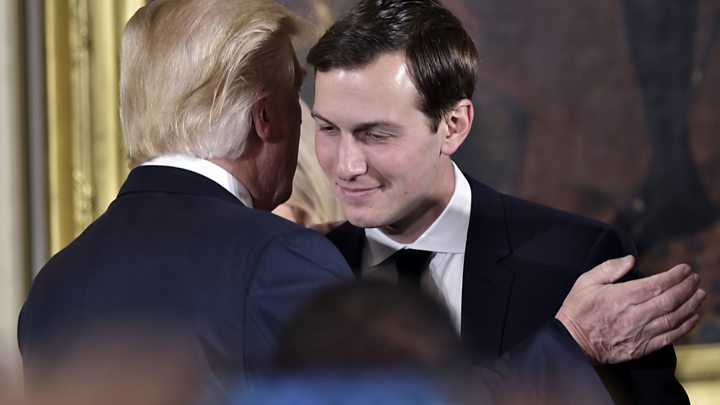 JARED KUSHNER, DONALD TRUMP BROKE THE LAW BY MEETING SAUDIS, PUTIN, KIM OFF THE RECORD: WATCHDOGS https://www.newsweek.com/jared-kushner-donald-trump-broke-law-saudis-putin-kim-1418596
In a lawsuit filed Tuesday against Trump and the executive office of the president, the watchdog Citizens for Responsibility and Ethics in Washington (CREW) alleged that White House officials including the president and Kushner seem to have violated the Presidential Records Act and the Federal Records Act by intentionally neglecting to create and keep records of meetings with Putin and Kim, among other foreign officials.
“There are a lot of questions surrounding Jared Kushner and the extent to which he, like the president, has an agenda that also serves his own personal and family business interests,” CREW’s chief FOIA counsel Anne Weismann told Newsweek on Tuesday.
The suit cites news reports that Trump had at least five different meetings with Putin with no notetaker in the room, meaning an official record of the meeting does not exist. Trump also confiscated a State Department interpreter’s notes after meeting with Putin in Germany, and had a private meeting with Kim in Vietnam with two interpreters but no record was produced, according to the suit.
In addition, the suit raises a recent meeting Kushner had with top Saudi officials that did not include State Department officials, and from which no record was created.
“The absence of records in these circumstances when the President and his top advisers are exercising core constitutional and statutory powers causes real, incalculable harm to our national security and the ability of our government to effectively conduct foreign policy,” the suit states, “Because the documentary record of this administration’s foreign policy regarding Russia, North Korea, and Saudi Arabia will be unavailable to policy makers and forever lost to history.”
Weismann said Kushner—whom Trump tasked with creating a supposedly soon-to-be-released Middle East peace plan—is meeting with very sophisticated and possibly adversarial foreign leaders and “that alone raises concerns.”
“He may be compromising American interests in ways that we don’t know about,” Weismann said. “Even if he’s not acting to pursue his business or financial interests, he doesn’t come to the job with experience in foreign relations.”
The White House did not immediately respond to a request for comment from Newsweek on Tuesday.
Co-plaintiffs in the suit are the National Security Archive and the Society for Historians of American Foreign Relations, which has nearly 1,000 members.
“The problem goes beyond improperly shredding records, to the deliberate failure to create the records in the first place,” stated Tom Blanton, director of the archive, which has sued past presidents who failed to keep records.
Neglecting to make and preserve records “undermines the principle of government accountability that is the very bedrock of democracy,” the historians society president Barbara Keys stated.
Julian Assange’s father comes to Ireland, Europe, to campaign for his son’s release
Will you come and help?’ Father of Julian Assange on campaign to free his son, Irish Examiner, MICHAEL CLIFFORD November 09, 2019 At 80, John Shipton thought he would be enjoying his retirement, he tells Michael Clifford. Instead, he is touring European capitals campaigning for his son, Wikileaks founder Julian Assange.
A parent’s work is never done. John Shipton entering his ninth decade. He’d like to kick back, maybe learn a few recipes, stroll at a leisurely pace towards the declining years.
But his son needs him. His son’s health is in serious danger and his future looks dark, with the prospect of spending decades, if not the remainder of his life, in prison.
His son is Julian Assange. It’s a name that is familiar to most people, although many would, at this remove, find it difficult to couple his celebrity standing with his talent or achievement.
Assange is an Australian who has been a serious thorn in the side of the powerful. His Wikileaks organisation was responsible for disseminating information that showed what exactly the US and its allies were getting up to in foreign wars.
Wikileaks exposed war crimes. It was the receptor for whistleblower Chelsea Manning’s treasure trove of documents that painted a picture of torture and maltreatment by US forces in Iraq, among other crimes.
Vanity Fair described the resultant stories as “one of the greatest journalistic scoops of the last 30 years… they have changed the way people think about how the world is run”…….
Assange is a category B prisoner, which means he’s not considered an immediate danger to fellow human beings or society in general, but his conditions of detention are still onerous.
“He’s locked up 22 or 23 hours a day,” his father says. “It’s a grade A maximum security prison. Because those in it are treated like terrorists, that’s what Julian is being subjected to.”
Shipton was in Dublin recently on a flying visit that now forms part of his current “job”. That entails lobbying, meeting, and publicising on behalf of his son. Shipton is on a tour of European capitals trying to round up support……
Assange is in a bad way, there is no doubt about that. Both physically and psychologically, his condition is deteriorating. The prison conditions are onerous but they come following eight years cooked up in the embassy, at times under serious stress. The day before arriving in Dublin Shipton had been in to see his son.
“As you would expect after nine years of persecution, he’s a bit down in the dumps,” he says.
“The report of the UN rapporteur on torture says it all really, pointing out that he has every sign of having suffered torture with both physical and mental results…..
The UN rapporteur on torture, Nils Melzer, did visit Assange with two doctors in June in Belmarch and were highly condemnatory of the conditions in which he was being kept.
Last week, Melzer issued a further statement, saying Assange’s life was at risk and that he must not be extradited to the US as a consequence of “exposing serious governmental misconduct”…..
Melzer goes further and offers an opinion on what is driving the harsh treatment.
“In my view, this case has never been about Mr Assange’s guilt or innocence, but about making him pay the price for exposing serious governmental misconduct, including alleged war crimes and corruption,” he says. “Unless the UK urgently changes course and alleviates his inhumane situation, Mr Assange’s continued exposure to arbitrariness and abuse may soon end up costing his life.”…..
Since coming to power, Trump has railed against many forms of the free press. And his government has requested Assange’s extradition to stand trial for spying.
If he is extradited, his father doesn’t have much confidence in the prospects of a fair trial.
“The espionage law courts are held in Elizabeth, Virginia,” says Shipton. “It’s a town where all the constituents are from the intelligence community. Every judgement in the espionage courts they say just go to jail. It’s not theoretical. If he’s tried he will go to jail.”
The next hearing on extradition isn’t scheduled until February and on the basis that he previously did skip bail while awaiting an extradition hearing he is unlikely to get bail. For his family and close friends, the most immediate issue is his health rather than the political and legal vortex into which he has been drawn.
At a recent court appearance on October 21, he was described by eyewitnesses as appearing “distressed and disorientated”.
He is subject to a legal process, but few could argue that it is anything more than political. Assange published leaked material. In that he was performing an act of journalism.
Manning, for instance, was prosecuted and served seven years of what was originally a 35-year sentence. But Assange’s role was that of publisher.
Much of Wikileaks most serious material was presented in collaboration with leading global newspapers, including the New York Times and The Guardian.
His father believes that the attack on the press through Assange is not fully appreciated.
“It’s in the self interests of all journalists and news corporations to ensure that this is fought,” he says…… https://www.irishexaminer.com/breakingnews/views/analysis/michael-clifford/will-you-come-and-help-father-of-julian-assange-on-campaign-to-free-his-son-962776.html
Entire world wants nuclear weapons-free Middle East — except for USA and Israel
US and Israel were lone votes against UN resolutions opposing space arms race, nuclear Middle East, Cuba embargo, The United States and Israel were the only countries that voted against UN General Assembly draft resolutions calling for a nuclear weapons-free Middle East, measures to stop an arms race in outer space, and an end to the blockade of Cuba. THE GRAYZONE, By Ben Norton, 11 Nov 19,
Important breakthroughs have arrived at the United Nations seeking to prevent an arms race in outer space and create a nuclear weapons-free Middle East. There are just two main obstacles: the United States and Israel.
While Washington and corporate media outlets portray China and Russia as aggressive warmongering rogue states, their votes at the UN show which nations are actually expanding dangerous militarism into new frontiers.
China and Russia joined dozens of other countries in sponsoring resolutions at the UN General Assembly (UNGA) that sought to prevent armed conflict in space. Most of the international community supported these historic peace measures. The only consistent outliers were the US and Israel.
Beijing and Moscow have been leading global efforts to stop the use of weapons in space. Meanwhile, Washington has unilaterally blocked the international consensus on preventing the deadly space race.
Moreover, as nearly all UN member states have united in calling for a Middle East free of nuclear weapons, the US and Israel have singlehandedly undermined their peace efforts.
This roguish behavior predates the election of President Donald Trump.
At the UNGA on November 7, almost every country in the world also voted to end the US embargo against Cuba. This was the 28th year in row that the international community united in calling for the American noose to be taken off the neck of the Cuban people.
While 187 member states supported the resolution demanding an end to the blockade, the US, Israel, and Brazil’s far-right government were the lone nations to oppose it. American allies Colombia and Ukraine abstained.
Washington’s UN votes show who truly is a rogue state.
Entire world wants nuclear weapons-free Middle East — except for USA and Israel
The UNGA’s First Committee, which oversees disarmament and international security, voted on November 1 to overwhelmingly approve a draft resolution entitled “Establishment of a nuclear-weapon-free zone in the region of the Middle East.”
A staggering 172 countries voted in support of this resolution. Only two nations voted against it: the US and Israel. Just two more countries abstained: the United Kingdom and Cameroon.
At the same meeting, the First Committee approved a draft resolution on “The risk of nuclear proliferation in the Middle East,” which called for the region to abide by the Treaty on the Non-Proliferation of Nuclear Weapons (NPT).
Given Israel is the only country in the Middle East with nuclear weapons, the UNGA resolution called on Tel Aviv to join the NPT (Israel has long refused to sign the treaty), and demanded that Israeli nuclear facilities be overseen by International Atomic Energy Agency (IAEA) safeguards.
The draft resolution was also overwhelmingly approved, with 151 votes in support and a mere six votes against — from the US, Israel, and Canada, along with the tiny island nations of Palau, Micronesia, and the Marshall Islands, which function as vassals of Washington at the UN.
American and Israeli votes against resolutions to prevent an arms race in outer space…….https://thegrayzone.com/2019/11/08/us-israel-un-resolutions-space-arms-race-nuclear/
: The nuclear dimension of US security assistance to Ukraine
|
Impeachment backstory: The nuclear dimension of US security assistance to Ukraine, Bulletin of the Atomic Scientists, By Mariana Budjeryn, October 29, 2019, Ukraine has burst into international headlines as the country at the heart of the impeachment investigation of US President Donald Trump. Earlier this year, President Trump halted nearly $400 million of military aid to Ukraine, which has been battling Russian aggression for over five years at the cost of 13,000 lives. This move might have been used by Trump as leverage to pressure Ukrainian leadership to assist him in undermining his political rival, former Vice President Joe Biden, an allegation the impeachment investigation is set to establish.
In response, Trump retorted that the military aid to Ukraine had been withheld in order to get European countries to step up, because the United States is the only one paying in. That claim has been fact-checked (here, here, and here) and proven wrong. Yet many Americans, for whom Ukraine remains a faraway country about which they know little, may wonder why their tax dollars should be spent on security assistance to this country in the first place. In fact, there is a very good reason for doing so, with or without the involvement of the Europeans, that Mr. Trump and the American public ought to know. It’s called the Budapest Memorandum, or formally the Memorandum on Security Assurances in Connection with Ukraine’s Accession to the Treaty on the Nonproliferation of Nuclear Weapons. By making its end of the bargain enshrined in the Budapest Memorandum contingent on the president’s whims, the United States is weakening the nonproliferation regime. The Budapest Memorandum. Concluded in Budapest on December 5, 1994, the memorandum was part of the deal under which Ukraine agreed to surrender the world’s third-largest nuclear arsenal. When the Soviet Union collapsed in 1991, Ukraine inherited more nuclear weapons than China, France, and the United Kingdom combined: 176 intercontinental ballistic missiles and 44 strategic bombers capable of delivering over 2,000 nuclear warheads, as well as over 2,800 tactical nuclear weapons. While Moscow still retained operational control over strategic nuclear weapons, Ukraine also inherited a scientific and military-industrial capacity that would have allowed it to become a fully-fledged nuclear weapons state in a relatively short time. Ukraine chose to surrender nuclear arms for a number of reasons, not least of which was its desire to be an international citizen in good standing. In return, however, it wanted its security concerns addressed. In particular, Ukraine was wary of Russia, which even under the quasi-democratic leadership of Boris Yeltsin remained reluctant to accept Ukraine’s independent statehood and borders……..https://thebulletin.org/2019/10/impeachment-backstory-the-nuclear-dimension-of-us-security-assistance-to-ukraine/ |
|
U.S. renews support for foreign companies working with Iran’s nuclear program
U.S. renews support for foreign companies working with Iran’s nuclear program CBS News, 1 Nov Washington — The Trump administration is keeping alive one of the last remaining components of the 2015 Iran nuclear deal by extending sanctions waivers that allow foreign companies to work with Iran’s civilian nuclear program without U.S. penalties.
The waivers had been due to expire Tuesday but were extended by Secretary of State Mike Pompeo for another 90 days. The extensions were not announced until Thursday.
Pompeo has been a champion of President Trump’s maximum pressure campaign on Iran.
State Department spokeswoman Morgan Ortagus said the move “will help preserve oversight of Iran’s civil nuclear program, reduce proliferation risks, constrain Iran’s ability to shorten its ‘breakout time’ to a nuclear weapon, and prevent the regime from reconstituting sites for proliferation-sensitive purposes.”
Pompeo also announced new sanctions on Iran’s construction sector, which he determines to be under the control of the Iranian Revolutionary Guard Corps. The IRGC was designated earlier this year as a “foreign terrorist organization.”
Mr. Trump withdrew last year from the nuclear deal and has steadily ramped up sanctions on Iran that had been eased under the agreement. But the so-called “civilian nuclear cooperation” waivers will permit European, Russian and Chinese companies to continue to work at Iranian civilian nuclear facilities……https://www.cbsnews.com/news/u-s-renews-support-for-foreign-companies-working-with-irans-nuclear-program/
African countries being conned into nuclear debt, by Russia
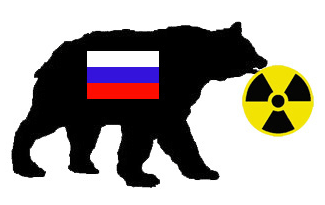 African countries rush to sign nuclear deals with Russia, Daily Maverick By Peter Fabricius• 29 October 2019
But concerns are being raised about whether they can all afford nuclear energy.
The Russian nuclear power corporation Rosatom has already signed nuclear cooperation agreements with about 18 African counties, as Russia accelerates its drive for nuclear business on the continent.
The growing commitment of African countries to high capital cost nuclear energy has raised some concern about whether they are committing themselves to unaffordable debt.
Rosatom director-general Alexey Likhachev revealed a large number of nuclear agreements with African countries after signing an intergovernmental agreement on cooperation in the peaceful uses of nuclear energy with the Ethiopian Minister of Innovation and Technology, Getahun Mekuria Kuma, during the Russia-Africa Summit in Sochi on the Black Sea last week.
Mekuria later told the Russian official news agency Tass that Ethiopia had plants to build a nuclear power plant.
Rosatom later also signed an agreement with Rwanda at the summit on cooperation for the construction of a centre of nuclear science and technology in Rwanda. Rosatom had a strong presence at the economic forum which paralleled the political summit. The Rosatom stand attracted scores of interested African government officials on the sidelines of the forum. …..
Likhachev told journalists after the discussion that Rosatom had now signed memoranda of understanding or intergovernmental agreements with about one-third of countries on the continent – about 18. He could not say how many of these were about scientific cooperation and how many were about producing nuclear energy “because very often those two tracks go hand in hand”.
But he did say in the discussion that about half of the African countries with which Rosatom had signed nuclear agreements were actively discussing joint projects with the corporation, which had been stipulated in contracts. The most advanced joint project is with Egypt, which has contracted Rosatom to build a 4,800MW nuclear power plant……
“We are ready to propose to Ethiopia cutting-edge solutions of nuclear technology. And our Ethiopian partners are invited to visit nuclear facilities in our country.
“Apart from larger capacity nuclear power plants, we also stand ready to offer smaller capacity, modular reactors.”
……..However, the apparent rush to nuclear energy by African countries has raised some concerns that they may be committing themselves to high capital costs of nuclear power production which they will be unable to afford.
Analysts have noted that even South Africa, one of the top two economies on the continent, backed away from an apparent commitment by former president Jacob Zuma to order 9,600MW of nuclear power plant production from Rosatom – at an estimated cost of about R1-trillion.
President Cyril Ramaphosa said after meeting Putin on the sidelines of the summit that the Russian president had once again asked him if South Africa was still interested in building a nuclear power plant and he had told him once again that it still could not afford to.
An African minister at the summit told Daily Maverick that although power plants could be an important source of economic growth, African countries were sinking further into debt and had to be careful to ensure they could afford the infrastructure they built.
Likhachev defended nuclear energy as an economical source of electricity over the long term. ……….
Olivier Nduhungirehe, Rwandan minister in charge of the East African community would not be drawn on the cost and affordability implications, saying the details of the agreement would be announced in due course. https://www.dailymaverick.co.za/article/2019-10-29-african-countries-rush-to-sign-nuclear-deals-with-russia/
Argentina’s Grossi chosen to head UN nuclear agency
Argentina’s Grossi chosen to head UN nuclear agency, Star Tribune, Associated Press, OCTOBER 29, 2019
The International Atomic Energy Agency’s board of governors selected Grossi as its new director general. The appointment still requires the formal approval of the IAEA’s general conference, in which all of the nuclear watchdog’s 171 member countries are represented……
The new director general is due to start his four-year term by Jan. 1 and will be the IAEA’s sixth since the agency was founded in 1957.
Amano, a Japanese diplomat who died in July at age 72, was extensively involved in negotiations over Iran’s nuclear program and the cleanup of the 2011 Fukushima nuclear disaster in Japan. http://www.startribune.com/argentina-s-grossi-chosen-to-head-un-nuclear-agency/564030732/
China Rejects Policy of Nuclear Launch on Warning of an Incoming Attack
Cong also asked nuclear weapons states to take additional steps to diminish the role of nuclear weapons in their national security doctrines, including joining China in publicly committing to never use nuclear weapons first.
The Chinese Foreign Ministry’s criticism of launch on warning comes less than two weeks after Russian president Vladimir Putin announced China was cooperating with Russia “to model a national early warning system.” At present only the United States and Russia have systems that allow them to detect missile launches.
Those systems give both nuclear-armed nations the option to launch a retaliatory response as soon as the system warns them of an incoming missile attack. Russia and the United States keep their missiles on high alert so they are ready for rapid launch on warning.
Both the Russian and the US early warning systems have a history of generating false warnings. The practice of combining those systems with preparations for rapid launch creates the danger that either country could start a nuclear war by mistake.
China’s current policy is to wait to retaliate until after being struck first. It protects its small nuclear force of several hundred nuclear capable missiles from an enemy first strike by hiding them in a large network of underground tunnels. The missiles are kept off alert and the warheads are stored separately. They would be brought together and mated with the missiles only after the Chinese leadership gave the order to prepare for a launch.
Some Chinese officials are concerned recent improvements to US satellite reconnaissance, forward-based radars, precision guidance systems and ballistic missile defenses might lead US decision makers to believe China’s nuclear forces could be neutralized, allowing the United States to strike China first without fear of nuclear retaliation. Recent improvements to Chinese nuclear forces, in particular the development of a longer range intercontinental ballistic missile that can carry multiple warheads, are intended to convince US decision-makers not to take that risk.
Several years ago researchers at the Chinese Academy of Military Science (AMS) suggested China could eliminate concerns about the vulnerability of its nuclear forces by moving to a launch on warning posture. Fu Cong responded to a question about the AMS suggestion by stating that in his view a launch on warning posture would be incompatible with China’s long-standing promise not to use nuclear weapons first under any circumstances.
Cong also said he was unaware of Putin’s statement on cooperation on an early warning system, but that the existence of such a project did not imply that China would change its nuclear policy and shift to a launch on warning posture. Such a change would also require China to keep its missiles on constant alert with warheads attached so that they could be launched quickly. A former director of China’s nuclear weapons lab told me privately that the cooperative project with Russia on warning technology would increase China’s overall situational awareness but would not lead to a change China’s nuclear doctrine, policy or practice.
U.S. Energy Secretary Rick Perry says USA and Saudi Arabia negotiating on nuclear sales
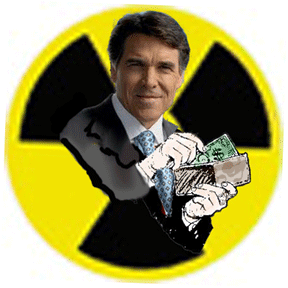 U.S. says talks progressing with Saudi on possible
 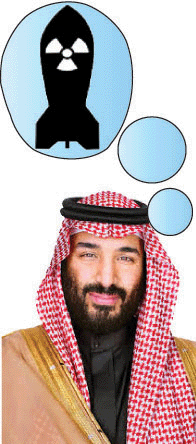 nuclear program, DUBAI (Reuters) 27 Oct 19– U.S. Energy Secretary Rick Perry said on Saturday that conversations with Saudi Arabia on a nuclear program are going forward.The world’s top oil exporter had said it wanted to use nuclear power to diversify its energy mix. It wants to go ahead with a full-cycle nuclear program, including the production and enrichment of uranium for atomic fuel.
In order for U.S. companies to compete for Saudi Arabia’s project, Riyadh would normally need to sign an accord on the peaceful use of nuclear technology with Washington.
Reuters has reported that progress on the discussions has been difficult because Saudi Arabia does not want to sign a deal that would rule out the possibility of enriching uranium or reprocessing spent fuel – both potential paths to a bomb.
“The kingdom and the leadership in the kingdom .. will find a way to sign a 1,2,3 agreement with the United States, I think,” Perry said.
Speaking at a round table in Abu Dhabi, Perry added that the United States was doing everything it could to have a ready global supply of oil…… https://www.reuters.com/article/us-uae-us-energy/us-says-talks-progressing-with-saudi-on-possible-nuclear-program-idUSKBN1X509E
North Korea exasperated with USA’s hostile policies and demands
SEOUL, South Korea — North Korea on Sunday said it’s running out of patience with the United States over what it described as hostile policies and unilateral disarmament demands, and warned that a close personal relationship between the leaders alone wouldn’t be enough to prevent nuclear diplomacy from derailing.
In a statement published by Pyongyang’s official Korean Central News Agency, senior North Korean official Kim Yong Chol said there has been no substantial progress in relations despite warm ties between leader Kim Jong Un and President Donald Trump. He said the persisting hostility means “there can be the exchange of fire at any moment.”
Kim Yong Chol said the Trump administration would be “seriously mistaken” if it ignores an end-of-year deadline set by Kim Jong Un to propose mutually acceptable terms for a deal to salvage nuclear negotiations.
The North issued a similar statement on Thursday that was attributed to veteran diplomat Kim Kye Gwan. He criticized U.S. officials for maintaining “Cold War mentality and ideological prejudice” and urged the United States to act “wisely” through the end of the year……..
talks have faltered after the collapse of a February summit between Kim and Trump in Hanoi, Vietnam, where the U.S. rejected North Korean demands for broad sanctions relief in exchange for a piecemeal deal toward partially surrendering its nuclear capabilities.
The North expressed its displeasure with a flurry of short-range missile tests while Kim said he would “wait with patience until the end of the year for the United States to come up with a courageous decision.”……..
North Korea for decades has been pushing a concept of denuclearization that bears no resemblance to the American definition, with Pyongyang vowing to pursue nuclear development until the United States removes its troops and the nuclear umbrella defending South Korea and Japan. https://www.wusa9.com/article/news/nation-world/north-korea-running-out-of-patience-with-united-states-nuclear-diplomacy/65-7aaa9700-aadd-44b2-8070-73e53732a579
Iran Looms Over Race to Lead U.N. Nuclear Agency
Iran Looms Over Race to Lead U.N. Nuclear Agency
Group’s most powerful members are split over IAEA’s approach to Tehran……..(subscribers only) https://www.wsj.com/articles/iran-looms-over-race-to-lead-u-n-nuclear-agency-11572197016
1 This Month
26 September – International Day for the Total Elimination of Nuclear Weapons





PLEASE OPPOSE HR 8255 AND S.3639 – bills would accelerate satellite deployment, with no environmental review or safeguards – https://ncstd5li.quorum.us/campaign/169331/
To see nuclear-related stories in greater depth and intensity – go to https://nuclearinformation.wordpress.com
-
Archives
- September 2026 (291)
- August 2026 (330)
- July 2026 (355)
- June 2026 (287)
- May 2026 (306)
- April 2026 (356)
- March 2026 (251)
- February 2026 (267)
- January 2026 (308)
- December 2025 (358)
- November 2025 (359)
- October 2025 (375)
-
Categories
- 1
- 1 NUCLEAR ISSUES
- business and costs
- climate change
- culture and arts
- ENERGY
- environment
- health
- history
- indigenous issues
- Legal
- marketing of nuclear
- media
- opposition to nuclear
- PERSONAL STORIES
- politics
- politics international
- Religion and ethics
- safety
- secrets,lies and civil liberties
- spinbuster
- technology
- Uranium
- wastes
- weapons and war
- Women
- 2 WORLD
- ACTION
- AFRICA
- Atrocities
- AUSTRALIA
- Christina's notes
- Christina's themes
- culture and arts
- Events
- Fuk 2022
- Fuk 2023
- Fukushima 2017
- Fukushima 2018
- fukushima 2019
- Fukushima 2020
- Fukushima 2021
- general
- global warming
- Humour (God we need it)
- Nuclear
- RARE EARTHS
- Reference
- resources – print
- Resources -audiovicual
- Weekly Newsletter
- World
- World Nuclear
- YouTube
-
RSS
Entries RSS
Comments RSS

