UK govt trying to finance new nuclear plants, – complicated relations with China and USA
boss Vincent de Rivaz ill-advisedly said that customers would be using
electricity from the planned Hinkley Point C power plant to cook their
Christmas turkeys by 2017. Two years on from that self-imposed deadline,
the £21bn nuclear power station is still being built over a sprawling site
in the Somerset countryside – while the very future of nuclear power in
the UK is up for debate as other sources of energy snap at its heels and
investment in the sector gets harder to find.
backdrop of wariness about the source of potential investments:
state-backed China General Nuclear (CGN) is one of few investors willing to
pour money into the risky nuclear sector – but the communist
superpower’s involvement has brought political and security concerns as
well as opposition from the US.
beset by controversy, with Theresa May, the former prime minister,
reversing George Osborne’s courting of China in 2016 when she ordered a
review of China’s involvement in the UK’s nuclear industry, amid
concerns about national security.
consultation opened in the summer on the potential new financing mechanism for nuclear power plants which will see consumers pay for nuclear power plants before they start producing, in an attempt to bring down the costs of financing.
https://www.telegraph.co.uk/business/2020/01/05/britain-heading-fallout-nuclear-conundrum/

Suleimani’s Gone, and the Iran Nuclear Deal May Be Next
Suleimani’s Gone, and the Iran Nuclear Deal May Be Next
Europe fears that its faltering efforts to preserve the 2015 pact have been dealt a fatal blow with the United States’ killing of a top Iranian commander. NYT, By Steven Erlanger, Jan. 3, 2020
-
- BRUSSELS — How Iran will respond to the American assassination of Maj. Gen. Qassim Suleimani remains a matter of speculation, but one outcome seems almost certain: the end of Europe’s long effort to keep the 2015 Iranian nuclear deal alive.
In interviews on Friday, European analysts envisioned a number of baleful results from the killing of the general, who was a national hero and potential political leader in Iran, and whose death Tehran has vowed to avenge.
Among those were the downgrading of diplomacy, the destabilization of Iraq and the further strengthening of Iran’s hard-liners and the Islamic Revolutionary Guards Corps.
Prime Minister Netanyahu almost blew the secret of Israel’s nuclear arsenal
|
In momentary slip, Netanyahu breaks Israel’s nuclear ambiguity Hailing gas pipeline deal, PM trips up in calling Jewish state a ‘nuclear power,’ but quickly clarifies, Times of Israel, By TOI STAFF, 5 Jan 2020 Prime Minister Benjamin Netanyahu on Sunday called Israel a “nuclear power” before correcting himself mid-word to say “energy power.” The premier’s comment came during the weekly cabinet meeting as he briefed ministers about the deal signed Thursday between Israel, Greece and Cyprus on Thursday for a huge pipeline project to ship gas from the eastern Mediterranean to Europe. Israel has never acknowledged possessing nuclear weapons, instead maintaining a policy of “strategic ambiguity.” Foreign reports have put the size of Israel’s nuclear arsenal in the dozens to hundreds of weapons…….. https://www.timesofisrael.com/in-momentary-slip-netanyahu-breaks-israels-nuclear-ambiguity |
|
The escalation of nuclear tension between USA and Iran
Timeline: How tensions escalated with Iran since Trump withdrew US from nuclear deal
President Trump’s decision to leave the 2015 nuclear deal with Iran was followed by an escalation of rhetoric, sanctions and attacks between the countries. George Petras, Jim Sergent, Janet Loehrke, Karl Gelles and Javier Zarracina, USA TODAY, 3 Jan 2020,
July 25, 2015
Iran, the United States and other nations approve a deal in which Iran agrees to shift its nuclear program from weapons production to peaceful commercial use for 10 years. Iran allows international inspectors on its nuclear weapons sites.
In exchange, the United States and the United Nations Security Council lift energy, trade, technology and financial sanctions against Iran.
The pact, established during the tenure of President Barack Obama, is an executive agreement, not a treaty, which means it isn’t formally approved by Congress. Republicans oppose the deal and question its legality.
Leaving the deal
October 2016
Presidential candidate Donald Trump says Iran should write the United States a thank you letter for “the stupidest deal of all time.” Trump says the United States will withdraw from the deal if he’s elected.
May 8, 2018
President Trump announces the withdrawal from the Iran deal. Iran, France, Britain and Germany say they will stay in the pact.
US increases pressure
August-November 2018
The United States reimposes economic sanctions targeting Iran’s energy, financial, shipping and shipbuilding industries. Iran says it will take unspecified actions regarding the nuclear deal if Britain, France, Germany, Russia and China don’t help it engage in international trade.
April 8, 2019
Trump says he will designate Iran’s Islamic Revolutionary Guards as a foreign terrorist organization. The Pentagon opposes the change, saying it increases the possibility of retaliation against American military and intelligence personnel.
April 22
May 5
John Bolton, Trump’s national security adviser, says the United States will send an aircraft carrier strike force and Air Force bombers to the Middle East. The deployment shows Iran that “any attack on United States interests or on those of our allies will be met with unrelenting force.”
Iran retaliates
May 8
Iran says it will increase its production of enriched uranium and heavy water.
May 12
Four oil tankers – two from Saudi Arabia, one from the United Arab Emirates and one from Norway – are attacked in the Persian Gulf. The United States says Iran is behind the attacks.
June 13
Two oil tankers – one from Norway, the other from Japan – are attacked in the Gulf of Oman. The United States blames Iran, which denies responsibility.
June 20
Iran shoots down a U.S. surveillance drone it says violated Iranian airspace. The U.S. Central Command says the aircraft was in international territory.
June 20
Trump orders retaliatory attacks against Iran but cancels the strikes shortly before they are to be launched. Four days later, he imposes more sanctions against Iran.
July 1
Iran says it’s exceeded the amount of low-enriched uranium it was allowed to build under the 2015 agreement.
US-Iranian tensions rise………
Jan. 2 2020
Iranian military leader Qasem Soleimani and five others are killed in a U.S. drone strike at Baghdad airport. U.S. officials call it a “defensive action,” saying Soleimani planned attacks on U.S. diplomats and troops. https://www.usatoday.com/in-depth/news/2020/01/03/us-iran-conflict-since-nuclear-deal/2803223001/
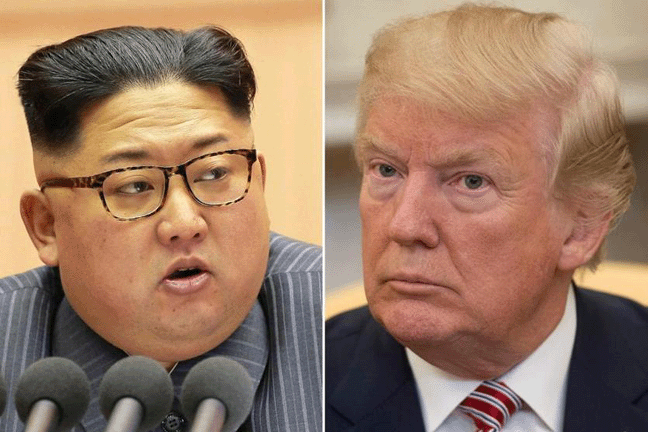
Kim Jong Un May Be Leaving The Door Open To Nuclear Talks
Why North Korea’s Kim Jong Un May Be Leaving The Door Open To Nuclear Talks, January 1, 2020, ANTHONY KUHN
Some analysts believe a key reason behind his calculations may be President Trump’s prospects for surviving an impeachment process and possibly winning a second term in the White House.
“Donald Trump happens to be the first sitting U.S. president to view North Korea as a source of political victory, for domestic purposes,” says Go Myong-hyun, a research fellow and expert on North Korea at the Asan Institute for Policy Studies, a Seoul-based think tank.
Pyongyang has said it has no intention of handing President Trump any victories on denuclearization, but officials see Trump’s eagerness to tout achievements to his domestic audience as a source of leverage.
In remarks carried by state media, Kim on Tuesday had plenty of tough words for the U.S. as he addressed a plenum of the ruling Workers Party Central Committee. He acknowledged the countries’ current stalemate on nuclear talks, but insisted he would not passively wait for things to improve……
Prolonged stalemate likely
For now, analysts see a prolonged stalemate over North Korea’s nukes as all but inevitable……North Korea’s only remaining tool is nuclear brinksmanship — essentially bluffing opponents into thinking Pyongyang might actually use atomic weapons, even though it is plainly evident that the cost of doing so is prohibitive for both sides.
Fuhrmann’s theory has implications for policy: a nuclear-armed North Korea is not the apocalyptic event some fear, “even if we might prefer a situation where they were not to have nuclear weapons.”
He advises that a complete and verifiable nuclear disarmament is “somewhat unrealistic.” Better, he says, for the U.S. to “look for a deal that allows us to place meaningful limits on North Korean capabilities.” https://www.npr.org/2020/01/01/792843551/north-korea-drops-testing-moratorium-but-leaves-door-open-to-u-s-nuclear-talks
North Korea preparing for nuclear negotiations with USA
|
The ruling Workers’ Party meeting is a focus of keen attention as some observers predict North Korea might use the conference to announce it would abandon faltering diplomacy with the U.S. and lift its moratorium on major weapons test. The Korean Central News Agency reported that leader Kim Jong Un presided over a plenary meeting of the party’s Central Committee convened in Pyongyang on Saturday. It called the gathering the “first-day session,” suggesting it would continue for at least another day. The meeting is intended to “overcome the manifold and harsh trials and difficulties and further accelerate the development of the revolution with transparent anti-imperialist independent stand and firm will,” KCNA said. The meeting will also discuss “important matters” in the party and national defence, KCNA said……. Diplomacy breakdown would be blow to TrumpAfter his second summit with U.S. President Donald Trump in February in Vietnam failed, Kim gave the U.S. until the end of this year to offer new initiatives to salvage the nuclear negotiations. North Korea has recently warned that its resumption of tests of long-range missiles and nuclear devices depends on U.S. action. Restarting nuclear and ICBM tests would be a blow to Trump, who has boasted that North Korea’s moratorium was a major foreign policy win. But that would also likely completely derail diplomacy with the U.S. and further dim the prospect for North Korea to get badly needed sanctions relief to rebuild its troubled economy, some experts said. North Korea is pushing to win major sanctions relief in return for limited denuclearization steps, but the U.S. maintains sanctions will stay in place until North Korea takes significant steps toward ridding itself of nuclear weapons and technology.https://www.cbc.ca/news/world/north-korea-meeting-political-conference-nuclear-1.5410028 |
|
European Union split on nuclear energy, but manages a draft Green Finance deal.
Green-finance deal survives EU split on nuclear energy. European Central Bank chief Christine Lagarde has underlined the importance of the reform, with sustainable finance deals reaching one half a trillion dollars in 2018.
But the long-standing disagreement over nuclear energy has undermined the EU’s efforts to cut greenhouse emissions, with a promise last week by EU leaders for carbon neutrality by 2050 nearly scuppered by a feud over atomic energy.
https://www.khmertimeskh.com/50671303/green-finance-deal-survives-eu-split-on-nuclear-energy 23 Dec 19, EU negotiators have been struggling for weeks to finalise a harmonised classification system for green finance in Europe that could decide the fate of hundreds of billions of euros in investment.
The lobbying frenzy in Brussels over the new EU norm has been immense, with soon to Brexit Britain also making its voice heard while protecting the interests of the City of London financial hub.
“This is a historic moment… the much-needed enabler to get green investments to flow and help Europe reach climate neutrality by 2050,” said EU Commission Vice President Valdis Dombrovskis.
Late on Monday, EU lawmakers approved an offer by member states that delayed the nuclear question – as well as the role of natural gas cherished by Berlin – until the end of 2021.
“I am fully aware that the nuclear problem will return in two years’ time. We pushed back the matter,” said the chairman of the European Parliament’s Environment Committee, French centrist MEP Pascal Canfin.
“The risk was to take the whole classification hostage,” he added.
Ever since the European Commission’s proposal was put on the table in May 2018, nuclear energy has been the subject of a huge fight between its supporters, led by France and backed by Eastern European countries.
But opponents of nuclear power – such as Germany, Austria, Luxembourg and Greece – have refused to back down, with domestic opinion fearing atomic energy disasters, such as Fukushima or Chernobyl.
The compromise suggested by Finland, which holds the EU’s rotating presidency, was reached with MEPs behind closed doors and needs final approval by member states envoys on Wednesday.
Once approved, the European Commission will then have two years to draw up detailed lists of sectors eligible for a Green finance label, based on the criteria.
Kim Jong Un refers to North Korea being ‘prepared’ for war, hinting at nuclear capabilities
|
Kim Jong Un stresses nuclear capabilities during meeting https://www.dailynk.com/english/kim-jong-un-stresses-nuclear-capabilities-during-meeting/The Third Expanded Meeting of the Central Military Commission was held on Sunday, according to Rodong Shinmun, By Lee Sang Yong, 2019.12.27 North Korean leader Kim Jong Un recently presided over an expanded meeting of the Central Military Commission of the Workers’ Party of Korea (WPK). At the meeting, Kim made references to readying North Korea’s nuclear capabilities for war, Daily NK has learned.
Although Kim did not explicitly say so, his remarks on “launchers,” the reorganization of the military, as well as his emphasis on self-reliant defense capabilities, can all be seen as a roundabout reference to the country’s nuclear capabilities. NO EXPLICIT MENTION OF NUCLEAR CAPABILITIES AT MEETING At the meeting, Kim stressed that rockets (missiles) and artillery capabilities should be strengthened, according to a high-ranking North Korean source speaking to Daily NK on Monday. These are the “decisions on organizational matters” alluded to in the North Korean media, which were also presumably the main issues of the meeting. “They say that Kim Jong Un issued a direct order calling for the reinforcement of military divisions where relevant to rocket and artillery capabilities,” a source in North Korea told Daily NK. “This essentially translates to an order to improve every aspect related to the strengthening of rocket and artillery capabilities, and can be seen as very relevant to ensuring nuclear weapons are battle-ready.” ”There was no explicit mention of nuclear weapons, but those present understood the order to mean that Kim Jong Un should be able to launch whatever he makes up his mind to launch, should he decide to do so,” continued the source. “Thus, whether it’s rockets or weapons of mass destruction, we must be prepared for every possibility.” In this context, “rocket” is a catch-all term that refers to both short-range and long-range missiles. Since Kim Jong Un came into power, North Korea has invested in the operational capabilities of various missiles, such that a dedicated branch was formed, called the Strategic Rocket Forces (currently Strategic Forces Command). The Strategic Forces Command reportedly consists of three divisions: the Scud missile division, the Rodong missile division, and the Musudan missile division. The announcement that there is to be a new division in addition to these three can be read as a move to create a separate division for strategic weapons, including intercontinental ballistic missiles (ICBM) like the Hwasong-15. A MOVE TOWARD MORE CONFRONTATION WITH SOUTH KOREA? North Korea also recently conducted a series of tests at the Sohae Satellite Launch Site in Dongchang-ri, Cholsan County in North Pyongan Province. The tests involved a new solid-fuel engine for its ICBMs as well as a stability test. This has led to speculation over whether this is an indicator of North Korea’s determination to construct a system with the ability to stealthily launch both short- and long-range missiles at any hour of the day. “It’s been made clear that North Korean rockets must be shown as a force to be contended with,” said a source. “Apparently there was considerable emphasis on the sanctions against North Korea, and the fact that the military must take the lead in developing a self-reliant defense system.” “The order to strengthen artillery capabilities seems to indicate that they’re more interested in a confrontation with South Korea, rather than dialogue,” continued the source. “Given the emphasis on being prepared for every possibility in a fight, it seems they will continue to conduct tests with the aim of improving the relevant technologies.” On Sunday, the Korean Central News Agency (KCNA) reported that North Korean leader Kim Jong Un had presided over the Third Expanded Meeting of the Seventh WPK Central Military Commission and discussed issues pertaining to the strengthening of “self-reliant defense capabilities.” This meeting is presumed to have taken place on Saturday, given that top military officials assembled in Pyongyang on Friday morning. *Translated by Violet Kim Please direct any comments or questions about this article to dailynkenglish@uni-media.net. |
|
Iran and US both undermining nuclear deal says UN political affairs chief
|
Iran and US both undermining nuclear deal says UN political affairs chief, UN News , 19 December 2019
Both Iran and the United States have been putting strain on the groundbreaking 2015 deal to monitor Iran’s nuclear programme, which remains a “cornerstone of international peace and security”, said the UN’s political affairs chief on Thursday. Rosemary DiCarlo was briefing the Security Council on nuclear non-proliferation, and resolution 2231 that specifically backed the Joint Comprehensive Plan of Action (JCPOA), agreed in July 2015, by China, France, Germany, Russia, The United Kingdom, the United States, the European Union, and Iran (see fact box below for full details). She said the “full and effective implementation” of the Plan was “key to ensuring the peaceful nature of Iran’s nuclear programme and to secure tangible economic benefit to the Iranian people.” Ms. DiCarlo said the US decision to pull out of the deal was a source of “regret” as well as “the recent steps taken by Iran to reduce its nuclear-related commitments”. “Certain actions taken by the United States, since its withdrawal from the Plan, are contrary to the goals of the Plan”, she said and the re-imposition of its national sanctions lifted under the Plan, and decision not to extend waivers for the trade in oil with Iran. But according to the IAEA, she added, Iran since July “has surpassed JCPOA-stipulated limits on its uranium enrichment level, as well as limits on its stockpiles of heavy water and low-enriched uranium.” Steps have also been taken on centrifuge research and development: “Iran has stated that all these steps are reversible and that it intends to remain in the Plan. It is important that Iran returns to full implementation of the Plan, and refrain from further steps to reduce its commitments”, said the UN Political and Peacebuilding Affairs chief. Rising regional tensions…….Summing up the importance of the JCPOA, Ms DiCarlo said that António Guterres considers the full implementation of resolution 2231, by all Member States “as an integral component of our collective conflict prevention efforts.” Given the year of tension in the Gulf, “this has assumed greater importance” she noted, adding that it was the Secretary-General’s wish for all countries “to avoid confrontational actions and explore avenues for dialogue and cooperation in the interest of international peace and security.” https://news.un.org/en/story/2019/12/1054071 |
|
Hazards of Russia’s nuclear colonialism- example South Africa
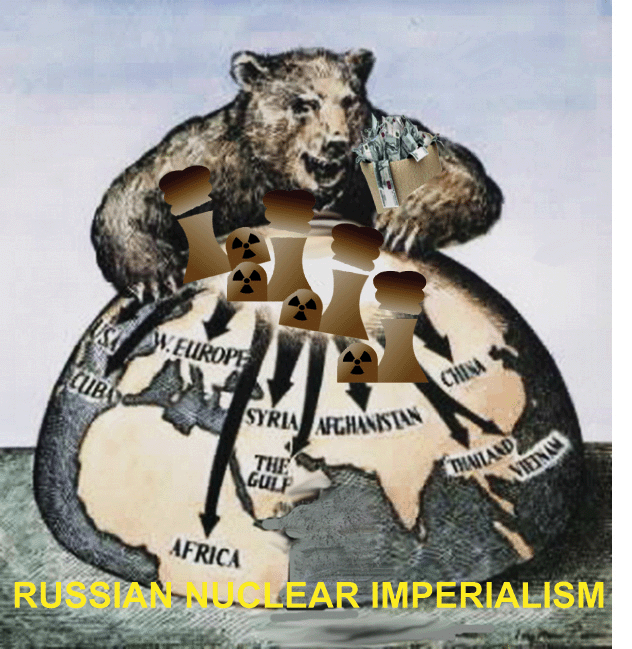
 Africa, Russia squandered close ties with the South African government by overplaying its hand and getting caught up in a corrupt nuclear energy pact. Carnegie Endowment For International Peace (thoroughly researched and referenced) 16 Dec 19,
 SUMMARY
 Amid the widespread attention the Kremlin’s recent inroads in Africa have attracted, there has been surprisingly little discussion of South Africa, a country which, for nearly a decade, unquestionably represented Russia’s biggest foreign policy success story on the continent. As relations soared during the ill-starred presidency of Jacob Zuma (2009–2018), the Kremlin sought to wrest a geopolitically significant state out of the West’s orbit and to create a partnership that could serve as a springboard for expanded influence elsewhere in Africa. Continue reading
 European Union’s sustainable finance debate bogged down in question of including nuclear power
 Nuclear power toxifies EU sustainable finance debate EU28 ambassadors meet on Monday morning to see if they can come up with a compromise that can keep all sides happy Mehreen Khan 15 Dec 19 Nuclear power toxifies EU sustainable finance debate EU28 ambassadors meet on Monday morning to see if they can come up with a compromise that can keep all sides happy Mehreen Khan 15 Dec 19https://www.ft.com/content/f4ee6bfc-1fb2-11ea-b8a1-584213ee7b2b Nuclear power toxifies EU sustainable finance debate EU28 ambassadors meet on Monday morning to see if they can come up with a compromise that can keep all sides happy Share on Twitter (opens new window) Share on Facebook (opens new window) Share on LinkedIn (opens new window) Save Mehreen Khan YESTERDAY Agreeing on international climate deals is harder than it looks. Despite rising public pressure for policymakers to grapple with the challenge, marathon talks at the UN’s COP25 summit ended this weekend in failure. In what was the world’s longest ever climate negotiation (14 consecutive days), international delegates in Madrid failed to agree rules for how rich and poorer countries should construct a new global carbon trading market. The FT’s Leslie Hook dissects how the summit came to an inconclusive end and why the EU and environmental NGOs are lamenting the outcome.
The EU, which was part of the negotiations in Madrid, will be discouraged by the rancour over carbon trading permits — especially as Brussels is drawing up contentious plans to force third countries to pay a price for carbon it exports to the bloc.
Away from the UN talks, EU governments will have to face down their own green divisions on Monday when they meet to discuss much-anticipated market rules on sustainable finance products. Despite hopes for a deal before the end of the year, France and eastern European capitals last week demanded the rules make explicit to investors that nuclear energy is part of the EU’s journey towards carbon neutrality.
EU28 ambassadors meet on Monday morning to see if they can come up with a compromise that can keep all sides happy. Austria and Luxembourg have led the charge against giving a green-stamp to nuclear, with Germany also resisting over concerns about the environmental impact of nuclear waste.
While the EU has championed itself as a global leader in climate policy, Brussels has yet to prove whether it can “walk the talk” on green policy. The debate over the classification system (known as the “taxonomy”) is the new European Commission’s first real test.
Energy policy is a fiercely protected part of governments’ national powers. Divisions were laid bare in a tense leaders’ summit last week where member states ultimately failed to convince Poland to sign up to the bloc’s 2050 net zero carbon target. But in a triumph for France and its eastern allies, the summit conclusions gave an explicit nod to nuclear as “part of the energy mix” in some countries.
Diplomats think the summit agreement on nuclear should pave the way for pro-nuclear countries to win the argument over the taxonomy. Even if they do, another battle with MEPs lies ahead. Should ambassadors get a compromise on Monday, it still has to be agreed by the European Parliament, which has insisted on its “no” to nuclear.
Pascal Canfin, head of the EP’s environment committee and member of Emmanuel Macron’s En Marche, also held firm on the issue. He told the Brussels Briefing that EU governments should not “modify the balanced political compromise” agreed with MEPs earlier this month. “All parties know that it is the only deal that could have been reached. That’s why I’m confident we will get a formal endorsement this week,” said Mr Canfin.
|
|
USA rejects North Korea’s ‘hostile’ deadline over nuclear talks
|
Top US diplomat rejects North Korea’s ‘hostile’ deadline over nuclear talks and says Washington will not bow to Pyongyang’s ominous threat of a ‘Christmas Gift’ provocation,
By ROSS IBBETSON FOR MAILONLINE and AFP 17 Dec 19, A senior US diplomat has today slammed North Korea for making ‘hostile demands’ over nuclear talks and warned Kim Jong-un against his planned ‘Christmas Gift’ provocation. US special representative Stephen Biegun told reporters in Seoul that Washington would not bow to Pyongyang’s increasingly strident demands for concessions by 2020. ‘Let me be absolutely clear: The United States does not have a deadline. We are fully aware of the strong potential for North Korea to conduct a major provocation in the days ahead,’ Biegun said. ‘To say the least, such an action will be most unhelpful in achieving lasting peace on the Korean Peninsula.’….. Pyongyang has said that if Washington fails to make it an acceptable offer, it will adopt a so far unspecified ‘new way’. It has carried out a series of static tests at its Sohae rocket facility this month, after a number of weapons launches in recent weeks, some of them described as ballistic missiles by Japan and others – which Pyongyang is banned from testing under UN sanctions……Pyongyang has said that if Washington fails to make it an acceptable offer, it will adopt a so far unspecified ‘new way’. It has carried out a series of static tests at its Sohae rocket facility this month, after a number of weapons launches in recent weeks, some of them described as ballistic missiles by Japan and others – which Pyongyang is banned from testing under UN sanctions…https://www.dailymail.co.uk/news/article-7797205/Top-diplomat-rejects-North-Koreas-deadline-says-Washington-not-bow-threats.html |
|
|
Turkey may shut US nuclear weapons base over sanctions threat
|
Turkey may shut US nuclear weapons base over sanctions threat
The Turkey-US row is partly over Ankara’s military offensive in Syria targeting American-backed Kurdish forces. Sky News Sunday 15 December 2019 Turkey’s leader says his country could close two military installations where American troops are stationed “if necessary”. One of the sites, called the Incirlik air base, is where some US nuclear warheads are kept. The other is the Kurecik radar station.
President Recep Tayyip Erdogan spoke in response to a threat of American sanctions over Ankara’s military offensive in Syria targeting US-backed Kurdish forces. His comments also followed a US senate resolution over Armenian claims about mass killings a century ago – a move which has further increased tensions between Ankara and Washington……. The Incirlik air base, located about 100 miles from Turkey’s border with Syria, is often referred to as one of the major strategically located US military bases. The Kurecik radar station hosts NATO’s early-warning radar systems against ballistic missile attacks. https://news.sky.com/story/turkey-may-shut-us-nuclear-weapons-base-over-sanctions-threat-11887811 |
|
Marathon UN climate talks have a rather disappointing outcome
Disappointment as marathon climate talks end with slim deal. AP News, By FRANK JORDANS and ARITZ PARRA,MADRID (AP) 15 Dec 19, — Marathon U.N. climate talks ended Sunday with a slim compromise that sparked widespread disappointment, after major polluters resisted calls for ramping up efforts to keep global warming at bay and negotiators postponed debate about rules for international carbon markets for another year.
Organizers kept delegates from almost 200 nations in Madrid far beyond Friday’s scheduled close of the two-week talks. In the end, negotiators endorsed a general call for greater efforts to tackle climate change and several measures to help poor countries respond and adapt to its impacts.
U.N. Secretary-General António Guterres said he was “disappointed” by the meeting’s outcome.
“The international community lost an important opportunity to show increased ambition on mitigation, adaptation and finance to tackle the climate crisis,” he said. “We must not give up and I will not give up.”
The final declaration cited an “urgent need” to cut planet-heating greenhouse gases in line with the goals of the landmark 2015 Paris climate change accord. But it fell far short of explicitly demanding that countries submit bolder emissions proposals next year, which developing countries and environmentalists had demanded……
Thankfully, the weak rules on a market-based mechanism, promoted by Brazil and Australia, that would have undermined efforts to reduce emissions, have been shelved,” said Mohamed Adow, director of Nairobi-based campaign group Power Shift Africa.
Helen Mountford, from the environmental think-tank World Resources Institute, said that “given the high risks of loopholes discussed in Madrid, it was better to delay than accept rules that would have compromised the integrity of the Paris Agreement.”…….
Delegates made some progress on financial aid for poor countries affected by climate change, despite strong resistance from the United States to any clause holding big polluters liable for the damage caused by their emissions. Countries agreed four years ago to funnel $100 billion per year by 2020 to assist developing nations, but so far nowhere near that amount has been raised. …..
The United States will be excluded from much of those talks after President Donald Trump announced the country’s withdrawal from the Paris accord, a process than comes into force Nov. 4, 2020……. https://apnews.com/aca79ab4956f370b8892ba574fe56834
EU heads of state and government agreed that nuclear energy will be recognized as a way to fight climate change
 EU leaders include nuclear energy in green transition, By SAMUEL PETREQUIN, Associated Press Dec. 13, 2019 BRUSSELS (AP) — European Union leaders agreed Friday that nuclear energy will be part of the bloc’s solution to making its economy carbon neutral by 2050, allowing them to win the support of two coal-dependent countries.
EU heads of state and government agreed that nuclear energy will be recognized as a way to fight climate change as part of a deal that endorsed the climate target. While Poland did not immediately agree to the plan, the concessions on nuclear energy were enough for the Czech Republic and Hungary to give their approval…….. (subscribers only) https://www.sfchronicle.com/news/world/article/EU-leaders-include-nuclear-energy-in-green-14904378.php
1 This Month
26 September – International Day for the Total Elimination of Nuclear Weapons





PLEASE OPPOSE HR 8255 AND S.3639 – bills would accelerate satellite deployment, with no environmental review or safeguards – https://ncstd5li.quorum.us/campaign/169331/
To see nuclear-related stories in greater depth and intensity – go to https://nuclearinformation.wordpress.com
-
Archives
- September 2026 (291)
- August 2026 (330)
- July 2026 (355)
- June 2026 (287)
- May 2026 (306)
- April 2026 (356)
- March 2026 (251)
- February 2026 (267)
- January 2026 (308)
- December 2025 (358)
- November 2025 (359)
- October 2025 (375)
-
Categories
- 1
- 1 NUCLEAR ISSUES
- business and costs
- climate change
- culture and arts
- ENERGY
- environment
- health
- history
- indigenous issues
- Legal
- marketing of nuclear
- media
- opposition to nuclear
- PERSONAL STORIES
- politics
- politics international
- Religion and ethics
- safety
- secrets,lies and civil liberties
- spinbuster
- technology
- Uranium
- wastes
- weapons and war
- Women
- 2 WORLD
- ACTION
- AFRICA
- Atrocities
- AUSTRALIA
- Christina's notes
- Christina's themes
- culture and arts
- Events
- Fuk 2022
- Fuk 2023
- Fukushima 2017
- Fukushima 2018
- fukushima 2019
- Fukushima 2020
- Fukushima 2021
- general
- global warming
- Humour (God we need it)
- Nuclear
- RARE EARTHS
- Reference
- resources – print
- Resources -audiovicual
- Weekly Newsletter
- World
- World Nuclear
- YouTube
-
RSS
Entries RSS
Comments RSS

