President Trump ‘talked about nuclear weapons’ with Vladimir Putin in a call to the Kremlin over the weekend as START Treaty’s expiration looms
- resident Trump told reporters Monday that he discussed nuclear arms control during his latest conversation with Russian President Vladimir Putin
- The president shared phone call with Putin on Sunday just hours after he helped broker a historic deal with the OPEC+ to shore up plummeting oil prices
- Trump revealed the contents of the call during the White House’s daily coronavirus press briefing on Monday evening
- ‘We did talk about the arms. Yes, we did,’ Trump told reporters from the podium. ‘It was a very important part of the call actually’
- Though Trump failed to divulge specifics the Russian president’s press secretary said Putin and Trump spoke of the START Treaty, which is set to expire next year……….. https://www.dailymail.co.uk/news/article-8216245/President-Trump-talked-nuclear-weapons-Vladimir-Putin-call-weekend.html
Belarus to get a new nuclear reactor along with $10 billion debt to Russia
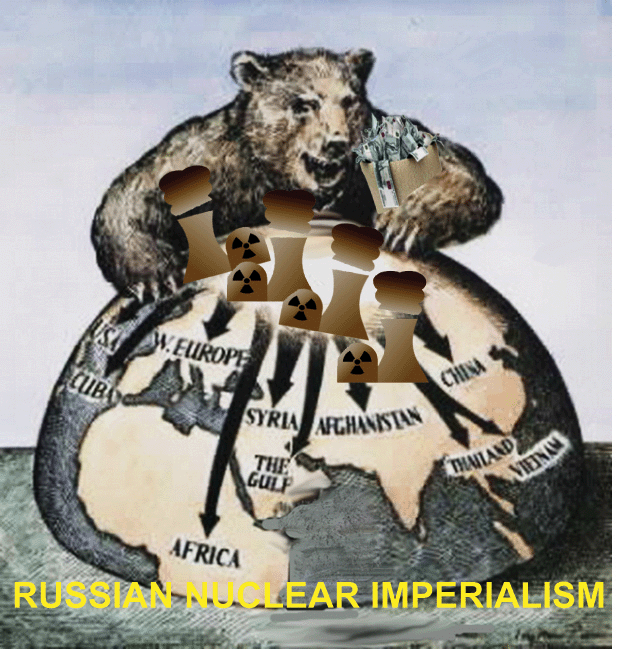
In January, Lithuanian Energy Minister Zygimantas Vaiciunas told RFE/RL that the Belarusian plant is “a threat to our national security, public health, and environment.”
“The key question is the site selection, which was done politically — geopolitically,” Vaiciunas told RFE/RL.
Plans for the nuclear plant were unveiled by Belarusian President Alyaksandr Lukashenka in 2008 when Minsk received a $10 billion loan from Moscow for the project.
The general contractor for the Belarusian nuclear power plant building is Atomstroiexport, an affiliate of Russia’s state-owned Rosatom. Based on reporting by TASS, ONT, and RFE/RL correspondent Matthew Luxmoore
A win-win for USA and North Korea? Helping to fight coronavirus
|
Why Helping North Korea Fight Coronavirus Could Lessen the Chance of a Nuclear War https://nationalinterest.org/blog/korea-watch/why-helping-north-korea-fight-coronavirus-could-lessen-chance-nuclear-war-143697
A necessary win-win for Washington and Pyongyang?
by Cynthia Lazaroff Follow @CynthiaLazaroff on Twitter 13 Apr 20, Amidst the existential nightmare unfolding with the coronavirus, comes the news that North Korea has ramped up its missile testing and lost all interest in a dialogue with the United States. At a March meeting with G-7 Foreign Ministers, Secretary of State Pompeo called on all nations to maintain diplomatic and economic pressure on North Korea over its nuclear and ballistic missile programs. Pompeo’s ill-timed call to uphold sanctions even during the global pandemic escalated tensions and triggered Pyongyang’s chilling response: North Korea has become “more zealous for our important planned projects aimed to repay the U.S. with actual horror and unrest for the sufferings it has inflicted upon our people.”
While some may call this mere bluster, Pyongyang’s warning serves as a grim reminder that the existential nuclear threat is not going on lockdown during this pandemic. It is a clear and present danger like COVID-19, invisible but very much alive. And like the virus, it has been ignored for perilously too long. Former U.S. Secretary of Defense William J. Perry has sounded the alarm: “Today, the danger of some sort of a nuclear catastrophe is greater than it was during the Cold War and most people are blissfully unaware of this danger.”
We are now awake to the COVID-19 catastrophe, the enormity of the pain and suffering, the staggering human and economic costs. Worst case projections estimate that COVID-19 deaths could be in the millions globally, with variable forecasts over the past month for America. Estimates show Americans could lose anywhere from 60,000 to 2.2 million or more of their loved ones to the virus because Washington ignored repeated warnings and failed to act before it was too late. This is the price of sleepwalking in the face of this existential threat, which is horrific, but these numbers nonetheless pale in comparison to the estimated tens of millions in North and South Korea, Japan, Guam, Hawaii and beyond who could die in the mass carnage if nuclear weapons were to be launched by Kim or Trump in a moment of anger, accident, miscalculation or mistake.
Existential threats by nature do not discriminate. Like nuclear weapons, COVID-19 attacks human beings indiscriminately, oblivious to race, religion, gender, ideology or country of origin. Like radioactive fallout, the virus does not recognize borders, and like nuclear war, it spares no one—whether rich, poor, Korean, American, sanctioned or unsanctioned.
If Washington doesn’t take emergency measures to stop the spread of COVID-19 in the human population as a whole, America fails to do so at its own peril. Outbreaks in other countries increase the risk of outbreaks around the world. This is why it makes no sense to uphold sanctions that in any way hinder a country’s capacity to combat the virus. U.N. High Commissioner for Human Rights Michelle Bachelet has called for humanitarian exemptions to sanctions because “in a context of global pandemic, impeding medical efforts in one country heightens the risk for all of us.” In other words, what America does to the people of North Korea, Iran, Venezuela, Russia, Cuba and other sanctioned countries, America does to itself.
If Washington doesn’t take emergency measures to stop the spread of COVID-19 in the human population as a whole, America fails to do so at its own peril. Outbreaks in other countries increase the risk of outbreaks around the world. This is why it makes no sense to uphold sanctions that in any way hinder a country’s capacity to combat the virus. U.N. High Commissioner for Human Rights Michelle Bachelet has called for humanitarian exemptions to sanctions because “in a context of global pandemic, impeding medical efforts in one country heightens the risk for all of us.” In other words, what America does to the people of North Korea, Iran, Venezuela, Russia, Cuba and other sanctioned countries, America does to itself.
Guterres calls on Americans further to unite now in solidarity to protect the most vulnerable and susceptible to COVID-19 everywhere—those ravaged by war, women, children, the elderly, homeless and displaced populations, along with those living in the poorest countries with weak health care infrastructures like North Korea. During this global existential crisis, Bachelet and Guterres are inviting Americans to rise to the better angels of our nature, transcend our differences and get our priorities straight: to stop wasting precious time and resources on conflict and war and mobilize as a “human family” to give it everything we’ve got to save lives.
If the United States applies Bachelet and Guterres’ recommendations to North Korea, Washington can make progress on the existential threat of COVID-19 and the existential threat of a nuclear exchange with Pyongyang. America and North Korea can work together to halt the spread of COVID-19, thereby create goodwill and de-escalate tensions. Washington can and should take further steps to reduce tensions and the risk of a nuclear missile launch due to anger, accident, miscalculation or mistake.
Here are five steps the United States should take right now:
Americans wake up every morning to soaring death tolls, the tragic cost of waiting too long to act to contain COVID-19. It is already late—for the United States, for North Korea, for the world. Millions of lives are at stake. The time to act on these existential threats is now. Cynthia Lazaroff is an expert on U.S.-Russia relations, a documentary film producer, and environmental activist. She has been engaged in Track II and 1.5 dialogue for the past forty years and has directed several films on the Soviet Union and nuclear proliferation. You can follow her on Twitter @CynthiaLazaroff. |
|
New START treaty must be extended, a U.S. – Russia nuclear arms race an intolerable threat to the whole world
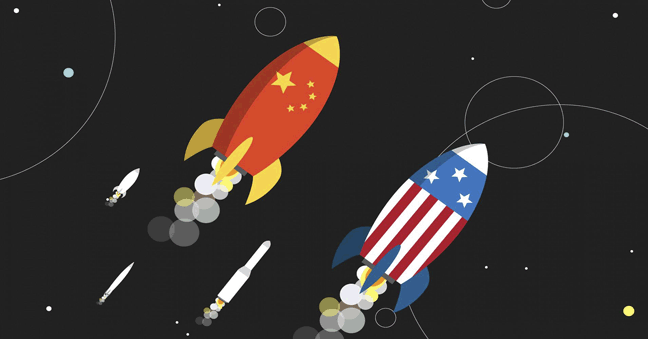 Extend New START — The World Can’t Afford a U.S.-Russia Nuclear Arms Race Too, JUST SECURITY, by Kingston Reif and Shannon Bugos, April 10, 2020 The unrelenting and rapid spread of the novel coronavirus underscores the cost of neglect and indecision by the Trump administration in the face of serious threats to U.S. and global security. This reckless abandonment of leadership also characterizes America’s response to other transnational challenges, including the potential for conflict on the European continent and the threat posed by nuclear weapons.
For example, The Guardian reported on April 5 that the Trump administration may withdraw the United States from the Open Skies Treaty this fall. The treaty allows for short-notice, unarmed, observation flights over the territory of treaty parties to collect data on military forces and activities, and is staunchly supported by U.S allies. Nothing screams the U.S. absence in a world starving for leadership during a pandemic than moving forward with plans to withdraw from a treaty that continues to benefit U.S. and European security and that our allies want us to continue to support.
In addition, and even more consequentially, the New Strategic Arms Reduction Treaty (New START), which was signed a decade ago this week, expires in just 10 months. New START is the only remaining arms control agreement limiting the world’s two largest nuclear arsenals. However, as the novel coronavirus emerged earlier this year, the administration continued to stiff-arm Russian overtures to prolong the life of the agreement by five years, as permitted by the accord. Instead, the administration has pursued the idea of striking an entirely new, trilateral arms control agreement that would include China in addition to Russia.
The chances of successfully negotiating such a new, complex deal were already slim before the coronavirus pandemic. Now, in the midst of what clearly will be an extended crisis, the odds are nigh nonexistent……
Extending New START will maintain a cap on the Russian nuclear arsenal and is a necessary condition for follow-on talks with Russia and new negotiations with China. As the world girds for a long fight against the coronavirus pandemic, the preservation of New START represents the best immediate option that Trump has to reduce the risks of instability and insecurity posed by the still-bloated and dangerous U.S. and Russian nuclear arsenals. https://www.justsecurity.org/69613/extend-new-start-the-world-cant-afford-a-u-s-russia-nuclear-arms-race-too/
Russia wants to extend New START nuclear weapons treaty, but the U.S. has not revealed its plans
|
RUSSIA SAYS U.S. ‘UNWILLINGNESS’ IS THREATENING MAJOR NUCLEAR WEAPONS DEAL https://www.newsweek.com/russia-us-unwillingness-threatening-major-nuclear-weapons-deal-1496824 BY DAVID BRENNAN ON 4/8/20 Russia has again pointed the finger at the U.S. for delaying the extension of the New START nuclear weapons treaty, which expires next year.
Kremlin spokesperson Dmitry Peskov told reporters Wednesday that any questions about why the deal has not been extended should be directed to Washington rather than Moscow. Peskov said the Kremlin remains keen to make a deal, but has met with delay from the White House. “Actions on destruction of this document—on its non-extension—are taken not by Moscow,” Peskov told reporters, according to the Tass state news agency. “Rather, this is our U.S. colleagues’ unwillingness, and we have repeatedly expressed our regret in that regard.” The 10-year New START treaty came into force in 2011. It extended the existing START agreement, which was signed in the early 1990s. New START capped the number of deployed Russian and U.S. strategic nuclear warheads and bombs at 1,550, and the number of deployed intercontinental ballistic missiles, submarine-launched ballistic missiles and heavy bombers used for nuclear missions at 700. The total allowed number of deployed and non-deployed assets is currently 800. New START is the last of what former Soviet Premier Mikhail Gorbachev called the “three principal pillars of global strategic stability,” following the collapse of the Anti-Ballistic Missile Treaty in 2002 and the Intermediate-Range Nuclear Forces treaty last year. Russia has repeatedly said that it wants to extend New START, but the U.S. has still not revealed its plans. President Donald Trump has hinted that they wish to include China in any new deal, but experts—among them one of the original negotiators of START—have warned this is not feasible in such a short time frame. Chinese officials have dismissed any suggestion of involvement in a new treaty. Newsweek has contacted the State Department for comment on its plans regarding New START. Peskov acknowledged that the New START deal has fallen down the pecking order with the appearance of the coronavirus pandemic. Both the U.S. and Russia—like many other nations—are struggling to contain the virus. “The coronavirus has halted many vital processes,” Peskov said, “This is the reality we have to face.” Russian Deputy Chairman of the Security Council of Russia Dmitry Medvedev—who was serving as president when New START was signed—complained Wednesday that in the nine years since the deal was agreed, the U.S. has flipped from “cooperation to political pressure and unleashed an unprecedented war of sanctions against us, trying to oust Russia from the global agenda.” In an op-ed for Tass, Medvedev suggested that removing sanctions on Moscow would be a good first step to re-open New START talks. “If the New START deal ceases to exist, its demise will have extremely serious consequences for international security,” the former president and prime minister said. Russian officials including President Vladimir Putin have urged the White House to lift sanctions—imposed because of Russia’s annexation of Crimea, support of separatists in eastern Ukraine and meddling in the 2016 U.S. presidential election—to help the global response to coronavirus. |
|
Bosnia might need international arbitration over Croatia’s nuclear waste dump plan near the border
|
Bosnia May Seek Arbitration on Croatia Nuclear Waste Dispute
https://balkaninsight.com/2020/04/08/bosnia-may-seek-arbitration-on-croatia-nuclear-waste-dispute/ Nedim Dervisbegovic, Sarajevo, BIRN
April 8, 2020, Minister says Bosnia will ramp up its protests after Croatia gives go-ahead for nuclear waste store to be built near Bosnian border. Bosnia may request international arbitration if Croatia proceeds with a plan to create a nuclear waste disposal site just across the border from Novi Grad in north-west Bosnia, Foreign Trade and Economic Relations Minister Stasa Kosarac was reported as saying. Kosarac’s ministry said dumping waste from the Croatian-Slovenian jointly-owned Krsko nuclear power plant at a former military storage facility near the Croatian town of Dvor would endanger the health and lives of some 250,000 people living in 13 Bosnian municipalities along the Una River. He made the statement after speaking with a group of ministers from Bosnia’s two entities, state parliamentarians and Novi Grad’s mayor via video link on Tuesday. Kosarac reportedly informed them about his telephone conversations with the Croatian ambassador to Bosnia, Ivan Sabolic, and Croatia’s Environment and Energy Minister, Tomislav Coric, after the fund for financing the decommissioning of the Krsko power plant and the disposal of its radioactive waste said last week that it had received approval from Coric’s environment ministry to use the former Čerkezovac military barracks at Trgovska Gora near Dvor. The statement said the video conference had concluded that Bosnia’s Ministry of Foreign Trade and Economic Relations would now ask the Council of Ministers – Bosnia’s state government – to help set up legal teams “to deal with this open bilateral issue with Croatia, and that budget funds be allocated for this”. “It was also concluded that it was necessary for all relevant institutions to strengthen diplomatic activities with the goal of preventing Croatia from designating this location as the final solution for the disposal of the nuclear waste,” it added. Croatia needs to take over half of the nuclear waste from the Krsko power plant, which lies inside Slovenia, by 2023. The plant was a joint venture of the two republics when both were part of former Yugoslavia. |
Trump’s stringent sanctions on Iran could result in a dangerous backlash
 WW3 warning: Donald Trump’s grave error may accelerate Iran’s push for nuclear weaponsDONALD TRUMP’S military errors may spark the next world war conflict as his stringent sanctions on Iran could result in a dangerous backlash. Express UK By GERRARD KAONGA Apr 5, 2020 Tensions between the US and Iran have remained high for years and the killing of general Qassem Soleimani raised fears of World War 3 in early 2020. Iranian expert of Iran International TV Dr Pupak Mohebali warned Iran’s stockpiling of nuclear-rich Uranium and ignoring the rules of the 2015 nuclear agreement may be a response to Donald Trump’s recent military and political actions. During an interview with Express.co.uk, Dr Mohebali claimed Iran stockpiling Uranium could be linked to the US leaving the nuclear agreement in 2018 and the killing of Qassem Soleimani.
Earlier in the interview, Dr Mohebali warned one wrong move from either the US or Iran could result in a major conflict.
She said: “I would not say there is one worst-case scenario but more like a domino effect.
“One problematic decision leads to another and another.
“If Iran was to withdraw from the Treaty on the Non-Proliferation of Nuclear Weapons (NPT) it could bring further diplomatic isolation.
Bosnia and Herzegovina oppose Croatia’s nuclear waste plan
 BiH warns Croatia against storing nuclear waste from Krško at borderhttps://balkangreenenergynews.com/bih-warns-croatia-against-storing-nuclear-waste-from-krsko-at-border/ Bosnia and Herzegovina Croatia April 3, 2020 An environmental impact study is underway after Croatia gave the green light to a special fund to use a former barracks near the border with Bosnia and Herzegovina for the disposal of nuclear waste from the Krško nuclear power plant. Both the government in Sarajevo and the Republic of Srpska entity protested against the decision. BiH warns Croatia against storing nuclear waste from Krško at borderhttps://balkangreenenergynews.com/bih-warns-croatia-against-storing-nuclear-waste-from-krsko-at-border/ Bosnia and Herzegovina Croatia April 3, 2020 An environmental impact study is underway after Croatia gave the green light to a special fund to use a former barracks near the border with Bosnia and Herzegovina for the disposal of nuclear waste from the Krško nuclear power plant. Both the government in Sarajevo and the Republic of Srpska entity protested against the decision.
Bosnia and Herzegovina’s Minister of Foreign Trade and Economic Relations Staša Košarac told Croatia’s Ambassador Ivan Sabolić that the neighboring country’s intention to build a storage site for radioactive and nuclear waste from Krško less than a kilometer from the border is unacceptable. The Čerkezovac location at Trgovska gora is a former army barracks near the town of Dvor. Croatia’s Fund for Financing the Decommissioning of the Krško Nuclear Power Plant and the Disposal of Krško NPP Radioactive Waste and Spent Nuclear Fuel just got the approval to use the facility. It revealed an environmental impact study would be conducted before it seeks permits. The Una river, separating the two states, is a protected area. Following earlier announcements about the project, BiH threatened to sue the other country and pursue arbitration and its officials have cited risk from seismic activity. Protests have been held as well.
Košarac claimed more than 250,000 people living near the river would be endangered if the plan is implemented and that it would be bad for the environment. BiH will continue to prove the damaging effect and mobilize its institutions, his ministry said. Čerkezovac is near the country’s northwestern tip. The fund based in Zagreb vowed to cooperate with the local community, the general public and stakeholders on the other side. It claimed that if the project goes through, it would manage the radioactive waste from Krško in a safe, systematic and standardized way. The nuclear power plant is in Slovenia, just 10 kilometers from the border with Croatia and just over 30 kilometers from the center of Zagreb. It was built jointly by the two republics, then part of Yugoslavia, in 1981. Slovenia plans to store waste in Krško’s vicinity, in Vrbina, but there is no consensus with Croatia.
Croatian authorities have filed the domestic national strategy with the European Atomic Energy Community (Euratom) for evaluation. The said study is planned to include geological work and the determination of the so-called zero radiation conditions. The fund said it would perform security analysis as well. Košarac informed Johann Sattler, Head of the Delegation of the European Union and the EU’s Special Representative in BiH, of the country’s stance. |
|
The Russian point of view on nuclear arms control
|
Russia’s View on Nuclear Arms Control: An Interview With Ambassador Anatoly Antonov, Arms Control Association April 2020Arms Control Today conducted a written interview in early March with Anatoly Antonov, Russian ambassador to the United States on issues including the current status of U.S.-Russian strategic security talks, the future of New START, talks on intermediate-range missile systems, engaging China in arms control, and President Vladimir Putin’s proposal for a summit of the leaders of the five permanent members of the UN Security Council……..
Amb. Anatoly Antonov: Russia and the United States are the largest nuclear weapons powers and permanent members of the UN Security Council. They bear a special responsibility for preserving world peace and security. That is why it is crucial to maintain the bilateral strategic stability dialogue at any given circumstance, regardless of political situation. It goes without saying that such engagement should be conducted on a regular basis. ……. As for the consultations in January, our reaction can be described as “cautious optimism.” On the bright side is the fact that the meeting did take place, even though it exposed serious disagreements between our countries on a number of topics. ….. There is no doubt that the Russian-U.S. bilateral arms control agenda remains relevant. We are open to discussing within the strategic dialogue the issue of the newest and prospective weapons that do not fall under New START. ……. https://www.armscontrol.org/act/2020-04/interviews/russias-view-nuclear-arms-control-interview-ambassador-anatoly-antonov |
|
New hypersonic weaponry complicates Nuclear Arms Control Regime
The advent of hypersonic weaponry introduces a new complication to the arms control landscape. Fortunately, New START is a flexible treaty. It includes specific provisions for dealing with emerging weapon systems via its Bilateral Consultative Commission. And, as Russia has demonstrated, hypersonic weapons can be incorporated into existing arms control protocols.
With the United States and Russia suddenly in agreement on the need to limit the deployment of hypersonic missiles, now is an ideal time to explicitly and transparently address these weapons under the New START framework. Doing so would ensure that nuclear arms limitations remain robust, even as tensions flare. With the clock ticking on renewal, neither nation can afford to let a hypersonic arms race get in the way of a proven instrument of global security. https://allthingsnuclear.org/ctracy/fitting-hypersonic-weapons-into-the-nuclear-arms-control-regime
New START’s hypersonic gap
New START sets limits on the deployment of US and Russian nuclear forces. Because these nations possess the vast majority of the world’s nuclear weapons, it constitutes the bedrock of modern nuclear arms control.
The treaty’s core provisions were carefully crafted to address the complexities of nuclear weapons technology. It does not directly limit the number of nuclear warheads either nation may possess, as these are difficult to track and account for. Rather, it focuses on the nuclear warhead delivery systems—ground-launched missiles, submarine-launched missiles, and heavy bomber aircraft—by which these destructive payloads can be carried intercontinental distances. New START limits the number of these systems each nation may possess (up to 800) and deploy (up to 700), as well as the number of warheads that can be mounted on them (up to 1,550).
China is Willing to Negotiate on Nuclear Arms, But Not on Trump’s Terms
 China is Willing to Negotiate on Nuclear Arms, But Not on Trump’s Terms, Defense One, BY GREGORY KULACKI, 30 Mar 20
President Trump announced to the world in a March 5 tweet that he would propose “a bold new trilateral arms control initiative with China and Russia.” China immediately rejected the idea the very next day. It would be wrong, however, to infer that Chinese leaders are opposed to nuclear arms control. They are not. They are just not interested in what Trump appears to be offering.
There are good reasons for China to suspect Trump’s motives. He used China as a scapegoat when withdrawing from the Intermediate Nuclear Forces Treaty, for example, and he may be using this vague new initiative to justify allowing the New START Treaty to expire. China was not a party to either agreement. Walking away from treaties with Russia and blaming China for it is unlikely to encourage Chinese leaders to come to the negotiating table.
Trump premised his announcement of this new initiative with a questionable claim that China will “double the size of its nuclear stockpile” before the end of the decade. That sounds ominous, but in fact China has only about 300 warheads and barely enough plutonium to get to 600. Meanwhile, the United States and Russia each possess more than 6,000 warheads. Any new agreement based on parity among the three states would require steep U.S. and Russian cuts even if China did indeed double its arsenal.
China certainly would welcome major U.S. and Russian reductions. But there is no sign either nation is willing to make them. On the contrary, Trump and President Putin have announced ambitious nuclear modernization programs that dwarf China’s. Since neither of the two countries are planning to reduce their arsenals, it is difficult for Chinese leaders to understand what Trump wants to discuss. Neither the president nor his aides have provided a tentative agenda or cited desired outcomes.
Despite Trump’s apparent failure to engage China, if he or his successor wants to bring China to the negotiating table, there is a path to follow. Below are four steps the United States can take to convince Chinese leaders to negotiate on nuclear arms.
Step 1. Pursue International, not Multilateral, Negotiations
There is a marked difference between international and multilateral negotiations, and it matters to China……..
Step 2. Accept Mutual Vulnerability
Accepting mutual vulnerability sounds defeatist. But all it means is that no one can win a nuclear arms race. The United States cannot prevent China from being able to retaliate and deliver some number of nuclear weapons if the United States should ever choose to use nuclear weapons first during a war……
Step 3. Take No-First-Use Seriously
China is serious about not using its nuclear weapons first in an armed conflict. In a statement after its first nuclear test in 1964, the Chinese government declared it will “never at any time and under any circumstances be the first to use nuclear weapons.”…
Step 4. Discuss Limits on Missile Defense
When the United States and the Soviet Union finally realized that no one could win a nuclear arms race, they decided to talk. Negotiators quickly discovered that limiting offense was impossible without limiting defense as well, since an effective way to counter defenses is to build more offensive weapons…..https://www.defenseone.com/ideas/2020/03/china-willing-negotiate-nuclear-arms-not-trumps-terms/164204/
With all eyes on pandemic, Nuclear Non Proliferation Treaty still needs attention
 Nuclear Proliferation Treaty Troubles Remain Unaddressed Amid a Global Pandemic, https://nationalinterest.org/feature/nuclear-proliferation-treaty-troubles-remain-unaddressed-amid-global-pandemic-138162 It is vital that would-be bombmakers be disabused of any notion that they could evade tough international sanctions. We need a country-neutral, reasonably predictable, more-or-less automatic sanction regime that puts all countries on notice, even friends of the powerful. Nuclear Proliferation Treaty Troubles Remain Unaddressed Amid a Global Pandemic, https://nationalinterest.org/feature/nuclear-proliferation-treaty-troubles-remain-unaddressed-amid-global-pandemic-138162 It is vital that would-be bombmakers be disabused of any notion that they could evade tough international sanctions. We need a country-neutral, reasonably predictable, more-or-less automatic sanction regime that puts all countries on notice, even friends of the powerful.
by Victor Gilinsky Henry Sokolski, 27 Mar 20, Just as we’ve had to discard business-as-usual thinking to deal with the current worldwide health emergency; it’s time to get serious about the spread of nuclear weapons. It doesn’t have the immediacy of the coronavirus, but it will last a lot longer and is no less threatening. In particular, we need to fortify the Nuclear Nonproliferation Treaty (NPT), which is fifty years old this year and badly needs fixing. The April 2020 Review Conference will likely be postponed, which provides time to develop something more than the usual charade of incremental proposals that nibble at the problem.
What needs fixing? Five problems: The NPT allows withdrawal on three months notice; it does not bar the use of nuclear explosives as fuels; its inspection arm, the International Atomic Energy Agency (IAEA), is too much involved in promoting nuclear energy; it lacks an established enforcement system, so each violation requires an improvised response; and it is undermined by the holdouts—India, Israel, North Korea, and Pakistan—thumbing their noses at the treaty. International lawyers may scream, but we need to make it essentially impossible to exercise the NPT’s withdrawal provision. This is vital because the member states’ safeguards agreements with the IAEA remain in force only so long as the states remain parties to the treaty. A country should not be allowed to gather the wherewithal for a bomb while a member and then free itself of its treaty responsibilities by announcing its withdrawal. It shouldn’t be allowed to leave the treaty with technology, imported or indigenous, it obtained as a member, because it did so with the forbearance of other members on the assumption that it was doing so for peaceful uses.There has to be a wide safety margin between genuinely peaceful and potentially military applications to make it impossible to surprise the world with a bomb.
The oft-cited “inalienable right” to “nuclear energy for peaceful purposes” in the NPT’s Article IV has to be interpreted strictly in terms of the treaty’s overriding objective expressed in Article I (nuclear weapons countries can’t help others get bombs), and Article II (non-weapons countries can’t get them, period). That’s a long way of saying no commercial use of highly enriched uranium or plutonium, which today has no economic justification.
Another relic embedded in the NPT and the IAEA Statute is their promotion of nuclear power. With mind-numbing regularity, IAEA officials argue that accommodating countries on nuclear energy technology helps to gain their assent to control measures. But this approach weakens the NPT by creating a zero-sum game in which nonproliferation obligations of the many members are held hostage to technology sharing by the main supplier states. Unfortunately, too many members want dangerous technologies. That is not all. The agency’s singling out of nuclear energy as the anointed energy source leads to a misallocation of economic and scientific resources in countries that can’t afford it.
In the initial years of the NPT, there was an implicit assumption that the Western states and Soviets would police their spheres. But now, with the Cold War over, the NPT needs an established enforcement mechanism to deal predictably with violations, instead of each instance requiring improvisation by the leading members. The logic of “safeguards” assumes rapid international reaction, but experience shows it is more often measured in years. It is vital that would-be bombmakers be disabused of any notion that they could evade tough international sanctions. We need a country-neutral, reasonably predictable, more-or-less automatic sanction regime that puts all countries on notice, even friends of the powerful. A permanent secretariat attached to the treaty would help. Finally, it undermines the treaty when a non-member is used to enforce it, as when the United States acquiesced in Israel’s 2007 bombing of Syria’s clandestine reactor, instead of involving the IAEA, or when it cooperated with Israel in sabotaging Iran’s nuclear program.
The most difficult issue is what to do about the three NPT holdouts—India, Israel, and Pakistan—and the member-in-violation, North Korea. The drafters’ intent to only recognize five nuclear states was to first make sure that number did not grow larger while treating reductions among the five separately. To add new nuclear weapon members in addition to these five would undermine the treaty. However impossible it may now seem, the only way that all states can be brought under the NPT system is if all commit themselves to reduce their nuclear weapons to zero. The United States and Russia have made substantial reductions, but the continuation of that process requires all nuclear states to join in further cuts. Towards this end, we would universalize the treaty—that is, regard it as applicable to all states. The three holdouts would then be in non-compliance. Of course, as a legal matter, you cannot force a country to join a treaty. But if the 190 NPT members so decided, they could treat the three holdouts, and North Korea, as countries in non-compliance, with appropriate disadvantages that would follow from that. At the same time, if these countries joined the weapons reductions process under adequate monitoring, they could be considered as approaching compliance, and disadvantages could be moderated.
This much is clear: Incremental, least-common-denominator steps are never going to get us to where we need to be, and serious people responsible for security know it. To cope with proliferation hazards in the face of weak international controls over nuclear programs, the world seems to be slipping—witness the case of Iran—into relying on greatly increased national intelligence operations backed up in the last instance by bombing and even assassinations. It is difficult to imagine that this is a workable solution for the long term.
To stop the further spread of nuclear weapons, we have to stop downplaying the NPT. Instead, we should strengthen and use it. Victor Gilinsky is a program advisor for the Nonproliferation Policy Education Center (NPEC) in Arlington, Virginia. He served on the Nuclear Regulatory Commission under Presidents Ford, Carter, and Reagan. Henry Sokolski is executive director of NPEC and the author of Underestimated: Our Not So Peaceful Nuclear Future (second edition 2019). He served as deputy for nonproliferation policy in the Cheney Pentagon. |
|
Belarus to swap gas dependence on Moscow for nuclear dependence on Moscow
|
Belarus to swap gas dependence on Moscow for nuclear dependence on Moscow https://bellona.org/news/nuclear-issues/2020-03-belarus-to-swap-gas-dependence-on-moscow-for-nuclear-dependence-on-moscowA nuclear power plant built to lessen Belarus’s dependence on Moscow for natural gas – but constructed and lavishly financed by Russia’s state nuclear corporation Rosatom – is due to begin operation later this year, officials in the Belarus capital of Minsk have said. March 24, 2020 by Charles Digges
A nuclear power plant built to lessen Belarus’s dependence on Moscow for natural gas – but constructed and lavishly financed by Russia’s state nuclear corporation Rosatom – is due to begin operation later this year, officials in the Belarus capital of Minsk have said. The plant will feature two VVER-1200 reactors – the second of which will come online next year – that will together generate some 2.4 gigawatts of power in the cloistered post-Soviet dictatorship on Russia’s western border. The International Atomic Energy Agency found that the plant largely fulfilled general safety guidelines and issued a number of recommendations for improvement. Others have raised alarm over potential safety issues. GlobalData quoted energy and nuclear policy analyst Mycle Schneider as warning: “Neighboring countries have voiced concern over the lack of review of some serious safety concerns, and Lithuania has transmitted an official note to the European Council.” Since its inception in the early 2000s, the Belarus nuclear power plant, in Ostrovets near the border of Lithuania, has been fraught with difficulties. Environmentalists who oppose the plant are routinely harassed and stifled and in some cases kicked out of the country. Neighboring Lithuania, once seen as a promising potential market when construction began, is now so opposed to the plant that its parliament outlawed purchasing any electricity it produces and has sent envoys to other countries encouraging them to do the same. Poland and the Ukraine have also spoken out against the plant. Each of these groups have called attention to the mishaps that have plagued the plant during its construction, including an incident in 2016 when technicians inadvertently dropped a 330-ton reactor pressure vessel – which houses the core – from a crane. A replacement unit sent to the site was accidentally run into a column at a railway station when it arrived. But the plant also illustrates an energy conundrum facing many European countries. While a number of nations in the old Soviet orbit seek to diversify their energy supplies away from Russian natural gas, Rosatom is more than willing to step into the vacuum left by that shift. By offering huge loans to build and supply nuclear power plants, Rosatom can keep customers financially and technically beholden to Moscow for as long as 50 years. With other kinds of power infrastructure, a contractor builds a facility and leaves it to be operated by the country where it stands. Not so with nuclear power plants, where foreign government customers, like Belarus, remain dependent on Rosatom – and thus the Russian state – for fuel, know-how and eventual decommissioning works. That geopolitical strategy is not lost on Lithuania, whose prime minister recently told the New York Times that: “The [Ostrovets} nuclear plant is an example of Russia’s desire to keep states along its borders in its orbit at all costs – it helps them preserve more influence.” The policy is has broad implications. Rosatom has convinced dozens of countries to sign memorandums of understanding on all manner of nuclear services, from research and training facilities to nuclear power plant construction. As a result, Rosatom says that its portfolio of foreign projects has swelled to more than $200 billion. But that figure invites skepticism. Many of the counties Rosatom counts toward that figure – like Ethiopia, Algeria, Nigeria, Sudan and Rwanda – won’t be ready to support nuclear power on their grids for decades. Others where Rosatom builds are already underway – like India’ Kudankulam, Iran’s Bushehr and China’s Tianwan – are already familiar with Rosatom’s typical cost overruns and delays. Furthermore, a deep dig into Rosatom’s claimed income by the Russian environmental group Ecodefence revealed that business wasn’t going quite as indicated. A report by the group, published last year, detailed a number of cases where the corporation misstated the worth of its overseas reactor construction projects, and inflated their worth by several billion dollars. Still, the corporation is an ambitious and successful presence on the international market. According to one study, cited by the New York Times, Rosatom has sold more nuclear technology abroad since 1999 than the United States, France, China, South Korea and Japan combined. Rosatom’s approach to marketing its reactors is distinct from its western competitors because it offers to finance, build and operate the plants that it builds abroad. These generous terms come thanks to the enormous state subsidies Rosatom receives – and which it can then funnel into loans that boost its profits on paper. The Belarus plant, for instance, comes thanks to a $10 million line of credit from Rosatom. Hungary, a member of the EU, became another customer when it took an $11 billion loan to build its Paks II in 2016. Rosatom also won a $30 billion contract for four reactors in Egypt, and another big nuclear plant deal in Turkey. While it’s tempting to see a strategy afoot in Rosatom’s foreign projects, the Kremlin insists it’s just business. President Vladimir Putin has publicly distanced himself from mixing politics with foreign commerce. |
|
Iran, hit by hardship and coronavirus, gets callous sanctions from Trump administration
 Trump’s callous sanctions risk tipping Iran over the nuclear precipice, Mike Pompeo’s imposition of further sanctions is another disaster for the people of Iran and could cause Tehran to raise the stakes, Guardian, Simon Tisdall Sun 22 Mar 2020
Displaying the sort of unthinking bellicosity that has characterised his tenure as US secretary of state, Mike Pompeo chose last week – a time of unprecedented global turmoil – to impose yet more unilateral sanctions on Iran. This was akin to pouring petrol on a burning building, then waiting to see how big an explosion ensues.
The timing of the new measures was doubly inept. Iran’s freeing of thousands of political prisoners last week raised hopes of full pardons for jailed US citizens and the British-Iranian dual national Nazanin Zaghari-Ratcliffe, who has been temporarily released.
Those hopes have receded now. Meanwhile, Pompeo’s heedless intervention risked fuelling calls inside Iran to
not only the creaking 2015 nuclear deal but also the nuclear non-proliferation treaty (NPT) – the cornerstone since 1970 of international efforts to curb the spread of nuclear weapons.
,………. the move could hardly have been more provocative, or more cruel. Iranians have endured many months of intensifying hardship as US sanctions have shrunk the economy, destroyed jobs and depressed living standards. They have been badly hit by the coronavirus, which the health ministry has said is killing one person every 10 minutes.
Advertisement
Callous US disregard for Iran’s Covid-19 emergency – it is effectively blocking bilateral medical aid and a request for a $5bn loan from the International Monetary Fund – suggests that Washington is not interested in confidence-building measures. “The Wuhan virus is a killer and the Iranian regime is an accomplice,” Pompeo snarled.
Iran’s leadership is under pressure from conservative hardliners after the latter’s recent election successes. This latest manifestation of Washington’s unremitting hostility may help push them over the brink. Thanks mainly to Donald Trump and his sidekick, Tehran could soon move a crucial step closer to going nuclear – the very outcome the Americans most fear……. https://www.theguardian.com/commentisfree/2020/mar/21/trump-pompeo-iran-callous-sanctions-nuclear-precipice
Sun 22 Mar 2020 Trump’s callous sanctions risk tipping Iran over the nuclear precipiceSimon Tisdall
isplaying the sort of unthinking bellicosity that has characterised his tenure as US secretary of state, Mike Pompeo chose last week – a time of unprecedented global turmoil – to impose yet more unilateral sanctions on Iran. This was akin to pouring petrol on a burning building, then waiting to see how big an explosion ensues.
The timing of the new measures was doubly inept. Iran’s freeing of thousands of political prisoners last week raised hopes of full pardons for jailed US citizens and the British-Iranian dual national Nazanin Zaghari-Ratcliffe, who has been temporarily released.
Those hopes have receded now. Meanwhile, Pompeo’s heedless intervention risked fuelling calls inside Iran to
not only the creaking 2015 nuclear deal but also the nuclear non-proliferation treaty (NPT) – the cornerstone since 1970 of international efforts to curb the spread of nuclear weapons.
,………. the move could hardly have been more provocative, or more cruel. Iranians have endured many months of intensifying hardship as US sanctions have shrunk the economy, destroyed jobs and depressed living standards. They have been badly hit by the coronavirus, which the health ministry has said is killing one person every 10 minutes.
Callous US disregard for Iran’s Covid-19 emergency – it is effectively blocking bilateral medical aid and a request for a $5bn loan from the International Monetary Fund – suggests that Washington is not interested in confidence-building measures. “The Wuhan virus is a killer and the Iranian regime is an accomplice,” Pompeo snarled.
Iran’s leadership is under pressure from conservative hardliners after the latter’s recent election successes. This latest manifestation of Washington’s unremitting hostility may help push them over the brink. Thanks mainly to Donald Trump and his sidekick, Tehran could soon move a crucial step closer to going nuclear – the very outcome the Americans most fear……. https://www.theguardian.com/commentisfree/2020/mar/21/trump-pompeo-iran-callous-sanctions-nuclear-precipice
What effect will pandemic have on tensions with North Korea?
Breakthrough or Crisis? How Will Coronavirus Impact Tensions with North Korea?
Is a breakthrough possible?: “As it continues to call on Pyongyang to resume negotiations, Washington could consider gathering support for an interim agreement from Seoul, Tokyo, Beijing, and Moscow. If successful, perhaps North Korea will feel pressured to return to dialogue or risk being blamed for breaking the diplomatic process. If a deal cannot be reached before November, the elements of such an interim agreement could be the starting point of discussions with the US administration after the elections.” National Interest, by Duyeon Kim, 22 Mar 20 The novel coronavirus pandemic has accelerated geopolitical tensions first in Northeast Asia, with the original outbreak in China, and now around the world as the United States, Europe and many others battle their own epidemics and global markets spiral downward. Leaders among the big powers—particularly the US, China, and Russia—already trying to exploit this global crisis to gain advantage and exert power instead of coming together to fight a common threat. This climate adds another layer of uncertainty over the Korean Peninsula where an authoritarian leader is trying to exert his power at a time when every world leader is preoccupied with the viral disease that is simultaneously testing their leadership and competence.
1 This Month
26 April – Chernobyl: Inside the Meltdown airs on National Geographic on Sunday 26th April from 4pm
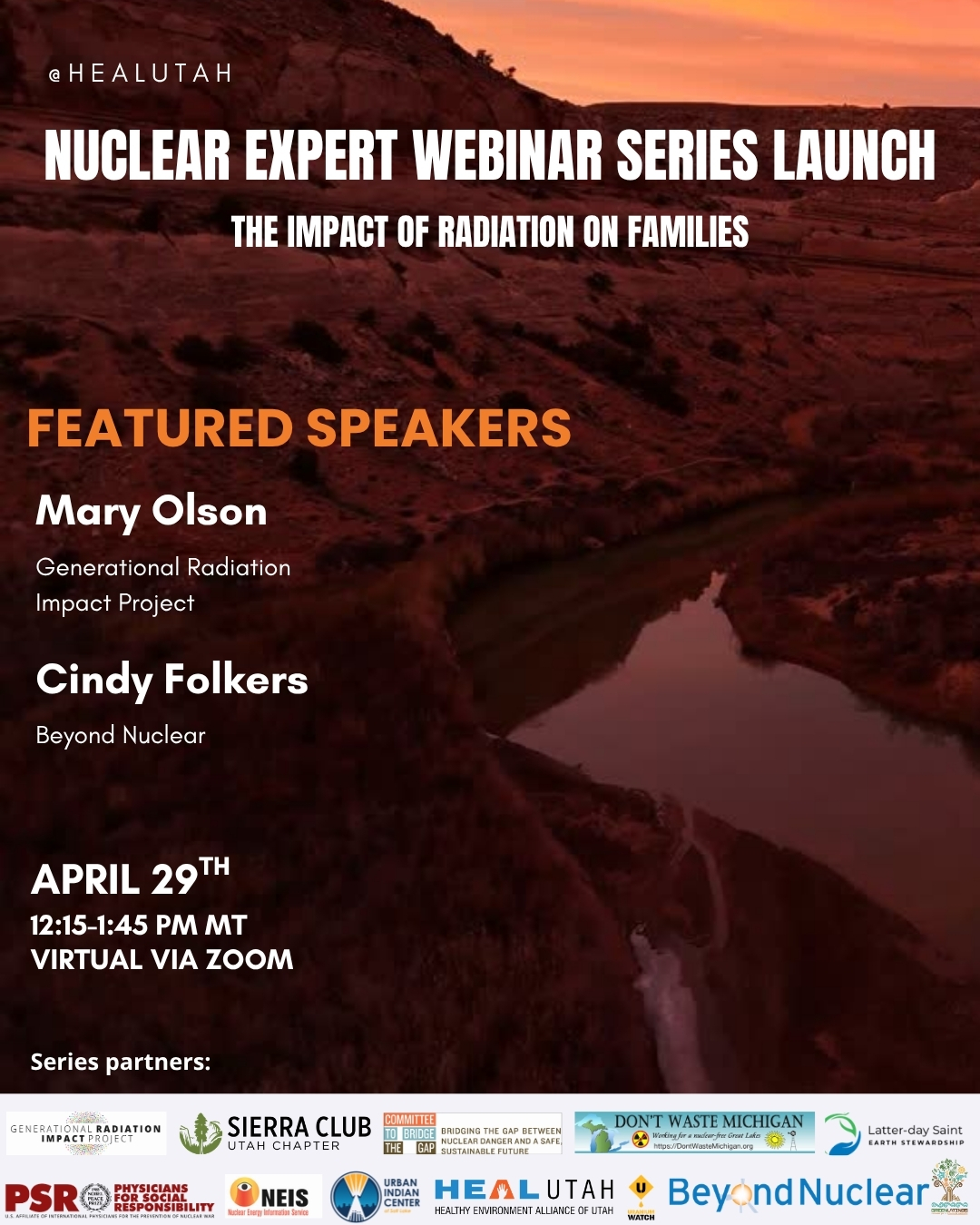
29 April – Nuclear Expert Webinar #1 – Radiation Impacts on Families with Mary Olson and Cindy Folkers
- 12:15 PM MT – 1:45 PM MT
- Location: Virtual – REGISTER TODAY

4 May -West Suburban Peace Coalition to discuss Iran war at May Educational Forum
Monday, May 4, 7:00 – 8:00 PM Central Standard Time
Title: : How Trump’s Narrative Tries to Shape the Reality of the War on Iran.
Contact Walt Zlotow, zlotow@hotmail.com 630 442 3045 for further information
14 May – online event From Bombs to Data Centres: the Face of Nuclear Colonialism

Pine Ridge Uranium is the real threat, not Tehran- Tell Burgum: Stop the Extraction.
Chernobyl: The Lost Tapes – A good documentary on Chernobyl on SBS available On Demand for the next 3 weeks– https://www.sbs.com.au/ondemand/tv-program/chernobyl-the-lost-tapes/2352741955560
To see nuclear-related stories in greater depth and intensity – go to https://nuclearinformation.wordpress.com
-
Archives
- April 2026 (327)
- March 2026 (251)
- February 2026 (268)
- January 2026 (308)
- December 2025 (358)
- November 2025 (359)
- October 2025 (376)
- September 2025 (257)
- August 2025 (319)
- July 2025 (230)
- June 2025 (348)
- May 2025 (261)
-
Categories
- 1
- 1 NUCLEAR ISSUES
- business and costs
- climate change
- culture and arts
- ENERGY
- environment
- health
- history
- indigenous issues
- Legal
- marketing of nuclear
- media
- opposition to nuclear
- PERSONAL STORIES
- politics
- politics international
- Religion and ethics
- safety
- secrets,lies and civil liberties
- spinbuster
- technology
- Uranium
- wastes
- weapons and war
- Women
- 2 WORLD
- ACTION
- AFRICA
- Atrocities
- AUSTRALIA
- Christina's notes
- Christina's themes
- culture and arts
- Events
- Fuk 2022
- Fuk 2023
- Fukushima 2017
- Fukushima 2018
- fukushima 2019
- Fukushima 2020
- Fukushima 2021
- general
- global warming
- Humour (God we need it)
- Nuclear
- RARE EARTHS
- Reference
- resources – print
- Resources -audiovicual
- Weekly Newsletter
- World
- World Nuclear
- YouTube
-
RSS
Entries RSS
Comments RSS
 nuclear-news