Reviving the Iran nuclear deal will test Joe Biden
Reviving the Iran nuclear deal will test Joe Biden, Tehran says the ball is in America’s court, but Washington first wants compliance, Ft.com, DAVID GARDNER, 27 Jan 21,
US president Joe Biden’s incoming foreign policy team, full of veterans from the Barack Obama administrations, will have no illusions about how tricky it will be to refloat the 2015 nuclear deal with Iran that was torpedoed by Donald Trump in 2018. They know from direct experience how canny Iranian negotiators are — and how antagonistic relations have become with the Islamic Republic. ………
Buddhist leader urges international co-operation in further steps on the Nuclear Ban Treaty
 Buddhist Leader Welcomes Entry into Force of Nuclear Ban Treaty, Urges
 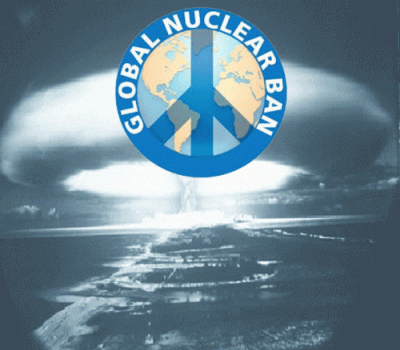 International Cooperation to CombatPandemic in 39th Annual Peace Proposal, Soka Gakkai , Jan 26, 2021, TOKYO, Jan. 26, 2021 /PRNewswire/ — On January 26, 2021, the 39th annual peace proposal by Daisaku Ikeda, president of the Soka Gakkai International (SGI) Buddhist association, titled “Value Creation in a Time of Crisis” was released, marking the anniversary of the founding of the SGI.
Ikeda calls for further global cooperation to address the key issues of our time: the COVID-19 pandemic, the climate crisis, and the need to rid the world of nuclear weapons. These issues are not constrained by national borders and cannot be solved by any one government or organization alone……….
Consistent with his decades of action toward the abolition of nuclear weapons, Ikeda welcomes the UN Treaty on the Prohibition of Nuclear Weapons (TPNW), which entered into force on January 22, 2021, as a “pivotal event ushering in a new era” that will spur a paradigm shift in approaches to security. He calls on Japan to participate in the first meeting of the States Parties to the TPNW, to begin to create the conditions in which future ratification can become possible.
He proposes that a forum for discussing the relationship between nuclear weapons and the UN Sustainable Development Goals (SDGs) be held during the first meeting of States Parties to the TPNW.
At the Nuclear Non-Proliferation Treaty (NPT) Review Conference scheduled for August 2021, Ikeda also urges discussion on the true meaning of security in the light of crises such as the climate emergency and the pandemic.
He calls for the final document of the Review Conference to include a pledge of non-use of nuclear weapons and the freezing of all nuclear weapon development until 2025.
A statement from Soka Gakkai President Minoru Harada welcoming the entry into force of the TPNW issued on January 22 can be found at: https://www.sokaglobal.org/contact-us/media-room/statements/tpnw-entry-into-force.html. The SGI has also cosigned an interfaith statement together with more than 170 other religious groups. See: https://sgi-ouna.org/tpnw-eif-interfaith-statement ………..https://www.prnewswire.com/news-releases/buddhist-leader-welcomes-entry-into-force-of-nuclear-ban-treaty-urges-international-cooperation-to-combat-pandemic-in-39th-annual-peace-proposal-301214677.html
Russia and USA exchange documents to extend the NEW START nuclear weapons agreement

 Russia, US Exchange Documents to Extend Nuclear Pact
The Kremlin says Russia and the United States have exchanged documents to extend their last remaining nuclear arms control pact days before it is set to expire. U.S. News, BY VLADIMIR ISACHENKOV, Associated Press, MOSCOW (AP) 26 Jan 21 — Russia and the United States traded documents Tuesday to extend their last remaining nuclear arms control treaty days before it is due to expire, the Kremlin said.
A Kremlin readout of a phone call between U.S. President Joe Biden and Russian President Vladimir Putin said the two leaders voiced satisfaction with the exchange of diplomatic notes about extending the New START treaty.
“In the nearest days, the parties will complete the necessary procedures that will ensure further functioning of this important international legal nuclear arms control tool,” the Kremlin said.
The pact’s extension doesn’t require congressional approval in the U.S., but Russian lawmakers must ratify the move. Top members of the Kremlin-controlled parliament said they would fast-track the issue and complete the necessary steps to extend the treaty this week.
New START expires on Feb. 5. After taking office last week, Biden proposed extending the treaty for five years, and the Kremlin quickly welcomed the offer………. https://www.usnews.com/news/world/articles/2021-01-26/russia-diplomat-hails-progress-in-nuclear-pact-talks-with-us
Biden’s USA headed for confrontation with Russia? The troubling appointment of Victoria Nuland
Nuland’s actions helped produce the regime change in Ukraine which led to U.S. arms sales, U.S. sanctions on Russia, even the first Trump impeachment over the matter of anti-tank missile delivery. The coup damaged U.S.-Russian relations
Basic Notes on Victoria (“Fuck the EU!”) Nuland, more https://www.counterpunch.org/2021/01/25/basic-notes-on-victoria-fuck-the-eu-nuland/ BY GARY LEUPP, 25 Jan 21
On January 5 Joe Biden quietly announced the nomination of Victoria (“Fuck the EU!”) Nuland as Deputy Secretary of State for Political Affairs. This announcement may signal the inception of the confrontation with Russia placed on hold during the Trump presidency.
For four years the Democrats have pilloried Trump for “coddling” Putin, although in fact Trump has heaped sanctions on Russia bringing relations to their lowest point since the early Cold War. Now they want some more serious anti-Russian measures. They want their president, Commander-in-Chief of the Exceptional Nation and Leader of the Free World against its adversaries, return us to Clinton-Obama normalcy. That means “getting tougher” with Russia. But what does tougher mean?
Nuland is eminently qualified for the task of making things much worse, even provoking war with the other superpower that while lacking foreign bases, and spending a fraction of what NATO spends on military defense, has over 6000 nuclear weapons. (Remember? The U.S. developed and used nuclear weapons in 1945, the only country to ever do so. The Soviets followed by developing their own bomb in 1949, in self-defense. That’s when Truman established NATO as an anti-Soviet, anti-communist military alliance.)
Moscow feels a mounting resentment over the expansion of a hostile military alliance, formed during the Cold War under conditions no longer pertinent, to surround it. Is this hard to fathom? How would Congress view a gradual expansion of a Russian-led military alliance committed to spending 2% of its members’ GDPs on military spending to embrace Mexico, Cuba, Nicaragua, Venezuela, Panama and maybe Canada next year?
Nuland is a career official, serving under multiple administrations, representing bipartisan imperialism. She was deputy director for “affairs in the former Soviet republics” in the Bill Clinton administration. Her task was to exploit the pain and suffering caused by the implosion of the Soviet Union to assert greater U.S. hegemony over Eurasia, using the traditional mix of covert operations, National Endowment for Democracy meddling, “color revolutions,” aid promises, etc.
During this period Clinton reneged on the U.S. promise to Moscow in 1989 that NATO would not advance “one inch” east after the Soviets accepted German reunification. Instead he drew Poland, Hungary and Czechoslovakia, long members of the dissolved Warsaw Pact, into the anti-Russian military alliance in 1999. It was an extraordinary repudiation of the Bush-Gorbachev agreement, an egregious provocation of a now-friendly country (then headed by the buffoonish Boris Yeltsin), unremarked on by the U.S. press at the time as anything controversial. Since then the expansion of NATO has been treated as no more remarkable than the expansion of UNESCO. Thank Nuland in part for making you think relentless NATO growth is normal, and that it makes sense for North Macedonia and Montenegro to have joined most recently (during the Trump term).
Thank Nuland too, in part, for the “color revolutions” in Serbia (2000), Georgia (2003), Ukraine (2004) and Kyrgyzstan (2005). The (fake) concept of the popular uprising against (Russian-backed) tyranny, backed by an altruistic America that stands for Freedom and Democracy—that’s Nuland’s baby. She surely has plans for Belarus. And she must be deeply alarmed that the State Department did not try to interfere in the last flare-up of violence in Nagarno-Karabakh leaving Russian diplomacy to resolve the situation. (Just because Russia itself extends into the Caucasus and borders Georgia and Azerbaijan doesn’t mean that it should “interfere” in countries that ought by rights to be ruled by the U.S.A.—due to Exceptionalism and all.)
The extremely reactionary chauvinistic Nuland was deputy foreign advisor to Dick Cheney during the Bush-Cheney administration (2003-2005) and then U.S. ambassador to NATO (2005-2008). Under Obama she was Under Secretary of State for Europe and Eurasia, handpicked by Hillary Clinton. She is married to noted neocon warmonger-scholar Robert Kagan. Both were deeply complicit in spreading the Big Lies leading to the Iraq War in 2003. Nuland supported Hillary Clinton’s terroristic regime change efforts in Libya and Syria. But her main mission in life is to expand NATO. Joe Biden shares her passion for this project.
Nuland is perhaps best known for her pithy ejaculation: “Fuck the EU!” in a telephone call with the U.S. ambassador to Ukraine in 2014.
In that year, while Nuland built support for the coup in Kiev (Feb. 18 to 21), she boasted openly that the U.S. had invested $5 billion in supporting “the Ukrainian people’s European aspirations.” (This referred to the support of some Ukrainians for the violent overthrow of the democratically elected president, Viktor Yanukovych, on the basis of his alleged pro-Russian policies and his opposition to European Union affiliation under the conditions the EU was then offering.) To state the matter honestly: the U.S. spent $5 billion to install a government in Kiev that would request NATO membership (ostensibly to protect it from always-aggressive, always expanding Russia) and bind it forever to the U.S. military-industrial complex and “Free World.”
Since NATO membership since the end of the Cold War has invariably been followed by EU membership, it was easy for Nuland to pose as the champion of Ukraine’s EU membership versus the evil Russians (supposedly) opposing that membership. Yanukovych himself had negotiated seriously with the EU but rejected a plan for association due to its austerity provisions. Meanwhile Moscow offered an attractive aid package. This in the world of U.S. propaganda was a choice between Europe and Russia, with Yanukovych siding with America’s adversary.
The Maidan coup occurred just a month after Nuland was recorded discussing the upcoming event with U.S. ambassador to Ukraine, Geoffrey Pyatt. Nuland, who had joined Sen. John McCain and other U.S. politicians in offering cookies to the Maidan protestors, discussed with Pyatt who should serve as prime minister after the coup. Pyatt noted that the EU favored Vitali Klitschko, the ex-boxer.
“Fuck the EU!” replied Nuland, who wanted banker and NATO supporter Arseniy Yatsenyuk to lead the new government. She soon got her way.
Nuland worked with Oleh Tyahnybok, head of the neo-Nazi Svoboda Party (and one of the three leaders Nuland ordered Pyatt to keep in touch with) and the Right Sector militia. Both glorify Stephan Bandera, the Ukrainian fascist leader who aided the Nazis in rounding up Ukrainian Jews during the war. Tyahnybok publicly inveighs against the “Moscow-Jewish mafia ruling Ukraine.”
When Congressman Dana Rohrbacher Nuland in a hearing was asked soon after the coup whether there had been any neo-fascists on the Maidan she refused to answer the question, stating there were “mothers, grandmothers, and veterans…all colors of Ukraine, including ugly colors” on the Maidan. In other words, a diverse anti-Russian crowd. (Notice how she ignored the existence of the 30% of Ukrainians who are ethnic Russians and were a support base for the president targeted for toppling. Just the sort of sensitivity to ethnicity you’d expect from a top U.S. State Department official who’d been comfortable with the slaughter of Iraqis.) Continue reading
Iran urges Biden to make haste to rejoin the nuclear deal
 Iran warns Biden over nuclear deal, Canberra Times Nasser Karimi 26 Jan 21, Iran has warned the Biden administration it will not have an indefinite time period to rejoin the 2015 nuclear deal between Tehran and world powers.
Iran also said it expects Washington to swiftly lift crippling economic sanctions that Donald Trump imposed after pulling America out of the atomic accord in 2018, as part of what he called maximum pressure against Tehran.
Biden has pledged to return to the nuclear deal, but Iran’s cabinet spokesman Ali Rabiei said there has yet to be any communication between the two sides on the subject……..https://www.canberratimes.com.au/story/7101356/iran-warns-biden-over-nuclear-deal/?cs=14264
Nuclear Ban Treaty obligates countries to assist nuclear victims and remediate environments
Policy Approaches Addressing the Ongoing Humanitarian and Environmental Consequences of Nuclear Weapons: A Commentary, Wiley Online Library Nate Van Duzer Alicia Sanders‐Zakre 20 January 2021 https://doi.org/10.1111/1758-5899.12870
Abstract
The 2017 Treaty on the Prohibition of Nuclear Weapons (TPNW) not only bans nuclear weapons, it obligates its states parties to engage in assisting victims and remediating contaminated environments (Articles 6 and 7). As states and civil society consider the best methods to implement these provisions, it is important to take stock and review existing policy approaches addressing the ongoing humanitarian and environmental consequences of nuclear weapons. This practitioner commentary, written by members of the International Campaign to Abolish Nuclear Weapons (ICAN), which was awarded the 2017 Nobel Peace Prize for its advocacy for the TPNW, reviews existing programs of victim assistance and environmental remediation. It highlights key considerations for policy makers seeking to improve on the existing mechanisms.
……….. Key takeaways
Dozens of identified sites around the world remain contaminated by nuclear weapons use, production and testing, and there is no one standard for their remediation. Notably, there is no widely accepted standard to determine how clean is clean, or how to monitor radiation levels over time. Speed and thoroughness of cleanup vary widely as well, and the cost to remediate each site ranges from millions of US$ to billions. Even remediated sites are often still somewhat closed to the public. The nuclear‐armed states have historically done the most to direct and carry out the cleanup of sites, even if the test site is not under those states’ jurisdiction. However, nuclear‐armed states do not always respond to local requests for action. https://onlinelibrary.wiley.com/doi/10.1111/1758-5899.12870
5 nuclear activities that are now Illegal under international law
 Here are five examples of the type of activities that will be Illegal under international law on 22 January 2021 https://nukewatch.org/new-and-updated-item/here-are-five-examples-of-the-type-of-activities-that-will-be-illegal-under-international-law-on-22-january-2021/
One of the main problems with talking about nuclear weapons is that it often becomes abstract and hypothetical. Most people barely know which countries have nuclear weapons and do not know to what extent other actors are involved in maintaining and upholding nuclear weapons.
WHAT THE TREATY PROHIBITS
Article 1 of the treaty prohibits states parties from developing, testing, producing, manufacturing, transferring, possessing, stockpiling, using or threatening to use nuclear weapons, or allowing nuclear weapons to be stationed on their territory. It also prohibits them from assisting, encouraging or inducing anyone to engage in any of these activities.
#1: THE TREATY BANS THE DEVELOPMENT OF NEW NUCLEAR WEAPONS SYSTEMS
Right now, all nuclear armed states are quantitatively or qualitatively advancing their nuclear arsenals, to the tune of nearly $73 billion in 2019 alone. Developing nuclear weapons is banned for states parties in Article 1(a) of the treaty. So activities like India’s Agni-V intercontinental ballistic missile? Banned under international law. Pakistan’s Babur-3 submarine-launched ballistic missile? Banned under international law. North Korea’s’ growing nuclear warhead arsenal? Banned under international law. Nuclear-armed states may not be legally obligated to comply with a treaty they haven’t joined. But their behavior contradicts this new instrument of international law and the growing norm it represents.
#2: THE TREATY BANS ASSISTING WITH DEVELOPING NUCLEAR WEAPONS
Dozens of U.S. universities are involved in the U.S. nuclear weapons complex, including through direct management and research partnerships with the laboratories that design and can produce nuclear weapons components. The University of California, Texas A&M University, Johns Hopkins University, the Massachusetts Institute of Technology, and the University of Rochester receive billions in contracts to directly manage laboratories that work on nuclear weapons. The University of California and Texas A&M University are both operators of the Los Alamos National Laboratory, which provides design and engineering for several nuclear warhead types, conducts simulated experiments to evaluate warheads, and has the capacity to produce plutonium pits, the core material for nuclear warheads. An average-sized U.S. nuclear weapon, that could be designed and developed at Los Alamos overseen by the University of California and Texas A&M University, detonated over the center of Paris would immediately kill over 500,000 civilians, and injure more than one million, causing third-degree burns all the way out to the suburbs.
From 22 January 2021, these universities, and others that are participating in the development and production of nuclear weapons, are carrying out activities that are banned under international law. Students should demand their universities focus on research to save lives, not end them.
#3: THE TREATY BANS THE HOSTING OF NUCLEAR WEAPONS
Article 1(g) of the TPNW explicitly prohibits allowing the stationing, installation or deployment of nuclear weapons.
|
There are five countries in the world that are currently engaged in this soon to be banned behaviour: Belgium, Germany, the Netherlands, Italy, and Turkey.These five countries currently host collectively about 150 U.S. nuclear weapons at bases on their territory. The fact is, there are likely more nuclear weapons in Italy than in North Korea. Not only does the continued hosting of U.S. nuclear weapons run contrary to international law, it also flies in the face of public opinion. Less than one-third of the public in most nuclear hosting states support the continued existence of weapons of mass destruction on their soil. A recent poll in Belgium shows that 77% of Belgians want their government to join the TPNW. #4: THE TREATY BANS THE MANUFACTURING OF NUCLEAR WEAPONSEven outside of nuclear-armed states companies contribute to the development and production of nuclear weapons. Belarus’ Minsk Automotive Factory manufactures mobile launchers for a Russian intercontinental ballistic missile. The multinational Airbus Group, headquartered in the Netherlands, contributes through a German-headquarted subdivision to the development and production of the French submarine-launched ballistic missiles. These companies are engaging in activities outlawed under international law. There is a growing trend for financial institutions to divest from companies producing weapons banned under international law. If these companies do not choose to adhere to the new norm on nuclear weapons, they may pay the price. #5: THE TREATY BANS ENCOURAGING THE USE OF NUCLEAR WEAPONSNuclear-armed states are always ready to use nuclear weapons. They regularly prepare to use nuclear weapons through joint exercises, where many states contribute to nuclear attack exercises. One example is the annual NATO Steadfast Noon nuclear exercise. Non-nuclear-armed states that participate in these mass murder trial runs would be acting contrary to Article 1(e), the prohibition against encouraging prohibited behaviour. This year, countries like the Czech Republic and Poland contributed conventional aircraft to the Steadfast Noon nuclear strike exercise – something that will be illegal under international law when the TPNW enters into force. CONCLUSIONThe entry into force of the TPNW is the perfect opportunity for all countries, companies, universities and other entities to re-evaluate their relationship to this new international legal standard. Countries producing or hosting nuclear weapons or participating in nuclear strike exercises, as well as the companies manufacturing them and universities helping to design them are acting against international law. All entities should end these illegal activities and join the international community in renouncing nuclear weapons entirely. When the Treaty on the Prohibition of Nuclear Weapons (TPNW) enters into force on 22 January 2021, that will need to change. |
|
|
Arab League hails passing of Treaty on Prohibition of Nuclear Weapons
 Arab League hails passing of Treaty on Prohibition of Nuclear Weapons, Business Standard, 24 Jan 21, The Treaty on the Prohibition of Nuclear Weapons was adopted in July 2017 and was opened for signature in September 2017
The Arab League has welcomed the Treaty on the Prohibition of Nuclear Weapons, commonly known as the Nuclear Weapon Ban Treaty’s coming into force and urged for intensifying international efforts to establish a nuclear-weapon-free zone in the Middle East.
In a statement on Friday, AL Secretary-General Ahmed Aboul-Gheit descibed the move as an important step towards the disarmament and the non-proliferation of nuclear weapons in the world, reports Xinhua news agency.
He explained that the Arab countries were supportive of international efforts during the negotiation process for this treaty, “despite Israel’s boycott of this path as an extension of its anti-nuclear disarmament policies and its stances opposing international efforts aimed at getting rid of nuclear weapons, especially in the Middle East”.
“It is time to intensify efforts to establish a nuclear-weapon-free zone in the Middle East, which is fully consistent with the objectives of this treaty,” the AL chief said… https://www.business-standard.com/article/international/arab-league-hails-passing-of-treaty-on-prohibition-of-nuclear-weapons-121012300306_1.html
The nuclear weapons ban treaty is groundbreaking, even if the nuclear powers haven’t signed
 The nuclear weapons ban treaty is groundbreaking, even if the nuclear powers haven’t signed https://theconversation.com/the-nuclear-weapons-ban-treaty-is-groundbreaking-even-if-the-nuclear-powers-havent-signed-153197January 22, 2021 Tilman Ruff, Honorary Principal Fellow, School of Population and Global Health, University of Melbourne, Today, many around the world will celebrate the first multilateral nuclear disarmament treaty to enter into force in 50 years.The UN Treaty on the Prohibition of Nuclear Weapons (TPNW) was adopted at the United Nations in 2017 and finally reached the milestone of 50 ratifications in October. The countries that have signed and ratified include Austria, Ireland, Mexico, New Zealand, South Africa, Nigeria and Thailand. The nuclear weapons ban treaty is groundbreaking, even if the nuclear powers haven’t signed https://theconversation.com/the-nuclear-weapons-ban-treaty-is-groundbreaking-even-if-the-nuclear-powers-havent-signed-153197January 22, 2021 Tilman Ruff, Honorary Principal Fellow, School of Population and Global Health, University of Melbourne, Today, many around the world will celebrate the first multilateral nuclear disarmament treaty to enter into force in 50 years.The UN Treaty on the Prohibition of Nuclear Weapons (TPNW) was adopted at the United Nations in 2017 and finally reached the milestone of 50 ratifications in October. The countries that have signed and ratified include Austria, Ireland, Mexico, New Zealand, South Africa, Nigeria and Thailand.
The treaty completes the suite of international bans on all major weapons considered unacceptable because of their indiscriminate and inhumane effects, including anti-personnel landmines, cluster munitions, biological and chemical weapons. The countries that have signed the TPNW were fed up with over half a century of the nuclear-armed states flouting their obligation to rid the world of their weapons. They have asserted the interests of humanity and global democracy in a way the nuclear-armed states were powerless to stop. It is certainly long overdue for the most cruel and destructive weapons of all — nuclear weapons — to be banned. But this treaty is a sign of hope — a necessary and important step toward a less destructive planet. What will the treaty do?The aim of the treaty is a comprehensive and categorical ban of nuclear weapons. It binds signatories not to develop, test, produce, acquire, have control of, use or threaten to use nuclear weapons. States also cannot “assist, encourage or induce” anyone to engage in any activity prohibited under the treaty — essentially anything to do with nuclear weapons. The TPNW strengthens the current nuclear safeguards found in the 1970 Treaty on the Non-Proliferation of Nuclear Weapons by requiring all states that join to have comprehensive provisions in place and not allowing states to weaken their existing safeguards. The treaty provides the first legally binding multilateral framework for a process by which all nations can work toward eliminating nuclear weapons. For instance, states with another nation’s nuclear weapons stationed on their territory must remove them. States with nuclear weapons can “destroy then join” the treaty, or “join then destroy”. They must irreversibly dismantle their weapons, as well as the programs and facilities to produce them, subject to agreed timelines and verification by an international authority. Further, the TPNW is the first treaty to commit member nations to provide long-neglected assistance for the victims of atomic bombs and weapon testing. It also calls for nations to clean up environments contaminated by nuclear weapons use and testing, where feasible. Nuclear-armed states have been put on noticeCurrently, 86 nations have signed the TPNW, and 51 have ratified it (meaning they are bound by its provisions). The treaty now becomes part of international law, and the number of signatories and ratifications will continue to grow. However, none of the nine nuclear powers — the US, China, Russia, France, the UK, India, Pakistan, Israel and North Korea — have yet signed or ratified the treaty. Many other countries that rely on other nations’ nuclear weapons for their security, such as the 27 members of NATO, Australia, Japan and South Korea, have also not signed. So, why does the treaty matter given these states currently oppose it? And what effect can we expect the treaty to have on them? While any treaty is technically only binding on the states that join it, the TPNW establishes a new international legal standard against which all nuclear policies will now be judged. The treaty, in short, is a game-changer, and the nuclear-armed and dependent countries have been put on notice. They know the treaty jeopardises their claimed right to continue to threaten the planet with their weapons, as well as their plans to modernise and maintain their nuclear arsenals indefinitely. The strength of their opposition is a measure of the treaty’s importance. It will have implications for everything from defence policies and military plans to weapons manufacturing to financial investments in the companies that profit from making now illegal nuclear weapons. For example, a growing number of banks, pension funds and insurance companies around the world are now divesting from companies that build nuclear weapons. These include the Norwegian Pension Fund (the world’s largest sovereign wealth fund), ABP (Europe’s largest pension fund), Deutsche Bank, Belgium’s largest bank KBC, Resona Holdings, Kyushu Financial Group and Mitsubishi UFJ Financial Group in Japan, and the Japanese insurance companies Nippon Life, Dai-ichi Life, Meiji-Yasuda and Fukoku Mutual. A ‘dangerous’ belief nuclear weapons enhance securityWould joining the treaty mean nations like Australia, Japan, South Korea and NATO members would have to end their military cooperation with nuclear-armed states like the US? No. There is nothing in the TPNW that prevents military cooperation with a nuclear-armed state, provided nuclear weapons activities are excluded. Countries like New Zealand and Kazakhstan have already demonstrated that joining the treaty is fully compatible with ongoing military cooperation with, respectively, the US and Russia. In a recent letter urging their governments to join the treaty, 56 former presidents, prime ministers and defence and foreign ministers from these nations said
The signatories include two former NATO secretaries-general, Willy Claes and Javier Solana. Ban treaties have been proven to work with other outlawed weapons — landmines, cluster munitions and biological and chemical weapons. They have provided the basis and motivation for progressive efforts to control and eliminate these weapons. They are now significantly less produced, deployed and used, even by states that haven’t joined the treaties. We can achieve the same result with nuclear weapons. As Hiroshima survivor Setsuko Thurlow said at the UN after the treaty was adopted, This is the beginning of the end of nuclear weapons. |
|
|
USA and Iran must overcome 9 hurdles to revive the nuclear deal.
Nine hurdles to reviving the Iran nuclear deal, Bulletin of the Atomic Scientists, By Seyed Hossein Mousavian | January 19, 2021, Although reviving the agreement is certainly still possible, it won’t be easy. The two sides will need to overcome nine hurdles to make it happen.
First, the sequencing of a mutual return could be an immediate problem. Iran expects the United States to lift sanctions first, because it was the Trump administration that withdrew first. While Tehran’s demand is legitimate, Washington may ask that Iran come into full compliance before lifting sanctions. …….
Second is the issue of what compliance constitutes …….
Third, the Trump administration imposed numerous sanctions against Iran under the guise of terrorism and human rights, aimed at preventing the Biden administration from returning to the deal. For a clean implementation of the agreement, Biden will need to remove all of these sanctions as well.
Fourth, Trump’s withdrawal from the agreement and violation of the UN Security Council Resolution 2231 as well as other international commitments has damaged US credibility abroad. …..Fifth, because of Trump’s maximum pressure policy, the Iranian economy has suffered hundreds of billions of dollars of losses while Iran was in full compliance with the terms and conditions of the deal……..
Sixth, the “snapback” mechanism built into the agreement allows any country to force the UN Security Council to reimpose multilateral sanctions against Iran if Iran fails to fulfill its commitments. But this is one-sided: There is no such remedy for Iran if other parties fail to do their part. ………
Seventh, in the first week of December 2020, the Iranian parliament passed a bill mandating Iran’s Atomic Energy Organization to resume enriching uranium to 20 percent purity. The legislation also requires the Iranian government to cease voluntary implementation of the IAEA’s Additional Protocol within two months of the bill’s enactment if the other signatories fail to fully deliver on their commitments under the agreement. …….
Eighth, there are some in the United States who are worried that Trump may start a reckless last-ditch war with Iran before leaving office. ……
Ninth, some pundits and politicians in Washington want Biden to leverage the Trump administration’s sanctions to pressure Iran to accept additional commitments beyond the original agreement as a condition for US return to compliance……..
Despite these hurdles, Biden should nevertheless seek a reentry into the deal. Only a clean and full implementation by all parties can save the world’s most comprehensive nuclear agreement, contain rising US-Iran tensions, and open the path toward more confidence building measures. That path should include, upon Biden’s issuing an executive order to rejoin the JCPOA, the creation of a working committee of parties to the agreement tasked with ensuring full compliance by all signatories, and a forum, organized by the UN secretary general, in which Iran and the Gulf countries can discuss a new structure for improving security and cooperation in the region. https://thebulletin.org/2021/01/nine-hurdles-to-reviving-the-iran-nuclear-deal/?utm_source=Newsletter&utm_medium=Email&utm_campaign=ThursdayNewsletter01212021&utm_content=NuclearRisk_9hurdles_01192021
Russia welcomes US proposal to extend New Start nuclear treaty
Russia welcomes US proposal to extend nuclear treaty, 9 News, By Associated Press
The 70-year nuclear gloom begins to lift on January 22
Abolishing Nuclear Weapons: A New Chance, https://portside.org/2021-01-19/abolishing-nuclear-weapons-new-chance– 20 Jan 21,
The 70-year nuclear gloom begins to lift on January 22, 2021. The nine countries that have held the world captive to the threat of nuclear war are losing moral ground to 122 smaller countries that approved the world’s first nuclear weapons ban.
The 70-year nuclear gloom begins to lift on January 22, 2021. The nine countries that have held the world captive to the threat of nuclear war are losing moral ground to 122 smaller countries that approved the world’s first nuclear weapons ban in July 2017. Once 50 of those 122 approving countries completed the ratification process of the UN Treaty for the Prohibition of Nuclear Weapons in their legislatures, it became international law in October 2020.
The law goes into effect January 22, 2021 to the profound relief of most people of the world. Those now 51 “freedom fighter” countries commit to having nothing to do with nuclear weapons – no design, testing, manufacturing, storage, transport, use or threat of use. Consider this a marathon for disarmament to outpace the current nuclear arms race in which all nuclear-armed countries are, in lockstep, upgrading their weapons.
And this is only the beginning. Thirty five additional countries are in the process of ratifying the Treaty; 50 more support the Treaty; a dozen more have immense popular support, among them Canada, and are one election away from signing the Treaty. If the United States, where a majority of citizens does not want to use nuclear weapons, signed the Treaty, the rest would follow.
Actions of note:
- The General Electric Company stopped production of nuclear weapons in 1993.
- Two of the world’s largest pension funds have divested from nuclear weapons.
- Mitsubishi UFG Financial Group, 1 of the 5 largest banks in the world, has excluded nuclear weapons production from its portfolio, labeling them “inhumane.”
- Kennedy and Khrushchev were working toward the abolition of nuclear weapons when Kennedy was assassinated.
- Reagan and Gorbachev agreed to a radical dismantling of their nuclear weapons.
- Our goal must be a world “without nuclear weapons… “nuclear war cannot be won and must never be fought:” Former Republican Secretary of State George Schultz and former Democrat Secretary of Defense William Perry.
- Mayors for Peace: 7675 cities in 163 countries support the total abolition of nuclear weapons.
- 56 former presidents, prime ministers, foreign and defense ministers from 20 NATO countries and Japan and South Korea recently signed an open letter in support of the UN treaty to ban nuclear weapons. “Sooner or later our luck will run out – unless we act…There is no cure for a nuclear war,” they asserted. “Prevention is our only option.”
- Pope Francis: “The use of atomic energy for purposes of war is immoral. As is the possession of atomic weapons.”
A limited nuclear war could trigger a global famine that would likely end billions of lives. A full scale nuclear war would end human and most other life on Earth, reminding us of the classical depiction of total war: they had to destroy the village to save it. A nuclear war, whether by accident, misjudgment or intention to destroy the enemy would destroy the rest of us as well – how insane is that?
What then can President-elect Biden do?
Open dialogue with and renew nuclear agreements and diplomacy with Russia immediately.
Change US policy in 3 key ways: No first use of nuclear weapons; take weapons off of hair trigger alert; and select another senior official to share decision-making about “pressing the button.”
Revive the agreement with Iran: they do not develop nuclear weapons, we lift sanctions.
With South Korea, engage in diplomacy with North Korea to freeze and roll back their nuclear weapons program.
Stop the new program of upgrading nuclear weapons.
Listen to the world’s majority and lead the United States toward signing the new UN Treaty and the others will follow. It is our only solution to exit a dead-end system that permits a single human being, in the words of national security analyst Joseph Cirincione, “to destroy in minutes all that humanity has constructed over millennia.”
Pat Hynes, retired from Boston University, is on the board of the Traprock Center for Peace and Justice https://traprock.org.
Trump’s worst move – gambling on nuclear war with North Korea

He didn’t merely threaten to attack North Korea if it possessed the ability to strike the U.S. He ordered the Pentagon to develop new plans, over the resistance of then-Secretary of Defense James Mattis, to do so. As Slate columnist Fred Kaplan reports in his book “The Bomb,” the Joint Chiefs of Staff created new war plans “that assumed the United States would strike the first blow.”
|
By Far the Worst Thing Trump Did Was Flirt With Nuclear War With North Korea
Trump’s actions on this one issue outweigh everything else, yet it’s received less attention than many of his tweets. The Intercept Jon Schwarz, January 21 2021, JUST BEFORE NOON Wednesday, when President Joe Biden took the oath of office, the nuclear codes in the briefcase carried by a military aide to Donald Trump became invalid. The United States and the world survived the four years of Trump’s presidency without him starting a nuclear war.
This was a genuine possibility during 2017 and early 2018, Trump’s first year in office, when he brought the U.S. far closer to a nuclear conflict with North Korea than most Americans realize. Incredibly, the American foreign policy establishment seemed to look upon this risk with equanimity at the time and by now seems to have completely forgotten it.
The significance of Trump’s actions on this one issue outweighs every other aspect of the Trump years, including his response to the coronavirus pandemic. A conflict with North Korea could have led to the deaths of millions, tens of millions, or even more. Yet it’s received less attention than many of his tweets. Here’s what happened and why Trump’s behavior was extraordinarily dangerous. Continue reading
|
Gorbachev Urges Biden to Improve Relations With Russia, Extend Key Nuclear Pact
|
Gorbachev Urges Biden to Improve Relations With Russia, Extend Key Nuclear Pact, Moscow Times, 20 Jan 21, Mikhail Gorbachev, the last Soviet leader, has urged Joe Biden’s administration to improve U.S.-Russia ties and extend a key nuclear pact ahead of the U.S. President-elect’s inauguration.”The current condition of relations between Russia and the United States is of great concern,” Gorbachev said in an interview with the state-run TASS news agency published Wednesday, the day Biden will be sworn in as president.
“But this also means that something has to be done about it in order to normalize relations,” he said. “We cannot fence ourselves off from each other.” Mikhail Gorbachev, the last Soviet leader, has urged Joe Biden’s administration to improve U.S.-Russia ties and extend a key nuclear pact ahead of the U.S. President-elect’s inauguration. “The current condition of relations between Russia and the United States is of great concern,” Gorbachev said in an interview with the state-run TASS news agency published Wednesday, the day Biden will be sworn in as president. “But this also means that something has to be done about it in order to normalize relations,” he said. “We cannot fence ourselves off from each other.” ……. Gorbachev said he felt optimistic toward the future of U.S.-Russia ties, pointing toward the Cold War, another difficult time in the countries’ relations. As the last Soviet leader, he played a pivotal role in ending the Cold War, reaching agreements with U.S. President Ronald Reagan on denuclearization and a number of other issues. “At the Geneva summit, we agreed to establish bilateral working groups on all issues: nuclear disarmament, bilateral relations, humanitarian cooperation and regional issues. There were many issues — no less than now,” Gorbachev said. https://www.themoscowtimes.com/2021/01/20/gorbachev-urges-biden-to-improve-relations-with-russia-extend-key-nuclear-pact-a72665 |
|
|
President Hassan Rouhani has urged U.S. President Joe Biden to return America to the nuclear deal
|
Iran’s President: Nuclear ball in US court, The West, AAP Wed, 20 January 2021 Iranian President Hassan Rouhani has urged US President-elect Joe Biden to return to a 2015 nuclear deal and lift crippling sanctions on the Islamic Republic,
Biden, who takes office on Wednesday, has said the United States will rejoin the pact that includes restrictions on Iran’s nuclear work if Tehran resumes strict compliance.
“The ball is in the US court now,” Rouhani said in a televised cabinet meeting. “If Washington returns to Iran’s 2015 nuclear deal, we will also fully respect our commitments under the pact. “Today, we expect the incoming US administration to return to the rule of law and commit themselves and if they can, in the next four years, to remove all the black spots of the previous four years.”…… https://thewest.com.au/politics/irans-president-nuclear-ball-in-us-court-ng-s-2046145 |
|
|
1 This Month
26 September – International Day for the Total Elimination of Nuclear Weapons





PLEASE OPPOSE HR 8255 AND S.3639 – bills would accelerate satellite deployment, with no environmental review or safeguards – https://ncstd5li.quorum.us/campaign/169331/
To see nuclear-related stories in greater depth and intensity – go to https://nuclearinformation.wordpress.com
-
Archives
- September 2026 (281)
- August 2026 (330)
- July 2026 (355)
- June 2026 (287)
- May 2026 (306)
- April 2026 (356)
- March 2026 (251)
- February 2026 (267)
- January 2026 (308)
- December 2025 (358)
- November 2025 (359)
- October 2025 (375)
-
Categories
- 1
- 1 NUCLEAR ISSUES
- business and costs
- climate change
- culture and arts
- ENERGY
- environment
- health
- history
- indigenous issues
- Legal
- marketing of nuclear
- media
- opposition to nuclear
- PERSONAL STORIES
- politics
- politics international
- Religion and ethics
- safety
- secrets,lies and civil liberties
- spinbuster
- technology
- Uranium
- wastes
- weapons and war
- Women
- 2 WORLD
- ACTION
- AFRICA
- Atrocities
- AUSTRALIA
- Christina's notes
- Christina's themes
- culture and arts
- Events
- Fuk 2022
- Fuk 2023
- Fukushima 2017
- Fukushima 2018
- fukushima 2019
- Fukushima 2020
- Fukushima 2021
- general
- global warming
- Humour (God we need it)
- Nuclear
- RARE EARTHS
- Reference
- resources – print
- Resources -audiovicual
- Weekly Newsletter
- World
- World Nuclear
- YouTube
-
RSS
Entries RSS
Comments RSS

