Biden and Putin agree: ‘Nuclear war cannot be won and must never be fought’
Biden and Putin agree: ‘Nuclear war cannot be won and must never be fought’ DW, 17 June 21
US President Joe Biden and Russian President Vladimir Putin have concluded a high-stakes summit aimed at cooperation but dominated by deep disagreements.
US President Joe Biden and his Russian counterpart Vladimir Putin have ended their highly anticipated summit in Geneva.
The leaders’ first in-person meeting since Biden became president took place at a lakeside villa amid soaring tensions between their two countries.
As talks ended after less than the five hours either side thought they would need, Biden gave a thumbs up. Members of the US team said the meeting had been “quite successful.”
After the meeting, the two sides released a joint statement on one of the main topics of discussion, nuclear proliferation. The statement read, “Nuclear war cannot be won and must never be fought.”
DW Moscow correspondent Emily Sherwin said, “Biden managed to walk a fine line with Putin,” recognizing Russia’s desire to be seen as a major geopolitical power.
The joint US-Russian statement said progress on shared goals could be achieved, “even in periods of tension,” going on to state, “The United States and Russia will embark together on an integrated bilateral Strategic Stability Dialogue in the near future that will be deliberate and robust.”
The statement added that the countries “seek to lay the groundwork for future arms control and risk reduction measures.” …………………… https://www.dw.com/en/biden-and-putin-agree-nuclear-war-cannot-be-won-and-must-never-be-fought/a-57921072
Collaboration between Russia and Europe finally cleans up the most dangerous nuclear ship in the Arctic.
After 27 Years, Lepse No Longer Poses a Nuclear Threat to the Arctic, High North News, PETER B. DANILOV 17 June 21, Last week, the Russian service ship Serebryanka delivered the last spent-fuel bundles from the Lepse floating maintenance base to an Atomflot storage site in Murmansk, completing the final stage of securing the nuclear waste……. To ensure the dismantling of the Lepse floating maintenance base, it was necessary to specially develop new technologies and equipment and make innovative decisions,” said FSUE Atomflot Director General Mustafa Kashka.
In July 2020, the Lepse floating maintenance base’s main batch of spent nuclear fuel was unloaded at the Nerpa shipyard. A total of 620 spent-fuel bundles were extracted and unloaded.
Lepse was regarded as the most dangerous nuclear vessel in the north and the Norwegian environmental NGO Bellona began the work of securing the spent nuclear fuel onboard the vessel in 1994.
……….. The project to dismantle and dispose of the Lepse Floating Maintenance Base is multilaterally implemented.
In 1996, the project was included in the EU’s TACIS program (Technical Assistance to the Commonwealth of Independent States), which involved the allocation of funds for the inspection of the state of spent nuclear fuel.
Since 2008, the project has been carried out in the framework of a Grant Agreement between the European Bank for Reconstruction and Development (EBRD), Rosatom, and JSC NFC Logistics Centre (the project’s customer and coordinator).
The EBRD has provided 54 million euros from the Northern Dimension Environmental Partnership Fund (NDEP). https://www.highnorthnews.com/en/after-27-years-lepse-no-longer-poses-nuclear-threat-arctic
U.S. wants nuclear deal done before Iran’s new president takes power
U.S. wants nuclear deal done before Iran’s new president takes power, Dave Lawler Axios, 17 June 21, The Biden administration wants to finalize a deal with Iran to return to the 2015 nuclear deal in the six weeks remaining before a new Iranian president is inaugurated, a U.S. official tells Axios.
Key quote: The official said it would be “concerning” if talks dragged on into early August, when Iran’s transition is due to take place. “If we don’t have a deal before a new government is formed, I think that would raise serious questions about how achievable it’s going to be,” the official said.
Driving the news: Conservative judiciary chief Ebrahim Raisi, a close ally to Supreme Leader Ali Khamenei, is the clear favorite to win Friday’s presidential election in Iran. No prominent members of the reformist camp were permitted to run, meaning the more moderate President Hassan Rouhani will almost certainly hand power to a hardliner.
- Analysts and some diplomats involved in the negotiations have long said it would be easier to reach a deal with the outgoing administration than with a newly inaugurated government, particularly one led by Raisi.
- Six rounds of talks have been held so far in Vienna, with the U.S. not in the room but negotiating indirectly through EU intermediaries.
State of play: Iran’s top negotiator, Abbas Araghchi, said this week that while a deal wouldn’t be possible in the current round of talks, Iran had no interest in “wasting time” and the elections wouldn’t be a factor………….https://www.axios.com/us-iran-nuclear-deal-talks-raisi-inauguration-ed00555e-db84-4d26-9e2b-1ad8b21f9fc5.html
NATO’s hostility to the Nuclear Weapons Ban Treaty is in conflict with its true goal – to become a non-nuclear alliance .
NATO’s Nuclear Two-Step, An alliance that avows nuclear disarmament should not cling so dangerously to its weapons. https://www.defenseone.com/ideas/2021/06/natos-nuclear-two-step/174703/ BY RICHARD LENNAN, EFORMER UN DISARMAMENT OFFICIAL, JUNE 14, 2021
NATO wants to become a non-nuclear alliance. That sentence might surprise many, but it’s true: when the organization achieves its long-standing goal of full implementation of the Nuclear Non-proliferation Treaty, its members will no longer possess nuclear weapons.
Given the growing risks, it would be natural for NATO to be reinvigorating and accelerating its efforts on nuclear disarmament. Perversely, however, the alliance has been moving in the opposite direction.
Despite NPT commitments to work to reduce stockpiles and diminish the role of nuclear weapons in security doctrines, the three nuclear-armed NATO members are all improving their nuclear arsenals. NATO rhetoric in favor of nuclear weapons is hardening, and the alliance is “circling the wagons” around nuclear deterrence. Although the North Atlantic Treaty makes no mention of nuclear weapons, NATO was officially dubbed a “nuclear alliance” in the 2010 Strategic Concept and this deliberate embedding of nuclear weapons in the alliance’s identity has steadily continued.
Political support by individual NATO members for retaining NATO’s nuclear weapons capability is increasingly seen as a test of loyalty and unity; discussion of alternatives is discouraged, even punished. Bizarrely, the NATO 2030 Reflection Group report recommended that “NATO should better communicate on the key role of its nuclear deterrence policy… so as to effectively counter hostile efforts to undermine this vital policy.” An uninitiated observer could be forgiven for thinking that NATO’s raison d’être is not “to safeguard the freedom, common heritage and civilization” of its members, but rather to defend and protect their right to use weapons of mass destruction.
When much of the world is strengthening the norm against nuclear weapons by joining the 2017 Treaty on the Prohibition of Nuclear Weapons, or TPNW, NATO is undermining its own security by encouraging proliferation of nuclear weapons, by provoking arms races with nuclear-armed rivals, and by constraining the ability of alliance members to pursue effective steps towards nuclear disarmament.
Nowhere is the harmful effect of this trend clearer than in NATO’s counterproductive hostility to the TPNW. The treaty’s objective is also one professed by NATO: ending the nuclear weapons threat by eliminating nuclear weapons. Any differences therefore come down to the means by which this objective is to be achieved. Yet NATO has reacted to the TPNW as if it were some kind of dangerous assault on its core values, if not a threat to its very existence.
The reasons given for NATO’s opposition have been described by Hans Blix as “strained” and by former Canadian foreign minister Lloyd Axworthy as “phoney baloney”. There is no legal reason that NATO allies cannot join the TPNW, and NATO’s obsessive focus on the treaty has prevented any consideration of what it can offer the alliance.
By supporting and joining the the treaty, individual NATO states can help to build a robust new global norm against nuclear weapons, strengthening barriers against proliferation, diminishing pressure for nuclear arms races, and reducing the overall reliance of NATO on nuclear weapons, opening up pathways for progress on disarmament. They will also demonstrate their commitment to fully discharging their disarmament obligations under the earlier Non-Proliferation Treaty, easing tensions among its signatories.
Conversely, the approach of blanket dismissal of and hostile non-engagement with the TPNW will only constrain NATO’s options, alienate potential partners, and push the alliance’s nuclear disarmament goal further out of reach.
Outside the alliance’s current leadership, there is growing support within a number of member states for joining the TPNW. A range of former leaders, including NATO secretaries general and defense and foreign ministers, have called on NATO states to join. Parliaments in NATO states have passed motions in support of the treaty; cities across the alliance have called on their governments to join it. Opinion polls in many NATO states consistently support, by a clear margin, accession to the treaty.
NATO as a non-nuclear alliance would be something to celebrate. Yet rather than openly aspiring to such status, and discussing how it might look and function, the alliance seems to be actively avoiding – even suppressing – any consideration of the possibility. This is a dangerously counterproductive and shortsighted approach.
It is time for NATO members to shake off the restrictions of reactive, short-term thinking about nuclear weapons, and instead to re-embrace the vision of nuclear disarmament as a preventative tool for shaping NATO’s security environment. While total elimination of nuclear weapons may remain a distant goal, envisioning and planning for NATO as a non-nuclear alliance should begin now. Positive and constructive engagement with the TPNW, including joining the treaty for those NATO members willing and ready to do so, would be a logical place to start.
Richard Lennane is a former Australian diplomat and UN disarmament official. He is a principal co-author of A Non-Nuclear Alliance: Why NATO Members Should Join the UN Ban on Nuclear Weapons, published on 10 June 2021 by the International Campaign to Abolish Nuclear Weapons (ICAN).
Growing support for the nuclear ban treaty in public opinion polls , voters and lawmakers in NATO’s 30 countries
As President Biden and his NATO counterparts focus on nuclear-armed Russia
at their summit meeting on Monday, they may also face a different sort of
challenge: growing support, or at least openness, within their own
constituencies for the global treaty that bans nuclear weapons.
The International Campaign to Abolish Nuclear Weapons, the Geneva-based group
that was awarded the 2017 Nobel Peace Prize for its work to achieve the
treaty, said in a report released on Thursday that it had seen increased
backing for the accord among voters and lawmakers in NATO’s 30 countries,
as reflected in public opinion polls, parliamentary resolutions, political
party declarations and statements from past leaders.
New York Times 10th June 2021
Australia is in denial over one-way relationship with U.S.

Australia is in denial over one-way relationship with U.S. https://independentaustralia.net/politics/politics-display/australia-is-in-denial-over-one-way-relationship-with-us,15171#.YMBaWGL2H14.twitter By Bruce Haigh | 9 June 2021, Tensions with China resulting in economic sanctions are the result of Australia’s blind allegiance to the USA that began decades ago, writes Bruce Haigh.
AFTER THE AMERICAN defeat by the Japanese in the Philippines, it needed a base from which to regroup, resupply and take the fight back through the Pacific. Australia was a bread bowl, training camp and aircraft carrier. Its north was intersected with airfields used by American bombers and fighters in attacks against Japanese bases and shipping on and around Papua New Guinea, the Solomons and other nearby Islands.
Australia was fearful of attack by the Japanese after their rapid advance through south Asia and the Pacific. The Americans arrived as the Japanese were advancing over PNG toward Port Moresby. The Australian Army had been conducting a successful fighting retreat in order to shorten their supply line, extend that of the Japanese and organise a major offensive. Douglas MacArthur, the arrogant American general in command, sacked a number of Australian generals and ordered the retreat to stop.
Instead of being angry with MacArthur, the average Australian thought he was a hero. The myth was born that America had saved Australia, whereas America came to Australia purely for self-interest. Australians were impressed with American largesse and technology. Many bought into the American “dream”. This was the point at which America could do no wrong. The ANZUS Treaty came into being at the time of the Cold War and hostilities in Korea. America was seen by Australians as the protector against Russian and Chinese expansionism.
Australia was also seduced by American consumerism, Hollywood, Nashville and Detroit. A common language facilitated the absorption of American culture. Military, academic and business exchanges grew. However, it was largely a one-way street, although that went mostly unnoticed in Australia given the sycophantic nature of the relationship. Australians were in awe of American power and wealth.
They undertook no foreign policy initiatives without first checking with the Americans. The exception being the recognition of China by the Whitlam Government in 1972, which many junior diplomats welcomed with pride and pleasure. Australia bought into the American line on the civil war in Viet Nam, much to its subsequent but unacknowledged regret. That did not stop the “provincial” Prime Minister, John Howard, from buying into the wars in Iraq and Afghanistan as a favour to the equally limited George Bush.
Australia bought military hardware from the Americans, under pressure, to increase U.S. force structure in the region. We bought the F-111 which took forever to iron out the cracks (pun intended), the single screw FFGs, the next to useless Abrams tanks, the F35 flying lemon and to boost the alliance, Australia has ordered 12 submarines from the French which it does not need.
America has a highly sophisticated spy base, Pine Gap, in the Northern Territory, but from which Australia is excluded from sharing sensitive information. They have access to Tindal Airbase from which B52s, in theory, could bomb submarine pens in Sanya and they have established a military base in Darwin for 10,000 American marines.

None of this offers any advantage for Australia, although the Americans have convinced the conservative governing establishment that it does. They believe that no matter what, Australian interests are best served by remaining in lockstep with American interests. The Australian Government lacks emotional intelligence and courage. They are “provincial” politicians who know and understand very little of the wider world. To illustrate the point, the Government does not believe in climate change, at least insofar as believing in the efficacy of fossil fuels.
As products of the Howard-era Prime Ministers, Tony Abbott, Malcolm Turnbull and, most recently, Scott Morrison have all demonstrated blind faith in the American alliance. They have placed a great deal of trust in the word of Americans. Morrison has possibly been the most naive and gullible. He took Trump at his word — a big mistake. Trump fired up Morrison over China and convinced him that not only did the COVID-19 virus originate in Wuhan, but he should unilaterally make a demand that an international investigation take place. Morrison took Australia way out in front with an unsustainable and undiplomatic demand — the U.S. and Trump stood in the background and grinned.
Australia refused to back down and apologise, so China imposed sanctions on a range of Australian imports in order to obtain a change of attitude on the part of Australia. The loss of income has not been felt because of unprecedented levels of borrowing by Australia to meet the economic challenges of COVID-19. And Australia has allowed itself to be lulled into a false sense of security by words of reassurance from U.S. Secretary of State Antony Blinken, who guaranteed that America had Australia’s back.
It does not and it never did. America acts purely in self-interest. Australia, because of its long love affair with the U.S. and its inferiority complex, is in denial. Australia seems blind to the fact that the U.S. has stepped in to supply China with many of the goods denied through trade sanctions.
China does not seem to understand the extent of the incompetence and naivety of the Australian leadership. Thinking people and intellectuals in Australia are appalled at Morrison and his Government. However, tough Chinese sanctions and harsh words have only given Morrison the domestic ammunition he needs to bolster his claims that China is aggressively expansionist and seeks to dominate the region. Bruce Haigh is a political commentator and retired diplomat.
Pacific Islands forum wants answers on the effects of Japan’s Fukushima waste water to be dumped into the Pacific Ocean

Forum head calls for answers on Japan’s plans to dump nuclear waste, https://www.rnz.co.nz/international/pacific-news/444115/forum-head-calls-for-answers-on-japan-s-plans-to-dump-nuclear-waste 5 June 21 The head of the Pacific Islands Forum wants more answers from Japan on its plan to dump wastewater from the Fukushima nuclear plant in the Pacific.
Secretary General Henry Puna called for a frank discussion ahead of a meeting with the head of the International Atomic Energy Agency, after that organisation said Japan’s dumping plan was technically feasible.
The Japanese government has said it plans to release more than a million tonnes of contaminated wastewater from the wrecked plant into the sea.
Puna has demanded clarity over what impact those plans will have on the Pacific Ocean, with Pacific countries united in their outrage at the plan.
The legacy of nuclear testing hangs over the region, with the associated health and environmental issues caused by United States, British and French testing largely unresolved today.
“The threat of nuclear contamination continues to be of significant concern to the health and security of our Blue Pacific continent,” Puna said.
He said the Pacific was entitled to clear answers, including evidence-based scientific assessments, to underpin Japan’s plan.
“Our 50-year history as the Forum has been overshadowed by our nuclear legacy issues, which continue to impact affected communities today, and we should not accept anything less,” Puna said.
Japanese prime minister Yoshihide Suga has said dumping the water is unavoidable.
Biden Dangerously Accelerating the New Cold War with China, by Joseph Gerson — Rise Up Times

“While there is much in Joe Biden’s and the Democratic Party’s domestic policy agenda to be admired and supported, rooting it in Trump initiated anti-China hysteria undercuts our national security.”
Biden Dangerously Accelerating the New Cold War with China, by Joseph Gerson — Rise Up Times
China warns of ‘nuclear showdown’ with the United States
China warns of ‘nuclear showdown’ with the United States
China has launched a blistering attack on the West threatening it with a “high intensity showdown” possibly involving nuclear weapons. news.com.au, 2 June 21,
The Chinese government’s mouthpiece newspaper has launched a blistering attack on the United States threatening it with a “high intensity showdown” possibly involving nuclear weapons.
Hu Xijin, the editor of the Chinese state-run newspaper the Global Times, said enhancing China’s nuclear program was now vital to the country’s “strategic deterrence” against the United States.
His comments came shortly after US President Joe Biden called for a further investigation into the origins of the coronavirus pandemic.
…….. “We must be prepared for a high-intensity showdown between the US and China, at which point a large number of DF-41 and JL-2 and JL-3 will be the backbone of our strategic will. “Our nuclear missiles must be so numerous that the US elite will tremble at the thought of military confrontation with China at that time.
“On such a basis, we can calmly and actively manage our differences with the US and avoid all kinds of gunfire. https://www.news.com.au/technology/innovation/military/china-warns-of-nuclear-showdown-with-the-united-states/news-story/19b296a931815cc6e9a7947c95c95116

UN nuclear watchdog chides Iran over uranium enrichment
UN nuclear watchdog chides Iran over uranium enrichment, DW, 31 May 21,
A report by IAEA chief Rafael Grossi says Tehran has failed to provide a proper explanation for the discovery of uranium particles at three sites across the country. The IAEA suspects Iran has been boosting uranium enrichment since April, dampening hopes of salvaging the JCPOA
The UN nuclear watchdog said on Monday that Iran has failed to explain traces of processed uranium found at several undeclared sites.
A quarterly report by IAEA chief Rafael Grossi said Iran is continuing to breach enrichment limits set by a 2015 nuclear accord, and that Tehran has failed to provide enough information about the discovery of uranium.
IAEA chief Rafael Grossi has been warning about the direction of Tehran’s compliance with the 2015 deal for weeks.
The report added that Iran has produced more than 2.4 kilograms (5.2 lbs) of nearly weapons grade uranium: a clear breach of the deal that its leadership says it wants to salvage.
The move to enrich uranium to a purity level of nearly 60% began in April, said the IAEA’s Grossi, who has for weeks been signaling that he is worried about the direction of Iran’s nuclear program.
……………….. What could happen next?
It will now be up to the three European powers to decide whether to go ahead with their plan amid fears it could undermine wider negotiations to revive the 2015 Iran nuclear deal at talks currently underway in Vienna.
…………. Iran started limiting inspections in a bid to put pressure on US President Joe Biden to lift crippling sanctions reimposed after then-President Donald Trump pulled out of the 2015 nuclear deal with Iran unilaterally in 2018.
According to the 2015 deal, Iran is only allowed to enrich uranium to a level of 4%, which is what is needed to fuel atomic reactors.
Nuclear weapons require uranium enriched to a level of 90%.
But once uranium has been taken to 60%, it is possible to enrich it to the higher level very quickly https://www.dw.com/en/un-nuclear-watchdog-chides-iran-over-uranium-enrichment/a-57733155
The USA-UK nuclear cabal

A toxic relationship that could destroy the world
The USA-UK nuclear cabal — Beyond Nuclear International The USA-UK nuclear cabal
May 30, 2021 by beyondnuclearinternational
A “special relationship” in nuclear collusion
By Leonard Eiger On March 16th the United Kingdom announced (in its Integrated Review of Security, Defence, Foreign Policy and Development titled Global Britain in a Competitive Age) that it will increase the limit on its nuclear arsenal for the first time in decades. Instead of maintaining a cap of 180 warheads (as it had previously stated), the UK will increase its stockpile cap to 260 warheads — a 40% increase. The review also broadens the role of nuclear weapons to include the possible use of nuclear weapons to address emerging technologies (cyber attacks). This is shocking and unacceptable! Indeed, it seems the British Empire is flexing its imperial muscles as it breaks away from the rest of Europe.
The announcement comes at a precarious time. A new nuclear arms race is brewing. The US and Russia, the two largest nuclear powers (with some 93 percent of global nuclear warheads) are failing to lead the world away from reliance on nuclear weapons, and other nations are following their lead. At a time when most nations are calling for an end to nuclear weapons (UN Treaty on the Prohibition of Nuclear Weapons), rather than setting a positive example and supporting the treaty, the UK is instead fanning the flames of proliferation. And, it is getting loads of help along the way.
Just prior to the announcement a spokesperson for the UK Ministry of Defence reiterated the longstanding claim that the “UK is committed to maintaining its independent nuclear deterrent, which exists to deter the most extreme threats to our national security and way of life.” The British have been claiming their nuclear weapons systems to be “independent” for so long that the world seems to have accepted this fraudulent claim. In fact, the UK’s nuclear forces are anything but independent, and there is ample evidence to disprove the governments claim. To more fully understand the situation, we need to study a bit of history.
Although the US declared its independence when the original 13 American colonies severed their political connections to Great Britain, the two countries have since found it mutually beneficial to develop a strong alliance; what has become known as the “Special Relationship,” an unofficial term used to describe certain aspects of their relationship including political, diplomatic, cultural, economic, and military.
And nowhere has their relationship been quite as special as is the case involving nuclear weapons. The two countries signed the Mutual Defence Agreement (MDA) in 1958, a secretly negotiated bilateral treaty on nuclear weapons cooperation under which both countries agreed to exchange classified information to develop their respective nuclear weapon systems.
The treaty permits “the transfer between the United States and the United Kingdom of classified information concerning atomic weapons; nuclear technology and controlled nuclear information; material and equipment for the development of defence plans; training of personnel; evaluation of potential enemy capability; development of delivery systems; and the research, development, and design of military reactors.”
The MDA was last amended in 2014. In 2018, officials from the UK and US met to celebrate the 60-year anniversary of the MDA. The official statement from the US State Department referred to “promoting peace to fighting terrorism” and “advancing each nations’ mutual understanding of the safety, security, and reliability of their respective nuclear weapon stockpiles,” while making no mention of the direct transfers of nuclear warheads and their delivery systems (missiles) currently deployed on British Trident submarines.
The MDA only came about after the UK developed its own thermonuclear weapons, and the US then agreed to supply delivery systems, and designs and nuclear material for British warheads. Both countries’ ballistic missile submarines are commonly referred to as “Trident” due to the missiles they both carry, which are the Trident II D5 submarine-launched ballistic missile manufactured by Lockheed Martin Aerospace, a US-based corporation.
The UK leases the Trident missiles, deployed on its four Trident submarines, from the US government. Those submarines return regularly to the US Trident submarine base in King’s Bay, Georgia, for the maintenance and replacement of the missiles. As of 2017, the UK paid an annual contribution of approximately $16.7 million towards the operations cost of Kings Bay.
Both the Trident missile’s navigation and guidance systems are the same on both US and UK versions, and utilize US software. The US Navy supplies weather and gravity data to both US and UK submarines, which is vital to ensuring missile accuracy. Both hardware and software for the fire control system (used to assign targets to warheads) are produced by US companies. The hardware is produced by General Dynamics, a US-based corporation.
All test launches of Trident missiles from British Trident submarines are conducted off the Florida coast and under US supervision. The test data is analyzed by the Applied Physics Laboratory (APL) at Johns Hopkins University and by the Charles Stark Draper Laboratories.
The UK’s warheads are what the UK calls “Holbrook”, and are mounted on Trident II D5 missiles carried on British Vanguard-class “Trident” nuclear submarines. The “Holbrook” thermonuclear warhead is nearly identical to the US W76 warhead deployed on those same Trident II D5 missiles on US OHIO-class “Trident” submarines. Is this a case of plagiarism or just an all-too cozy, mutually beneficial relationship between two nuclear-armed nations?
According to the British government, their nuclear warheads are designed, manufactured and maintained by the Atomic Weapons Establishment (AWE) in the UK. AWE has been managed since 2000 by AWE Management, of which US-based Lockheed Martin Corporation is a partner, holding a 51 percent stake in the operation. It was announced in late 2020 that the British government will regain direct control of operations and development of AWE as of June 2021.
A UK Ministry of Defence fact sheet states that their warheads are “designed and manufactured in the U.K.” However, a declassified U.S. Department of Energy (DOE) document obtained by the Federation of American Scientists (FAS) under the Freedom of Information Act directly links the warhead designs on U.S. and U.K. Trident missiles. Alas, the British nuclear warheads are not so British (if at all)……………
Looking into the future, both the US and UK are engaged in programs to build the next generation of ballistic missile submarines to replace their current fleets. Both new subs will incorporate the US-built Common Missile Compartment. There has been talk about a replacement missile for the D5, and a new warhead called the W93 is already being planned, and the British government is engaged in extensive lobbying for it.
The evidence is abundantly clear. The British Trident system is dependent on and, in many ways controlled by, the US in essentially every aspect. It is by no means an “independent nuclear deterrent,” even if you believe in deterrence theory. And this has deeply important meaning under international legal norms.
Article I of the Treaty on the Non-Proliferation of Nuclear Weapons (NPT), to which the US and UK are both signatories, explicitly prohibits the “transfer to any recipient whatsoever nuclear weapons or other nuclear explosive devices or control over such weapons or explosive devices directly, or indirectly…” Under international law the NPT should take precedence over the the US-UK mutual defence agreement, and therefore the agreement would be in violation of the NPT.
The US and UK have, for decades, undermined both the letter and intent of the NPT through their special nuclear relationship. They have found ways to make their nuclear arsenals more effective and continue to modernize in the name of deterrence and national security. And now, the UK has announced an increase in its nuclear warhead cap. While the UN and a number of countries have chimed in with grave concerns about the UK’s announcement, the US has been noticeably silent. Might the US be pondering such an increase? After all, aren’t treaties meant to be broken (as we saw in the prior US administration)?
sn’t it time to end the special nuclear relationship? Isn’t it time to re-think “deterrence” theory and “national security”? Isn’t it time to recognize that so long as nuclear weapons exist, humanity teeters on the brink of disaster?
And speaking of history, we need to learn the lessons of the past. We have come close to the nuclear precipice far too many times, and the (Doomsday) clock is still ticking. We can’t stop the Clock until we abolish nuclear weapons. Empires come and empires go, yet humanity has only one chance. As for the US and UK, it is time for citizens of both nations to come together to pressure our governments to end the special nuclear relationship, and sign and ratify the Treaty on the Prohibition of Nuclear Weapons, showing real leadership towards a world free of the threat of nuclear annihilation.
Leonard Eiger is a student and practitioner of nonviolence, working for the abolition of all nuclear weapons. He coordinates media and outreach for Ground Zero Center for Nonviolent Action, the Puget Sound Nuclear Weapon Free Zone and the NO To NEW TRIDENT Campaign.
Headline photo by Nicholas Raymond/Creative Commons/www.freestock.ca https://beyondnuclearinternational.org/2021/05/30/the-usa-uk-nuclear-cabal/
1st U.N. nuclear ban meeting may be postponed until after Non Proliferation Treaty review
1st U.N. nuclear ban meeting may be postponed until after NPT review, https://english.kyodonews.net/news/2021/05/7809e5aa594f-1st-un-nuclear-ban-meeting-may-be-postponed-until-after-npt-review.html
The first meeting of parties to a U.N. treaty banning nuclear weapons, set to be held next January, may be pushed to the spring so that it takes place after a rescheduled U.N. conference on nuclear nonproliferation, diplomatic sources said Tuesday.
The review conference on the Nuclear Non-Proliferation Treaty, held every five years in New York, has already been pushed back multiple times from its original date of April last year to August this year due to the coronavirus pandemic, but there are talks of postponing it again to the beginning of next year.
The Treaty on the Prohibition of Nuclear Weapons, which is the first international pact outlawing the development, testing, possession and use of nuclear weapons, came into effect in January this year with the support of many non-nuclear states.
Its first meeting, which must be held within one year of coming into force, is currently scheduled for January next year in Austria. Japanese survivors of the 1945 atomic bombing are also expected to attend.
With the momentum for nuclear disarmament waning due to the pandemic, the international community stands at a critical juncture concerning whether nuclear-armed states will curb their nuclear expansion.
As it will be unrealistic to hold both conferences in January next year, proposals have been made to postpone the first meeting of the nuclear ban treaty by several months or hold the meeting in January as scheduled but postpone substantive discussions until after the NPT review conference.
There are strong calls among countries supporting the nuclear weapon ban treaty to hold the NPT conference as soon as possible, with many likely eager to also observe the discussions at the review conference attended by the nuclear powers
Iran agrees to extend IAEA nuclear monitoring deal for one month
Iran agrees to extend IAEA nuclear monitoring deal for one month. BBC, Iran has agreed to extend by one month an agreement allowing the International Atomic Energy Agency (IAEA) to keep surveillance cameras at nuclear sites. 25 May 21,
IAEA chief Rafael Grossi told reporters that the deal would now end on 24 June.
Iran reduced its co-operation with the watchdog in February in retaliation for sanctions reinstated by the US when it abandoned a nuclear deal in 2018.
It said the extension was a gesture of “good faith” while talks on lifting the sanctions continued in Vienna.
However, it will expire soon after Iran’s presidential election on 18 June, when hard-line opponents of the outgoing Hassan Rouhani are expected to do well and the Iranian negotiators in the Austrian capital are likely to change…………. https://www.bbc.com/news/world-middle-east-57229775
United States considered nuclear strike on China over Taiwan in 1958, classified documents reveal
United States considered nuclear strike on China over Taiwan in 1958, classified documents reveal https://www.scmp.com/news/world/united-states-canada/article/3134511/united-states-considered-nuclear-strike-china-over
The US also assumed that the Soviet Union would aid China and retaliate with nuclear weapons, according to the documents
Former military analyst Daniel Ellsberg is famous for his 1971 leak to US media of a top-secret Pentagon study on the Vietnam war known as the Pentagon Papers
US military planners pushed for nuclear strikes on mainland China in 1958 to protect Taiwan from an invasion by Communist forces, classified documents posted online by Daniel Ellsberg of The Pentagon Papers television show.
US planners also assumed that the Soviet Union would aid China and retaliate with nuclear weapons – a price they deemed worth paying to protect Taiwan, according to the document, first reported by The New York Times.
Former military analyst Ellsberg posted online the classified portion of a top-secret document on the crisis that had been only partially declassified in 1975.
Ellsberg, now 90, is famous for his 1971 leak to US media of a top-secret Pentagon study on the Vietnam war known as the Pentagon Papers.
llsberg told the Times that he copied the top-secret Taiwan crisis study in the early 1970s, and is releasing it as tensions mount between the United States and China over Taiwan.
Had an invasion taken place, General Nathan Twining, the chairman of the Joint Chiefs of Staff at the time, “made it clear that the United States would have used nuclear weapons against Chinese airbases to prevent a successful air interdiction campaign,” the document’s authors wrote.
If this did not stop an invasion, then there was “no alternative but to conduct nuclear strikes deep into China as far north as Shanghai,” the document said, paraphrasing Twining.
In the event, US president Dwight D Eisenhower decided to rely initially on conventional weapons.
The 1958 crisis ended when Communist forces halted artillery strikes on islands controlled by Taiwan, leaving the area under the control of Nationalist forces under Chiang Kai-shek.
China considers Taiwan to be a rebel province that will one day return to the mainland’s fold, by force if necessary.
Washington has recognised Beijing since 1979, but maintains relations with Taipei and is its most important military ally.
In recent months the Chinese air force has increased incursions into Taiwan’s air defence identification zone.
The 1958 crisis ended when Communist forces halted artillery strikes on islands controlled by Taiwan, leaving the area under the control of Nationalist forces under Chiang Kai-shek.
China considers Taiwan to be a rebel province that will one day return to the mainland’s fold, by force if necessary.
Washington has recognised Beijing since 1979, but maintains relations with Taipei and is its most important military ally.
In recent months the Chinese air force has increased incursions into Taiwan’s air defence identification zone.
Iran says IAEA access to nuclear sites images has ended
Iran says IAEA access to nuclear sites images has ended
Iran says IAEA access to nuclear sites images has ended https://www.aljazeera.com/news/2021/5/23/iran-says-iaea-access-to-nuclear-sites-images-has-ended
Three-month monitoring deal between Tehran and the UN nuclear watchdog expires, raising questions over talks.3 May 2021
The speaker of Iran’s parliament said a three-month monitoring deal between Tehran and the UN nuclear watchdog has expired and that its access to images from inside some Iranian nuclear sites would cease.
The announcement on Sunday raised further questions about the future of indirect talks under way between the United States and Iran on reviving the 2015 Iran nuclear deal.
“From May 22 and with the end of the three-month agreement, the (IAEA) agency will have no access to data collected by cameras inside the nuclear facilities agreed under the agreement,” state TV quoted parliament speaker Mohammad Baqer Ghalibaf as saying.
The International Atomic Energy Agency and Tehran struck the three-month monitoring agreement in February to cushion the blow of Iran reducing its cooperation with the agency, and it allowed monitoring of some activities that would otherwise have been axed to continue.
IAEA chief Rafael Grossi is in talks with Iran about extending the agreement.
European diplomats said last week that a failure to agree upon an extension would plunge the wider, indirect talks between Washington and Tehran on reviving the 2015 deal into crisis. Those talks are due to resume in Vienna this week.Play Video
The IAEA had planned for Grossi to hold a news conference on Sunday but it said he was still “consulting with Tehran” and that his news conference had been postponed until Monday morning.
An unnamed Iranian official was quoted as saying the agreement between the IAEA and Tehran could be extended “conditionally” for a month.
“If extended for a month and if during this period major powers … accept Iran’s legal demands, then the data will be handed over to the agency. Otherwise, the images will be deleted forever,” according to the member of Iran’s Supreme National Security Council.
Without commenting on the parliament speaker’s earlier announcement, Iran’s president, Hassan Rouhani, said on Sunday that Tehran would continue the talks in Vienna “until reaching a final agreement”.
He also repeated an earlier statement that “Washington has agreed to lift sanctions” on Iran, according to Iranian state media.
US says unclear if Iran ready to return to pact.
Iran and global powers have held several rounds of negotiations since April in Vienna, Austria, working on steps that Tehran and Washington must take, on sanctions and nuclear activities, to return to full compliance with the nuclear pact.
Iran began gradually breaching terms of the 2015 pact with world powers after former President Donald Trump withdrew the United States from the deal in 2018 and re-imposed sanctions.
On Sunday, US Secretary of State Antony Blinken said that it remains unclear whether Iran is “ready and willing” to take the necessary steps to return to compliance with the multination nuclear agreement.
European External Action Service (EEAS) Deputy Secretary-General Enrique Mora and Iranian Deputy at Ministry of Foreign Affairs Abbas Araghchi during a meeting of the JCPOA Joint Commission in Vienna, Austria [File: EU Delegation in Vienna/Handout/Reuters]Speaking before a fifth round of talks in Vienna on rescuing that deal, Blinken was asked about Iranian reports that Washington had already agreed to lift some of the sanctions that have crippled the Iranian economy.
“We know what sanctions would need to be lifted if they’re inconsistent with the nuclear agreement,” he said on ABC’s This Week.
He added that more importantly, “Iran, I think, knows what it needs to do to come back into compliance on the nuclear side, and what we haven’t yet seen is whether Iran is ready and willing to make a decision.
1 This Month

of the week – THE ONENESS of HUMANITY
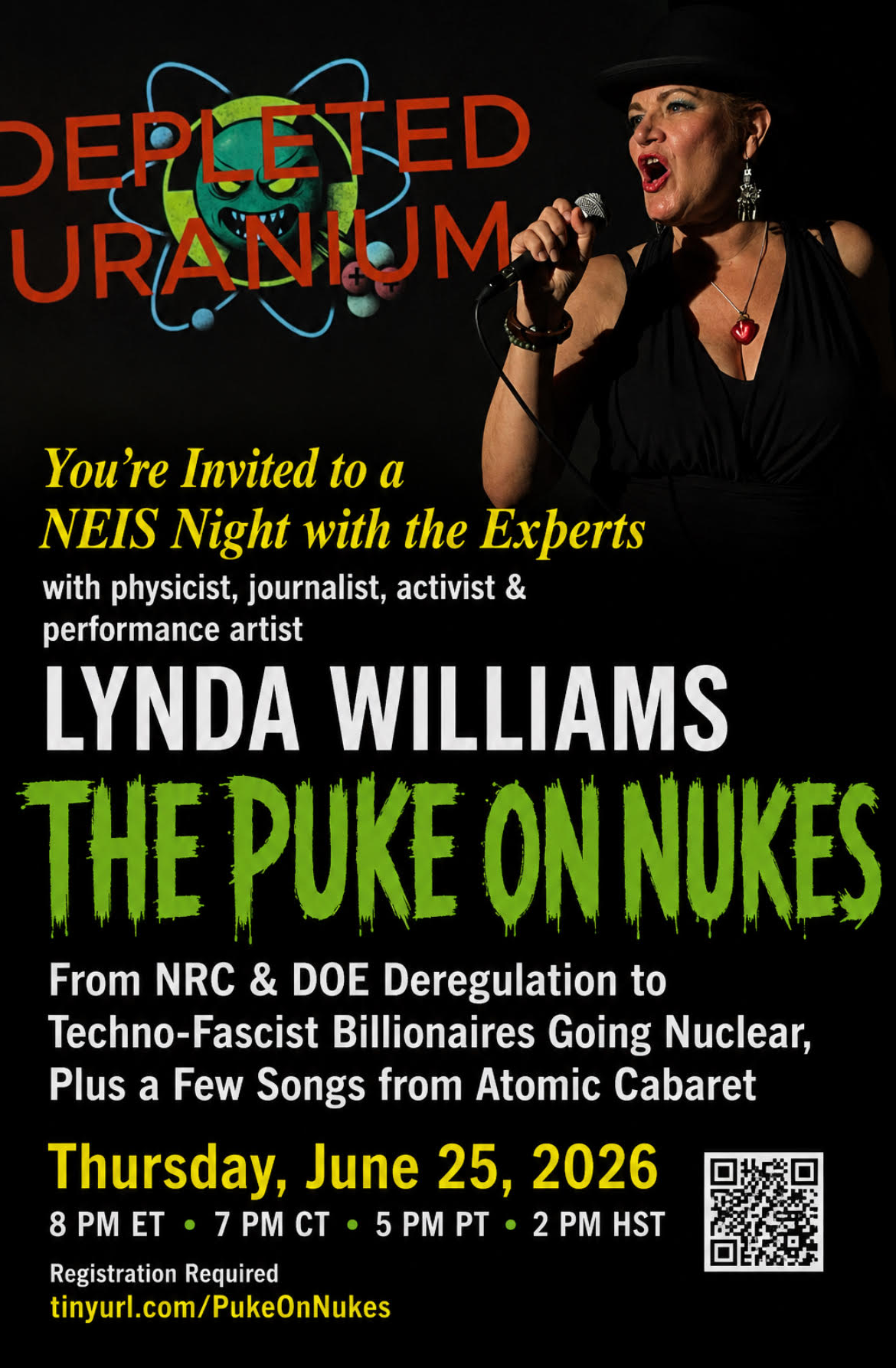
25 June- THE PUKE ON NUKES
Thursday, June 25, 2026
7pm Central Time (8pm ET, 6pm MT, 5pm PT) UTC – 5
From NRC & DOE Deregulation to Techno-Fascist Billionaires Going Nuclear, Plus a Few Songs from Atomic Cabaret REGISTER
26 June – Radiation Trainwreck at the NRC / Join the Protect Better Campaign – https://us02web.zoom.us/meeting/register/4ZlZ5_qLSHGiLSCg8FF6Bg#/registration
1st July – Webinar Waste of Space: The Environmental Harm of Military and Civil Space Activity st July, 7 pm

Report Launch Online: We are seeing an increasing exploitation of space for military and commercial purposes. This must change.

Protect Sazan Island from the Trump family! https://secure.avaaz.org/campaign/en/protect_sazan_island_from_the_trump_family_loc/?bqFCVab&v=174511&cl=22707147157&_checksum=5e9dde668860e8231c33699735e16a1fbf22ab2cb01da50c999fe8732b9775ef&utm_source=email&utm_medium=blast_email&utm_campaign=174511


Cuba Is Not a Failed State – It Is a Besieged State
PETITION: “Global Appeal to Endorse Palestinian Right of Return of Refugees”
To see nuclear-related stories in greater depth and intensity – go to https://nuclearinformation.wordpress.com
-
Archives
- June 2026 (251)
- May 2026 (306)
- April 2026 (356)
- March 2026 (251)
- February 2026 (268)
- January 2026 (308)
- December 2025 (358)
- November 2025 (359)
- October 2025 (376)
- September 2025 (257)
- August 2025 (319)
- July 2025 (230)
-
Categories
- 1
- 1 NUCLEAR ISSUES
- business and costs
- climate change
- culture and arts
- ENERGY
- environment
- health
- history
- indigenous issues
- Legal
- marketing of nuclear
- media
- opposition to nuclear
- PERSONAL STORIES
- politics
- politics international
- Religion and ethics
- safety
- secrets,lies and civil liberties
- spinbuster
- technology
- Uranium
- wastes
- weapons and war
- Women
- 2 WORLD
- ACTION
- AFRICA
- Atrocities
- AUSTRALIA
- Christina's notes
- Christina's themes
- culture and arts
- Events
- Fuk 2022
- Fuk 2023
- Fukushima 2017
- Fukushima 2018
- fukushima 2019
- Fukushima 2020
- Fukushima 2021
- general
- global warming
- Humour (God we need it)
- Nuclear
- RARE EARTHS
- Reference
- resources – print
- Resources -audiovicual
- Weekly Newsletter
- World
- World Nuclear
- YouTube
-
RSS
Entries RSS
Comments RSS
 nuclear-news