China supports North Korea’s call to revise sanctions, return to nuclear talks
China backs North Korean call to revise sanctions to revive nuclear talks SCMP, 2 Oct 21,
Instead of empty slogans, US should restart UN resolutions and ‘revise sanctions related to humanitarian aspects’, Beijing says
Denuclearisation talks stalled in 2019 and Pyongyang has resumed its missile tests
China has backed North Korea’s calls for the US to revise its sanctions to break the stalemate in denuclearisation talks.
Pyongyang resumed its missile tests last month after a six-month lull, the latest being a new hypersonic missile fired on Tuesday. It first fired a
nuclear-capable cruise missile on September 12, then followed up with two railway-borne ballistic missiles days later – in breach of UN Security Council resolutions.
Although the Chinese foreign ministry has continued to urge restraint from all parties in response to Pyongyang, spokeswoman Hua Chunying also called for North Korea’s “justified and reasonable concerns” to be taken seriously and addressed.
“The US should not fall back on empty slogans calling for dialogue, but should demonstrate sincerity and come up with a realistic dialogue proposal, restart the reversible UN resolutions at the Security Council, and revise sanctions that are related to humanitarian aspects,” Hua said on Thursday……………… https://www.scmp.com/news/china/diplomacy/article/3150921/china-backs-north-korean-call-revise-sanctions-revive-nuclear
Russia wants help to clean up sunken nuclear submarines – while it invests in new ones!
Norway celebrates 25-years paying for nuclear-dump cleanup. Russia showcases new reactor weapons
Rosatom officials and Norwegian project partners are Wednesday marking that it is 25 years since the first money check was sent from Oslo to help improve infrastructure at the ill-fated Andreeva Bay dump site for spent nuclear fuel and radioactive waste accumulated from the operation of Cold War submarines. The Barents Observer ,By Thomas Nilsen September 29, 2021
”………………….. Sunken reactors
Andrey Zolotkov with ANO Bellona Murmansk says there are problems in the sphere of nuclear safety that Russia can’t deal with alone.
“This is to raise the sunken nuclear submarines,” he says.
On the seafloor of the Barents Sea, the old November class K-159 that sank in August 2003 has two reactors with spent nuclear fuel on board. The submarine lays in an area of high importance for the fisheries of both Russia, Norway and the European Union. Further east, in the Kara Sea, the submarine K-27 was dumped on purpose, along with several other submarine reactors and thousands of containers with radioactive waste.
Zolotkov fears the submarines may corrode to the worse if nothing is done.
If we constantly postpone this for later, then something may happen. The lifting operation will sooner or later become impossible because supporting structures will be destroyed as a result of corrosion.”
A key question is how eager potential donor nations would be to cash out even more money to assist in reducing the environmental risks caused by the past nuclear legacy, like the dumped reactors in the Kara Sea, as long as Russia itself gives priority to creating nuclear weapons systems beyond what the world ever has seen before.
Rearmament of the north
Russia’s rearmament of the north includes a new generation of both multi-purpose submarines and ballistic missile submarines. Currently, some 12-13 reactor-powered subs are under construction at the Sevmash yard in Severodvinsk. The new vessels will sail for both the Northern Fleet and the Pacific Fleet. Little is known about 4th generation Russian navy reactors and uranium fuel enrichment.
Maybe more frightening than the new submarines are two other reactor-powered weapons systems currently under testing and development in northern Russia: the Poseidon underwater drone and the Burevestnik cruise missile. Both are said to carry nukes and have a nearly unlimited range.
New satellite images
In late August, Google Earth updated its satellite images from above the naval yards in Severodvinsk…………………
Nenoksa accident
In August 2019, five employees from Rosatom were killed when a nuclear object was about to be raised from the seabed outside Nenoksa in the White Sea, only a few kilometers west of Severodvinsk. What exactly happened remains secret, but radiation monitors in Severodvinsk saw a spike, and locals took photos of ambulances where both the interior and the drivers were wearing protective dressed against radiation.
As reported by the Barents Observer, the explosion was most likely involving the reactor from a Burevestnik test. This autumn, Russia’s top-secret testing of the Burevestnik nuclear-powered missile is moved to Novaya Zemlya in the Arctic, an archipelago under full military control and formerly used for real nuclear weapons tests in the atmosphere and underground.
This week, a large area both on land at Novaya Zemlya and in the waters along the west coast on the Barents Sea side is closed off with NOTAM-warnings (Notice to Airmen). The size of the closed-off areas fits with a likely test launch of the nuclear-powered missile……… https://thebarentsobserver.com/en/nuclear-safety/2021/09/while-norway-celebrates-25-years-paying-cleanup-nuclear-dumpsite-russia-gives
World Nuclear Industry Status Report 2021

The World Nuclear Industry Status Report 2021 (WNISR) was released overnight. For nearly 30 years, these reports have provided important factual antidotes to industry promotion and obfuscation. This year’s report is the work of 13 interdisciplinary experts from across the world.
Naoto Kan, Japan’s Prime Minister at the time of the Fukushima disaster, writes in the foreword: “As Prime Minister of Japan at the time of the disaster, I now believe that the time has come for Japan and the world to end its reliance on nuclear power.”
In broad terms, nuclear power has been stagnant for 30 years. WNISR notes that the world’s fleet of 415
power reactors is 23 fewer than the 2002 peak of 438, but nuclear capacity and generation have marginally increased due to uprating and larger reactors being built.
There is one big difference with the situation 30 years ago: the reactor fleet was young then, now it is old. The ageing of the reactor fleet is a huge problem for the industry (as is the ageing of the nuclear workforce ‒the silver tsunami). The average age of the world’s reactor fleet continues to rise, and by mid-2021 reached 30.9 years. The mean age of the 23 reactors shut down between 2016 and 2020 was 42.6 years. The International Atomic Energy Agency anticipates the closure of around 10 reactors or 10 gigawatts (GW) per year over the next three decades.
Reactor construction starts need to match closures just for the industry to maintain its 30-year pattern of stagnation. But construction starts have averaged only 4.8 per year over the past five years, and
there’s no indication of looming growth. Nuclear power’s contribution to global electricity supply has fallen from a peak of 17.5 percent in 1996 to 10.1 percent in 2020 (a 4.3 percent share of global commercial primary energy consumption).
Renewables reached an estimated 29 percent share of global electricity generation in 2020, a record share. Non-hydro renewables(10.7 percent in 2020) overtook nuclear in 2019 and the gap grew in 2020.
Criminality
In addition to a vast amount of energy data, WNISR includes detailed analyses of the Fukushima and Chernobyl disasters; the vulnerabilities of nuclear power to the impacts of climate change (e.g. dwindling and warming water resources, storm impacts, sea-level rise, etc.); and a chapter on nuclear decommissioning.
WNISR details the slow and unsteady progress of small modular reactors. The report notes that “so-called advanced reactors of various designs, including so-called Small Modular Reactors (SMRs), make a lot of noise in the media but their promoters have provided little evidence for any implementation scheme before a decade at the very least.”
WNISR notes that previous reports have covered irregularities, fraud, counterfeiting, corruption, and other criminal activities in the nuclear sector. This year’s report dedicates a chapter to nuclear criminality and includes 14 case studies with serious implications (safety, public governance) that came to trial in the period 2010-2020.
The report states:
“A stunning number of revelations in recent years on irregularities, fraud, counterfeiting, bribery, corruption, sabotage, theft, and other criminal activities in the nuclear industry in various countries suggest that there is a systemic issue of “criminal energy” in the sector. …
“Although not comprehensive, this analysis offers several noteworthy insights:
* Criminal activities in the nuclear sector are not new. Some major scandals date back decades or have been ongoing for decades.
* Organized crime organizations have been supplying workers to nuclear sites — e.g. the Yakuza in Japan — for over a decade.
* Serious insider sabotage has hit major nuclear countries in recent years — like a Belgian nuclear power plant — without ever leading to arrests.
There is no systematic, comprehensive, public database on the issue.
* In 2019, the IAEA released a report on cases of counterfeit or fraudulent items in at least seven countries since at least the 1990s.
* In Transparency International’s 2020 Corruption Perceptions Index about half of the 35 countries operating or constructing nuclear power plants on their territory rate under 50 out of 100.
* In the Bribery Payers Index (BPI, last published in 2011), seven out of the ten worst rated
countries operate or are building nuclear power plants on their territory.”
Author: Dr. Jim Green is the national nuclear campaigner with Friends of the Earth Australia
Renew Economy 29th Sept 2021
Norway paid to help Russian nuclear submarine waste clean-up – but now – new submarines!
Norway celebrates 25-years paying for nuclear-dump cleanup. Russia showcases new reactor weapons
Rosatom officials and Norwegian project partners are Wednesday marking that it is 25 years since the first money check was sent from Oslo to help improve infrastructure at the ill-fated Andreeva Bay dump site for spent nuclear fuel and radioactive waste accumulated from the operation of Cold War submarines. The Barents Observer ,By Thomas Nilsen September 29, 2021
Hindered from on-site meetings due to the pandemic, today’s 25-years anniversary meeting in Andreeva Bay is long overdue. However, the meeting comes in pole position as the two countries are trying to improve bilateral relations in times of more complex geopolitics and higher tensions between NATO and Russia up north.
……. ensuring nuclear safety is another topic for good bilateral cooperation.
For the Soviet nuclear navy, the Coastal Technical Base in Andreeva Bay became the main storage site for both spent fuel assemblies from submarine reactors, as well as a site to store containers with solid radioactive waste. Focus was not on safety and after years of exposure to Arctic climate, the site became contaminated and the infrastructure started to fall apart. With Russia being broke after the collapse of the Soviet Union, the call for international action was precarious. Norwegian money, and will to solve the problem, was most welcomed……………
Success story
More than 2 billion kroner (nearly €200 million) of Norwegian taxpayers money are spent on helping Russia secure its nuclear legacy since the mid-1990ties. The ground-breaking nuclear safety work initiated on the Kola Peninsula, only some 60 km from the border to Norway, has since been followed by many other countries and international financial grant programs.
For projects in Andreeva Bay, Norway has paid more than €30 million on things like fixing electricity, water pipelines, roads, fences, constructing a new sanitary building and improving the old pier in port with a new lifting crane. About half of the 21,000 spent uranium fuel elements originally stored in three rundown concrete tanks is so far lifted out, repacked and shipped out of Andreeva Bay. First to Atomflot in Murmansk, then by train further to Russia’s reprocessing plant at Mayak in the South Urals. Some 10,000 cubic meters of solid radioactive waste that previously was stored outdoor and exposed to snow and frost is now under roof in a new building erected at the site. Soon, also that will be transported away.
Present at the celebrations in Andreeva Bay is also representatives from the environmental NGO Bellona. It was this organization, with offices both in Murmansk and Oslo, that before the official country-to-country cooperation started, was first to uncover security breaches and the urgency to act before the entire storage site turned out to be a Chernobyl in slow-motion.
“Time has come”
Bellona’s Aleksandr Nikitin says to the Barents Observer that the time has come for Russia to solve its own nuclear challenges, not the international community. “But first we have to complete already started international projects, like the nuclear legacy,” Nikitin says and points to the ongoing work in Andreeva Bay………….
Meanwhile, and unlike the 1990ties, Russia is now investing huge money in building new nuclear-powered submarines and other military nuclear installations. A key question is whether Moscow now is arming the country again into a nuclear age that later could cause similar radiological waste challenges as the legacy from the last Cold War created.
…….. It is a task for Russia and Rosatom. We cannot hire anymore for a rich uncle from the west to come and help again. It was a time when it was necessary, not anymore.”
Meanwhile, Aleksandr Nikitin is glad to see the solution-oriented results of the work in Andreeva Bay.
“Bellona started it, and we have to finish it,” he says………………………………….
A Norwegian intelligence official has previously expressed fears for more accidents with the reactor-powered weapons systems now under testing and development in Norway’s neighboring areas up north.
For Norway, a challenge is to balance the aid-support to nuclear safety with making sure no funding ends up in Russia’s new crazy nuclear weapons programs…………..
The “Serebryanka” dilemma
A review made by the Barents Observer of the publicly available documents on financial aid from Norway and Sweden to equip modern communication and positioning systems on board “Serebryanka” shows that about 9 million kroner (€900,000) were spent on the project in 2013 and 2014. That was shortly before the Burevestnik testing program started.
The Swedish Radiation Safety Authority, in charge of the project, says in its annual overview of Non-Proliferation cooperation for 2013 that the “Serebryanka” was the largest project initiated in the Murmansk region.
Stockholm spent 4,1 million Swedish kroner (SEK) on equipment for “Serebryanka” in 2013 and an additional 217,000 SEK in 2014.
Describing the project, the Radiation Safety Authority writes: “This project is co-financed with Norway and the purpose is to equip the vessel “Serebryanka” with a physical protection system, as well as communications and positioning systems, in order to increase security when transporting nuclear materials and radioactive substances.”
The Norwegian share of the project was 3 million Norwegian kroner, paid as part of the Nuclear Action Plan financed by the Ministry of Foreign Affairs.
Conflict-of-interests
Asked about the potential conflicting interests, State Secretary Audun Halvorsen in Norway’s Foreign Ministry told the Barents Observer upfront of the annual meeting in the Norwegian-Russian Commission on Nuclear Safety this spring that “…. our bilateral cooperation on nuclear safety projects are related to civilian activities only, and questions regarding military activities are therefore considered outside of the scope of the commission by the Russian side.” https://thebarentsobserver.com/en/nuclear-safety/2021/09/while-norway-celebrates-25-years-paying-cleanup-nuclear-dumpsite-russia-gives
Australia the sucker for cash-strapped U.S, and U.K submarine companies General Dynamics and BAE Systems

UK Prime Minister Boris Johnson is close to BAE, the UK defence contractor whose nuclear subs program is struggling. The submarine program in the US too is foundering, so the game plan by our AUKUS partners is to rope in the dopey Aussies for a hundred billion dollars-plus to finance their distressed submarine sectors.
Both US submarine builder General Dynamics and its British counterpart BAE are looking for a new income stream from Downunder.
$66 Billion Reasons: did Scott Morrison get the French submarines right? By Michael West| September 30, 2021 ….. Michael West investigates the awkward AUKUS alliance and whether Scott Morrison made the right call on French submarines.As if ……….being dead last in the developed world on climate action , Scott Morrison and his Coalition have now burnished their reputation for incompetence on the global stage.
In one fell swoop, the sudden AUKUS declaration, they have achieved a stunning betrayal of the French, further peeved our biggest trading partner China, upset half of Europe, shown the bird to New Zealand and our neighbours in the Asian region, and waved an open cheque-book at the US and the UK military industrial complex.
Yet, in their ardour to crawl back to the Mother Country and bat their debutante eyes at Washington, they appear to have got something right: axing the French submarines. Are our self-described band of “Superior Economic Managers” accidental heroes, or did they mean to get it right?
If they double down and splash $100b plus on nuclear submarines, they will have got it doubly wrong.
Defence correspondent Michelle Fahy has documented here the $90b shocker which is Australia’s deal with French shipbuilder Naval Group. Naval itself has an ugly history of corruption and there are serious questions about how the deal came about in the first place, indeed serious questions about the billions in public money smoked every year in Defence procurement.
Murder, corruption, bombings – the company at centre of Australia’s submarine deal
The arms company at the centre of a deadly criminal saga and numerous global corruption scandals, Naval Group, was selected by the Australian government to build our new fleet of submarines – a deal heralded as ‘one of the world’s most lucrative defence contracts’. How did this happen? In this special investigation Michelle Fahy discovers significant gaps in anti-bribery and corruption measures.
Yet there is upside. Scott Morrison and co have junked a deal which would have delivered a fleet of expensive, obsolete submarines 20 years too late for the war which the government’s champions in the media keep telling us we might have to fight against China. Even though a war with China is nothing more than a grotesque proposition, scaremongering by the weapons lobby and media to distract from corruption and mismanagement at home. Media war porn.
The same might be said of the F-35 Strike Fighter debacle and the BAE frigates scandal. Every large defence procurement is marred by billions of dollars in waste. But here’s the thing with the subs; there is a solid body of work which suggests submarines are already obsolete, nuclear or not. They can be tracked; they are a titanic waste of money.
The National Security College (Federal Government and ANU) published a working paper in May 2020 saying nuclear powered ballistic missile submarines will be detectable at sea.
Meanwhile, the French are complaining we owe them $US66 billion for reneging on the deal with Naval. That’s an ambit claim, to be sure. It might cost the government $5b-$10b all up, some already sunk, the rest to stave off an embarrassing court action; but the result so far is: one, no obsolete subs deal with the French, and two, only a mooted nuclear subs deal with the Brits and Americans which may never happen. Hopefully.
UK Prime Minister Boris Johnson is close to BAE, the UK defence contractor whose nuclear subs program is struggling. The submarine program in the US too is foundering, so the game plan by our AUKUS partners is to rope in the dopey Aussies for a hundred billion dollars-plus to finance their distressed submarine sectors.
The doctrine of the gullible Aussie is getting airplay in the US press. According to war contractor expert Charles Tiefer in Forbes:
“Under the cloud of smoke around the Australian submarine deal, are the unspoken aspects of the enrichment of American military contractors. There is no public mention of which American contractors will build the expensive parts of the expensive Australian submarines.”
Both US submarine builder General Dynamics and its British counterpart BAE are looking for a new income stream from Downunder.
Should the Coalition stay true to its track record of dithering though, it may soon become evident that submarines in general are a leviathan waste of money and public money ought to be expended on something less wasteful.
Scott Morrison might, unwittingly, have got it right. He might not have to spend much on submarines at all. The question then becomes, what has he got us into?
Back to the future
As three former prime ministers in Paul Keating, Malcolm Turnbull and Kevin Rudd have already pointed out, AUKUS puts Australians in greater danger, renders Australia a vassal to foreign power and antagonises our neighbours in the region.
Depending on how you count them, there are probably already four US bases in operation now:
- Pine Gap near Alice Springs, Northern Territory,
- Naval Communication Station Harold E. Holt, north of the town of Exmouth, Western Australia,
- Robertson Barracks in Darwin, Northern Territory,
- Australian Defence Satellite Communications Station near Geraldton, WA.
However, the US military already has access to all major Australian Defence Force (ADF) training areas, northern Australian RAAF airfields, port facilities in Darwin and Fremantle, and probably future access too to an expanded Stirling naval base in Pe
Under AUKUS, this may just be the beginning. It was largely ignored during the AUKUS media blitz and the dramatic cuckolding of the French but Peter Dutton had this to say at his press conference on September 16,
Unveiling plans for new facilities on Australian soil for US naval, air, and ground forces would entail “combined logistics, sustainment, and capability for maintenance to support our enhanced activities, including … for our submarines and surface combatants”. That is on top of “rotational deployments of all types of US military aircraft to Australia”.
If the plan is to shred Australia’s sovereignty and make us a target for China, he is succeeding with aplomb. We are about to be swamped by US military.
Forward to the past
It is poetic too, that at this very time we are striking even stronger and even more unnecessary ties with Westminster and Washington. Boris Johnson’s government is beset by the chaos which is Brexit, such chaos now that it has spawned a global energy emergency. While the EU has the wobbles on its trade deal with Australia, Boris is in the market for a friend.
It is poetic too, that at this very time we are striking even stronger and even more unnecessary ties with Westminster and Washington. Boris Johnson’s government is beset by the chaos which is Brexit, such chaos now that it has spawned a global energy emergency. While the EU has the wobbles on its trade deal with Australia, Boris is in the market for a friend………… https://www.michaelwest.com.au/aukus-french-submarines-scott-morrison/
AUKUS and confronting China throws fuel on the fire of Indo-Pacific tensions. An accelerating arms race will follow.

Australia commits fully to China containment
Canberra is now a fully paid-up member of a China containment front, whether it wants to admit it, or not. In the process, it has yielded sovereignty to the US by committing itself to an interlocking web of military procurement decisions that includes the acquisition of a nuclear-propelled submarine fleet.
New drives to counter China come with a major risk: throwing fuel on the Indo-Pacific arms race SMH, Tony Walker Tony Walker is a Friend of The Conversation.Vice-chancellor’s fellow, La Trobe University September 27, 2021 An accelerating arms race in the Indo-Pacific is all but guaranteed now that China finds itself a target of new security arrangements — AUKUS and the Quad — aimed at containing its power and influence.
This has the makings of a new great game in the region in which rival powers are no longer in the business of pretending things can continue as they are.
The AUKUS agreement, involving Australia, the US and UK to counter China’s rise means a military power balance in the Indo-Pacific will come more sharply into focus.
The region has been re-arming at rates faster than other parts of the world due largely to China’s push to modernise its defence capabilities.
In their latest surveys, the London-based International Institute of Strategic Studies (IISS) and the Stockholm International Peace Research Institute (SIPRI) report no let-up in military spending in the Indo-Pacific. This is despite the pandemic.
SIPRI notes a 47% increase in defence spending in the Indo-Pacific in the past decade, led by China and India.
China can be expected to respond to threats posed by the new security arrangements by further expediting its military program.
It will see the formation of AUKUS as yet another attempt to contain its ambitions — and therefore a challenge to its military capabilities.
The Quad makes clear its ambitions
Unambiguously, AUKUS implies a containment policy.
Likewise, the further elevation of the Quad security grouping into a China containment front will play into an atmosphere of heightened security anxiety in the Indo-Pacific.
The four Quad participants – the US, Japan, India and Australia – have their own reasons and agendas for wanting to push back against China.
After their summit last week in Washington, the Quad leaders used words in their joint statement that might be regarded as unexceptional in isolation.
Together with other developments such as AUKUS, however, the language was pointed, to say the least:
Together, we re-commit to promoting the free, open, rules-based order, rooted in international law and undaunted by coercion, to bolster security in the Indo-Pacific and beyond.
The “beyond” part of the statement was not expanded on, but might be read as a commitment to extend the Quad collaboration globally.
All this has come together at the dawn of a new US administration whose members include several conspicuous China hawks, and at a moment when China has shown itself to be ever-willing to throw its weight around.
Beijing’s crude campaign against Australian exports in an effort to bend Australia’s policy to its will is a prime example. It is doubtful an AUKUS or an invigorated Quad would have emerged without this development.
The Obama administration talked about pivoting to the Asia-Pacific without putting much meat on the bones.
Under President Joe Biden, this shift will be driven by a hardening in American thinking that now recognises time is running out, and may already have expired, in the US ability to constrain China’s rise.
These are profound geopolitical moments whose trajectory is impossible to predict.
Australia commits fully to China containment
Canberra is now a fully paid-up member of a China containment front, whether it wants to admit it, or not. In the process, it has yielded sovereignty to the US by committing itself to an interlocking web of military procurement decisions that includes the acquisition of a nuclear-propelled submarine fleet.
Whether these submarines are supplied by the US or Britain is a bit immaterial since the technology involved originates in America.
The submarines will not be available for the better part of two decades under the most optimistic forecasts. However, in the meantime, Australia could base US or British submarines in its ports or lease American submarines.
Meanwhile, Australia is committing itself to a range of US-supplied hardware aimed at enhancing the inter-operability of its military with the US.
This is the reality of fateful decisions taken by the Morrison government in recent months. Such a commitment involves a certain level of confidence in America remaining a predictable and steadfast superpower, and not one riven by internal disputes.
Australian defence spending likely to rise. What is absolutely certain in all of this is that an Indo-Pacific security environment will now become more, not less, contentious. …………………………………
What other Indo-Pacific nations are doing
Many other Indo-Pacific states can now be expected to review their military acquisition programs with the likelihood of a more combative security environment.
Taiwan, for example, is proposing to spend $US8.69 billion (A$11.9 billion) over the next five years on long-range missiles, and increase its inventory of cruise missiles. It is also adding to its arsenal of heavy artillery.
South Korea is actively adding to its missile capabilities. This includes the testing of a submarine-launched ballistic missile.
Seoul has also hinted it might be considering building its own nuclear-propelled submarines (this was among President Moon Jae-in’s election pledges in 2017). Signs that North Korea may have developed a submarine capable of firing ballistic missiles will be concentrating minds in Seoul.
All this indicates how quickly the strategic environment in the Indo-Pacific is shifting.
Australia — perhaps more so than others — is the prime example of a regional player that has put aside a conventional view of a region in flux. It now sees an environment so threatening that a policy of strategic ambiguity between its custodial partner (the US) and most important trade relationship (China) has been abandoned.
The price tag for this in terms of equipment and likely continuing economic fallout for Australian exporters will not come cheap. https://theconversation.com/new-drives-to-counter-china-come-with-a-major-risk-throwing-fuel-on-the-indo-pacific-arms-race-168734
Why America is ecstatic about Morrison’s AUKUS pact

Why Washington was so ecstatic about Morrison’s AUKUS pact, SMH, 28 Sept 21,
Political and international editor ”………….. For many years, a critical element of American war planning has been to defeat China’s navy by bottling it up in the shallow waters of the South China Sea.
It would do this by blocking choke-points that allow passage in and out. And submarines are the most effective tool for achieving this.
If much of China’s navy is contained in those coastal waters, it’s relatively easy for the US to find and destroy. China’s submarines are at their most vulnerable in the shallow littorals nearest their homeland. It’s easier to shoot fish in a barrel than in a pond.
“US forces and their allies will stand a far greater chance of finding Chinese submarines, hemmed into the South China Sea, than China will of finding America’s in the vast Pacific,” as Rory Medcalf of the ANU’s National Security College puts it.
This helps explain why Beijing has put such effort into asserting control of the South China Sea and, just to its north, the East China Sea. In the event of a crisis, China’s priority is to scramble its submarines well beyond the first island chain into the deep waters of the Pacific where they can operate freely, concealed and lethal.
……………In the event of all-out war, the US wants Tokyo’s 22 subs and Canberra’s six to complement the US fleet of 68. Japan’s have been pencilled in to operate in the north and Australia’s in the south.
This is where AUKUS come in. It includes in-principle agreement from Washington and London to supply Australia with nuclear propulsion technology for a new fleet of eight submarines instead of the planned 12 diesel-electric subs, now ditched.
Why was this greeted rapturously in Washington? “The long-term prospect of eight nuclear-powered RAN subs prowling the Pacific resets the naval balance of power,” says Mike Green of the Centre for Strategic and International Studies in Washington.
…….. Australian officials say it will take almost 20 years to actually get the first Australian-built, nuclear propelled sub into the water. ……. The Australian Strategic Policy Institute’s subs expert, Marcus Hellyer says that the only plausible way that Australia could put a nuclear-powered sub in the water in time to be relevant to the looming US-China contest would be if America handed over some of its ageing Los Angeles class subs. The Pentagon is currently pensioning them off. They’d need to be refurbished. But that’d still be a lot faster, taking years rather than the decades of waiting for the first Australian-made one…..
And AUKUS is about much more than subs. “It’s about areas like cyber and emerging technologies…….https://www.smh.com.au/national/why-washington-was-so-ecstatic-about-morrison-s-aukus-pact-20210927-p58v3c.html
AUKUS deal leaves France out of South East Asian security arrangement.

Australian Prime Minister Scott Morrison on Wednesday said the three nations had agreed to “a new enhanced trilateral security partnership”.
The subtext of France and Australia’s submarine deal, Aljazeera, 27 Sep 21,
What do a new security pact and a cancelled military contract say about France’s place in the world? It was supposed to be an announcement of a pact, not the start of a foreign relations crisis between allies. But as Australia announced a new security partnership with the United Kingdom and the United States, dubbed AUKUS, it also cancelled a multibillion-dollar contract to buy submarines from France. So how did an abandoned deal for a dozen submarines turn in to the diplomatic version of a lover’s quarrel?Australia’s decision to cancel a multibillion-dollar order for French submarines in favour of American and British technology has sparked a diplomatic row of unprecedented proportions between longtime Western allies.
The French foreign ministry recalled its ambassadors to the United States and Australia citing “duplicity, disdain and lies”.
China’s Xi warns of ‘interference’ as Australia brushes off angerHundreds arrested in Australian anti-lockdown protestsFrance accuses Australia, US of ‘lying’ over submarine deal
Alongside the economic damage for tens of billions of euros, France said it resents the way Australia and its partners have handled the matter. French Foreign Minister Jean-Yves Le Drian, said, “There has been contempt so it’s not going well between us, not at all.”
President Emmanuel Macron will have a call with his US counterpart, Joe Biden, in the next few days, the French government said on Sunday.
Australia’s strategic alignment
Australia announced on Wednesday it would ditch a contract worth more than 50 billion euros ($59bn) to acquire 12 French-made diesel-electric submarines.
Instead, it will commission at least eight US nuclear-powered submarines in the framework of a new alliance – known by its acronym AUKUS – which will see Australia, the US, and the United Kingdom share advanced technologies with one another.
Australian Prime Minister Scott Morrison on Wednesday said the three nations had agreed to “a new enhanced trilateral security partnership”.
How AUKUS May Damage NATO
How AUKUS May Damage NATO https://www.pressenza.com/2021/09/how-aukus-may-damage-nato/ 24.09.21 – US, United States – Independent Media Institute The fallout over the AUKUS deal, as we are now seeing, has been a severe rift in relations between two historic allies, the U.S. and France. And the collateral damage may also include NATO.
By James W. Carden
Only weeks after U.S. President Joe Biden courageously ended the war in Afghanistan—in the face of bitter opposition from the media and Congress—came the announcement of the formation of AUKUS, a new trilateral security alliance between the U.S., the UK and Australia.
The creation of AUKUS is only further confirmation—as if more was needed—that the Biden administration intends to wage a new cold war in Asia with China as its target.
This is not a development we should welcome. As the Quincy Institute for Responsible Statecraft’s Anatol Lieven has recently observed, a new cold war “with China… will continue to lock in place the power of the U.S. military-industrial complex and squander trillions more on wasteful and unnecessary military programs designed to benefit American corporations rather than defend the actual security of actual American citizens.”
And so, as Biden puts an end to one hot war, he finds himself starting yet another cold war: One step forward, two steps back.
AUKUS’s debut has been marred by a high-profile controversy with France, which believed it had reached a deal with Australia to provide it with 12 diesel-electric submarines. Australian Prime Minister Scott Morrison, meanwhile, noted in a statement that, instead, the Americans and the British will be providing Australia with nuclear-powered submarines.
European leaders have come out strongly against AUKUS. Both European Council President Charles Michel and European Commission President Ursula von der Leyen condemned the move. And the French are furious. French President Emmanuel Macron has recalled his ambassadors to the U.S. and Australia, while the former French Ambassador to the U.S. Gérard Araud observed on Twitter, “The new reality of the world rivalry of great and middle powers should lead France to a 2.0 Gaullist stance. Allied but not aligned. Some confrontations are not ours.”
And so, the fallout over the AUKUS deal, as we are now seeing, has been a severe rift in relations between two historic allies, the U.S. and France.
And the collateral damage may also include NATO.
The AUKUS controversy puts the future of the transatlantic alliance in question. Recall that Macron has long been a vocal and perceptive critic of the nearly 75-year-old alliance. A self-described disciple of France’s wartime leader and former President Charles de Gaulle, Macron has criticized the foreign policy of his immediate predecessors as a kind of “imported neoconservatism.” His own foreign policy forays can be characterized as a quest for strategic autonomy, away from the dictates of Washington and London.
Biden’s AUKUS debacle just may give Macron the leverage he needs to move the rest of Europe in his direction, toward a foreign policy that rejects the decades-old Atlanticist consensus in favor of a continental security architecture that takes into account the interests of all of Europe, as de Gaulle once put it, “from the Atlantic to the Urals.”
At a minimum, the AUKUS debacle may have the effect of pushing France closer together with its old ally Russia. Macron may double down on his policy of detente with the Kremlin, which only recently was the target of criticism by his partners in the EU.
This would leave Anglo-American neoconservatives and liberal hawks seething, but such a development might be just what is needed for a stable and peaceful future for Europe.
This article was produced by Globetrotter in partnership with the American Committee for U.S.-Russia Accord. James W. Carden is a writing fellow at Globetrotter and a former adviser to the U.S. State Department. Previously, he was a contributing writer on foreign affairs at the Nation, and his work has also appeared in the Quincy Institute’s Responsible Statecraft, the American Conservative, Asia Times, and more.
Uncertainty on how UK will exclude Chinese involvement in Sizewell and Bradwell nuclear projects
China set to be banned from investing in the UK’s nuclear power stations on security grounds – leaving a huge financial gap which may be plugged by pension funds.
- Exactly how the Chinese will be frozen out of Sizewell on Suffolk coast is unclear
- CGN is also involved at Bradwell, where progress is understood to have stalled
- By ALEX LAWSON and GLEN OWEN FOR THE MAIL ON SUNDAY
Chinese investment in Britain’s next generation of nuclear power stations is set to be banned on security grounds, leaving a multi-billion pound funding hole in the plans……
The Government has committed to making a final investment decision on at least one large nuclear project during this parliament.
Officials are understood to be keen to publish a decision on the future of Sizewell C ahead of next month’s spending review and the UN climate change conference in Glasgow in November.
A senior industry source said: ‘The Chinese will not be involved at Sizewell. This is part of a long journey and is politically much bigger than just one plant.’ Exactly how the Chinese will be frozen out of Sizewell, on the Suffolk coast, is unclear.
They have a 20 per cent stake in development of the project and an option to remain once it is built.
CGN is also involved at Bradwell in Essex, where progress is understood to have stalled, and in the EDF-led Hinkley Point in Somerset, due to be completed in 2026.
Treasury officials have studied several options to replace China’s funds at the plant.
Sources said the favoured option is a regulated asset base (RAB) model, which has been used in other big infrastructure projects such as the Thames Tideway and requires legislation.
Last week, it emerged that Ministers are in talks with the US nuclear reactor manufacturer Westinghouse over a proposal to build a new plant in Anglesey, North Wales.
Separate proposals have been mooted for a series of small modular reactors (SMRs) to complement larger plants, including a programme led by Rolls-Royce.
A Government spokeswoman said: ‘CGN is currently a shareholder in Sizewell C up until the point of the Government’s final investment decision. Negotiations are ongoing and no final decision has been taken.’ https://www.dailymail.co.uk/news/article-10028807/China-set-banned-investing-UKs-nuclear-power-stations-security-grounds.html
UK should think twice before ousting Chinese company from its nuclear project
 |
UK should think twice before ousting Chinese company from its nuclear project By Global Times Published: Sep 26, 2021 The UK government is reportedly closing in on a deal that could kick China’s nuclear power giant General Nuclear Power Group (CGN) out of the £20 billion ($27 billion) Sizewell C nuclear power project on so-called security grounds.
London may announce a decision ahead of next month’s spending review and the UN climate change conference in Glasgow in November, but it remains unclear how the Chinese company will be frozen out of Sizewell C, according to UK media outlet Daily Mail.
Whether related reports are complete and accurately reflect the position of the UK government is not known yet. There was similar speculation by the UK media in July, but, if the alleged decision is confirmed by Johnson’s government, it will have adverse impact on the UK. For starters, it will leave the UK a huge financial gap which has to be plugged by pension funds. CGN has a 20 percent stake in the Sizewell C project and an option to retain that share of the nuclear project once it is built. If CGN is forced to pull out from the project, the UK side needs to figure out options to fill up the multi-billion pound funding hole. The Daily Mail reported that the Treasury Department is examining plans to use pension funds to plug the gap for Sizewell C.
Second, it risks further ratcheting up geopolitical tensions, which are already running high after London’s decision to join the AUKUS pact with the US and Australia. ………
Third, it will delay construction of the UK nuclear power stations, ………. British companies will face Chinese company’s demand for economic compensation. …………… https://www.globaltimes.cn/page/202109/1235101.shtml
Australia’s Prime Minister Scott Morrison on the defensive as Europe and South-East Asian countries react badly to AUKUS and the nuclear submarines

Morrison in defence mode as AUKUS fallout goes global, Frozen out in Europe, feted in Washington, alarming some of its south-east Asian neighbours: questions are being raised about whether Australia has the right diplomatic skills and resources to perform on the world stage. The Age By Anthony Galloway SEPTEMBER 25, 2021 or six days, the Indonesians knew something big was coming from Australia.
At a meeting in Jakarta on September 9, Australian Foreign Minister Marise Payne let her friend, Indonesian Foreign Minister Retno Marsudi, know a major shift was coming.
“The Foreign Minister of Australia mentioned there will be an announcement, but at the time we didn’t receive any information [about] what sort of announcement because I assume at that time it was not final yet,” Retno said this week.
The following Wednesday, Payne messaged Retno hours before the announcement of the AUKUS defence pact between Australia, the United States and Britain to share military technology and help Canberra build a fleet of nuclear-powered submarines in the face of Beijing’s growing aggression and military might.
The two ministers then talked over the phone, and Retno told Payne she hoped Australia would uphold its obligations to the Treaty on the Non-Proliferation of Nuclear Weapons and its commitment to “contribute to the peace and stability of the region”.
“I mentioned to my good friend Marise that Indonesia really hopes Australia will fulfil that commitment,” Retno said.
Since then, Malaysia has gone even further in expressing its reservations about the agreement, saying this week it will now consult China on how to react to the development.
And French President Emmanuel Macron is continuing to snub Australian Prime Minister Scott Morrison’s offer of a phone call after he was infuriated by Australia’s decision to dump a $90 billion submarine agreement with Paris and instead negotiate the AUKUS deal behind his back.
All of this contrasts sharply with Morrison’s week-long trip to New York and Washington. His interactions with the Americans have been glowing: not just with President Joe Biden, but also Democratic House Speaker Nancy Pelosi and Republican Senate leader Mitch McConnell. The first physical leaders meeting of the “Quad” grouping – Australia, the US, Japan and India – was expected to have a similar air of friendliness to it on Friday.
A week after the announcement of AUKUS, Australia finds itself at the forefront of world politics in a way it has never before been. Frozen out in Europe, feted in Washington, alarming some of its south-east Asian neighbours, and backed in by the Quad, these are unfamiliar times for little old Australia. And questions are being asked about whether we’ve got the right diplomatic skills and resources to perform on the world stage.
The ‘Anglosphere’ is back
When announcing AUKUS, Morrison described it as a “forever partnership”, while British Prime Minister Boris Johnson said it was an agreement among “kindred” nations. This led to a perception it was an alliance, when it is not. AUKUS is an agreement to share military technology including nuclear submarine capability, long-range missiles, cyber, artificial intelligence, quantum technologies and undersea drones.
Former senior diplomat and intelligence official Allan Gyngell, now national president of the Australian Institute of International Affairs, says Australia sent a problematic message to the region that the “Anglosphere is back”.
It reinforces perspectives that Australia is not really a legitimate part of the region, but a junior partner in a three-way partnership between English-speaking countries,” Gyngell says. “However much we say Asia is important to us, it is clear that home is where the heart is and the heart is with our two great and powerful friends.”
Some south-east Asian countries were also said to be uneasy with the focus on “values” and “democracy”. Many countries in the region are anxious about the growing assertiveness of China but they aren’t liberal democracies. They don’t see a nexus between liberal democratic values and the need to counterbalance a stronger, more aggressive China………………….
With the emergence of new formations such as the Quad and AUKUS, south-east Asian nations have been concerned about the power of ASEAN weakening. Australian diplomats have been insisting the nation is committed to “ASEAN centrality” in both private meetings and public statements.
Gyngell says Australia needs to be careful not to dismiss the concerns of south-east Asian nations, adding “we always look to vindication of our own positions and prejudices”.
Europe’s fury
Further afield, the Morrison government is most concerned about the repercussions in Europe, where there is visceral anger stemming from the AUKUS agreement being negotiated in secret all year even though the US and Britain are key members of NATO.
On the sidelines of the United Nations General Assembly, European Council President Charles Michel reminded Morrison of the need for “transparency and loyalty” during an awkward encounter, while German Foreign Minister Heiko Maas described the agreement as “unsettling”.
While the EU contemplates whether to scuttle talks over a free trade deal with Australia, Canberra can also expect a Europe that is less forgiving over its action on climate change………
Not enough focus has been on whether Australia is adequately investing in all the instruments of statecraft, most notably diplomacy and foreign aid, to support its strategic intentions.
Between 2013 and 2020, Australia’s total diplomatic and development budgets fell from 1.5 per cent of the federal budget to 1.3 per cent. The government gutted parts of the foreign aid budget in south-east Asia to pay for its “step-up” in the Pacific…………. https://www.theage.com.au/politics/federal/morrison-in-defence-mode-as-aukus-fallout-goes-global-20210924-p58ui2.html
Nuclear lobby stooge Jennifer Granholm wants ”unusual partnerships” in order to save the nuclear industry
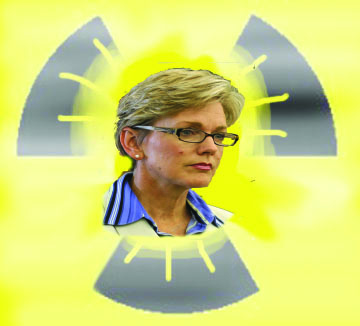
Top U.S. Energy Official Sees ‘Unusual Partnerships’ for Nuclear, From reactors at coal plants to hydrogen production and potential cross-border collaboration, Secretary of Energy Jennifer Granholm is seeking new roles for U.S. nuclear power.
Bloomberg Green, By Jonathan Tirone, 21 September 2021, The Biden administration’s top energy official said the nuclear industry should broaden its business case beyond power markets in order to ensure its place in a carbon-free economy.
U.S. nuclear energy has come under relentless pressure in recent years from cheap natural gas, solar and wind power. More reactors are being taken offline permanently than built, risking the long-term future of the country’s biggest clean energy source. resident Joe Biden has pledged financial support to keep aging atomic plants online. Secretary of Energy Jennifer Granholm said “building back better” for nuclear might mean more than just generating electricity as it competes with emerging renewable energy and storage technologies.

“We need to pursue a silver buckshot rather than a silver bullet approach,” Granholm said in an interview with Bloomberg News in Vienna. The former governor of Michigan said some “unusual partnerships” between nations and industries might be needed for U.S. nuclear operators to tap the $23 trillion global clean [nuclear is NOT clean] energy market over the next decade. Granholm urged more cross-border collaboration in developing a new generation of small modular reactors, as well as using nuclear plants for the production of emissions-free hydrogen…….
Granholm spoke at a meeting of senior officials at the International Atomic Energy Agency, where Chinese and Russian envoys called for more research-and-development collaboration to accelerate the deployment of new generations of miniature reactors.
The Department of Energy curtailed some joint projects with China during the Trump administration, including work on a test reactor backed by billionaire Bill Gates. Granholm suggested the urgency of the climate crisis might require re-evaluating prohibitions on some technology transfers and cooperation. She did not signal any new near-term partnerships with Russia or China. The issue could be revisited during two weeks of international climate talks — known as COP26 — beginning Oct. 31 in Glasgow, Scotland…..

Granholm reserved special praise for the Gates-led company, TerraPower LLC, which in June announced it would build its first test plant at a shuttered coal site in Wyoming rather than in China. …. https://www.bloomberg.com/news/articles/2021-09-21/top-u-s-energy-official-sees-unusual-partnerships-for-nuclear
AUKUS, nuclear submarines and the new dangers of weapons proliferation and war
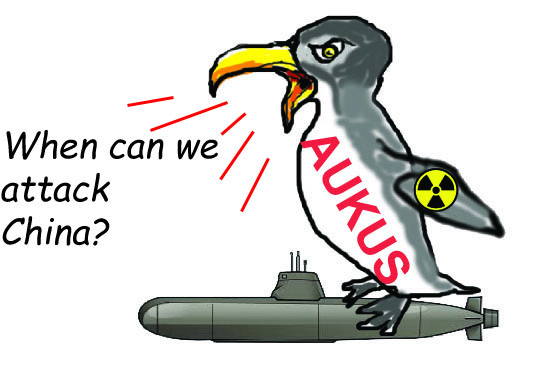
Paul Keating has explained the folly of antagonising China, constantly provoking further militarisation. Regional countries are concerned at the heightened militarisation, and the passage of nuclear submarines through their waters. The use of Highly Enriched Uranium (HEU) fuel brings risks of weapons proliferation. Now the previously nuclear-free zone looks like soon to be bristling with nuclear weapons .
And the big corporations that rule USA policy, UK policy, and now Australian policy, will be rejoicing. Watch as UK’s BAE Systems and USA’s General Dynamics fight it out for the loot from Australian tax-payers.
French ambassador says Scott Morrison gave no warning on the nuclear submarine deal
‘Maybe we’re not friends’: French Ambassador claims ScoMo offered no warning about AUKUS deal A powerful French official has slammed Scott Morrison, accusing the Prime Minister of one thing to do with the submarine deal. news.com.au , Helena Burke, 20 Sep 21
The former French Ambassador to Australia has ripped into Scott Morrison for his defence of the AUKUS submarine deal, claiming the Prime Minister lied about warning France about it.
Jean-Pierre Thebault, who had been the French Ambassador in Canberra since 2020, was recalled last week after France expressed outrage at being left out of the new nuclear submarine deal between the US, UK, and Australia.
Speaking to Radio National on Monday, Mr Thebault said France had been completely blindsided by Mr Morrison’s decision to accept the new deal.
“We discover(ed) through the press that the most important person in the Australian government kept us in the dark intentionally until the last minute and was not willing to at least have the decency to enter conversation about the alternative,” Mr Thebault said.
“This is not an Australian attitude towards friends.”
Maybe we’re not friends.”
Mr Morrison had previously rejected that he had not warned France about the new deal, insisting he told French President Emmanuel Macron in June that Australia might scrap its original submarine agreement,,,,
But the French Ambassador insisted France had never been warned about the potential for a new deal which would exclude them. https://www.news.com.au/national/politics/maybe-were-not-friends-french-ambassador-claims-scomo-offered-no-warning-about-aukus-deal/news-story/467293b479eca4741c116ba5ced54751
1 This Month



26 September – International Day for the Total Elimination of Nuclear Weapons


PLEASE OPPOSE HR 8255 AND S.3639 – bills would accelerate satellite deployment, with no environmental review or safeguards – https://ncstd5li.quorum.us/campaign/169331/
To see nuclear-related stories in greater depth and intensity – go to https://nuclearinformation.wordpress.com
-
Archives
- September 2026 (269)
- August 2026 (330)
- July 2026 (355)
- June 2026 (287)
- May 2026 (306)
- April 2026 (356)
- March 2026 (251)
- February 2026 (267)
- January 2026 (308)
- December 2025 (358)
- November 2025 (359)
- October 2025 (375)
-
Categories
- 1
- 1 NUCLEAR ISSUES
- business and costs
- climate change
- culture and arts
- ENERGY
- environment
- health
- history
- indigenous issues
- Legal
- marketing of nuclear
- media
- opposition to nuclear
- PERSONAL STORIES
- politics
- politics international
- Religion and ethics
- safety
- secrets,lies and civil liberties
- spinbuster
- technology
- Uranium
- wastes
- weapons and war
- Women
- 2 WORLD
- ACTION
- AFRICA
- Atrocities
- AUSTRALIA
- Christina's notes
- Christina's themes
- culture and arts
- Events
- Fuk 2022
- Fuk 2023
- Fukushima 2017
- Fukushima 2018
- fukushima 2019
- Fukushima 2020
- Fukushima 2021
- general
- global warming
- Humour (God we need it)
- Nuclear
- RARE EARTHS
- Reference
- resources – print
- Resources -audiovicual
- Weekly Newsletter
- World
- World Nuclear
- YouTube
-
RSS
Entries RSS
Comments RSS

