Biden must end sanctions against North Korea — and finally end the Korean War
Biden Must End Sanctions Against North Korea — and Finally End the Korean War Simone Chun, Truthout 21 May 21, Noam Chomsky recently argued that the Biden administration’s foreign policy remains committed to maintaining U.S. global hegemony through sanctions and nuclear weapons. Nowhere else in the world is this more evident than in the Korean Peninsula, where the U.S. is pressuring its “ally” South Korea into the front lines of a long-simmering confrontation with China, and where a nuclear standoff between the U.S. and an increasingly isolated North Korea remains a real possibility.
On the early morning of May 13, residents of the central farm town of Seongju, South Korea, joined in protest against the deployment of the latest battery of the U.S. Terminal High Altitude Area Defense (THAAD) missile defense system in their backyard. Chained together to form a human barrier, they physically blocked the road to the nearby U.S. base. Two thousand South Korean police forcibly dispersed them — the second time in a month they had clashed with residents protesting the missile system — injuring dozens, including women and elderly farmers.
In the wake of the ensuing public relations fiasco, South Korea’s Defense Minister reportedly admitted that the forcible removal of the villagers blocking the base was in response to a request by U.S. Secretary of Defense Lloyd J. Austin III. The South Korean government had hoped that acceding to Austin’s request would help secure President Joe Biden’s support for resuming the inter-Korean peace process.
The timing of this incident, just a week before South Korean President Moon Jae-in’s planned May 21 visit to Washington for his first summit with Biden, may foreshadow what is to come. Moon believes it is time to take action on North Korea, and is expected to press Biden to engage in diplomacy with Pyongyang. Nevertheless, in spite of the fact that the stalled denuclearization talks with the North are expected to top the summit’s agenda, odds of a breakthrough at this point seems slim.
Biden will likely tout the U.S.-South Korea alliance, which is the cornerstone of U.S. regional containment policy, and whose framework, according to historian Bruce Cumings, is based on two pillars: isolating North Korea from the rest of the world while pressuring South Korea to serve as a forward base for the U.S.’s ongoing East Asian operations. This “alliance” reduces South Korea to the status of an occupied frontline outpost, saddling it with the burgeoning cost of supporting the massive U.S. military presence on its soil, depriving it of the authority to craft independent state policy and subordinating its military to U.S. command in the event of conflict. Framed by the neocolonial subtext that favors maintenance of this one-sided status quo, inter-Korean diplomacy is dismissed as a high-risk endeavor, leaving the two Koreas in a state of perpetual war.
……….. Biden’s policy amounts to little more than a repackaging of the failed approaches of previous U.S. administrations toward Pyongyang. There has been no mention of security guarantees for North Korea, implementing a peace treaty to end the 70-year-old war or reassessing sanctions that primarily target the civilian sector
In fact, in spite of North Korea’s unilateral 2018 moratorium suspending nuclear weapons tests, Washington has not only refused to reciprocate, but has added hundreds of more brutal sanctions against the North…………… https://truthout.org/articles/biden-must-end-sanctions-against-north-korea-and-finally-end-the-korean-war/?eType=EmailBlastContent&eId=38e75c75-15fe-4ef5-9150-0ebccd5fbf3a
Iran: talks in Austria with UK, France and Germany head towards nuclear agreement
Iran nuclear deal ‘starting to take shape’ Albert Otti AAPThu, 20 May 2021 An agreement to restore the 2015 Iran nuclear deal is beginning to take shape after six weeks of talks, European diplomats say.
“Both on the nuclear side and on the sanctions side, we are now beginning to see the contours of what the final deal could look like,” senior diplomats said after the latest round of talks.
The negotiators from the UK, France and Germany – sometimes referred to as the E3 – have been meeting in working groups in the Austrian capital since early April, aiming to revive the 2015 nuclear deal which was crafted to prevent Iran from developing nuclear weapons.
The nuclear accord has been hanging by a thread since 2018 when then-US president Donald Trump pulled the US out and Iran began to increasingly violate its terms.
“However, success is not guaranteed. There are still some very difficult issues ahead. We do not underestimate the challenges that lay before us,” the diplomats said.
Negotiations are under way on which sanctions the US would be prepared to lift and what steps Iran would be willing to take in return to curb its nuclear program.
Iranian Deputy Foreign Minister Abbas Araghchi said the structure of the agreement had been achieved.
“The content is almost clear although not yet finalised,” he said……… https://thewest.com.au/politics/iran-nuclear-deal-starting-to-take-shape-c-2884918
Israeli public opinion makes a US-Iran nuclear deal urgent
Israeli public opinion makes a US-Iran nuclear deal urgent, Bulletin of the Atomic Scientists, By Doreen Horschig | May 14, 2021 Israel has consistently opposed the Joint Comprehensive Plan of Action (JCPOA)—the 2015 Iran nuclear deal that the Biden administration is seeking to revive. The recent diplomatic talks in Vienna have been a welcome opportunity for proponents of the deal. But when progress was reported, Israel allegedly damaged an Iranian military vessel and a few days later caused a power outage at the Iranian nuclear site in Natanz.
Israel believes Tehran never abandoned its ambition to become a nuclear-armed state and that the deal paves the path for realizing this ambition. Prime Minister Benjamin Netanyahu and his administration have been trying to convince the United States that a return to the JCPOA would be a mistake unless major flaws are addressed.
There are some straightforward reasons why it might be in Israel’s interest to revive the JCPOA, including a reduction of Iran’s installed centrifuges and stockpiles of enriched uranium. But another reason for reviving the deal has received little attention: Israeli public opinion. Not because the public supports the JCPOA (they don’t), but because—as my own recent research found—the Israeli public is highly hawkish and would be supportive of a nuclear first strike against a nuclear-armed Iran.
In other words, the world cannot rely on the Israeli public to avoid atomic warfare in the Middle East. Because of this, the Biden administration needs to redouble its efforts to make sure that the United States and Iran re-enter the nuclear deal. If Iran further develops the bomb and eventually obtains it, Israel’s government has public backing for a nuclear first strike against Iran—which would be both a regional and global disaster. The Israeli public will not provide a constraint if a nuclear strike is being considered………………
Israeli public opinion. Very few recent polls have attempted to identify preferences among the Israeli population for a nuclear strike. To fill this gap, I worked with Midgam—an Israeli research and consulting firm that frequently partners with academics—last summer to survey a nationally representative sample of 1,022 Israeli adults, including both Jews and Arabs. The survey aims to understand the circumstances under which people might support a first strike with a nuclear weapon………..
My survey results confirm a large hawkish majority indeed lurks within the Israeli public. Survey respondents read a government press release presenting a scenario that included an Iranian nuclear threat—and suggesting that an Israeli nuclear strike would effectively destroy an Iranian nuclear facility. The respondents were then asked: “Given the facts described in the article, if Israel decides to strike, how much would you approve or disapprove of this decision?” The findings suggest that 60 percent of Israelis approved of a nuclear first strike on Natanz if they felt threatened by a (hypothetically) nuclear-armed Iran. Even with a reminder of likely Iranian retaliation, approval for a strike was higher (45 percent) than disapproval (38 percent).
When I dug deeper to explore why some people are so supportive of the use of an atomic bomb, my research suggested that Israelis who were reminded of their mortality (through open-ended questions about their own deaths) were significantly more likely to support nuclear use in a first strike than those who were not reminded of death. Though it may seem paradoxical, a theory of psychology called Terror Management Theory predicts just that. It suggests that, when individuals are prompted to think of their own death, they become less risk-averse and increase their support for extreme aggression toward whatever it is that challenges their worldview—a worldview that normally provides a defensive death-denying belief. And what could remind Israelis more of their death than the threat of a nuclear-armed Iran?
This all suggests that the public cannot be counted on to be a constraint on Israeli leadership. Unlike during the Cold War, when people took to the streets to protest the US-Soviet arms race and use of nuclear weapons, there is currently no visible pro-disarmament sentiment in Israel. No public opposition in Israel will put a check on an Israeli nuclear first strike.
To avoid a dire conflict, it is in Israel’s interest to support diplomatic steps. So far, the JCPOA has prevented a trajectory to a nuclear first strike more effectively than counterproliferation measures and withdrawal did. If Israel needs one more reason to sympathize with the JCPOA, here it is: Public hawkishness could be a contributing factor that spirals the country into a nuclear crisis.
……….. If Israel wants to prevent a situation in which a nuclear-armed Iran causes the Israeli citizenry to support a nuclear first strike, then it should get on board with the JCPOA. And the Israeli public’s hawkishness should give the Biden administration an increased sense of purpose and urgency.
The window of opportunity to revive the Iran nuclear deal is closing quickly………………While the deal is not perfect, it’s at least a measure that has shown effectiveness in the past. ……….https://thebulletin.org/2021/05/israeli-public-opinion-makes-a-us-iran-nuclear-deal-urgent?utm_source=Newsletter&utm_medium=Email&utm_campaign=MondayNewsletter05172021&utm_content=NuclearRisk_IranDealUrgent_05142021
Avoiding an unintentional space war: Lessons from Cold War nuclear diplomacy
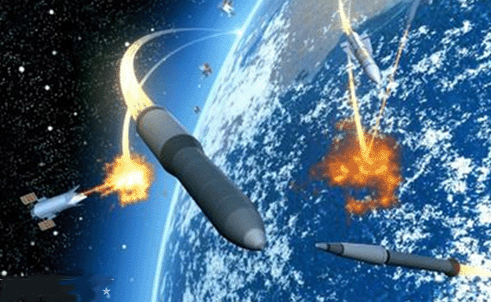
Avoiding an unintentional space war: Lessons from Cold War nuclear diplomacy, Bulletin of the Atomic Scientists By Maxwell Simon, Sam Wilson, May 13, 2021 In July of 2020, senior US and Russian officials held talks about space security and strategic stability, the first such talks between the two countries dedicated to these issues in seven years. The meetings came at a time when the domain of space has been becoming increasingly tense: Just a few weeks earlier, the US Space Command reported that Russia had tested a space-based weapon (US Space Command Public Affairs 2020a); almost a year earlier, the US Director of National Intelligence had reported that Russia and China were fielding new weapons that could put US space capabilities at risk (Coats 2019).
Tensions have not eased since then, and in December 2020, the US Space Command reported that Russia had tested as direct ascent anti-satellite weapon, its second such test of 2020 (US Space Commands Public Affairs 2020b). Meanwhile, both countries are blaming the other for weaponizing space. ….. (subscribers only) https://thebulletin.org/premium/2021-05/avoiding-an-unintentional-space-war-lessons-from-cold-war-nuclear-diplomacy/
How to deal with a nuclear-armed Kim Jong Un

How to deal with a nuclear-armed Kim Jong Un, by David A. Andelman, May 10, 2021, CNN,The Biden administration has pledged to pursue “calibrated” diplomacy.
to persuade North Korean leader Kim Jong Un to halt his mad dash toward a deliverable nuclear weapon. But that is a vain hope. Instead, the world and especially the United States must find a way to live with a North Korea armed with The Bomb. And keep Kim from using — or selling — it.
Discussions with a number of individuals who have dealt with the North Korean government or monitored the actions of its ruling family have convinced me that no Kim — neither Kim Jong Un, nor his father nor his grandfather — ever has or will give up a quest for a deliverable nuclear weapon. Nor is Kim likely to relinquish such a device once it can be deployed. Indeed, North Korea clearly does have any number of such devices — some analysts say it could be more than 60 — though the delivery vehicles are still in development.
That brings us to the realm of what may be possible and achievable. For Kim, possession of a nuclear weapon is a question of existential survival. His ultimate fear is no doubt the fate of Libyan strongman Colonel Moammar Gadhafi — dragged from a drain pipe by rebels and executed, a direct consequence of the decision to relinquish his own nuclear program that allowed his enemies in the West to undermine his regime.
Still, it’s not clear that President Biden or his principal advisers are prepared to accept any nuclearized North Korea. President Joe Biden has said that any diplomacy “has to be conditioned upon the end result of denuclearization.” At the same time, he and his team are rightly rejecting former President Donald Trump’s “go big or go home” approach — agreeing to remove all sanctions in exchange for North Korea fully dismantling its weapons program — which Kim rejected out of hand at their last, abortive summit in Hanoi……….
The essence of any such [diplomacy] plan must lie in the United States finding a way to persuade the North to join the global nuclear non-proliferation club. Implicit would be the acceptance that it already has a weapon. In turn the North will need to make its weapons and their security clearly visible and open to inspection…………
The essence of any such plan must lie in the United States finding a way to persuade the North to join the global nuclear non-proliferation club. Implicit would be the acceptance that it already has a weapon. In turn the North will need to make its weapons and their security clearly visible and open to inspection. https://edition.cnn.com/2021/05/09/opinions/north-korea-nuclear-biden-andelman/index.html
Australia risks bringing on a nuclear war with China. Urgent need to change foreign policy.
Nuclear’: Grim prediction for what war with China would look like, Yahoo News. Brooke Rolfe· News Reporter, Sat, 8 May 2021
Australia’s escalating rift with China could see the hypothetical prospect of war swiftly become a reality if the government doesn’t urgently rethink its approach, according to Hugh White, a leading expert on Australia’s strategic defence………..
Now our government has begun, with disconcerting nonchalance, to talk of war,” he wrote in The Saturday Paper.
“And yet our government seems to have no idea how serious, and dangerous, our situation has become, and has no viable plan to fix it. This must count as one of the biggest failures of statecraft in Australia’s history.”………..
“It would be a war the US and its allies would have no clear chance of winning. Indeed, it is not even clear what winning a war with a country such as China means. And it would very likely become a nuclear war,” he wrote.
Recent reports from the government saying Australia’s troops should be ready for a military conflict suggest Prime Minister Scott Morrison and Defence Minister Peter Dutton are prepared to go to war with China, Prof White noted.
He urged against any notion of heated conflict and implored the Federal Government to rethink its relationship with China from the ground up.
China’s inevitable rise needs to be accepted, combined with “a new order in Asia” which includes the rise of India and Indonesia.
“Australia must conceive a new relationship with China, one that takes account of this reality and works to balance and protect the full range of our interests … this would require hard work, deep thought and subtle execution. It would mean a revolution in our foreign policy.”…….
He urged against any notion of heated conflict and implored the Federal Government to rethink its relationship with China from the ground up.
China’s inevitable rise needs to be accepted, combined with “a new order in Asia” which includes the rise of India and Indonesia.
“Australia must conceive a new relationship with China, one that takes account of this reality and works to balance and protect the full range of our interests … this would require hard work, deep thought and subtle execution. It would mean a revolution in our foreign policy.” https://au.news.yahoo.com/nuclear-grim-prediction-for-what-war-with-china-would-look-like-051637841.html
China sets out to control the world nuclear industry, – Pakistan, UK, and beyond
Nikkei Asian Review 9th May 2021, Nick Butler: On Mar. 11, Pakistan inaugurated its most recent and largest civil nuclear power project with the opening of the 1.1-gigawatt plant in Karachi, doubling the capacity of Pakistan’s four existing nuclear facilities. A second similar unit is due to come online in the coming months. The event marked a significant step for Pakistan which needs additional capacity from all sources to bolster its existing inadequate power supplies. But even more important was the fact that the plant was built and will be operated by the state-owned China National Nuclear Corp. (CNNC), one of the companies leading Beijing’s drive to join the very short list of countries with the capability to build and operate civil nuclear power projects around the world. The development of China’s nuclear industry over the last decade has been remarkable. With over 30 new reactors commissioned and another 16 under construction, China is now the main source of growth for nuclear power across the world. China’s objective is to create a closed cycle, self-reliant nuclear industry within China from the processing of uranium to produce fuel for the reactors through to construction and management of the operating plants. This is being achieved through the adaptation of international technology, in particular from Westinghouse into new Chinese designed reactors. In the process, the Chinese nuclear industry will reduce or eliminate the role of the foreign companies whose capabilities established the first wave of development. The other part of the Chinese strategy is to create an export industry, with the plan focused on a range of countries lacking resources of their own and, in most cases, also lacking the technical skills to develop their own indigenous nuclear skills. The leading Chinese nuclear company, the China General Nuclear Power Group (CGN), formerly the China Guangdong Nuclear Power Group, joined the French state company Electricite de France (EDF) in the U.K. in funding a third of the Hinkley Point project. Their aim was to secure the opportunity to go on to build, own and operate a Chinese reactor in Britain, beginning with a new plant at Bradwell in Essex. China, by pursuing its industrial aspirations, is creating a set of relationships and alliances, making full use of the fact that power supplies are crucial for the day-to-day operations of economic life. In the modern world, this is the way in which empires are built. https://asia.nikkei.com/Opinion/What-China-s-rapidly-expanding-nuclear-industry-means-for-the-West |
Talks ‘intensify’ on bringing US back to Iran nuclear deal
Talks ‘intensify’ on bringing US back to Iran nuclear deal
World powers have held a fourth round of high-level talks aimed at bringing the United States back into a landmark nuclear deal with Iran,abc news, DAVID RISING and PHILIPP JENNE , Associated Press, 8 May 21,
VIENNA — World powers held a fourth round of high-level talks Friday aimed at bringing the United States back into the nuclear deal with Iran, with both sides signaling a willingness to work out the major stumbling blocks.
The talks began in Austria in early April. Russian delegate Mikhail Ulyanov tweeted following Friday’s meeting that “the participants agreed on the need to intensify the process.”
“The delegations seem to be ready to stay in Vienna as long as necessary to achieve the goal,” he wrote……..
U.S. President Joe Biden says he wants to rejoin the deal, known as the Joint Comprehensive Plan of Action, or JCPOA, but that Iran needs to return to compliance.
Speaking to reporters at the White House on Friday, Biden said he believed the Iranians were approaching the talks seriously…..
The pact is meant to prevent Iran from obtaining a nuclear bomb, something the country insists it does not want to do, and the government in Tehran has said it is prepared to reverse all of its violations but that Washington must remove all sanctions imposed under Trump.
Still unresolved is what Iran’s return to compliance would look like. Delegates to the Vienna talks concede, for example, that Iranian nuclear scientists cannot unlearn the knowledge they acquired in the last three years, but it is not clear whether Iran’s new centrifuges would need to be destroyed, mothballed and locked away, or simply taken offline.
Because the U.S. is currently out of the deal, there were no American representatives at the talks. Diplomats involved are shuttling between the Iranian side and a delegation from Washington elsewhere in Vienna.
Iran’s delegate to the talks, Deputy Foreign Minister Abbas Araghchi, told Iranian state television after the meeting that his impression was that all sides were committed to finding a solution.
“The reports that are being conveyed to us from Americans is that they are also serious about returning to JCPOA. So far, they have announced that they are ready to lift most of their sanctions, but we do not think it is enough,” Araghchi said.
“That is why the negotiations will continue until we reach all our demands in this regard,” he added. “If our demands are met, Iran will be quite serious about returning to its obligations in the full implementation of JCPOA.”
Between the high-level meetings in Vienna of the so-called Joint Commission, expert groups have been meeting to try and come up with solutions to the outstanding issues.
Alain Matton, a spokesperson for the EU delegation, which is chairing the meetings, said the expert discussions will continue in the days ahead.
“And the EU as a coordinator and facilitator of the JCPOA talks will continue with separate talks with all participants and with the U.S.,” Matton told reporters. “The participants are continuing with discussions, which are held on various levels and which have as their objective the full and effective implementation of the deal by all sides and the U.S. return to the JCPOA.”…….. https://abcnews.go.com/International/wireStory/high-level-talks-resume-returning-us-iran-nuclear-77550806
Iran nuclear talks in Vienna make headway, as USA shows plans for removing sanctions

Independent 3rd May 2021, For months, the United States was humming and hawing about how and on what
terms it would return to the nuclear deal with Iran, as doubts were percolating in world capitals about whether the administration of Joe Biden even wanted to revive the deal.
But during indirect talks between Iran and the US over the last couple weeks in Vienna, Washington startled just about
everyone involved when it suddenly presented plans detailing how it would remove sanctions on Iran if it were to roll back its nuclear programme for both countries to back come into compliance with the Joint Comprehensive
Plan of Action (JCPOA).
https://www.independent.co.uk/news/world/iran-us-nuclear-deal-headway-vienna-b1840992.html
Israel’s ‘shadow war’ and plans to scupper Iran’s nuclear deal
Israel’s ‘shadow war’ and plans to scupper Iran’s nuclear deal
Hawkish elements in Israel will continue to play a leading role moving forward on Tehran’s nuclear programme, analysts say. Aljazeera, Thomas O Falk, 3 May 2021
US President Joe Biden is pushing to reinstate Iran’s nuclear deal and weeks of talks in Austria appear to be bearing fruit.
Israel, however, continues to see its security jeopardised by a potentially nuclear Iran and is trying to thwart negotiations any way possible.
The Mossad spy agency chief Yossi Cohen – a close confidant of Prime Minister Benjamin Netanyahu – met Biden on Friday and, according to one media report, pressed the US president not to sign back on to the nuclear accord unless “improvements” were made.
An unnamed senior Israeli official is quoted as saying Biden responded that the United States “is not close” to returning to the Iran deal, Axios reported.
Israel’s opposition to the nuclear agreement seems to go beyond words, however, with Iran accusing it of assassinating its top nuclear scientist and sabotaging its main nuclear facility Natanz in a series of attacks. Israel has neither confirmed nor denied its involvement.
Benny Gantz, Israel’s defence minister, said in March his country has drawn up plans to strike Iranian targets if Tehran continues its nuclear escalation.
Simon Mabon, a professor of international politics at Lancaster University, told Al Jazeera that within Israel, and particularly in the government, hawkish elements will continue to play a leading role moving forward on Tehran’s nuclear programme.
“Those supporting Netanyahu’s view of the Iranian regime are steadfast in their view that the Islamic Republic cannot be deterred through conventional forms of deterrence and a military strike is needed,” said Mabon.
‘Considerable damage’
Yaniv Voller, senior lecturer in Middle East politics at the University of Kent, said Israel’s efforts against Iran’s nuclear programme – often described as “the shadow war” – are likely to continue given the positive events in Vienna after Tehran’s recent negotiations with world powers on the nuclear accord.
However, Voller said a hot war remains unlikely despite Israel’s best efforts.
“I do not think the shadow war will turn into a full-blown conflict between Israel and Iran. A greater risk is a local conflict between Israel and Iran’s proxies in the region, particularly Hezbollah,” Voller told Al Jazeera.
“This could be reminiscent of summer 2006, but with the potential to being even more devastating. Neither side has an interest in escalating the situation but, naturally, conflicts sometimes do spiral.”
He argued that, as the latest incidents have shown, Israel’s option to target the programme effectively is much broader than a mere preemptive attack.
“In any case, some of the actions that have been related to Israel and the US have already caused considerable damage to the Iranian nuclear programme, so a preemptive strike is not necessarily the only viable option to delay the Iranian nuclear programme.”…………. https://www.aljazeera.com/news/2021/5/3/israels-shadow-war-and-plans-to-scupper-irans-nuclear-deal
Britain is now undermining the Nuclear Non Proliferation Treaty (NPT)
ICAN (accessed) 3rd May 2021, Five Ways the UK is Undermining the NPT. The NPT has played an unparalleled
role in curtailing the nuclear arms race and it continues to play a role in keeping the world safe. It is at the centre of international efforts to stop the spread of nuclear weapons, to create a nuclear weapon free world,and to enable access to the peaceful use of nuclear energy.”
But the UK has now taken steps which dangerously undermine this crucial treaty. In its Integrated Review of Security, Defence, Development and Foreign Policy, the UK government announced that it will increase the maximum size of its
nuclear arsenal and reduce the information it provides about it.
Having consistently committed itself over the past decade to reducing its stockpile to a maximum of 180 warheads by the mid 2020s, the UK has now raised this limit to 260, an increase of over 40%. At the same time, the UK will no longer release operational stockpile, deployed warhead or deployed missile numbers.
https://www.icanw.org/five_ways_the_uk_is_undermining_the_npt
Serious concerns about China’s role in Hinkley Point nuclear power station
Independent 3rd May 2021. Chinese investors have amassed nearly £134bn of assets in key UK industries ranging from energy companies and transport hubs to breweries and schools. Nearly 200 British companies are either controlled by groups or individuals based in China and Hong Kong or count them as minority shareholders, according to an analysis of business data. The list of investments drawn up by the Sunday Times includes Hinkley Point C nuclear power station, Heathrow Airport, Northumbrian Water, pub retailer Greene King and Superdrug.
Serious concerns have been raised about the security implications of China’s investment in UK assets, most notably in relation to Hinkley Point nuclear power station which is owned by French energy firm EDF. In 2016 Theresa May’s government briefly put the project on hold before attaching new conditions to the £18bn deal. Nick Timothy, one of
the Ms May’s chief advisers, had warned that China “could use their role to build weaknesses into computer systems which will allow them to shut down Britain’s energy production at will”. China General Nuclear Power holds a 33.5 per cent stake in the plant, which is owned by the French state-owned energy firm EDF.
Bangor City Council supports the U.N. Treaty on the Prohibition of Nuclear Weapons, as do over 400 other jurisdictions.
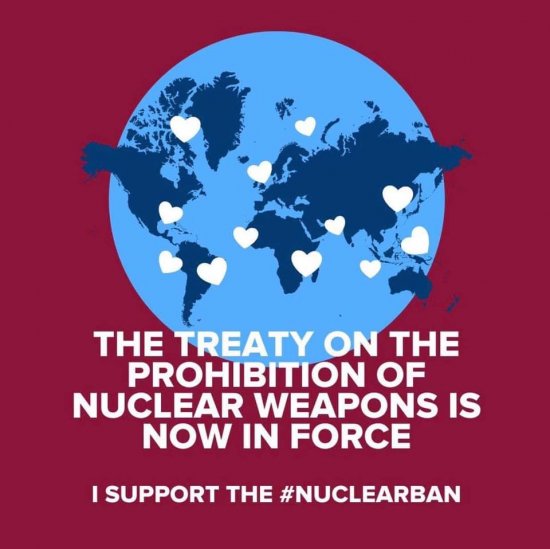
Nation Cymru 1st May 2021, Bangor City Council has become the first Welsh Council to support the
Treaty on the Prohibition of Nuclear Weapons. The treaty came into force in
January and seeks to start a process for effective nuclear disarmament and
to unlock the ongoing stalemate in discussions at the Nuclear
Non-Proliferation Treaty (NPT) Review Conferences.
There are currently 54 states that have ratified the TPNW, including the Irish Republic, Austria,
South Africa, New Zealand, Mexico and the Vatican State. A further 32
states have signed it and are in the process of ratifying it. To date over
400 towns, cities, counties and federal states have passed TPNW
resolutions, including Paris, Berlin, Oslo, Barcelona, Washington DC,
Sydney, Amsterdam, Bruges, Geneva, Montreal, Hiroshima and Nagasaki.
Malaysia needs to speak out on releasing nuclear waste into the sea
Malaysia needs to speak out on releasing nuclear waste into the sea https://www.theedgemarkets.com/article/malaysia-needs-speak-out-releasing-nuclear-waste-seaBernama/Bernama
May 02, 2021 KUALA LUMPUR : Malaysia needs to play its role as a member of the United Nations Environment Programme (UNEP) by speaking out on the long-term effect of releasing treated water from nuclear power plants into the ocean.
Co-founder of Project Ocean Hope, Mogesh Sababathy said actions need to be taken to ensure environmental sustainability, especially for marine life, is not threatened.
“Even though the nuclear waste will be diluted in water, its radioactive concentration should also be considered. And even when diluted, toxic is still toxic and it can still affect everyone.
“Hence, Malaysia needs to play its role and speak out on this issue at an international level, as this involves people’s security and health, as well as marine life in the region,” he told Bernama.
The Japanese government has recently approved a plan to release more than one million tonnes of treated water from the ruined Fukushima nuclear plant into the sea.
The plan also has the support of the International Atomic Energy Agency (IAEA), which says the release is comparable to the disposal of waste water from other nuclear plants globally.
Mogesh argued that this method will affect the world’s food chain security. “Nuclear radioactive is capable of affecting marine life and killing organisms, thus threatening the economic source of those who rely on it.
“It’s undeniable that Malaysia is far removed from Fukushima but we still share the same ocean. It is not impossible for the waste to drift to our country,” he said.
He hopes the relevant international bodies will study and develop safer alternative to dispose radioactive nuclear waste without harming the environment.
China’s big stake in UK’s new nuclear projects
Times 2nd May 2021 , How Beijing bought up Britain. China has quietly spent £134bn hoovering up
UK assets, from nuclear power to private schools and pizza chains. Research
reveals that almost 200 British companies are either controlled by Chinese
investors or count them as minority shareholders. The value of Chinese
investments totals £134 billion.
Some of the biggest sums have been spent
in the energy sector, notably nuclear power. Chinese state-owned China
General Nuclear (CGN) bought a 33.5 per cent stake in Hinkley Point C power
station in Somerset, the first new nuclear facility to be built in the UK
in more than 20 years.
The main investor is France’s EDF. CGN, which has
been blacklisted in America for allegedly helping to acquire US tech for
military use in China, has also joined with EDF on the proposed nuclear
plant at Sizewell C in Suffolk. CGN will take a 20 per cent stake during
the plant’s development. Plans for a third plant, at Bradwell in Essex,
have China hawks up in arms, because CGN intends to take a majority 66.5
per cent stake during development and will use its own reactor technology.
https://www.thetimes.co.uk/article/how-beijing-bought-up-britain-hqll9tjtx
1 This Month

of the week – THE ONENESS of HUMANITY
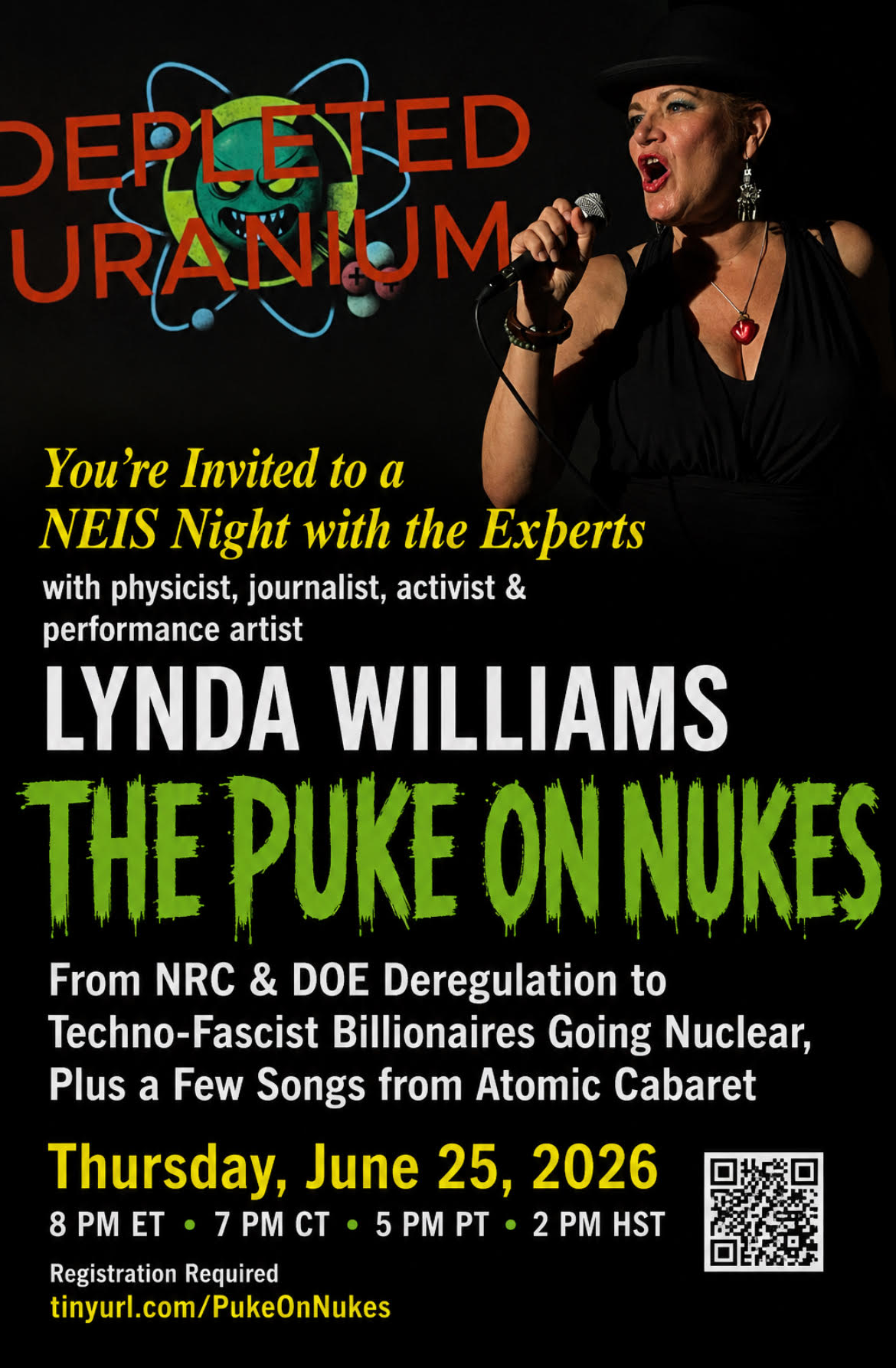
25 June- THE PUKE ON NUKES
Thursday, June 25, 2026
7pm Central Time (8pm ET, 6pm MT, 5pm PT) UTC – 5
From NRC & DOE Deregulation to Techno-Fascist Billionaires Going Nuclear, Plus a Few Songs from Atomic Cabaret REGISTER
26 June – Radiation Trainwreck at the NRC / Join the Protect Better Campaign – https://us02web.zoom.us/meeting/register/4ZlZ5_qLSHGiLSCg8FF6Bg#/registration
1st July – Webinar Waste of Space: The Environmental Harm of Military and Civil Space Activity st July, 7 pm

Report Launch Online: We are seeing an increasing exploitation of space for military and commercial purposes. This must change.

Protect Sazan Island from the Trump family! https://secure.avaaz.org/campaign/en/protect_sazan_island_from_the_trump_family_loc/?bqFCVab&v=174511&cl=22707147157&_checksum=5e9dde668860e8231c33699735e16a1fbf22ab2cb01da50c999fe8732b9775ef&utm_source=email&utm_medium=blast_email&utm_campaign=174511


Cuba Is Not a Failed State – It Is a Besieged State
PETITION: “Global Appeal to Endorse Palestinian Right of Return of Refugees”
To see nuclear-related stories in greater depth and intensity – go to https://nuclearinformation.wordpress.com
-
Archives
- June 2026 (251)
- May 2026 (306)
- April 2026 (356)
- March 2026 (251)
- February 2026 (268)
- January 2026 (308)
- December 2025 (358)
- November 2025 (359)
- October 2025 (376)
- September 2025 (257)
- August 2025 (319)
- July 2025 (230)
-
Categories
- 1
- 1 NUCLEAR ISSUES
- business and costs
- climate change
- culture and arts
- ENERGY
- environment
- health
- history
- indigenous issues
- Legal
- marketing of nuclear
- media
- opposition to nuclear
- PERSONAL STORIES
- politics
- politics international
- Religion and ethics
- safety
- secrets,lies and civil liberties
- spinbuster
- technology
- Uranium
- wastes
- weapons and war
- Women
- 2 WORLD
- ACTION
- AFRICA
- Atrocities
- AUSTRALIA
- Christina's notes
- Christina's themes
- culture and arts
- Events
- Fuk 2022
- Fuk 2023
- Fukushima 2017
- Fukushima 2018
- fukushima 2019
- Fukushima 2020
- Fukushima 2021
- general
- global warming
- Humour (God we need it)
- Nuclear
- RARE EARTHS
- Reference
- resources – print
- Resources -audiovicual
- Weekly Newsletter
- World
- World Nuclear
- YouTube
-
RSS
Entries RSS
Comments RSS
 nuclear-news