China threatens Japan with nuclear war over intervention in Taiwan
China threatens Japan with nuclear war over intervention in Taiwan, Business Standard, 23 July 21,
Deputy PM Aso urged dialogue to resolve any issue The Chinese Communist Party aired a video in which it warned Japan of a nuclear response and “full-scale war” if the island nation interferes in China’s handling of Taiwan, Fox News reported.
The video, which appeared on a channel approved by the CCP, singles out Japan as the one exception to China’s policy to not use nuclear weapons against non-nuclear powers.
“We will use nuclear bombs first,” the video said. “We will use nuclear bombs continuously. We will do this until Japan declares unconditional surrender for the second time.” The video was deleted from Chinese platform Xigua after gaining 2 million views, but copies were uploaded to YouTube and Twitter, Taiwan News reported. Accoding to Fox News,the threats follow comments made two weeks ago by Japanese officials about Taiwan’s sovereignty, with Deputy Prime Minister Taro Aso saying that Japan must “defend Taiwan,” The Japan Times reported……. https://www.business-standard.com/article/international/china-threatens-japan-with-nuclear-war-over-intervention-in-taiwan-121072300030_1.html
Do Germany and the Netherlands want to say goodbye to US nuclear weapons?
Do Germany and the Netherlands want to say goodbye to US nuclear weapons? Bulletin of the Atomic Scientists By Michal Smetana, Michal Onderco, Tom Etienne, July 21, 2021 Does stationing US nuclear weapons in Europe still make sense? As of 2021, there remain about 100 B61 nuclear bombs stored at military bases in Germany, the Netherlands, Belgium, Italy, and Turkey (Kristensen and Korda 2021). Deployed under NATO’s nuclear sharing policy, these air-deliverable weapons are supposed to serve as a tool of extended deterrence against Russia and assurance of European allies about the willingness of Washington to defend them with all means available.
Yet, there are new—and loud—voices on both sides of the Atlantic that question the need to continue this Cold War-era practice in the 21st century. While certainly not everyone agrees with the recent proposal by Harvard University’s Stephen Walt to “fold America’s nuclear umbrella” altogether (Walt 2021), many politicians in European hosting states advocate for at least an early removal of the remaining US bombs from their soil. Arguably, the debates over the future of US nuclear weapons in Europe are now of paramount importance given the attempts of the new US administration to balance its approach vis-à-vis Moscow (Squassoni 2021) and Europe’s ambition to seek strategic autonomy (Meijer and Brooks 2021)……… (subscribers only) https://thebulletin.org/premium/2021-07/do-germany-and-the-netherlands-want-to-say-goodbye-to-us-nuclear-weapons/
After the lab-leak theory, US-Chinese relations head downhill
The United States and China could work together in sharing biosecurity-related samples, genetic materials and data, developing protocols and countermeasures against biosafety accidents, promoting transparency in dual-use research of concern, countering disinformation, and strengthening compliance with global health laws, including the Biological Weapons Convention and the International Health Regulations.
But the US push to investigate the lab leak and the political context in both countries likely puts the goal of finding the origins of COVID-19 and many other ambitions at risk………
After the lab-leak theory, US-Chinese relations head downhill, Bulletin of the Atomic Scientists, By Yanzhong Huang | July 16, 2021 In October, 2018, more than a year before the COVID-19 pandemic, dozens of international trainees visited the Wuhan Institute of Virology for an expansive workshop meant to “promote the cooperation between China and other countries in the field of biosafety.” The attendees, many from developing countries, took classes on virus handling and bioethics, they listened to speeches by Chinese and UN arms control officials, and learned from eminent scientists. For the organizers, the 10-day event was a chance to showcase China’s expertise in biosafety management. And for this, they could hardly have chosen a more perfect location, a prestigious virology institute that had just months earlier opened the country’s first state-of-the-art, specialized facility for safely studying the world’s most dangerous pathogens, a biosafety-level (BSL) 4 lab.
The marketing plan hasn’t paid out.
Two years on, the lofty vision the workshop at the advanced Chinese biolab embodied—one of international collaboration on disease control and scientific research—has disintegrated as the United States and China tangle in an increasingly nasty fight over the origins of the still-raging coronavirus pandemic. In the United States, President Joe Biden, prominent scientists, and once-skeptical mainstream media outlets have collectively revived a hypothesis that was initially largely framed as a conspiracy theory, that the COVID-19 virus could have escaped from the Wuhan lab. Meanwhile, in China, many are convinced COVID-19 started somewhere else, outside of the country.
The Wuhan Institute of Virology now sits at the forefront of the US-China row on the origins of a once-in-a-century pandemic.
Continue readingProgressive lawmakers join across the world in a Global Alliance For A Green New Deal.

Labour MP Clive Lewis and Caroline Lucas of the Green Party join lawmakers from US, Brazil, EU and Costa Rica in new global climate justice campaign. Leading progressive lawmakers from the UK, USA, Brazil, Costa Rica, and the European Parliament are among those joining forces in a new Global Alliance for a Green New Deal today, in a bid to promote the case for “a rapid and just transition in response to Covid-19 and the climate and nature crises”.
The Alliance calls for the creation of “a new internationalism based on cooperation, collaboration and global justice” in order to address the interlinked climate, biodiversity, and coronavirus crises. It adds that a ‘Green New Deal’ should be placed at the heart of national and global Covid economic recovery efforts. Among the 21 founding politicians in the Alliance are British MPs Clive Lewis from the Labour Party and the Green
Party’s Caroline Lucas, who both co-chair the All Party Parliamentary Group on the Green New Deal in the UK.
Business Green 19th July 2021
https://www.businessgreen.com/news/4034612/moonshot-moment-uk-mps-join-global-alliance-green-deal
Nuclear-free Asia Pacific Report
Nuclear-free Asia Pacific Report
By APR editor – July 19, 2021 Over the past 50 years, France has continued to deny the tragedies of nuclear testing in French Occupied Polynesia by propagating the theory of “clean nuclear tests”. Image: Youngsolwara Pacific
Asia Pacific Report newsdesk Moana activists, campaigners, scholars, researchers and Green MPs gathered today in a show of solidarity for Tahiti’s Ma’ohi Lives Matter rally at Auckland University of Technology and vowed to work towards independence for the French-occupied Pacific territory.
A live feed from the Tahitian capital of Pape’ete was screened and simultaneous events happened across the Pacific, such as in Fiji.
Many of the Auckland participants were stalwarts from the early days of the Nuclear-Free and Independent Pacific (NFIP) movement from the 1970s and 1980s and declared their support for pro-independence Tahitian leader Oscar Temaru.
Many speakers protested that Tahitians were still awaiting compensation for the legacy of health problems and the devastation of Moruroa and Fangataufa atolls during 30 years of testing and 193 nuclear blasts, both atmospheric and underground.
The speakers said it was appalling that serious attempts for compensation and a state apology had not happened in the two decades since the tests ended in 1996.
However, reports from Paris at the weekend hinted that the French Polynesian President had indicated that France had for the first time conceded it should compensate Tahiti’s social security agency CPS for the medical costs caused by the tests.
The agency had repeatedly said that since 1995 it had paid out US$800 million to treat a total of 10,000 people suffering from cancer as the result of radiation from the tests.
French PM’s letter
Tahiti’s territorial President Édouard Fritch said he received a letter from French Prime Minister Jean Castex, in which he admitted that the demand for a re-imbursement of the outlays was legitimate…………….
Environmental journalist, author and academic Dr David Robie denounced the “decades of lies, bluster and cover-ups” by French authorities, saying recent allegations published by the book Toxique and investigative website The Moruroa Files were a “game changer” forcing action from Paris…………
The rally participants acknowledged the connection between indigenous struggles in Mā’ohi Nui, Aotearoa, Australia, Hawai’i, Kanaky New Caledonia, Micronesia, Papua New Guinea, Rapa Nui, Solomons, Vanuatu, West Papua, and the rest of Moana.,,,,,,, https://asiapacificreport.nz/2021/07/19/nuclear-free/
Nuclear colonialism
An Australian artist has accused a group of Conservative councillors of
using “bullying strategies” to silence and censor her work after an
installation she created to highlight Britain’s “identity as a colonial
nuclear state” was removed from a park in Essex. The councillors
threatened to “take action against the work” if it was not removed,
according to Metal, the arts organisation that commissioned and then
removed the installation from Gunners Park in Southend.
Guardian 17th July 2021
21
Australia’s weapons lobby drumming up fear of nuclear attack by China, against all logic

Those in Australia beating the “drums of war” point to Taiwan as the flashpoint for the next major global conflict. To what end does a first strike on Australia achieve China’s goals in relation to Taiwan?
War with China: zero logic yet the weapons lobby has 42% of Australians believing it Michael West Media, by Marcus Reubenstein | Jul 16, 2021 Incredibly, a survey finds 42% of Australians believe China will attack Australia, this despite exports to China surging 36% over in the last six months, and despite there being no logical rationale for war with China, or an attack by China. Marcus Reubenstein analyses the ludicrous position of Australia’s China hawks and the mainstream media pushing their agendas.
“Cry ‘Havoc!’ and let slip the dogs of war.”
William Shakespeare, Julius Caesar Act 3, Scene 1
China is a rapidly growing economic power, seeking to exert considerable influence in its region and beyond. And like every great power it is a bully which tries to entice, cajole or intimidate other nations into adopting its view of the world.
How is this such a difficult concept for Australians to embrace?
Since Federation we’ve tied our fortunes to two great powers, the declining British Empire then the rising, and rising even more, US global hegemony……….
Who is threatening whom?
A new report from the Australia Institute begins with the following words:

“In April this year, Australians were warned by no less an expert than the former Minister for Defence, Christopher Pyne, that they may need to engage in a ‘kinetic’ war with China in the next five to ten years.”
Perhaps, in the realm of China policy, ‘no lesser expert’ better describes his authority on the subject.

The same Pyne, famously discussed his role as a defence industry consultant with EY whilst he was a sitting member of the Federal Cabinet, a matter which prompted a Senate investigation.
He still works for EY, sits on the board of defence contractor XTEC, is Chair of the Advisory Board of another defence contractor NIOA, and in June last year Arawa Capital announced him as Chair of its Advisory Board and Investment Committee for a fund investing in weapons systems.
In heralding that appointment Arawa specifically referred to the, still unsubstantiated, Scott Morrison announcement of a malicious cyber attack by an unnamed “state-based” actor. Arawa trumpeted Pyne has “unrivalled knowledge of the cyber, intelligence and national security landscape.”
With Pyne on board, Arawa said it “anticipates closing out the initial $50mil capital raising swiftly.” It transpired there was a swift “closing out”, ASIC records show six months later Arawa Capital Pty Ltd was deregistered as a company.
According to research from Michael West Media’s “Revolving Doors” series, Pyne’s numerous board memberships and consultancies put him in direct, or indirect, contact with more than a dozen weapons makers and contractors.
Clearly, talking up a war with China is of no financial benefit to these companies.
Why would China attack Australia?
Should Australia go to war with China in defence of Taiwan? is the title of the Australia Institute report and 42% of its six hundred respondents think China is poised to attack Australia.
How and why?
Those in Australia beating the “drums of war” point to Taiwan as the flashpoint for the next major global conflict. To what end does a first strike on Australia achieve China’s goals in relation to Taiwan?
If Australia has something China wants, it is many times cheaper and easier to buy it than to send your army half way around the world to steal it.
China’s current leadership is presiding over a great deal more diplomatic disasters than triumphs but, if nothing else, the Chinese are pragmatic.
Australia’s rabid China hawks will no doubt dismiss such assessments, saying China doesn’t need to deploy military assets it would simply launch a nuclear strike on a target—which they ignore is home to 1.2 million ethnically Chinese people.
My counter argument?
The policy wonks in Washington, who made you their lapdogs, didn’t throw you a bone because they thought you were smart, they threw you the bone because they knew you were dumb enough to catch it!
This survey’s inconvenient truth
The same number of respondents were polled in Taiwan and only a few more (49 percent) expressed fears of an attack from the mainland. Bear in mind the Taiwanese are of the same Han ethnicity as the majority of Chinese, who moved over from the mainland in the 1680s; the PRC has never given up its claim to what was once part of China; and the island sits just 161 kilometres off the coast of China.
That four in ten Australians should think Beijing—a mere 9,000 kilometres from Canberra—is gearing up for invasion is staggering.
Report author Allan Behm noted, “Given Australia and Taiwan’s historical and geographical differences, it is astounding that Australians could be more fearful than Taiwan in anticipating an attack from China.”
This anticipation is undoubtedly fuelled by Australia’s China hawks, all with close ties to US-funded research groups and patronage from US weapons makers.
However, they should not be too smug in thinking their “drums of war” are resonating.
73 percent of Australians regard the United States as an aggressive nation, while only six in ten Australians believe the US would come to our aid in the event of war with China.
Given Australia has followed the United States into 100 percent of its wars, that Australians would only rate America a 60 percent chance of leaping to our defence is a sobering statistic.
Totally at odds with Prime Minister Morrison and Foreign Minister Maris Payne’s unquestioned support of the US antagonism towards China, 75 percent of Australians think it is in our interests that China and the US “work together towards world peace”. Of concern to the spin merchants inside the government an even higher number of coalition supporters, 79 percent, think peace with China is a good idea.
Despite the US, and Morrison’s, rhetoric of Taiwan being a like-minded democracy of shared values, 76 percent of Taiwanese rate America as an aggressor. Should the US come to Taiwan’s aid in a war with China, only 18 percent of Taiwanese people think they would win.
How reliable are drummers?
By any sensible strategic logic, the dogs of war should remain in their box. Let the drums of war continue to drum up business for the China threat industry and their death-merchant patrons. …..
Israel determined to“maintain military superiority”, in preparation for a nuclear Iran
Gantz: We must ‘adapt our plans’ to prepare for a nuclear Iran
Prime minister says Israel carefully monitoring situation in Lebanon and that IDF currently in better place than it was in 2006 war against Hezbollah, Tims of Israel, By JUDAH ARI GROSS15 July 2021, Defense Minister Benny Gantz on Wednesday called for Israel to step up its preparations for the possibility of Iran obtaining a nuclear weapon……… Israel has maintained that as it is not part of the nuclear deal, it is free to act as it sees fit to prevent Iran from obtaining an atomic bomb.
In his speech, Gantz called for the government to allow the country’s security services to “maintain military superiority, which ensures our secure existence and advances peace.”
The remark appeared to refer to a report by the Kan broadcaster earlier in the evening that the IDF was asking the government for a major budget increase, in large part to prepare itself to conduct strikes aimed at thwarting Iran’s nuclear pursuit………https://www.timesofisrael.com/gantz-we-must-adapt-our-plans-to-prepare-for-a-nuclear-iran/
Expert opinion: why nuclear energy should not be included as sustainable in Europe’s green taxonomy financing

BASE comments on the JRC report https://www.base.bund.de/SharedDocs/Stellungnahmen/BASE/DE/2021/0714_base-fachstellungnahme-jrc-bericht.html Federal Office for the Safety of Nuclear Waste Management (Bundesamt für die Sicherheit der nuklearen Entsorgung) 14 july 21
Expert opinion on the report of the Joint Research Center “Technical assessment of nuclear energy with respect to the‛ do no significant harm ‛criteria of Regulation (EU) 2020/852‛ Taxonomy Regulation ‛”
There are numerous reasons why the use of nuclear power is not ecologically sustainable and why this form of energy generation is therefore not part of the taxonomy regulation of the European Union ( EU ) – this is the conclusion of the Federal Office for the Safety of Nuclear Waste Management ( BASE ).
The basis for this is a specialist opinion for the Federal Environment Ministry, in which the Federal Office for Radiation Protection was also involved.
BASE statement is a reaction to the report of the Joint Research Center.
The reason for this statement is the report of the so-called Joint Research Center, an EU directorate-general whose origin was nuclear research. This came to a positive assessment of nuclear power in March 2021:
According to this, the catalog of criteria of the so-called “do no significant harm” principle is met – an assessment that evaluates forms of energy production according to their environmental balance.
If the EU Commission followed this evaluation by the JRC and rated nuclear energy as an ecologically sustainable form of economic activity, it would also appear attractive as a corresponding form of financial investment and would be equated, for example, with renewable energies.
BASE statement is a reaction to the report of the Joint Research Center
The reason for this statement is the report of the so-called Joint Research Center, an EU directorate-general whose origin was nuclear research. This came to a positive assessment of nuclear power in March 2021:
According to this, the catalog of criteria of the so-called “do no significant harm” principle is met – an assessment that evaluates forms of energy production according to their environmental balance.
If the EU Commission followed this evaluation by the JRC and rated nuclear energy as an ecologically sustainable form of economic activity, it would also appear attractive as a corresponding form of financial investment and would be equated, for example, with renewable energies.
Serious nuclear accidents were not adequately assessed in the JRC report
Background: The evaluation of nuclear power is controversial at the European level. A group of technical experts came to the conclusion in 2020 that a decision in favor of the use of nuclear power as part of the taxonomy should not be made. Thereupon the Joint Research Center of the EU was commissioned to evaluate the atomic energy.
In its report, BASE now points out the following points that should be assessed negatively with regard to nuclear power:
- failure to take into account the risk of major accidents,
- unresolved repository – or disposal problems and
- an insufficient consideration of subsequent loads for future generations.
As a result, the report comes to the following assessment:
“The JRC report only incompletely considers the consequences and risks of the use of nuclear energy for people and the environment as well as for subsequent generations or omits them in its assessment. Insofar as it deals with them, the principles of scientific work are sometimes not correctly taken into account. The JRC report thus provides an incomplete contribution with which the sustainability of the use of nuclear energy cannot be comprehensively assessed. “
Expert opinion (German)
Expert Response (English)
British court ruling heightens danger of Assange extradition to the US
British court ruling heightens danger of Assange extradition to the US, WSWS, Oscar Grenfell, 12 July 21, Last week’s ruling by the British High Court allowing prosecutors to appeal an earlier judgment blocking Julian Assange’s extradition, poses the very real danger that the WikiLeaks publisher will be dispatched to his American persecutors in the not-too-distant future.
The ruling is a microcosm of the Assange case as a whole. As they have for the past decade, the British courts have thrown aside the WikiLeaks founder’s legal and democratic rights. They have granted a US appeal that is both duplicitous and irregular under conditions in which the entire attempt by the American state to prosecute Assange has been exposed as an illegal frame-up.
The US appeal is a damning refutation of those, including among Assange’s own supporters, who have peddled dangerous illusions that the US administration of President Joe Biden may drop the prosecution if a sufficient number of moral pleas are addressed to the new occupant of the White House.
The appeal was first issued in the dying days of the Trump administration but it was continued, honed and argued for by Biden’s Justice Department. Assange remains in London’s maximum-security Belmarsh Prison and faces the prospect of lifetime incarceration in the US because Biden is determined to press ahead with the prosecution of a journalist and publisher for exposing American war crimes, human rights violations and illegal spying operations.
That is because the Assange prosecution is viewed as a crucial precedent by the imperialist powers for the suppression of dissent and anti-war opposition amid a ratcheting up of the preparations for military conflict, including the Biden administration’s threats and provocations against China, and the first signs of a resurgence of working-class struggle.
The appeal also confirms the warnings made by the World Socialist Web Site about January’s British District Court decision that barred extradition.
Judge Vanessa Baraitser accepted all the substantive arguments of the US prosecutors, including their right to try a publisher under the Espionage Act. Her ruling, prohibiting extradition, was framed in the narrowest terms. Its purpose was to defuse a groundswell of opposition to the prospect of Assange’s extradition and to provide the US with ample scope for appeal.
Baraitser ruled that extradition would be “oppressive.” Assange’s compromised health and the conditions of his imprisonment in the US would likely result in his suicide.
The deliberate consequence of that judgment was that there was only a legal sliver between Assange and extradition.
The US has exploited this with its appeal claiming that the conditions of imprisonment would not be so oppressive. It has proposed worthless assurances that Assange would not be held under Special Administrative Measures (SAM), regulations that impose almost total isolation on a prisoner, and that he could serve out his sentence in Australia.
The extradition hearing had heard harrowing testimony about the dire psychological consequences of SAMs and conditions at the supermax ADX Florence prison where they are frequently imposed.
The US arguments, accepted as a legitimate basis of appeal by the British court, were demolished by Stella Moris, Assange’s partner and an international human rights lawyer.
In a statement issued on Friday, Moris wrote: “Reports about US undertakings are grossly misleading. On any given day 80,000 prisoners in US prisons are held in solitary confinement. Only a handful are in ADX/under special administrative measures. ADX is just one of dozens of self-described supermax prisons in the United States. The US government also says it may change its mind if the head of the CIA advises it to do so once Julian Assange is held in US custody.
“With regard to the supposed concession of allowing Julian to serve jail time in Australia, it was always his right to request a prisoner transfer to Australia to finish serving his sentence because he is an Australian. It is no concession at all. There are existing agreements between the US and Australian authorities. What is crucial to understand is that prisoner transfers are eligible only after all appeals have been exhausted. For the case to reach the US Supreme Court could easily take a decade, even two.
“What the US is proposing is a formula to keep Julian in prison effectively for the rest of his life. The only assurance that would be acceptable would be for the Biden Administration to drop this shameful case altogether, once and for all. He should not be in prison for a single day, not in the UK, not in the United States, not in Australia—because journalism is not a crime.”
As Moris noted, the US appeal itself reserved the “right” to impose SAMs once Assange is on US soil. Testimony at the extradition hearing, including from a former US prison warden, established that the imposition of SAMs is essentially extra-judicial, often being introduced at the say-so of the intelligence agencies, and with no genuine means of appeal.
“What the US is proposing is a formula to keep Julian in prison effectively for the rest of his life. The only assurance that would be acceptable would be for the Biden Administration to drop this shameful case altogether, once and for all. He should not be in prison for a single day, not in the UK, not in the United States, not in Australia—because journalism is not a crime.”
As Moris noted, the US appeal itself reserved the “right” to impose SAMs once Assange is on US soil. Testimony at the extradition hearing, including from a former US prison warden, established that the imposition of SAMs is essentially extra-judicial, often being introduced at the say-so of the intelligence agencies, and with no genuine means of appeal.
The hearings, moreover, heard evidence of a case in which similar assurances were immediately thrown out the door once extradition was secured……………
Thordarson has now admitted, however, that almost all his testimony consisted of lies proffered in exchange for immunity from US prosecution. The American government thus submitted a false indictment to the British courts……….https://www.wsws.org/en/articles/2021/07/12/assa-j12.html?pk_campaign=assange-newsletter&pk_kwd=wsws
Australian Members of Parliament from right and left parties call on US President Biden to drop charges against Julian Assange,
Australian MPs call on US President Biden to drop charges against Assange, https://www.smh.com.au/politics/federal/australian-mps-call-on-us-president-biden-to-drop-charges-against-assange-20210629-p585a1.html By Rob Harris, June 30, 2021 Former security analyst turned federal Labor MP Peter Khalil has joined a group of Australian politicians directly lobbying the United States to drop an appeal over a British court’s ruling against the extradition of the WikiLeaks co-founder Julian Assange.
In a video message to US President Joe Biden released on Wednesday evening Australian time, 11 federal MPs from across the political spectrum have also appealed to Washington to drop its espionage charges against the Australian citizen and for the British government to allow him to return home.
Before entering politics Mr Khalil, the member for the Victorian seat of Wills, was director of National Security Policy of the Coalition Provisional Authority in Iraq. As a national security adviser to former prime minister Kevin Rudd, he was personally named in diplomatic cables sent to Washington by the US Embassy, which were later released by Wikileaks.
While he has previously criticised Mr Assange’s actions in helping obtain and leak classified information on the wars in Afghanistan and Iraq, Mr Khalil said the case was “not just about one individual”.
“In an era where rising authoritarian regimes are denying and attacking freedom of the press, such as the shut down of Hong Kong’s Apple Daily by the Chinese Community Party, it is more important than ever that when it comes to condemning the denial of press freedom the rhetoric of liberal democracies is actually matched with substantive actions to protect the right of journalists and the media to do their work freely to hold governments to account,” Mr Khalil said.
He said while the Obama administration had clearly chosen not to indict Mr Assange because it would set a damming precedent against journalistic practice and behaviour, the Trump administration aggressively pursued the case.
“Therein lies the problem. These charges are so broad-based that if successful they would go well beyond this individual case – they would impact investigative journalism and open up prosecutions of countless media doing this journalism, they would have a chilling effect on all journalists reporting on national security and foreign affairs matters,” he said.
The 49-year-old Mr Assange has been in Belmarsh Prison since April 2019 trying to avoid extradition to the US to face charges on multiple counts of conspiring with and directing others, from 2009 to 2019, to illegally obtain and release US secrets.
In doing so he aided and abetted hacking, illegally exposed confidential US sources to danger and used the information to damage the US, according to the charges. If convicted on all counts he faces a prison sentence of up to 175 years.
In 2012 Mr Assange sought asylum at the Ecuadorean embassy to avoid extradition to Sweden on a rape allegation that he denied. An investigation into the 2010 rape allegation has since been dropped by Swedish prosecutors.
He was awarded a Walkley award, Australian journalism’s highest honour, in 2011 for a “most outstanding contribution to journalism” for his “brave, determined and independent stand for freedom of speech and transparency”.
In March this year Nationals MP George Christensen, Independent Andrew Wilkie and Labor’s Julian Hill personally met with the US embassy’s charge d’affaires, Michael Goldman, arguing that Mr Assange should be allowed to return home.
A 24-member parliamentary group established to support Mr Assange’s bid to return home contains members from all major parties, including now Deputy Prime Minister Barnaby Joyce.
Prime Minister Scott Morrison said in January Mr Assange would be allowed to return to Australia if all charges were dropped. He said consular support had consistently been offered to Mr Assange, but made clear the government were “not parties to those set of proceedings”.
.
Nuclear arms control hasn’t worked. We need a new approach.
Why nuclear arms control is dead, The Hill, BY WARD WILSON, — 07/09/21 : This year the MacArthur Foundation said it will cease funding anti-nuclear weapons efforts by 2023. That means the largest foundation working in the nuclear weapons field is throwing in the towel. Ten million dollars a year of scholarly research, diplomatic conferences, track II meetings, and other work to limit nuclear weapons will disappear within two years.
Why would MacArthur do such a thing? They aren’t doing it because nuclear weapons have been eliminated. Perhaps it is because of a loss of faith in the cautious, step-by-step effort to slowly limit the number of nuclear weapons and, over time, work down to zero.
If MacArthur’s board decided that the step-by-step approach isn’t working, they wouldn’t be the first to come to that conclusion. The John Merck Fund, the Rockefeller Foundation, the Ford Foundation, the W. Alton Jones Foundation, the Compton Foundation, the William and Flora Hewlett Foundation, the Skoll Foundation — all these funders evidently have concluded the same. And a report in the Washington Post last week seems to confirm that they are right.
………………… we are entering a new and dangerous era of international competition and tension. The Cold War may have ended 20 years ago, but arms races often signal impending hot wars — and a nuclear arms race is the gravest of signs. Time is short. The cautious, step-by-step approach of arms control, with the minimalist goal of “limiting” nuclear weapons, indeed has failed.
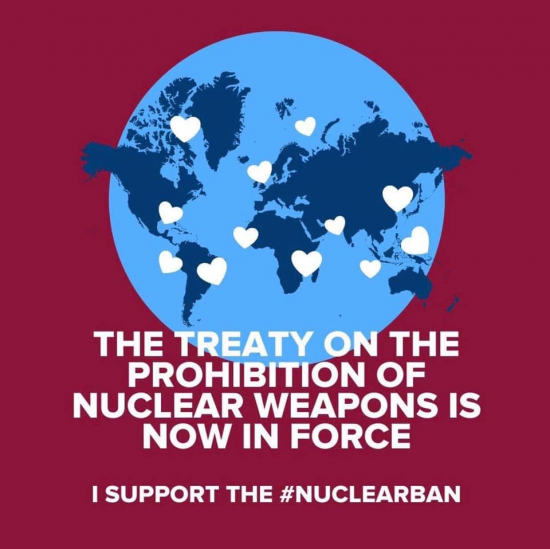
The need for a more aggressive approach ought to have been obvious, if for no other reason than the rest of the world already has given up hope for arms control. In 2017, more than 60 percent of the world’s nations — 122 countries — voted for a United Nations treaty not to limit, not to “one day” eliminate, but to abolish nuclear weapons now. If the apparent loss of faith in arms control by funders isn’t enough, the loss of faith by much of the world ought to be unmistakable proof.
Clearly, a more muscular approach is needed. Continuing to try long-term, careful approaches to the problem guarantees that efforts to oppose nuclear weapons eventually will wither and die. It is time for a stronger, more aggressive strategy — and past time to directly challenge the fundamental beliefs of nuclear weapons advocates. The arms control approach clearly has failed.
It has failed because it took the claims and assumptions of nuclear weapons advocates at face value. Nuclear weapons experts said that nuclear weapons were the “ultimate guarantee” of safety, and arms control nongovernmental organizations and scholars then tried to work within that assumption………..
Nuclear weapons advocates say that nuclear weapons are the “ultimate weapon.” Arms control advocates asked themselves, “How can we persuade people that a ban on the ultimate weapon would ever work?” They should have asked: “Isn’t utility the measuring stick of a weapon? How can a weapon be the ultimate weapon if it’s never used? Isn’t it possible that nuclear weapons are too clumsy, too poisonous, too dangerous to be useful? Isn’t it possible that they aren’t used because they aren’t militarily useful? And isn’t that why nearly 75 years have passed with them sitting idly in silos?”
Arms control is dead. The second nuclear arms race is on. The hour is late — but it is, perhaps, not too late to aggressively challenge the Cold War assumptions and the blinkered mindset that have kept us from seeing the reality of nuclear weapons. https://thehill.com/opinion/national-security/561786-why-nuclear-arms-control-is-dead
North Korea Needs the Bomb to Protect Itself From America
North Korea Needs the Bomb to Protect Itself From America
Pyongyang isn’t crazy, just focused on a credible threat.
Foreign Policy,By Doug Bandow, a senior fellow at the Cato Institute. 9 July 21, ”’………….. North Korea’s quest for nukes has helped make it an economic disaster, turning it into a global pariah and diverting resources from economic investment. That’s one reason the country, as Kim admitted in public recently, is facing another critical food crisis. However, it now is an unofficial member of the world’s exclusive nuclear club.
Nevertheless, the mere possession of nuclear weapons does not mean it threatens America with them. North Korea makes no pretense of having global concerns, other than using diplomatic relations for profit when possible. In the abstract, the Kim dynasty has no interest in the United States or even the Western Hemisphere. Pyongyang’s priority is regional, especially avoiding domination by another power.China exerted substantial influence (Russia less so) over the ancient Korean kingdom, long known as a shrimp among whales. Japan was a colonial oppressor during the first half of the 20th century. Most important today is North Korea’s relations with South Korea, as the two states remain engaged in a de facto civil war, short-circuited by outside intervention in 1953. One reason China’s importunities against North Korea’s nuclear program fall flat is because such weapons help Pyongyang preserve its independence from Beijing.
However, the United States has intruded in Northeast Asia. America intervened in the Korean War, maintains forces in and around the Korean Peninsula, is prepared to intervene in a future conflict, and regularly threatens to wage preventive war.
Indeed, Washington’s willingness to routinely oust governments on Uncle Sam’s naughty list makes the United States particularly dangerous. Washington can’t even be trusted to live up to a denuclearization accord, as Libya’s Muammar al-Qaddafi discovered a decade ago. The Iranians learned that one president’s word does not bind their successor.The North desires a deterrent. At the party congress earlier this year, Kim explained, according to a summary report by state media, that “Korea was divided by the U.S., the world’s first user of nukes and war chieftain, and the DPRK has been in direct confrontation with its aggressor forces for decades, and the peculiarities of the Korean revolution and the geopolitical features of our state required pressing ahead uninterruptedly with the already-started building of nuclear force for the welfare of the people, the destiny of the revolution and the existence and independent development of the state.”
That is a prolix way of saying Pyongyang needs the bomb to protect itself from Washington………… https://foreignpolicy.com/2021/07/07/north-korea-nuclear-weapons-united-states-deterrence/
If They Chose, Biden and Putin Could Make the World Radically Safer
If They Chose, Biden and Putin Could Make the World Radically Safer, By David Swanson, World BEYOND War, June 11, 2021
The danger of nuclear apocalypse is at an all-time high. Understanding of the damage that would result from a nuclear war is of a greater horror than ever previously understood. The historical record of threats of nuclear weapons use, and of near-misses through misunderstandings, has mushroomed.
The influence of the Israeli model of aquiring nuclear weapons but pretending not to have done so is spreading. The Western militarism that other nations see as justification for their own nuclear armament continues to expand.
Demonization of Russia in U.S. politics and media has reached a new level. Our luck will not hold out forever. Much of the world has banned the possession of nuclear weapons. Presidents Biden and Putin could very easily make the world dramatically safer and redirect massive resources into benefitting humanity and the earth, if they were to choose to abolish nuclear weapons.
The American Committee for U.S.-Russia Accord has made these three excellent proposals:…….. https://worldbeyondwar.org/if-they-chose-biden-and-putin-could-make-the-world-radically-safer/
“EDF’s Chinese dream seems well and truly over”- a minor nuclear incident becomes a major industrial disaster for the French nuclear firm.
Le Monde 6th July 2021 “EDF’s Chinese dream seems well and truly over”. The minor incident at a Chinese nuclear power plant could have repercussions … on French industrial cooperation with China, explains Frédéric Lemaître, correspondent for “Le Monde” in Beijing, in his column.
Since June 14, Fabrice Fourcade, the head of EDF in China, and the economic service of the French Embassy in Beijing have been absent subscribers. Within hours, an apparently minor technical incident at a Chinese nuclear power plant turned into a perfect crisis for the French electrician.
The cluster bomb came from the United States. Monday June 14, while the American President, Joe Biden, is in Europe, the American channel CNN announces that the French Framatome, a few days earlier, informed the White House of an “imminent radiological threat” to the nuclear power station of Taishan, in the far south of China.
Why Framatome? Because this plant, in which EDF is a 30% shareholder, was built on the model of the French EPR and because Framatome is one of its main architects. “The largest commercial contract signed by the French nuclear industry and, more generally, in the history of civil nuclear power, this project strengthens Framatome’s presence in China, one of the most promising markets in the world,” explains the group on its site.
Why the United States? The answer is complicated. According to Le Figaro, the French engineer in charge of monitoring the file – in fact, a leak of fuel rods supplied by Framatome – warned a colleague across the Atlantic because it is the American subsidiary which manages the database of all incidents in the group.
Problem: Taishan’s majority shareholder, Chinese CGN, is on the US government’s blacklist. In order to work on the
case and possibly come to Taishan’s aid, an American must therefore obtain the approval of the White House. EDF communicators may try to put out the fire by explaining, from Paris, that the incident is minor, while the industrial disaster is major.
The episode proves that EDF, a 30% shareholder in Taishan, has no say in the matter, is not informed of technical problems and cannot get a board meeting. In Xi Jinping’s China, where any situation is the result of a balance of power, a minority has – by definition – no rights.
1 This Month

of the week – THE ONENESS of HUMANITY

25 June- THE PUKE ON NUKES
Thursday, June 25, 2026
7pm Central Time (8pm ET, 6pm MT, 5pm PT) UTC – 5
From NRC & DOE Deregulation to Techno-Fascist Billionaires Going Nuclear, Plus a Few Songs from Atomic Cabaret REGISTER
26 June – Radiation Trainwreck at the NRC / Join the Protect Better Campaign – https://us02web.zoom.us/meeting/register/4ZlZ5_qLSHGiLSCg8FF6Bg#/registration

1st July – Webinar Waste of Space: The Environmental Harm of Military and Civil Space Activity st July, 7 pm

Report Launch Online: We are seeing an increasing exploitation of space for military and commercial purposes. This must change.

Protect Sazan Island from the Trump family! https://secure.avaaz.org/campaign/en/protect_sazan_island_from_the_trump_family_loc/?bqFCVab&v=174511&cl=22707147157&_checksum=5e9dde668860e8231c33699735e16a1fbf22ab2cb01da50c999fe8732b9775ef&utm_source=email&utm_medium=blast_email&utm_campaign=174511


Cuba Is Not a Failed State – It Is a Besieged State
PETITION: “Global Appeal to Endorse Palestinian Right of Return of Refugees”
To see nuclear-related stories in greater depth and intensity – go to https://nuclearinformation.wordpress.com
-
Archives
- June 2026 (251)
- May 2026 (306)
- April 2026 (356)
- March 2026 (251)
- February 2026 (268)
- January 2026 (308)
- December 2025 (358)
- November 2025 (359)
- October 2025 (376)
- September 2025 (257)
- August 2025 (319)
- July 2025 (230)
-
Categories
- 1
- 1 NUCLEAR ISSUES
- business and costs
- climate change
- culture and arts
- ENERGY
- environment
- health
- history
- indigenous issues
- Legal
- marketing of nuclear
- media
- opposition to nuclear
- PERSONAL STORIES
- politics
- politics international
- Religion and ethics
- safety
- secrets,lies and civil liberties
- spinbuster
- technology
- Uranium
- wastes
- weapons and war
- Women
- 2 WORLD
- ACTION
- AFRICA
- Atrocities
- AUSTRALIA
- Christina's notes
- Christina's themes
- culture and arts
- Events
- Fuk 2022
- Fuk 2023
- Fukushima 2017
- Fukushima 2018
- fukushima 2019
- Fukushima 2020
- Fukushima 2021
- general
- global warming
- Humour (God we need it)
- Nuclear
- RARE EARTHS
- Reference
- resources – print
- Resources -audiovicual
- Weekly Newsletter
- World
- World Nuclear
- YouTube
-
RSS
Entries RSS
Comments RSS
 nuclear-news