NATO and Washington spoiling for another war

Washington always looking for another war http://space4peace.blogspot.com/2021/10/washington-always-looking-for-fight.html
NATO ‘Master Plan’ aimed at Russia BRUCE K. GAGNON , BATH, MAINE, UNITED STATES,
The collapsing US military & economic empire is making Washington & NATO even more dangerous. US could not beat the Taliban but thinks it can take on China-Russia-Iran…a sign of psychopathology for sure.
It didn’t take long for the US to up the ante with China and Russia. So soon after the crushing defeat from 20 years of death and destruction in Afghanistan we find Washington stirring the fire pit and looking for more trouble.
It’s really no surprise. Just take a close look at US history – one filthy war after the other.
Just this past week we’ve seen ‘F the EU’ Victoria Nuland go to Moscow hoping for an audience with Putin. She only got to meet with lower level, but competent Russian diplomats, and came away with nothing other than furthering the divide between our two nations. Actually, that might have been the US strategy.
The word is that Nuland went in with a list of Washington’s demands. Russia said ‘nyet’ and handed Nuland a list of their own. Of course Nuland said ‘No’ and was then sent packing back to the US.
Secretary of War Lloyd Austin (former Raytheon board member) just stopped in Georgia, Ukraine, and Romania before heading to Brussels for hand-wringing with the NATO clowns.
Austin stated during a news conference in Bucharest that the purpose of these visits was to highlight “the importance of deepening cooperation among our Black Sea allies and partners to deter and defend against Russian malign activities in the region.”
That’s the political hype. His real purpose in Georgia, Ukraine, and Romania? Spur them to make trouble for Moscow in any way and every way they possibly can. And I’m sure Austin said the magic words, ‘Of course the US will back you if you get into a fight with Russia. First, we’ll supply you with more weapons and plant more of our troops in your nation to protect you from the Russian bear.’
At the Brussels meeting NATO Secretary General Jens Stoltenberg said the following:
Allies will kick off a $1.16 billion NATO Innovation Fund to develop dual-use emerging and disruptive technologies. NATO will also establish its first artificial intelligence strategy to incorporate data analysis, imagery, and cyber defense.- The allies are spending more on defense and they agreed to increase the readiness of forces.
- Significant improvements are being made to alliance air and missile defenses. NATO calls for strengthening conventional capabilities with fifth-generation jets, adapting exercises and intelligence, and improving the readiness and effectiveness of the nuclear deterrent.
- We exchanged views on how to preserve the gains and ensure Afghanistan never again becomes a safe haven for terrorists.
- NATO’s new strategy ensures that the alliance will have “the right forces in the right place at the right time.”They also characteristically took at shot at China from behind the safe walls of NATO HQ in Brussels with a stream of rhetoric.
Austin’s remarks followed the completion of a two-day NATO ministerial where he said officials offered “unique perspectives” on China, which he noted remains the Pentagon’s “primary pacing challenge.”
“Indeed, I applaud NATO’s work on China and I made it clear that the United States is committed to defending the international rules-based order which China has consistently undermined for its own interests,” Austin told reporters.
At an October 21 CNN town hall, Joe Biden was asked about China.
“I just want to make China understand that we are not going to step back, we are not going to change any of our views.” Biden said. Asked whether the US would come to Taiwan’s defense if it were attacked, he replied: “Yes, we have a commitment to do that.”
- Now let’s analyze this NATO meeting and the comments on China just a bit.First, who has Russia invaded? Since the US orchestrated coup in Ukraine in 2014 (when the Russian-ethnic people in Crimea voted to ask Russia to take them back into the federation) there has been no invasion of anyone near its borders. At the same time US-NATO has been holding war games repeatedly all along Russian borders. When Moscow has responded by holding counter-war games inside its own country Washington and Brussels have howled in condemnation. Talk about a double-standard!And please note the words above by Austin – “I applaud NATO’s work on China” – just what does that mean?
- NATO has gone global. The North Atlantic Treaty Alliance has now decided that it should be ‘defending democracy in the Pacific’. Who is the aggressor in this case? What right does NATO have to decide it is the new global cop?
- Can’t lick Afghanistan so let’s take on China & Russia
NATO has no legitimate reason to exist today – the Soviet Union and their Warsaw Pact Alliance are long gone. Russia just built an undersea natural gas pipeline called Nord Stream 2 to furnish fuel to Europe in order to help alleviate their current energy crisis. It’s a big business deal for Moscow. Why would Russia want war with Europe?The insanity of US-NATO is exposed for anyone willing to see the obvious. Washington and Brussels got their high-tech asses kicked by a ill-armed rag-tag but determined Taliban in Afghanistan. Now they somehow dream that they can take on both China and Russia who have formed a military alliance as they watch the NATO endless war machine heading their way. - I understand that all these moves by US-NATO absolutely benefit the military industrial complex which has installed one of their agents (Lloyd Austin) as secretary of war. But do these psychopaths actually believe they can start a war with China and Russia and possibly win? Don’t they know that such a war would go nuclear in a hot flash?
It’s obvious that the US-NATO war cabal are blinded by power and greed. There can be no other explanation that comes close to making sense.
It’s a dangerous and dirty game these fat cats are playing – at the same time that climate crisis rages in our faces, legions of people face evictions from their homes, and the basic cost of living goes sky high.
Are we heading for a collapse in the US and around the globe? How could that not be happening under these present conditions?
And the US-NATO response?
How about another war?
Which party in Washington is leading this descent into hell?
Electricite de France (EDF) will not proceed with Sizewell nuclear project unless the UK govt institutes tax – the Regulated Asset Base

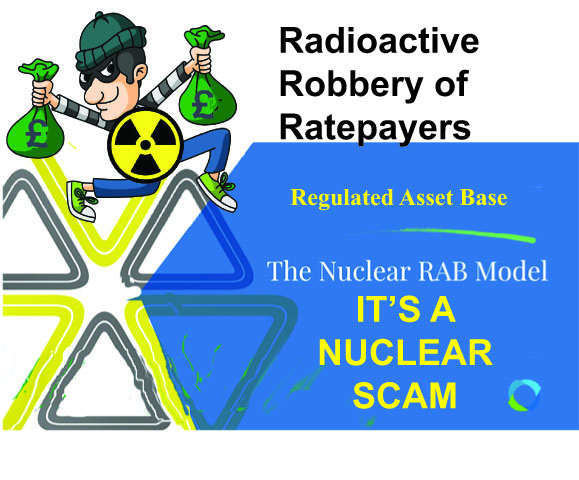
Stop Sizewell C denounces the government’s announcement today of legislation for a new tax on consumer energy bills to help build nuclear power stations such as Sizewell C. The Regulated Asset Base (RAB) model would transfer substantial upfront costs, and considerable risk, onto consumers already struggling with rising energy bills and other tax
increases.
Developer EDF Energy estimates Sizewell C – which does not have planning consent and may never get it – would cost at least £20 billion and has made no secret that the project could not proceed without a RAB. The announcement is clearly earmarked for large-scale nuclear projects, as Rolls Royce says it doesn’t anticipate using RAB for Small
Modular Reactors. The government is moving with extreme haste, with the second reading of the bill tomorrow.
Stop Sizewell C 26th Oct 2021
https://stopsizewellc.org/category/news/
Iran says nuclear talks with six powers to resume by end November
Iran says nuclear talks with six powers to resume by end November, By Parisa Hafezi, DUBAI, Oct 27 (Reuters) – Iran’s talks with six world powers aimed at reviving a 2015 nuclear deal will resume by the end of November, its top nuclear negotiator said on Wednesday, as Western concerns over the Islamic Republic’s nuclear advances grow.
“Had a very serious & constructive dialogue with @enriquemora_ on the essential elements for successful negotiations. We agree to start negotiations before the end of November,” Ali Bagheri Kani wrote on Twitter after meeting EU officials in Brussels……….
the talks have been on hold since the election of Iran’s hardline President Ebrahim Raisi in June, who is expected to take a tough approach if the talks resume in Vienna.
Raisi, like Iran’s Supreme Leader Ayatollah Ali Khamenei, wants results-oriented talks aimed at bringing Tehran and Washington back into full compliance with the pact……….
Iran has been unable to access tens of billions of dollars of its assets in foreign banks, mainly from exports of oil and gas, due to U.S. sanctions on its banking and energy sectors.Reporting by Dubai Newsroom, Parisa Hafezi; Editing by Alison Williams, Timothy Heritage and Hugh Lawson https://www.reuters.com/world/middle-east/iran-ready-direct-talks-with-european-parties-2015-nuclear-deal-press-tv-2021-10-27/
China squeezed out of Sizewell C nuclear, in UK’s new funding plan.
Ministers moved yesterday to cut China out of involvement in Britain’s
nuclear power sector with a new funding model that will place the risk of
future projects on to consumers. Under plans announced by Kwasi Kwarteng,
the business secretary, investors in new nuclear power stations will see a
return on their money before the plants are even built.
The move will effectively mean that consumers take on the risk of delays and cost
overruns to projects and will start paying for the new plants through their
bills before the reactors are built.
Times 27th Oct 2021
Israel preparing for possible strike on Iranian nuclear sites

Israel preparing for possible strike on Iranian nuclear sites, La Prensa Latina, By Sara Gomez Armas Online News EditorOctober 25, 2021
Ovda Airbase, Israel, Oct 25 (EFE).- The Israeli Air Force is preparing for a potential attack on Iran to stop the Islamic Republic from producing nuclear weapons in case negotiations with world powers in Vienna collapse.
The IDF (Israeli Defense Forces) have continuously trained and upgraded their capabilities to deal with the different Iranian threats. It’s definitely one of the most important core issues we are dealing with in the 2022 plan,” army spokesman Lt. Col. Amnon Shefler tells Efe from the Ovda Airbase in southern Israel, where the military drills are taking place.
The Israeli army has launched a new department in charge of dealing “solely and directly with the Iranian threat,” says Shefler.
Military sources confirmed to Efe that Aviv Kohavi, the IDF chief of general staff, has ordered the Israeli Air Force to step up training for a possible strike on Iran and that the defense ministry has requested a budget increase for the military in 2022.
Backing the budget hike, which needs to be approved in parliament before November 14, finance minister Avigdor Lieberman said last week that “a confrontation with Iran is only a matter of time and not a lot of time.”……..
Israel is currently hosting the Blue Flag international training exercise at Ovda Airbase, with the air forces from the United States, the United Kingdom, France, Germany, Italy, Greece and India.
“This is the biggest and most advanced exercise ever hosted in Israel,” says the chief of Air Force training, Brig. Gen. Amir Lazar. https://www.laprensalatina.com/israel-preparing-for-possible-strike-on-iranian-nuclear-sites/
China backs ‘no first use’ nuclear policy, calls on nations to cut warhead stockpile
China backs ‘no first use’ nuclear policy, calls on nations to cut warhead stockpile
Recent statement by former Chinese ambassador for disarmament suggests Beijing should rethink ‘no first use’ policy to counter US military presence in region
Position paper marks 50th anniversary of Beijing being awarded UN seat representing China over Taipei, SCMP, Liu Zhen in Beijing, 22 Oct, 2021 China has underlined its “no first use” nuclear policy in a position paper amid discussion over its commitments in a developing nuclear arms race.
In the “Position Paper on China and United Nations Cooperation” issued by the foreign ministry on Friday, China declared it had a history of initiating the no first use (NFU) principle, and said nuclear-weapon states should abandon pre-emptive deterrence policies.
| “Bear in mind that ‘a nuclear war cannot be won and must never be fought’,” the paper said.It called on all nuclear powers to reduce the role of nuclear weapons as part of their national security policy, stop developing and deploying global anti-ballistic missile systems and cease deployment of land-based intermediate-range ballistic missiles overseas. It called on them to promote global strategic balance and stability…………. Besides making a statement on NFU, Friday’s position paper continued to stress that “countries with the largest nuclear arsenals have special and primary responsibilities in nuclear disarmament”, with Beijing also under international pressure to do more in nuclear arms control and disarmament efforts……..https://www.scmp.com/news/china/diplomacy/article/3153387/china-backs-no-first-use-nuclear-policy-calls-nations-cut |
North Korea’s ongoing nuclear missile tests prove it’s time to normalize relations
North Korea’s ongoing nuclear missile tests prove it’s time to normalize relations
Given the history of repeated dead-end disarmament talks, déjà vu begs the question whether it is time to cut bait and accept the unacceptable. NBC NewsBy Bennett Ramberg, Former policy analyst at the U.S. State Department’s Bureau of Politico-Military Affairs
Pyongyang’s recent flurry of missile tests — most recently, a submarine-launched ballistic missile South Korea says North Korea launched Tuesday — and the apparent resumption of nuclear weapons materials production at the Yongbyon reactor are reminders that North Korea remains a central perennial problem befuddling U.S. foreign policy. Despite North Korea’s acknowledged shaky economy — further weakened by strong international economic sanctions and the coronavirus pandemic — leader Kim Jong Un’s commitment to maintaining the country’s bomb program remains unbowed.
The Biden administration’s ill-defined “calibrated approach” looks unlikely to move the nuclear-elimination needle. Nonetheless, Washington continues soldiering on — reaching out to China for help with its efforts to draw North Korea back into disarmament negotiations.
Given the history of these repeated dead-end disarmament talks, déjà vu begs the question whether it is time to cut bait: accept the unacceptable — nuclear North Korea is here to stay — and complement current U.S. military containment with an offer of diplomatic relations unconditioned by Pyongyang’s nuclear status.
History demonstrates that not only do such ties keep contacts on an even keel in normal times, they can play a critical role in resolving nuclear crisis.
This path would build on precedent. President Richard M. Nixon’s 1972 opening of relations with China, for example, did not involve questioning Beijing’s nuclear program.
Today, blunting North Korea’s nuclear threat relies on deterrence and defense — embodied in the long-standing U.S.-South Korea alliance, bolstered by nearly 30,000 U.S. troops stationed in the South, an offshore nuclear umbrella and an emerging sea-based ballistic missile defense. What’s lacking is a durable diplomatic component.
With the exception of the United States and North Korea, all nuclear weapons states have diplomatic relations……… https://www.nbcnews.com/think/opinion/north-korea-s-ongoing-nuclear-missile-tests-prove-it-s-ncna1282118
The nuclear industry might get taxpayers money by calling itself ”amber”, if it’s too hard to appear ”green”
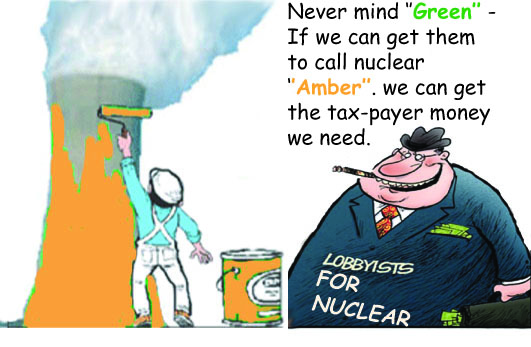
possible compromises included creating an “amber” label for activity that did not win the green label but would still secure a place in the bloc’s transition and not discourage private sector investment. ………..
Brussels to delay decision on how to classify nuclear power for green finance. Debate over energy has been supercharged by surging electricity costs, Ft.com Mehreen Khan and Sam Fleming in Brussels, 20 Oct 21
Brussels will delay long-awaited proposals on how to classify nuclear power and natural gas under the EU’s landmark labelling system for green finance, as member states demand looser rules to help counteract the continent’s energy crisis. EU financial services commissioner Mairead McGuinness told the Financial Times that Brussels would take more time before deciding how to deal with the controversial energy sources under the so-called “taxonomy on sustainable finance” that had been due this autumn.
The debate about how to classify low carbon natural gas and nuclear energy, which produces no CO2 [ ed.except in its long complex fuel and waste chains] but whose waste byproducts are toxic for the environment, has been supercharged by surging electricity costs that have prompted EU governments into emergency financial action to protect households. European leaders are due to debate the taxonomy and how to mitigate soaring prices at a summit in Brussels on Thursday.
“As we come to the end of the year there will be more pressure to resolve this,” said McGuinness. “We don’t have a ready-made solution because this is, both technically but politically . . . one of those issues where you have very divided views.” Europe’s pro-nuclear countries, led by France, and pro-gas member states in the south and east, are demanding the taxonomy rules do not penalise technologies they say are vital in securing the transition to net zero emissions. Environmental groups, however, want the system to abide by scientific criteria to ensure the rules stamp out, rather than encourage, so-called “greenwashing” in the investment industry. ………..
Europe’s energy crisis is the latest challenge to the credibility of the EU’s green labelling system which was designed to be a “gold standard” for investors to know what counts as truly sustainable economic activity. But the rules have been mired in controversy as Brussels struggles to balance science with sensitive political decisions about whether to award some activities the highest green label — penalising those that do not. Ten countries, including France, Finland, Poland and Hungary this week said it is “absolutely necessary that nuclear power was included in the taxonomy framework”.
McGuinness said it remained an “open question” as to whether the green label would be expanded to “accommodate nuclear and gas”. She said possible compromises included creating an “amber” label for activity that did not win the green label but would still secure a place in the bloc’s transition and not discourage private sector investment. ………..
The rules are being closely watched by investors and regulators in the US and UK, who have also said they will come up with their own classification systems. Within the EU, the taxonomy will be used to judge whether investments made by member states are truly green and will form the basis for an EU “green bond standard” that will be used to issue €250bn in sustainable debt under the bloc’s recovery fund. https://www.ft.com/content/898e6c53-8e85-4cfc-b00b-16a09d50b462
Backlash against Japanese Prime Minister’s haste to dump Fukushima nuclear water into the ocean

Kishida triggers backlash by saying dumping Fukushima nuclear water can’t be delayed, Global Times, By Xu Keyue: Oct 19, 2021 Only two weeks after taking office, Japan’s new prime minister Fumio Kishida pressed two hot buttons on the same day on Sunday – sending a ritual offering to the war-linked Yasukuni Shrine, and claiming the Fukushima wastewater release cannot be delayed, despite opposition from home and abroad.
Instead of taking full advantage of its own science and technology to process the Fukushima wastewater and deliver a qualified answer to the world over the water treatment, Japan has opted for its irresponsible plan to dump the wastewater as soon as possible and provided self-contradictory explanations for the decision, said Chinese experts.Speaking at his first visit to the tsunami-wrecked Fukushima nuclear plant since taking office, Kishida said the planned mass disposal of wastewater stored at the facility cannot be delayed, claiming his government would work to reassure residents nearby the plant about the technical safety of the wastewater disposal project, Asahi Shimbun reported Monday.
South Korea has expressed concern over Kishida’s plan to release the radioactive wastewater, according to South Korean media on Monday.
“Japan’s decision [to discharge the wastewater] was made without enough consultations with neighboring nations,” a senior South Korean foreign ministry official said. “We have expressed serious concerns and opposition to its plan, which could affect our people’s health and security as well as the ocean environment.”
The Tokyo Electric Power Company Holdings Inc. (TEPCO) has planned to build a one-kilometer undersea tunnel to release contaminated radioactive water out to sea, amid condemnation from fishermen, media reported in late August.
The plan again showed that Japan’s “explanation” over the safety of the water is “self-contradicting,” Liu Jiangyong, vice dean of the Institute of Modern International Relations at Tsinghua University, told the Global Times on Monday.
Assuming the wastewater has been processed without any side effects or pollution as the Japanese government claimed, and that people can even drink it, why does the Japanese government not simply discharge the water into the sea but plan to dump the water 1 kilometer away from the local residents? asked Liu. He also questioned the claim that it will have no impact on the marine environment and life chain, and asked why the water could not be recycled on land if the wastewater can be processed so cleanly and safely.
Japan can’t answer any of these questions, said Liu, noting that dumping the nuclear water shows that the water is “unusual.”…………. https://mail.google.com/mail/u/0/?tab=rm&ogbl#inbox?compose=DmwnWsTJtkLTcgrqMkBKSqBpmgbKhMHpzMMgttqhvJHgDJrfsKrtFCCwkflZJkjjhwgvJbPrQhFV
Concern in Association of Southeast Asian Nations (ASEAN) about Australia’s nuclear submarines
Indonesia, Malaysia concerned about Australia’s nuclear subs. By NINIEK KARMINI , 18 Oct 21,
JAKARTA, Indonesia (AP) — The foreign ministers of Malaysia and Indonesia expressed concern Monday that Australia’s plan to obtain nuclear-powered submarines may increase the rivalry of major powers in Southeast Asia.
The U.S., Britain and Australia announced last month that they have formed a security alliance that will help equip Australia with nuclear-powered submarines. The alliance will reshape relations in the Indo-Pacific region and beyond……..
“This situation will certainly not benefit anyone,” Indonesian Foreign Minister Retno Marsudi said after meeting with her Malaysian counterpart, Saifuddin Abdullah, in Jakarta. “We both agreed that efforts to maintain a peaceful and stable region must continue and don’t want the current dynamics to cause tension in the arms race and also in power projection.”
The two ministers said at a joint news conference that they agreed to strengthen the unity and centrality of the Association of Southeast Asian Nations and urged all members of the bloc to contribute to the stability, security, peace and prosperity of the region and respect international law.
Saifuddin said having a near-neighbor build new nuclear-powered submarines could encourage other countries to come more frequently into Southeast Asian territory………………………..
ASEAN’s members are Brunei, Cambodia, Indonesia, Laos, Malaysia, Myanmar, the Philippines, Singapore, Thailand and Vietnam. Brunei is chair of the bloc this year.
ASEAN has formal partnerships with several countries including Australia, China, Canada, New Zealand, South Korea and Pakistan as well as the European Union.
Malaysia and Indonesia share many similarities in religion, language and culture. https://apnews.com/article/business-asia-australia-indonesia-global-trade-fbbf5b52e6822d01cdc11c8a5870ebb4
The U.S. doesn’t need more nuclear weapons to counter China’s new missile silos
The U.S. doesn’t need more nuclear weapons to counter China’s new missile silos
Our current nuclear arsenal is more than enough for whatever Beijing is building. WP, 18 Oct 21, By Edward GeistEdward Geist is a policy researcher at the nonprofit, nonpartisan RAND Corporation.
The discovery of what appear to be hundreds of new missile silos under construction in China has inspired arguments that imply the United States needs more nuclear weapons. Matthew Kroenig, a Defense Department adviser during the Trump administration, suggested in a recent Wall Street Journal op-ed that “the Pentagon should study whether it can meet its deterrence requirements with existing stockpile numbers” in case “an increase … is necessary.”……….
But there’s little reason for the United States to worry much about whatever the Chinese military is building in these silos — and plenty of alternatives to building more nuclear weapons for dealing with it. The current U.S. nuclear arsenal was designed to guarantee deterrence even in the case of surprises such as this one. The nuclear weapons the United States already has should be adequate to counter the threat posed by new Chinese missiles even under very pessimistic assumptions. And if U.S. officials eventually decide they have to target the Chinese silos, nonnuclear weapons and sensors would provide a more credible deterrent than building additional nuclear weapons would……………………………………………….
| deploying more nuclear weapons might not be necessary. If a “shell game” is China’s aim, the United States could use remote sensing or other intelligence means to ascertain where the actual missiles are located. This could enable planners to avoid targeting empty silos and minimize the needed weapons.A real game-changer, however, would be a conventional weapon that could kill a silo without using a nuclear warhead. Such weapons were researched extensively during the late Cold War. They weren’t achieved with 20th-century technology, but progress in fields such as machine vision, terminal guidance and geospatial mapping may make them feasible in the not-distant future.A nonnuclear option would give a U.S. president a much easier choice for countering the silos. Such weapons would not violate the nuclear taboo or risk the hard-to-predict collateral damage of nuclear detonations………. https://www.washingtonpost.com/outlook/2021/10/18/china-silos-missiles-nuclear |
Demonising China is unhelpful while encouraging China to participate in Cop26
As Britain prepares to host the Cop26 climate conference in Glasgow next month, it is pursuing two contradictory policies that undermine its chances of success. On the one hand, it is seeking a unified global response to the climate crisis with nations agreeing to targets for the reduction of their coal and petroleum emissions.
But at the same time, it has joined the US in escalating a new cold war directed at confronting China and Russia at every turn. The two policies have polar opposite objectives in trying to persuade China, responsible for 27 per cent of global carbon emissions, to cut back on building new coal-fuelled power stations, but at the same time demonising China as a pariah state with whom political, commercial and intellectual contacts should be as limited as possible.
Independent 15th Oct 2021
https://www.independent.co.uk/climate-change/opinion/china-russia-climate-cop26-b1939164.html
AUKUS and the Philippines – sleepwalking into military-nuclear entanglements

From peaceful, nuclear-free Asean to battle-ready Indo-Pacific? Manila Times, By Dan Steinbock, October 18, 2021As the Duterte era is gradually ending, new arms races and nuclear proliferation cast a dark shadow over Southeast Asia. The Philippines may be sleepwalking into military-nuclear entanglements.
ACCORDING to the new trilateral security pact between the United States, the United Kingdom and Australia (Aukus), Washington and London will “help” Canberra to develop and deploy nuclear-powered submarines.
The highly controversial $66-billion deal is expected to trigger arms races and nuclear proliferation in Asia. It violates the Southeast Asian Nuclear-Weapon-Free Zone Treaty (SEANWFZ, 1995), effective since 1997. It would seem to violate the Philippine Constitution. And it is strongly opposed by China.
Yet, right after the Aukus, when Asean began to build consensus on the nuclear pact, Philippine Foreign Affairs Secretary Teodoro Locsin Jr. welcomed the pact.
PH policies, Asean concerns
According to Locsin, the Philippines “welcomes Australia’s decision to establish” the Aukus. And he added: “Asean member states, singly and collectively, do not possess the military wherewithal to maintain peace and security in Southeast Asia.”
According to this logic, Asean is irrelevant in matters of regional peace and security and therefore each Asean should align with one or another major military power, irrespective of collective consequences.
Such logic shuns and could derail, inadvertently or purposefully, the ongoing work by the Asean and China on the Code of Conduct for the South China Sea by 2022. Most importantly, the logic opens the door to the nuclearization of the region at the expense of the SEANWFZ treaty and the aspirations of the Asean community. That’s why Malaysia’s veteran statesman Mahathir Mohamad blasted the Aukus statement: “You have escalated the threat.”
The first reaction of both Malaysia and Indonesia was to warn of an impending arms race unleashed by such a pact. Australia’s nuclear decision prompted the Indonesian foreign ministry’s official note that it was “deeply concerned over the continuing arms race and power projection in the region.” So, why did Locsin choose to break ranks with the Asean?
ADRi: China the issue of 2022
The plan to drag the Philippines into the Indo-Pacific containment front against China seems to have evolved in the mid-2010s, but fell apart with the Duterte election triumph and the meltdown of the Liberal Party.
To avoid a déjà vu, former Foreign Affairs secretary Albert del Rosario recently called on the Philippines to choose a leader who will reverse President Rodrigo Duterte‘s policy of “loving and embracing” China after the “’22 polls.”
In this quest, a key supportive role belongs to the Stratbase Albert del Rosario Institute (ADRi), embedded with US business and national security interests. Through its board members and executives, Rosario’s ADRi is joined with its parent, Stratbase, an “advisory and research consultancy,” and Bower Group Asia led by Ernest Z. Bower 4th. Stratbase is the Philippine partner of Bower Group Asia.
Until the 2000s, Bower led the US-Asean Business Council. He is an ADRi board member and Southeast Asia advisor at the Center for Strategic and International Studies (CSIS), a leading US think-tank close to the State Department, Pentagon, defense contractors and Wall Street.
The maritime dispute with China, said ADRi’s president Victor Manhit, is what “we will make an issue in the 2022 elections.” Due to interlocking leaderships, Manhit himself heads Stratbase and Bower Asia Group‘s Philippine branch.
The goals go back to the Benigno “Noynoy” Aquino 3rd government (2010 to 2016).
As the Duterte era is gradually ending, new arms races and nuclear proliferation cast a dark shadow over Southeast Asia. The Philippines may be sleepwalking into military-nuclear entanglements.
ACCORDING to the new trilateral security pact between the United States, the United Kingdom and Australia (Aukus), Washington and London will “help” Canberra to develop and deploy nuclear-powered submarines.
The highly controversial $66-billion deal is expected to trigger arms races and nuclear proliferation in Asia. It violates the Southeast Asian Nuclear-Weapon-Free Zone Treaty (SEANWFZ, 1995), effective since 1997. It would seem to violate the Philippine Constitution. And it is strongly opposed by China.
Yet, right after the Aukus, when Asean began to build consensus on the nuclear pact, Philippine Foreign Affairs Secretary Teodoro Locsin Jr. welcomed the pact.
Such logic shuns and could derail, inadvertently or purposefully, the ongoing work by the Asean and China on the Code of Conduct for the South China Sea by 2022. Most importantly, the logic opens the door to the nuclearization of the region at the expense of the SEANWFZ treaty and the aspirations of the Asean community. That’s why Malaysia’s veteran statesman Mahathir Mohamad blasted the Aukus statement: “You have escalated the threat.”
The first reaction of both Malaysia and Indonesia was to warn of an impending arms race unleashed by such a pact. Australia’s nuclear decision prompted the Indonesian foreign ministry’s official note that it was “deeply concerned over the continuing arms race and power projection in the region.” So, why did Locsin choose to break ranks with the Asean?…………..
Conflicts of interest, military entanglements…………..
…….. the Aukus pact does contribute to the ongoing arms races in Southeast Asia. It will foster nuclear proliferation in the region. It violates the goals of the nuclear-free Southeast Asia treaty. It is not in line with the Philippine Constitution.
President Duterte has pledged to end the bilateral military deal with Washington if US nuclear weapons are found in the Philippines. But his term will end by next summer.
Obviously, Australia, the US and UK seek to calm Asean members, arguing that nuclear weapons are not really for military purposes. But since 1945, assurances have not been reliable in nuclear matters. During the Cold War, US nuclear warheads were secretly stockpiled in the Philippines. Moreover, in the 1965 Philippine Sea A-4 crash, a US Skyhawk attack aircraft fell into the sea off Japan. Coming from the US Naval Base in Subic Bay, it was carrying a nuclear weapon with 80 times the blast power of the Hiroshima explosion.
It wasn’t until 1989 that the Pentagon disclosed the loss of the 1-megaton hydrogen bomb.
New policy? Two policies? No policy?
Today, the destructive power of these weapons is far greater, as stressed by the International Campaign to Abolish Nuclear Weapons (ICAN). In January, the Philippines ratified the ICAN’s legally binding Treaty on the Prohibition of Nuclear Weapons (TPNW). On May 19, Locsin stated that the Philippines welcomes the Aukus nuclear pact.
Only two days later, Locsin reaffirmed the Philippines’ “principled policy and commitment toward the complete prohibition of nuclear weapons as enshrined in the relevant provisions of the Philippine Constitution and the Treaty.”
The Philippines’ principled policy is crystal clear: The country definitely welcomes nuclear proliferation in Southeast Asia. And the country is absolutely committed against nuclear-free Southeast Asia. Where will that “principled policy and commitment” take us after the 2022 election?
 |
India, China and the new missile silos
CHINA’S MISSILE SILOS AND THE SINO-INDIAN NUCLEAR COMPETITION, War on the Rocks, DEBAK DAS 15 Oct 21, This summer, U.S. analysts using commercial satellite imagery discovered that China was significantly expanding its nuclear forces and building hundreds of new missile silos. With the new silos, China could potentially double the size of its arsenal of intercontinental ballistic missiles. The news sent shockwaves through Washington. The head of Strategic Command called the developments “breathtaking,” and the news is sure to embolden efforts to fund U.S. nuclear modernization efforts on Capitol Hill. While the United States has a much larger nuclear force than China — with 3,750 nuclear warheads in its nuclear weapons stockpile compared to China’s 350 warheads — it will still likely take a forceful response to China’s latest nuclear developments.
But how will India — China’s other nuclear armed adversary — react to Beijing’s new missile silos? India has a nuclear triad and is reported to have 150 nuclear warheads deployed on different air-, sea-, and land-based platforms. China, meanwhile, is estimated to have its nuclear weapons stockpile of 350 nuclear warheads deployed across different platforms. However, with the new missile silos and fears of an increase in Chinese nuclear warheads, the strategic asymmetry in the Sino-Indian nuclear relationship may become more stark.
Moreover, China and India continue to engage in hostilities in the Himalayas. In August 2021, over a hundred soldiers from the Chinese People’s Liberation Army crossed over to the Indian side of the border and damaged a bridge and other infrastructure before retreating. In June 2020, in the deadliest clash between the two countries in 45 years, more than 20 soldiers were killed in the Galwan Valley in Ladakh. This led to a heightened state of tensions and a war scare between the two countries. High-level military talks between the two nuclear states remain deadlocked, with regular hostilities at different points along the 3,488-kilometer Line of Actual Control. An increase in Chinese nuclear capabilities in this context has the potential to destabilize the region and spark a nuclear arms race. But will it?
India has been cautious in its nuclear relationship with China and is unlikely to have a dramatic response to the new missile silos at the moment. It has two nuclear-armed adversaries to consider, and its focus will remain on Pakistan. India will continue to modernize its nuclear arsenal with new counterforce nuclear delivery systems and to test multiple independently targeted re-entry ballistic missiles, which will allow it to manage its nuclear relationship with both nations. While the counterforce missiles and short-range nuclear delivery systems are aimed at Pakistan, India’s nuclear relationship with China will continue to be based on ensuring a secure second-strike capability.
No First Use, Second-Strike, and Caution
Despite the continuing military engagements along the Line of Actual Control, the Sino-Indian nuclear relationship remains stable. This is because India’s nuclear relationship with China rests on its survivable second-strike nuclear doctrine. It has pledged not to use its nuclear weapons first as a part of a no first use policy. This doctrine means that as long as India has a secure-second-strike capability — that is, the capability to absorb a nuclear first strike on its soil and then retaliate using its remaining nuclear forces — it will not need to build a large arsenal of nuclear weapons. It just needs to make sure that its nuclear weapons systems are well dispersed and survivable……….
Manageable Historical Asymmetry
China’s additional nuclear silos do not represent a new strategic problem for India………………….
Border Conflict Remains at Low Escalation Level ………..
……… https://warontherocks.com/2021/10/chinas-missile-silos-and-the-sino-indian-nuclear-competition/
France building a pro-nuclear European alliance in lead-up to Cop26

France is building a pro-nuclear European alliance to overcome German resistance to new rules that would open the way for more [so-called] carbon-free atomic power. Nine other European countries have signed up to a nuclear power initiative at a time of spiralling energy prices, partly caused by EU
climate change policies that increase the cost of electricity generation using fossil fuels.
The countries are pushing for nuclear power, which produces no carbon emissions [if you just don’t count the full nuclear fuel chain] , and they want it to be classified as a greentechnology in EU industrial “taxonomy” ratings, which would clearprivate investment in atomic power to be linked to climate policy
subsidies.
Times 12th Oct 2021
1 This Month



26 September – International Day for the Total Elimination of Nuclear Weapons


PLEASE OPPOSE HR 8255 AND S.3639 – bills would accelerate satellite deployment, with no environmental review or safeguards – https://ncstd5li.quorum.us/campaign/169331/
To see nuclear-related stories in greater depth and intensity – go to https://nuclearinformation.wordpress.com
-
Archives
- September 2026 (269)
- August 2026 (330)
- July 2026 (355)
- June 2026 (287)
- May 2026 (306)
- April 2026 (356)
- March 2026 (251)
- February 2026 (267)
- January 2026 (308)
- December 2025 (358)
- November 2025 (359)
- October 2025 (375)
-
Categories
- 1
- 1 NUCLEAR ISSUES
- business and costs
- climate change
- culture and arts
- ENERGY
- environment
- health
- history
- indigenous issues
- Legal
- marketing of nuclear
- media
- opposition to nuclear
- PERSONAL STORIES
- politics
- politics international
- Religion and ethics
- safety
- secrets,lies and civil liberties
- spinbuster
- technology
- Uranium
- wastes
- weapons and war
- Women
- 2 WORLD
- ACTION
- AFRICA
- Atrocities
- AUSTRALIA
- Christina's notes
- Christina's themes
- culture and arts
- Events
- Fuk 2022
- Fuk 2023
- Fukushima 2017
- Fukushima 2018
- fukushima 2019
- Fukushima 2020
- Fukushima 2021
- general
- global warming
- Humour (God we need it)
- Nuclear
- RARE EARTHS
- Reference
- resources – print
- Resources -audiovicual
- Weekly Newsletter
- World
- World Nuclear
- YouTube
-
RSS
Entries RSS
Comments RSS

