Classified Documents Invalidate United States’ Appeal Against Assange — Richard Medhurst
‘‘I’m scared that will be Assange. They will make him go nuts.”
“I’m a nobody. If they’re capable of doing this to me, just imagine what they can do to Assange.”
The United States Broke Diplomatic Assurances for David Mendoza, It Will Do the Same with Julian Assange Richard Medhurst’s Newsletter
| Richard MedhurstNov 29 |
| Richard Medhurst Nov 29 In 2009, David Mendoza Herrarte was extradited from Spain to the United States, on condition he be allowed to serve his sentence in SpainClassified documents reveal the diplomatic assurances given by the U.S. Embassy in Madrid and how the U.S. violated the conditions of his extraditionMendoza spent over 6 years in the United States trying to return to Spain. Court documents show how the United States denied his transfer application multiple timesWhile in prison, Mendoza sued the United States, and Spain for failing to uphold the conditions of his extradition and violating his human rights. His case was recently taken up by the United Nations |
- Mendoza’s case was raised last month in the English High Court, where the United States is attempting to extradite Julian Assange to the U.S.
- The United States has offered similar diplomatic assurances that Assange could serve a sentence in Australia
- Assange’s lawyers cite Mendoza’s case as evidence that these assurances cannot be trusted
- James Lewis, the lead U.S. prosecutor, said that these assurances are bulletproof. He told the High Court that, “The United States have never broken a diplomatic assurance, ever”. Court documents and diplomatic assurances obtained by Richard Medhurst show this to be untrue
- David Mendoza Herrarte was born and raised in the United States. His mother being from Spain, he would go there every summer, describing it to me as his second home. He is both an American and Spanish national.
Mendoza was wanted by the United States for drug trafficking. In the early 2000s, he used helicopters to transport marijuana, known commonly as BC Bud, from Canada across the U.S. border into Seattle. Today, marijuana is legal in Seattle……………………………………………… - The diplomatic assurance did not specifically state that Mendoza would be sent to Spain to serve his sentence. It only said that the United States “does not object to Mendoza making an application to serve his sentence in Spain”– something the United States cannot object to anyway, as it is every prisoner’s right to apply for a treaty transfer.
Mendoza tells me, “This shows the deviance of these people. They use this ambiguous language on purpose. There’s precedent in federal court that if they don’t specifically agree to the transfer, it’s not valid”.
Recently, the United States offered similar diplomatic assurances to the United Kingdom, namely that Assange could could serve a sentence in his home country of Australia.
Mendoza says for this to be valid, the diplomatic assurances from the U.S. must explicitly state in advance that the U.S. Department of Justice and Australia accept Assange’s transfer— otherwise it’s meaningless.
“With the Assange thing, I can see it black and white. They [Australia] are not going to do a thing. Under the treaty, all three parties must agree: Julian, Australia, and the United States. But the U.S. can tell Australia behind the scenes: ‘screw this guy, don’t do anything’.”
- The Convention on the Transfer of Sentenced Persons specifically states under Article 3 (f) that a sentenced person may be transferred “if the sentencing and administering States agree to the transfer.” (The administering state meaning Australia)Being one of the few journalists to cover Assange’s extradition, I can confirm that as of now Australia has not given any indication that it would accept Julian Assange’s request to serve a sentence there, should he apply……….
- April 2009: David Mendoza Herrarte is extradited to the United States
After signing the Acta de Entrega, Mendoza was officially under U.S. jurisdiction. He recalls being handed over to U.S. authorities: “The first thing they do when they get you, is they strip you naked. The marshals look in your mouth, your ass, your ears, every orifice. They attempt to humiliate you in every fashion: ‘Squat! Now do this…’. They tell you: you’re under US jurisdiction now, and our law is what is going to apply to you.”
June 2009: Once in the United States, Mendoza took part in what is known as an arbitration hearing or settlement conference. This is where plea bargains are hashed out in the presence of the judge, between prosecutors and defendant……………………………………………
- It now became clear that the United States never intended to send Mendoza back to Spain. They had squeezed him for every last penny, then violated the diplomatic assurances given to Spain………….
- Mendoza expects the United States government will play the same trick on Assange if they refuse to send him to Australia and he contests it in court.“Within that note, it must specifically state that Julian has a right to contest non-compliance of the United States, even as a non-signatory to the treaty. Because the US will start playing games.”…………….
- Instead of being sent to Spain immediately to carry out his sentence, Mendoza was told to apply for a treaty transfer. He applied, and the answer from the United States was ‘no’……………
In total, Mendoza applied three times for treaty transfer to Spain. All three applications were denied, violating the conditions of his extradition. Each time he applied, he had to wait 8 months for a decision, and even longer to apply again. The denial states: “There is no administrative appeal from this decision. Unless otherwise noted above, the prisoner may reapply two years after this denial.”
Mendoza told me: “That’s when I realized I’m in the wrong court. I’m going to get nothing here. ……………………..
The other assurance offered by the United States appears to state that Assange would not be jailed at ADX Florence or placed under oppressive prison conditions known as Special Administrative Measures (SAMs).
Similiar to those offered for Mendoza, the assurances for Assange are ambiguous and vaguely-worded. The United States says he will not be subject to SAMs or imprisoned at ADX unless “in the event that, after entry of this assurance, he was to commit any future act that met the test for the imposition of a SAM pursuant to 28 C.F.R. § 501.2 or § 501.3”
Once in U.S. custody, the United States could simply allege that Assange did something that “met the test for the imposition of a SAM”, place him in isolation, and then claim that it never violated its assurances, because it already gave itself a backdoor to do so.
This is why Mendoza told me that assurances must be explicitly spelled out, with no room for derogation.
Assange’s extradition was blocked by a UK judge in January 2021, on grounds that U.S. prison conditions would be too oppressive, leading him to commit suicide.
While in the U.S., Mendoza was imprisoned at a medium-high security facility in Englewood, Colorado. This is near ADX Florence, where Assange is likely to be sent.
“Believe me, European prisons aren’t nice. But U.S. prisons are much worse. I was in Colorado, one of the biggest s–tholes I’ve ever been to. It was dirty; they let you out of your cell one hour a day– when they decided, not when I wanted.”…….. It’s 3am, for example, they would buzz you and say: do you want your hour of recreation?”. Prisoners who declined would not be able to leave their cell until the next day.
Mendoza explained to me the process of dehumanization and sleep deprivation in prison: “You don’t have a name; you have a number, and you have to repeat it during every count. Counts are every three hours in higher security federal prisons. Another thing guards would do is instead of pointing their flashlight up to the ceiling, they would flash it right in your face.”
“I’m scared that will be Assange. They will make him go nuts. The only thing that kept me sane is this legal work; writing to the judges and the press, going after the United States in civil court.”
What Mendoza went through is a step down from what Assange would be in. Not only is ADX Florence a federal super-maximum prison, but Assange would also be placed under Special Administrative Measures (SAMs), in extreme isolation.
Mendoza tells me that visitation had to be approved by specific people. ……………………
Mendoza’s case is an incredible story on its own merits.
Nevertheless, it must be examined in the context of Assange’s extradition. When James Lewis told High Court judges that “the United States have never broken a diplomatic assurance, ever”— this is simply untrue.
The above documents [on original] make it clear that the United States violated its agreement and broke diplomatic assurances to Spain. Mendoza was to be returned to Spain to carry out his sentence, instead he spent six years and nine months in various U.S. prisons. Only after suing both the United States and Spain— his own countries— for failing to enforce the conditions of his extradition, was he allowed to return. Only after the Spanish Supreme Court ruled in his favor, threatening the U.S.-Spain Extradition Treaty itself, could he compel the United States to enforce the conditions of his extradition and return him to Spain.
Mendoza was fortunate enough to have the Spanish Supreme Court, senior judges and public on his side. Were the United States to violate the assurances of Assange’s extradition, it is extremely unlikely given the “Special Relationship” between the U.K. and U.S., that Assange would be able to successfully lobby the British government into compelling the U.S. to uphold the conditions of his extradition.
James Lewis told the English High Court that diplomatic assurances are “solemn undertakings, given out at the highest order; they are not dished out like smarties”. He is correct. It is therefore incumbent on the Court to consider what happened to Mendoza, for whom the United States did offer diplomatic assurances, and assess whether those offered for Assange are adequate, but more importantly, whether they can be enforced once he is no longer under British jurisdiction.
Mendoza’s experience shows that for Assange, any diplomatic assurances or agreements must be written in explicit language and signed by all parties, including Assange, so that in the eventuality of non-compliance, he may be afforded the opportunity to contest this in court, despite his status as a non-signatory of the United Kingdom-United States Extradition Treaty.
Mendoza’s case offers the Court extraordinary insight into the innerworkings of American diplomacy, legal proceedings, and extradition to the United States. It is a serious warning which High Court Justices should heed, who at their discretion, have the power to prevent gross miscarriages of justice which gravely imperil the respondent, before they arise.
“I’m a nobody. If they’re capable of doing this to me, just imagine what they can do to Assange.” https://richardmedhurst.substack.com/p/mendoza
Russia is offering to USA and NATO an alternative way out of the present Ukraine crisis
Moscow Says It’s Offering US, NATO Alternative to New Cuban Missile Crisis-Style Scenario, Sputnik News, Ilya Tsukanov, 14 Dec 21, Tensions between Russia and the US-led military bloc have escalated dramatically in recent weeks amid Western claims that Moscow may be preparing to invade Ukraine. Russian officials have dismissed the claims, warning that Kiev that may be getting ready to try to resolve the frozen civil conflict in eastern Ukraine by force.Russia is offering the United States and NATO an alternative to a new Cuban Missile Crisis-style scenario, and is prepared to continue constructive dialogue with Washington on Ukraine, Deputy Foreign Minister Sergei Ryabkov has said.
”We are offering an alternative [to a repeat of a Cuban Missile Crisis-style event] – the non-deployment of these kinds of weapons near our borders, the withdrawal of forces and assets which destabilise the situation, a rejection of provocative measures, including various drills. But we need guarantees, and the guarantees must be legal,” Ryabkov told Sputnik during a press briefing in Moscow on Friday.
“It’s necessary to avoid a new missile crisis in Europe before it’s too late, before the appearance of medium- and short-range missiles in these territories. This is unacceptable and is a direct route to escalating the confrontation,” the diplomat warned.Ryabkov said he couldn’t understand the actions of the US and its European allies in this area, stressing that their behaviour has done nothing to strengthen their own security. “It’s ridiculous to suggest that their missiles are aimed at countering a limited rocket threat from the opposite direction,” he said.
The diplomat stressed that Russia will continue to use all available resources to push forward with dialogue with NATO on security issues, and to “make maximum use of any opportunities to build up common sense in this area.”Ryabkov said this dialogue will include a proposal on the reciprocal verifiable moratorium on the development of new ground-to-ground missile systems banned under the 1987 Intermediate-Range Nuclear Forces Treaty, which the US unilaterally walked out on in 2019.
Russia ‘Alarmed’ by NATO’s Eastward Expansion
He also commented indirectly on recent statements by US and NATO officials about Ukraine’s prospects of joining NATO, saying such a development would be unacceptable for Russia.
“I take all the signals on this subject as part of a larger picture which is very alarming for us. Once again: there should not be any further eastward expansion of NATO. Even in the absence of such expansion, there should be no absorption of nearby territory in the military and military-technical sense, as is currently taking place, to the detriment of Russia’s security interests,” Ryabkov said………….
Despite the recent rhetoric, Ryabkov expressed hope that the majority of the Washington establishment is not in favour of war with Russia, with the possible exception of Republican Senator Roger Wicker, who recently urged the Biden administration not to “rule out first use nuclear action” against Russia in the event of a Russian invasion of Ukraine…….. https://sputniknews.com/20211210/moscow-offering-us-nato-alternative-to-new-cuban-missile-crisis-scenario-foreign-ministry-says-1091417821.html
Australian taxpayers up for $170 Billion, for American nuclear submarines. No problem?

Australia’s Aukus nuclear submarines could cost as much as $171bn, report finds
Australian Strategic Policy Institute report calls project ‘most complex endeavour Australia has embarked upon’ Guardian, Tory Shepherd, Tue 14 Dec 2021
Australia’s eight planned nuclear submarines will cost $70bn at an “absolute minimum” and it’s “highly likely” to be more than that, defence analysts say.
With inflation, the cost could be as high as $171bn, according to a new report from the Australian Strategic Policy Institute.
The thinktank’s report contained a series of estimates ranging from low to high and conceded that estimating the final cost of the project is necessarily an “extremely assumption-rich activity”…………
The prime minister, Scott Morrison, has said the planned nuclear-powered submarines, part of the Aukus deal with the United States and the United Kingdom, would likely cost more than the scrapped plan for conventional submarines, which would have cost $90bn……..
Australia will partner with either the US or the UK to buy their boat designs, and a nuclear-powered submarine taskforce is working through the details
“We haven’t determined the specific vessel that we will be building, but that will be done through the rather significant and comprehensive program assessment that will be done with our partners over the next 12 to 18 months,” Morrison said in September.
“Now, that will also inform the costs that relate to this, and they are yet to be determined.”
The authors of the Aspi report, Implementing Australia’s Nuclear Submarine Program, wrote that while the Aukus deal has seemed to move fast, the enterprise would still be “a massive undertaking and probably the largest and most complex endeavour Australia has embarked upon”.
“The challenges, costs and risks will be enormous. It’s likely to be at least two decades and tens of billions of dollars in sunk costs before Australia has a useful nuclear-powered military capability…….
The Aspi report co-author Dr Marcus Hellyer told Guardian Australia the government needed to work out its priorities and would need to balance capability needs, scheduling and the Australian industry content. He emphasised that picking which submarine to build was “secondary” to picking a strategic partner.
The US is building submarines at a rate 10 times higher than the UK, he said……….
The report canvasses other issues that will need to be resolved.
There are likely to be legislative changes needed to allow nuclear reactors in Australia. The government should consider appointing an internal nuclear regulator, an inspector general of nuclear safety, and how it will responsibly dispose of radioactive waste once the reactors that power the submarines reach the end of their useful lives……..https://www.theguardian.com/world/2021/dec/14/australias-aukus-nuclear-submarines-estimated-to-cost-at-least-70bn
Nuclear power’s economic failure – a ”renaissance in reverse”

China is said to be the industry’s shining light but nuclear growth is modest ‒ an average of 2.1 reactor construction starts per year over the past decade.
Moreover, nuclear growth in China is negligible compared to renewables ‒ 2 gigawatts (GW) of nuclear power capacity were added in 2020 compared to 135 GW of renewables.
Nuclear power’s economic failure, Ecologist, Dr Jim Green, 13th December 2021
A new report from Friends of the Earth Australia details the catastrophic cost overruns with nuclear power projects.
Despite the abundance of evidence that nuclear power is economically uncompetitive compared to renewables, the nuclear industry and some of its supporters continue to claim otherwise.
Those claims are typically based on implausible cost projections for non-existent reactor concepts. Moreover, the nuclear lobby’s claims about the cost of renewables are just as ridiculous.
Claims about ‘cheap’ nuclear power certainly don’t consider the real-world nuclear construction projects detailed in a new report by Friends of the Earth Australia.
Every power reactor construction project in Western Europe and the US over the past decade has been a disaster.
The V.C. Summer project in South Carolina (two AP1000 reactors) was abandoned after the expenditure of at least US$9 billion leading Westinghouse to file for bankruptcy in 2017.
Criminal investigations
Criminal investigations and prosecutions related to the V.C. Summer project are ongoing ‒ and bailout programs to prolong operation of ageing reactors in the US are also mired in corruption.
The only remaining reactor construction project in the US is the Vogtle project in Georgia (two AP1000 reactors). The current cost estimate of US$27-30+ billion is twice the estimate when construction began (US$14-15.5 billion).
Costs continue to increase and the Vogtle project only survives because of multi-billion-dollar taxpayer bailouts. The project is six years behind schedule…..
In 2006, Westinghouse said it could build an AP1000 reactor for as little as US$1.4 billion, 10 times lower than the current estimate for Vogtle.
The Watts Bar 2 reactor in Tennessee began operation in 2016, 43 years after construction began. When construction resumed in 2008 after a long hiatus, the cost estimate to complete the reactor was US$2.5 billion but the final completion cost was US$4.7 billion.
US nuclear renaissance in reverse
The previous reactor start-up in the US was Watts Bar 1, completed 20 years earlier (1996) after a 23-year construction period. Thus Watts Bar 1 and 2 are the only power reactor start-ups in the US over the past quarter-century.
In 2021, TVA abandoned the unfinished Bellefonte nuclear plant in Alabama, 47 years after construction began and following the expenditure of an estimated US$5.8 billion.
There have been no other power reactor construction projects in the US over the past 25 years other than those listed above.
Numerous other reactor projects were abandoned before construction began, some following the expenditure of hundreds of millions of dollars. Twelve reactors have been permanently shut down over the past decade with many more closures in the pipeline.
Western Europe
The only current reactor construction project in France is one EPR reactor under construction at Flamanville. The current cost estimate of €19.1 billion is 5.8 times greater than the original estimate.
The Flamanville reactor is 10 years behind schedule.
The only current reactor construction project in the UK comprises two EPR reactors under construction at Hinkley Point. In the late 2000s, the estimated construction cost for one EPR reactor in the UK was £2 billion.
The current cost estimate for two EPR reactors at Hinkley Point is £22-23 billion, over five times greater than the initial estimate.
In 2007, EDF boasted that Britons would be using electricity from an EPR reactor at Hinkley Point to cook their Christmas turkeys in 2017, but construction didn’t even begin until 2018.
Is China a shining light for nuclear power?
One EPR reactor (Olkiluoto-3) is under construction in Finland. The current cost estimate of about €11 billion is 3.7 times greater than the original estimate. Olkiluoto-3 is 13 years behind schedule.
Nuclear power is growing in a few countries, but only barely. China is said to be the industry’s shining light but nuclear growth is modest ‒ an average of 2.1 reactor construction starts per year over the past decade.
Moreover, nuclear growth in China is negligible compared to renewables ‒ 2 gigawatts (GW) of nuclear power capacity were added in 2020 compared to 135 GW of renewables.
There were only three power reactor construction starts in Russia in the decade from 2011 to 2020, and only four in India.
Nuclear vs renewables costs
Continue readingBecause Trump left the nuclear deal, we might have to learn to live with a nuclear Iran
Because Trump left the nuclear deal, we might have to learn to live with a nuclear Iran https://www.washingtonpost.com/opinions/2021/12/13/because-trump-left-nuclear-deal-we-might-have-learn-live-with-nuclear-iran/ By Max Boot
President Donald Trump’s 2018 decision to pull out of the Iran nuclear deal might have been the most disastrous foreign policy miscalculation since the invasion of Iraq in 2003. (The only competitor for that dubious honor is the one-sided agreement that Trump concluded with the Taliban and that President Biden implemented.)
Under the 2015 nuclear deal, Iran got rid of 97 percent of its nuclear fuel and limited its uranium enrichment to just 3.67 percent purity. Its “breakout” time to produce enough material to make a nuclear bomb was estimated to be more than a year.
Trump’s withdrawal allowed Iran to rev up its nuclear program. The International Atomic Energy Agency reported last year that Iran had 12 times the amount of enriched uranium allowed under the deal. It is also enriching uranium to 60 percent purity, just short of the 90 percent needed to make nuclear weapons. Its breakout time has shrunk to as little as three weeks. It will take longer to manufacture the warheads needed to create nuclear weapons, but Iran is far closer to that dreaded milestone than it was in 2018.
Even former Israeli security officials, most of whom opposed President Barack Obama’s nuclear deal, now admit that pulling out of it has backfired. Benjamin Netanyahu’s former defense minister, Moshe Yaalon, said last month: “Looking at the policy on Iran in the last decade, the main mistake was the withdrawal of the U.S. administration from the agreement.” Former Mossad director Tamir Pardo described the pullout as a “tragedy.” Retired general Isaac Ben Israel, chairman of the Israeli Space Agency, called “Netanyahu’s efforts to persuade the Trump administration to quit the nuclear agreement … the worst strategic mistake in Israel’s history.”
Now they tell us.
The Biden administration has been trying to revive the nuclear deal. Talks are going on in Vienna. But Iran feels burned by Trump’s pullout, and its new hard-line president, Ebrahim Raisi, hasn’t shown much interest in compromise. Secretary of State Antony Blinken said this month that “Iran right now does not seem to be serious about doing what’s necessary to return to compliance.”
That means the United States and Israel might be drawing closer to the decision they have long dreaded: Do they bomb Iran or allow Iran to get The Bomb? In the past, I would have said that bombing was the least-bad option, but I no longer believe that.
A nation of 85 million people, Iran is much larger and much stronger than the adversaries that America couldn’t defeat in Iraq and Afghanistan. And its nuclear program is far more advanced than those of Iraq or Syria when Israel bombed suspected nuclear facilities in those countries in 1981 and 2007, respectively.
The Iranian nuclear program is dispersed across dozens of hardened, hidden sites, all protected by a sophisticated air-defense system. The Fordow fuel enrichment plant is buried deep inside a mountain. Taking down Fordow, if it can be done at all, would probably require the 30,000-pound Massive Ordnance Penetrator. Israel does not have this bomb or the bomber — either a B-2 or B-52— needed to drop it.
The United States could, of course, provide Israel with these munitions, or it could bomb Iranian installations itself. But even successful strikes would only delay Iran’s nuclear program: You can eliminate nuclear facilities but not nuclear know-how.
Moreover, there is a real risk that any attack could trigger a larger Middle Eastern war. Iran would likely retaliate against U.S. forces in the region and against U.S. allies. Lebanese Hezbollah, for example, could rain down more than 100,000 missiles and rockets on Israel, enough to overwhelm its missile defenses. (In the 2006 Lebanon war, Hezbollah fired only 4,000 short-range rockets at Israel.) There’s a good reason no Israeli or American leader — not even hawks such as Netanyahu, George W. Bush and Trump — has been willing to bomb Iran. As I wrote in 2019, war with Iran could be “the mother of all quagmires.”
Letting Iran go nuclear, if that proves unavoidable, might actually be the less dangerous option. The Iranian regime has employed suicide bombers in the past, but it isn’t suicidal itself. Its leaders know that Israel has a large nuclear arsenal — including nuclear missiles reportedly deployed on submarines that could survive any attack on Israel. The United States could further deter Iran by explicitly extending its nuclear umbrella not only to Israel but also to Saudi Arabia, Turkey and other neighboring states. Nuclear weapons would allow Iran to avert a U.S. invasion that isn’t going to happen anyway but would do nothing to protect the regime against the biggest danger it faces: an uprising from its own people.
The Biden administration should keep trying to peacefully stop the Iranian nuclear program, but that might no longer be possible because of Trump’s catastrophic decision to leave the accord. And if those efforts fail? Well, we have lived with nukes in the hands of other vile and abhorrent regimes, such as the Soviet Union/Russia, North Korea and China. If we have to, we could learn to live with a nuclear Iran, too.
Ukraine Is a Problem Only as Long as the West Makes It One
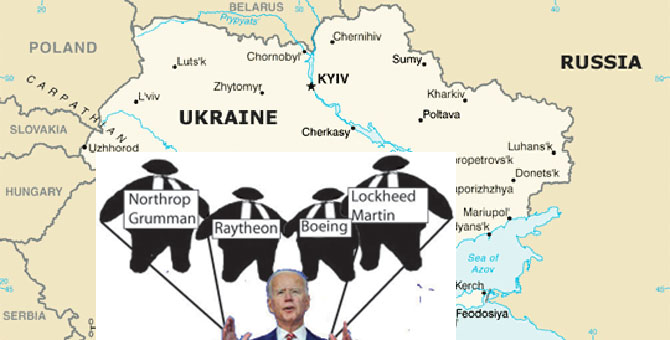
President Biden has the opportunity to re-direct US policy on Ukraine in a peaceful direction,
But it will take serious, steadfast courage. We don’t know how compromised he is by his previous dealing in Ukraine, or his son’s. We don’t know if he has the clarity of mind to see the obvious. And we don’t know if he has the strength to wage peace.
Ukraine Is a Problem Only as Long as the West Makes It One
https://www.rsn.org/001/ukraine-is-a-problem-only-as-long-as-the-west-makes-it-one.html
by William Boardman10 December 21,
Since the fall of the Soviet Union thirty years ago, US policy on Ukraine has been an ugly mix of inconsistency, quiet aggression, fear-mongering and stupidity. Now President Biden is recklessly intensifying the same failed tactics while expecting a different outcome and risking a confrontation of the world’s two major nuclear-armed states.
What could possibly go wrong?
What passes for conventional wisdom nowadays is expressed by the cover headline of the November 29 issue of The Nation magazine, of all places:
Ukraine: The Most Dangerous Problem in the World
That is such hogwash. The Nation’s knows better. But the fear-mongering leads, even though the magazine’s sub-head is: “But there’s already a solution.” Author Anatol Lieven argues persuasively that the essence of a solution for Ukraine issues have already been outlined in the so-called “Minsk II” agreement of 2015, reached by leaders of France, Germany, Russia, and Ukraine. The agreement was endorsed unanimously by the United Nations Security Council. Despite their formal assent to Minsk II, three US administrations have supported Ukraine in refusing to implement the agreement. Nor have they proposed any better idea. This is an example of foreign policy guided by denial of reality.
Ukraine remains a “dangerous problem” only as long as the US and Ukraine insist on making it one. (It’s hardly “the most dangerous,” given climate change, or US provocation of China, or the US-led nuclear arms race, or the self-gutting of US democracy.)
With the Soviet Union gone in 1991, US President Bush assured Russian leaders that NATO would not expand to include former Soviet states. Whether this was a lie or a broken promise hardly matters.
NATO expanded. Russia was confronted with the prospect of an avowedly hostile military alliance approaching its borders along the same invasion route followed by Napoleon and Hitler. As long as Ukraine remained unaligned, Russian historical memory could rest quietly. Ukraine puts almost 1,000 miles between Russia and NATO member Poland. Ukraine’s population of about 45 million ranges from very pro-western to virtually Russian. The country has long been deeply corrupt with a quasi-functional democracy (an opportunistic playground for the likes of Paul Manafort and Hunter Biden). All in all, from a geopolitical perspective, Ukraine was (and still is) a combustible potential best left undisturbed.
In 2013, Ukrainian President Viktor Yanukovych put NATO and European Union membership in play, then reversed course under Russian pressure. In November 2013, he cancelled an EU association agreement just days before it was to take effect. With US connivance, pro-western Ukrainian forces launched the Maidan Revolution that lasted into the spring of 2014. Elected president Yanukovich was forced out of office (shades of Iran 1953) and the country entered a period of chaos. Russia took advantage of this to walk into Crimea unopposed and to annex it, as voted by the Crimean parliament, despite objections from the West. These objections have continued to the present, together with economic sanctions and military provocations from the Black Sea.
The US and NATO have justified their hostile actions by claiming Russia was also about to invade eastern Ukraine, which still hasn’t happened. Eastern Ukraine, the Donbas, has been a war zone since March 2014 when separatist Ukrainian forces in Donetsk and Luhansk started fighting for independence from the central government in Kiev. This is a civil war between the self-declared People’s Republics of Donetsk and Luhansk against the Ukraine government. The People’s Republics comprise about 6,200 square miles (bigger than Connecticut) with almost 4 million people, mostly Russian-speaking, whose currency is the ruble. Russia has supported the People’s Republics, but short of introducing its own troops. Likewise, the US and NATO have supported Kiev, but short of introducing their own troops into the Donbas. The fighting has been intense in the past, with some 10,000 killed on both sides, but the conflict in recent years has been limited to trench warfare along a 400-mile front, with most casualties coming from sniper fire. Neither side has made significant advances in years.
In 2014, Russia and Ukraine met under the auspices of the European Union and signed the first Minsk Protocol in an ultimately ineffective effort to reach a ceasefire. The following year, five parties signed a second Minsk Protocol – Ukraine, Ukraine Separatists, Russia, France, and Germany – which led to reduced fighting but no lasting solution. Through all of this, the US under President Obama, played no useful role in resolving the issues or assuring anything like a stable peace.
The US remains gripped, apparently, by a reflexive Cold War rigidity which requires that Russia be to blame for anything we don’t like, such as the results of the US-sponsored coup in Ukraine in 2014. The new Cold War is manifested by the expansion of NATO, needlessly threatening Russia on the basis of a paranoid Western sense of threat.
Another manifestation of Cold War thinking is Biden’s choice of Victoria Nuland as his current special ambassador to Russia to discuss Ukraine. Nuland was notoriously involved in efforts to manipulate the 2013 Madan uprising and supporting the coup against Yanukovich. When apprised of European desires to proceed cautiously, Nuland was recorded on cell phone saying, “Fuck the EU.” Such assertions of American exceptionalism continue to make the world a more dangerous place.
What could Biden do now to make the world a safer place?
Biden could ease sanctions over Crimea, acknowledging that its return to Russia is a done deal with strong historic and geo-political justifications. Biden could also stop US nuclear-capable bombers from probing Russia in the Black Sea region. It’s hard to see how continuing such provocative flights can have a calming effect.
Most importantly, Biden could assure Russia (as the US did once before in 1992) that NATO would not expand to include Ukraine. In his recent conversation with Putin, Biden did the opposite, making it all but non-negotiable. That has the obvious effect of continuing the conflict, asserting the right to hold a knife to another’s throat.
This particular knife was forced into NATO’s hands in April 2008 by the illegitimate President Bush against the will of the majority of NATO members. The issue came up at NATO’s North Atlantic Council meeting in Bucharest. NATO members easily accepted the future membership of Albania and Croatia, but balked at approving Ukraine or Georgia. Instead, in the Bucharest Summit Declaration, members approved a compromise article drafted by the British with intentional imprecision, paragraph 23 of 50, that began:
ATO welcomes Ukraine’s and Georgia’s Euro-Atlantic aspirations for
membership in NATO. We agreed today that these countries will become
members of NATO….
The paragraph continues with generalizations about the countries’ contributions to the war in Afghanistan, their promised democratic reforms, and so on. But there is no date for membership, no process for achieving membership (as distinct from Albania and Croatia), and actual approval is only anticipated at some unknown future date. This paragraph in the Bucharest Declaration is essentially a throwaway line, putting off to an indeterminate future the clearly divisive and dangerous issue of relating to Russian border states.
ATO welcomes Ukraine’s and Georgia’s Euro-Atlantic aspirations for
membership in NATO. We agreed today that these countries will become
members of NATO….
The paragraph continues with generalizations about the countries’ contributions to the war in Afghanistan, their promised democratic reforms, and so on. But there is no date for membership, no process for achieving membership (as distinct from Albania and Croatia), and actual approval is only anticipated at some unknown future date. This paragraph in the Bucharest Declaration is essentially a throwaway line, putting off to an indeterminate future the clearly divisive and dangerous issue of relating to Russian border states.
The Alliance will continue to support, as appropriate, these efforts as guided by regional priorities and based on transparency, complementarity and inclusiveness, in order to develop dialogue and cooperation among the Black Sea states and with the Alliance. [paragraph 36]
The Bucharest Declaration does not express an alliance seeking confrontation with Russia, for all that George W. Bush wanted it.
The Bucharest Declaration treats NATO’s war in Afghanistan as a success and expresses the need for possible future military actions against Iran and North Korea (but no mention of China). There is no hint of anyone wondering why something called the North Atlantic Treaty Organization thinks it has any legitimate business operating in landlocked Afghanistan.
More than a decade later, four American presidents have turned Afghanistan into a world class disaster. America has turned its back on mass starvation there. And still there is no sense of national responsibility or shame as Biden and the US governing elite stumble provocatively toward new looming catastrophes with Iran, China, climate change, public health, and functioning democracy itself.
Ukraine is a wholly American-made pseudo crisis in which the US national interest is close to zero. The US forced NATO to put Ukraine in play in 2008 by breaking the earlier US pledge not to put Ukraine in play. Now our obtuse leadership poses as acting on principle by refusing to break the pledge that broke the first pledge, even though that is the most obvious, effective de-escalation available: guarantee Russia a border with no more NATO threats and negotiate (as others have done) in good faith to defuse the rest of the Ukrainian mishmash.
When Secretary of State Anthony Blinken says that “one country trying to tell another what its choices should be, including with whom it associates, that’s not an acceptable proposition,…” what we’re hearing is a US official ignoring reality and denying what the US does every day. And when former US ambassador Michael McFaul tweets: “Putin invented this ‘crisis’ single-handedly. Nothing changed in Ukraine. Nothing changed regarding NATO policy” – he’s just lying.
Worse, the blind rigidity of the likes of Blinken and McFaul serves to enable the truly mindless warmongers like US Senator Roger Wicker, R-MS, who doesn’t have the sense not to invite nuclear war when he tells Fox News:
Military action could mean that we stand off with our ships in the Black Sea, and we rain destruction on Russian military capability. It could mean that. It could mean that we participate, and I would not rule that out, I would not rule out American troops on the ground. We don’t rule out first use nuclear action.
President Biden has the opportunity to re-direct US policy on Ukraine in a peaceful direction,
But it will take serious, steadfast courage. We don’t know how compromised he is by his previous dealing in Ukraine, or his son’s. We don’t know if he has the clarity of mind to see the obvious. And we don’t know if he has the strength to wage peace.
Push for a nuclear-weapons-free zone in the Middle East, BUT Israel is the elephant in the room
A Nuclear-Weapons-Free-Zone in the Middle East— & the Elephant in the Room http://www.ipsnews.net/2021/12/nuclear-weapons-free-zone-middle-east-elephant-room/?utm_source=rss&utm_medium=rss&utm_campaign=nuclear-weapons-free-zone-middle-east-elephant-room By Thalif Deen UNITED NATIONS, Dec 8 2021 (IPS) – Israel’s nuclear presence in the Middle East is best characterized as “the elephant in the room” -– an obvious fact intentionally ignored with deafening silence.
A Wall Street Journal cartoon, amplified the idiom, when it depicted a group of animals huddled together in the jungle with the elephant complaining: “I don’t know why they keep ignoring me when I am in the room.”
Nobody wants to openly discuss Israel as a nuclear power because it is a politically-sensitive issue, particularly in the United States.
And Israel has remained tight-lipped in the company of the world’s eight other nuclear powers– US, UK, France, China, Russia, India, Pakistan and North Korea— and it has never formally declared itself a nuclear power.
In an op-ed piece in the New York Times last August, Peter Beinart, a Professor of Journalism and Political Science at the City University of New York, wrote that US attempts at “feigning ignorance about Israeli nuclear weapons makes a mockery of America’s efforts at non-proliferation.”
Last December, President-elect Joe Biden warned that if Iran goes nuclear, Saudi Arabia, Turkey and Egypt might go nuclear too — “and the last goddamn thing we need in that part of the world is a build-up of nuclear capability.”
But like most US politicians and presidents, including Barack Obama, Biden too believes that Israel’s nuclear weapons are best ignored—and never challenged in public.
Back in 2009, says Professor Beinart, when Obama was asked by a reporter if he knew of any country in the Middle East with nuclear weapons, he said: “I don’t want to speculate.”
It is time for the Biden administration to tell the truth, Beinart wrote.
The nuclear weapons gamesmanship in the militarily and politically volatile Middle East goes in circles and semi-circles reaching a point of no return.
If Israel gets away with its nukes, the Iranians argue, “why shouldn’t we go nuclear too”, while the Saudis, the Egyptians and Turks warn: “If Iran goes nuclear, we will follow too”.
Meanwhile, since 1967, five nuclear-weapon-free zones (NWFZ) have been established worldwide — in Latin America and the Caribbean, South Pacific, Southeast Asia, Africa and Central Asia.
But such a weapons-free zone in the conflict-ridden Middle East continues to remain elusive.
UN Secretary-General Antonio Guterres points out that the established five zones include 60 percent of the UN’s 193 Member States– and cover almost all of the Southern Hemisphere.
Guterres welcomed the successful conclusion of the Second Session of the “Conference on the Establishment of a Middle East Zone Free of Nuclear Weapons and Other Weapons of Mass Destruction,” which took place November 29 to December 3, and congratulated the participating States “on their constructive engagement and the decision to establish a working committee to continue deliberations during the intersessional period”.
Dr M.V. Ramana, Professor and Simons Chair in Disarmament, Global and Human Security at the School of Public Policy and Global Affairs (SPPGA), University of British Columbia, Vancouver, told IPS establishing a nuclear weapons free zone in the Middle East is not only a major challenge but it is also important.
The challenge is primarily due to Israel’s refusal to not just discuss its decades-old nuclear weapons program but even acknowledge it, while at the same time attacking countries like Iran over even its nuclear energy-related programs, he argued.
Being backed by the United States, which adopts one rule for Israel and another rule for other countries, it is very difficult to involve Israel, said Dr Ramana, who is also Director of the Liu Institute for Global Issues and the Acting Director of the Centre for India and South Asia Research (CISAR) in the Institute of Asian Research.
The only way to change this state of affairs is for efforts like this to be mounted. Even if they are not successful, they at least raise the issue publicly, Dr Ramana declared.
Hillel Schenker, Co-Editor, Palestine-Israel Journal, told IPS there is no question that a Nuclear and Weapons of Mass Destruction (WMD) Free Zone in the Middle East is in the interests of all the peoples of the region.
However, the issue of a WMD Free Zone is simply not on the political or public agenda in Israel, whose leaders and people find it very convenient to be the only presumed nuclear power in the region, he noted.
“And it also doesn’t appear to be on the agenda of the Egyptians who used to be the primary advocates for the Zone.”
Right now, he said, the main possible step to advancing towards this goal is a successful conclusion of the talks being held in Vienna for a revival of the Joint Comprehensive Plan of Action (JCPOA), the nuclear agreement with Iran and the Western powers.
Although Israeli Prime Minister Naftali Bennett and Foreign Minister Yair Lapid have expressed opposition to a renewed deal, many senior figures in the Israeli security establishment support it, and believe it was a major mistake for former Prime Minister Netanyahu to have urged former US President Trump to withdraw from the JCPOA, he added.
If the talks are not successful, and Iran moves forward towards becoming a nuclear threshold state, it could produce a very dangerous chain reaction which might motivate Saudi Arabia, Egypt, Turkey and perhaps others to also try to go nuclear, seriously destabilizing the entire region, said Schenker.
Abdulla Shahid of the Maldives, President of the UN General Assembly, said nuclear disarmament and non-proliferation regimes remain pivotal in ensuring that such an intolerable reality never manifests. And Nuclear-Weapon-Free Zones are crucial to the success of disarmament and non-proliferation regimes, he said.
Like other regions, he argued, the geopolitics of the Middle East are complex. Reaching just settlements that will satisfy all parties requires sound diplomacy and negotiations based on good faith.
The addition of nuclear weapons and other weapons of mass destruction to the region’s politics will complicate an already challenging process, undermining trust and portending existential consequences.
It was in recognition of this that the General Assembly mandated a nuclear-weapons-free Middle East back in 1974, he said last week.
Iran slams Europeans over nuclear deal stance
Iran slams Europeans over nuclear deal stance – Press TV https://www.reuters.com/world/iran-slams-europeans-over-nuclear-deal-stance-press-tv-2021-12-12/Reuters DUBAI, Dec 12 (Reuters) – European countries have failed to offer any constructive proposal or initiative amid efforts to revive a 2015 nuclear deal with Iran, Tehran’s top nuclear negotiator told Press TV on Sunday.
“European parties fail to come up with any initiatives to resolve differences over the removal of sanctions (on Iran),” Ali Bagheri said, referring to Britain, France and Germany, which are among the big powers trying to salvage the deal.
U.S. European Command, NATO Supreme Headquarters Allied Command Europe leaders meet to “improve warfighting readiness” — Anti-bellum
The two commands share a top commander, currently General Tod Wolters. U.S.-NATO staff talks fortify ironclad security alliance U.S. European Command and NATO Supreme Headquarters Allied Command Europe leaders met today for staff talks, enhancing military coordination for deterrence and security. *** The collaborative meeting strengthens…improving warfighting readiness between the two military organizations and is […]
U.S. European Command, NATO Supreme Headquarters Allied Command Europe leaders meet to “improve warfighting readiness” — Anti-bellum
European Union passes sustainable taxonomy law, but postpones decision about nuclear power.

“The commission must deliver a science-based taxonomy regulation that excludes fossil gas, nuclear, and factory farming. Otherwise, the credibility of the taxonomy is ruined.”
EU green taxonomy becomes law, gas and nuclear postponed, Institutional investors have signalled they want a taxonomy that is based on science – not political compromise. euobserver, By WESTER VAN GAAL 11 Dec 21,
BRUSSELS, The first two chapters of the sustainable taxonomy, the EU’s ambitious labelling system for green investment, were passed on Thursday (9 December).
Until midnight on Wednesday, EU member states had time to reject this first set of rules – the so-called ‘first delegated act’.
But despite opposition from a group of countries, the proposal passed and will come into force on 1 January 2022. It will describe the sustainable criteria for renewable energy, car manufacturing, shipping, forestry and bioenergy and more, and include a “technology-neutral” benchmark at 100 grams of CO2 per kilowatt-hour for any investments in energy production.
The criteria for the list has mainly been compiled by the Sustainable Finance Platform, a group of 57 NGOs, scientific and financial experts, making the first part of taxonomy “science-based”…..
The European Commission will now likely unveil the second delegated act on 22 December.
This will describe how nuclear and gas will be labelled under the taxonomy. But the process has become highly-politicised over the last months.
Second act
In a meeting of member states on 29 November the project nearly faltered.
An EU diplomat, speaking anonymously, explained to EUobserver that a French-led group of 13 member states tried to block the first list “out of principle” – because the commission had not agreed to include nuclear and gas in the green taxonomy.
France and Finland pushed for nuclear to be “fully part of the taxonomy.” Ten other mainly eastern European countries want gas included. Sweden joined the group because the new rules endanger its forestry sector.
The group tried to gain a supermajority of 15 to force the commission’s hand but fell short. Germany and Italy abstained, but did not respond to requests for explanation made by EUobserver.
The commission will now decide how to label nuclear and gas before the end of the year, and it is not yet clear how the issue will pan out…………..
Whatever the commission will decide, only a supermajority in the council – 15 member states – or a parliamentary majority can block the second delegated act. Both are unlikely.
What next?
Institutional investors have already signalled they want a taxonomy based on science, not political compromise.
This will “harm the objective-scientific, transparent character of the taxonomy and increases the risk of ‘greenwashing’. Europe promised the world climate leadership, it is time to show it,” a group of banks wrote this week.
Sebastien Godinot, a senior economist at WWF and member of the EU’s Sustainable Finance Platform, said the commission must not give in to blackmail and bullying.
“The commission must deliver a science-based taxonomy regulation that excludes fossil gas, nuclear, and factory farming. Otherwise, the credibility of the taxonomy is ruined.”
But the commission may have no choice but to compromise between the gas and nuclear-supporting member states on one side, and countries opposing these on the other – while also being mindful that investors and experts from its Sustainable Finance Platform will reject a system containing contradictory political concessions. https://euobserver.com/climate/153776
Russia Angered by Senator Roger Wicker’s Nuclear Strike Remarks on Ukraine
Russia Angered by Senator Roger Wicker’s Nuclear Strike Remarks on Ukraine, NewsWeek, BY BRENDAN COLE ON 12/9/21 Russia has condemned GOP Senator Roger Wicker for suggesting that the U.S. should consider launching a nuclear strike to defend Ukraine.
The Russian embassy in Washington also hinted that Wicker was championing businesses in his home state of Mississippi when he called for U.S. military intervention over Moscow’s buildup of troops close to the Ukrainian border.
Wicker provoked the stern Russian response after telling Fox News host Neil Cavuto: “I would not rule out American troops on the ground. We don’t rule out first-use nuclear action.”……
The statement added that “long-term security guarantees” between the U.S. and Russia required “a demonstration of readiness to compromise. It is unlikely that Roger Wicker’s ill-considered statements will help us get out of the current acute phase of Russian-American relations.”……….. https://www.newsweek.com/russia-nuclear-ukraine-roger-wicker-embassy-irresponsible-putin-biden-summit-1657634
How the military-industrial complex has captured Australia’s top strategic advisory body

AUSTRALIA CAPTURED – How the military-industrial complex has captured Australia’s top strategic advisory body, MICHELLE FAHY, DECLASSIFIED AUSTRALIA 9 DECEMBER 2021
The Australian Strategic Policy Institute has veered away from its founding vision of providing an array of independent diverse views, to now promote an aggressive militaristic solution to the heightened tensions in Australia’s region.
The Australian Strategic Policy Institute (ASPI) in Canberra is the government’s primary source of outside-government advice, research and analysis on military and strategic affairs. Since its establishment in mid-2001, it has veered away from its founding vision.
There is a jarring disconnect between the lofty goals of independence expressed in ASPI’s charter, and the infiltration of ASPI by tentacles of the military-industrial complex. This has been barely mentioned in Australia’s mainstream media.
A Declassified Australia investigation has uncovered a casebook example of ‘state-capture’, with the development of deep connections between ASPI, and the world’s largest and most powerful military weapons manufacturers.
Australia is a significant participant in the global arms trade at present. Its $270-billion decade-long spending spree upgrading weapons and war machines is large by international standards, and Australia is increasingly becoming an arms seller too. As Australia moves militarily ever closer to the US, even defence insiders say the defence industry is ‘awash with money’.
The wars in Iraq, Afghanistan, Syria and Yemen have made the world’s biggest weapons manufacturers richer, larger, and more influential. At the lesser-known end of the spectrum, the Yemen war is notable for its extensive human rights abuses and war crimes: it has created the world’s largest humanitarian crisis. Despite pleas from the UN, the arms still flow and the war continues. The weaponry for this war has been supplied by the world’s top arms manufacturers, including Lockheed Martin, BAE Systems, Boeing, and missile-maker Raytheon.
ASPI and the Weapons Lobby
The Australian subsidiaries of these and other global weapon-makers have been regular ASPI sponsors for years. Some of them have successfully used the back door to gain access to ASPI’s top table, its governing council. ASPI council members have included former senior military officers, defence ministers, and federal MPs who are also on arms and cyber company boards. It has also included former and current arms industry executives. The challenge to ASPI’s independence is large and real.
ASPI’s founding charter, since it was established in 2001 by then prime minister John Howard with bipartisan support from Labor leader Kim Beazley, declares it must ‘operate independently of Government and of the Defence Organisation’.
Further, it states that ‘the perception, as well as the reality, of that independence would need to be carefully maintained’. Thus, from the outset, the government was acknowledging how such an important think tank would be vulnerable to capture by vested interests, both ideological and commercial………..
Our investigation shows that the ASPI council has numerous members who represent or have close links to the military-industrial complex. Of the 11 non-executive directors on ASPI’s governing council, five sit on the boards or advisory boards of weapons or cybersecurity corporations, while numerous past council members have had similar connections.
The current council includes former Howard defence minister Robert Hill. He’s on the supervisory board of German weapon-maker Rheinmetall’s Australian subsidiary, which is supplying Defence’s $5 billion of Boxer combat reconnaissance vehicles, and will soon also produce and export ammunition for the US Joint Strike Fighter program. Hill is also chair of Viva Energy Group, a major supplier of fuel to the Australian Defence Force (ADF)…………………….
Declassified Australia put questions to ASPI and the current council members. Dr Nelson declined to comment. No other council member responded by deadline. ASPI replied saying it manages conflict of interest matters in line with other Australian proprietary limited companies, and that ‘Council members will recuse themselves from discussions which may give rise to the perception of a conflict of interest matter’.
ASPI has a history of council members with interests in the defence industry. Jim McDowell was chief executive of BAE Systems in Australia for a decade, and then ran BAE in Saudi Arabia, where the Saudi military has since used BAE arms in the catastrophic war in Yemen. Returning to Australia, he was engaged by Liberal defence industry minister Christopher Pyne, and Defence, on numerous sensitive defence projects while also on ASPI’s Council. BAE Systems is in the running to provide Australia’s planned nuclear-powered submarines under the AUKUS pact.
Former Labor senator Stephen Loosley’s Council membership, including seven years as chair, coincided with board roles at French arms multinational Thales Australia, manufacturer of the Austeyr, the service rifle for all the Australian military, as well as armoured vehicles, submarine sonars and munitions. The Thales group has been accused of selling weapons to the Indonesian military who are running a war in West Papua against the independence movement.
Former Labor defence minister Kim Beazley was an ASPI distinguished fellow for two years in 2016-2018. For the majority of that time he was on the board of Lockheed Martin Australia while writing regularly for ASPI, without ASPI disclosing his board position at Lockheed.
………..ASPI’s independence is drawn into question not just by its board appointees but also by some research fellows. One recent example is the former director of cyber, intelligence and security at BAE Systems Applied Intelligence, Rajiv Shah, who cowrote a report on collaboration within the intelligence community that was sponsored by BAE Systems. Shah is now an ASPI fellow and a consultant to government and industry. ASPI does not disclose either in the report nor in his website bio Shah’s previous employment with BAE Systems, one of the world’s top 10 arms companies. Dr Shah did not respond to questions.
Declassified Australia does not imply any illegality by any past or present ASPI council members, fellows, or staff. The issue is the deep involvement of people associated with global weapons manufacturers, and the potential for, and perception of, conflicts with ASPI’s charter of independence.
The Reshaping of ASPI
At its foundation, the ASPI Council was instructed by the government to ensure its independence. As set down by the defence minister, it is required not only to be ‘politically non-partisan’ but also, most crucially, to ‘reflect the priority given to both the perception and substance of the Institute’s independence’.
The Howard government had envisaged that ASPI would do this by maintaining a ‘very small’ permanent staff while relying mostly on short-term contracts, secondments and similar arrangements for its research work. It would not publish views in its own name but would provide a forum for the views of a wide variety of outside experts.
20 years on, ASPI has morphed into a very different organisation.
A decision by Labor prime minister Kevin Rudd to make Stephen Loosley the ASPI Council chair in 2009, while Loosley was on the Thales Australia board, tested perceptions of independence. Then, in 2012, the Gillard Labor government appointed the current executive director directly from the senior position of Deputy Secretary of Strategy in the Defence Department. In the late 90s, Peter Jennings had been chief of staff to Liberal defence minister Ian McLachlan when the Howard Government first mooted the idea of creating ASPI.
Under this new leadership, ASPI set about expanding. Staff numbers have quadrupled in nine years from 14 to 60, plus there are now 29 research fellows and nine interns.
ASPI receives its core funding via a grant from the Defence Department. In 2018, the Morrison government approved a $20 million grant to cover five years’ of ASPI operations. In May 2021, this grant was increased by $5 million to cover two years of operations of a new Washington DC office.
Since 2012, ASPI has vigorously pursued additional funding. Within two years, annual income from commissioned research jumped from $37,000 to $1.1 million, and sponsorships were up 235% to $746,000. ASPI’s own-sourced revenue has continued to grow dramatically. In 2011-12, ASPI received less than $500,000 above its base funding, by 2020-21 it had exploded to $6.7 million.
The single largest source of ASPI’s funding in 2020-21, beyond its core funding, was from the US Government’s Departments of Defense and State ($1.58m), followed by additional funding from Defence ($1.44m) and other federal government agencies ($1.18m). The NSW and Northern Territory governments provided $445,000. In the private sector, the largest source was social media, tech and cybersecurity companies ($737,362), with Facebook ($269,574), Amazon ($100,000) and Microsoft ($89,500) being the largest. From the arms industry, ASPI received $316,636, with more than two-thirds of that coming from two of Australia’s largest defence contractors, Thales ($130,000) and BAE Systems ($90,000).
In 2019-20, Twitter gave ASPI $147,319 for its cyber research. Significantly, Twitter last week announced a partnership with ASPI said to be dealing with misinformation from the Chinese communist party that was seeking to counter evidence of human rights abuses in Xinjiang. As a result of ASPI’s research, thousands of “state-linked accounts” were shut down by Twitter.
While the cash from the arms industry may not appear substantial, as we have seen, the arms industry wields its major influence via its representatives finding their way on to seats at the top table.
The substantial extra funding from the US government, Defence and other Australian government departments, as well as corporate interests, provides a real challenge to ASPI’s responsibility to remain independent. It raises serious questions about undue influence, including foreign influence, at ASPI.
ASPI responded to our questions about protecting the perception of its independence by saying it retains ‘complete editorial independence on the material we choose to research’. It said it would not accept funding from parties attempting to constrain its editorial independence.
But just what does the US government get in return for its $1.57 million funding of ASPI, beyond its research projects on human rights violations, disinformation, and cybersecurity in China?
And what might BAE Systems get for its $90,000 grant to ASPI, other than a new report on the need for a ‘collaborative and agile’ intelligence community?
And what about Thales Australia, in return for its $130,000 grant to ASPI, beyond just being lead sponsor of the 2020 ASPI Conference?
The answer for them all, is ‘influence’.
ASPI’s role in advising the Australian government on defence strategy and procurements and cybersecurity would better serve the Australian people if it was to return to its original charter of researching and publishing a diversity of views from a position of uncompromised independence.
MICHELLE FAHY is an independent writer and researcher, specialising in the examination of connections between the weapons industry and government, and has written in various independent publications. She is on twitter @FahyMichelle, and on Substack at undueinfluence.substack.com https://declassifiedaus.org/2021/12/09/australia-captured/?fbclid=IwAR0_MMo3hIrY7uDHK4d2l5M-nxdsGBFyA_6Xtim8jxjotqPkMXmFheeGNWM
Iran nuclear talks pulled back from the brink as Tehran shifts stance
 |

Iran nuclear talks pulled back from brink as Tehran shifts stance, Cautious optimism as Tehran revises its position after pressure from Russia and China Guardian, Patrick Wintour Diplomatic editor, Fri 10 Dec 2021 Efforts to revive the Iran nuclear deal have been hauled back from the brink of collapse as Tehran revised its stance after pressure from Russia and China and clear warnings that the EU and the US were preparing to walk away.
The cautiously optimistic assessment came at the start of the seventh round of talks on the future of the nuclear deal in Vienna. It follows what was seen as a disastrous set of talks last week in which the US and the EU claimed Iran had walked back on compromises reached in previous rounds.
The Russian ambassador to the talks, Mikhail Ulyanov, said: “We managed to eliminate a number of misunderstandings that created some tension. Everyone confirmed their commitment to productive work [to restore the nuclear agreement].”
Nevertheless, Joe Biden warned that the United States was preparing “additional measures” against Iran, amid lingering fears that the talks could still fail………….. https://www.theguardian.com/world/2021/dec/09/iran-nuclear-deal-pulled-back-from-brink-of-collapse-as-talks-resume-in-vienna
China Wants to Join Southeast Asia’s Nuclear-Free Zone

A greater factor in China’s calculus is the AUKUS alliance among the U.S., U.K. and Australia. Under the security partnership announced in September, the U.S. and U.K. agreed to equip Australia with a fleet of nuclear-powered submarines to counter China’s influence in the Indo-Pacific. China wants to even the score. In a phone call with counterparts from Malaysia and Brunei that same month, Chinese Foreign Minister Wang Yi skewered AUKUS as anathema to the Bangkok Treaty. “The United States and Britain chose not to participate in the SEANWFZ [Southeast Asia Nuclear Weapon-Free-Zone] Treaty,” Wang reminded his peers. “Instead, they have transferred military nuclear technology to the region under various pretexts and also provided the region with highly enriched uranium materials, running counter to the efforts made by ASEAN countries to build a nuclear-free zone.”
China Wants to Join Southeast Asia’s Nuclear-Free Zone. Why Now? LawfareBy Ryan A. Musto Thursday, December 9, 2021 China is ready to rock with the Treaty of Bangkok.
In a rare appearance at the special online summit for the Association of Southeast Asian Nations (ASEAN) on Nov. 22, China’s President Xi Jinping announced that China is prepared to sign the protocol of a 1995 agreement that establishes Southeast Asia as a nuclear-weapon-free zone. Under the agreement, known as the Bangkok Treaty, 10 regional states renounce the right to nuclear weapons in any form within the ASEAN zone. If it joins the treaty, China would agree not to use or threaten the use of nuclear weapons within the zone or against its members. It would make China the first nuclear-weapon state to adhere.
China’s support for the treaty is no surprise. To strengthen its enduring “no-first-use” policy to never initiate nuclear conflict, China routinely has asserted (most recently in a 2019 white paper) that it “is always committed to … not using or threatening to use nuclear weapons against non-nuclear-weapon-states or nuclear-weapon-free zones unconditionally.” For the Bangkok Treaty, ASEAN and China agreed in 2011 to a secret memorandum of understanding that preserves China’s territorial claims in the South China Sea, removing the greatest hurdle to Beijing’s commitment. China was ready to sign the protocol and memorandum in 2012 but deferred once the other eligible “P-5” nuclear-weapon states under the Non-Proliferation Treaty—France, Russia, the United Kingdom and the U.S.—refused to join. Now, Xi wants to legally bind China to the treaty “as early as possible.” But what’s the rush?
Adherence to the Bangkok Treaty would burnish China’s image amid its rapid expansion in nuclear capabilities…………
A greater factor in China’s calculus is the AUKUS alliance among the U.S., U.K. and Australia. Under the security partnership announced in September, the U.S. and U.K. agreed to equip Australia with a fleet of nuclear-powered submarines to counter China’s influence in the Indo-Pacific. China is furious and wants to even the score. In a phone call with counterparts from Malaysia and Brunei that same month, Chinese Foreign Minister Wang Yi skewered AUKUS as anathema to the Bangkok Treaty. “The United States and Britain chose not to participate in the SEANWFZ [Southeast Asia Nuclear Weapon-Free-Zone] Treaty,” Wang reminded his peers. “Instead, they have transferred military nuclear technology to the region under various pretexts and also provided the region with highly enriched uranium materials, running counter to the efforts made by ASEAN countries to build a nuclear-free zone.”……….. https://www.lawfareblog.com/china-wants-join-southeast-asias-nuclear-free-zone-why-now
1 This Month



26 September – International Day for the Total Elimination of Nuclear Weapons


PLEASE OPPOSE HR 8255 AND S.3639 – bills would accelerate satellite deployment, with no environmental review or safeguards – https://ncstd5li.quorum.us/campaign/169331/
To see nuclear-related stories in greater depth and intensity – go to https://nuclearinformation.wordpress.com
-
Archives
- September 2026 (269)
- August 2026 (330)
- July 2026 (355)
- June 2026 (287)
- May 2026 (306)
- April 2026 (356)
- March 2026 (251)
- February 2026 (267)
- January 2026 (308)
- December 2025 (358)
- November 2025 (359)
- October 2025 (375)
-
Categories
- 1
- 1 NUCLEAR ISSUES
- business and costs
- climate change
- culture and arts
- ENERGY
- environment
- health
- history
- indigenous issues
- Legal
- marketing of nuclear
- media
- opposition to nuclear
- PERSONAL STORIES
- politics
- politics international
- Religion and ethics
- safety
- secrets,lies and civil liberties
- spinbuster
- technology
- Uranium
- wastes
- weapons and war
- Women
- 2 WORLD
- ACTION
- AFRICA
- Atrocities
- AUSTRALIA
- Christina's notes
- Christina's themes
- culture and arts
- Events
- Fuk 2022
- Fuk 2023
- Fukushima 2017
- Fukushima 2018
- fukushima 2019
- Fukushima 2020
- Fukushima 2021
- general
- global warming
- Humour (God we need it)
- Nuclear
- RARE EARTHS
- Reference
- resources – print
- Resources -audiovicual
- Weekly Newsletter
- World
- World Nuclear
- YouTube
-
RSS
Entries RSS
Comments RSS

