Germany, France, Britain, U.S. discuss Ukraine crisis, Iran nuclear talks
Germany, France, Britain, U.S. discuss Ukraine crisis, Iran nuclear talks https://www.reuters.com/world/europe/germany-france-britain-us-discuss-ukraine-crisis-iran-nuclear-talks-2021-12-29/Reuters BERLIN, Dec 29 (Reuters) – The foreign ministers of Germany, France, Britain and the United States discussed the situation at the Ukrainian border and upcoming dialogue formats with Russia, Germany’s foreign ministry said on Twitter on Wednesday.
The four foreign ministers also discussed the latest round of international talks in Vienna about Iran’s nuclear program and how to show solidarity with Lithuania regarding China’s recent actions, the foreign ministry said.
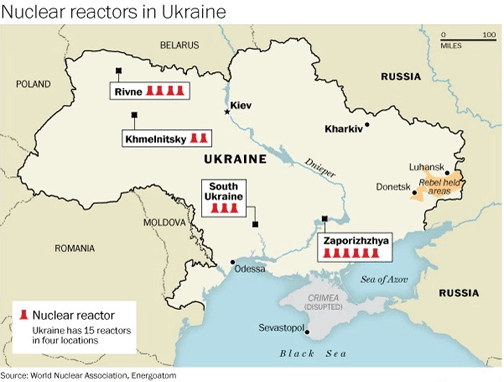
A Ukrainian invasion could go nuclear: 15 reactors would be in a war zone
 | |||
|
A Ukraine Invasion Could Go Nuclear: 15 Reactors Would Be In War Zone https://www.forbes.com/sites/craighooper/2021/12/28/a-ukraine-invasion-will-go-nuclear-15-reactors-are-in-the-war-zone/?sh=1c9a8a0a27aa&fbclid=IwAR1k5sz1_5PLOb7Lg6qMjULu_lj0nqF-6SXx7NifPxr6uakDliSUlgyHFqI Craig HooperSenior Contributor
As Russia’s buildup on the Ukrainian border continues, few observers note that an invasion of Ukraine could put nuclear reactors on the front line of military conflict. The world is underestimating the risk that full-scale, no-holds-barred conventional warfare could spark a catastrophic reactor failure, causing an unprecedented regional nuclear emergency.
The threat is real. Ukraine is heavily dependent upon nuclear power, maintaining four nuclear power plants and stewardship of the shattered nuclear site at Chernobyl. In a major war, all 15 reactors at Ukraine’s nuclear power facilities would be at risk, but even a desultory Russian incursion into eastern Ukraine is likely to expose at least six active reactors to the uncertainty of a ground combat environment.
The world has little experience with reactors in a war zone. Since humanity first harnessed the atom, the world has only experienced two “major” accidents—Chernobyl and Japan’s Fukushima disaster. A Russian invasion, coupled with an extended conventional war throughout Ukraine, could generate multiple International Atomic Energy Agency “Level 7” accidents in a matter of days. Such a contingency would induce a massive refugee exodus and could render much of Ukraine uninhabitable for decades.
Turning the Ukraine into a dystopian landscape, pockmarked by radioactive exclusion zones, would be an extreme method to obtain the defensive zone Russian President Vladimir Putin seems to want. Managing a massive Western-focused migratory crisis and environmental cleanup would absorb Europe for years. The work would distract European leaders and empower nativist governments that tend to be aligned with Russia’s baser interests, giving an overextended Russia breathing room as the country teeters on the brink of technological, demographic, and financial exhaustion.
Put bluntly, the integrity of Ukrainian nuclear reactors is a strategic matter, critical for both NATO and non-NATO countries alike. Causing a severe radiological accident for strategic purposes is unacceptable. A deliberate aggravation of an emerging nuclear catastrophe—preventing mitigation measures or allowing reactors to deliberately melt down and potentially contaminate wide portions of Europe—would simply be nuclear warfare without bombs.
Such a scenario can’t be ruled out. Russia has repeatedly used Ukraine to test out concepts for “Gray Zone” warfare, where an attacker dances just beyond the threshold of open conflict. Given Russia’s apparent interest in radiation-spewing nuclear-powered cruise missiles, robotic undersea bombs with a radiological fallout-oriented payload, destructive anti-satellite tests and other nihilistic, world-harming weapons, Russia’s ongoing dalliance with “Gray Zone” warfare in Ukraine may, for the rest of Europe, become a real matter of estimating radiological “grays,” or, in other words, estimating the amount of ionizing radiation absorbed by humans.
When War Comes To Zaporizhzhia
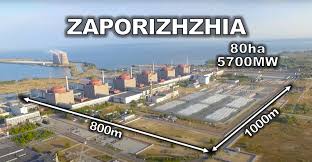
Ukraine’s Zaporizhzhia nuclear power plant is a particular risk. It is the second-largest nuclear power plant in Europe (essentially tied with a French reactor complex near Calais), and one of the 10 largest nuclear power plants in the world. The site has little protection, and the six VVER-1000 pressurized water reactors could easily be embroiled in any Russian invasion.
If war comes, the fight will be close by. The Zaporizhzhia nuclear power plant is located only 120 miles from the current “front line” in the Donbass region and is on the hard-to-defend east bank of the Dnieper River. Aside from the geographical hazards, the power plant provides about a quarter of Ukraine’s total electrical power. Given the importance of the electricity, plant managers will be reluctant to shut it down, securing the reactors only at the very last possible second. Ukraine’s desperate need for energy only compounds the opportunities for an accident.
Outside of direct battle damage, cyber and other Russian-sourced “grey zone” mischief could make the plant unmanageable even before the battle arrives at the reactor gates.
Though unlikely, direct bombardment could cause serious damage to reactor containment structures. While the reactor structures themselves are strong, warfare at the plant could kill key personnel and destroy command-and-control structures, monitoring sensors or critical reactor-cooling infrastructure. And, as an operating power plant, the reactors are not the only threat. Dangerous spent fuel rods are sitting in vulnerable cooling ponds, while older fuel sits in the site’s 167 dry spent fuel assemblies.
If the reactors suffer any operational anomalies, crisis management is not going to happen. Support infrastructure needed for safe reactor management will collapse during conflict. Plant security forces will disappear, operators will flee, and, if an accident occurs, mitigating measures will be impossible.
It seems unlikely that Russia has mobilized trained reactor operators and prepared reactor crisis-management teams to take over any “liberated” power plants. The heroic measures that kept the Chernobyl nuclear accident and Japan’s Fukushima nuclear disaster from becoming far more damaging events just will not happen in a war zone.
Again, the risks are very high. The world has never dealt with an unmanaged meltdown at a large nuclear power plant. The very real prospect of an extended and unmitigated incident at a six-reactor powerplant in a war zone is worth urgent and immediate consultations throughout Europe and NATO.
Gray Zone Nuclear Conflict Can Happen
The world has never experienced war that threatens active nuclear power infrastructure, and world leaders may be underestimating the peril conventional warfare presents to these powerful and perilous assets.
On the other hand, heedless purveyors of “gray zone” warfare may be underestimating the risk themselves, all too eager to determine just how degraded nuclear infrastructure might serve as a “less risky” surrogate for nuclear conflict.
To them, it’s not nuclear war, but just a series of unfortunate nuclear accidents.
Germany steadfast in rejecting nuclear power, aims for 100% renewables
The Germans persist and sign against nuclear power and for renewables. Across the Rhine, the debate pushed by France on nuclear power, presented as “green” energy, is clearly not taking hold. The consensus remains around the bet made by the new government that a direct switch to “all renewable” is possible and will ultimately pay off much more, even if it involves painful decisions. Mediapart 25th Dec 2021 https://www.mediapart.fr/journal/international/251221/les-allemands-persistent-et-signent-contre-le-nucleaire-et-pour-le-renouvelable |
Belgian government to close its nuclear plants by 2025
The Belgian government agreed in principle on Thursday to close its
nuclear power plants by 2025, but left open the possibility of extending
the life of two reactors if it could not otherwise ensure energy supply.
The seven-party coalition has wrestled for months with the topic, with the
Greens adamant that a 2003 law setting out a nuclear exit be respected,
while the French-speaking liberals favoured extending the life of the two
newest reactors. The government had given itself an end-2021 deadline to
settle the matter.
Reuters 23rd Dec 2021
https://www.reuters.com/markets/commodities/belgian-government-reaches-deal-nuclear-exit-media-2021-12-23/
The Belgian government agreed in principle on Thursday to close its
nuclear power plants by 2025, but left open the possibility of extending
the life of two reactors if it could not otherwise ensure energy supply.
Globe and Mail 23rd Dec 2021
Euro News 23rd Dec 2021
https://www.euronews.com/2021/12/23/belgium-to-shut-down-all-seven-of-its-nuclear-reactors-by-2025
BBC 23rd Dec 2021
Iran Simulated Attack On Israel’s Dimona Nuclear Site In Recent Wargames
Iran Simulated Attack On Israel’s Dimona Nuclear Site In Recent Wargames, Iran International, 26 Dec 21, Iran simulated an attack against Israel’s Dimona nuclear reactor during extensive military drills this week, that included launching multiple ballistic missiles.
Fars news agency, an affiliate of Iran’s Revolutionary Guard, published a video on Sunday that shows a mock-up of the Israeli nuclear site as the target of the simulated operation.
The Dimona reactor, officially known as the Shimon Peres Negev Nuclear Research Center, was marked as “WMD production center” in the high-resolution video.
Sixteen ballistic missiles and five suicide drones were launched against the mock target in the operation.
Rhetoric has intensified between Iran and Israel in recent weeks as nuclear talks between Tehran and world powers have stalled in Vienna. Israel has vowed that if Iran’s nuclear program reaches a statge close to production of weapons, it will act regardless of an agreement the United States and other world powers reach with Tehran……………. https://www.iranintl.com/en/202112260336
Iran: The chance for nuclear diplomacy shouldn’t be wasted
Mahmood Monshipouri, PhD. The chance for nuclear diplomacy shouldn’t be wasted, Tehran Times, ,December 26, 2021 – With negotiations over the Iran nuclear deal (also known as the Joint Comprehensive Plan of Actions—JCPOA) being disrupted and delayed for so long, the parties concerned cannot avoid very serious talks any longer. Given the ongoing the US-Russia tensions over Ukraine on the one hand and the US-China tensions over Taiwan on the other, the importance of the negotiations over Iran’s nuclear deal cannot be underestimated. Furthermore, regional cooperation between Iran and its oil-rich neighbors is likely to increase as the prospects for the gradual U.S. withdrawal from the Persian Gulf region seem all but certain.
It is worth noting that the UAE has facilitated selling Iranian oil to China, significantly reducing the risks of regional escalation with Iran. Many sources have recently indicated that a thaw in economic relations between Tehran and Abu Dhabi has already occurred even as U.S. sanctions on Iran continue to remain in place. In light of these new realities, the real question persists: Will the Biden administration stay on the current path of stalemate and trigger further tensions with Iran or will it instead act swiftly enough to avoid the very worst consequences of gamesmanship? A failed nuclear diplomacy could have profound and destabilizing consequences for the region and the rest of the world. Needless to say, such an eventuality must be avoided at all costs. …………………………………….
What is at stake is the global economy and peace. The likely consequences of failed diplomacy—both in the immediate future and over the longer term—include military conflicts, disruption of oil shipments, and an unprecedented rise in regional tensions. Aside from the dangers of military confrontation, which could have grave ramifications, disruption of the world’s most important oil chokepoint, the Strait of Hormuz—through which over 20 million barrels of oil flow per day, or the equivalent of nearly one-fifth of global petroleum consumption—could plunge the global economy into a depression of historic proportion. Increasing regional tensions between Iran and its neighbors and the possibility of Iranian military actions in retaliation to mounting economic and political pressures would have far worse consequences……………………. https://www.tehrantimes.com/news/468480/The-chance-for-nuclear-diplomacy-shouldn-t-be-wasted
Iran Diplomat Condemns West’s ‘Psychological Warfare’ in Nuclear Deadlock
Iran Diplomat Condemns West’s ‘Psychological Warfare’ in Nuclear Deadlock, NewsWeek
BY DAVID BRENNAN ON 12/23/21 An Iranian official has fired more barbs at the Western signatories of the Joint Comprehensive Plan of Action (JCPOA) nuclear deal, ahead of the resumption of talks to revive the accord in Vienna next week.
Iran’s ambassador to the U.K., Mohsen Baharvand, is the latest Iranian diplomat to criticize the conduct of the U.S., France, Germany and the U.K. in the ongoing negotiations, which after seven rounds of talks have failed to break the deadlock.
Both European and American representatives are warning that the window to make a deal is closing. In the absence of a diplomatic solution, some reports have suggested that the U.S.—with Israeli backing—will consider military action to slow Iran’s nuclear program.
“When we do not negotiate with them, they use all their tools and hypocritically pretend to be in favor of dialogue and engagement,” Baharvand wrote on his Instagram account, as reported by Iran’s Mehr News Agency.
“However when Iran agrees to sit at the table, the Western side makes excessive demands contrary to their previous statements. They do not give the other side any rights and adopt an aggressive stance so that any negotiator with any political background regrets the constructive and positive attitude…………….
Iran and its European and American partners have blamed one another for the failure of the recent rounds of talks, both sides suggesting the other is making unrealistic demands designed to be rejected…………..
Tensions are high as representatives prepare for the next round of Vienna talks on Monday.
From Iran, Abolfazl Amouei—the spokesperson for the Iranian Parliament’s National Security and Foreign Policy Committee—said on Friday that Western negotiators should “stop stubbornness and accept Iran’s proposals for removal of sanctions.” https://www.newsweek.com/iran-diplomat-condemns-west-psychological-warfare-nuclear-deadlock-jcpoa-vienna-1662569
USA puts pressure on Japan to not attend nuclear ban treaty meeting, not even as an observer

U.S. urges Japan not to join nuclear ban treaty meeting: sources KYODO NEWS 20 Dec 21, The United States has urged Japan not to attend as an observer the first meeting of signatories to a U.N. treaty banning nuclear weapons, according to U.S. government sources, reflecting Washington’s opposition to the pact.The Japanese government has suggested it will come into line with the United States and take a cautious approach to the issue, the sources said. Prime Minister Fumio Kishida told a parliamentary committee on Thursday that Tokyo has no “concrete plans” to attend the meeting as an observer.
The sources said the U.S. administration of President Joe Biden made the request to Japan through diplomatic channels after German political parties announced Nov. 24 that the deal for the new ruling coalition included taking part as an observer at the meeting scheduled for March in Vienna.
Maybe because of the request, Kishida also suggested last week that participation in the meeting would be premature “before building a relationship of trust with President Biden.”
Germany’s move has put Japan — which has stated it aspires to a world free of nuclear weapons as the only country to have suffered the devastation of atomic bombings — in the spotlight. Both countries are key U.S. allies that rely on American nuclear forces for protection.
The U.S. government has maintained its opposition to the Treaty on the Prohibition of Nuclear Weapons, which entered into force in January this year, even as Biden has pledged to strive for a world without nuclear weapons………..
The U.S. government is also calling on the new three-party German government, launched in December, to give up on the idea of taking part in the March 22-24 meeting in Vienna, according to the sources.
The new U.N. treaty completely outlaws the development, testing, possession and use of nuclear weapons. It only binds states that have formally signed and ratified it.
More than 50 countries, including Austria, Malaysia, Mexico, New Zealand, the Philippines, South Africa and Vietnam, have ratified the pact, according to the website of the U.N. Office for Disarmament Affairs.
But nuclear weapon states, including the United States, Russia and China, are not signatories. Japan has also refrained from signing the pact in consideration of its long-standing security alliance with the United States. https://english.kyodonews.net/news/2021/12/54ab486540a3-us-urges-japan-not-to-join-nuclear-ban-treaty-meeting-sources.html
France and Germany – opposite attitudes to nuclear power
Is nuclear energy green? France and Germany lead opposing camps.
The French government wants to build reactors. The German government wants to shut them down. WP 19 Dec 21,
”………………….. France is leading a group of mostly central and eastern European countries that are pushing the European Union to add modern nuclear energy to a list of “environmentally sustainable economic activities.”
…………. The president of the surrounding Alsace region, Frédéric Bierry, has urged Macron to consider Fessenheim as a possible future site, calling the old plant’s closure a “financial,” “social” and “economic” scandal in the face of a warming climate.
But one of the biggest obstacles — for Fessenheim and for Macron’s broader plans — lies about half a mile to the east of the town’s old nuclear plant. That’s where France ends and Germany begins.
The new German economy and climate minister, Green party member Robert Habeck, was among the politicians who signed a statement celebrating the closure of the Fessenheim plant. The German government has argued that nuclear plants are too risky, and too slow and costly to build, to be a solution to the climate crisis. Germany’s outlook is influenced by nuclear accidents, such as the 2011 Fukushima meltdown in Japan. And Berlin points to reports like one this past week, of cracks in the pipes at a French nuclear reactor, as evidence that plant safety remains a problem.
Germany is among a group of skeptics, including Denmark and Austria, that wants Europe to shut down its remaining nuclear plants and that fiercely oppose a climate-friendly designation for nuclear power, which would signal to green investors that nuclear energy is worthy of financing.
The controversy may come to a head within days, with the European Commission expected to make a decision just before its Christmas break.
………………………………… Environmental activists in Germany acknowledge that continued reliance on coal is a problem even in the medium term. But they are optimistic about how quickly the country can ramp up alternative energy.
Germany’s Green party, in its position as part of the new ruling coalition, has vowed to increase spending significantly on renewables and to limit energy price spikes for consumers. It wants renewables to account for 80 percent of electricity by 2030, up from the present target of about 50 percent.
For German politicians and activists, the idea of nuclear power as green or sustainable is anathema. They talk about the potential for accidents with catastrophic environmental consequences. They note the problems associated with the long-term storage of deadly radioactive waste. They say they don’t want to draw investment away from wind and solar.
German anti-nuclear and environmental activist Stefan Auchter said his country’s path will be validated when the next Chernobyl or Fukushima comes. He compared the use of nuclear energy to playing Russian roulette………………………. https://www.washingtonpost.com/world/2021/12/18/nuclear-energy-climate-france-germany/
U.S. congressional delegation arrives in Ukraine to discuss threat of war with Russia — Anti-bellum
US Congress delegation arrives in Ukraine to discuss threat of war with RussiaA group of congressmen announced Washington’s readiness to take tough measures in response to any encroachment on sovereign Ukrainian territory *** “Representative Jason Crow led a U.S. Congressional delegation to Kyiv to discuss Russia’s aggressive military buildup in and around Ukraine and hear […]
U.S. congressional delegation arrives in Ukraine to discuss threat of war with Russia — Anti-bellum
How to keep US-China rivalry from starting a nuclear arms race
The US needs to understand the Chinese government’s deeply anxious view of its own nuclear and wider geostrategic vulnerability.
China’s strategic culture is deeply realist. Moral appeals to China about doing the right thing will not get American negotiators anywhere, but cold, pragmatic arguments can.
The deepening US-China rivalry might itself create an incentive for Beijing to come to the table. That is provided the US can convince China it would be less vulnerable with an arms-control agreement than without one.
How to keep US-China rivalry from starting a nuclear arms race, https://www.scmp.com/comment/opinion/article/3159963/how-keep-us-china-rivalry-starting-nuclear-arms-race
With tensions threatening to undermine strategic nuclear stability, talks are urgently needed to prevent the situation from spinning out of controlEven if the relationship is destined to be marked by mutual suspicion, establishing strategic transparency is still possible Kevin Rudd
19 Dec, 2021 China’s recently reported tests of a nuclear-capable hypersonic missile in July and August, though officially denied, are threatening to undermine strategic nuclear stability. They have already added to escalating tensions between the United States and China.
Throughout the summer, satellite images revealed that China was in the process of building as many as 300 new missile silos in its northern deserts. Some of these silos are likely to be used merely as empty decoys. But, if even half of them become sites for nuclear-armed missiles, it would represent a near-tripling of China’s nuclear arsenal.
China’s recently reported tests of a nuclear-capable hypersonic missile in July and August, though officially denied, are threatening to undermine strategic nuclear stability. They have already added to escalating tensions between the United States and China.
Following these revelations, the US State Department warned that, “This build-up is concerning. It raises questions about the PRC’s intent … We encourage Beijing to engage with us on practical measures to reduce the risks of destabilising arms races and conflict.”
China’s ambassador for disarmament affairs, Li Song, responded the same day. He described the new Aukus pact between Australia, Britain and the US to help Australia acquire nuclear submarines as a “textbook case” of nuclear proliferation spurring a regional arms race.
Continue readingVietnam set to restart nuclear power project, with Russia’s help
Vietnam poised to resume nuclear project a decade after Fukushima, Free Malaysia Today Nikkei -December 19, 2021 –HANOI: Vietnam says it will proceed with a project to build a 10-megawatt nuclear research reactor with Russian help, a move seen as a new step toward reviving plans to build nuclear power plants a decade after the Fukushima disaster.
Vietnamese President Nguyen Xuan Phuc was escorted by Vietnamese nuclear experts when he visited Moscow for four days starting Nov 29………..
Unlike in democratic countries, where there is criticism of nuclear power programmes and public opinion tends to be divided, such criticism cannot easily surface in Vietnam with its single-party political system, making it possible to resume the nuclear programme……………………..
Political and nuclear energy experts in Vietnam agree that if Hanoi resumes the plan for using nuclear power, Russia could be an initial partner in the projects.https://www.freemalaysiatoday.com/category/world/2021/12/19/vietnam-poised-to-resume-nuclear-project-a-decade-after-fukushima/
French President says discussions continue with Germany about nuclear power as ”green”
French President Emmanuel Macron said on Thursday France and Germany would
continue discussions in the coming days to find a compromise on whether the
European Union should label nuclear and gas as green investments. France
wants to be able to attract green finance to fund the construction of new
nuclear power plants in France, while Germany is phasing out nuclear and
keen on switching to gas — a fossil fuel. Macron said in a joint news
conference with his German counterpart Olaf Scholz that a decision on the
subject, the so-called green taxonomy, would soon be issued by the European
Commission.
Reuters 17th Dec 2021
Iran and UN inspector reach agreement on reinstalling cameras at Karaj nuclear facility
Iran and the UN inspector have reached an agreement on the imminent reinstallation of cameras at the Karaj nuclear facility, a move that is seen as indispensable to keeping alive the broader nuclear talks and the lifting of US sanctions on Tehran. Those negotiations appear to be hanging by a thread judging by a string of negative comments from European diplomats when they discussed the progress of the talks at the UN security council on Tuesday. Guardian 16th Dec 2021 https://www.theguardian.com/world/2021/dec/16/iran-un-inspector-agreement-cameras-nuclear-facility-us-sanctions |
Iran nuclear talks to resume ‘soon’ after modest gains in Vienna
Iran nuclear talks to resume ‘soon’ after modest gains in Vienna
Negotiators trying to agree on a joint text that would act as the basis for a potential agreement. Aljazeera By Maziar Motamedi 17 Dec 202117 Dec 2021
The seventh round of talks in Vienna to restore Iran’s 2015 nuclear deal has ended and while it appears progress was made, the negotiating world powers are not close to an agreement.
A Joint Commission meeting of the remaining signatories of the deal the United States abandoned in 2018 was held in Palais Coburg on Friday…………………….. https://www.aljazeera.com/news/2021/12/17/iran-nuclear-talks-to-resume-soon-after-modest-gains-in-vienna
1 This Month



26 September – International Day for the Total Elimination of Nuclear Weapons


PLEASE OPPOSE HR 8255 AND S.3639 – bills would accelerate satellite deployment, with no environmental review or safeguards – https://ncstd5li.quorum.us/campaign/169331/
To see nuclear-related stories in greater depth and intensity – go to https://nuclearinformation.wordpress.com
-
Archives
- September 2026 (269)
- August 2026 (330)
- July 2026 (355)
- June 2026 (287)
- May 2026 (306)
- April 2026 (356)
- March 2026 (251)
- February 2026 (267)
- January 2026 (308)
- December 2025 (358)
- November 2025 (359)
- October 2025 (375)
-
Categories
- 1
- 1 NUCLEAR ISSUES
- business and costs
- climate change
- culture and arts
- ENERGY
- environment
- health
- history
- indigenous issues
- Legal
- marketing of nuclear
- media
- opposition to nuclear
- PERSONAL STORIES
- politics
- politics international
- Religion and ethics
- safety
- secrets,lies and civil liberties
- spinbuster
- technology
- Uranium
- wastes
- weapons and war
- Women
- 2 WORLD
- ACTION
- AFRICA
- Atrocities
- AUSTRALIA
- Christina's notes
- Christina's themes
- culture and arts
- Events
- Fuk 2022
- Fuk 2023
- Fukushima 2017
- Fukushima 2018
- fukushima 2019
- Fukushima 2020
- Fukushima 2021
- general
- global warming
- Humour (God we need it)
- Nuclear
- RARE EARTHS
- Reference
- resources – print
- Resources -audiovicual
- Weekly Newsletter
- World
- World Nuclear
- YouTube
-
RSS
Entries RSS
Comments RSS

