A clarification about China and Taiwan
Norman Realname, 5 Aug 22,

I’m grateful to a reader for providing this explanation.
I still think that it’s a pretty bad idea for USA and Australia to start a probable World War 3 over Taiwan.
The Republic of China (ROC) and the People’s Republic of China (PRC) are NOT synonyms and should not be used as such. The ROC has NO control over Hong Kong; it’s a semi-autonomous territory ruled by the PRC under the “one country, two systems” arrangement, as per treaty. Thus, grumbling about democratic subversion aside, there was no question of the PRC’s sovereignty over it.
The ROC, however, DOES have control over Taiwan, and the PRC does NOT. As to why this is the case, the most oversimplified answer is that the Chinese Civil War never fully ended and both governments claim to rule the territory of the other, but since the PRC has the de facto control of almost all of it, it’s recognized as the “real” China. The more complicated answer is that since democratization the ROC government no longer wants to rule the mainland and sees itself as a separate Taiwanese nation but is forbidden to relinquish its territorial claims (under threat of invasion) by the PRC who view Taiwan as integral Chinese territory and would interpret any movement away from them as secession (even though the PRC has never actually ruled over Taiwan).
The US and China differ over their interpretation of the situation. The PRC’s One China PRINCIPLE states that there is only one China, and Taiwan is a part of China. The US’s One China POLICY states that they *acknowledge* the PRC’s position on the matter, without actually saying whether or not they agree that Taiwan is part of China. In other words: the US generally agrees there is only one China, but they’re not sure (read: deliberately ambiguous) whether Taiwan is part of it.
Fundamentally, while the PRC has been successful in preventing international recognition of the ROC (Taiwan), they do not control the territory and cannot control the territory without:
1. The ROC (Taiwanese) government agreeing to hand over power peacefully to the PRC.
2. A full-scale military invasion of Taiwan aimed at the surrender and/or destruction of the ROC (Taiwanese) government.
To compare the situation to Hong Kong, – the crucial difference is the People’s Republic of China did not need to roll in their military to fight some theoretical Hong Kong military in order to be able to tell Hong Kong what to do.
Washington Is Making the Same Blunder Regarding Taiwan That It Did in Ukraine

y Ted Galen Carpenter Posted on
Tensions between the United States and the People’s Republic of China (PRC) are rising sharply over the Taiwan issue. House Speaker Nancy Pelosi’s stated intention to include a stop in Taipei to meet with Taiwanese officials during her forthcoming trip to East Asia is the latest source of trouble. Pelosi apparently escalated that provocation further by inviting other prominent members of Congress to join her in that stop. Her actions have caused even the staunchly pro-Taiwan Biden administration to quietly press her to change her plans. Conversely, congressional hawks are urging Pelosi not to back down.
The reason for the administration’s caution are readily apparent. Beijing has reacted with unusually intense anger to the prospective visit…………………………
For 4 decades after Washington shifted diplomatic relations from Taipei to Beijing in 1979 and passed the Taiwan Relations Act to govern reduced, informal relations with Taiwan, US administrations were careful to limit visits to the island to low-level officials.
That restraint diminished dramatically during Donald Trump’s presidency, when Congress authorized and the administration approved meetings by National Security Advisor John Bolton and other Cabinet-level officials with their Taiwanese counterparts. Those trips were part of a new policy of much stronger US diplomatic and military support for Taiwan – a course of action that the Biden administration has continued, despite insisting that the United States still adheres to a “one-China” policy.
………. The Biden administration needs to take the PRC’s warnings more seriously. In many ways, Washington’s determination to press ahead with greater support for Taiwan as part of an overall containment policy directed against China is reminiscent of the blunders US officials made with respect to NATO expansion, especially the campaign to incorporate Ukraine, and Washington’s tone-deaf response to Moscow’s escalating complaints.
Biden administration policymakers dismissed the Kremlin’s repeated warnings that trying to make Ukraine a NATO military asset would cross a red line with respect to Russia’s security interests. They discovered belatedly that Russian President Vladimir Putin was not about to cower and accept US diktats simply because the United States insisted that Ukraine had a “right” to join NATO. Nor did he accept Washington’s accelerating campaign to make Ukraine a de facto US military and intelligence ally perched on Russia’s border.
The outcome of Washington’s approach has been horrifyingly bloody and tragic for the people of Ukraine. Even more worrisome, the administration’s policies have led to an extremely dangerous confrontation between NATO and a nuclear-armed Russia, with the United States and NATO cynically using Ukraine as a pawn in a proxy war against Moscow.
Washington risks making a comparable blunder in its dealings with China. The administration must implement a quiet retreat regarding its growing political and military ties to Taipei and adopt a less confrontational approach to Beijing. Moreover, that change needs to go well beyond merely discouraging Pelosi’s provocative visit to Taipei. It has become increasingly obvious to PRC leaders that the United States is pursuing a full-blown anti-China containment policy, with Taiwan as the point of the spear, in a desperate effort to preserve Washington’s fading strategic primacy in East Asia. It is highly unlikely that Beijing will passively accept such an intrusive US presence in China’s core security sphere over the long term. As the PRC’s economic and military power continues to grow, Beijing’s resistance to Washington’s hegemonic efforts will escalate.
US arrogance and inflexibility helped lead to the current tragedy in Ukraine. Policymakers blew through red warning light after red warning light from the Kremlin. A similar approach seems to be taking place in Washington’s relations with Beijing, and it threatens to produce a similar ugly outcome in East Asia over the Taiwan issue.
Ted Galen Carpenter, a senior fellow in defense and foreign policy studies at the Cato Institute, is the author of 13 books and more than 1,100 articles on international affairs. His latest book is Unreliable Watchdog: The News Media and U.S. Foreign Policy (forthcoming, September 2022).
Nancy Pelosi’s Taiwan Visit Stoked Tensions With China. What Comes Next?
Truthout Amy Goodman & Juan González, Democracy Now! U.S. House Speaker Nancy Pelosi has left Taiwan after a series of high-profile meetings with Taiwan’s pro-democracy president and other lawmakers. Pelosi’s visit made her the most senior U.S. official to visit Taiwan in 25 years and stoked tensions with China, prompting the nation to announce it would carry out new air and naval drills and long-range live-fire exercises in six areas around Taiwan beginning Thursday. The Quincy Institute’s Michael Swaine says President Biden should have done more to prevent the visit and uphold the One China policy, calling the move a “basic violation of the understanding that the United States and China reached at the time of normalization.”……………………………………..
more https://truthout.org/video/nancy-pelosis-taiwan-visit-stoked-tensions-with-china-what-comes-next/?eType=EmailBlastContent&eId=cc78ff56-e8af-4904-b6ea-6971941975d2
Is Taiwan’s Independence Worth War?
https://original.antiwar.com/buchanan/2022/08/01/is-taiwans-independence-worth-war/ by Patrick J. Buchanan
When a man knows he is about to be hanged in a fortnight, it concentrates his mind wonderfully, said Dr. Samuel Johnson.
If there is any benefit to be realized from the collision between China and the U.S. over Speaker Nancy Pelosi’s proposed trip to Taiwan, it is this: America needs to reflect long and hard upon what it is we will fight China to defend in the Taiwan Strait and South China Sea.
China, after all, is a nuclear-weapons nation with a manufacturing base larger than our own, an economy equal to our own, a population four times ours and fleets of warships larger in number than the US Navy.
An air-naval-and-missile war in the Western Pacific and East Asia would be no cakewalk.
A massive barrage of anti-ship and hypersonic missiles launched by China could cripple and conceivably sink the US carrier Ronald Reagan now in the South China Sea. The Reagan carries a crew of thousands of sailors almost as numerous as the US casualty lists from both Pearl Harbor and 9/11, the worst attacks in and on the US outside of such Civil War battles as Gettysburg and Antietam.
What in East Asia or the Western Pacific would justify such losses?
What would justify such risks?
Since President Richard Nixon’s trip to China, and President Jimmy Carter’s abrogation of the mutual defense treaty with the Republic of China on Taiwan in 1979, the US is not obligated to come to the defense of Taiwan against China, which claims that island the size of Maryland as “part of China.”
Our military posture has been one of “strategic ambiguity.” We will not commit to go to war to defend Taiwan, nor will we take the war option off the table if Taiwan is attacked.
But if the US went to war to defend Taiwan, what would it mean?
We would be risking our own security and possible survival to prevent from being imposed on the island of Taiwan the same regime lately imposed on Hong Kong without any US military resistance.
If Hong Kong, a city of 7 million, can be transferred to the custody and control of Beijing without resistance from the US, why should it be worth a major US war with China to prevent that same fate and future from befalling 23 million Taiwanese?
The retort comes instantly.
Allow China to take Taiwan without US resistance, and our treaties to fight for the sovereignty, independence and territorial integrity of Japan, South Korea, the Philippines, Australia and New Zealand become suspect.
Belief in the US commitment to fight for the nations of East Asia and the Western Pacific would dissipate. The entire architecture of Asian defense against Communist China could disintegrate and collapse.
If we allowed Taiwan to be taken by China without intervening, it is argued, the value of US commitments to fight to defend scores of allies in Europe and Asia would visibly depreciate. US credibility would suffer a blow as substantial as the loss of South Vietnam in 1975.
The fall of Saigon was followed by the loss of Laos and Cambodia to communism, the overthrow of the shah, the Iranian hostage crisis, the Soviet invasion of Afghanistan, the strategic transfer of Ethiopia, Angola, Mozambique, Nicaragua and Grenada to the Soviet bloc, and the rise of Euro-communism on the Old Continent.
Pelosi’s prospective visit to Taiwan, and the bellicose reaction of Beijing, should raise other relevant questions.
If this should lead to a U.S.-China war, what would we be fighting for? And what would victory look like?
A restoration of the status quo ante? Permanent independence for Taiwan, which would require a new and permanent war guarantee by the US and a new U.S.-Taiwan defense pact?
Would a permanent commitment to fight to defend Taiwan from China be acceptable to an American people weary of commitments and wars?
Again, why would we risk our own peace and security for Taiwan’s freedom and independence, when we would not risk our own peace and security for the freedom or independence of Hong Kong?
And after our victory in the Taiwan Strait, how would we secure indefinitely the independence of that nation of 23 million from a defeated power of 1.4 billion, bitter and bristling at its loss?
Consider: China, in this 21st century, has grown massively, both militarily and economically, and in both real and relative terms, at the expense of the United States.
Nor are the growth trends for China, with four times as many people as there are Americans, favorable to the USA.
What guarantees are there that 2025 or 2030 will not bring a more favorable balance of power for China in what is, after all, their continent, not ours?
Unlike in the Cold War, time is not necessarily on the side of the United States and its allies when all three of the nuclear powers in East Asia – China, Russia, North Korea – are hostile to the USA.
Patrick J. Buchanan is the author of Churchill, Hitler, and “The Unnecessary War”: How Britain Lost Its Empire and the West Lost the World. To find out more about Patrick Buchanan and read features by other Creators writers and cartoonists, visit the Creators Web page at www.creators.com.
Is nuclear disarmament possible?
Aljazeera, 2 August 22, “We are pushing closer and closer to that point where [nuclear weapons are] eventually going to be used, and we have to drastically change,” says Beatrice Fihn, the executive director of the International Campaign to Abolish Nuclear Weapons, ICAN.
“It is the nuclear-armed states, and it’s the nuclear-allied states in NATO, for example, that really have to lead this charge,” she says of the push for disarmament.
ICAN was awarded a Nobel Peace Prize for spearheading the 2017 Treaty on the Prohibition of Nuclear Weapons. Fihn says it is imperative for all countries to eliminate nuclear weapons, adding that the treaty is a “way of creating a revolution in this nuclear structure that we created”.
“The powerful have always lost their power when the majority has risen up and stood against it.” On UpFront, Marc Lamont Hill sits down with ICAN Executive Director Beatrice Fihn to discuss nuclear threats and the fight for global nuclear disarmament.
World one misstep from ‘nuclear annihilation’: UN chief
https://www.aljazeera.com/news/2022/8/1/un-chief-warns-world-is-one-step-from-nuclear-annihilation 2 Aug 22, Antonio Guterres sounds a global alarm at the opening of the meeting to review a landmark nuclear weapons treaty.
Nuclear threats emanating from the war in Ukraine as well as in Asia and the Middle East have put the world “one miscalculation away from nuclear annihilation”, the United Nations secretary-general said.
At the UN on Monday, Antonio Guterres issued the dire warning at the opening of a long-delayed meeting to review the landmark 50-year-old Non-Proliferation Treaty (NPT) aimed at preventing the spread of nuclear weapons and eventually achieving a nuclear-free world.
Guterres told many ministers, officials and diplomats gathered in the General Assembly Hall that the month-long review conference is taking place “at a time of nuclear danger not seen since the height of the Cold War”.
The meeting is “an opportunity to hammer out the measures that will help avoid certain disaster, and to put humanity on a new path towards a world free of nuclear weapons”, he said.
However, Guterres warned that “geopolitical weapons are reaching new highs” as almost 13,000 nuclear arms are in arsenals around the world and countries are seeking “false security” by spending hundreds of billions of dollars on “doomsday weapons”.
“We have been extraordinarily lucky so far. But luck is not a strategy. Nor is it a shield from geopolitical tensions boiling over into nuclear conflict,” the UN chief said………………………………………………
International Atomic Energy Agency (IAEA) Director-General Rafael Grossi said the Ukraine conflict is “so grave that the spectre of a potential nuclear confrontation, or accident, has raised its terrifying head again”.
Grossi warned that at the Zaporizhzhia nuclear plant, “the situation is becoming more perilous by the day”, and he urged all countries to help make possible his visit to the facility with a team of IAEA safety and security experts, saying his efforts for the past two months have been unsuccessful.
In force since 1970, the Non-Proliferation Treaty has the widest adherence of any arms control agreement with some 191 countries that are members.
Under its provisions, the five original nuclear powers – the United States, China, Russia (then the Soviet Union), Britain and France – agreed to negotiate towards eliminating their arsenals someday and nations without nuclear weapons promised not to acquire them in exchange for a guarantee to be able to develop nuclear energy for peaceful purposes.
India and Pakistan, which did not join the NPT, went on to develop nuclear weapons. So did North Korea, which ratified the pact but later announced it was withdrawing. Non-signatory Israel is believed to have a nuclear arsenal, but neither confirms nor denies it.
Beatrice Fihn, from the International Campaign to Abolish Nuclear Weapons, said the failure to fulfil legal commitments by nuclear powers and to work seriously on disarmament is concerning.
“If they don’t, countries like Iran might be very tempted in the future to develop nuclear weapons,” Fihn told Al Jazeera.
The UN meeting, which ends August 26, aims to generate a consensus on next steps, but expectations are low for substantial – if any – agreement. There were 133 speakers as of Monday plus dozens of side events.
The NPT’s five-year review was supposed to take place in 2020 when the world already faced plenty of crises, but was delayed because of the COVID-19 pandemic.
The Anti-China Brainwashing Is Working: Notes From The Edge Of The Narrative Matrix
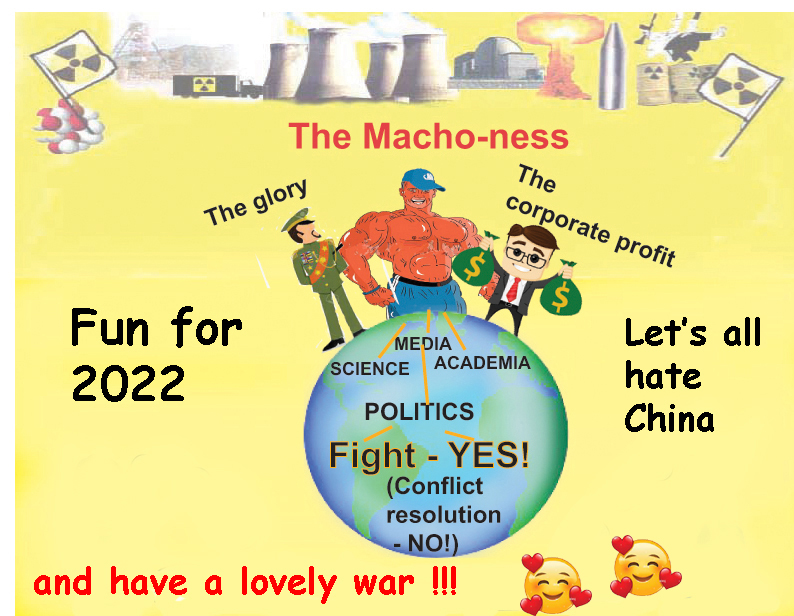
Caitlin Johnstone 2 Aug 22, If someone criticizing the most dangerous agendas of the most powerful and destructive government on earth looks like “Russian propaganda” or “Chinese propaganda” to you, it’s because you yourself have been brainwashed by propaganda.
The western propaganda campaign against China is succeeding, even among many who consider themselves anti-war or critical of establishment power. Whatever sick future agendas they’re manufacturing consent for, they’ll be able to roll right on out. People’s brains are turning to soup.
❖
The best case scenario for Nancy Pelosi’s Taiwan visit — the absolute best case — is that it ratchets up cold war tensions with China that threaten us all and benefit ordinary people in no way. The worst case scenario is as bad as anything you can possibly imagine.
So why are we being told that it’s still happening? Well, as Antiwar’s Dave DeCamp reminded us a few months ago, one major factor is that it facilitates US military expansionism geared toward encirclement strategies against China.
“The United States no longer sees Taiwan as a ‘problem’ in our relations with China, we see it as an opportunity to advance our shared vision for a free and open Indo-Pacific,” Raymond Greene, the deputy director of the de facto US embassy in Taipei, said last year.
Imagine if the Democratic Party fought against Republicans as hard as they fight against world peace……..
Taiwan is a US military asset, not a US ally. That’s a very significant difference that everyone, especially the Taiwanese, would do well to keep in mind………
It’s a safe bet that a minority of Americans could find Taiwan on a map, and that of these the overwhelming majority believe it’s just some island nation that China randomly decided it hates…….
There needs to be a major war every generation or two, otherwise peace becomes normalized and becomes the expectation. If you allow that to happen then war begins to stand out against expected norms like the freakish abomination that it is, and militarism looks insane.
They use propaganda to facilitate war, but they also use war to facilitate propaganda. Keeping the wars going helps the propaganda machine spin war as something normal and expected and to be continuously prepared for. It acts as an immunosuppressant against the public’s natural, healthy rejection of war. The more normalized war becomes, the more suppressed our collective immune system’s rejection of it becomes.
War is the absolute worst thing in the world. It’s the most insane thing humans do. The most destructive. The least sustainable. The most conducive to human suffering. Only by very aggressive narrative management can the public be dissuaded from insisting on peace…………………..
Westerners are only encouraged to contemplate the horrors of war when it is someone else’s war.
https://caitlinjohnstone.substack.com/p/the-anti-china-brainwashing-is-working?r=19f8t&s=r&utm_campaign=post&utm_medium=web&utm_source=direct
Biden, Putin strike conciliatory tones as nuclear arms talks start at U.N.
By Michelle Nichols , UNITED NATIONS, Aug 1 (Reuters) – U.S. President Joe Biden said on Monday he is ready to pursue a new nuclear arms deal with Russia and called on Moscow to act in good faith as his Russian counterpart Vladimir Putin said there could be no winners in any nuclear war.
Both leaders issued written statements as diplomats gathered for a month-long U.N. conference to review the Treaty on the Non-Proliferation of Nuclear Weapons (NPT). It was supposed to take place in 2020 but was delayed by the COVID-19 pandemic…………………… more https://www.reuters.com/world/biden-urges-russia-china-engage-nuclear-talks-2022-08-01/
Iran says ‘optimistic’ after EU proposal for nuclear deal
The New Arab Staff & Agencies, 01 August, 2022,
Iran said Monday it remains “optimistic” about a possible revival of the 2015 nuclear deal after the European Union tabled a proposal aiming for a compromise in the talks stalled since March.
“We remain optimistic that the negotiation process will lead us to a logical and reasonable outcome,” foreign ministry spokesman Nasser Kanani said at his weekly news conference.
The comment comes after EU foreign policy chief and coordinator of the nuclear talks between Iran and world powers, Josep Borrell, last Tuesday submitted a new draft text and urged the different sides of the negotiations to accept it or “risk a dangerous nuclear crisis”.
Negotiations in Vienna began in April 2021 to restore the deal, but have stalled since March amid differences between Tehran and Washington on several issues.
The two sides negotiated indirectly through the European Union coordinator in a bid to bring the US back into the deal and to lift sanctions on Iran, on the basis that Tehran would return to its nuclear commitments…………………………………….
more https://english.alaraby.co.uk/news/iran-says-optimistic-after-eu-proposal-nuclear-deal
Joe Biden offers to negotiate a new arms control framework with Russia to replace New START
 |
By: Srishti Singh Sisodia, Washington, US Aug 01, 2022,
United States President Joe Biden said that Washington has expressed its readiness to open talks with Moscow, the Russian state-controlled news television network RT reported on Monday (August 1). The report mentioned that the negotiation is apparently “a new arms control framework” with Russia to potentially replace the New START (Strategic Arms Reduction Treaty).
As quoted by the RT website, Biden said: “Today, my Administration is ready to expeditiously negotiate a new arms control framework to replace New START when it expires in 2026. But negotiation requires a willing partner operating in good faith.”
No one can win a nuclear war: Putin
https://www.canberratimes.com.au/story/7843236/no-one-can-win-a-nuclear-war-putin/ 2 Aug 22, Russian President Vladimir Putin says there can be no winners in a nuclear war and no such war should ever be started.
The Kremlin leader made the comment in a letter to participants of a conference on the nuclear non-proliferation treaty (NPT), more than five months into his war on Ukraine.
“We proceed from the fact that there can be no winners in a nuclear war and it should never be unleashed, and we stand for equal and indivisible security for all members of the world community,” he said.
His words to the NPT forum appeared aimed at striking a reassuring note and portraying Russia as a responsible nuclear power.
They contrasted with earlier statements by Putin and other Russian politicians that have been interpreted in North America and Europe as implicit nuclear threats.
In a speech on February 24, as he launched the Russian invasion of Ukraine, Putin pointedly referred to Russia’s nuclear arsenal and warned outside powers that any attempt to interfere would “lead you to such consequences that you have never encountered in your history”.
Days later, he ordered Russia’s nuclear forces to be put on high alert.
The world is facing a level of danger from nuclear weapons not seen since the height of the Cold War, UN Secretary General Antonio Guterres said at the start of the NPT conference on Monday.
The NPT is subject to review every five years, and the 10th review was to have taken place in 2020 but was postponed on account of the pandemic.
CIA director William Burns said in April that given the setbacks Russia had suffered in Ukraine, “none of us can take lightly the threat posed by a potential resort to tactical nuclear weapons or low-yield nuclear weapons”.
Russia, whose military doctrine allows for the use of nuclear weapons in the event of an existential threat to the Russian state, has accused the US of leading a “proxy war” against it by arming Ukraine and imposing sanctions.
Earlier on Monday, a Russian foreign ministry source questioned the seriousness of comments by US President Joe Biden calling for talks on a nuclear arms control framework to replace a treaty expiring in 2026.
“Is this a serious statement or has the White House website been hacked?” a Russian foreign ministry source told Reuters.
The World Does Not Want a Global NATO.

Although NATO’s member states may believe that they possess global authority, the overwhelming majority of the world does not.
It is clear that NATO’s claim to be “a bulwark of the rules-based international order” is not a view which is shared by most of the world
Most of the world rejects NATO’s policies and global aspirations and does not wish to divide the international community into outdated Cold War blocs, writes Vijay Prashad.
Consortium News, By Vijay Prashad. Tricontinental: Institute for Social Research ” 29 July 22..………………….. At No Cold War, an international platform seeking to bring sanity to international relations, we have been closely observing the shifting tenor of the war in Ukraine and the U.S.-driven pressure campaign against China.
We have published three previous briefings from this platform in our newsletters; below, you will find briefing No. 4, The World Does Not Want a Global NATO, which details the emerging clarity in the Global South regarding the U.S.-European attempt to drive a belligerent agenda around the world.
This new clarity relates not only to the militarisation of the planet, but also to the deepening conflicts in trade and development, as evidenced by the G7’s new initiative, the Partnership for Global Infrastructure and Development, which clearly targets China’s Belt and Road Initiative.
In June, member states of the North Atlantic Treaty Organisation (NATO) gathered in Madrid for their annual summit. At the meeting, NATO adopted a new Strategic Concept, which had last been updated in 2010. In it, NATO names Russia as its “most significant and direct threat” and singles out China as a “challenge [to] our interests.” In the words of NATO Secretary General Jens Stoltenberg, this guiding document represents a “fundamental shift” for the military alliance, its “biggest overhaul… since the Cold War.”
Monroe Doctrine for the 21st Century?
Although NATO purports to be a “defensive” alliance, this claim is contradicted by its destructive legacy – such as in Serbia (1999), Afghanistan (2001) and Libya (2011) – and its ever-expanding global footprint.
At the summit, NATO made it clear that it intends to continue its global expansion to confront Russia and China. Seemingly oblivious to the immense human suffering produced by the war in Ukraine, NATO declared that its “enlargement has been a historic success… and contributed to peace and stability in the Euro-Atlantic area,” and extended official membership invitations to Finland and Sweden.
However, NATO’s sights extend far beyond the “Euro-Atlantic” to the Global South. Seeking to gain a foothold in Asia, NATO welcomed Japan, South Korea, Australia and New Zealand as summit participants for the first time and stated that “the Indo-Pacific is important for NATO.”
On top of this, echoing the Monroe Doctrine (1823) of two hundred years ago, the Strategic Concept named “Africa and the Middle East” as “NATO’s southern neighbourhood,” and Stoltenberg made an ominous reference to “Russia and China’s increasing influence in [the Alliance’s] southern neighbourhood” as presenting a “challenge.”
Most of World Seeks Peace
Although NATO’s member states may believe that they possess global authority, the overwhelming majority of the world does not. The international response to the war in Ukraine indicates that a stark divide exists between the United States and its closest allies on the one hand and the Global South on the other.
Governments representing 6.7 billion people – 85 percent of the world’s population – have refused to follow sanctions imposed by the U.S. and its allies against Russia, while countries representing only 15 percent of the world’s population have followed these measures. According to Reuters, the only non-Western governments to have enacted sanctions on Russia are Japan, South Korea, the Bahamas and Taiwan – all of which host U.S. military bases or personnel.
There is even less support for the push to close airspace to Russian planes spearheaded by the U.S. and European Union. Governments representing only 12 percent of the world’s population have adopted this policy, while 88 percent have not.
U.S.-led efforts to politically isolate Russia on the international stage have been unsuccessful. In March, the U.N. General Assembly voted on a nonbinding resolution to condemn Russia’s invasion of Ukraine: 141 countries voted in favour, five countries voted against, 35 countries abstained and 12 countries were absent. However, this tally does not tell the full story. The countries which either voted against the resolution, abstained, or were absent represent 59 percent of the world’s population. Following this, the Biden administration’s call for Russia to be excluded from the G20 summit in Indonesia was ignored.
Meanwhile, despite intense backing from NATO, efforts to win support for Ukraine in the Global South have been a complete failure. On June 20, after several requests, Ukrainian President Volodymyr Zelensky addressed the African Union; only two heads of state of the continental organisation’s 55 members attended the meeting. Shortly thereafter, Zelensky’s request to address the Latin American trade bloc, Mercosur, was rejected.
It is clear that NATO’s claim to be “a bulwark of the rules-based international order” is not a view which is shared by most of the world. Support for the military alliance’s policies is almost entirely confined to its member countries and a handful of allies which together constitute a small minority of the world’s population. Most of the world’s population rejects NATO’s policies and global aspirations and does not wish to divide the international community into outdated Cold War blocs. https://consortiumnews.com/2022/07/29/the-world-does-not-want-a-global-nato/
UN Nuclear Review: A Prime Time to Stop the New Arms Race
The real solution to the threat of nuclear war is in plain sight, but still the powerful weapons makers and war profiteers refuse to yield.
https://medium.com/@codepink/un-nuclear-review-a-prime-time-to-stop-the-new-arms-race-6e3303aa0ccd By Marcy Winograd and Medea Benjamin, 31 July 22,
In the run-up to August’s United Nation’s 10th Annual Review of the landmark Nuclear Non-Proliferation Treaty (NPT), a review undertaken every five years, Secretary of State Antony Blinken’s State Department issued a surprising reaffirmation of the U.S. commitment to this treaty and the “ultimate goal of a world without nuclear weapons.”
The NPT, designed to “further the goal of achieving nuclear disarmament,” entered into force in 1970 and was extended indefinitely in 1995. It has now been signed by 191 nations, including the U.S. and Russia.
If only Blinken’s verbal support for the NPT was U.S. policy, as opposed to wishful thinking or trickery.
As treaty signatories and civil society representatives from around the world gather for a month in New York to evaluate the treaty’s implementation, the White House, Congress, and military contractors will move ahead on a near $2 trillion nuclear rearmament program euphemistically termed “nuclear modernization.”
Modernization is a kitchen upgrade. New touch-to-open cabinets. New LED recessed lighting.
It is not 600 new–instead of funeralized–intercontinental ballistic missiles (ICBM’s) on hair trigger alert to replace the Minuteman III in the midwest. Each of these “modern missiles” would span the length of a bowling lane with new warheads that are 20 times more powerful than the bombs that incinerated Hiroshima and Nagasaki.
Modernization is not a new sea-launched nuclear cruise missile that carries both conventional and nuclear warheads with the same radar profile to confuse “the enemy.”
Modernization is not 100 new stealth air-launched nuclear missiles like the B-21 Raider, also capable of carrying both conventional and nuclear weapons.
Ahh, but these nuclear weapons are just upgrades, not new systems, right?
Semantic back-flips aside, U.S. nuclear “modernization” means the development of new weapon systems with new nuclear warheads and a new arms race. What the State Department failed to mention in its reaffirmation of the NPT was that the U.S. nuclear rearmament program violates the spirit and intent of Article 6 of the NPT, which prohibits the pursuit of new nuclear weapons.
Instead of pursuing world peace and climate preservation for our children, US leaders are chasing a reckless foreign policy.
In April, the Wall Street Journal published a commentary titled “The U.S. should show it can win a nuclear war.”
More recently, the City of New York, home of the United Nations, released, however well-intentioned, a so-called public service announcement on how to survive a nuclear attack, referring to it as “the big one”, as though it were an earthquake. No mention was made of blinding flashes of light or widespread radiation that blisters the skin or immediate incineration. Instead, New Yorkers were instructed to get inside, stay inside and stay tuned. Tuned to what? Our fading heartbeats?
According to the International Committee to Abolish Nuclear Weapons (ICAN), a nuclear war between the US and Russia would lead to over 34-million dead and 57 million injured in the first few hours — and a dark subzero winter of famine and soot blocking the sun for those who survived.
No mention is made of this nightmare scenario, however, in the 2019 Joint Chiefs Nuclear Operations Publication (3–72), a Strangelovian document briefly released then deleted from the website of the Joint Chiefs of Staff. The vanishing unclassified document, preserved by the Federation of American Scientists, reflects the Pentagon’s delusional thinking that a nuclear war can be limited and won. Mark Milley, then Secretary of the Army, now Chair of the Joint Chiefs, signed off on the chilling statements below:
“A nuclear weapon could be brought into the campaign as a result of perceived failure in a conventional campaign, potential loss of control or regime, or to escalate the conflict to sue for peace on more-favorable terms.”
“Using nuclear weapons could create conditions for decisive results and the restoration of strategic stability …”
UN treaty signatories, along with NGO conference delegates, should use the month-long NPT operations review to speak truth to power.
First, they should speak out against the dangerous proxy war in Ukraine between the U.S./NATO and Russia that could lead to a nuclear confrontation. The delegates should denounce Russian President Vladmir Putin for ordering the invasion of Ukraine and call on all parties in the war to engage in a negotiated settlement.
One miscalculation, one moment of confusion, one intentional launch of a short-range nuclear warhead, followed by a retaliatory long-range nuclear weapon, could burn us alive and blanket the world in ash.
Delegates should also call on the United States and NATO to denuclearize Europe. This would entail removing US nuclear weapons from Belgium, the Netherlands, Germany, Italy and Turkey; scrapping plans to redeploy nuclear weapons to the United Kingdom, where for 14 years nuclear storage facilities rightfully have sat empty; and removing the provocative anti-ballistic missiles from Romania and Poland, both of which are perilously close to Russia’s border.
On the broader issue of disarmament, attendees at the UN meetings should shout “Come to your senses!” to the President Biden, Secretary of State Antony Blinken, National Security Advisor Jake Sullivan, Secretary of Defense Lloyd Austin and Chair of the Joint Chiefs of Staff Mark Milley for supporting nuclear rearmament. Delegates should denounce members of Congress who recently voted for the $840 billion dollar military budget that includes $30 billion as another down payment on the nuclear rearmament program.
Participants at the UN gathering could also call on President Biden to declassify his Nuclear Posture Review. Every administration is obligated by US law to release a new Nuclear Posture Review outlining the administration’s nuclear policy.
To date, Biden’s Nuclear Posture Review remains a secret.
Classified.
Declassifying the Review would allow the people of the United States, and the world, to know whether President Biden is committed to keeping his campaign promise of no first use of nuclear weapons and if he abides by the Joint Statement he signed with Putin in 2021 and the Joint Agreement he signed in 2022 with five nuclear weapons states, including Russia and China, committing the US to the NPT because “a nuclear war can never be won and must never be fought.”
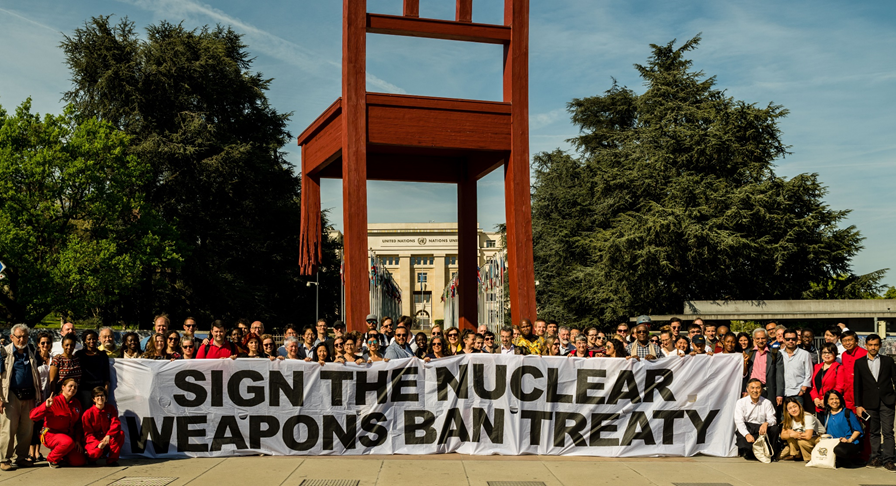
The real solution to the threat of nuclear war is in plain sight. It is the UN Treaty on the Prohibition of Nuclear Weapons, the first legally binding international agreement to comprehensively prohibit nuclear weapons. It was adopted in July 2017 and entered into force in January 2021, after it was ratified by 50 states. None of the nuclear states have signed it.
The NPT Review Conference is a golden opportunity for the participants, and the public in general, to call on all nations to sign the UN Treaty on the Prohibition of Nuclear Weapons and to once and for all embrace the Nuclear Non-Proliferation Treaty to, in the treaty’s words, “pursue negotiations in good faith on effective measures relating to cessation of the nuclear arms race at an early date and to nuclear disarmament.”
Take Action: Email the White House to demand President Biden’s Nuclear Posture Review be made public. Call your US Senators (202) 224–3121 to urge them to vote NO on the 2023 military budget or NDAA.
Marcy Winograd of Progressive Democrats of America served as a 2020 DNC Delegate for Bernie Sanders and co-founded the Progressive Caucus of the California Democratic Party. Coordinator of CODEPINKCONGRESS, Marcy spearheads Capitol Hill calling parties to mobilize co-sponsors and votes for peace and foreign policy legislation.
Medea Benjamin, co-founder of Global Exchange and CODEPINK: Women for Peace, is the author of the 2018 book, “Inside Iran: The Real History and Politics of the Islamic Republic of Iran.” Her previous books include: “Kingdom of the Unjust: Behind the U.S.-Saudi Connection” (2016); “Drone Warfare: Killing by Remote Control” (2013); “Don’t Be Afraid Gringo: A Honduran Woman Speaks from the Heart” (1989), and (with Jodie Evans) “Stop the Next War Now (Inner Ocean Action Guide)” (2005).
Ukraine War Hangs Over UN Meeting on Nuclear Treaty’s Legacy
VOA UNITED NATIONS 31 July 22, —
There was already plenty of trouble to talk about when a major U.N. meeting on the landmark Nuclear Nonproliferation Treaty was originally supposed to happen in 2020.
Now the pandemic-postponed conference finally starts Monday as Russia’s war in Ukraine has reanimated fears of nuclear confrontation and cranked up the urgency of trying to reinforce the 50-year-old treaty.

“It is a very, very difficult moment,” said Beatrice Fihn, the executive director of the Nobel Peace Prize-winning International Campaign to Abolish Nuclear Weapons.
Russia’s invasion, accompanied by ominous references to its nuclear arsenal, “is so significant for the treaty and really going to put a lot of pressure on this,” she said. “How governments react to the situation is going to shape future nuclear policy.”
The four-week meeting aims to generate a consensus on the next steps, but expectations are low for a substantial — if any — agreement……………………………
The events in Ukraine create a tricky choice for the upcoming conference, said Patricia Lewis, a former U.N. disarmament research official who is now at the international affairs think tank Chatham House in London.
“On the one hand, in order to support the treaty and what it stands for, governments will have to address Russia’s behavior and threats,” she said. “On the other hand, to do so risks dividing the treaty members.”
Another uncomfortable dynamic: The war has heightened some countries’ apprehensions about not having nuclear weapons, especially since Ukraine once housed but gave up a trove of Soviet nukes.
Ukraine is hardly the only hot topic.
North Korea appears to have been preparing recently for its first nuclear weapons test since 2017. And talks about reviving the deal meant to keep Iran from developing nukes are in limbo.
The U.S. and Russia have only one remaining treaty curtailing their nuclear weapons and have been developing new technologies. Britain last year raised a self-imposed cap on its stockpile. China says it’s modernizing — or, the U.S. claims, expanding — the world’s third-largest nuclear arsenal……………..
In recent years, frustration with the Nonproliferation Treaty catalyzed another pact that outright prohibits nuclear weapons. Ratified by more than 60 countries, it took effect last year, though without any nuclear-armed nations on board.
At a recent meeting in Vienna, participating countries condemned “any and all nuclear threats” and inked a lengthy plan that includes considering an international trust fund for people harmed by nuclear weapons.
Fihn, whose Geneva-based group campaigned for the nuclear ban treaty, hopes the vigor in Vienna serves as inspiration — or notice — for countries to make progress at the U.N. conference.
“If you don’t do it here,” she said, “we’re moving on without you elsewhere.” https://www.voanews.com/a/ukraine-war-hangs-over-un-meeting-on-nuclear-treaty-legacy/6681249.html
Kishida to call for nuke-free world in historic address at U.N. treaty conference
Japan Times, BY ERIC JOHNSTON, 31 July 22,
In a year in which nuclear disarmament hopes have been dented by not-so-subtle references by Russia to its own arsenal following its invasion of Ukraine, Prime Minister Fumio Kishida is set to make history as the first Japanese leader to address the United Nations’ nuclear nonproliferation treaty review conference, which begins in New York on Monday.
Kishida, who represents a district in Hiroshima, is expected to call for a world without nuclear weapons and for greater transparency among nuclear powers regarding their stockpiles and capabilities. His message will refer to Japan’s experience as the only country to have been attacked with an atomic bomb. The leader will also stress that all countries should neither use nuclear weapons nor threaten to use them.
Speaking to reporters in Tokyo on Friday, the prime minister said it was important to link the treaty’s ideals with current geopolitical realities.
“The debate on nuclear disarmament is atrophying,” Kishida said, and he announced he would present a plan at the conference that would hopefully serve as a roadmap toward reaching a world without nuclear weapons.
The prime minister sees Japan’s role at the nearly monthlong conference, which will focus on keeping the buildup of nuclear weapons under control, as one of helping to bridge the differences between nuclear powers and nonnuclear states. Kishida is hoping to promote talks between China and the United States on nuclear disarmament and arms control. He’s also expected to call on the international community to work toward North Korea’s denuclearization………………………….
more https://www.japantimes.co.jp/news/2022/07/31/national/nuclear-conference-kishida-speech/
1 This Month



26 September – International Day for the Total Elimination of Nuclear Weapons


PLEASE OPPOSE HR 8255 AND S.3639 – bills would accelerate satellite deployment, with no environmental review or safeguards – https://ncstd5li.quorum.us/campaign/169331/
To see nuclear-related stories in greater depth and intensity – go to https://nuclearinformation.wordpress.com
-
Archives
- September 2026 (257)
- August 2026 (330)
- July 2026 (355)
- June 2026 (287)
- May 2026 (306)
- April 2026 (356)
- March 2026 (251)
- February 2026 (267)
- January 2026 (308)
- December 2025 (358)
- November 2025 (359)
- October 2025 (375)
-
Categories
- 1
- 1 NUCLEAR ISSUES
- business and costs
- climate change
- culture and arts
- ENERGY
- environment
- health
- history
- indigenous issues
- Legal
- marketing of nuclear
- media
- opposition to nuclear
- PERSONAL STORIES
- politics
- politics international
- Religion and ethics
- safety
- secrets,lies and civil liberties
- spinbuster
- technology
- Uranium
- wastes
- weapons and war
- Women
- 2 WORLD
- ACTION
- AFRICA
- Atrocities
- AUSTRALIA
- Christina's notes
- Christina's themes
- culture and arts
- Events
- Fuk 2022
- Fuk 2023
- Fukushima 2017
- Fukushima 2018
- fukushima 2019
- Fukushima 2020
- Fukushima 2021
- general
- global warming
- Humour (God we need it)
- Nuclear
- RARE EARTHS
- Reference
- resources – print
- Resources -audiovicual
- Weekly Newsletter
- World
- World Nuclear
- YouTube
-
RSS
Entries RSS
Comments RSS
 nuclear-news