They’ve Bankrupted Themselves’: Europe Gutted Own Security to Funnel Kiev Weapons, Expert Says
Sputnik News 19 Aug 22
Ukraine’s European benefactors made a big show of rushing military aid to Kiev in the early months of Russia’s special military operation, but the torrent has waned to a trickle since then, with no new pledges being made in July. One military expert said Europe is running out of both equipment and willpower to support the “horribly corrupt regime.”
Scott Ritter, a military analyst and former US Marine Corps intelligence officer, told Sputnik on Thursday that NATO’s policy of giving Ukraine billions of dollars in weapons that so quickly get destroyed is “inefficient and counterproductive” from both a political and a national security point of view.
“The more Europe invests its military capacity into Ukraine, the weaker Europe gets,” Ritter said.
Proxy Wars Are Expensive
“I think there’s a couple of things at play here. One, and I think first and foremost, is that Europe has bankrupted its own military capacity by transferring military equipment to Ukraine in an unconstrained manner. It’s becoming clear to all that Ukraine is facing a very difficult time on the battlefield. Weaponry is being provided by Europe, by the United States, by NATO, and this weaponry is not being absorbed in a coherent manner by the Ukrainian Armed Forces.
Instead, it’s being received and rushed to the front where it is not being used effectively and increasingly it’s being destroyed by the Russians. This is very expensive, very inefficient. It’s detrimental not only to Ukraine’s military capability but also the nations providing the equipment. They’re literally stripping bare their own inventories to support Ukraine in a losing cause,” Ritter explained.
The second part of this equation is, not only is this inefficient and counterproductive from a national security standpoint, but it’s expensive and counterproductive from a political standpoint,” he said. “I think the political cost of supporting Ukraine is about to become very, very high.”
“Many political leaders in Europe now are going to be facing an increasingly hostile constituency, demanding answers as to why their leaders committed: a) economic suicide by joining in on a failed sanctions effort; b) are further bankrupting the nation by stripping bare their own arsenals, requiring them to expend money to restock. This is an expensive proposition. And c), supporting what is increasingly being documented as a very corrupt and, frankly speaking, vile regime in Kiev.”
“Many political leaders in Europe now are going to be facing an increasingly hostile constituency, demanding answers as to why their leaders committed: a) economic suicide by joining in on a failed sanctions effort; b) are further bankrupting the nation by stripping bare their own arsenals, requiring them to expend money to restock. This is an expensive proposition. And c), supporting what is increasingly being documented as a very corrupt and, frankly speaking, vile regime in Kiev.”
…………………………………….Ritter recalled Berlin and Paris were also key guarantors of the Minsk Accords, which were supposed to settle the Donbass conflict in the context of autonomy for the Russian-speaking regions………………………… more https://sputniknews.com/20220818/theyve-bankrupted-themselves-europe-gutted-own-security-to-funnel-kiev-weapons-expert-says-1099744371.html
US ‘on brink’ of war with Russia and China – Kissinger
A lack of visionary leadership is to blame, the veteran statesman says, Rt.com 13 Aug 22
Former US Secretary of State Henry Kissinger has told the Wall Street Journal that Washington has rejected traditional diplomacy, and in the absence of a great leader, has driven the world to the precipice of war over Ukraine and Taiwan.
Kissinger previously courted controversy for suggesting that Kiev abandon some of its territorial claims to end the conflict with Russia.
“We are at the edge of war with Russia and China on issues which we partly created, without any concept of how this is going to end or what it’s supposed to lead to,” Kissinger said in the interview, published on Saturday.
Kissinger, now 99 years old, elaborated on the West’s role in the Ukraine conflict in a recent book profiling prominent post-WWII leaders. He described Russia’s decision to send troops into the country in February as motivated by its own security, as having Ukraine join NATO would move the alliance’s weapons to within 300 miles (480km) of Moscow. Conversely, having Ukraine in its entirety fall under Russian influence would do little to “calm historic European fears of Russian domination.”
“We are at the edge of war with Russia and China on issues which we partly created, without any concept of how this is going to end or what it’s supposed to lead to,” Kissinger said in the interview, published on Saturday.
Kissinger, now 99 years old, elaborated on the West’s role in the Ukraine conflict in a recent book profiling prominent post-WWII leaders. He described Russia’s decision to send troops into the country in February as motivated by its own security, as having Ukraine join NATO would move the alliance’s weapons to within 300 miles (480km) of Moscow. Conversely, having Ukraine in its entirety fall under Russian influence would do little to “calm historic European fears of Russian domination.”
In the runup to its military operation in Ukraine, Russia presented the US and NATO with written outlines of its security concerns, which were rejected by both receiving parties.
Kissinger, who in the late 1960s and early 1970s held extensive negotiations with Vietnamese communists even as the US military waged war against them, said that modern American leaders tend to view diplomacy as having “personal relationships with the adversary,” and in words paraphrased by the Wall Street Journal, “tend to view negotiations in missionary, rather than psychological terms, seeking to convert or condemn their interlocutors rather than to penetrate their thinking.”
Instead, Kissinger argued that the US should seek “equilibrium” between itself, Russia, and China.
This term refers to “a kind of balance of power, with an acceptance of the legitimacy of sometimes opposing values,” Kissinger explained. “Because if you believe that the final outcome of your effort has to be the imposition of your values, then I think equilibrium is not possible.” ………………………… more https://www.rt.com/news/560780-henry-kissinger-ukraine-taiwan/
Russia summons session of UN Security Council over nuclear emergency
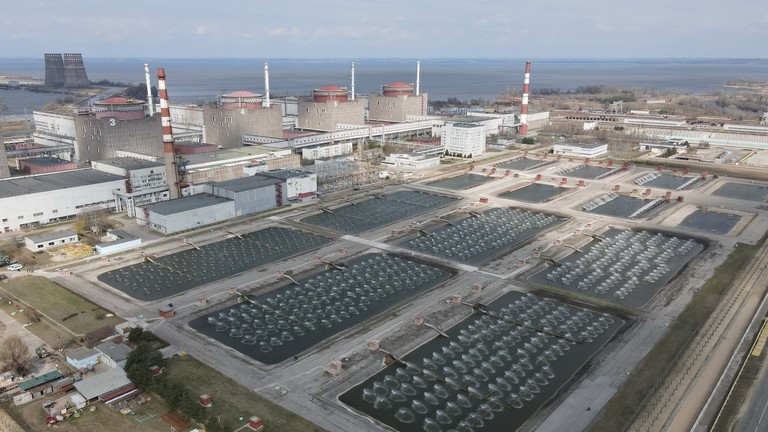
https://www.rt.com/russia/560576-zaporozhye-nuclear-plant-un/ 10 Aug 22, Moscow has accused Kiev of striking the Zaporozhye nuclear power plant, risking a repeat of the Chernobyl disaster
Russia has summoned an emergency session of the UN Security Council to discuss the situation at Ukraine’s Zaporozhye nuclear power plant, which has been the subject of regular shelling attacks. Moscow wants the chief of the UN nuclear watchdog, the International Atomic Energy Agency (IAEA), to brief the council on the situation.
The move, which was reported by Russian media on Tuesday, was confirmed by the deputy head of Russia’s mission to the UN, Dmitry Polyansky, who said the public needed to learn about “Ukrainian provocations.” The meeting is expected to take place on Thursday.
Russia has summoned an emergency session of the UN Security Council to discuss the situation at Ukraine’s Zaporozhye nuclear power plant, which has been the subject of regular shelling attacks. Moscow wants the chief of the UN nuclear watchdog, the International Atomic Energy Agency (IAEA), to brief the council on the situation.
The move, which was reported by Russian media on Tuesday, was confirmed by the deputy head of Russia’s mission to the UN, Dmitry Polyansky, who said the public needed to learn about “Ukrainian provocations.” The meeting is expected to take place on Thursday.
The IAEA has not had access to the site since before the Russian-Ukrainian conflict escalated in late February and relies on reports from Ukraine to assess the situation on the ground. The Zaporozhye plant is manned by Ukrainian nuclear workers despite being under Russian control.
On Saturday, Director General Rafael Mariano Grossi expressed the IAEA’s concern over the artillery strikes, stating that they underlined “the very real risk of a nuclear disaster that could threaten public health and the environment in Ukraine and beyond.”
“I condemn any violent acts carried out at or near the Zaporozhye nuclear power plant or against its staff,” he stressed.
Grossi is expected to lead an inspection of the facility for an independent assessment of the situation and verification that non-proliferation safeguards remain in place.
The Zaporozhye plant is the largest in Europe and stores tens of tons of enriched uranium and plutonium in its reactor cores and spent fuel storage, according to the IAEA. The watchdog chief earlier said he was alarmed that the security of the radioactive materials may be compromised amid Russian-Ukrainian hostilities.
Both Kiev and Moscow stated that they were eager for the proposed inspection to take place. However, it has yet to materialize due to security concerns. The Russian foreign ministry said on Tuesday that the delay played into Kiev’s hands by allowing it to continue its provocative attacks.
Moscow called on UN Secretary General Antonio Guterres to leverage his authority to speed up the IAEA visit. The UN Department of Safety and Security is acting irresponsibly by stalling the visit, foreign ministry spokesperson Maria Zakharova alleged in an interview on Wednesday.
Guterres last week said that “any attack to a nuclear plant is a suicidal thing.”
Russian diplomats and military officials stated that attacks on Zaporozhye power plant could result in a disaster worse than the Chernobyl reactor meltdown and steam explosion in 1986.
President Biden’s new weapons package for Ukraine is the largest one yet, Pentagon says

President Biden has sent $9.8 billion in security aid to Ukraine since entering office, https://www.foxnews.com/politics/president-bidens-new-weapons-package-ukraine-largest-yet-pentagon By Anders Hagstrom | Fox News 10 Aug 22
The Pentagon unveiled its latest $1 billion weapons package to support Ukraine against Russia’s invasion on Monday.
The Department of Defense says the massive delivery is the largest weapons package the U.S. has sent to Ukraine under President Joe Biden’s administration. The U.S. has sent a total of $9.8 billion in security assistance for Ukraine since Biden gained office, far eclipsing the $2 billion the U.S. sent between 2014 and 2021.
“To meet Ukraine’s evolving battlefield requirements, the United States will continue to work with its Allies and partners to provide Ukraine with key capabilities calibrated to make a difference,” the Pentagon wrote in a statement.
The United States, in decline but still able to kill us all
The march of folly in American strategic policy has enshrined the madness of control by a giant defence industry and defence budget now past $800 billion.

The fiercely presented wearisome trope of commitment to a Rules Based International Order is quite suddenly unmasked as an American Establishment desire to maintain a unipolar control of the world, with violence.
The fiercely presented wearisome trope of commitment to a Rules Based International Order is quite suddenly unmasked as an American Establishment desire to maintain a unipolar control of the world, with violence.
The global dominance of the United States, in so many fields, from space, to science, to entertainment, to sport, to novelty in the development of the English language, has been taken for granted, is part of our fabric of Australian existence.
Reinforced by the Covid Era of Isolation, Netflix, Facebook, and Computer Games and inability even to get to Bali or Thailand let alone China, we are now in a noisy metal barrel where even dissident voices seem projections from the dissident voices of the US, similarly muted and squeezed. At a time when the US and its roles in the world are suddenly dramatically changing.
The undoing of the United States, the collapse of the imperial centre, is happening with little awareness in Australia. Our generally oblivious mindframes affect the capacity of political leaders to reflect upon or point to core problems of our world. Richard Adams, the author of Watership Down, that great rabbit adventure full of meaning for human society, coined the rabbit language word ‘tharn’ for the mental state of rabbits caught in the headlights and stuck. We are a tharn nation, gabbling about entertainments and irritations, eyes glued to the seatback monitor, not wanting to know that the plane is crashing.
Heed these markers:
- The Americans were first to the moon, but NASA after the retirement of the space shuttle has depended on Russian rockets to get to their joint space station. The Russians are now planning to remove the propulsion units of the station which keep it from crashing, their property, for use on a bigger new venture. America is losing in space, though US private business has appallingly taken the lead in cluttering near space with junk.
- The fiercely presented wearisome trope of commitment to a Rules Based International Order is quite suddenly unmasked as an American Establishment desire to maintain a unipolar control of the world, with violence. This is being unmasked in much of the world if not NATO and AUKUS and the conservative acolytes in Japan and ROK. Ideological assertions of democracy versus autocracy, built by vilification and isolation of China and Russia, is rotting from the head as big democracies are in serious trouble.
- We are doing OK in Australia, our minds from age 12 filled with bubblegum flavoured vape and Tiktok, graduating to Facebook and the metaverse, and with a newer, kinder, kinda-tealish government we can all go to sleep, take off our masks and order American franchised fast food. Or real Aussie drinks. But while we have had a narrow focus on bad boys in the SAS we fail to review our complicity in the great crimes of the twenty first century, led by champions of democracy, smashing the lives of people in a number of countries far more violently than has the Ukraine war so far. Biden and his Secretary of State were advocates for invasions of Afghanistan and Iraq, so appallingly bringing down bad governments and making countries ungovernable. Creating Al Qaeda and ISIS in the process, directly through funding and arming extremists (in Afghanistan beginning before the Russians were invited into Afghanistan) and via embitterment of ordinary people. The world is destabilised, American control is widely undone.
- The march of folly in American strategic policy has enshrined the madness of control by a giant defence industry and defence budget now past $800 billion. Poverty of foreign policy has led to regimes of sanctions which have been substantially shaped by Richard Nephew whose book reveals that far from focusing on potentates and oligarchs, the targets of sanctions must be ordinary people and the purpose is to inflict pain and weaken resolve (his words). Consider sanctions related deaths in Iraq Venezuela Cuba, Afghanistan Pain but no loss of resolve, hatred not submission. The US official study of the effects of strategic bombing on Germany in World War II by J K Galbraith and others long ago suggested morale and resolve were increased by the bombing of cities and civilians. And yet we have the ongoing commitment to defend and achieve democracy by mass murder, with constant focus on disruption, regime change, and violence… not on peace.
- Jeffrey Sachs has recently returned to the themes of his 2013 book on the 50th anniversary of President John Kennedy’s Commencement Speech at American University in 1963. Speaking in the aftermath of the Cuban Missile Crisis, Kennedy spoke of peace not as an event or a state but a constant process of engagement. We now have no such thing, we are in an Age of Hostility, Meanness, Folly, and Decay.right wing is fervently in support. Stanley Kubrick made a movie about such madness, we are sleeping through it.
Australia recognises, as does the United States, that Taiwan is part of China. Though the media vague up the history, China kicked the Portuguese and Dutch out of Taiwan early in the 1600s, long before the greatest land grab in history, of Britain over the Australian continent, could even be imagined as the British didn’t know it was there then. The government in Taipei is the Government of the Republic of China. The large opposition party in the National Assembly is the Kuomintang, ruling party of the government of the Republic of China that lost the revolutionary war on the mainland in 1949 and retreated to Taiwan. The ROC held the China seat in the UN until 1971 with American backing. The majority of local governments in Taiwan are governed by the KMT because the party of the national government is on the nose both because of its independence-advocating foreign policy and corruption allegations. Pelosi’s visit risks great power war as not seen since 1945. The American right wing is fervently in support. Stanley Kubrick made a movie about such madness, we are sleeping through it.
The US economy is in serious trouble………………………………….
The US campaign for unipolar dominance has included partly fabricated propaganda against China and Russia. This no longer convinces or concerns a wide sweep of the world beyond NATO, the G7, the EU and AUKUS. Mix in enough lies and it all seems lies.
The summit meeting of BRICS in June seemed a more constructive meeting than the G7. The countries of Eurasia also have the Shanghai Cooperation Organisation SCO. The Iran,Russia, Turkey summit meeting in Tehran in July 2022 seems to have been more successful than President Biden’s visit to Saudi Arabia to meet also other Arab leaders, a visit described by the Wall Street Journal as worse than an embarrassment,…………………………..more https://johnmenadue.com/the-united-states-in-decline-but-still-able-to-kill-us-all/
Regional security threat haunts nuclear power debate in Australia
we cannot ignore when weighing up these arguments that recent events at Zaporizhzhia help bolster the case against nuclear power. We would not want any future nuclear facilities to become hostage to the vagaries of war.
https://www.theage.com.au/national/regional-security-threat-haunts-nuclear-power-debate-20220808-p5b82t.html Editorial, August 8, 2022, The alarm sounded by the head of the International Atomic Energy Agency (IAEA), Rafael Mariano Grossi, that fighting between Russian invaders and Ukrainian forces near the Zaporizhzhia nuclear power plant carried “the very real risk of a nuclear disaster” is one with relevance far beyond the war raging within Ukraine’s borders.
The conflict has already served as a grim warning for powers such as Germany and the United States of the costs of relying on fossil fuel-producing nations with despotic leaders for energy supply. But Russia’s seizures of Zaporizhzhia and the defunct power plant at Chernobyl in the early days of the war – though Chernobyl later returned to Ukrainian control – have highlighted that a decision to increase reliance on nuclear power would carry risks even beyond the familiar ones.
As Industry and Science Minister Ed Husic pointed out during Grossi’s recent visit to this country, Australia has an exemplary record on nuclear safety. But one of the most important reasons for this is that we have a ban on using nuclear fission for power generation and have committed not to develop a nuclear arsenal under the Non-Proliferation Treaty (NPT).
In recent times both these bans have returned to the spotlight, as the Coalition in opposition has raised the possibility of domestic nuclear power plants to address our energy needs. This followed the Morrison government’s signing of the AUKUS deal with London and Washington last year. The deal envisions Royal Australian Navy submarines being fuelled with weapons-grade uranium.
Peter Hartcher reported for The Agethat the first question US President Joe Biden raised when the AUKUS proposal was put to him was whether it breached non-proliferation commitments. The key to addressing this question has been paragraph 14 of the IAEA’s safeguards agreement with Australia, which creates a loophole allowing weapons-grade material to be used without the usual safeguards in “non-proscribed military activity”. Concerns were raised earlier this month, at the latest meeting to review the treaty, that regardless of Australia’s good intentions, this would set a precedent for further transfers of highly enriched nuclear material to other nations.
Grossi has pointed out that Iran, which first informed the IAEA of its interest in naval nuclear propulsion in 2018, cited the AUKUS deal to argue for its own plans at meetings in 2021.
Some argue that this is a form of proliferation, and even our allies and neighbours, from New Zealand to Indonesia, have expressed strong reservations about the AUKUS arrangement. Australia has said that the nuclear material in its submarines will be handled only by existing nuclear states. Nevertheless, the deal could lead to a perception that nuclear “haves” will simply ignore “have-nots”.
The case for nuclear power more broadly – replacing coal and gas with another non-renewable resource in uranium – faces its own hurdles, from the cost, to the emissions involved in mining and waste management to the question of where highly radioactive waste might be stored.
As The Age has pointed out, nuclear power generation globally is declining. One major reason is the expense. A recent CSIRO report underlines that renewables are far cheaper, even after transmission and storage are taken into account.
All sides of politics agree that Australia faces an increasingly complex and challenging security environment, from talk of Chinese bases in Cambodia and Solomon Islands to cyberattacks by rogue international actors targeting key infrastructure, while general-turned-Coalition senator Jim Molan has outlined an even more apocalyptic scenario, a “second Pearl Harbour” aimed at establishing Chinese supremacy in the western Pacific.
The Age has agreed in the past that Australia should be prepared to have another look at the arguments for nuclear power. That remains our position. But we cannot ignore when weighing up these arguments that recent events at Zaporizhzhia help bolster the case against it. We would not want any future nuclear facilities to become hostage to the vagaries of war.
U.S. says ready to quickly conclude Iran nuclear deal based on EU text
WASHINGTON, Aug 8 (Reuters) – The United States stands ready to “quickly conclude a deal” to revive the 2015 Iran nuclear agreement on the basis of proposals put forward by the European Union, a State Department spokesperson said on Monday.
The spokesperson, speaking on condition of anonymity, said Tehran has repeatedly said it is prepared for a return to mutual implementation of the agreement. ………. https://www.reuters.com/world/middle-east/us-says-ready-quickly-conclude-iran-nuclear-deal-based-eu-text-2022-08-08/
—
Russia and Ukraine accused each other of shelling Europe’s biggest nuclear power plant in the Zaporizhzhia region
Russia and Ukraine accused each other of shelling Europe’s biggest nuclear
power plant in the Zaporizhzhia region as the world on Saturday marked the
77th anniversary of the first atomic bomb attack in the Japanese city of
Hiroshima, with UN chief Antonio Guterres warning against nuclear arms
build-up amid fears of another such attack in the context of war in
Ukraine.
France24 6th Aug 2022
Russia the most popular national destination for refugees from Ukraine
UN: The Largest Number of Ukrainian Refugees Are Fleeing From “Russian Aggression” … to Russia!
The Stalker Zone 6 August (good tables and graphs)
Theses of Ukrainian propaganda about “Kremlin aggression” and the “genocide of the Ukrainian people” are in danger – the Office of the United Nations High Commissioner for Refugees (UNHCR) has reported fresh data about the movement of refugees from Ukraine across Europe. As of August 3 of this year, 6,303,226 refugees from Ukraine were registered in Europe, while from February 24 to August 03 there were 10,350,489 crossings of the Ukrainian border outbound and 4,272,233 crossings inbound.
The distribution by country of destination (top 5) as of August 3rd is as follows:
- Russian Federation – 1,968,127 crossings;
- Poland – 1,256,568;
- Germany – 915,000;
- Czech Republic – 400,559;
- Italy – 157,309.
Out of the 6.3 million Ukrainian refugees, about 2 million (every third!) chose the Russian direction. In addition, according to the UN, 105,000 citizens of the Donetsk and Lugansk People’s Republics were evacuated to Russia from February 18 to 23, which exceeds the number of refugees in 5 months, for example, to the UK (104,000 people).
Cross-border movement on the Polish-Ukrainian border is also of interest: from February 24 to August 03, there were 5,105,850 departures (with a peak of 140,843 on March 06 and a further sharp decline) and 3,083,783 entries. Since the end of March, the number of returnees (about 35,000) significantly exceeds the number leaving Ukraine via Poland (about 25,000 per day).
As of 03.08.2022, 1,256,568 Ukrainian refugees were registered in Poland, from which 1,138,647 (90%) were children under the age of 18 and women (data for voivodeships, gender and age are below on original ) https://www.stalkerzone.org/un-the-largest-number-of-ukrainian-refugees-are-fleeing-from-russian-aggression-to-russia/
Chinese expert from Peace Centre points out America’s hypocrisy, double standards, on Nuclear Non Proliferation

the US, which has the largest and most advanced nuclear arsenal, plans to spend over $1 trillion to maintain and modernize its nuclear triad. Furthermore, Washington withdrew from the Anti-Ballistic Missile and the Intermediate-Range Nuclear Forces treaties successively. President Joe Biden stepped back from a campaign promise that the sole purpose of nuclear weapons should be to deter nuclear attacks. All these moves may result in nuclear proliferation globally.
under AUKUS, the US and the UK are anticipated to assist Australia to have nuclear-powered submarines, which has severely violated the principles of the NPT.
Root of the grave, urgent nuclear proliferation situation lies in US.
https://www.globaltimes.cn/page/202208/1272415.shtml By Global Times, Aug 07, 2022With the 10th Review Conference of the Parties to the Treaty on the Non-Proliferation of Nuclear Weapons (NPT) being held at the United Nations headquarters in New York from August 1 to 26, the issue of nuclear non-proliferation has once again become the focus of global attention.
Washington today doesn’t let go of any occasion that can be exploited to smear and contain China. A US representative on Thursday at the NPT Review Conference baselessly criticized China for accelerating the expansion of its nuclear arsenal. And the US side also accused China of not engaging in talks on new arms control framework. China has lashed out at the rhetoric.
“By making such groundless accusations, Washington wants to deflect blame, distract attention and shun US’ due responsibility in securing global nuclear safety. Washington hopes this way can constrain the improvement of its main competitor’s nuclear capabilities,” Su Hao, founding director of the Center for Strategic and Peace Studies at the China Foreign Affairs University, told the Global Times.
China has always kept the quantity and size of its armed forces at the minimum level necessary for maintaining national security. China’s nuclear strategy focuses on self-defense, and aims to ensure the strategic security of the country by deterring the potential threat or use of nuclear weapons by others against China. And China has never taken part and will never take part in any nuclear arms race. Washington’s rhetoric is totally irrational.
In fact, the country that has blatantly violated the nuclear non-proliferation agreement is the US. Chinese Ambassador for Disarmament Affairs Li Song on Friday blasted the US for its negative moves on disarmament. He told a committee meeting of 10th NPT Review Conference that Driven by the Cold War mentality, the US has been obsessed with major-power strategic competition and has sought absolute strategic advantage, strengthened military alliances, stirred up bloc confrontation on the eastern and western sides of the Eurasia continent, and pressed ahead with the forward deployment of nuclear missiles and other strategic forces.
The landscape on international security is deteriorating and the risk of nuclear proliferation is growing. The responsibility lies with the US.
The US-led NATO’s continuous eastern expansion triggered the military clash between Russia and Ukraine, with no sign of easing up to now. In the Asia-Pacific region, Washington has provoked China’s national security in a high-profile manner for several times, in an attempt to contain China. US House Speaker Nancy Pelosi’s visit to the island of Taiwan is the latest example, which has ramped up the cross-Straits tensions.
Meanwhile, the US, which has the largest and most advanced nuclear arsenal, plans to spend over $1 trillion to maintain and modernize its nuclear triad. Furthermore, Washington withdrew from the Anti-Ballistic Missile and the Intermediate-Range Nuclear Forces treaties successively. President Joe Biden stepped back from a campaign promise that the sole purpose of nuclear weapons should be to deter nuclear attacks. All these moves may result in nuclear proliferation globally.
According to Song Zhongping, a Chinese mainland military expert and TV commentator, the US has always adopted double standards on nuclear non-proliferation. As one of the first countries to call for a nuclear non-proliferation treaty, the US is constantly setting rules on the nuclear non-proliferation to deter other countries, especially its rivals, from developing nuclear capabilities. But ironically, the US itself does not abide by these treaties and rules at all. For example, under AUKUS, the US and the UK are anticipated to assist Australia to have nuclear-powered submarines, which has severely violated the principles of the NPT. The US should not always give the green light to itself and the red light to others on this issue, as such a practice will lead to nuclear proliferation and arms race.
The biggest crisis confronted by the nuclear non-proliferation mechanism is that because of US’ double standards, distrust among countries has been rising. As a result, an increasing number of countries do not believe in the restraint mechanism brought by the NPT. It can be concluded that the root of the grave and urgent nuclear proliferation situation lies in the US.
The US-led global governance mechanism is disabled in nuclear non-proliferation. “This is because this mechanism is a unilateral, selfish, narrow-minded, bloc-political governance, to serve the US in maintaining its global hegemony. Such a global governance system will only lead the international community more tense and turbulent,” noted Su.
“The nuclear non-proliferation advocated by the US is entirely out of its geopolitical consideration. Washington’s hegemonic mindset increases the difficulty of achieving true nuclear non-proliferation. The US must take the lead in implementing the NPT; otherwise, nuclear non-proliferation cannot become a reality,” said Song.
China has always advocated building a community with a shared future for mankind. Only if the international community, including the US, can consider the nuclear non-proliferation from this perspective will such a crucial international problem be addressed.
USA hostility to China on yet another front
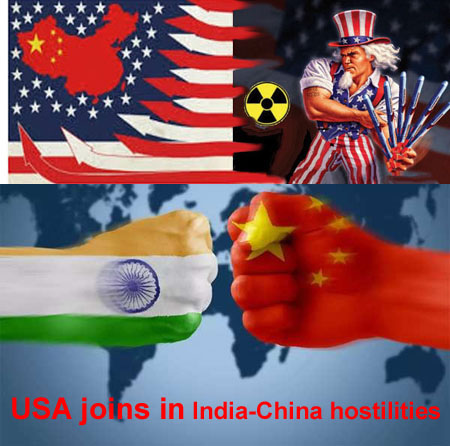
US to take part in military exercise near India’s disputed border with China
By Vedika Sud, Barbara Starr, Sahar Akbarzai and Kathleen Magramo, CNN
Updated 12:29 AM EDT, Sat August 06, 2022
(CNN)The United States is to take part in a joint military exercise with India less than 100 kilometers (62 miles) from the South Asian country’s disputed border with China.
The military drills will be held in mid-October at an altitude of 10,000 feet in Auli in the Indian state of Uttarakhand and will focus on high-altitude warfare training, according to a senior Indian Army officer with knowledge of the matter.
Auli is about 95 kilometers from the Line of Actual Control (LAC), an inhospitable piece of land where the disputed border between India and China is roughly demarcated.
The drills will take place as part of the 18th edition of an annual joint exercise known as “Yudh Abhyas” — or “War Practice”.
Relations between India and China have been strained since a bloody clash between their soldiers in the Himalayas in June 2020 left at least 20 Indian troops and four Chinese soldiers dead…………………….
Asked about the joint exercises, a US Department of Defense spokesperson told CNN that the partnership with India was “one of the most important elements of our shared vision for a free and open Indo-Pacific region.”…………..
Any military provocations between Indian and China could have grave consequences. Both have nuclear weapons……………. more https://amp.cnn.com/cnn/2022/08/06/india/india-us-military-exercise-line-of-actual-control-china-intl-hnk
Nuclear weapons will not bring peace or security, only dangers

We can honour the victims of Hiroshima and Nagasaki by supporting the prohibition treaty, says RAE STREET https://morningstaronline.co.uk/article/f/nuclear-weapons-will-not-bring-peace-or1 6 Aug, 22,
THIS is the month when we commemorate the fearful nuclear bombings of the people of Hiroshima and Nagasaki.
Alas, the myth is still put out that the bombs were dropped to end the second world war. That is not true.
By the time the bomb was ready for use, Japan was ready to surrender. As General Dwight D Eisenhower said, Japan was at that very moment seeking some way to surrender with minimum loss of face, and “it wasn’t necessary to hit them with that awful thing.”
Thus, the bomb on Hiroshima was dropped on August 6 before it was publicly stated that the Japanese had surrendered.
The Soviet Union entered the war in Asia on August 9. Later the same day, the US dropped a second bomb on Nagasaki.
We now know the horrors that nuclear bombs inflict. We have heard from the Hibaksha, the survivors. Now instead of heeding the survivors of those bombs, the Hibaksha, that nuclear weapons should be ended, governments across the world have developed more destructive nuclear bombs.
Britain, part of the US Trident submarine system, carries warheads on multiple missiles, with 15 times the power of the bomb used on Hiroshima.
Proponents of nuclear weapons, including the Nato military alliance, claim that they keep the peace and repeatedly talk of nuclear deterrents.
But the US has the largest nuclear arsenal in the world, and it did not stop the attack on the Twin Towers; nor did Trident stop terrorist attacks in Britain.
What is never mentioned is the death and destruction which has been brought about with the development of nuclear weapons, mainly on indigenous peoples.
This starts with the beginning of the cycle with uranium mining where native people in the US, in Canada, in Australia and the Congo, among others, have been forced into mining.
They and their families have suffered serious illness and even death. Above-ground testing has also brought suffering to native peoples.
After the French testing in the Pacific, mothers gave birth to “jellyfish” babies which died within a few hours. In the US above-ground testing meant that many of the “downwinders,” including the Western Shoshone, became seriously ill.
Although above-ground tests have now ended following the Comprehensive Test Ban Treaty, uranium mining has not ceased.
It continues except for Greenland where the Inuit, now in government, have banned uranium mining.
In 2022, with the war in Ukraine, we are now in more danger than ever before of a further use of nuclear weapons. If ever one of these highly destructive current bombs were exploded either by intent or accident, it would be a worldwide catastrophe.
There would be fires and radioactive fallout and fatal illnesses from acute radiation sickness, cancer and genetic damage which can be passed on to offspring.
At the same time, nuclear fireballs would send up enormous quantities of dust high into the atmosphere, blotting out the sun which would lead to nuclear winter.
And the contaminated ground would be unsuitable for food production leading to food shortages. In effect, if people had not died any other way, they would die of hunger.
Yet our current government not only supports the replacement of Trident but in the Integrated Defence Review increased the cap on Britain’s stockpile for 2025 from 180 to 260.
They even changed the scenario for nuclear use to “emerging technologies that could have a comparable impact,” possibly cyber-attacks but maybe some conventional weapons?
Starmer, once more making himself into a Tory by default, said via his shadow defence minister that Trident was “non-negotiable.”
Even the cost should have made him hesitate on this. It is estimated that the cost in public money — our money — will be £205 billion (and rising) to replace Trident.
And that when working people are struggling and across the world people starve; where we also urgently need funding for the transition from fossil fuels.
Nato too still holds a policy of first use of nuclear weapons and through the US, which has always dominated Nato policy, keeps “nuclear sharing,” weapons on the territory of five states: Belgium, Germany, Italy, the Netherlands and Turkey.
Without any public debate, we now know that nuclear bombs and nuclear capable aircraft are to be brought back to Lakenheath in Suffolk.
But the majority world wants nuclear disarmament. In January 2021, the UN-negotiated Treaty on the Prohibition of Nuclear Weapons came into force which now has 138 signatories — but not the Nato nuclear-armed states which were prevented by Nato.
Sixty-six states have now ratified the treaty. Our government and the Labour Party should be supporting the treaty because nuclear weapons will not bring peace or security, only dangers.
That way we would honour the memory of the victims of Hiroshima and Nagasaki. Our politicians should be looking at how to develop “common security,” putting funding and resources into dialogue and negotiation and respecting the security of everyone.
Needles of Hope in the Ukraine War Haystack — Russian & Eurasian Politics

There recently have emerged small trends that demonstrate, first, that the hot heads are not completely in charge in the East or even in the West, and second, that there may be hope that both sides in the catastrophic Russo-Ukrainian war over NATO expansion can be ended some day in the not too distant future.…
Needles of Hope in the Ukraine War Haystack — Russian & Eurasian Politics
https://gordonhahn.com/2022/08/05/needles-of-hope-in-the-ukraine-war-haystack/ GORDON M. HAHN August 5, 2022,
There recently have emerged small trends that demonstrate, first, that the hot heads are not completely in charge in the East or even in the West, and second, that there may be hope that both sides in the catastrophic Russo-Ukrainian war over NATO expansion can be ended some day in the not too distant future.
First, Lithuania’s extremist attempt to draw a Russian overreaction and bring NATO into the war by setting up a blockade against Russian transport between the Russian ‘mainland’ and its exclave of Kaliningrad was avoided. Reasonable minds in the European Union cajoled Vilnius into abandoning the ban on rail transport, which far exceeds road transport, which remains closed.
Second, by way of Turkey’s mediation, Russia and Ukraine agreed to cooperate in getting Ukrainian grain out to the rest of the world through the Black Sea Fleet, which had been heavily mined by Kiev and largely sealed by the Russian navy. Ukraine will remove its mines, Russia will allow ships through, and ships arriving and returning to Ukraine’s port of Odessa will be searched for weapons.
Third, August 29th saw the renewal of official Russia-US contact in the form of a phone call between Russian Foreign Minister Sergei Lavrov and US Secretary of State Anthony Blinken in which a return to “quiet diplomacy” a discussion regarding the need for talks on prisoner exchanges between Washington, Moscow and presumably Kiev and its Donbass foes. This and any successful overall ceasefire talks in future will require American participation.
Fourth, Ukrainian President Volodomyr Zelenskiy and even more so his team, are looking increasingly desperate, and Russian Telegram channels have seen reports of chatter/rumors of Ukrainian military claims that Kiev will seek an end to the war in late August, because it lacks the fuel and food to get the army and population through the winter. Combine this with Russia’s grinding but successful war of attrition in the east and the likely failure of any Ukrainian offensive towards Kherson or a successful Russian offensive in south towards Mikolaiv and Odessa, and the stage could be set for the renewal of direct ceasefire and peace talks.
Finally, it is possible that the practice and psychological breakthrough of agreements on Kaliningrad, grain exports, and prisoner exchanges will facilitate the renewal of such talks as well as offer lessons on how best to conduct such talks so as to make agreement more possible.
On the other hand, the overall situation remains catastrophic, and it is August. We shall see.
Why Is There More Media Talk About Using Nuclear Weapons Than About Banning Them?
https://fair.org/uncategorized/why-is-there-more-media-talk-about-using-nuclear-weapons-than-about-banning-them/ KARL GROSSMAN, 5 Aug 22,
It’s of critical importance—indeed, existential importance—to the world: the Treaty on the Prohibition of Nuclear Weapons. And a coalition of peace organizations in the United States is charging that media are acting like the treaty “does not exist.”
The Nuclear Ban Treaty Collaborative is waging a campaign to encourage press coverage of the treaty, which, it argues, “provides the only pathway to a safe, secure future free of the nuclear threat” (Oak Ridge Environmental Peace Alliance Newsletter, 6/22).
In the words of the UN, the treaty is “a legally binding instrument to prohibit nuclear weapons, leading towards their total elimination.” It was adopted by the UN General Assembly—with 122 nations in favor—and opened for signature in 2017. It was entered into force in January 2021.
But its provisions only apply to nations which are party to it. Countries with nuclear weapons—including the United States, Russia and China—have not. Instead, “so far, they have refused, boycotted meetings, and even pressured countries not to sign on,” the Federation of American Scientists has noted (FAS, 1/22/09).
Media attention vital
Media attention is vital if the TPNW is to become a reality. But as the Oak Ridge Environmental Peace Alliance (OREPA), a member of the Collaborative, explained in its June newsletter:
The last time the New York Times mentioned the TPNW was October of 2020, when Honduras became the 50th nation to ratify the Treaty, triggering its Entry in Force. In all the coverage of nuclear weapons since then, including a surge since Vladimir Putin invaded Ukraine, the TPNW has not been mentioned once.
National Public Radio has had four significant reports about nuclear weapons in the last three months, including a seven minute report on Sunday, March 27. None of the reports mentioned the TPNW—the last time NPR mentioned it was in January 2021 when it reported on the Treaty’s entry into force, noting it was a significant treaty becoming international law. Since then, crickets.
CNN is marginally better. A search of the website for “nuclear weapons” turns up almost daily reports; but the Treaty on the Prohibition on Nuclear Weapons gets only one mention—an op-ed on May 3 from Ira Helfand, co-president of International Physicians for the Prevention of Nuclear War.
The Collaborative is calling for media to cover the treaty whenever reporting on the threat of nuclear weapons.
Plenty of nuclear talk
Ralph Hutchison, coordinator of OREPA, said in an interview:
What became alarming was that there was a revival of coverage of nuclear weapons after Vladimir Putin made his threat. In all those articles we seemed to be locked into Cold War thinking which ignores the reality that an alternative to “mutually assured destruction” exists: the Treaty for the Prohibition of Nuclear Weapons. And yet there was nothing.
Indeed, according to a search of the Nexis news database, US newspapers have mentioned “nuclear weapons” 5,243 times between February 24, when Putin began talking about their potential use in Russia’s invasion of Ukraine, and August 4. Only 43 of those times included a mention of the treaty; the great majority of these were letters to the editor or opinion columns.
This comes against the backdrop of the Bulletin of Atomic Scientists in 2020 moving its “Doomsday Clock” forward to 100 seconds to midnight, where it has remained through today. It defines midnight as “nuclear annihilation.” This was the closest to midnight the clock has been set at since it was created in 1947 (1/20/22).

“Let’s eliminate these weapons before they eliminate us,” said UN Secretary-General Antonio Guterres at the conclusion in June of a “Political Declaration and Action Plan” for implementation of the TPNW—“important steps,” he said, “toward our shared goal of a world free of nuclear weapons” (UN Press, 6/21/22).
Guterres went on:
Today, the terrifying lessons of Hiroshima and Nagasaki are fading from memory. The once‑unthinkable prospect of nuclear conflict is now back within the realm of possibility…. In a world rife with geopolitical tensions and mistrust, this is a recipe for annihilation.
We cannot allow the nuclear weapons wielded by a handful of states to jeopardize all life on our planet. We must stop knocking at doomsday’s door. The Treaty on the Prohibition of Nuclear Weapons is an important step towards the common aspiration of a world without nuclear weapons.
Can the atomic genie be put back in the bottle? Anything people have done, other people can undo. And the prospect of massive loss of life from nuclear destruction is the best of reasons.
There’s a precedent: the outlawing of chemical warfare after World War I, when its terrible impacts were horrifically demonstrated, killing 90,000. The Geneva Protocol of 1925 and the Chemicals Weapons Convention of 1933 outlawed chemical warfare, and to a large degree the prohibition has held.
As Pope Francis said on a visit to Nagasaki in 2019, in which he condemned the “unspeakable horror” of nuclear weapons: “A world without nuclear weapons is possible and necessary.”
To learn more about or join the Collaborative’s ongoing media activism campaign, please visit https://www.nuclearbantreaty.org/
Does Australia actually need nuclear submarines?

“It’s obvious the real policy is to subsidise the US Navy’s submarine budget. Some will be located in Australia, with Australian flags and personnel, but they’re essentially US boats operated in the US’s great power interests. We’re paying for them to set up part of their current and future fleet in Australia.”
fewer than two of Australia’s eight nuclear submarines would be operationally available, on average, each year. And the cost of the purchases is likely to be stunning, possibly as high as $171 billion……………….. No other country has bought this type.
“Australia could buy 20 high-quality, off-the-shelf, modern submarines for $30 billion.”
influential Australian intelligence and defence officials are ignoring the point that there is no need for Australian submarines to spend much time in China’s waters
Gilligan also warns that the shallow and warm waters around Australia’s north are unsuited to large nuclear submarines.
As experts question the diplomatic, strategic and economic rationale behind Australia’s purchase of nuclear-powered submarines, the gaps in the country’s defensive fleet could be filled by conventional subs. https://www.thesaturdaypaper.com.au/news/politics/2022/08/06/does-australia-actually-need-nuclear-submarines#mtr By Brian Toohey. 6 Aug 22,
In 1992, an Australian Oberon-class submarine entered the crowded waters of Shanghai’s port and became entangled in fishing nets. It had to surface for crew members to cut it free with axes. Chinese Navy sailors witnessed this, but nevertheless the submarine escaped. Had it not, the crew would’ve been imprisoned and Australia widely condemned and potentially convicted for an outrageous breach of international law.
Almost a decade earlier, the Australian Navy had seriously considered scrapping submarines, according to former senior Australian Defence official Mike Gilligan. A study in 1985 had concluded they offered “little marginal benefit to Australia’s defences yet inflict a large marginal cost”. The cost could’ve been much higher given the tremendous risks the government allowed the navy to take, snooping in Chinese and Russian waters on behalf of the Americans, who wouldn’t put their nuclear submarines in danger.
Australia now faces some tough and highly consequential decisions with respect to its fleet. Some experts in the defence field question not only the utility of nuclear-powered vessels but the diplomatic, strategic and economic commitment they entail.
In Washington last month, Defence Minister Richard Marles said Australia, the United States and Britain were moving from “interoperability to interchangeability in defence hardware”. This would effectively mean Australia could not buy high-quality defence equipment from other countries if there was a higher-cost American or British version available. Professor Clinton Fernandes at the UNSW Canberra campus says, “It’s obvious the real policy is to subsidise the US Navy’s submarine budget. Some will be located in Australia, with Australian flags and personnel, but they’re essentially US boats operated in the US’s great power interests. We’re paying for them to set up part of their current and future fleet in Australia.”
Australia has a short and patchy record on submarine purchases. The government acquired many major weapons during World War II. None were submarines. That capability had to wait until the first of a total of six Oberon-class submarines was commissioned in 1967 from a Scottish shipyard. They operated satisfactorily but weren’t considered the nation’s most important military assets.
After Kim Beazley became Defence minister in the Hawke government, he gambled on the value of submarines by ordering six large, battery-powered versions to be built in Adelaide. No other country has bought this type.
The first was commissioned in 1966 and the last in 2003. Called the Collins class, it was based on a good Swedish design. But Beazley greatly increased its size and complexity, partly by adding American equipment that proved completely useless. Maintenance problems drove annual sustainment costs to $670 million. Often only two or three were available at a time, although availability later improved. And none attended the 2010 Rim of the Pacific event – known as Rimpac, the world’s largest international maritime warfare exercise, held biennially near Hawaii.
Former prime minister Scott Morrison and his successor, Anthony Albanese, have taken a much bigger gamble than Beazley did, with their commitment to buy at least eight nuclear attack submarines – almost certainly the American Virginia class. One of the US’s most highly regarded defence analysts, Winslow Wheeler, recently pointed out the Virginia-class subs have been available only 15 times in 33 years for their six-monthly deployments. This suggests fewer than two of Australia’s eight nuclear submarines would be operationally available, on average, each year. And the cost of the purchases is likely to be stunning, possibly as high as $171 billion when accounting for inflation, according to the Australian Strategic Policy Institute, and more recent estimates are above $200 billion. The costliest previous military acquisition, for the Australian Air Force, is the inflation-adjusted $16.6 billion program cost for 72 F-35 fighter jets.
Former submariner, naval consultant and South Australian senator Rex Patrick says, “Australia could buy 20 high-quality, off-the-shelf, modern submarines for $30 billion.”
Patrick also makes the point that nuclear submarines are often “defeated” in exercises by ultra-quiet conventional submarines.
Major new developments are making conventional submarines even more formidable than the nuclear versions. More powerful sensors mean submarines can be detected by the noise they make and by their passage through the Earth’s magnetic field. In addition, nuclear submarines can be detected by the wake they leave at high speeds, as well as the hot water they release from cooling their nuclear reactors, operating loud steam engines and other equipment. In future, submarines may also be detected by blue-green lasers that make the ocean more transparent.
A prize-winning essay published in the US Naval Institute’s magazine Proceedings in June 2018 said the US Navy would do well to consider acquiring “some quiet, inexpensive and highly capable diesel-electric submarines”. Until recently, conventionally powered submarines frequently had to rise close the surface to expose a mast and snorkel to obtain fresh air for their diesel engines to recharge the batteries. This process can be detected by radar.
Most conventionally powered submarines – except Australia’s – use what is called air independent propulsion (AIP), which allows them to remain silent for four to six weeks before snorkelling. That often entails using a hydrogen fuel cell to propel the submarine, but it takes up significant space on the vessel.
In a major change, Japan’s new Taigei-class submarines don’t need AIP because they’re equipped with particularly efficient lithium-nickel-cobalt-aluminium oxide batteries, rather than the lead-acid batteries that the Australian Navy prefers, due in part to the risks of lithium-ion batteries catching fire. Other navies are increasingly confident the new types of battery will prove safe. Hans Ohff, a submarine specialist and visiting fellow at Adelaide University, told The Saturday Paper, “Generally speaking, lithium-ion batteries have a 1.5-times range advantage over lead-acid at lower speeds and an incredible four-times range advantage at high speeds.”
Since the Collins class is due to start retiring in 2026, a replacement is urgently required to help fill the gap until the first nuclear submarine might arrive, near 2045, and the last in 2065. Senator Patrick says the time it takes to do this can be reduced by choosing one of the three available “off-the-shelf” submarines: Japan’s Taigei, which has passed numerous tests demonstrating the safety of its new batteries; Singapore’s Type 218SG, made by Germany’s thyssenkrupp Marine Systems; and the Spanish S-81. The latter two still use conventional lead-acid batteries, but Ohff says a French and German joint venture is under way to develop their own lithium-ion batteries.
These options have advantages and drawbacks. The new Taigei class – of which Japan is acquiring 22 – requires a costly crew of 70 per vessel. The Type 218SG’s German manufacturer is the biggest submarine exporter in the world, with an enviable reputation for low maintenance costs across its range. Extensive automation means it needs only 28 crew members, and the vessel has a longer range than the Taigei’s 12,500 kilometres. Spain’s S-81 has a crew of 32 but a less experienced manufacturer.
With China being the principal concern of Australian diplomatic and defence policymakers, Ohff says the navy will never accept off-the-shelf submarines unless it can “Australianise” them – meaning they must have the range to operate for long periods, many thousands of kilometres away, probably in Chinese waters or nearby. Ohff says the navy’s preferences would take a minimum of 10 years to deliver the first boat and additional two-year intervals for the following boats. He says delivery of a Swedish “Son of Collins” could take nine years.
Patrick says influential Australian intelligence and defence officials are ignoring the point that there is no need for Australian submarines to spend much time in China’s waters: Japan, South Korea, Singapore and Vietnam have high-quality submarines closer to China. The main attraction of nuclear submarines for these officials is they could fire subsonic cruise missiles at land targets in China from more than 1000 kilometres off its coast. However, cruise missiles can be shot down by fighter planes overhead. Once a nuclear submarine fired its missiles, it would be detected and swiftly targeted. Even if it survived, reloading would require the help of a tender – a large depot ship that supplies and supports submarines – probably from the distant base at Fremantle, which recently hosted a reloading for a US nuclear submarine. In any event, an attack on Chinese territory could provoke a heavy counterattack on Australia’s forces or its mainland.
Gilligan says most of the capability offered by submarines is better provided by Australia’s maritime and land-based aircraft. He says submarines, including nuclear ones, are slow compared to aircraft. Technically, a plane could sink a ship off Australia’s west coast in the morning, refuel, then sink another off the east coast in the afternoon. Gilligan also warns that the shallow and warm waters around Australia’s north are unsuited to large nuclear submarines.
Deploying nuclear submarines far from Australia marks a return to the previously discredited doctrine of “forward defence” in South-East Asia that concentrated on a big British naval base in Singapore, which was swiftly overrun by the Japanese in 1942. When this doctrine failed during the Vietnam War, the Coalition government in the late 1960s adopted a “defence of Australia” doctrine, which survived until its recent abandonment. Patrick and other proponents of this latter doctrine expect a revised doctrine would put more emphasis on having medium-sized conventional submarines to help deny hostile forces access to the approaches to Australia, unless they could detect and destroy all the submarines, drones, planes and land-based missiles blocking their way.
Finally, from a defence perspective, much of the planning around nuclear submarines assumes – implausibly – that Chinese and US policies will proceed in a predictable way until past 2060. A purely geopolitical analysis, however, could easily underplay the disruptive role of climate change.
In purely geopolitical terms, the region may become more peaceful or more dangerous. The only urgency for Australia is to forget about nuclear submarines and get some conventionally powered submarines to enhance deterrence.
1 This Month



26 September – International Day for the Total Elimination of Nuclear Weapons


PLEASE OPPOSE HR 8255 AND S.3639 – bills would accelerate satellite deployment, with no environmental review or safeguards – https://ncstd5li.quorum.us/campaign/169331/
To see nuclear-related stories in greater depth and intensity – go to https://nuclearinformation.wordpress.com
-
Archives
- September 2026 (257)
- August 2026 (330)
- July 2026 (355)
- June 2026 (287)
- May 2026 (306)
- April 2026 (356)
- March 2026 (251)
- February 2026 (267)
- January 2026 (308)
- December 2025 (358)
- November 2025 (359)
- October 2025 (375)
-
Categories
- 1
- 1 NUCLEAR ISSUES
- business and costs
- climate change
- culture and arts
- ENERGY
- environment
- health
- history
- indigenous issues
- Legal
- marketing of nuclear
- media
- opposition to nuclear
- PERSONAL STORIES
- politics
- politics international
- Religion and ethics
- safety
- secrets,lies and civil liberties
- spinbuster
- technology
- Uranium
- wastes
- weapons and war
- Women
- 2 WORLD
- ACTION
- AFRICA
- Atrocities
- AUSTRALIA
- Christina's notes
- Christina's themes
- culture and arts
- Events
- Fuk 2022
- Fuk 2023
- Fukushima 2017
- Fukushima 2018
- fukushima 2019
- Fukushima 2020
- Fukushima 2021
- general
- global warming
- Humour (God we need it)
- Nuclear
- RARE EARTHS
- Reference
- resources – print
- Resources -audiovicual
- Weekly Newsletter
- World
- World Nuclear
- YouTube
-
RSS
Entries RSS
Comments RSS
 nuclear-news