Washington split over Ukraine’s NATO bid – Politico
https://www.rt.com/news/563851-washington-split-ukraine-nato/ 2 Oct 22,
Zelensky’s unexpected demand to fast-track membership talks has reportedly been met with a mixed reaction
Ukraine’s bid for accelerated accession to NATO caught Washington off-guard, driving a wedge between a number of US lawmakers, Politico reported on Friday.
When the outlet asked US House Speaker Nancy Pelosi if she supports Kiev’s demand to join NATO, she stopped short of unequivocally endorsing the move, saying the US is “very committed to democracy in Ukraine.”
“Let’s win this war. But I would be for them having a security guarantee,” she told Politico.
Democratic Party colleague Representative Mike Quigley (D- Illinois) said that Washington should support Ukraine’s NATO bid. “Ukraine’s fight is the reason we formed NATO in the first place,” he told Politico, adding that since WWII, the US has recognized “that an authoritarian regime cannot be allowed to wipe out a democratic country.”
On Friday, following the start of the formal accession of four former Ukrainian regions to Russia, Ukrainian President Vladimir Zelensky demanded that the procedure for joining NATO be fast-tracked. This apparently came as a surprise to the Biden administration, according to two US officials cited by the outlet.
Many Western officials fear that if Kiev becomes a full-fledged member of the bloc, it would not only provoke Russia, but would also draw Washington and Moscow into a direct war, as NATO’s charter stipulates that an attack on one member is considered an attack against the entire alliance. The only instance in which this principle has been applied came after the 9/11 terrorist attacks against the US.
On Friday, President Vladimir Putin signed treaties on the inclusion of the two Donbass republics, as well as the two southern Ukrainian regions which had declared independence, into the Russian Federation. All four territories held referendums from September 23 to 27, in which the people voted overwhelmingly in favor of joining Russia.
Western leaders have condemned Moscow’s latest moves. US President Joe Biden has vowed to impose further sanctions on Russia and continue to supply Kiev with military aid.
NATO in the horns of a dilemma after former Ukrainian regions vote to join Russia
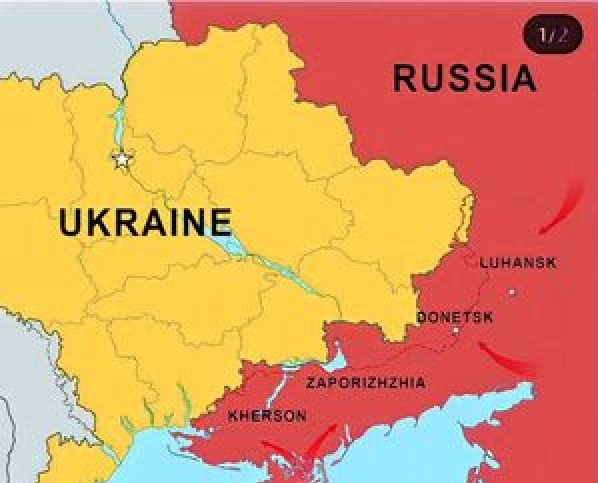
NATO, having overcommitted to Ukraine, now finds itself “on the horns of a dilemma” – if it continues to provide massive material and financial support to Ukraine, it will, in effect, become a direct party to the conflict, something no one in the bloc wants. However, if it backs away from supporting Ukraine, the various Western political leaders and institutions which have made support for Kiev a sacred obligation will be seen as going back on their word.
How NATO opts to proceed has yet to be manifest, but indications are that it will not be in a manner which continues to double down on supporting Ukraine no matter what
https://www.rt.com/russia/563788-referendums-ukraine-nato-dilemma/–-1 Oct 22,
Moscow is flipping the bloc’s script by moving to absorb Kiev’s lost lands, thus switching the fight to its own turf.
By infusing tens of billions of dollars’ worth of military aid into Ukraine, NATO produced a “game-changing” dynamic designed to throw Russia off balance. By undertaking the referendums in Kherson, Zaporozhye, Donetsk, and Lugansk, Russia changed the game altogether.
The ancient Greeks spoke of lemma as representing a logical premise, a matter taken for granted. This contrasted with a dilemma, or “dual premise”, where one would be presented with an either/or proposition. The Romans furthered this notion, referring to a “double premise” as argumentum cornutum, of the “horned argument,” because by answering one argument, an individual would be impaled by the logic of the second. Thus are the ancient roots of the modern idiom, “on the horns of a dilemma.”
This is the ultimate objective of maneuver warfare, for example: to position your forces in such a manner as to present the enemy with no good option – should they react to one pressing threat, they would find themselves overwhelmed by the other.
The Russian military operation that has been underway in Ukraine for more than seven months now has provided ample examples of the military forces of both sides being confronted with a situation that compelled them to alter their preferred course of action; the Russian “diversion” against Kiev early on in the SMO prevented the Ukrainians from reinforcing their forces in eastern Ukraine, and the recently concluded Ukrainian counteroffensive in Kharkov compelled a hasty Russian withdrawal from a significant swath of previously occupied Ukrainian territory.
Both examples cited presented one side with a lemma, or a single problem, which needed to be addressed. But neither was able to put its opponent “on the horns of a dilemma,” forcing a response which would result in impalement regardless of the option chosen. The reason for this is simple – very rarely will competent military commanders allow themselves to be presented with a military problem for which there is no viable response. War, it seems, is hard work, and dilemmas don’t fall from trees.
Or do they? Ever since Boris Johnston flew to Kiev in April to convince Ukrainian President Vladimir Zelensky to pull out of peace talks then ongoing with Russia in the Turkish city of Istanbul, NATO has embarked on a program designed to provide Ukraine with tens of billions of dollars in military and financial assistance, including the transfer of modern heavy weapons and the use of facilities on Western soil where tens of thousands of Ukrainian troops could be trained and organized without fear of Russian intervention.
The purpose behind the NATO infusion of weaponry into Ukraine was straightforward – to empower Ukraine to not only lengthen the conflict, but also to undertake offensive military operations designed to evict Russia from what Kiev and its backers consider occupied Ukrainian territory, including the Donbass and Crimea. The counteroffensive in Kharkov in early September underscored the serious consequences of NATO’s actions – even though, given the massive loss of life and material suffered by the attacking Ukrainian forces, made the Kharkov victory Pyrrhic in nature, it was a Ukrainian victory, and one which compelled a Russian retreat.
By transforming the Ukrainian army into a NATO army which was manned by Ukrainians, the US-led bloc had, in fact, changed the nature of the game from a straightforward Russia-versus-Ukraine “special military operation” into a “Russia-versus-the collective West” struggle where the military resources originally allocated by Moscow to the fight were now insufficient to the task.
Russia, however, was not taking the game-changing actions of NATO standing still. Responding to the new reality on the ground in Ukraine, Russian President Vladimir Putin opted not to simply up the ante in this new NATO-driven game of increasing military power but change the game altogether. Not only did he order the partial mobilization of some 300,000 Russian reservists to reinforce the troops currently committed to the SMO, Putin also approved referendums in the four territories where Russian forces are presently fighting – Kherson and Zaporozhye (formerly occupied Ukrainian regions), and Donetsk and Lugansk (former regions of Ukraine, de-facto independent since 2014). These referendums asked the citizens of these four territories one simple question: do you wish to become part of Russia?
After five days of voting, the results from all four territories were clear – by an overwhelming majority, the participants in the referendums approved the proposition. Shortly thereafter, they were incorporated into the Russian Federation. What was once Ukraine has now become Mother Russia
Russia didn’t just change the rules of the game – it changed the game itself. Instead of Ukrainian forces fighting Russian forces on the territory of Ukraine, any future combat carried out by Ukraine against Russian forces would represent an attack on the Russian homeland itself.
Where does this leave NATO? The bloc’s leadership has made it clear from day one that it is not seeking direct confrontation with Russia. While its members have poured in tens of billions of dollars of material into Ukraine to help reconstitute its military, and provided critical logistics, intelligence, and communications support to Ukraine, it has repeatedly and insistently stated that it has no desire to fight a war with Russia directly and has made it clear that it would rather have the Ukrainians serve as a de facto NATO proxy in resisting Moscow.
NATO has gone “all in” both economically and politically when it comes to supporting Ukraine, to the extent that some of its members, having stripped their respective military structures of equipment and material, have nothing left to give. Despite this, European political and economic elites continue to articulate their strong support for Ukraine going forward.
This support, however, was predicated on the fundamental assumption that by providing Ukraine with this massive level of support, NATO would not get directly involved in a conflict with Moscow. But Russia, by transforming the battleground from one being fought on Ukrainian soil to one where it’s now defending its own land, has flipped the script.
NATO, having overcommitted to Ukraine, now finds itself “on the horns of a dilemma” – if it continues to provide massive material and financial support to Ukraine, it will, in effect, become a direct party to the conflict, something no one in the bloc wants. However, if it backs away from supporting Ukraine, the various Western political leaders and institutions which have made support for Kiev a sacred obligation will be seen as going back on their word.
How NATO opts to proceed has yet to be manifest, but indications are that it will not be in a manner which continues to double down on supporting Ukraine no matter what. Secretary General Stoltenberg’s tepid speech condemning Russia while showing no enthusiasm for Zelensky’s “accelerated application” for membership is indicative of the less-than-resolute nature of its support for Kiev.
NATO now will find its role diminished by the consequences of the Russian mobilization and referendums. Years from now, when the history of the conflict is finally written, the decision by President Putin to simultaneously mobilize the Russian reserves while absorbing the territory of southern and eastern Ukraine into the Russian Federation will serve as one of the premier modern-history examples of putting an adversary “on the horns of a dilemma.” The effective neutering of NATO by this action will more than likely be seen as a turning point in the conflict, one which sealed the fate of Ukraine in the face of an inevitable Russian victory.
“End War in Ukraine” Say 66 Nations at UN General Assembly
Common Dreams, BY MEDEA BENJAMIN – NICOLAS J. S. DAVIES, 30 Sept 22,
We have spent much of the past week reading and listening to speeches by world leaders at the UN General Assembly in New York. Most of them condemned Russia’s invasion of Ukraine as a violation of the UN Charter and a serious setback for the peaceful world order that is the UN’s founding and defining principle.
But what has not been reported in the United States is that leaders from 66 countries, mostly from the Global South, also used their General Assembly speeches to call urgently for diplomacy to end the war in Ukraine through peaceful negotiations, as the UN Charter requires. We have compiled excerpts from the speeches of all 66 countries to show the breadth and depth of their appeals, and we highlight a few of them here.
African leaders echoed one of the first speakers, Macky Sall, the president of Senegal, who also spoke in his capacity as the current chairman of the African Union when he said, “We call for de-escalation and a cessation of hostilities in Ukraine, as well as for a negotiated solution, to avoid the catastrophic risk of a potentially global conflict.”
The 66 nations that called for peace in Ukraine make up more than a third of the countries in the world, and they represent most of the Earth’s population, including India, China, Indonesia, Bangladesh, Brazil and Mexico.
While NATO and EU countries have rejected peace negotiations, and U.S. and U.K. leaders have actively undermined them, the leaders of five European countries – Hungary, Malta, Portugal, San Marino and the Vatican – joined the calls for peace at the General Assembly.
The peace caucus also includes many of the small countries that have the most to lose from the breakdown of the UN system that recent wars in Ukraine and the Greater Middle East represent, and who have the most to gain by strengthening the UN and enforcing the UN Charter to protect the weak and restrain the powerful.
Philip Pierre, the Prime Minister of Saint Lucia, a small island state in the Caribbean, told the General Assembly,
“Articles 2 and 33 of the UN Charter are unambiguous in binding Member States to refrain from the threat or use of force against the territorial integrity or political independence of any state and to negotiate and settle all international disputes by peaceful means.…We therefore call upon all parties involved to immediately end the conflict in Ukraine, by undertaking immediate negotiations to permanently settle all disputes in accordance with the principles of the United Nations.”
Global South leaders lamented the failure of the UN system, not just in the war in Ukraine but throughout decades of war and economic coercion by the United States and its allies. President Jose Ramos-Horta of Timor-Leste directly challenged the West’s double standards, telling Western countries,
“They should pause for a moment to reflect on the glaring contrast in their response to the wars elsewhere where women and children have died by the thousands from wars and starvation. The response to our beloved Secretary-General’s cries for help in these situations have not met with equal compassion. As countries in the Global South, we see double standards. Our public opinion does not see the Ukraine war the same way it is seen in the North.”
Many leaders called urgently for an end to the war in Ukraine before it escalates into a nuclear war that would kill billions of people and end human civilization as we know it. The Vatican Secretary of State, Cardinal Pietro Parolin, warned,
“…the war in Ukraine not only undermines the nuclear non-proliferation regime, but also presents us with the danger of nuclear devastation, either through escalation or accident. … To avoid a nuclear disaster, it is vital that there be serious engagement to find a peaceful outcome to the conflict.”
Others described the economic impacts already depriving their people of food and basic necessities, and called on all sides, including Ukraine’s Western backers, to return to the negotiating table before the war’s impacts escalate into multiple humanitarian disasters across the Global South…………………………………………………
At the end of the debate on September 26, Csaba Korosi, the president of the General Assembly, acknowledged in his closing statement that ending the war in Ukraine was one of the main messages “reverberating through the Hall” at this year’s General Assembly.
You can read here Korosi’s closing statement and all the calls for peace he was referring to.
And if you want to learn more about the “legions working together in solidarity… to impose the unconditional option of peace on the war lobbies,” as Jean-Claude Gakosso said, you can find out more at https://www.peaceinukraine.org/. https://qoshe.com/common-dreams/medea-benjamin/-end-war-in-ukraine-say-66-nations-at-un-general-assembly/147104931
America’s nuclear industry remains dependent on Russia for enriched uranium fuel

Russia’s dominance in the global nuclear fuel market presents another
massive challenge for Washington, especially the liberal hawks in the Biden
administration, who are trying to wean Western countries off Russian energy
supplies. Secretary of Energy Jennifer Granholm said President Biden is
redoubling efforts to break the US reliance on Russian nuclear fuel,
indicating domestic uranium-enrichment capacity could be increased with
upcoming key legislation.
Oil Price 1st Oct 2022
Russia’s oil and gas sanctioned, – but its profitable nuclear trade allowed to roll on!
Russia’s nuclear trade with Europe flows despite Ukraine war. European
Union nations are continuing to import and export nuclear fuel that is not
under EU sanctions on Russia. While the European Union has agreed to
curtail its use of Russian oil and gas, its member nations continue to
import and export nuclear fuel that is not under EU sanctions — to the
chagrin of the Ukrainian government and environmental activists.
A cargo ship carrying uranium that departed from the French port of Dunkirk
traveled across the North Sea on Thursday, heading toward the Russian
Baltic port of Ust-Luga. It was the third time in just over a month that
the Panama-flagged Mikhail Dudin ship docked in Dunkirk to transport
uranium from or to Russia.
Environmental group Greenpeace France denounced
the ongoing shipments and called for stopping all trade in nuclear fuel,
which it said was “financing the war in Ukraine, extending (Europe’s)
energy dependence and delaying the transition to renewable energy.” The
EU’s executive arm, the European Commission, did not propose targeting
Russia’s nuclear sector in its latest sanctions package presented
Wednesday.
ABC News 29th Sept 2022
Uncle Sam’s Long Trail of Wreckage
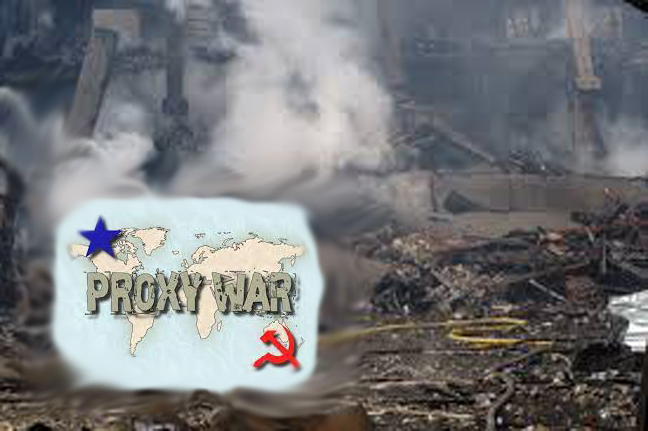
the Biden administration opted to use Ukraine in a Western proxy war against Russia.
Washington and London appear to have sabotaged a possible peace accord between Moscow and Kiev.
The Biden administration is risking nuclear war with Russia to assist a corrupt, authoritarian regime in a country of little importance to the United States.
Until the early 1990s, Ukraine wasn’t even an independent country, much less a U.S. vital interest.
Very few policymakers even concede that Washington’s overseas military adventures often have not turned out as planned.
The American Conservative, Ted Galen Carpenter, Sep 28, 2022, The leaders and most of the news media in the U.S. seem to believe that Washington’s foreign policy over the past several decades has been a success and benefitted both the United States and the world. That assumption wasn’t really true even during the Cold War, although that confrontation eventually resulted in the peaceful demise of America’s nasty totalitarian adversary. There was plenty of collateral damage along the way, with the suffering caused by Washington’s conduct in Vietnam and Afghanistan being the most glaring examples.
The performance of U.S. leaders after the Cold War has been even worse. An array of disruptive, bloody tragedies—most notably those in the Balkans, Afghanistan (again), Iraq, Libya, Syria, and Yemen—mark Uncle Sam’s global trail of wreckage. The Biden administration’s decision to use Ukraine as a pawn in Washington’s power struggle with Russia is fast becoming the latest example.
Very few policymakers even concede that Washington’s overseas military adventures often have not turned out as planned. The news media, which is supposed to serve as the public’s watchdog, have routinely ignored or excused America’s foreign-policy disasters. Instead, when one intervention fails, they simply move on to lobby for the next crusade pushed by U.S. leaders. Consider how few news accounts now deal with the ongoing violence and chaos in places such as Libya, Syria, and Yemen, even though Washington was a major contributor to all of those tragedies.
Paul Poast, a scholar with the Chicago Council on Global Affairs, aptly describes the conflict in Syria as America’s “forgotten war.” “That the war in Syria has become the “forgotten war,” he observes, “points to a more disturbing trend in U.S. foreign policy: The United States is so engaged in wars and interventions around the world that a conflict involving the U.S. military that has killed hundreds of thousands of civilians does not even register with the American public anymore.”………………………………………
The turmoil in Iraq is less severe, but is still damaging the country. Political disputes and mass demonstrations against the current government regularly surface in Iraq. Pro-Iranian militias continue to play a prominent role in the country’s government, and the three-way split among Sunni Arabs, Shiite Arabs, and Kurds is becoming ever more contentious. Political violence among rival factions shows no signs of subsiding, nor does public resentment against the presence of U.S. troops. Washington so lacks trust in its “ally” that officials once threatened to seize the country’s bank reserves if Iraqi leaders continued to press for the withdrawal of U.S. forces.
The level of human tragedy in Libya and Yemen is horrifying. Washington and its NATO allies bear almost exclusive responsibility for the situation in Libya………………………
The latest application of Washington’s meddlesome policy is in Ukraine. U.S. leaders ignored repeated Russian warnings that making Ukraine a NATO member or even an unofficial NATO military asset would cross a line that threatened Russia’s security. When Moscow finally responded to the provocations with an invasion of Ukraine in February 2022, the Biden administration opted to use Ukraine in a Western proxy war against Russia.
The conflict has already done enormous damage to Ukraine’s infrastructure and taken thousands of lives. Worse, Washington and London appear to have sabotaged a possible peace accord between Moscow and Kiev.
The U.S. foreign-policy record over the past three decades could hardly be worse. It is crucial not to let policymakers and their media mouthpieces get away with convenient collective amnesia and imitations of Pontius Pilate. Instead, they need to be held fully accountable for their blunders and deception.
Future U.S. policymakers also need to avoid repeating the faulty performance of their predecessors. To do so, they must make three significant changes to U.S. foreign policy.
First, Washington should utterly renounce nation-building. Trying to remake alien societies by force and impose Western political, economic, and social values is the essence of folly.
Even when the United States has not yet been drawn into a new war to enforce crumbling nation-building goals, as in Bosnia and Kosovo, such armed social experiments are an exercise in futility and frustration. Worse, nation-building missions frequently worsen conditions in the targeted country, and the predictable failure of U.S. objectives even can lead to Washington’s outright humiliation. The debacle in Afghanistan is a stark reminder of that danger.
Second, the United States must avoid the temptation to engage in regime-change wars. Such offensives often are a prelude to disastrous nation-building ventures. That was the case in Iraq, Afghanistan, and Libya. Those wars not only made matters worse for the populations in the three countries, but worsened the security situation for neighboring states and even the United States. In both Iraq and Libya, U.S. actions toppled secular dictators, paving the way for chaos that strengthened the position of Islamic jihadists. Granted, the secular dictators were brutal and sometimes caused problems for the United States, but Washington’s “solution” clearly made matters worse, not better.
Third, U.S. leaders must do a much better job of distinguishing vital national interests from secondary or peripheral ones. Washington’s current policy of using Ukraine as a proxy for a war against Russia is a troubling example of the failure to make such basic distinctions. The Biden administration is risking nuclear war with Russia to assist a corrupt, authoritarian regime in a country of little importance to the United States.
Until the early 1990s, Ukraine wasn’t even an independent country, much less a U.S. vital interest. To accept the risks the Biden administration is incurring is irresponsible and violates the U.S. government’s responsibility to the American people.
Unless these policy changes are made, it is just a matter of time until a new set of officials repeat the disastrous blunders of their predecessors. If they do, the consequences to America and the world will be equally damaging. Indeed, the Ukraine adventure reveals that the consequences could be even worse than the wreckage already wrought by Uncle Sam. https://www.theamericanconservative.com/uncle-sams-long-trail-of-wreckage/
Sanctions against Russian exports – but that doesn’t apply to NUCLEAR EXPORTS, (while they bring in funding for Russia’s war!)

ED note. When will they all wake up? The nuclear industry is essential for the nuclear weapons so beloved by the governments that have them.
Keeping the nuclear industry going is essential for the wealth, power and influence of the global nuclear lobby, and the future of all their crackpot super-costly ‘advanced’ nuclear gimmicks.
Apparently we can all accept cutting back gas, oil, food ……. but must not let anyone curtail that sacred cow – the nuclear industry
Russia’s nuclear trade with Europe flows despite Ukraine war, By SYLVIE CORBET, September 30, 2022,
PARIS (AP) — While the European Union has agreed to curtail its use of Russian oil and gas, its member nations continue to import and export nuclear fuel that is not under EU sanctions — to the chagrin of the Ukrainian government and environmental activists.
A cargo ship carrying uranium that departed from the French port of Dunkirk traveled across the North Sea on Thursday, heading toward the Russian Baltic port of Ust-Luga. It was the third time in just over a month that the Panama-flagged Mikhail Dudin ship docked in Dunkirk to transport uranium from or to Russia.
Environmental group Greenpeace France denounced the ongoing shipments and called for stopping all trade in nuclear fuel, which it said was “financing the war in Ukraine, extending (Europe’s) energy dependence and delaying the transition to renewable energy.”
The EU’s executive arm, the European Commission, did not propose targeting Russia’s nuclear sector in its latest sanctions package presented Wednesday.
“France ensures strict compliance by economic players with all the European sanctions adopted against Russia. Civil nuclear power is not affected by these sanctions,” the French Foreign Affairs Ministry told the Associated Press.
The ministry that EU nations “did not consider this to be a relevant area for ending Russian aggression against Ukraine.”
Ukraine, meanwhile, is pushing for European sanctions in that area. The Ukrainian president’s economic adviser, Oleg Ustenko, said Wednesday that “in terms of uranium, we think it’s extremely important to impose sanctions, not only on Russian oil.”
“Oil, gas, uranium and coal, all this should be banned. Because they are using this money in order to finance this war,” Ustenko said.
According to Greenpeace France, reprocessed uranium meant to be transported to Russia were loaded onto the Mikhail Dudin on Wednesday. Pauline Boyer, an energy campaigner at Greenpeace France, said the ship’s repeated trips between Russia and France show “the extent to which the French nuclear industry is trapped in its dependence on Russia.”
French authorities have repeatedly said the country does not depend on Russia to supply the nuclear power plants that provide 67% of its electricity — more than any other nation………………………………………..
The Lingen plant is operated by Framatome, which is majority-owned by French utility giant EDF. It is supplying nuclear fuel to plants in France, Belgium, Switzerland, the Netherlands, Britain, Spain, Sweden and Finland.
Faced with activists’ protests, the German government took a critical view toward the uranium shipment but said it couldn’t stop the fuel from being processed because it isn’t covered by the EU’s war-related sanctions on Russia.
At the end of last month, enriched uranium unloaded from the Mikhail Dudin in Dunkirk was destined for the Rhone valley in southern France, which is home to major sites of the French civil nuclear industry, according to Greenpeace France.
The French nuclear sector has a series of contracts with Russian state-controlled energy giant Rosatom, including some to import enriched uranium destined for European nuclear power plants and to export reprocessed uranium to Russia. Rosatom is one of the world’s biggest actors in the nuclear energy market.
Multinational company Orano, headquartered in France, has a contract with Rosatom to buy reprocessed uranium to convert it into nuclear fuel at its Seversk plant, in Siberia, and ultimately use it in reactors to produce energy.
The U.S. power industry also imports uranium from Russia to feed its nuclear plants.
AP recently tracked millions of dollars worth of shipments of radioactive uranium hexafluoride from Russian state-owned Tenex JSC, the world’s largest exporter of initial nuclear fuel cycle products, to Westinghouse Electric Co. in South Carolina. https://apnews.com/article/russia-ukraine-france-global-trade-only-on-ap-business-c521f2248c823f69f0a677735a78e89d
Conditions for Fair Iran Nuclear Deal Outlined
Iran is ready for an agreement, but that has to be fair, Raisi said. https://financialtribune.com/articles/national/115358/conditions-for-fair-nuclear-deal-outlined 30 Sept 22,
President Ebrahim Raisi said a fair agreement on the revival of the 2015 nuclear deal is conditional on guarantees for the lasting removal of sanctions as well as the settlement of safeguards issues.
“We are ready for an agreement, but the agreement must be fair,” he said in an address to the Iranian people on state television on Wednesday, President.ir reported.
The 2015 deal, known as the Joint Comprehensive Plan of Action, lifted international sanctions on Tehran in return for curbs on its nuclear program, but the United States pulled out in 2018 and reimposed tough sanctions that prompted Iran to react by rowing back on its commitments.
Negotiations have been going on since April 2021 in Vienna, Austria, to work out how both sides can resume compliance.
The talks, however, are facing a stalemate with the West refusing to entertain Iran’s key demands, including assurances that the sanctions will not be reimposed again under a new US government.
Given that the Americans exited the nuclear deal and Europeans failed to meet their commitments, it is essential to focus on adherence to obligations this time, Raisi said.
He stressed the need for guarantees by western countries as a prerequisite for an agreement.
Iran has also demanded the closure of investigations by the International Atomic Energy Agency over nuclear material allegedly found at undeclared sites in the country.
The IAEA has called for explanation about the origin and current whereabouts of uranium particles it claims have been found at three sites in Iran, and has so far rejected Tehran’s answers as incredible.
The global watchdog’s Board of Governors also passed a resolution against Iran in June on the same ground.
The Islamic Republic argues that the allegation is based on false and fabricated data and is meant to be used against the country in the future in the event that an agreement is sealed on the JCPOA.
“In the latest script the Islamic Republic has presented, it has emphasized reliable guarantees and settlement of safeguards issues to prevent repeated violation of commitments by the western side and passing of resolutions against Iran under political safeguards pretexts,” Raisi said.
The president also criticized the IAEA for politicization, of which there are numerous examples, including the director general’s change of tone soon after leaving Iran.
Raisi further highlighted his administration’s policy of neutralizing sanctions, so that people’s lives would not be dependent on the nuclear deal.
“Sanctions will not stop us and we will not tie people’s lives to this agreement,” he said.
He said despite sweeping sanctions, there is huge interest among all countries for cooperation with Iran.
“In all my foreign meetings, I faced other countries’ welcoming of cooperation with Iran,” he said, referring particularly to his meetings during a trip to Uzbekistan to attend the Shanghai Cooperation Organization summit.
Authorities from China, Russia and India were among the countries which emphasized the need to expand relations with Tehran, according to the president.
“Our intention is [to enhance] economic and trade ties with all countries, regardless of eastern or western.”
He later highlighted Iran’s admission as permanent member of the Shanghai Cooperation Organization as an important achievement of his government.
“By becoming a member of the SCO, Iran was linked with Asia’ economic infrastructures,” he said.
India makes sure that China withdraws proposal against AUKUS nuclear submarines plan at IAEA
https://www.business-standard.com/article/international/china-withdraws-proposal-against-aukus-nuclear-submarines-plan-at-iaea-122100100002_1.html 30 Sept 22, China withdraws proposal against AUKUS nuclear submarines plan at IAEA, China withdrew a draft resolution at the IAEA against the AUKUS grouping seeking to provide Australia with nuclear-powered submarines following India’s objective view on the issue, sources said.
China on Friday withdrew a draft resolution at the IAEA against the AUKUS grouping seeking to provide Australia with nuclear-powered submarines following India’s objective [?] view on the issue, sources said.
China tried to get the resolution passed at the general conference of the International Atomic Energy Agency (IAEA) which took place in Vienna from September 26 to 30.
The AUKUS (Australia, the UK and the US) security partnership announced in September last it would facilitate Australia getting technology to build nuclear-powered submarines.
The sources said India’s “deft and impactful” diplomacy was deeply appreciated by IAEA member states, particularly the AUKUS partners.
Russia open to in-person talks with U.S. on nuclear arms treaty
https://ca.news.yahoo.com/russia-open-person-talks-u-134957998.html Thu, September 29, 2022,
MOSCOW (Reuters) – Russia said on Thursday it was studying the possibility of a face-to-face meeting between Russian and U.S. negotiators on a landmark nuclear arms control treaty.
In a briefing in Moscow, Foreign Ministry spokeswoman Maria Zakharova said Russia was open to reviving inspections under the New START treaty and considering the possibility of in-person meetings of a joint commission of representatives from the United States and Russia.
Physical inspections under the treaty have been suspended since 2020, initially as a result of the coronavirus pandemic.
“The topic of resuming them is being considered,” Zakharova said on Thursday. “The possibilities for holding a face-to-face session of the bilateral advisory commission are being studied.”
The treaty sets limits on the number of nuclear arms each side can have deployed, and outlines the terms for verification and inspection of each other’s nuclear arsenals.
Moscow said in August it was considering a new meeting of the commission, as well as a possible resumption of negotiations to extend the treaty, one of the few major diplomatic agreements that remain in place between Moscow and Washington as relations hit rock-bottom over the conflict in Ukraine.
(Reporting by Reuters; Editing by Kevin Liffey)
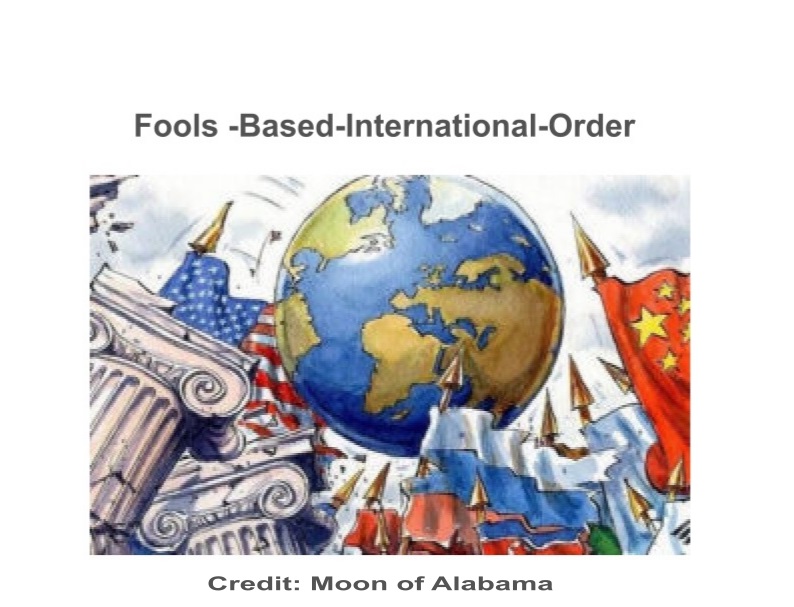
Canada and the International Fools-Based Order
https://worldbeyondwar.org/canada-and-the-international-fools-based-order/?utm_content=buffer7ff3e By Cymry Gomery, Coordinator, Montreal for a World BEYOND War, September 21st, 2022
Statement for World Peace Day, September 21st, 2022
On September 18, 2022, Canadian Minister of National Defence Anita Anand was interrupted as she made a speech promoting Canada’s participation in the war in Ukraine. Caught by surprise when an activist raised a banner with the words, ”Trudeau, Freeland, Anand, Joly : Stop the War – Peace with Ukraine and Russia” Anand invoked the NATO mantra: ”We are defending…. we are defending the International rules-based order to protect you, and everyone in this room, and our country safe [sic] ”
What is this rule-based order that politicians seem to call on whenever they are promoting war?
Some say that the rules-based order is only a vague concept invented by G7 countries to lull us into accepting their presumptive international hegemony. Nonetheless, there is a formal international body that sets rules: the United Nations. And, when it comes to war, or the potential for war, Chapter VI of the UN Charter enjoins all countries to seek to resolve their disputes through peaceful means. If this doesn’t work, they are to refer it to the UN Security Council (UNSC), which could recommend solutions.
But what if countries are considering war and they know in advance that the UNSC would not offer a resolution in their favor, because of their self-serving motives? Take, for example, the Russia-Ukraine conflict, widely considered to be a U.S. proxy war. However, not only the U.S., but also Europe, Canada, Australia and China—just about everyone with an army–has economic interests in this war, which can be seen as a geopolitical tug-of-war for valuable commodities like lithium, gas, and wheat.
How do Canadian interests stand to benefit from the Russia-Ukraine war? It is already happening :
- Canada increased oil and gas exports in 2022 as Russia’s former customer nations sought alternative energy supplies;
- The US, EU, Canada, Australia, China, and Russia are all very interested in the Lithium deposits in Ukraine, which are among the largest in the world. The outcome of this war determines which players nab the market for this key climate-change era mineral.
- Before the Russia-Ukraine war, Russia was expected to become one of the world’s largest exporters of hydrogen, and was poised to supply hydrogen fuel to Germany. However, Russia is now faced with economic sanctions and the unwillingness of the world’s most powerful nations and largest economies to do business with Russia. All this appears very convenient for Justin Trudeau and his government, who can now scoop up hydrogen exports to the EU.
So, how can we really keep a straight face when Anand invokes the International Rules-based order? Perhaps we should call it what it really is, an attempt to hoodwink the gullible public into thinking the Canadian government is sending weapons to Ukraine for altruistic, morally sound reasons, when in fact the Liberals are just doing what they do best : looking after the ”economy” (read corporate profits) and protecting their own assets.
On this International Day of Peace, we will put on our good faith hat (not to be confused with a fools cap) and respectfully ask the Canadian government to take these measures :
As the image below suggests, (Anand’s comment about our safety notwithstanding), defense spending is more indicative of a nation’s geopolitical aggressiveness than its concern for the well-being of its citizens.

The Canadian government (our representatives, in case they forgot) could use the money thus saved to implement the Green New Deal and basic income, to address climate change, to build houses, to protect Canada’s remaining wild spaces, to make national parks into Indigenous protected areas, and so much more.
We will need a nationwide consultation to decide on how best to spend this money creatively, in a life-affirming way, which is something we are not yet that experienced doing. But I am sure we will manage.
So, on this day dedicated to world peace, let’s chart a new course. Let us repudiate a foolish, nihilistic world order predicated on militarism and destruction, and vow henceforth to champion and advance a hopeful, loving world order that outlaws war.
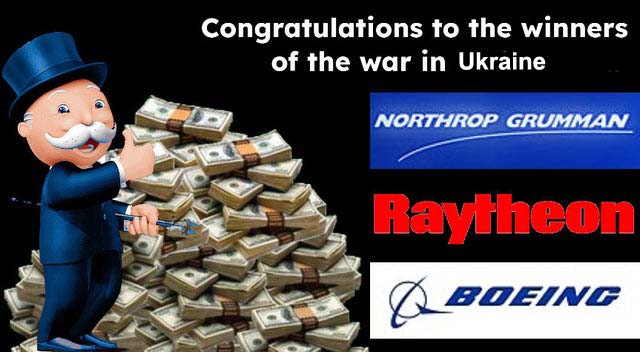
The real Winners of Ukraine war – the USA weapons manufacturers! U.S. Announces $1.1 Billion In Aid For Building Ukraine’s Military
The United States has now committed approximately $16.9 billion in security assistance to Ukraine since January 2021
Radio Free Europe, 29 Sept 22, The United States will provide an additional $1.1 billion in military aid to Ukraine, including funding for about 18 more advanced rocket systems and other weapons to counter drones, the White House announced on September 28.
The package is aimed at helping Ukraine secure its longer-term defense needs under the Ukraine Security Assistance Initiative, which funds the purchase of weapons and equipment. This means it could take a year or more for Ukraine to get the systems.
Most of the other military aid packages announced by the United States have thus far used Pentagon drawdown authority to provide weapons more immediately.
The new package “represents a multi-year investment in critical capabilities to build the enduring strength of Ukraine’s Armed Forces” as they continue to battle the invading Russian Army, the Pentagon said in a statement.
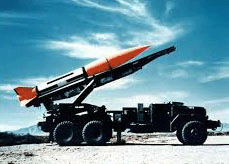
The package includes funding for 18 units of the High-Mobility Artillery Rocket System, known as HIMARS, and 12 Titan systems, which are used to counter drones………………
Also in the package is funding for about 150 armored vehicles, 150 tactical vehicles for towing weapons, trucks and trailers, and a variety of radars, communications, and surveillance equipment.
The United States has now committed approximately $16.9 billion in security assistance to Ukraine since January 2021. https://www.rferl.org/a/ukraine-us-military-aid-1-1-billion/32056533.html
US, UK sabotaged peace deal because they ‘don’t care about Ukraine’: fmr. NATO adviser
https://thegrayzone.com/2022/09/27/us-uk-sabotaged-peace-deal/ AARON MATÉ· SEPTEMBER 27, 2022,
Former Swiss intelligence officer and NATO adviser Jacques Baud on the next phase of the Russia-Ukraine war and new allegations that the US and UK undermined a peace deal that could have ended it.
The West’s aim “is not the victory of Ukraine, It’s the defeat of Russia,” Baud says. “The problem is that nobody cares about Ukraine. We have just instrumentalized Ukraine for the purpose of US strategic interests — not even European interests.”
Guest: Jacques Baud. Former intelligence officer with the Swiss Strategic Intelligence Service who has served in a number of senior security and advisory positions at NATO, the United Nations, and with the Swiss military.
Corrections:
- In his Sept. 21 speech, Putin did not make an explicit threat to use nuclear weapons. He vowed to “make use of all weapon systems available to us,” in the event of “a threat to the territorial integrity of our country and to defend Russia and our people.”
On nuclear weapons, the US did not have a “No First Use” policy. On the 2020 campaign trail, Joe Biden said that he supported the idea of “No First Use.” He abandoned that in his presidential nuclear posture; but that was reversing his campaign stance, not official US policy.
Nuclear power classed as “amber”, not “green”. Is it officially accepted as Environmental, Social, and corporate Governance (ESG) ?

the Commission applies a number of screening and disclosure conditions to nuclear’s taxonomy inclusion. For instance, there are screens based on scientific advice such as requiring disposal facilities for low-level radioactive waste to already be operational, member states having a plan for high-level waste disposal by 2050 and a ban on exporting radioactive waste to developing countries for disposal.
Does the EU taxonomy vote mean nuclear is officially ESG? ETF Stream, By Jamie Gordon, 26 Sep 2022,
The implementation of the Delegated Act will test both the EU’s credibility and investors’ appetite to adhere to prescriptive ESG frameworks
The European Parliament took the contentious step in July of voting to include nuclear energy within its taxonomy of sustainable activities, however, it remains to be seen whether other ESG frameworks will follow suit and if any naysayer investors will be swayed by the regulator’s decision.
Almost three years after first being discussed, nuclear energy, along with natural gas, look set to be added to the EU’s taxonomy via the Complementary Climate Delegated Act from 1 January 2023, earmarking them as sustainable investments for the time being.
The road to this verdict was not only meandering but full of obstacles, with Kenneth Lamont, senior research analyst at Morningstar, previously describing nuclear as being “stony on a political level” for investors and policymakers.
It began with the European Commission’s Technical Expert Group publishing the Taxonomy Technical Report in March 2020, which notably snubbed nuclear from its list of green activities.
A year later, leaders of seven EU member states wrote a letter calling on the European Commission to accommodate all paths to climate neutrality while the Commission’s Joint Research Centre argued nuclear should be eligible for ESG investment.
Even though the Commission announced a month later it would bootstrap nuclear and gas to its taxonomy via a Delegated Act, in October, a ‘Nuclear Alliance’ of 15 European Ministers called for the energy source to be included in the main body of the taxonomy by the end of 2021.
Ignoring these calls, the Commission published a draft of the Delegated Act on 31 December, which was soon met by fierce opposition as Austria and Luxembourg threatened to bring a lawsuit before the European Court of Justice.
Despite members of the Environment and Economic Affairs committees later voting against the proposed taxonomy changes in June, the defeat of the motion to block the Delegated Act in the European Parliament in July means nuclear will soon make its delayed entry into the taxonomy.
Conditional inclusion
While the move is significant for challenging the nuclear exclusions applied to many ESG frameworks and products, it bears remembering the Commission’s Platform on Sustainable Finance views nuclear as an ‘amber’ rather than ‘green’ activity – and its inclusion in the taxonomy is both conditional and time-limited………………………………..
Despite nuclear’s seemingly low-carbon credentials, the European countries most active in building new plants – Ukraine, the UK and France – currently only have a combined five plants under construction versus 17 for China alone.
Similarly, 27 out of the 31 reactors that have been under construction since 2017 are of Russian or Chinese design, according to analysis by SocGen.
…………………………….. there are several compelling arguments against nuclear being in the taxonomy such as what to do with thousands of tonnes of radioactive waste, concerns around directing capital away from renewables and the worthwhile geopolitical point that in 2020, 20.2% of the EU’s uranium supply came from Russia and 19.2% from its ally, Kazakhstan, according to Eurostat.
It is also worth noting the size of political opposition to nuclear as a ‘transition energy’, with 278 of 639 MEPs opposing the Delegated Act in July’s motion.
Considering these points, the Commission applies a number of screening and disclosure conditions to nuclear’s taxonomy inclusion. For instance, there are screens based on scientific advice such as requiring disposal facilities for low-level radioactive waste to already be operational, member states having a plan for high-level waste disposal by 2050 and a ban on exporting radioactive waste to developing countries for disposal.
Also, large listed non-financial and financial companies will be required to disclose what portion of their activities are linked to the energies included in the Delegated Act.
Greater complexity across EU policy……………………………………………………………………..
The ultimate test, however, will be if taxonomy inclusion changes investor attitudes towards nuclear, given its aim is to act as a framework for guiding capital towards worthy recipients.
………………………………. Many index providers will remove nuclear power operators from their exclusion lists and will become more flexible in including utilities that generate power from nuclear facilities in their indices,” he added.
However, he warned others with their own internal rules and those fulfilling client mandates would be less likely to change their indices in fear of losing business.
FTSE Russell, for instance, continues to categorise nuclear as tier three under its Green Revenues Classification System, meaning it has some environmental benefit but this is overall net neutral or negative……………………………………
Some investors might also be put off by the fact the technical screening criteria of the Delegated Act will be reviewed every three years, which includes time limits for the contribution of nuclear and gas to climate change mitigation efforts. If the EU reverses its recent taxonomy changes in future, investors in nuclear and gas will have to rush to get rid of these exposures in order to remain aligned.
For now, ESG might like nuclear a little more than it did a year ago but EU taxonomy support only applies to certain subsectors, subject to conditions and set to be reviewed over time.
Overall, though, the Delegated Act should be understood as more an act of EU pragmatism than moral change of heart on what it means to be sustainable. Nuclear may have a role to play in net-zero efforts but will face an uphill battle to convert its detractors. https://www.etfstream.com/features/does-the-eu-taxonomy-vote-mean-nuclear-is-officially-esg/
JOHN PILGER’S 2014 WARNING ABOUT UKRAINE
- https://popularresistance.org/john-pilgers-2014-warning-about-ukraine/ By John Pilger, Consortium News., September 25, 2022, Educate!
- John Pilger Warned The “U.S. Is Threatening To Take The World To War” Over Ukraine, Words That Have Taken On New Meaning.
- Originally published in The Guardian on 13 May 2014.
Why do we tolerate the threat of another world war in our name? Why do we allow lies that justify this risk? The scale of our indoctrination, wrote Harold Pinter, is a “brilliant, even witty, highly successful act of hypnosis”, as if the truth “never happened even while it was happening”.
Every year the American historian William Blum publishes his “updated summary of the record of U.S. foreign policy” which shows that, since 1945, the U.S. has tried to overthrow more than 50 governments, many of them democratically elected; grossly interfered in elections in 30 countries; bombed the civilian populations of 30 countries; used chemical and biological weapons; and attempted to assassinate foreign leaders.
In many cases Britain has been a collaborator. The degree of human suffering, let alone criminality, is little acknowledged in the west, despite the presence of the world’s most advanced communications and nominally most free journalism. That the most numerous victims of terrorism – “our” terrorism – are Muslims, is unsayable. That extreme jihadism, which led to 9/11, was nurtured as a weapon of Anglo-American policy (Operation Cyclone in Afghanistan) is suppressed. In April the U.S. state department noted that, following Nato’s campaign in 2011, “Libya has become a terrorist safe haven“.
The name of “our” enemy has changed over the years, from communism to Islamism, but generally it is any society independent of western power and occupying strategically useful or resource-rich territory, or merely offering an alternative to U.S. domination.
The leaders of these obstructive nations are usually violently shoved aside, such as the democrats Muhammad Mossedeq in Iran, Jacobo Arbenz in Guatemala and Salvador Allende in Chile, or they are murdered like Patrice Lumumba in the Democratic Republic of Congo. All are subjected to a western media campaign of vilification – think Fidel Castro, Hugo Chávez, now Vladimir Putin.
Washington’s role in Ukraine is different only in its implications for the rest of us. For the first time since the Reagan years, the U.S. is threatening to take the world to war. With eastern Europe and the Balkans now military outposts of Nato, the last “buffer state” bordering Russia – Ukraine – is being torn apart by fascist forces unleashed by the U.S. and the EU. We in the west are now backing neo-Nazis in a country where Ukrainian Nazis backed Hitler.
Having masterminded the coup in February against the democratically elected government in Kiev, Washington’s planned seizure of Russia’s historic, legitimate warm-water naval base in Crimea failed. The Russians defended themselves, as they have done against every threat and invasion from the west for almost a century.
But Nato’s military encirclement has accelerated, along with U.S.-orchestrated attacks on ethnic Russians in Ukraine. If Putin can be provoked into coming to their aid, his pre-ordained “pariah” role will justify a Nato-run guerrilla war that is likely to spill into Russia itself.
Instead, Putin has confounded the war party by seeking an accommodation with Washington and the EU, by withdrawing Russian troops from the Ukrainian border and urging ethnic Russians in eastern Ukraine to abandon the weekend’s provocative referendum.
These Russian-speaking and bilingual people – a third of Ukraine’s population – have long sought a democratic federation that reflects the country’s ethnic diversity and is both autonomous of Kiev and independent of Moscow. Most are neither “separatists” nor “rebels”, as the western media calls them, but citizens who want to live securely in their homeland.
Like the ruins of Iraq and Afghanistan, Ukraine has been turned into a C.I.A. theme park – run personally by C.I.A. director John Brennan in Kiev, with dozens of “special units” from the C.I.A. and F.B.I. setting up a “security structure” that oversees savage attacks on those who opposed the February coup. Watch the videos, read the eye-witness reports from the massacre in Odessa this month. Bussed fascist thugs burned the trade union headquarters, killing 41 people trapped inside. Watch the police standing by.
A doctor described trying to rescue people, “but I was stopped by pro-Ukrainian Nazi radicals. One of them pushed me away rudely, promising that soon me and other Jews of Odessa are going to meet the same fate. What occurred yesterday didn’t even take place during the fascist occupation in my town in world war two. I wonder, why the whole world is keeping silent.” [see footnote]
Russian-speaking Ukrainians are fighting for survival. When Putin announced the withdrawal of Russian troops from the border, the Kiev junta’s defence secretary, Andriy Parubiy – a founding member of the fascist Svoboda party – boasted that attacks on “insurgents” would continue. In Orwellian style, propaganda in the west has inverted this to Moscow “trying to orchestrate conflict and provocation“, according to William Hague. His cynicism is matched by Obama’s grotesque congratulations to the coup junta on its “remarkable restraint” after the Odessa massacre. The junta, says Obama, is “duly elected”. As Henry Kissinger once said: “It is not a matter of what is true that counts, but what is perceived to be true.”
In the U.S. media the Odessa atrocity has been played down as “murky” and a “tragedy” in which “nationalists” (neo-Nazis) attacked “separatists” (people collecting signatures for a referendum on a federal Ukraine). Rupert Murdoch’s Wall Street Journal damned the victims – “Deadly Ukraine Fire Likely Sparked by Rebels, Government Says“. Propaganda in Germany has been pure cold war, with the Frankfurter Allgemeine Zeitung warning its readers of Russia’s “undeclared war”. For the Germans, it is a poignant irony that Putin is the only leader to condemn the rise of fascism in 21st-century Europe.
A popular truism is that “the world changed” following 9/11. But what has changed? According to the great whistleblower Daniel Ellsberg, a silent coup has taken place in Washington and rampant militarism now rules. The Pentagon currently runs “special operations” – secret wars – in 124 countries. At home, rising poverty and a loss of liberty are the historic corollary of a perpetual war state. Add the risk of nuclear war, and the question is: why do we tolerate this?
1 This Month



26 September – International Day for the Total Elimination of Nuclear Weapons


PLEASE OPPOSE HR 8255 AND S.3639 – bills would accelerate satellite deployment, with no environmental review or safeguards – https://ncstd5li.quorum.us/campaign/169331/
To see nuclear-related stories in greater depth and intensity – go to https://nuclearinformation.wordpress.com
-
Archives
- September 2026 (257)
- August 2026 (330)
- July 2026 (355)
- June 2026 (287)
- May 2026 (306)
- April 2026 (356)
- March 2026 (251)
- February 2026 (267)
- January 2026 (308)
- December 2025 (358)
- November 2025 (359)
- October 2025 (375)
-
Categories
- 1
- 1 NUCLEAR ISSUES
- business and costs
- climate change
- culture and arts
- ENERGY
- environment
- health
- history
- indigenous issues
- Legal
- marketing of nuclear
- media
- opposition to nuclear
- PERSONAL STORIES
- politics
- politics international
- Religion and ethics
- safety
- secrets,lies and civil liberties
- spinbuster
- technology
- Uranium
- wastes
- weapons and war
- Women
- 2 WORLD
- ACTION
- AFRICA
- Atrocities
- AUSTRALIA
- Christina's notes
- Christina's themes
- culture and arts
- Events
- Fuk 2022
- Fuk 2023
- Fukushima 2017
- Fukushima 2018
- fukushima 2019
- Fukushima 2020
- Fukushima 2021
- general
- global warming
- Humour (God we need it)
- Nuclear
- RARE EARTHS
- Reference
- resources – print
- Resources -audiovicual
- Weekly Newsletter
- World
- World Nuclear
- YouTube
-
RSS
Entries RSS
Comments RSS
 nuclear-news