New nuclear tech not the answer to Canada’s climate woes, MPs say
National Observer, By Natasha Bulowski & Matteo Cimellaro, Ottawa Insider | April 26th 2023
Next-generation nuclear technology “has no part in fighting the climate emergency,” Green Party Leader Elizabeth May said Tuesday as a handful of MPs joined anti-nuclear activists to voice concern about the federal government’s intention to expand nuclear power.
“It, in fact, takes valuable dollars away from things that we know work, that can be implemented immediately, in favour of untested and dangerous technologies that will not be able to generate a single kilowatt of electricity for a decade or more,” the Saanich-Gulf Islands MP said at a cross-party press conference.
The comments came one day after Prime Minister Justin Trudeau said Canada must produce more nuclear power in the years to come. The federal government is funding the development of small modular reactors (SMRs) with a stated aim of replacing coal plants, powering heavy industry operations such as the oilsands and providing electricity for remote, diesel-reliant communities.
Ontario, Saskatchewan, New Brunswick and Alberta have agreed to a joint strategic plan for deploying SMRs to “provide safe, reliable and zero-emissions energy to power our growing economy and population.” In 2019, approximately 38 per cent of New Brunswick’s electricity generation was from nuclear, and Ontario is sitting at roughly 60 per cent.
…………critics argue the timelines, cost overruns and delays associated with building nuclear power generation facilities contrast with the need to immediately scale up fossil fuel-free energy to avoid the worst impacts of climate change. The longevity of radioactive waste, which is hazardous to human health and the environment, also raises questions among critics, as do concerns about nuclear proliferation.
Susan O’Donnell, a member of the Coalition for Responsible Energy Development in New Brunswick, warned: “SMRs create new types of toxic radioactive waste that would be very costly and difficult to isolate from the environment for millions of years.”
Some SMRs would extract plutonium — a radioactive, silvery metal used in nuclear weapons and power plants — mixed with other substances from nuclear fuel waste. But to do so undermines global nuclear weapons non-proliferation agreements, said O’Donnell, who is also an adjunct research professor in the environment and society program at St. Thomas University.
May, Liberal MP Jenica Atwin, Bloc Québécois MP Mario Simard and NDP MP Alexandre Boulerice attended the cross-party press conference on April 25…………..
May and Boulerice pointed to the influence of the nuclear industry on Parliament Hill and the close relationship between Natural Resources Canada and Atomic Energy of Canada Limited, a federal Crown corporation and the largest nuclear science and technology laboratory in the country.
“They don’t have to knock on the door to get into the house because they own the house,” said Boulerice of industry lobbyists.
“There’s no question that the nuclear industry has far more access to the Canadian Nuclear Safety Commission in terms of raising different concerns about SMRs” compared to the anti-nuclear camp, said O’Donnell.
The expansion and maintenance of nuclear power in Canada will have to deal with its significant waste problem. …………………..
…………………………………… not all agree Canada should remain a nuclear-dependent nation.
“I think the prime minister needs better advisers,” said O’Donnell, in reference to Trudeau’s recent comments that an expansion of nuclear energy will be necessary going forward………. https://www.nationalobserver.com/2023/04/26/news/new-nuclear-tech-not-answer-canada-climate-woes-mps-say
Canada’s push for small nuclear reactors will be costly, ineffective, some MPs warn
By David Fraser, The Canadian Press, Tue., April 25, 2023
Prime Minister Justin Trudeau has asserted that Canada is “very
serious” about developing nuclear technology across the country to meet
growing power needs, but some members of Parliament are warning the
technology could be costly and ineffective.
A Liberal MP is among the critics who say Ottawa is looking at an expensive investment into an unproven and potentially dangerous technology. The federal government
started actively exploring small modular reactor technology in 2018, and
released an action plan in 2020 that dubbed them a strategic Canadian asset
that could leverage significant economic, geopolitical, social and
environmental benefits.
But Green Party Leader Elizabeth May says other
renewable energy sources are getting cheaper, so there’s not much of a case
for Canada to expand its capacity on that technology, which she said is
being pushed by powerful lobbyists.
Liberal MP Jenica Atwin, who was first
elected under the Green banner, said she is used to being an outlier in her
caucus, but the party has allowed her to express her concerns about the
unknowns of emerging nuclear technologies. Four nuclear energy stations are
generating about 15 per cent of Canada’s electrical grid today, mostly in
Ontario and New Brunswick, and as the facilities age more attention is
being paid to the potential of smaller, more-portable reactors.
Toronto Star 25th April 2023
US Senators and Congress Members introduce Bill to stop A1 from power to launch a nuclear weapon.

MARKEY, LIEU, BEYER, AND BUCK INTRODUCE BIPARTISAN LEGISLATION TO PREVENT AI FROM LAUNCHING A NUCLEAR WEAPON
Washington (April 26, 2023) – Senator Edward J. Markey (D-Mass.) and Representatives Ted W. Lieu (CA-36), Don Beyer (VA-08) and Ken Buck (CO-04) today introduced the bipartisan and bicameral Block Nuclear Launch by Autonomous Artificial Intelligence Act, legislation to safeguard the nuclear command and control process from any future change in policy that allows artificial intelligence (AI) to make nuclear launch decisions.
The Department of Defense’s 2022 Nuclear Posture Review states that current policy is to “maintain a human ‘in the loop’ for all actions critical to informing and executing decisions by the President to initiate and terminate nuclear weapon employment” in all cases. The Block Nuclear Launch by Autonomous AI Act would codify the Department’s existing policy by ensuring that no federal funds can be used for any launch of any nuclear weapon by an automated system without meaningful human control. Furthermore, the National Security Commission on Artificial Intelligence, established by Congress through the FY19 National Defense Authorization Act, recommended in their final report that the U.S. clearly and publicly affirm its policy that only human beings can authorize employment of nuclear weapons. This bill follows through on their recommendation.
“As we live in an increasingly digital age, we need to ensure that humans hold the power alone to command, control, and launch nuclear weapons – not robots,” said Senator Markey. “That is why I am proud to introduce the Block Nuclear Launch by Autonomous Artificial Intelligence Act. We need to keep humans in the loop on making life or death decisions to use deadly force, especially for our most dangerous weapons.”……………………………………………………………………………………………….
In April, Senator Markey and Representative Lieu reintroduced the Restricting First Use of Nuclear Weapons Act to prohibit any U.S. President from launching a nuclear strike without prior authorization from Congress. Last October, Senator Markey, then-member of Senate Foreign Relations Committee, filed eight amendments to the National Defense Authorization Act (NDAA) to reduce the risk of ‘nuclear Armageddon’ and stop the proliferation of nuclear weapons. Last January, co-chairs of the Nuclear Weapons and Arms Control Working Group, Senators Markey and Jeff Merkley (D-Ore.) and Representatives John Garamendi (CA-03) and Beyer led 51 of their colleagues in a letter to President Joe Biden urging the United States to take bold steps to reduce the nation’s reliance on nuclear weapons and to elevate arms control. https://www.markey.senate.gov/news/press-releases/markey-lieu-beyer-and-buck-introduce-bipartisan-legislation-to-prevent-ai-from-launching-a-nuclear-weapon
Return to Russia: Crimeans Tell the Real Story of the 2014 Referendum and Their Lives Since — RADIATION FREE LAKELAND

Originally posted on In Gaza: Crimeans gather with Russian national and Crimea flags in Sevastopol, Crimea, March 14, 2018. Alexander Zemlianichenko | AP Eva Bartlett traveled to Crimea to see firsthand out how Crimeans have fared since 2014 when their country reunited with Russia, and what the referendum was really like. October 9, 2019, Mint…
Return to Russia: Crimeans Tell the Real Story of the 2014 Referendum and Their Lives Since — RADIATION FREE LAKELAND
SIMFEROPOL, CRIMEA — In early August I traveled to Russia for the first time, partly out of interest in seeing some of the vast country with a tourist’s eyes, partly to do some journalism in the region. It also transpired that while in Moscow I was able to interview Maria Zakharova, spokeswoman of the Foreign Ministry.
High on my travel list, however, was to visit Crimea and Donetsk People’s Republic (DPR) — the former a part of Russia, the latter an autonomous republic in the east of Ukraine, neither accurately depicted in Western reporting. Or at least that was my sense looking at independent journalists’ reports and those in Russian media.
Both regions are native Russian-speaking areas; both opted out of Ukraine in 2014. In the case of Crimea, joining Russia (or actually rejoining, as most I spoke to in Crimea phrased it) was something people overwhelmingly supported. In the case of the Donbass region, the turmoil of Ukraine’s Maidan coup in 2014 set things in motion for the people in the region to declare independence and form the Donetsk and Lugansk People’s Republics.
In March 2014, Crimeans held a referendum during which 96 percent of voters chose to join Russia. This has been heavily disputed in Western media, with claims that Crimeans were forced to hold the referendum and claims of Russian troops on the streets “occupying” the peninsula.
Because Western media insisted the referendum was a sham held under duress, and because they bandy about the term “pro-Russian separatists” for the people of the DPR, I decided to go and speak to people in these areas to hear what they actually want and feel.
From the Russian mainland to the Crimean Peninsula………………………………………………………………
In the evening, we stay in the home of Vlad’s friend Tata, a Russian woman who moved to Crimea in 2012.
Since there was so much hype in Western media about a Russian takeover of the peninsula, I ask the burning questions: Were Crimeans forced to take part in the referendum? What was the mood like around that time? Tata replies:
“I never saw so many people in my life go out to vote, of their own free will. There was a period before the referendum, maybe about two months, during which there were two holidays: International Women’s Day, March 8, and Defender of the Fatherland Day, February 23.
……………………………………………………………I never saw tanks, I never saw Russian soldiers. I never saw any of that in the city.”
I ask Tata about how life had changed after the referendum:………………………………….
After the Soviet Union collapsed, it wasn’t the will of the Crimean people to join Ukraine. People were always Russian here; they always identified as Russian. Ukraine understood this well, and put nothing into Crimea, as punishment. Ukraine didn’t build any hospitals, kindergartens or roads.
In the past four years, the Crimean government has built 200 new kindergartens. This is the most obvious example of how things have improved. They also built the new Simferopol airport.
I worked in aviation. It took three years to build an airport of this standard in Yekaterinburg, Russia. It took half a year in Simferopol.”
International Jazz Festival……………………………………………………….
Construction everywhere……………………………………….
I remark on how kind and gentle people are here, as in Russia. Vlad replies:
“It shouldn’t be surprising — people are people anywhere. But Western media conditions us with stereotypes of Russians as cold and hard, vilifying an entire nation.”
The coastal city of Yalta lies further west along the peninsula. The drive there the following day is more beautiful still, the road flanked by mountains to one side, hills cascading down to the Black Sea on the other, endless wineries and, before Yalta itself, the stunning cliff-top castle known as “Swallow’s Nest.”
In the evening, we stay in the home of Vlad’s friend Tata, a Russian woman who moved to Crimea in 2012.
Since there was so much hype in Western media about a Russian takeover of the peninsula, I ask the burning questions: Were Crimeans forced to take part in the referendum? What was the mood like around that time? Tata replies:
“I never saw so many people in my life go out to vote, of their own free will. There was a period before the referendum, maybe about two months, during which there were two holidays: International Women’s Day, March 8, and Defender of the Fatherland Day, February 23.
Normally, people would go away on vacation during these holidays. But that year, Crimeans didn’t go anywhere; they wanted to be sure they were here during the referendum. We felt the sense of a miracle about to happen. People were anxiously awaiting the referendum.
There were military tents in the city, but they were not erected by the military, but by local men. They would stand there every day, and people could come and sign a document calling for a referendum.
I went one day and asked if I could add my name but I couldn’t, because I have a Russian passport. Only Crimean citizens could sign it. This was the fair way to do it.
At that time, my husband was in America. One day, he was watching CNN and got scared and called me because he saw reports of soldiers in the streets, an ‘invasion’ by Russia.
The local navy came from Sevastopol to Yalta and anchored their ships off the coast, made a blockade to ensure no larger Ukrainian or other ships could come and attack.
But I never saw tanks, I never saw Russian soldiers. I never saw any of that in the city.”
I ask Tata about how life had changed after the referendum:
When I came here in December 2012, everything was dilapidated and run down. The nice roads you were driving on, they didn’t exist when we were a part of Ukraine. I didn’t understand why Crimea was still a part of Ukraine. It was Russian land ever since the Tsars, the imperial time of Russia. This is where the Russian soul is, and the soul of the Russian navy.
After the Soviet Union collapsed, it wasn’t the will of the Crimean people to join Ukraine. People were always Russian here; they always identified as Russian. Ukraine understood this well, and put nothing into Crimea, as punishment. Ukraine didn’t build any hospitals, kindergartens or roads.
In the past four years, the Crimean government has built 200 new kindergartens. This is the most obvious example of how things have improved. They also built the new Simferopol airport.
I worked in aviation. It took three years to build an airport of this standard in Yekaterinburg, Russia. It took half a year in Simferopol.”
Finally, after night falls, we drive into the city of Koktebel, where an annual Jazz Festival is starting.
During all these hours of driving, the roads are smooth and well-trafficked, and I don’t see a single Russian military vehicle.
The next day, I walk through Koktebel, taking in the local markets brimming with produce, cheeses, and other goods, and every so often come across a streetside stand laden with fresh fruits. In the late afternoon, I walk along the sea, past packed beaches, and meet with a Crimean woman, Yaroslava, who lives in Austria but every summer returns to her beloved Crimea. She is ardently supportive of the decision to have joined Russia and spends much of her time back in Austria trying to educate people on why Crimeans wanted to be a part of Russia.
These are reasons I hear throughout my travels in Crimea: We wanted to be able to speak our native language [Russian] and be educated in that language; we wanted to be able to practice our cultural traditions; we have always been a part of Russia and we wanted to return.
Yaroslava is busy helping out with the Jazz Festival and wants to use the rest of our short time talking to help me arrange future meetings with people in Crimea. We decided to do a proper interview via Skype in the future when time allows.
I drift on to the Jazz Festival, where a talented pianist and band play beach-side to an enthusiastic crowd. Some songs later, I drift back along the beach, passing numerous musicians busking, and a pulsing nightlife that isn’t going to bed any time soon.
…………………………………As I stand to orient the map route and zoom in to look for any signs of cafes, a woman walks by me and says with a smile something with the word “shto,” which I think means “what.” When I reply in English, she laughs and flags down another woman, Yana, who speaks English well and insists she and her husband drive me.
As we drive, we chat. I ask her about the referendum, mentioning that many in the West have the notion that it was done under duress, with a heavy military presence to influence the vote. She laughs, saying: “There were no troops, no military, around us during the referendum.” She speaks of the joy of Crimeans to vote, says that maybe 98 percent of Sevastopol voters had voted in favor [it was apparently 96 percent, but close enough], and adds, “We are now under the wing of Russia.”
I ask about developments since then. She mentions the improvements in roads, also the modern trolley-buses and regular buses, the opening of kindergartens and schools, and free courses (like music) for children……………………………………..
Ukrainians in Crimea
In Simferopol anew, I meet Anastasiya Gridchina, the Chair of the Ukrainian Community of Crimea, an organization formed in 2015 whose main goals, she tells me, “are to have friendly relations between two great peoples: Ukrainians and Russians — not the politicians but the people. The second goal is to preserve inter-ethnic peace in the Republic between different nationalities.”
Gridchina explains that in Crimea there are more than 175 nationalities, just 20 less than in all of Russia, but in a very small territory. Hence the importance of preserving inter-ethnic peace. After Russians, Ukrainians comprise the second largest population in Crimea.
I ask Anastasiya whether she supported, much less participated in the referendum.
“I worked very hard in order that we could have a referendum. I live in Perevalne, the last settlement in the mountains above Alushta. There was a Ukrainian military detachment which did surrender. In February 2014, I was among a line of people standing between the Ukrainian and Russian military detachments, to prevent any bloodshed. The fear that prevailed at that time was that nationalists from Ukraine would come here and we would have massacres.
In February, there was a confrontation outside the Parliament here in Simferopol. It was organized by leaders of the Mejlis — the Crimeans Tatars. On the other side, there were some pro-Russia organizations who were protecting the Parliament. They were far less [numerous] than the Mejlis. The Mejlis were armed with sticks and knives. There were clashes and two people were killed, but thankfully it didn’t escalate beyond that.
When the news came that there would be a referendum, people relaxed. They had a chance to express their point of view and 96 percent of the population of Crimea voted for Crimea to return to Russia.”
Since she is Ukrainian, I ask Anastasiya why she wanted Crimea to join Russia:
“I’ve lived in Crimea all my life, and my language is Russian. And I know the history of Crimea, which has always been Russian territory, which has a history beginning with the Russian Empire and then the Soviet Union. So, it is Russian-speaking territory, first of all. That’s why I believe it should be in the Russian Federation, not in Ukraine.”
I ask about the claims that Russian soldiers invaded Crimea:
“Whatever they might have said about Russian soldiers forcing people to participate in the referendum, it was all lies, pure lies. We did not see any soldiers on the streets, especially on the day of the referendum.
I gave an interview to foreign journalists before the referendum. But when they published it, they changed my words. I said we were very thankful to the Russian troops that were here, that protected us from the attacks of Ukrainian nationalists prior to the referendum. But they translated it that I said ‘Please, we want Ukrainian soldiers to defend us from those Russian soldiers.’
The Russian troops that were here were not on the streets on the day of the referendum but, at the time in general, they were there to protect civilians from an attack by Ukrainians.
On the day of the referendum, there were no soldiers, no military. The only security were there to prevent any illegal actions. No military people were there, no arms, no armored personnel carriers, no military equipment, nothing. Only members of the election commission and the people voting.”
I ask whether many Ukrainian Crimeans left following the referendum:
“There were those who immediately after the referendum left Crimea for Ukraine because it was their personal wish. Nobody prevented them from going. Even the soldiers had an option: to stay and continue military service here, or to leave……………
Finally, Anastasiya gives me a message for the people outside of Crimea:
“I’d like to tell people around the world, welcome to Crimea, come here yourselves and see and hear with your own eyes and ears, to understand that all the lies you hear about Crimea, that we are oppressed or under pressure from the military…this is all lies, this is all not true.
Also, that we are not allowed to speak Ukrainian is a lie. One of the state languages is Ukrainian. Russian and Tatar are also state languages.”……………………
Next, I speak to Yuri Gempel, a member of Parliament, and the chairman of the Standard Commission on Inter-Ethnic Relations of the Parliament of Crimea.
“Crimea, under Ukraine, was robbed,” Gempel says. He continues:
“Everything was taken by the government and representatives of the ruling elite of Ukraine. For the 23 years Crimea was a part of Ukraine, they robbed Crimea. Not a single kindergarten was built in Crimea during those years. Kindergartens built during Soviet times stopped functioning.
But the main issue is that during that time, the people still felt themselves to be in Russian territory, not Ukrainian, in language, culture and in spirit. Under Ukrainian rule, Crimeans were made to speak Ukrainian, although Crimeans’ native language is Russian. People were deprived of the right to be in state service if they did not speak Ukrainian.”…………………………………………………………………………………………………………………………………
As for the claims that Russia invaded Crimea and of Russian forces intimidating voters, I believe the many people I met who denounced those claims and articulated very clearly why they wanted to join Russia, or as they say, “return to Russia.” https://ingaza.wordpress.com/2019/10/10/return-to-russia-crimeans-tell-the-real-story-of-the-2014-referendum-and-their-lives-since/
Presidential candidate Robert F. Kennedy Jr. vows to ‘unwind US empire’
Rt.com 23 Apr 23
Robert F. Kennedy Jr., nephew of JFK, is set to challenge Joe Biden for the Democratic nomination in 2024
US presidential candidate Robert F. Kennedy Jr has pledged to wind down American military interventionism abroad if he is elected to the White House in 2024.
Kennedy, who is the son of Robert F. Kennedy and the nephew of former President John F. Kennedy, confirmed his candidacy for the Democratic nomination at a campaign rally in Boston last week, placing him in competition with current US leader Joe Biden.
Also known for being a prominent anti-vaccine activist, the 69-year-old environmental lawyer has acknowledged that he is not an “ideal” candidate given his often-controversial brand of discourse, but has argued that he is “not one of those people who said I have to be careful because one day I’m going to be in the White House.”
Chief among Kennedy’s campaign proposals, as noted in a six-point plan published on his official website, would be drawing a line through US military interventionism abroad and “start[ing] the process of unwinding [an] empire.”
We will bring the troops home. We will stop racking up unpayable debt to fight one war after another. The military will return to its proper role of defending our country,” the plan stated, adding that “America cannot be an empire abroad and a democracy at home.”
Regarding the Ukraine conflict, Kennedy stated that the US mission is “to end the suffering of the Ukrainian people.” However, he argued that Ukrainians are “victims” not just of Russia, but also of “American geopolitical machinations going back to at least 2014.”
Kennedy, who has never held significant public office, has drawn criticism from health experts – and even members of his own family – amid various outspoken comments throughout his career. In 2005, a prominent science publication issued a stinging rebuke of claims he made in which he appeared to link the development of autism to vaccines.
His wife, the actress Cheryl Hines, condemned Kennedy last year for invoking the name of Anne Frank and the Holocaust while describing US vaccine requirements. He later withdrew the comments…..https://www.rt.com/news/575267-us-kennedy-unwin-empire/
 | |||
| to me | |||
‘There’s a lot of posturing’: Europe’s nuclear divide grows as one plant opens and three close
Guardian Jon Henley Europe correspondent, and Kate Connolly in Berlin, 21 Apr 23,
When Europe’s first new nuclear reactor in 16 years came online in Finland, it was hailed by its operator as a “significant addition to clean domestic production” that would “play an important role in the green transition”.
The opening last Sunday of the long-delayed Olkiluoto 3 plant, Europe’s largest, means about 40% of Finland’s electricity demand will soon be met by nuclear power, which the government says will boost energy security and help it achieve its carbon neutrality targets.
Across the Baltic Sea and just hours before the Finnish plant came on stream, Germany was finally pulling the plug on its last three nuclear power plants, shutting down the steaming towers of Isar II, Emsland and Neckarwestheim II reactors late on Saturday.
The environmental group Greenpeace, at the heart of Germany’s long-lived and powerful anti-nuclear movement, organised a party at the Brandenburg Gate in Berlin. “Finally, nuclear energy belongs to history,” it proclaimed.
There are few clearer illustrations of Europe’s nuclear divide. One faction, led by Germany, argues that the costs are too high and the risks – from reactor accidents and toxic waste – are, as the Green environment minister, Steffi Lemke, put it, “ultimately unmanageable”.
Another, headed by France, argues equally forcefully that nuclear power is a reliable, low-carbon alternative to fossil fuels for electricity, and that phasing it out as Europe tries to meet vital green targets is ecologically damaging and economically senseless.
The debate is not new. But with a third of the bloc’s nuclear reactors nearing the end of their original lifespan by 2025, and a legally binding aim of cutting net greenhouse gas emissions by 55% from 1990 levels by 2030, it is becoming increasingly intense.
The energy shock that followed Russia’s invasion of Ukraine last year, which brought an end to cheap gas imports and led Germany to briefly delay closing its last nuclear plants, has only entrenched the divisions.
“There’s a lot of posturing,” the centrist MEP Pascal Canfin, who chairs the European parliament’s environment committee, said. “Different member states have made very different choices and have very different positions – and interests.
According to Eurostat, 25.4% of the EU’s electricity was nuclear generated in 2021, with 100-odd reactors in 13 member states. France, which has 56 operable nuclear reactors, accounting for just over half of that total.
The divide across the bloc, though, is stark. If France has the highest share of nuclear in its electricity mix (almost 70%), followed by Slovakia (52.4%) and Belgium (50.6%), others hardly touch it. The Netherlands stands at barely 3%…………
Advocates of its “Energiewende” green transition plan note that the 46% share of its electricity generated by renewables is far greater than the share that was produced by nuclear when its phase-out was first announced in 1998.
While its plan, aimed at winning long-term public and industry support, will increase fossil fuel consumption and CO2 emissions in the short term (coal is due to be phased out by 2038 or earlier), Germany argues it will also stimulate renewables growth.
Immediate energy supply concerns meant public opinion swung against the shutdown last weekend, but polls before the war in Ukraine showed broad support for the principle. Other countries hold similar views.
Several have already phased out nuclear, or plan to do so. Italy shut all its plants in 1990, after a 1987 referendum (in a 2011 plebiscite, held weeks after the Fukushima disaster, 94% of voters rejected a government plan to reintroduce nuclear power).
Belgium was planning to close the last of its seven reactors by 2025, but recently extended the life of the two newest for a further decade, saying they were “critical to our energy security”. Spain aims to phase out its five active plants by 2035.
Other opponents include Portugal, Denmark and Austria – which, along with Luxembourg, is suing the European Commission for classing nuclear energy as a “bridge technology” on the path to net zero, and thus as a “green” investment.
In the French-led pro-nuclear camp, meanwhile, are Bulgaria, Croatia, the Czech Republic, Finland, Hungary, the Netherlands, Poland, Romania, Slovakia and Slovenia – which this year launched an alliance to boost nuclear cooperation within the bloc.
Far from phasing out nuclear, Romania has doubled production in the last 15 years; Hungary and the Czech Republic have increased theirs by a fifth. Sweden is drafting a law to allow it to build more, while France aims to extend its plants’ life to 50 years and open at least six new ones by 2035.
“Certain countries have made the extreme choice of turning their back on nuclear energy,” President Emmanuel Macron said when unveiling his plans in February. “Not France.” The country launched its nuclear programme after the 1973 oil crisis; a poll last year showed nearly 80% of voters support it, up 20 points from 2016.
The nuclear standoff – at its most tense between France and Germany – has the potential to disrupt a range of vital EU projects, from changes to the bloc’s electricity market to the Green Deal programme supporting industry’s transition to net zero………………………… https://www.theguardian.com/world/2023/apr/21/europe-nuclear-divide-grows-one-plant-opens-three-close-finland-germany
Whaa -at ? Bill in North Carolina legislature would define nuclear as source of CLEAN energy

North Carolina Public Radio | By Rusty Jacobs, April 19, 2023
“…………………………… The bill, which advanced through the Senate Agriculture, Energy and Environment Committee on Wednesday, would change statutory language from “renewable” to “clean” energy, and would add nuclear facilities to that category along with wind and solar.
“I am for the least cost (sic) energy consumers have to buy,” Newton said…………..
Sen. Mike Woodard (D-Durham), a member of the Agriculture, Energy and Environment Committee, expressed reservations about a bill that would change statutory language from “renewable” to “clean” energy and add nuclear facilities to that category along will wind and solar.
…………….The bill now goes to the Senate Rules Committee. https://www.wunc.org/environment/2023-04-19/bill-north-carolina-legislature-nuclear-source-clean-energy
Germany and Finland: Two sides of the nuclear power coin in Europe

“What we see in Germany is a measured but speedier version of a European trend: the decline of the nuclear industry,”
“It’s a progressive closure — the replacement rate is insufficient for nuclear energy to survive.”
The shutdown of the remaining German reactors coincides with the startup of a new reactor on the Finnish coast
IGNACIO FARIZA. El Pais, Madrid – APR 19, 2023
As chance would have it, the shutdown of the Germany’s remaining nuclear reactors coincided exactly with the opening of a new one in Finland, the first in over 15 years in the European Union (EU). Both countries are highly vulnerable to the vagaries of Russian energy sources, but represent two opposing European visions of the always controversial nuclear energy.
The timing could not have been more incongruous. Almost 12 years after Angela Merkel’s administration decided to abandon nuclear power following the Fukushima (Japan) disaster, three plants were disconnected from the grid and mothballed: Isar 2 (Bavaria); Neckarwestheim 2 (Baden-Württemberg); and Emsland (Lower Saxony). A few hours later, in the early hours of the morning, the largest reactor in Europe was inaugurated 1,000 miles to the north. After almost 15 years of construction and many cost overruns, the Olkiluoto Nuclear Power Plant started producing 1.6 gigawatts (GW) of electricity, about one seventh of Finland’s total electricity demand.
The start-up of the Finnish reactor was a rocky road: it was first scheduled to be completed in 2009 and cost $12 billion, three times more than the original estimate. With Finnish conservatives holding a firm grip on power, more nuclear power projects are expected. Petteri Orpo, the front-runner in the prime minister race, often says in campaign speeches that nuclear power should be “the cornerstone of Finnish energy policy.”
The brutal energy shock aggravated by the Russian invasion of Ukraine has recently rekindled the debate about the role of nuclear power in Europe. Germany delayed the closure of its reactors by four months amid the energy crisis, and several political parties (including Merkel’s center-right CDU party) have reversed their original positions. The International Energy Agency (the Organization for Economic Cooperation and Development’s energy arm) has emerged as a leading advocate for nuclear reactors in a context increasingly dominated by renewable energy. A report by the International Energy Agency last summer noted the growing momentum for nuclear energy in many countries given rising fuel prices and growing concerns about stable energy supplies……………….
Although wind and photovoltaic energy are gaining traction in Germany, Europe’s biggest economy and most populous country, fossil fuels will have to fill some of the gap left by the nuclear plant shutdowns (6% of Germany’s electricity in 2022). Highly polluting coal plants still produce a third of the country’s electricity but will have to close by 2038……………………….
Consultant and environmentalist Mycle Schneider, author of one of the most comprehensive annual report on the global state of nuclear power, doesn’t see it that way. “What we see in Germany is a measured but speedier version of a European trend: the decline of the nuclear industry,” he told EL PAÍS in an e-mail. “It’s a progressive closure — the renewal rate is insufficient for nuclear energy to survive.”
Schneider, a German expert based in Paris, says in the last 30 years EU countries have connected 16 new reactors, closed 47 and started construction on only two: Flamanville 3 (in France) and Olkiluoto 3. “Since the construction of these facilities began, the cost of solar [photovoltaic] energy has plunged by 90% and wind power by 70%. It’s simply impossible for a nuclear plant to compete with those low costs,” he said. Over the same period, the EU has added 157 GW of solar energy capacity, wind has added 175 GW, and nuclear has accounted for a 24 GW loss in capacity.
Paris and Berlin dominate the debate
Apart from the diverging paths of Berlin and Helsinki, the nuclear energy debate is still dominated by the two major continental powers: Germany, which has the unwavering support of Spain and Austria, and France, supported by several Eastern European countries.
Broad swaths of German society vehemently oppose nuclear energy, unlike French society and its government. France depends highly on nuclear energy, even during 2022 when a plague of technical issues caused shutdowns of many power plants. 60% of France’s electricity is nuclear, perhaps because prior to its 2016 corporate restructuring, Areva — a global power in nuclear plant construction — was majority-owned by the French state. Areva was the lead engineering firm for Olkiluoto 3. However, the future of nuclear energy will not be driven by France, Germany or the EU, says Zurita, but by “China, India, South Korea and the other emerging countries” that are growing so rapidly. https://english.elpais.com/international/2023-04-19/germany-and-finland-two-sides-of-the-nuclear-power-coin-in-europe.html
Jonathon Porritt: Germany’s nuclear nous vs UK nuclear nutters.

So that’s another dead duck in the case made for new nuclear. Which just leaves the final barrier: the continuing reality that our nuclear weapons capability still depends very heavily on maintaining a civil nuclear power programme – not just to guarantee a continuing supply of nuclear engineers and R&D funding, but to keep the public in the dark about the increasingly insupportable costs of renewing our notionally ‘independent’ nuclear deterrent.
I’m celebrating today – for the simple reason that Germany closed down its three remaining nuclear reactors on Saturday 15th April.
I’ve followed the nuclear debate in Germany ever since I first got involved in green politics back in the 1970s, and was hugely inspired by the campaigns of Die Grünen against both nuclear power and nuclear weapons – seeing the two as inextricably linked. Interestingly, it’s as controversial a debate now as it was then – with a majority of people in Germany (including some Die Grünen voters) still believing that nuclear power should be part of the electricity mix.
As I argued back in 2011, I did not agree with the decision of the Merkel Government (in coalition with Die Grünen) to close down all its remaining reactors in response to the Fukushima disaster – well before the end of their scheduled operational lifetime. Inevitably, this decision caused an (albeit temporary) increase in burning coal and gas.
That’s now water under the bridge – and Germany’s energy system will now be completely nuclear-free, even if it will be dealing with the legacy of its nuclear waste for many years to come. As the German Environment Minster, Steffi Lemke, said: ‘Three generations have benefitted from nuclear power in Germany, but about 30,000 generations will be affected by the ongoing presence of nuclear waste.’
But my celebration has been sadly attenuated by the current nuclear frenzy going on here in the UK. I’ve been through many periods of nuclear hype over the years, but nothing quite like this one – with all the mainstream political parties, the industry itself and all mainstream media (including some sorely deluded muppets in the BBC and the Guardian) ramping up their ‘nuclear renaissance’ rhetoric in increasingly dishonest and fact-free ways.
I suspect they see this as a ‘now or never’ moment before economic reality kills off nuclear power once and for all – when that combination of renewables-storage-efficiency is so massively outperforming nuclear as to starve all nuclear options of the capital they will still need. Government subsidy can only go so far.
In the meantime, however, we have a Government still strenuously seeking investors in its godforsaken plans for two more ludicrously expensive reactors at Sizewell C – an asset that already looks totally stranded even before a Final Investment Decision is taken.
Even that, however, is just a sideshow in comparison to the hype around prospects for Small Modular Reactors (SMRs) here in the UK. In March, the Chancellor announced a new competition to identify the best value SMR design for the UK, with a view to its eventually handing over a full £1bn in co-funding to get that design off the ground. Ludicrous. But full marks to the Tories for ‘recycling’ here: the announcement sounded almost identical to the earlier competition it announced back in March 2016. (And it was only the fifth time that the Chancellor reconfirmed plans for a new Great British Nuclear agency!)

Apart from the nuclear industry itself, and all its happy-clappy cheerleaders, the majority of independent commentators continue to point out that SMRs cannot possibly deliver what we now need: safe, affordable, ultra-low-carbon electricity that can actually make a practical difference in meeting our Net Zero target by 2035.
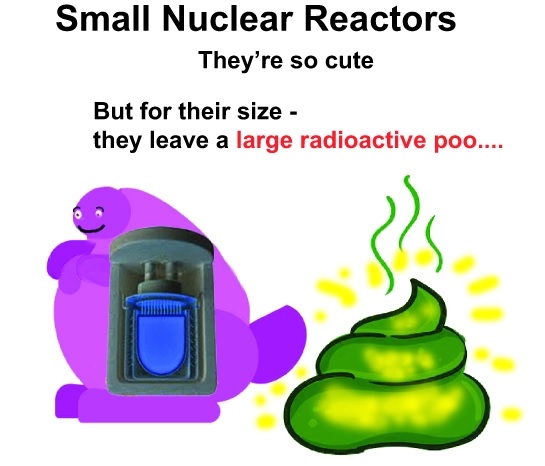
And that’s before one thinks about the nuclear waste nightmare: a new study published in Proceedings of the American National Academy of Sciences estimates that SMRs will create 30 times as much nuclear waste (per unit of electricity generated) as conventional reactors.
It’s all just a massive waste of time and public money – but with devastating consequences. If we could just free ourselves of our residual hankering after nuclear power, we could (finally!) double down on the infinitely more cost-effective renewables-storage-efficiency alternatives. With massive benefits in terms of decarbonisation, jobs, addressing fuel poverty and so on.
The case for this transition (away from fossil fuels and nuclear) is now incontrovertible but two remaining barriers stand in the way of us doing what Germany has managed to do.
The first is the endlessly repeated argument from nuclear industry spokespeople that nuclear power is the only way of providing the baseload generation our current electricity supply system depends on – once big thermal coal and gas plants are taken off the grid. There was indeed a time when grid stability depended on ‘always on’ big power stations. But that is now widely seen (outside the nuclear industry) to be a completely outmoded concept.
……………………… , the Government acknowledges that there is now no specific baseload expectations of nuclear or anything else. It is now all about ‘lowest cost’, rather than baseload,………..
So that’s another dead duck in the case made for new nuclear. Which just leaves the final barrier: the continuing reality that our nuclear weapons capability still depends very heavily on maintaining a civil nuclear power programme – not just to guarantee a continuing supply of nuclear engineers and R&D funding, but to keep the public in the dark about the increasingly insupportable costs of renewing our notionally ‘independent’ nuclear deterrent.

Which takes us right back to the origins of the German anti-nuclear movement in the 1970s. These ‘evil twins’, nuclear weapons and nuclear power, have forever been joined at the hip, and always will be until the world rids itself of the deadly incubus of nuclear weaponry.
As Germany ends nuclear era, activist says there is still more to do
By Riham Alkousaa 13 Apr 23 https://www.reuters.com/world/europe/germany-ends-nuclear-era-activist-says-still-more-do-2023-04-15/?fbclid=IwAR2vNrwrRP0HzRERH0bM02b4-zC1-Zd9NAhDKtbpSleRXrTvHbRlOa0HRzs
- Germany is closing its last three reactors on Saturday
- Smital says protest against nuclear power is not over
- Cites fuel assembly, enrichment facilities still operating
- Anti-nuclear movement helped spawn Germany’s Greens
BERLIN, April 15 (Reuters) – Heinz Smital was a 24-year-old nuclear physics researcher when he first saw how far nuclear contamination could spread after the Chornobyl disaster in 1986.
A few days after it occurred he waved a damp cloth out of a window at the University of Vienna to sample the city’s air and was shocked by how many radionuclides could be seen under a microscope.
“Technetium, Cobalt, Cesium 134, Cesium 137 …Chornobyl was 1,000 kilometres away … That made an impression,” Smital, now 61, said as he told Reuters about his life-long activism against nuclear power in Germany.
On Saturday Germany will shut off its last three reactors, ending six decades of nuclear power which helped spawn one of Europe’s strongest protest movements and the political party that governs Berlin today, the Greens.
“I can look back on a great many successes where I saw injustice and many years later, there was a breakthrough,” Smital said, showing a photo of himself in 1990s in front of the Unterweser Nuclear Power Plant, which was closed in 2011 following the Fukushima disaster in Japan.
Former Chancellor Angela Merkel responded to Fukushima by doing what no other Western leader had done, passing a law to exit nuclear by 2022.
An estimated 50,000 protesters in Germany formed a 45-kilometre long (27-mile) human chain after the Fukushima disaster from Stuttgart to the Neckarwestheim Nuclear Power Plant. Merkel would announce Germany’s planned nuclear exit within weeks.
“We really stood hand in hand at a certain point in time. I was also in the chain … It was impressive how that formed,” Smital said.
“That was a great feeling of a movement and also of belonging …a very nice, communal, exciting feeling that also develops a power,” Smital said.
One of the long-running movement’s early successes came in the 1970s when it managed to get plans for a nuclear plant in Wyhl in western Germany overturned.
THE GREENS
In parallel, a divided Germany during the Cold War also saw a peace movement evolve amid concerns among Germans that their land could become a battlefield between the two camps.
“This produced a strong peace movement and the two movements reinforced each other,” said Nicolas Wendler, a spokesperson for Germany’s nuclear technology industry group KernD.
Moving from street protests to organised political work with the establishment of the Greens party in 1980 gave the movement more power.
It was a Greens-coalition government that introduced the country’s first nuclear phase-out law in 2002.
The nuclear phase-out is a Greens project … and all parties have practically adopted it,” said Rainer Klute, head of pro-nuclear non-profit association Nuklearia.
On Saturday, both Smital and Klute stood as protesters at Berlin’s Brandenburg Gate, one celebrating the end of nuclear power, the other lamenting its demise.
“We have no other choice but to accept the phase-out for the time being,” Klute said.
Yet for Smital, the reactor closures do not mean the end of his activism.
“We have a uranium fuel assemblies factory in Germany … we have uranium enrichment, so there is still a lot that needs to be discussed here and I will be on the street a lot …very gladly,” he said.
Reporting by Riham Alkousaa; editing by Jason Neely
Germany’s last nukes shut down — Beyond Nuclear
As planned, Germany closed the last of its three operational reactors on April 15. These were kept running beyond their original December 2022 shutdown dates, largely as a political concession to conservative minority partners within the German government, as their electricity was not actually needed. The German winter energy crunch was related to a cutoff of gas imports from Russia, needed for heating. Since German heating is not electric, nuclear power had no role to play in easing that situation.
Amidst all the false propaganda in circulation that the German nuclear shutdown has caused a rise in coal use in Germany, it’s important to note an important historical fact that is the genesis for the German green energy revolution — known in Germany as the Energiewende.
Germany’s last nukes shut down — Beyond Nuclear
The Renewable Energy Act of 2000 stipulated as a pre-condition, that if nuclear power plants were to be shut down, these would be replaced by renewable energy and not by fossil fuels. And by creating a favorable and reliable investment environment for renewables, this is exactly what happened. Given its starting point in 2000, the growth of renewables has been stratospheric and Germany is well on target for its 2045 carbon-neutral goal. It also plans to phase out all coal use by 2038 at the latest and possibly by 2030. Moreover, while the nuclear share of Germany’s electricity market in 2000 was around 30%, today it is less than 6%.
Recent slight increases in brown coal (lignite) production in Germany were not for domestic consumption but market driven and, ironically, to meet winter electricity needs in nuclear France, which saw more than half of its not-so-reliable nuclear power fleet go down. More information about why Germany’s Energiewende is working, can be found in the 5th edition of our Talking Points. (Headline photo: Jakob Huber/Wikimedia Commons)
SEN. MARKEY AND REP. LIEU ANNOUNCE LEGISLATION TO LIMIT U.S. PRESIDENT’S POWER TO UNILATERALLY START NUCLEAR WAR
17 Apr 23
Bill would prevent any American president from launching a nuclear first strike without Congressional approval
Washington (April 14, 2023) – Senator Edward J. Markey (D-Mass.), co-chair of the Nuclear Weapons and Arms Control Working Group, and Representative Ted Lieu (CA-33) today announced the reintroduction of the Restricting First Use of Nuclear Weapons Act to prohibit any United States President from launching a nuclear strike without prior authorization from Congress. The legislation would also institute safeguards to prevent the president from introducing nuclear weapons in a conflict and reaffirm Congress’ singular constitutional authority to declare war. The reintroduction of Restricting First Use of Nuclear Weapons Act comes after a year of reckless nuclear threats from Russian President Vladimir Putin in his war of aggression against Ukraine. Fifty-four years ago this week, on April 15, 1969, North Korea shot down a U.S. military plane. According to top aides present at the time, an intoxicated President Richard Nixon allegedly ordered a nuclear strike in response. Thankfully, that order was disregarded and never carried out – however, it exposed the dangerous possibility of a rogue U.S. president ordering a nuclear strike without Congressional authorization.
“No president has the right or the constitutional authority to unilaterally declare war, let alone launch a nuclear first strike,” said Senator Markey. “In the face of Vladimir Putin’s nuclear threats, Congress must pass the Restricting First Use of Nuclear Weapons Act to reaffirm its authority and make clear to world leaders that the United States will uphold its commitment to peace, stability, and democracy.”
“Our founders established a system of checks and balances for a reason—no one person should have the ability to launch a war that would end life as we know it,” said Representative Lieu. “Congress alone has the constitutional duty to declare war, and decide whether a nuclear launch is necessary. In the wake of Russia’s unprovoked and illegal invasion of Ukraine, and given the volatility of autocrats like war criminal Vladimir Putin, the threat presented by unpredictable use of nuclear weapons has never been clearer. I’m proud to join Senator Markey in reintroducing this important legislation, which will establish necessary guardrails to the President’s ability to launch nuclear weapons.”
A copy of the legislation can be found HERE.
The Restricting First Use of Nuclear Weapons Act is endorsed by Physicians for Social Responsibility, Council for a Livable World, Foreign Policy for America, Friends Committee on National Legislation, Global Zero, Win Without War, and Ploughshares Fund.
In 2022, Senators Markey and Jeff Merkley (D-Ore.) and Representatives John Garamendi (CA-03) and Don Beyer (VA-08) led 51 of their colleagues in a letter to President Joe Biden urging the U.S. to reduce its reliance on nuclear weapons. On the one-year anniversary of the start of Russia’s full-scale invasion of Ukraine, the lawmakers condemned President Putin’s nuclear threats and Russia’s violation of the New START Treaty.
German nuclear phaseout – a victory of reason over the lust for profit
Millions of people worked towards this day for years. People who protested
against reprocessing plants, nuclear waste transport, unsafe nuclear waste
storage facilities and the construction of new nuclear power plants.
Those decades of resistance were worth it. The German nuclear phase-out is a
victory of reason over the lust for profit; over powerful corporations and
their client politicians.
It is a people-powered success against all the
odds. I thank all the brave people who took risks for their beliefs;
everyone who took part in demonstrations; all the people who signed
petitions and sent letters of protest. And I’m proud of the role Greenpeace
has played in opposing high-risk nuclear technology.
Greenpeace 15th April 2023 https://www.greenpeace.org/international/story/59219/tschuss-atomkraft-end-nuclear-power-germany/
Virginia lawmakers kill Governor Youngkin’s amendment to define nuclear energy as renewable
The Hill, BY ZACK BUDRYK – 04/14/23
Virginia’s Democratic-controlled Senate rejected an amendment to an energy bill this week that would have allowed nuclear and hydrogen power to qualify as renewables.
In a 22-18 party line vote on Wednesday, the Senate rejected several amendments offered by Gov. Glenn Youngkin (R) to state legislation that would qualify certain biomass facilities as renewable energy.
Mike Town, executive director of the Virginia League of Conservation Voters, said the organization is “grateful” for the vote…………………………..
The vote is the latest clash between Youngkin and the upper chamber of the legislature on environment and energy issues……………………. https://thehill.com/policy/energy-environment/3951137-virginia-lawmakers-kill-youngkin-amendment-to-define-nuclear-energy-as-renewable/
A new era’: Germany quits nuclear power, closing its final three plants

“There will be a moment of decision as to whether nuclear really has a future”
By Laura Paddison, Nadine Schmidt and Inke Kappeler, CNN, 15 Apr 23
Germany’s final three nuclear power plants close their doors on Saturday, marking the end of the country’s nuclear era that has spanned more than six decades.
Nuclear power has long been contentious in Germany.
There are those who want to end reliance on a technology they view as unsustainable, dangerous and a distraction from speeding up renewable energy.
But for others, closing down nuclear plants is short-sighted. They see it as turning off the tap on a reliable source of low-carbon energy at a time when drastic cuts to planet-heating pollution are needed.
Even as these debates rumble on, and despite last-minute calls to keep the plants online amid an energy crisis, the German government has been steadfast.
“The position of the German government is clear: nuclear power is not green. Nor is it sustainable,” Steffi Lemke, Germany’s Federal Minister for the Environment and Consumer Protection and a Green Party member, told CNN.
“We are embarking on a new era of energy production,” she said.
A plan decades in the making
The closure of the three plants – Emsland, Isar 2 and Neckarwestheim – represents the culmination of a plan set in motion more than 20 years ago. But its roots are even older.
In the 1970s, a strong anti-nuclear movement in Germany emerged. Disparate groups came together to protest new power plants, concerned about the risks posed by the technology and, for some, the link to nuclear weapons. The movement gave birth to the Green Party, which is now part of the governing coalition.
Nuclear accidents fueled the opposition: The partial meltdown of the Three Mile Island nuclear power plant in Pennsylvania in 1979 and the 1986 catastrophe at Chernobyl that created a cloud of radioactive waste which reached parts of Germany.
In 2000, the German government pledged to phase out nuclear power and start shutting down plants. But when a new government came to power in 2009, it seemed – briefly – as if nuclear would get a reprieve as a bridging technology to help the country move to renewable energy.
Then Fukushima happened.
In March 2011, an earthquake and tsunami caused three reactors of the Fukushima Daiichi power plant to melt down. For many in Germany, Japan’s worst nuclear disaster was confirmation “that assurances that a nuclear accident of a large scale can’t happen are not credible,” Miranda Schreurs, professor of environment and climate policy at the Technical University of Munich, told CNN.
Three days later then-Chancellor Angela Merkel – a physicist who was previously pro-nuclear – made a speech called it an “inconceivable catastrophe for Japan” and a “turning point” for the world. She announced Germany would accelerate a nuclear phase-out, with older plants shuttered immediately.
Russia’s invasion of Ukraine, however, provided another plot twist.
Fearful of its energy security without Russian gas, the German government delayed its plan to close the final three plants in December 2022. Some urged a rethink.
But the government declined, agreeing to keep them running only until April 15.
For those in the anti-nuclear movement, it’s a moment of victory.
“It is a great achievement for millions of people who have been protesting nuclear in Germany and worldwide for decades,” Paul-Marie Manière, a spokesperson for Greenpeace, told CNN
A polarizing energy
For critics of Germany’s policy, however, it’s irrational to turn off a low-carbon source of energy as the impacts of the climate crisis intensify……………………………………………………………….
……………………………………………………..supporters of the nuclear shutdown argue it will ultimately hasten the end of fossil fuels.
Germany has pledged to close its last coal-fired power station no later than 2038, with a 2030 deadline in some areas. It’s aiming for 80% of electricity to come from renewables by the end of this decade.
While more coal was added in the months following Fukushima, Schreurs said, nuclear shutdowns have seen a big push on clean energy. “That urgency and demand can be what it takes to push forward on the growth of renewables,” she said.
Representatives for Germany’s renewable energy industry said the shutdown will open the door for more investment into clean energy……….
Representatives for Germany’s renewable energy industry said the shutdown will open the door for more investment into clean energy.
“Germany’s phase-out of nuclear power is a historic event and an overdue step in energy terms,” Simone Peter, president of the German Renewable Energy Federation (BEE), told CNN. “It is high time that we leave the nuclear age behind and consistently organize the renewable age.”
The impacts of nuclear power shouldn’t be overlooked either, Schreurs said, pointing to the carbon pollution created by uranium mining as well as the risk of health complications for miners. Plus, it creates a dependency on Russia, which supplies uranium for nuclear plants, she added.
Nuclear has also shown itself to have vulnerabilities to the climate crisis. France was forced to reduce nuclear power generation last year as the rivers used to cool reactors became too hot during Europe’s blistering heatwave.
A million-year problem
Now Germany must work out what do with the deadly, high-level radioactive waste, which can remain dangerous for hundreds of thousands of years.
Currently, the nuclear waste is kept in interim storage next to the nuclear plants being decommissioned. But the search is on to find a permanent location where the waste can be stored safely for a million years.
The site needs to be deep – hundreds of meters underground. Only certain types of rock will do: Crystalline granite, rock salt or clay rock. It must be geologically stable with no risks of earthquakes or signs of underground rivers.
The process is likely to be fraught, complex and breathtakingly long – potentially lasting more than 100 years.
BGE, the Federal Company for Radioactive Waste Disposal, estimates a final site won’t be chosen until between 2046 and 2064. After that, it will take decades more to build the repository, fill it with the waste and seal it.
What are other countries doing?
Plenty of other countries are treading paths similar to Germany’s. Denmark passed a resolution in the 1980s not to construct nuclear power plants, Switzerland voted in 2017 to phase out nuclear power, Italy closed its last reactors in 1990 and Austria’s one nuclear plant has never been used.
But, in the context of the war in Ukraine, soaring energy prices and pressure to reduce carbon pollution, others still want nuclear in the mix.
The UK, in the process of building a nuclear power plant, said in its recent climate strategy that energy nuclear power has a “crucial” role in “creating secure, affordable and clean energy.”
France, which gets about 70% of its power from nuclear, is planning six new reactors, and Finland opened a new nuclear plant last year. Even Japan, still dealing with the aftermath of Fukushima, is considering restarting reactors.
The US, the world’s biggest nuclear power, is also investing in nuclear energy and, in March, started up a new nuclear reactor, Vogtle 3 in Georgia – the first in years.
But experts suggest this doesn’t mark the start of a nuclear ramp up. Vogtle 3 came online six years late and at a cost of $30 billion, twice the initial budget.
It encapsulates the big problem that afflicts the whole nuclear industry: making the economics add up. New plants are expensive and can take more than a decade to build. “Even the countries that are talking pro-nuclear are having big trouble developing nuclear power,” Schreurs said.
Many nuclear power plants in Europe, the US and elsewhere are aging – plants have an operating life of around 40 to 60 years. As Germany puts an end to its nuclear era, it’s coming up to crunch time for others, Schreurs said.
“There will be a moment of decision as to whether nuclear really has a future”
CNN’s Chris Stern contributed reporting.
1 This Month
23-25 October – on Zoom – World BEYOND War’s annual global conferenc


Shut down the radiation-damaged Heysham nuclear reactors now
To see nuclear-related stories in greater depth and intensity – go to https://nuclearinformation.wordpress.com

Say No to NASA’s Reckless Nuclear Reactor on the Moon
Say No to NASA’s Reckless Nuclear Reactor on the Moon
-
Archives
- October 2026 (190)
- September 2026 (339)
- August 2026 (330)
- July 2026 (355)
- June 2026 (287)
- May 2026 (306)
- April 2026 (356)
- March 2026 (251)
- February 2026 (267)
- January 2026 (308)
- December 2025 (358)
- November 2025 (359)
-
Categories
- 1
- 1 NUCLEAR ISSUES
- business and costs
- climate change
- culture and arts
- ENERGY
- environment
- health
- history
- indigenous issues
- Legal
- marketing of nuclear
- media
- opposition to nuclear
- PERSONAL STORIES
- politics
- politics international
- Religion and ethics
- safety
- secrets,lies and civil liberties
- spinbuster
- technology
- Uranium
- wastes
- weapons and war
- Women
- 2 WORLD
- ACTION
- AFRICA
- Atrocities
- AUSTRALIA
- Christina's notes
- Christina's themes
- culture and arts
- Events
- Fuk 2022
- Fuk 2023
- Fukushima 2017
- Fukushima 2018
- fukushima 2019
- Fukushima 2020
- Fukushima 2021
- general
- global warming
- Humour (God we need it)
- Nuclear
- RARE EARTHS
- Reference
- resources – print
- Resources -audiovicual
- Weekly Newsletter
- World
- World Nuclear
- YouTube
-
RSS
Entries RSS
Comments RSS

