Elon Musk’s Shadow Rule

In the past twenty years, against a backdrop of crumbling infrastructure and declining trust in institutions, Musk has sought out business opportunities in crucial areas where, after decades of privatization, the state has receded. The government is now reliant on him, but struggles to respond to his risk-taking, brinkmanship, and caprice.
Musk was asked whether he has more influence than the American government. He replied immediately, “In some ways.”
“We are living off his good graces,” a Pentagon official said of Musk’s role in the war in Ukraine. “That sucks.”
How the U.S. government came to rely on the tech billionaire—and is now struggling to rein him in.
New Yorker, By Ronan Farrow, August 21, 2023
Last October, Colin Kahl, then the Under-Secretary of Defense for Policy at the Pentagon, sat in a hotel in Paris and prepared to make a call to avert disaster in Ukraine. A staffer handed him an iPhone—in part to avoid inviting an onslaught of late-night texts and colorful emojis on Kahl’s own phone. Kahl had returned to his room, with its heavy drapery and distant view of the Eiffel Tower, after a day of meetings with officials from the United Kingdom, France, and Germany. A senior defense official told me that Kahl was surprised by whom he was about to contact: “He was, like, ‘Why am I calling Elon Musk?’ ”
The reason soon became apparent. “Even though Musk is not technically a diplomat or statesman, I felt it was important to treat him as such, given the influence he had on this issue,” Kahl told me. SpaceX, Musk’s space-exploration company, had for months been providing Internet access across Ukraine, allowing the country’s forces to plan attacks and to defend themselves. But, in recent days, the forces had found their connectivity severed as they entered territory contested by Russia.
More alarmingly, SpaceX had recently given the Pentagon an ultimatum: if it didn’t assume the cost of providing service in Ukraine, which the company calculated at some four hundred million dollars annually, it would cut off access. “We started to get a little panicked,” the senior defense official, one of four who described the standoff to me, recalled. Musk “could turn it off at any given moment. And that would have real operational impact for the Ukrainians.”
Musk had become involved in the war in Ukraine soon after Russia invaded, in February, 2022. Along with conventional assaults, the Kremlin was conducting cyberattacks against Ukraine’s digital infrastructure. Ukrainian officials and a loose coalition of expatriates in the tech sector, brainstorming in group chats on WhatsApp and Signal, found a potential solution: SpaceX, which manufactures a line of mobile Internet terminals called Starlink. The tripod-mounted dishes, each about the size of a computer display and clad in white plastic reminiscent of the sleek design sensibility of Musk’s Tesla electric cars, connect with a network of satellites.
The units have limited range, but in this situation that was an advantage: although a nationwide network of dishes was required, it would be difficult for Russia to completely dismantle Ukrainian connectivity. Of course, Musk could do so. Three people involved in bringing Starlink to Ukraine, all of whom spoke on the condition of anonymity because they worried that Musk, if upset, could withdraw his services, told me that they originally overlooked the significance of his personal control. “Nobody thought about it back then,” one of them, a Ukrainian tech executive, told me. “It was all about ‘Let’s fucking go, people are dying.’ ”
In the ensuing months, fund-raising in Silicon Valley’s Ukrainian community, contracts with the U.S. Agency for International Development and with European governments, and pro-bono contributions from SpaceX facilitated the transfer of thousands of Starlink units to Ukraine. A soldier in Ukraine’s signal corps who was responsible for maintaining Starlink access on the front lines, and who asked to be identified only by his first name, Mykola, told me, “It’s the essential backbone of communication on the battlefield.”
Initially, Musk showed unreserved support for the Ukrainian cause, responding encouragingly as Mykhailo Fedorov, the Ukrainian minister for digital transformation, tweeted pictures of equipment in the field. But, as the war ground on, SpaceX began to balk at the cost. “We are not in a position to further donate terminals to Ukraine, or fund the existing terminals for an indefinite period of time,” SpaceX’s director of government sales told the Pentagon in a letter, last September. (CNBC recently valued SpaceX at nearly a hundred and fifty billion dollars. Forbes estimated Musk’s personal net worth at two hundred and twenty billion dollars, making him the world’s richest man.)
Musk was also growing increasingly uneasy with the fact that his technology was being used for warfare. That month, at a conference in Aspen attended by business and political figures, Musk even appeared to express support for Vladimir Putin. “He was onstage, and he said, ‘We should be negotiating. Putin wants peace—we should be negotiating peace with Putin,’ ” Reid Hoffman, who helped start PayPal with Musk, recalled. Musk seemed, he said, to have “bought what Putin was selling, hook, line, and sinker.” A week later, Musk tweeted a proposal for his own peace plan, which called for new referendums to redraw the borders of Ukraine, and granted Russia control of Crimea, the semi-autonomous peninsula recognized by most nations, including the United States, as Ukrainian territory. In later tweets, Musk portrayed as inevitable an outcome favoring Russia and attached maps highlighting eastern Ukrainian territories, some of which, he argued, “prefer Russia.” Musk also polled his Twitter followers about the plan. Millions responded, with about sixty per cent rejecting the proposal. (Volodymyr Zelensky, Ukraine’s President, tweeted his own poll, asking users whether they preferred the Elon Musk who supported Ukraine or the one who now seemed to back Russia. The former won, though Zelensky’s poll had a smaller turnout: Musk has more than twenty times as many followers.)
……… . One day, Ukrainian forces advancing into contested areas in the south found themselves suddenly unable to communicate…………………………………….. . The Financial Times reported that outages affected units in Kherson, Zaporizhzhia, Kharkiv, Donetsk, and Luhansk. American and Ukrainian officials told me they believed that SpaceX had cut the connectivity via geofencing, cordoning off areas of access.
The senior defense official said, “We had a whole series of meetings internal to the department to try to figure out what we could do about this.” Musk’s singular role presented unfamiliar challenges, as did the government’s role as intermediary……………… The Pentagon would need to reach a contractual arrangement with SpaceX so that, at the very least, Musk “couldn’t wake up one morning and just decide, like, he didn’t want to do this anymore.”
……………… To the dismay of Pentagon officials, Musk volunteered that he had spoken with Putin personally. Another individual told me that Musk had made the same assertion in the weeks before he tweeted his pro-Russia peace plan, and had said that his consultations with the Kremlin were regular……………. On the phone, Musk said that he was looking at his laptop and could see “the entire war unfolding” through a map of Starlink activity. ………….Musk told Kahl that the vivid illustration of how technology he had designed for peaceful ends was being used to wage war gave him pause.
After a fifteen-minute call, Musk agreed to give the Pentagon more time. He also, after public blowback and with evident annoyance, walked back his threats to cut off service. “The hell with it,” he tweeted. “Even though Starlink is still losing money & other companies are getting billions of taxpayer $, we’ll just keep funding Ukraine govt for free.” This June, the Department of Defense announced that it had reached a deal with SpaceX.
The meddling of oligarchs and other monied interests in the fate of nations is not new.……………………………….
But Musk’s influence is more brazen and expansive. There is little precedent for a civilian’s becoming the arbiter of a war between nations in such a granular way, or for the degree of dependency that the U.S. now has on Musk in a variety of fields, from the future of energy and transportation to the exploration of space. SpaceX is currently the sole means by which nasa transports crew from U.S. soil into space, a situation that will persist for at least another year. The government’s plan to move the auto industry toward electric cars requires increasing access to charging stations along America’s highways. But this rests on the actions of another Musk enterprise, Tesla. The automaker has seeded so much of the country with its proprietary charging stations that the Biden Administration relaxed an early push for a universal charging standard disliked by Musk. His stations are eligible for billions of dollars in subsidies, so long as Tesla makes them compatible with the other charging standard.
In the past twenty years, against a backdrop of crumbling infrastructure and declining trust in institutions, Musk has sought out business opportunities in crucial areas where, after decades of privatization, the state has receded. The government is now reliant on him, but struggles to respond to his risk-taking, brinkmanship, and caprice.
Current and former officials from nasa, the Department of Defense, the Department of Transportation, the Federal Aviation Administration, and the Occupational Safety and Health Administration told me that Musk’s influence had become inescapable in their work, and several of them said that they now treat him like a sort of unelected official. One Pentagon spokesman said that he was keeping Musk apprised of my inquiries about his role in Ukraine and would grant an interview with an official about the matter only with Musk’s permission. “We’ll talk to you if Elon wants us to,” he told me. In a podcast interview last year, Musk was asked whether he has more influence than the American government. He replied immediately, “In some ways.” Reid Hoffman told me that Musk’s attitude is “like Louis XIV: ‘L’état, c’est moi.’ ”
Musk’s power continues to grow. His takeover of Twitter, which he has rebranded “X,” gives him a critical forum for political discourse ahead of the next Presidential election. He recently launched an artificial-intelligence company, a move that follows years of involvement in the technology. Musk has become a hyper-exposed pop-culture figure, and his sharp turns from altruistic to vainglorious, strategic to impulsive, have been the subject of innumerable articles and at least seven major books, including a forthcoming biography by Walter Isaacson. But the nature and the scope of his power are less widely understood.
More than thirty of Musk’s current and former colleagues in various industries and a dozen individuals in his personal life spoke to me about their experiences with him. Sam Altman, the C.E.O. of OpenAI, with whom Musk has both worked and sparred, told me, “Elon desperately wants the world to be saved. But only if he can be the one to save it.”
…………………………………………………..officials expressed profound misgivings. “Living in the world we live in, in which Elon runs this company and it is a private business under his control, we are living off his good graces,” a Pentagon official told me. “That sucks.”
……………………………………………………………………………………………………………………………………………………………………………………………………Of all Musk’s enterprises, SpaceX may be the one that most fundamentally reflects his appetite for risk…………………………………………………………………………………………………………………………………………………………….. “He has a long history of launching and blowing up rockets. And then he puts out videos of all the rockets that he’s blown up. And like half of America thinks it’s really cool,” the former nasa administrator Jim Bridenstine told me. “He has a different set of rules.”
……………………………………………………………………………………………………………………………….. There are competitors in the field, including Jeff Bezos’s Blue Origin and Richard Branson’s Virgin Galactic, but none yet rival SpaceX. The new space race has the potential to shape the global balance of power. Satellites enable the navigation of drones and missiles and generate imagery used for intelligence, and they are mostly under the control of private companies…………………………………
Several officials told me that they were alarmed by nasa’s reliance on SpaceX for essential services. “There is only one thing worse than a government monopoly. And that is a private monopoly that the government is dependent on,” Bridenstine said. “I do worry that we have put all of our eggs into one basket, and it’s the SpaceX basket.”
………………………………………………………………………………………………………. Officials who have worked at osha and at an equivalent California agency told me that Musk’s influence, and his attitude about regulation, had made their jobs difficult…………………………………………………………………………………. You add on the fact that he considers himself to be a master of the universe and these rules just don’t apply to people like him,” Jordan Barab, a former Deputy Assistant Secretary of Labor at osha, told me. “There’s a lot of underreporting in industry in general. And Elon Musk kind of seems to raise that to an art form.” Garrett Brown, a former field-compliance inspector at California’s Division of Occupational Safety and Health, added, “We have a bad health-and-safety situation throughout the country. And it’s worse in companies run by people like Elon Musk, who was ideologically opposed to the idea of government enforcement of public-health regulations.”
………………………………………………………………………………………………………………………………………………………………………………………………………………………………. On July 12th, Musk announced xAI, his entry into a field that promises to alter much about life as we know it. He tweeted an image of the new company’s Web site, featuring a characteristically theatrical mission statement: the firm’s goal, he said, was “to understand the true nature of the universe.”
……………………………………………………… Musk has been involved in artificial intelligence for years. In 2015, he was one of a handful of tech leaders, including Hoffman and Thiel, who funded OpenAI, then a nonprofit initiative. (It now has a for-profit subsidiary.)………………………………………………… Musk left the company in 2018, reneging on a commitment to further fund OpenAI……………………………. a lot of my life and time to make sure we had enough funding.” OpenAI went on to become a leader in the field, introducing ChatGPT last year. Musk has made a habit of trashing the company,
……………………..It is difficult to say whether Musk’s interest in A.I. is driven by scientific wonder and altruism or by a desire to dominate a new and potentially powerful industry.
……………………….. In March, Musk, along with dozens of tech leaders, signed an open letter calling for a six-month pause in the development of advanced A.I. technology……………………. Yet in the period during which Musk endorsed a pause, he was working to build xAI, recruiting from major competitors, including OpenAI, and even, according to someone with knowledge of the conversation, contacting leadership at Nvidia, the dominant maker of chips used in A.I. The month the letter was distributed, Musk completed the registrations for xAI.
…………… “His whole approach to A.I. is: A.I. can only be saved if I deliver, if I build it.” …………………………………. more https://www.newyorker.com/magazine/2023/08/28/elon-musks-shadow-rule#:~:text=How%20the%20U.S.%20government%20came,struggling%20to%20rein%20him%20in.&text=Last%20October%2C%20Colin%20Kahl%2C%20then,to%20avert%20disaster%20in%20Ukraine.–
Chicago Tribune should support Vivec Ramasramy’s call for end to perpetual war in Ukraine .
Walt Zlotow, President, West Suburban Peace Coalition, Glen Ellyn IL 27 Aug 23
As a peace advocate for the local West Suburban Peace Coalition, I take issue with the Trib’s Editorial: ‘Vladimir Putin is no Bond villain. Supporting him is morally repulsive.’
It mischaracterized Ramaswamy’s implied plea for peace in Ukraine thru ending unlimited weaponizing of the failed Ukraine counteroffensive. It said not one word about “going soft” on Russian President Putin.
Ramaswamy is not “morally repugnant”. He was simply reflecting current US public opinion. A majority now support ending weapons which squander US treasure while extending the killing and destruction in Ukraine indefinitely. –The Trib should know that virtually every war ends with a negotiated settlement. The only way that will not occur in Ukraine is if it goes nuclear. Ramaswamy was the only candidate on the podium promoting peace in Ukraine. That deserves our support, not condemnation.
Kudankulam Nuclear plant will destroy Southern Tamil Nadu, warns Vaiko
August 28, 2023 https://www.thehindu.com/news/national/tamil-nadu/kudankulam-nuclear-plant-will-destroy-southern-tamil-nadu-warns-vaiko/article67241700.ece
MDMK general secretary Vaiko on Sunday feared that waste water stored in the Nuclear Power Plants in Kudankulam could be released in the future into the Bay of Bengal destroying the coastal villages in southern Tamil Nadu. His apprehension was triggered by Japan’s decision to release stored waste water from the Fukushima nuclear plant into the pacific ocean.
In a statement in Chennai, he said the power plant was a Damoclean sword hanging over Tamil Nadu and closing the plant alone could save the people.
“You may land on the Moon. But I am worried that a part of Tamil Nadu will be destroyed. I would like to warn the Centre which is not bothered about the threat,” he said.
Mr Vaiko said nuclear plants in Russia, Japan and the US had affected a lot of people. “Japan has released waste water in the Pacific Ocean and the people of the country are opposing it,” he said.
Senate extends nuclear liability-limiting law without public scrutiny. Here’s why we should care.
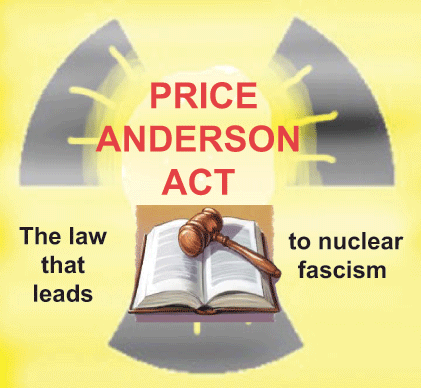
The chief problem with the Price-Anderson Act is the difference in how the law affects the public and the nuclear firms. In view of federal preemption of nuclear licensing, the public has essentially no say in the siting of a nuclear power plant and so must accept the associated accident risk. Nuclear vendors, however, are freed from all liability for offsite consequences of a nuclear accident, and so have nothing to worry about, either financially or legally.
Bulletin, By Victor Gilinsky | August 22, 2023
By Victor Gilinsky | August 22, 202
On the night of July 27, the US Senate passed the National Defense Authorization Act for fiscal year 2024. The Senate-approved bill included a 20-year extension of the Price-Anderson Nuclear Industries Indemnity Act, which provides that if there are any offsite lives and property lost in a severe reactor accident, nuclear industry manufacturers and builders cannot be held liable. The extension of the act also includes another controversial provision—the adequacy of funds provided by the act for compensating victims of a nuclear accident.
The approval last month of this extension came without any public hearings and was introduced in Congress in a rather troubling manner. The extension’s backers, knowing it would face rough sledding in an open hearing, first attached it to the Accelerating Deployment of Versatile, Advanced Nuclear for Clean Energy (ADVANCE) Act of 2023, which was then placed on the Senate legislative calendar on July 10 and added to the “must-pass” National Defense Authorization Act. While it has yet to pass the House, the act bears powerfully on the country’s commitment to nuclear energy, and especially on safety standards for nuclear power plants and therefore should not escape public scrutiny.
The Price-Anderson Act was first approved in 1957, soon after the Atomic Energy Act of 1954 permitted private nuclear energy activity. Firms like General Electric and Westinghouse, among others, told Congress they would not build commercial nuclear power plants—a technology with which there was essentially no experience—if they faced vast liability for possible accidents. To promote rapid investment in nuclear power plants, the government gave the builders and vendors freedom from liability for offsite accidents. It added provisions for public compensation after a catastrophic accident. But both provisions need updating in view of what we have learned in the last 60-odd years.
The act currently provides about $13 billion for post-accident public compensation, with the funds coming over time from a self-insurance scheme funded by the owners of nuclear power plants. But the estimated cost of the 2011 Fukushima accident—several hundred billion dollars—dwarfs the Price-Anderson amount. Yet, there is more. If an accident was to lead to widespread and long-term nuclear plant shutdowns, as occurred in Japan, it isn’t clear the owners would be able to meet their financial obligations. What’s clear is that after a severe nuclear accident, the issue of compensation would land in the lap of Congress.
At a 2014 Nuclear Regulatory Commission hearing on a safety upgrade for the 19 US plants essentially identical to the ones at Fukushima, the staff of the US Nuclear Regulatory Commission (NRC) told the commissioners that a fire in only one of the pools in which nuclear plants store highly radioactive used fuel could release much more radioactivity, conceivably 20 times more, than in the 2011 Fukushima accident. The commissioners at the time dismissed the concern on grounds that such an event was so improbable it failed the NRC’s cost-benefit analysis. But, however remote, the possibility remains.
The chief problem with the Price-Anderson Act is the difference in how the law affects the public and the nuclear firms. In view of federal preemption of nuclear licensing, the public has essentially no say in the siting of a nuclear power plant and so must accept the associated accident risk. Nuclear vendors, however, are freed from all liability for offsite consequences of a nuclear accident, and so have nothing to worry about, either financially or legally.
According to the NRC, calculations using “probabilistic risk assessment” serve as proof that the probability of severe nuclear accidents at US nuclear plants is extremely remote. But large nuclear vendors like General Electric and Westinghouse evidently don’t believe these numbers; otherwise, they would accept liability and would not fear risking their stockholders’ investment. If reactor builders won’t accept paying for the consequences of a possible nuclear accident, why then should members of the public, whose health and communities would be affected?……………………………………………………….
The current exuberance over “advanced” reactors” has some of the same boosterish markings as the earlier AEC episode, with the advocates so sure they are right that they think cutting corners is okay—like dispensing with public hearings on Price-Anderson Act extension.
The Price-Anderson Act extension is part of a larger program that would pull out the stops on granting generous subsidies to private nuclear firms, speeding approvals of nuclear license applications and promoting nuclear reactor exports—all supposedly in the interest of “reestablishing America’s preeminence as the global leader in nuclear energy in the 21st century.”
We need to stop and think as a society before it’s too late. Rather than a hastily and quietly passed 20-year extension, we need first a thorough public examination of the Price-Anderson Act’s fundamental provisions and their effect on nuclear reactor safety and licensing standards. https://thebulletin.org/2023/08/senate-extends-nuclear-liability-limiting-law-without-public-scrutiny-heres-why-we-should-care/?utm_source=Newsletter&utm_medium=Email&utm_campaign=ThursdayNewsletter08242023&utm_content=NuclearRisk_NuclearLiabilityLimiting_08222023
Neocon Dark Money Front Launches Desperate Ad Blitz, as Support for Ukraine Forever War Craters
By Alexander Rubinstein / The Grayzone 23 Aug 23
Defending Democracy Together, a neoconservative outfit led by career chickenhawk scribe Bill Kristol, has launched a new initiative called “Republicans for Ukraine” to transform the 2024 presidential election into a referendum on US funding for the NATO proxy war.
Urging Republicans in Congress to support more funding for Ukraine in the upcoming appropriations bill is also a key item on the agenda…………………………………………………….
Now, as the Ukrainian counteroffensive fails and a majority of Americans declare opposition for the first time to sending more military aid to Ukraine, Kristol is launching a multimillion dollar ad blitz to keep the tanks slogging through the Donbas mud and the dark money flowing into his bank accounts. https://scheerpost.com/2023/08/23/neocon-dark-money-front-launches-desperate-ad-blitz-as-support-for-ukraine-forever-war-craters/
More nuclear challenges await Japan after Fukushima water release
By Kiyoshi Takenaka, TOKYO, Aug 24 (Reuters) https://www.reuters.com/world/asia-pacific/more-nuclear-challenges-await-japan-after-fukushima-water-release-2023-08-24/ Twelve years after the Fukushima nuclear disaster, Japan has started to release treated radioactive water into the sea, a key step in the process of decommissioning the stricken plant, but much tougher tasks lie ahead, such as molten fuel removal.
Here are the challenges facing the government and plant operator Tokyo Electric Power Co (Tepco) (9501.T) as they try to draw a line by the middle of the century under the world’s worst nuclear accident since Chornobyl.
MOLTEN FUEL REMOVAL
Tepco has described the effort to remove highly radioactive fuel debris from reactor cores as an “unprecedented and difficult challenge never attempted anywhere in the world”.
Trial-based retrieval at the No.2 reactor, the first at the plant to go through such a step, has been delayed twice from an initially scheduled date of 2021, and is now set for a six-month period starting in October.
At Three Mile Island (TMI), the U.S. nuclear plant in Pennsylvania that partly melted down in 1979 after a failure, fuel debris was kept under water during retrieval work, providing a shield against radiation.
That was the worst nuclear plant accident before the 1986 Chornobyl tragedy in Ukraine, then part of the Soviet Union.
Japan and Tepco plan to remove molten fuel while it is exposed to air because it is difficult to fill the badly damaged reactor cores with water.
But that will also make it hard to protect workers and retrieval gear from strong radiation.
The Fukushima plant suffered triple meltdowns, compared to the single fuel core meltdown at Three Mile Island, which means the debris retrieval operation will be much larger and more complicated this time around.
The retrieval will be done by a remotely controlled, 22-metre-long (72-foot) robot arm. The initial stage aims to extract only a few grammes of fuel debris, although the total molten fuel at the plant is estimated to be 880 metric tonnes.
RADIOACTIVE SOIL
The 2011 accident spewed radiation into the air, which eventually contaminated the soil. Part of that tainted soil is stored at an interim site more than four times as big as New York’s Central Park.
But the law requires the soil stored at the interim site, located next to the tsunami-wrecked power plant, to be moved out of Fukushima within 30 years from when it began operating in 2015.
More than a quarter of that interval has elapsed with no clear sign the government is nearer to securing permanent storage, though the environment ministry says the earliest the search for specific locations will start is 2025.
BALLOONING COSTS
In 2016, the government doubled to 21.5 trillion yen ($148.60 billion) its estimate of the costs of responding to the Fukushima disaster, including compensation, decommissioning and decontamination efforts.
About 12.1 trillion yen had been spent on such activities by March 2022, Japan’s audit panel, which reviews government expenditures, has said.
That represents an expenditure of more than half of the government’s estimate, even before really tough tasks such as fuel debris retrieval have begun, in turns raising concerns about cost overruns.
Tepco’s continuing payouts to the victims hits its bottom line.
In 2019, a private think tank, the Japan Center for Economic Research, said compensation, decommissioning and decontamination costs were expected to reach 41 trillion yen in a scenario in which Fukushima water was diluted and discharged into the sea.
($1 = 144.6800 yen)
For the sake of Suffolk, Nuclear Free Local Authorities urge Centrica to ‘Say Non to Sizewell C’

Sizewell C is also a site presenting unique challenges. It is located on the Suffolk Heritage Coast, facing the increasing threat of storm surges……………
The Chairs of the Nuclear Free Local Authorities (NFLA) Steering Committee and the NFLA English Forum have written to the Chief Executive of Centrica, which owns British Gas, urging him ‘for the sake of our planet, the people, fauna and flora of Suffolk, the wallets of your hard-pressed electricity customers, and your own company bottom-line’ to say NON to Sizewell C.
The Times reported in July that Chief Executive Chris O’Shea was considering taking a stake in the project and Councillors O’Neill and Blackburn in their letter point out the pitfalls of investment ‘which would bring with it clear financial, ESG and reputational risks for Centrica’.
EDF Energy, now wholly owned by the French state, is currently building a similar plant at Hinkley Point C in Somerset – its history has not been a happy one with the project hugely behind schedule and massively over budget. In addition, Sizewell C will utilise the same EPR reactor as Hinkley Point C, a reactor design with a chequered safety and reliability record. A reactor in China was involved in an accident and is currently again shutdown (Taishan-1) and in Finland a second one only came online after the operator was forced to carry out repairs after a succession of equipment failures (Olkiluoto-3).
Sizewell C is also a site presenting unique challenges. It is located on the Suffolk Heritage Coast, facing the increasing threat of storm surges and coastal erosion, and with climate change modelling suggesting it would become inundated and isolated; there are several sites of scientific interest nearby; and the county is under increasing water stress with fears that there will be insufficient fresh water to meet the needs of the plant as well as local people.
The Councillors point out that several prospective investors who manage large pension funds have clearly indicated that ‘they will not be dipping their financial toe into the radioactive water’ of Sizewell C. Pension managers at The People’s Pension; Nest; BT; BBC; Tesco; and Pearson have all, in correspondence seen by campaigners at Stop Sizewell C, indicated they will not be backing Sizewell C, whilst the Daily Mail reported that Nat West and BT told the paper they would also not be investing and Legal and General’s Nigel Wilson told the BBC’s Today programme: “We are not big fans of HS2 and Sizewell C”.
Councillor O’Neill believes this to be sage advice:
“At a current projected cost of £32.7 billion, Hinkley Point C’s budget is fast approaching twice its first estimate at the time of financial close, and there is no reason to believe that Sizewell C will be delivered any more quickly or any more cheaply as the construction of large nuclear power plants in the UK is a litany of projects being delivered late and vastly over budget.”
Councillor David Blackburn, Chair of the NFLAs English Forum, is a co-signatory to the letter. He is urging opponents of the project to also contact Centrica to ask them not to invest:
“It would be far wiser for Centrica to direct every available penny into the proven renewable technologies that we already have now – these would generate power and heat far more quickly and more cheaply, and generate for them a more immediate financial return, than any further investment in this monstrous nuclear boondoggle.
“The NFLAs are pleased to back the campaign launched by Stop Sizewell C asking supporters to send an email directly to Mr O’Shea asking him not to invest in Sizewell C.
“You can take this direct action in just a few clicks by going to the site at https://action.stopsizewellc.org/centrica
The role of nuclear in the UK’s energy mix.
In 2022, nuclear power provided 13.9% of total electricity supplied in the UK. However, as the table below [on original] illustrates, its contribution has fallen significantly since
the 1990s, when it provided around a quarter of the UK’s total
electricity supply.
Since 1995 there have been eight nuclear plant
closures, with no new plants coming online, reducing installed nuclear
capacity reducing by more than a quarter.
Declining nuclear capacity has
been (more than) compensated for by the rise of renewable energy, whose
share of electricity generation rose from 3% in 2000 to 42% in 2022.
The chief scientist of Greenpeace UK, Dr Doug Parr, said that the nuclear
industry was making “speculative claims” regarding the proposed
benefits of SMRs relative to conventional nuclear power. He said that
“SMRs have no track record, but initial indications are that the familiar
problems of cost overruns and delays will be repeated”.
In addition to these concerns, Steve Thomas, an emeritus professor of energy policy at the
University of Greenwich, suggests that the focus on SMRs will divert time
and resources away from energy efficiency and renewables which he believes
are the “answers” to net zero electricity generation.
Professor Thomas’s position is in line with that of the Green Party, the Liberal
Democrats, and the Scottish National Party. The co-leader of the Green
Party Adrian Ramsey has described nuclear as an “expensive
distraction”, arguing that renewable energy technologies and energy
efficiency are “cleaner and cheaper solutions that can be delivered far
quicker than nuclear ever can”.
Wera Hobhouse, the Liberal Democrat
energy and climate change spokesperson, has also criticised the expense of
nuclear power relative to renewables. Referring to the Nuclear Energy
(Financing) Act 2022, she argued it was “madness” that the government
had “recently passed a new law that will allow them to add levies to
energy bills to fund new nuclear plants”.
Scotland’s last remaining
nuclear power plant in Torness is due to close in 2028 and SNP energy
spokesperson Alan Brown has said that the UK government should be focussing
its efforts on Scotland’s “renewable energy potential” rather than
attempting to build more nuclear power stations.
House of Lords Library 23rd Aug 2023
Biden’s rival, Robert F. Kennedy Junior, labels F-16s for Ukraine ‘a disaster for humanity’

21vAug 23 , https://www.rt.com/news/581543-kennedy-ukraine-f16-delivery/1
Supplying US-made fighter jets to Kiev would only benefit the defense industry, RFK Jr. says
The looming delivery of US-made F-16 fighter jets to Ukraine will not prevent the “collapse” of the country’s military and will only benefit the military-industrial complex, Democrat presidential hopeful Robert F. Kennedy Junior has claimed.
The Ukrainian conflict should be resolved through negotiations, RFK Jr. argued in a thread on social media platform X (formerly Twitter), stating that supplying F-16s to Kiev was a “great decision for the defense industry, but a disaster for Ukraine and humanity.”
“F-16s won’t stop the collapse of the Ukrainian military (which some experts say is imminent). These planes require a lot of training and maintenance. This isn’t the movies,” Kennedy stressed.
The presidential hopeful has long-opposed the enduring Western aid to Ukraine, spearheaded by Washington, arguing that the US should admit its “failure” in the country and focus on domestic issues instead. Kennedy’s criticism of the fighter-jet delivery comes after Washington enabled its European allies to re-export older planes to Ukraine, and hours before the move was officially announced by Denmark and the Netherlands.
The upcoming delivery was heralded by Dutch PM Mark Rutte on Sunday as he hosted Ukrainian President Vladimir Zelensky at a military airbase in Eindhoven.
“Today we can announce that the Netherlands and Denmark commit to the transfer of F-16 aircraft to Ukraine and the Ukrainian Air Force, including cooperation with the United States and other partners once the conditions for such a transfer have been met,” Rutte said at a press conference.
Simultaneously, the Danish Ministry of Defence released a statement confirming its pledge to provide Kiev with F-16s from its inventory, once certain “conditions” are met. The conditions “include, but are not limited to, successfully selected, tested and trained Ukrainian F-16 personnel as well as necessary authorizations, infrastructure and logistics,” it said.
Kiev has long-demanded modern aircraft, as well as other, increasingly sophisticated weaponry, from its Western backers, arguing the planes would help it turn the tide of the conflict with Russia, which has been going on since February 2022. Moscow has repeatedly urged the collective West to stop the military deliveries, arguing they would only prolong the hostilities rather than change their ultimate outcome.
UK ‘s Minister for Nuclear and Networks very upbeat about nuclear energy’s future

In February, Andrew Bowie
became the UK’s first-ever
Minister for Nuclear and Networks
2 Andrew Bowie
became the country’s first-ever U.K.,”
Minister for Nuclear and Networks nuclear minister in February,
TOKYO — The U.K. government is “absolutely committed” to boosting nuclear power as a key energy source, but national security is paramount as Chinese investment in new plants raises concerns, the minister in charge of the sector told Nikkei Asia.
Most of the U.K.’s existing nuclear plants are to be retired by the end of this decade, while a new generation of reactors is still under construction………
“The British government is absolutely committed to new nuclear, after about three decades of underinvestment. We are reinvesting and reinvigorating an industry which has not had the attention that it should in the U.K.,” Minister for Nuclear and Networks Andrew Bowie said in a recent interview. “On the whole, we are open to investors from overseas,” he added……………….
The UK government has announced plans to build as many as eight new reactors. However, major projects already underway are mired in controversy over funding from Chinese investors, given tense relations between London and Beijing……………
Now uncertainty looms for Hinkley Point C, which broke ground in 2016 under a joint investment by EDF and CGN as the first new nuclear power station built in the U.K. in nearly 30 years. The plant is home to the only two reactors now under construction, according to data from the International Atomic Energy Agency……….
“The pendulum has swung” on British nuclear policy, the minister said, but the pronuclear plans could fall victim to politics, with a general election due within 15 months………… https://asia.nikkei.com/Business/Energy/U.K.-committed-to-nuclear-power-despite-China-funding-concerns2
New York governor blocks discharge of radioactive water into Hudson River from closed nuclear plant.

A measure to block discharges of radioactive
water into the Hudson River as part of the Indian Point nuclear plant’s
decommissioning was signed into law Friday by New York Gov. Kathy Hochul.
The bill was introduced to thwart the planned release of 1.3 million
gallons of water with traces of radioactive tritium from the retired
riverside plant 25 miles (40 kilometers) north of New York City.
The plan sparked a groundswell of opposition in the suburban communities along the
river. Many feared the discharges would depress real estate values and
drive away sailors, kayakers and swimmers after decades of progress in
cleaning up the Hudson River.
AP 18th Aug 2023
OPPENHEIMER AUTHOR ENDORSES NORTON BILL – Nuclear Abolition and Conversion Act, H.R. 2775
New York (August 16, 2023) more https://www.nuclearban.us/kai-bird/?utm_source=rss&utm_medium=rss&utm_campaign=kai-bird–
Kai Bird, co-author of American Prometheus: The Triumph and Tragedy of J. Robert Oppenheimer, the Pulitzer Prize-winning book on which Christopher Nolan’s Oppenheimer movie is based, issued the following statement endorsing a bill by Congresswoman Eleanor Holmes Norton (D-DC), the Nuclear Abolition and Conversion Act, H.R. 2775:
“My book chronicles the birth of the nuclear age. Since the first nuclear testing and bombing in 1945, the man-made nuclear danger has continually increased. Now, today’s 13,000 atomic weapons are unthinkably destructive, indiscriminate, climate-altering devices that can be unleashed by design, by sabotage, or by accident. Therefore, I strongly endorse Congresswoman Norton’s Nuclear Abolition and Conversion Act, H.R. 2775. The bill calls for the US to sign the Treaty on the Prohibition of Nuclear Weapons as a first step to safely, fairly, verifiably eliminating all nuclear weapons from all countries, and eventually converting the nuclear weapons jobs, brainpower, money, and infrastructure to genuine climate solutions and other pressing human needs.”
“Kai Bird is keenly aware of how the nuclear arms race started, and where it has taken us,” said Vicki Elson of NuclearBan.US. “He has said that ‘humanity missed a crucial opportunity at the outset of the nuclear age’ to eliminate the risk of nuclear catastrophe. But with this new movie reminding us of the urgency, and the Nuclear Ban Treaty offering a sensible pathway to global disarmament, maybe it’s not too late.”
The bill’s original co-sponsors are Rep. Eleanor Holmes Norton (D-DC), Rep. Jim McGovern (D-MA), Rep. Ilhan Omar (D-MN), Rep. Raul Grijalva (D-AZ), Rashida Tlaib (D-MI), and Mark Pocan (D-WI).
Zelensky holds court with Ukraine’s most notorious neo-Nazi
ALEXANDER RUBINSTEIN·AUGUST 16, 2023, https://thegrayzone.com/2023/08/16/zelensky-ukraines-notorious-neo-nazi/—
Western media has dismissed evidence of neo-Nazi influence in Ukraine by citing President Zelensky’s Jewish heritage. But new footage published by Zelensky shows the leader openly collaborating with a fascist ideologue who once pledged to “lead the white races of the world in a final crusade…against Semite-led Untermenschen.”
Ukrainian President Vlodymyr Zelensky has uploaded a video to his Telegram channel showing him holding court with one of the most notorious neo-Nazis in modern Ukrainian history: Azov Battalion founder Andriy Biletsky.
On August 14, just over an hour after Secretary of State Anthony Blinken announced another $200 million in military aid to Kiev, Ukrainian President Vlodomyr Zelensky published the video depicting what he called an “open conversation” with Ukraine’s 3rd Separate Assault Brigade.
“I am grateful to everyone who defends our country and people, who brings our victory closer,” Zelensky wrote, following his encounter with the unit on the outskirts of Bakhmut.
While casual Western observers might not have realized it, the brigade Zelensky was addressing is actually the newest iteration of Ukraine’s neo-Nazi Azov Battalion.
“The 3rd separate assault brigade, excellent fighters,” Zelensky wrote days after the consultation, in a Twitter post which also alluded to a separate meeting with the Aidar Battalion, another neo-fascist outfit that has been accused of war crimes by Amnesty International. “They have stopped the enemy from advancing towards Kostiantynivka and pushed the occupiers back up to 8 kilometers.”
But the group’s origins are no secret. Describing their most recent rebrand in a YouTube video released in January, the unit explained: “Today we officially announce that the SSO AZOV is expanding to a brigade. From now on, we are the 3rd separate assault brigade of the Ground Forces of the Armed Forces of Ukraine.”
Like its predecessor, the unit is led by Andriy Biletsky, who founded the Azov Battalion and has long served as a figurehead for the closely-aligned National Corps political movement.
But in spite of Biletsky’s rich Nazi pedigree, the video Zelensky published shows him sharing a moment of bonhomie with a white nationalist militant who has described Jews as “our enemy,” or as the “real masters” of the oligarchs and craven politicians that have corrupted Ukraine.
“How could I be a Nazi?” Zelensky asked on the eve of Russia’s invasion, pointing to his Jewish heritage. “How could a people who lost eight million lives fighting Nazis support Nazism?”
Perhaps the question needs to be asked again of the Ukrainian president following the tribute he paid to his country’s top neo-Nazi ideologue.
Ukraine’s Jewish leader meets “The White Leader”
Since Russia’s military operations in Ukraine kicked off in 2022, Biletsky had taken pains to distance himself from his fascist past. He now claims that an infamous promise he made to rid the world of “Semite-led untermenschen” was actually fabricated by Russian Foreign Minister Sergei Lavrov.
But Biletsky’s most notorious screed against Jews was not an isolated outburst. Indeed, his record of Nazi-inspired tirades is extensive, and has been a matter of public record for decades.
Biletsky’s college thesis was a defense of the Ukrainian Insurgent Army, a group of paramilitary Nazi collaborators founded by Stepan Bandera’s Organization of Ukrainian Nationalists that carried out ethnic cleansings of more than 100,000 Jews and Poles. After leaving university, Biletsky quickly embedded with multiple fascist outfits, including the “Stepan Bandera All-Ukrainian Organization ‘Tryzub’” and the Social-National Party — not to be confused with the National Socialist Party of 1940’s Germany.
Biletsky left the Social-National Party in protest in 2004 as the group began to rebrand and move away from overt neo-Nazi symbolism. Two years later, he led an organization called Patriots of Ukraine, which has been linked to numerous mob assaults. One Patriot of Ukraine member has claimed the group was behind the seizure and torching of the headquarters of a political party during the US-backed “Maidan” coup in 2014.
According to Ukraine’s Kharkiv Human Rights Protection Group, Patriots of Ukraine “espoused xenophobic and neo-Nazi ideas, and was engaged in violent attacks against migrants, foreign students in Kharkiv and those opposing its views.” What’s more, “Biletsky and some other members were suspected of violent seizures of newspaper kiosks and similar criminal activities.”
“For three years running, the organization has gained notoriety for its torch processions around student campuses in Kharkiv, Kyiv and Chernivtsi which fill foreign students studying in Ukraine with terror,” the human rights group noted in 2008.
During a Patriots of Ukraine general meeting in 2009, Biletsky raved: “How can we describe our enemy? The authorities and the oligarchs. Do they have anything in common? Yes, they have one thing in common: they are Jews, or behind them are their real masters — Jews.”
In 2011, Biletsky was arrested for allegedly ordering Patriot of Ukraine members to kill a fellow ultranationalist inside the group’s office following a dispute, and spent the following years in pre-trial detention. Thanks to a resolution passed by the Ukrainian parliament after the Western-backed overthrow of President Viktor Yanukovych, he would ultimately be released in 2014. But during his three years in custody, Biletsky managed to have a number of his fascist screeds published in a collection titled “The Word of the White Leader.”
One essay in the collection, dated to 2007, rails against Jews and Black migrants, casually dropping the n- word in the process. “Ukraine is the light of Europe! Our Nation still has enough strength to withstand this influx of foreigners, to cleanse our land and light the fire of purification throughout Europe!” the essay concludes.
In another essay outlining the ideology of “Social-Nationalism,” Biletsky praised National Socialism as a “great idea,” but criticized the Nazis as having been insufficiently eugenicist in their family welfare programs. He complained they supported parents with multiple children “without considering the biological quality of each individual family.”
“The result,” he continued, was “a significant increase in the birth rate, [but] a significant decrease in the percentage of the Nordic type in the population.” Because “these social benefits are aimed at the masses, they encouraged the worst human material to give birth to a child in the first place,” the self-proclaimed “White Leader” lamented.
A subsequent Biletsky manifesto entitled “Language and Race – Primary Issues” expanded on the “social-nationalist” concept: “Ukrainian social-nationalism considers the Ukrainian Nation to be a blood-racial community… Race is everything for nation-building – Race is the basis on which the superstructure grows in the form of national culture, which again comes from the racial nature of the people, and not from language, religion, economy, etc.”
As for the Russian-speaking population of Eastern Ukraine, Biletsky wrote, “The issue of total Ukrainization in the future social nationalist state will be resolved within 3-6 months with the help of a tough and balanced state policy.”
Following his release from prison, Biletsky got his chance to carry out a campaign of violence against the ethnic Russians of eastern Ukraine. As war broke out in the country, with the Russian majority of the east seeking self-determination in the face of a nationalist post-coup government viewed as Western puppets, Biletsky dissolved the Patriot of Ukraine and formed the Azov Battalion to wage a war against the separatists. Around this time, he was also elected to the Ukrainian parliament, remaining in office until 2019.
The new paramilitary outfit set up shop in Mariupol, using the port city as a staging ground for attacks on the Donbas, and violently crushing forms of feminist and liberal political expression on the city’s streets.
Meanwhile, the National Corps, a political party founded by Biletsky in 2016, has been described as a “nationalist hate group” even by the US State Department. The party has repeatedly incited violence against the Kiev Pride march, in 2018 calling on “all concerned citizens of Ukraine” to prevent the march from being held. In 2019, one National Corps leader had a more direct message: “Stay home, and don’t show up in public. Ever. That will make our life easier and keep you safe ;).”
In 2019, it seemed almost as though Biletsky’s influence was waning. An electoral coalition he formed with several other prominent neo-Nazis in Ukraine failed to gain enough votes to pass the threshold to gain any seats in parliament. Meanwhile, Vlodomyr Zelensky won the presidential election on a platform of making peace with Russia.
But Biletsky still held on to a trump card as a nationally-recognized strongman. When a Ukrainian news channel announced a two-hour live studio “TV bridge” between Ukrainian and Russian civilians aimed at fostering a stronger mutual understanding, Biletsky seized the moment to issue a thinly-veiled threat against Zelensky if he did not have the event canceled in a day’s time. If Zelensky did not intervene, “the answer to the Kremlin’s ‘little green men’ will begin to be given by ‘little black men,’” Biletsky said, referring to the black garb of fascist elements like Azov.
Biletsky called on Zelensky to be “The leader of a state at war,” and, “Not a clown, not an artist from oligarchic corporations, but the President.”
Zelensky responded within the timeframe of the ultimatum by denouncing the dialogue and seemingly offering a jab back at Biletsky, arguing that Ukrainians were being “manipulated by politicians who really want to get into parliament.”
A few months later, the pair butted heads again after Zelensky ordered Ukrainian troops, including Azov fighters, to withdraw from a frontline town in the Donbas in an apparent effort to honor the terms of the Minsk Accords. Biletsky fired back with threats to dispatch thousands more troops in open defiance of the president’s orders.
Zelensky’s showdown with fighters refusing his orders culminated with the head of state nearly breaking down on camera and pleading to the militants: “I’m the president of this country. I’m 41 years old. I’m not a loser. I came to you and told you: remove the weapons.”
Just a few short years later, in the midst of a hot war with Russia, Ukraine’s Jewish president and Ukraine’s most famous living antisemite seem to have put aside their differences. As Shakespeare put it, “misery acquaints a man with strange bedfellows.”
Pritzker was right to keep moratorium on new Illinois nuclear plants
The bill the governor vetoed would have opened the door to negative environmental impacts and higher costs for consumers while jeopardizing progress toward Illinois’ clean energy future.
Gov. J.B. Pritzker’s veto of Senate Bill 76 on Friday solidifies his national reputation as an environmental leader. SB 76, which would have removed the ban on new nuclear power in Illinois, was moved forward without careful consideration, and signing it would have opened the door to increased risk, negative environmental impacts and higher costs for consumers, all while jeopardizing our progress toward Illinois’ clean energy future.
The original concerns about constructing new nuclear power plants that led the General Assembly to impose the current moratorium remain today and, in fact, those concerns are arguably greater now than they were in 1987.
We are no closer to a national solution for the disposal of dangerous high-level nuclear wastes. Illinois already has the most nuclear reactors in the country and bears the burden of storing this waste in our communities, including along the shores of Lake Michigan and the Mississippi River. These wastes have significant safety risks and threaten our drinking water and communities. We should not add to the growing stockpiles of hazardous waste.
Nuclear power is also extremely expensive. Efforts in other states to build new nuclear plants are plagued with high-cost overruns and extensive delays. These exorbitant costs not only dwarf those associated with readily available clean energy technologies, but they also threaten to derail the progress Illinois is now making to deploy win-win solutions like clean energy, storage and energy efficiency programs.
Illinois should continue prioritizing these investments, which support good union jobs and pathways to prosperity for our marginalized communities, rather than encourage highly speculative proposals for new nuclear energy.
Illinois does not need the massive, decades-long rate hikes it would take to attempt to site and build new nuclear power plants that wouldn’t be available for over a decade. Illinois does need action and investment now in transmission, storage, energy efficiency and demand response solutions to ensure adequate capacity and protect consumers from spikes in fossil fuel prices.
Keep the focus on clean energy
While Illinois hosts roughly 11 gigawatts of nuclear power, over 700 gigawatts of additional power are awaiting interconnection approval from regional energy markets across the country. The majority of these resources waiting in line are solar, wind and battery storage — proven technologies that are already creating good jobs and delivering consumer savings. These smart solutions should remain our focus.
The rules, regulations and oversight for all nuclear plants are not up to date. SB 76 would have removed the moratorium on nuclear power without a full study and review of whether current rules and regulations are sufficient to site, build and operate a nuclear power plant safely. In addition, the siting laws for nuclear are completely insufficient. Any plant could be built anywhere at any time, with only approval at the federal level. The issue is even worse in the case of Small Modular Nuclear Reactors — small units that have been proposed to be deployed inside shipping containers within communities. Projects could, in theory, be deployed near residences, for example.
Our community is proud of the work we did together with Pritzker and the General Assembly to enact the Climate and Equitable Jobs Act in 2021. CEJA gives Illinois a roadmap to a clean energy future that generates high-quality jobs equitably and attracts global investments in our communities. To sustain that progress, we must stay the course in implementing that vision and reject proposals that would distract our resources from this framework. The veto of SB 76 will help Illinois implement this clean energy vision, and Pritzker’s veto should be upheld by the General Assembly.
Jen Walling is the executive director of the Illinois Environmental Council. Jack Darin is director of the Illinois chapter of the Sierra Club.
Risks of further delays at Hinkley Point C, EDF warns
EDF has admitted there is a risk of further delays to two nuclear reactors
at Hinkley Point C due to construction setbacks. The French energy giants
behind the new nuclear power station along the Somerset coast remarked last
year that the plants may start 15 months late. In an earnings presentation
in late July, EDF said the increased risk of a 15-month delay is due to
“performances on civil works and challenges on mechanical, electrical,
heating, ventilation and air conditioning” and “progress is below the
planned trajectory and action plans have been set”.
EDF has targeted June
2027 as the first operation of Unit 1, also known as Hinkley Point C, and
has already factored in construction delays and other factors. Originally
scheduled to be generating energy in 2025, Hinkley Point C has faced
several delays due to reduced workforce and workflow challenges caused by
the Covid-19 pandemic, as well as increasing costs.
Somerset Live 14th Aug 2023
https://www.somersetlive.co.uk/news/somerset-news/risks-further-delays-hinkley-point-8663204
1 This Month
23-25 October – on Zoom – World BEYOND War’s annual global conferenc


Shut down the radiation-damaged Heysham nuclear reactors now
To see nuclear-related stories in greater depth and intensity – go to https://nuclearinformation.wordpress.com

Say No to NASA’s Reckless Nuclear Reactor on the Moon
Say No to NASA’s Reckless Nuclear Reactor on the Moon
-
Archives
- October 2026 (180)
- September 2026 (339)
- August 2026 (330)
- July 2026 (355)
- June 2026 (287)
- May 2026 (306)
- April 2026 (356)
- March 2026 (251)
- February 2026 (267)
- January 2026 (308)
- December 2025 (358)
- November 2025 (359)
-
Categories
- 1
- 1 NUCLEAR ISSUES
- business and costs
- climate change
- culture and arts
- ENERGY
- environment
- health
- history
- indigenous issues
- Legal
- marketing of nuclear
- media
- opposition to nuclear
- PERSONAL STORIES
- politics
- politics international
- Religion and ethics
- safety
- secrets,lies and civil liberties
- spinbuster
- technology
- Uranium
- wastes
- weapons and war
- Women
- 2 WORLD
- ACTION
- AFRICA
- Atrocities
- AUSTRALIA
- Christina's notes
- Christina's themes
- culture and arts
- Events
- Fuk 2022
- Fuk 2023
- Fukushima 2017
- Fukushima 2018
- fukushima 2019
- Fukushima 2020
- Fukushima 2021
- general
- global warming
- Humour (God we need it)
- Nuclear
- RARE EARTHS
- Reference
- resources – print
- Resources -audiovicual
- Weekly Newsletter
- World
- World Nuclear
- YouTube
-
RSS
Entries RSS
Comments RSS

