A new French fairy tale: “Cheap” nuclear electricity in France is not what it appears.

The French public are paying for their nuclear addiction — and will pay even more when the plants need decommissioning.

By Axel Mayer, 11 Sept 23, https://beyondnuclearinternational.org/2023/09/11/a-new-french-fairy-tale/—
“Bread and games”(Panem et circenses) were the enforcement strategies in the Roman Empire to maintain power. “Cheap petrol, cheap electricity and football” are popular campaign strategies under a democracy, says Axel Mayer, Vice-President of the Trinational Nuclear Protection Association (TRAS).
In France, the nuclear industry is in decline and the nuclear company EDF is heavily in debt. At the same time, President Macron is once again promising cheap nuclear power and wants to have new small nuclear power plants built. A small part of the French nuclear industry’s financial problems is to be solved with EU money.
In this context, the fairy tale of cheap French nuclear power is happily spread in France and also in Germany and the use of nuclear energy is praised as the miracle weapon in the losing war against nature and the environment. However, the price of electricity in France is only apparently cheap.
According to a report of the supreme audit court in France, the research and development, as well as the construction of the French nuclear power plants, cost a total of 188 billion euros. Since in France the “civilian” and the military use of nuclear power cannot be separated, the sum is probably much higher. Retrofitting France’s outdated reactors will cost over 55 billion euros. Liberation magazine reports retrofitting costs of nearly 100 billion euros by 2030.
People of France are paying for expensive nuclear power with their taxes
According to a report by the French Ministry of Economy, the semi-state-owned EDF had debts of about 41 billion euros at the end of 2019, an amount that is expected to be nearly 57 billion euros by 2028. To avoid domestic political problems, EDF is not allowed to raise the price of electricity for political reasons. EDF liabilities are driving up France’s national debt massively. The people of France (and especially their grandchildren) are paying for the seemingly cheap, but in reality expensive nuclear power with their taxes.
This cost does not include the dismantling of the nuclear power plants or any costs of a severe accident. A serious nuclear accident would have devastating consequences in France. A government study estimates the cost at 430 billion euros.
Demolition costs of over 100 billion euros
In France, EDF operates 56 outdated reactors that are now becoming old and decrepit almost simultaneously, but the company has built up almost no reserves for decommissioning. In Germany, the government is very optimistic about a 47 billion euros cost for decommissioning and final storage. The decommissioning of the large number of French nuclear power plants could cost well over 100 billion euros as costs rise, if no savings are made on safety. There is a distinct possibility that the nuclear industry could bankrupt the French state even without a nuclear accident that could happen at any time.
A “European Pressurized Water Reactor” (EPR) has been under construction on France’s Atlantic coast in Flamanville since 2007. The flagship project was originally scheduled for completion in 2012 at a fixed price of 3.2 billion euros. Since then, the start of operation has been postponed again and again, and the Court of Auditors now puts the cost at over 19 billion euros. Whether the EPR can go online in 2024 is questionable. The model reactor will never work economically.
In countries with a functioning market, no new nuclear power plants are building
Swiss nuclear lobbyist and Axpo CEO Christoph Brand puts the kibosh on dreams of cheap nuclear power from new, small nuclear plants. “The production costs for the electricity supplied by new nuclear power plants are currently about twice as high as those of larger wind and solar plants,” Brand said. “No matter how one assesses the risks of nuclear power, it is simply not economical to rely on new nuclear plants,” he said in the pro-nuclear NZZ on Oct. 21, 2021.
In countries with a functioning market, no new nuclear power plants are being built. When in doubt, it always helps to look at EDF’s share price, which has fallen massively over the long term, to assess the market chances of the nuclear renaissance announced by President Macron.
“Bread and games” with artificially low nuclear electricity prices can work in election campaigns. Low-cost, risk-free electricity is generated today with photovoltaics and wind energy. (AM/hcn)
Democrats Release Insanely Hawkish Middle East Policy Platform
“President Biden and Vice President Harris believe a strong, secure, and democratic Israel is vital to the interests of the United States,” the platform reads. “Their commitment to Israel’s security, its qualitative military edge, its right to defend itself, and the 2016 Memorandum of Understanding is ironclad.”
The 2016 Memorandum of Understanding is the agreement by which the United States agrees to continue sending Israel $3.8 billion a year to spend on weapons.
Caitlin Johnstone, Aug 21, 2024
Celebrity progressive Alexandria Ocasio-Cortez falsely claimed that Vice President Kamala Harris “is working tirelessly to secure a ceasefire in Gaza” at the Democratic National Convention on Monday night. There is literally no evidentiary basis anywhere for this assertion. She made it up.
Kamala Harris is not “working tirelessly” to do anything at this time besides become the next president. Her own staff are saying she is opposed to an arms embargo on Israel and won’t consider cutting or conditioning military aid, which is the only way the Israeli government can be effectively forced to stop sabotaging a peace deal so that the US-backed genocide can finally end. Saying you’ll continue pouring military explosives into a regime that is using those military explosives to conduct regular massacres of civilians is the exact opposite of working tirelessly to secure a ceasefire.
“This is false, it’s propaganda, and it’s making people misunderstand the issue,” Current Affairs’ Nathan Robinson said of AOC’s statement. “The Biden administration could have imposed a ceasefire anytime it wanted to. The only reason there isn’t one is that Biden has made sure Israel has no incentive to agree to one.”
As we deal with this crap, the DNC has approved a 2024 party platform whose section on the middle east is so surprisingly hawkish that it largely reads like it could have been written by some of Washington’s most war-horny Republicans. It repeatedly calls its support for Israel and the continuation of arms shipments thereto “ironclad”. It criticizes Trump as having been too soft on Iran, for god’s sake.
After boasting about the Biden administration’s bombing campaign against the “Iranian-linked Houthi forces” in Yemen, its “precision airstrikes on key Iranian-linked targets,” and its success in neutralizing Iran’s retaliatory strikes on Israel after Israel assassinated multiple Iranian military officials in Syria, the platform says that this “stands in sharp contrast to Trump’s fecklessness and weakness in the face of Iranian aggression during his presidency.”
Then they literally attack Trump for not going to war with Iran:
“In 2018, when Iranian-backed militias repeatedly attacked the U.S. consulate in Basra, Iraq Trump’s only response was to close our diplomatic facility. In June 2019, when Iran shot down a U.S. surveillance aircraft operating in international airspace above the Straits of Hormuz, Trump responded by tweet and then abruptly called off any actual retaliation, causing confusion and concern among his own national security team. In September 2019, when Iranian-backed groups threatened global energy markets by attacking Saudi oil infrastructure, Trump failed to respond against Iran or its proxies. In January 2020, when Iran, for the first and only time in its history, directly launched ballistic missiles against U.S. troops in western Iraq, Trump mocked the resulting Traumatic Brain Injuries suffered by dozens of American servicemembers as mere ‘headaches’ — and again, took no action.”
The “national security team” who suffered “confusion and concern” when Trump opted not to wade into a middle eastern war of unfathomable horror includes psychopathic war criminal John Bolton, who was reportedly “devastated” when Trump called off a deadly military assault on Iran in retaliation for its shooting down the aforementioned (unmanned) surveillance aircraft.
When you’re siding with John Bolton on whether to bomb Iran, you’re as insanely hawkish as it gets.
“President Biden and Vice President Harris believe a strong, secure, and democratic Israel is vital to the interests of the United States,” the platform reads. “Their commitment to Israel’s security, its qualitative military edge, its right to defend itself, and the 2016 Memorandum of Understanding is ironclad.”
The 2016 Memorandum of Understanding is the agreement by which the United States agrees to continue sending Israel $3.8 billion a year to spend on weapons.
This comes as Kamala Harris’ current and former staff members report that not only will the vice president refuse to cut or condition military support to Israel, she will also refuse to re-enter the Iran deal to ease tensions in the region. The Times of Israel cites congressman Brad Schneider saying he was told by the Harris campaign’s Jewish outreach chief that “the Democratic Party’s presidential nominee would oppose a return to the Iran nuclear deal.”
The Iran nuclear deal, formally known as the Joint Comprehensive Plan of Action, was one of the only decent foreign policy moves made by the Obama administration, and killing it was one of the nastiest things Trump did as president — along with his other recklessly hawkish actions against Iran like implementing starvation sanctions and assassinating Soleimani. But rather than pledging to re-enter the Obama era of de-escalation and detente with Iran, the Democrats are attacking Trump for not fighting a war with Iran while pledging ironclad support for the nation that’s doing everything it can to get that war started.
So yeah, that’s the Democratic Party for you. Vote for them and you get a nicer-looking mask on the blood-spattered face of the US war machine. It’ll kill just as many middle eastern kids as the Republicans will, but it will kill them under the presidency of a woman of color with “she/her” in her Twitter bio.
The U.S. and China Can Lead the Way on Nuclear Threat Reduction

Policies of “no first use” are a model for nuclear states.
Foreign Policy, By Zhou Bo, a senior fellow at the Center for International Security and Strategy at Tsinghua University and a retired senior colonel in the Chinese People’s Liberation Army. August 20, 2024,
Since the end of the Cold War, the role of nuclear weapons has only grown. Nuclear arsenals are being strengthened around the world, with many nuclear states continuing to modernize their arsenals. In June, outgoing NATO Secretary-General Jens Stoltenberg said that the alliance was in talks to deploy more nuclear weapons, taking them out of storage and placing them on standby. Robert C. O’Brien, a former national security advisor to former U.S. President Donald Trump, has urged him to conduct nuclear tests if he wins a new term, arguing that it would help the United States “maintain technical and numerical superiority to the combined Chinese and Russian nuclear stockpiles.”
There are two bleak conclusions about nuclear diplomacy in this age. First, it will be impossible to ban such weapons anytime soon. Since its passage in 2017, no nuclear-armed states have signed the United Nations Treaty on the Prohibition of Nuclear Weapons, some of them instead contending that it will distract attention from other disarmament and nonproliferation initiatives.
It is also very hard, if not impossible, to convince these states to reduce their nuclear stockpiles amid ever-intensifying geopolitical and military competition. On the contrary, in February 2023, Russia announced that it was suspending its participation in the 2010 Treaty on Measures for the Further Reduction and Limitation of Strategic Offensive Arms (New START)—the last remaining nuclear arms control treaty limiting Russian and U.S. strategic nuclear forces.
In response, the United States has also suspended the sharing and publication of treaty data. In November, Russia went a step further and withdrew its ratification of the Comprehensive Nuclear Test Ban Treaty (CTBT), citing “an imbalance” with the United States, which has failed to ratify the treaty since it opened for signature in 1996.
Amid such a situation, it is impossible for Beijing to stand by idly. The Stockholm International Peace Research Institute estimates that the size of China’s nuclear arsenal has increased from 410 warheads in January 2023 to 500 in January 2024, and it is expected to continue to grow. For the first time, China may also now be deploying a small number of warheads on missiles during peacetime. According to the U.S. Defense Department, China is likely to increase its nuclear warheads to 1,500 by 2035.
Given this reality, perhaps the most promising near-term way to guard against nuclear risks is not by limiting the number of nuclear weapons but by controlling the policies that govern their use. In this regard, a pledge by nuclear-armed states of “no first use” of nuclear weapons looks to be the most realistic approach in reducing the escalation of nuclear threats.
In theory, no first use refers to a policy by which a nuclear-armed power formally refrains from the use of nuclear weapons or other weapons of mass destruction in warfare, except in the case of doing so as a second strike in retaliation to an attack by an enemy power using weapon of mass destruction.
Of the five nuclear states that have signed onto the Treaty on the Nonproliferation of Nuclear Weapons (NPT)—China, France, Russia, the United Kingdom, and the United States—only China has ever declared a no-first-use policy. On Oct. 16, 1964, when China successfully detonated its first atomic bomb, the country immediately declared that it would not be the first to use nuclear weapons at any time and under any circumstances, and unconditionally committed itself not to use or threaten to use nuclear weapons against nonnuclear states or in nuclear-weapon-free zones…………………………………………..
All nuclear powers could afford to adopt a formal no-first-use policy—taking the moral high ground without reducing their capabilities for retaliation.
Though it has never adopted a no-first-use policy itself, the United States’ nuclear posture is actually more similar to China’s than it seems. In its 2022 Nuclear Posture Review, the Biden administration declared that it would only consider the use of nuclear weapons “in extreme circumstances to defend the vital interests of the United States or its allies and partners.” But it is hard to imagine which interests are so vital that they might require Washington to use nuclear weapons as a first measure to defend them.
To be sure, it is important for the United States to assure its allies that it will follow through on its deterrent promises. It is equally hard to imagine who would venture to launch a nuclear strike on a U.S. ally, knowing the dire potential consequences.
The United Kingdom’s nuclear deterrent, meanwhile, is operationally independent. But in terms of its nuclear policy, the British government has made it clear that “we would consider using our nuclear weapons only in extreme circumstances of self-defence, including the defence of our NATO allies.” France, meanwhile adheres to a principle of “strict sufficiency.”
The real challenge, then, is getting Russia to commit to a no-first-use policy. The Soviet Union adopted a formal policy of no first use in 1982. But after its dissolution, the Russian Federation reversed this approach in 1993, likely to mitigate the comparative weakness of the Russian Armed Forces in the post-Soviet era………………………………………………….
A dual-track approach may be the best bet for the adoption of a formal no-first-use policy.
In Europe, NATO can start with a unilateral no-first-use pledge against Russia as a gesture of goodwill. Even if such an offer isn’t immediately reciprocated by Russia, it might begin to thaw tensions.
As a second—and crucial—step, NATO could pledge to halt any further expansion of its alliance in exchange for Moscow adopting a no-first-use policy This would be a difficult pill for the alliance to swallow. But after Sweden’s and Finland’s entry earlier this year, there are only three aspiring countries on the waiting list: the barely significant Bosnia and Herzegovina as well as Georgia and Ukraine, which have deeply problematic ongoing conflicts with Russia that NATO is sensitive about.
The path forward would likely be smoother if it went through Asia. Both Russia and China have already agreed to no first use against each other. China and the United States could reach a similar agreement, thus de-escalating potential conflicts involving U.S. allies—such as the Philippines and Japan—as well as the dangers that could be provoked through accidental collisions in the sea or air. A U.S.-led example might then make it easier to bring the Europeans on board.
This may seem far-fetched in the current geopolitical climate, but there is precedent for it. When India and Pakistan tested nuclear devices in May 1998, they incurred swift condemnation from the U.N. Security Council, which called for both countries to sign both the NPT and the Comprehensive Nuclear Test Ban Treaty. In a rare show of solidarity, China and the United States made a joint declaration in June 1998 agreeing to de-target their nuclear weapons against each other.
This was largely a symbolic and unverifiable step. But it was not only a defusing of tensions, but also good to see nuclear states at least partially honoring the vision of nuclear disarmament laid out in Article VI of the NPT. And this China-U.S. joint statement eventually led to another joint statement among the five nuclear-armed permanent Security Council states in May 2000, which affirmed that their nuclear weapons are not targeted at each other or at any other states.
No first use is a big step forward from nontargeting. It’s not out of bounds to imagine that, with enough diplomatic capital, a similar but more important pledge of no first use could be made today. In fact, in January 2022—only a month before Russia’s invasion of Ukraine—these five nuclear powers agreed in a joint statement that “a nuclear war cannot be won and must never be fought.”
What is more significant is that during Chinese President Xi Jinping’s visit to Moscow last year, China and Russia reiterated this commitment, even amid Russia’s ongoing war.
If, indeed, a nuclear war cannot be won, then what is stopping these nuclear powers from taking a no-first-use pledge? Nuclear weapons didn’t help the United States in its wars in Vietnam, Iraq, and Afghanistan—or the Russians in Ukraine. A commitment of no first use by the nuclear-armed states would give people hope that a nuclear-free world, however distant, is still possible one day.
This essay is published in cooperation with the Asian Peace Programme at the National University of Singapore’s Asia Research Institute. https://foreignpolicy.com/2024/08/20/nuclear-weapons-war-no-first-use-policy/—
Biden’s Convention Speech Made Absurd Claims About His Gaza Policy

August 21, 2024 By Norman Solomon, https://scheerpost.com/2024/08/21/bidens-convention-speech-made-absurd-claims-about-his-gaza-policy/
An observation from George Orwell — “those who control the present, control the past and those who control the past control the future” — is acutely relevant to how President Biden talked about Gaza during his speech at the Democratic convention Monday night. His words fit into a messaging template now in its eleventh month, depicting the U.S. government as tirelessly seeking peace, while supplying the weapons and bombs that have enabled Israel’s continual slaughter of civilians.
“We’ll keep working, to bring hostages home, and end the war in Gaza, and bring peace and security to the Middle East,” Biden told the cheering delegates. “As you know, I wrote a peace treaty for Gaza. A few days ago I put forward a proposal that brought us closer to doing that than we’ve done since October 7th.”
It was a journey into an alternative universe of political guile from a president who just six days earlier had approved sending $20 billion worth of more weapons to Israel. Yet the Biden delegates in the convention hall responded with a crescendo of roaring admiration.
Applause swelled as Biden continued: “We’re working around-the-clock, my secretary of state, to prevent a wider war and reunite hostages with their families, and surge humanitarian health and food assistance into Gaza now, to end the civilian suffering of the Palestinian people and finally, finally, finally deliver a ceasefire and end this war.”
In Chicago’s United Center, the president basked in adulation while claiming to be a peacemaker despite a record of literally making possible the methodical massacres of tens of thousands of Palestinian civilians.
Orwell would have understood. A political reflex has been in motion from top U.S. leaders, claiming to be peace seekers while aiding and abetting the slaughter. Normalizing deception about the past sets a pattern for perpetrating such deception in the future.
And so, working inside the paradigm that Orwell described, Biden exerts control over the present, strives to control narratives about the past, and seeks to make it all seem normal, prefiguring the future.
The eagerness of delegates to cheer for Biden’s mendaciously absurd narrative about his administration’s policies toward Gaza was in a broader context — the convention’s lovefest for the lame-duck president.
Hours before the convention opened, Peter Beinart released a short video essay anticipating the fervent adulation. “I just don’t think when you’re analyzing a presidency or a person, you sequester what’s happened in Gaza,” he said. “I mean, if you’re a liberal-minded person, you believe that genocide is just about the worst thing that a country can do, and it’s just about the worst thing that your country can do if your country is arming a genocide.”
Beinart continued: “And it’s really not that controversial anymore that this qualifies as a genocide. I read the academic writing on this. I don’t see any genuine scholars of human rights international law who are saying it’s not indeed there. . . . If you’re gonna say something about Joe Biden, the president, Joe Biden, the man, you have to factor in what Joe Biden, the president, Joe Biden, the man, has done, vis-a-vis Gaza. It’s central to his legacy. It’s central to his character. And if you don’t, then you’re saying that Palestinian lives just don’t matter, or at least they don’t matter this particular day, and I think that’s inhumane. I don’t think we can ever say that some group of people’s lives simply don’t matter because it’s inconvenient for us to talk about them at a particular moment.”
Underscoring the grotesque moral obtuseness from the convention stage was the joyful display of generations as the president praised and embraced his offspring. Joe Biden walked off stage holding the hand of his cute little grandson, a precious child no more precious than any one of the many thousands of children the president has helped Israel to kill.
California legislators break with Gov. Newsom over loan to keep state’s last nuclear plant running

greenwich time, By MICHAEL R. BLOOD, Associated Press, Aug 15, 2024
LOS ANGELES (AP) — The California Legislature signaled its intent on Thursday to cancel a $400 million loan payment to help finance a longer lifespan for the state’s last nuclear power plant, exposing a rift with Gov. Gavin Newsom who says that the power is critical to safeguarding energy supplies amid a warming climate.
The votes in the state Senate and Assembly on funding for the twin-domed Diablo Canyon plant represented an interim step as Newsom and legislative leaders, all Democrats, continue to negotiate a new budget. But it sets up a public friction point involving one of the governor’s signature proposals, which he has championed alongside the state’s rapid push toward solar, wind and other renewable sources.
The dispute unfolded in Sacramento as environmentalists and antinuclear activists warned that the estimated price tag for keeping the seaside reactors running beyond a planned closing by 2025 had ballooned to nearly $12 billion, roughly doubling earlier projections. That also has raised the prospect of higher fees for ratepayers……………………..
The votes in the Legislature mark the latest development in a decades-long fight over the operation and safety of the plant, which sits on a bluff above the Pacific Ocean midway between Los Angeles and San Francisco…………………….
In 2016, PG&E, environmental groups and plant worker unions reached an agreement to close Diablo Canyon by 2025. But the Legislature voided the deal in 2022 at the urging of Newsom, who said the power is needed to ward off blackouts as a changing climate stresses the energy system. That agreement for a longer run included a $1.4 billion forgivable state loan for PG&E, to be paid in several installments.
California energy regulators voted in December to extend the plant’s operating run for five years, to 2030.
The legislators’ concerns were laid out in an exchange of letters with the Newsom administration, at a time when the state is trying to close an estimated $45 billion deficit. Among other concerns, they questioned if, and when, the state would be repaid by PG&E, and whether taxpayers could be out hundreds of millions of dollars if the proposed extension for Diablo Canyon falls through.
…………………………………………..The questions raised by environmentalists about the potential for soaring costs stemmed from a review of state regulatory filings submitted by PG&E, they said. Initial estimates of about $5 billion to extend the life of the plant later rose to over $8 billion, then nearly $12 billion, they said.
“It’s really quite shocking,” said attorney John Geesman, a former California Energy Commission member who represents the Alliance for Nuclear Responsibility, an advocacy group that opposes federal license renewals in California. The alliance told the state Public Utilities Commission in May that the cost would represent “by far the largest financial commitment to a single energy project the commission has ever been asked to endorse.”……….. https://www.greenwichtime.com/business/article/correction-california-s-last-nuclear-plant-story-19658633.php?fbclid=IwY2xjawEuMDlleHRuA2FlbQIxMQABHVvxRKXYzA1jZri4TZdyt4rL1rA9cxRHZHKTVFATkmwDmExIrs3feHydxA_aem_8Q7on7q9UlKUH6RZYqNx5w
South Africa halts plans for nuclear power.
Minister of Energy and Electricity, Dr Kgosientsho Ramokgopa, has announced
that the Ministerial Determination for the procurement of 2 500MW of
nuclear energy, has been withdrawn. The Minister was speaking during a
media briefing held on Friday in Pretoria. The determination, and the
National Energy Regulator of South Africa’s (Nersa) concurrence of the
process, had come under legal pressure with groups contending that, amongst
others, public comments had not been sought and the procedure had not been
fair.
Business Tech 16th Aug 2024
https://businesstech.co.za/news/energy/787277/south-africa-halts-nuclear-plans-for-now/
The two faces of Kamala Harris on Israeli genocide in Gaza.
Kamala Harris’s seeks to have it both wars on Israeli genocide in Gaza.
Walt Zlotow, West Suburban Peace Coalition, Glen Ellyn IL 16 Aug 24
The sensible, mentally centered Harris, tells Israeli Genocide In Chief Benjamin Netanyahu to implement a ceasefire to end the destruction of sustainable life for 2,300,000 Palestinians in Gaza.
But then the pandering Harris, seeking millions in Israel Lobby money, and trying to avoid The Lobby throwing their full support to her even more pro genocide opponent, tells Netanyahu, ‘Here’s another $23.5 billion in genocide weapons to finish the job.’
Harris has yet to learn that opposing genocide is a one way street. Her moving back and forth seeking to both end and enable genocide in Gaza, may cost her millions of Biden’s 2020 voters and a 4 year lease on the White House. It’s already costing 2,300,000 Palestinians in Gaza infinitely worse.
Ukraine’s plan to buy Russian-made nuclear reactors sparks uproar

Lawmakers argue buying aging atomic energy equipment from Bulgaria won’t help keep the lights on and could fuel corruption.
Politico, August 15, 2024 , By Gabriel Gavin
Ukraine’s government is fighting off growing opposition to a multimillion-dollar scheme to buy mothballed nuclear reactors, facing accusations that officials are opening the door to corruption just as they push to clean up the country’s energy sector.
The government wants to bring two new units online at the Khmelnytskyi Nuclear Power Station in Western Ukraine, arguing they will help shore up the country’s energy grid that Russian bombs have decimated. The quickest and fastest way to do so, they argue, is to buy Russian-made reactors currently sitting in storage in Bulgaria at an estimated cost of $600 million.
But the deal needs lawmakers’ sign-off, and several parliamentarians — including at least one from President Volodymyr Zelenskyy’s own party — are alleging the deal could blow a massive hole in the country’s tattered budget for outdated technology that won’t necessarily help Ukrainians stave off looming blackouts.
………………………………………The row has created another point of contention as Ukraine tries to crack down on corruption in its energy sector. Earlier this week, Galushenko’s deputy minister, Oleksandr Kheil, was arrested over allegations he pushed for a bribe of half a million dollars in exchange for transferring coal mining equipment belonging to a state enterprise.
Zhupanyn and his colleagues claim the Russian nuclear reactor purchase will become another venue for such dodgy dealing.
“In the last 10 years, there have been many criminal cases against people using tenders to extract cash from Ukraine’s state nuclear power company,” he said in an interview. “If you allow them to spend billions of hryvnia on this, you can expect a pipeline of criminal cases in the next 10 years.”
Galuschenko denied accusations the government was withholding information…………………………………….
“There are a lot of MPs from basically all factions that are not supporting it,” Yaroslav Zheleznyak, an economist and MP from Ukraine’s liberal Holos party, told POLITICO following the meeting on Tuesday. “We are concerned about corruption in this procurement process and we have not received any explanations.”………………………………………………………………………..
Ukrainian energy and environment NGO Ekodiya has also raised concerns about the proposals for Khmelnytskyi, arguing that the project would rely on “obsolete Russian-made equipment” and that “the use of outdated technology can lead to serious safety and efficiency problems.”
Instead, the group argues, the better investment would be in smaller electricity-generating facilities, including renewables, distributed across a wider area. Volodymyr Kudrytskyi, the chief executive of state power firm Ukrenergo, told POLITICO earlier this year that building a broad green energy network would make the grid less susceptible to Russian attacks……………………………………….. https://www.politico.eu/article/ukraine-buy-russia-made-nuclear-reactor-uproar-war-corruption/
Rebranded SNC-Lavalin seeks as much as $75M in taxpayer dollars to build more powerful Candu nuclear reactors.
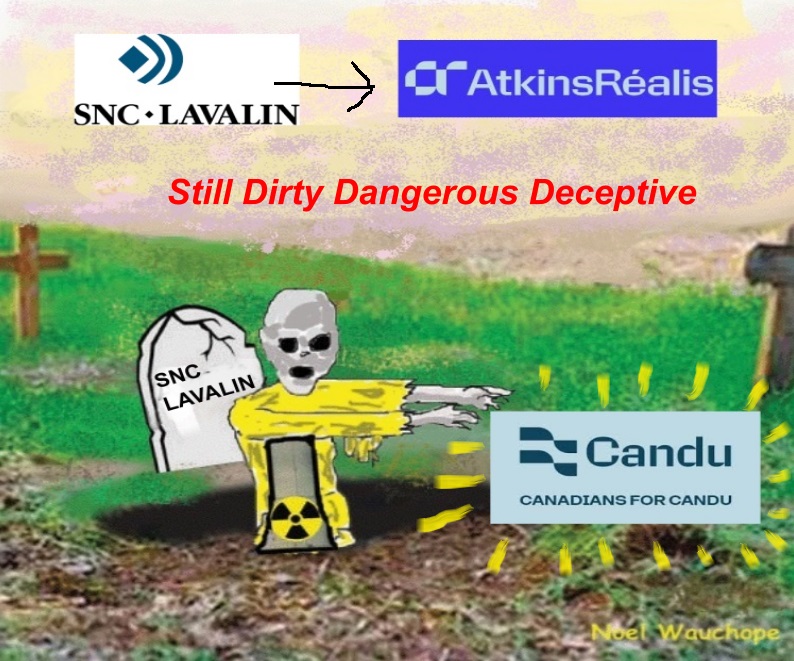
AtkinsRéalis wants to develop a new Candu reactor to sell around the world, but an industry insider says the company’s past could be a ‘big problem’ to getting funding
National Post Ryan Tumilty, Aug 15, 2024
OTTAWA – A company formerly at the centre of one of the biggest scandals of the Trudeau government is now looking for as much as $75 million in annual funding to update a nuclear reactor Canada has exported around the world.
AtkinsRéalis, formerly named SNC Lavalin, launched the Canadians for Candu campaign earlier this year. It’s a push to get both provincial governments and the federal government to back a new, more powerful Candu nuclear reactor that could be built both home and abroad.
The lobbying effort, started earlier this year, has recruited other engineering and construction firms, local unions and other groups to advocate for government support of the made in Canada reactor. The co-chairs of the campaign are former prime minister Jean Chrétien and Ontario premier Mike Harris.
Gary Rose, executive vice-president of nuclear, said the company wants Canadians to be aware of the potential.
“The campaign is really all about promoting Candu, the fact that Canada owns a world-class nuclear technology,” he said. “As provinces make decisions on which technologies that they wish to pursue, when it comes to large nuclear, we want that pursuance to be Candu technology because it’s a Canadian technology.”
AtkinsRéalis holds the license for Candu reactors which were first developed in the 1950’s by the Canadian government. All of Canada’s current nuclear reactors are Candu models ………….
In 2011, the Harper government sold the right to develop Candu reactors to what was then SNC-Lavalin for $15 million. The Crown corporation, Atomic Energy of Canada Limited, retained the intellectual property of the reactors.
With the license in place, AtkinsRéalis has worked on large refurbishment projects and last year signed a deal to build two new reactors in Romania with the help of export financing from the Canadian government.
The proposed Romanian reactors are Candu-6 models capable of producing 700 megawatts of power, but to attract more business, including here in Canada, AtkinsRéalis is working on a new reactor, the Candu Monark, which would be capable of 1,000 megawatts…..
That’s where the company is seeking federal cash. Rose said they are currently spending $50 to $75 million a year on engineering to complete the Monark design and expect to do the same over the next three years. They would like the government to match that spending, potentially adding up to a $300 million bill for taxpayers.
He said ultimately the government will win out in the end.
“We’re asking for it to be an investment. We’re not asking for a handout,” he said. “The IP that we develop as Monark will stay owned by the Canadian government.”
Minister of Natural Resources Jonathan Wilkinson’s office said only that they were aware of the Canadians for Candu campaign when the National Post reached out.
…………………………….AtkinsRéalis has at least one specific project in mind for the Monark, the proposed expansion of the Bruce Nuclear plant in southern Ontario. That project announced last year aims to add up to 4,800 megawatts of power to the Bruce plant, which is already the largest nuclear installation in the world.
Ontario’s then Minister of Energy Todd Smith, said last year, the province would need a lot more power………………….
The proposed site C project is in its infancy and the company has only just started consultations with local communities and planning for what the project would look like. It has only started to look at what reactor technology it might use, but has said it intends to conduct an open process with a “technology neutral” approach.
Rose said the Monark design work could be done in the next four years and be ready to build at the end of this decade.
“The Monark is an evolution of existing Candu technology so we are not starting from scratch,” he said. Most of the components, over 85 per cent, of a Monark reactor would come from Canadian suppliers.
Aaron Johnson, a vice president with AECON construction who worked on nuclear refurbishment projects with AtkinsRéalis and is part of the Canadians for Candu campaign, said new reactors would be a big boost to the local economy.
“That’s already an existing supply base, and that’s something that would only be furthered upon in a Candu new build application,” he said………………………………….
AtkinsRéalis’ request for more government funding comes as the company is shedding the SNC-Lavalin brand that was tarnished in a scandal.
In 2019, the company pleaded guilty to fraud and agreed to a $280 million fine for its actions in Libya between 2001 and 2011. In an agreed statement of facts at the time, the company admitted having paid nearly $48 million to the son of Libyan dictator Muammar Ghadafi to secure contracts.
Former attorney general Jody Wilson-Raybould resigned from cabinet earlier that year after she came under pressure from Prime Minister Justin Trudeau’s office to work out a deal with the company. The ethics commissioner ultimately found Trudeau had improperly pressured Wilson-Raybould.
Rose joined the company only last year and said he was assured he was making the right choice to come aboard because much more than the name of the company has changed.
“The entire management team, leadership team, programs that support it. I believe it’s a totally different company than it was,” he said.
Chris Keefer, president of the group Canadians for Nuclear Energy, acknowledges that AtkinsRéalis’ former name will be a political problem………………………..
Keefer’s group doesn’t receive funds from AtkinsRéalis and isn’t a member of Canadians for Candu, but he does believe the reactor should get government support. American company Westinghouse, which has the AP1000 reactor, received U.S. support for its design and Keefer argued it is not uncommon in the industry…………………………
At the COP 28 climate change conference last year, more than 20 countries including Canada, signed onto a pledge to triple nuclear power production by 2050.
Rose said he believes Candu reactors could easily be 10 per cent of the global market, but they need government support to do it.
“We’re building up front with the hopes of selling 25 in Canada, 75 to 100 globally, and having the federal government standing up and supporting us on that is really key.”https://nationalpost.com/news/politics/snc-lavalin-candu-nuclear-reactors?utm_source=Sailthru&utm_medium=email&utm_campaign=National%20Post%20-%20Posted%202024-08-15&utm_term=NP_HeadlineNews
Congressman Garamendi Asks “Why does America need nuclear weapons?”
August 15th, 2024 https://nuclearactive.org/
On August 13th, U.S. Congressman John Garamendi of California delivered a speech at the United States Strategic Command 2024 Strategic Deterrence Amidst Global Transformation Symposium in which he asked “Why?” as in “Why does America need nuclear weapons?” and mostly importantly asked, “How do we deter in a way that ensures there is a tomorrow worth protecting? Must we continue a 50-year-old triad strategy without considering the alternatives? Why, why are we stuck in a logic silo with the blast door closed?” To read Congressman John Garamendi’s (CA-08) full statement, 240813 Garamendi U.S. Strategic Command 2024 Deterrence Symposium Remarks 1
While the focus of the speech was about “Why the Sentinel is a Costly and Dangerous Mistake,” he began by describing the efforts in 1985 of Ronald Reagan and Mikhail Gorbachev, whom he called “two cold warriors at the head of the world’s largest nuclear arsenals.
“Leaders like Reagan, JFK, Eisenhower, Carter, and Obama knew that nuclear weapons could end civilization and, with those heavy moral and ethical considerations in mind, negotiated significant safety measures and a serious reduction in nuclear weapons.
“These leaders demonstrated vision and commitment. They knew that war was not an option, so they had to create a vision for a safer future. Unfortunately, too many today shrug their shoulders and say the time for negations is not now. Which brings us to yet another question…Why not try? Over the next 30 years, we will spend almost 2 trillion dollars on our nuclear weapons… what if we spent just 1% on diplomatic and risk reduction efforts?”
To read Congressman John Garamendi (CA-08) full statement, 240813 Garamendi U.S. Strategic Command 2024 Deterrence Symposium Remarks 1
Sweden Considers Borrowing $28.5 Billion to Finance Nuclear

By Lars Paulsson and Niclas Rolander, August 12, 2024
(Bloomberg) — Sweden could borrow 300 billion Swedish kronor ($28.5 billion) to help finance a new fleet of nuclear reactors in the coming decades.
A government study released Monday in Stockholm highlighted several features of its preferred model in order provide certainty for investors. Funding instruments include government borrowing to support construction, and 40 years of guaranteed revenues through a so-called contract-for-difference or CfD. ……….
Financing is one of the biggest hurdles for nuclear energy, with reactors costing multiple billions of dollars and taking years to build — often compounding the price. The model presented on Monday is focused on financing a program of as much as 6,000 megawatts, or four large-scale reactors, and has taken inspiration from the Czech Republic’s plans for financing new units at the Dukovany complex. ……..
The proposals will be sent for consultation to various institutions, companies and government agencies before they may be adopted by the government.
One feature is the CfD model, used for both Electricite de France SA’s Hinkley Point C in the UK and Dukovany. Under this mechanism, developers and the government agree a fixed price for electricity for a certain period of time, providing certainty of future revenue. If market prices fall too low, the generator receives a top-up from the state. On the flip side, the plant operator must pay back the difference if the market rate is higher.
In contrast with the financing scheme for Hinkley Point, which has a total cost estimate of about £47.9 billion ($61.2 billion) in today’s prices, the suggested model for Sweden also involves public borrowing to finance construction. According to the proposal, the government would borrow as much as 75% of investment costs, which Dillen expects could increase public debt by some 300 billion Swedish kronor ($28.5 billion).
Swedish state-owned Vattenfall AB and Finland’s Fortum are among the utilities studying new reactors……
In a comment on its website, Vattenfall said it agreed with a lot of the points made by Dillen, but that it was unclear how the state will ensure that the first wave of new reactors actually will be built.
Sweden has had a love-hate relationship with atomic energy since the first commercial reactor began operations in 1972. Mounting grassroots opposition in subsequent years culminated in a 1980 referendum calling for the dismantling of all reactors — an effort that ultimately failed. The winning center-right coalition in the 2022 election made a nuclear renaissance a pillar of its election campaign. ………. https://www.bnnbloomberg.ca/investing/2024/08/12/sweden-leans-toward-czech-style-funding-for-new-nuclear-reactors/
Gantz warns of a civil war in “Israel”
By Al Mayadeen English, Source: Agencies, 12 Aug 2024
Israeli Channel 14 reported on his statements, indicating that he expressed his thoughts during a public ceremony held Monday commemorating the so-called “destruction of the Temple.”
Israeli Knesset member and opposition leader Benny Gantz has warned that Israeli Prime Minister Benjamin Netanyahu will not “sacrifice his government to protect Israelis,” or do what is necessary to prevent civil war.
The former member of the Israeli war cabinet stressed that if Israelis “do not come to our senses, there will be a civil war here… It is forbidden to hide the truth.”
According to him, there is a “leadership that divides the people and poisons the well from which everyone drinks.”
Israeli Channel 14 reported on his statements, indicating that he expressed his thoughts during a public ceremony held Monday commemorating the so-called “destruction of the Temple.”
Gantz criticized the raids on military bases and the “trampling on the dignity of captives’ families.”…………………………………
According to Israeli Channel 12 last month, high-ranking security officials have warned that the personal and political conflict between Netanyahu and Gallant is “damaging” the management of ongoing military operations. It was noted that the two do not communicate outside of official discussions…………………………….. https://english.almayadeen.net/news/politics/gantz-warns-of-a-civil-war-in–israel
Revealed: ministers’ doubts over nuclear plant at Torness
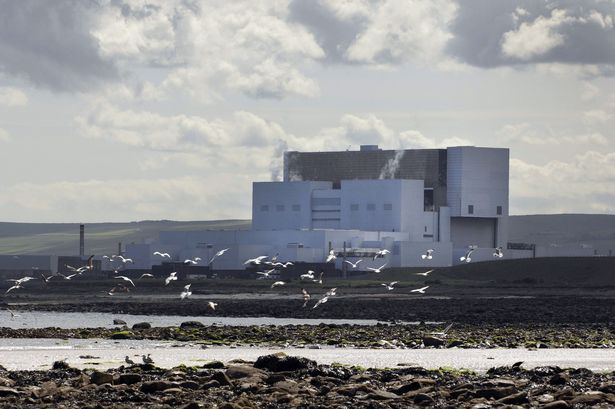
Torness Rob Edwards, August 12, 2024
Labour and Conservative governments secretly harboured doubts about building a nuclear power station at Torness in East Lothian in the late 1970s, according to internal documents released by the Scottish Government.
Campaigns against Torness won support within the then Scottish Office, and came closer to success than realised. There was a “real risk” of the treasury in London delaying the project, warned one official.
But the nuclear industry fought a fierce behind-the-scenes battle in defence of the power station, and it ended up being built in the 1980s.
Campaigners condemned past decision-making about Torness as a “total sham”. According to one former UK Government adviser, lobbying by the nuclear industry had always been “more influential” than evidence.
The Ferret analysed 11 large government files on Torness in 1978 and 1979 at the National Records of Scotland in Edinburgh. One was only released in 2023 after a request under freedom of information law.
The files reveal that ministers and officials in both James Callaghan’s and Margaret Thatcher’s governments privately raised concerns about the proposed nuclear station at Torness.
Torness was the target for a series of anti-nuclear protests in the 1970s, initially organised by the Scottish Campaign to Resist the Atomic Menace (SCRAM). There were demonstrations and an occupation of the site in 1978, and in May 1979 more than 10,000 people joined a weekend protest there.
Despite further protests in 1980 and 1981, the nuclear station was built and formally opened by Thatcher in 1989. It is currently scheduled to keep operating until 2028, though there are plans to run it for longer.
Early in 1978 SCRAM made a submission to the Scottish Office arguing that Torness should be subject to a new public inquiry. An earlier inquiry in 1974 had been inadequate because it had not specified the type of reactors to be built, the campaign group argued……………………………………………………………………………………………………
Case for Torness ‘less than convincing’
However, a covering note from an official on 16 May 1979 admitted that the case for Torness was “less than convincing”. The absence of information in support of the plant was “worrying”, the official commented, “because I think there is a real risk in the present climate of the treasury seeking to re-examine or hold up the project”.
In a memo two days later, Fletcher said: “I still have some doubts concerning the advisability of a nuclear station at Torness”. A handwritten note by an official added simply “Amen”.
A memo on 1 June 1979 reported that Torness’s backer, the government-owned South of Scotland Electricity Board (SSEB), was “most despondent” about the lack of investment approval. All the signs were that the project was “slipping out of control”, it said.
In the end, though, the government documents show that the SSEB, backed by its supporters in the Scottish Office, saved Torness. They worked hard to convince the treasury and, ultimately, Thatcher, that it should go ahead because it was needed to sustain the power station industry…………………………………………………………………………
Torness ‘a total sham’
The veteran environmental campaigner and energy author, Walt Patterson, testified at the Torness inquiry in 1974. “Torness was a total sham, and the inquiry had no relevance to the official decision to build it,” he told The Ferret.
“Torness was ordered just to keep the power station building industry busy, not because we could use the electricity.”
Pete Roche, a nuclear consultant who worked with SCRAM in Edinburgh in the 1970s and 1980s, suggested that politicians might have been worried that cancelling Torness would “somehow legitimise protest”.
He said: “We knew at the time that the case for Torness was collapsing before our very eyes, but it’s a pleasant surprise to learn that both Labour and Tory Ministers had secretly expressed doubts about the plant.”
Dr Ewan Gibbs, a researcher from the school of social and political sciences at University of Glasgow who has studied Torness protests, pointed out that anti-nuclear activists had mobilised tens of thousands of people in opposition to the plant.
“Thanks to these new research findings, we now know that both Scottish Labour and Tory ministers had serious doubts over the nuclear power station project in the late 1970s.”……………………………………….. more https://theferret.scot/torness-nuclear-doubts-ministers/—
Iran´s new president reappoints UN-sanctioned official as head of the country’s nuclear agency
By Associated Press, 10 August 2024
TEHRAN, Iran (AP) – Iran´s newly-elected president reappointed a U.S.-educated official who came under United Nations sanctions 16 years ago as head of the country´s nuclear department, state TV reported Saturday.
Mohammad Eslami, 67, will continue his work as chief of Iran’s civilian nuclear program and serve as one of several vice presidents. Eslami’s reappointment by President Masoud Pezeshkian comes as Iran remains under heavy sanctions by the West following the collapse of the 2015 deal that curbed Iran´s nuclear activities in exchange for sanctions relief.
Pezeshkian had said during his presidential campaign that he would try to revive the nuclear deal.
The United Nations sanctioned Eslami in 2008 for “being engaged in, directly associated with or providing support for Iran´s proliferation of sensitive nuclear activities or for the development of nuclear weapon delivery systems”, when he was the head of Iran´s Defense Industries Training and Research Institute.
He was appointed as the chief of Iran´s nuclear department for the first time by late President Ebrahim Raisi in 2021, before that, from 2018, in moderate former President Hassan Rouhani´s era, Eslami served as Transport and Urban Development Minister.
He has experience working in Iran´s military industries, for years, most recently as deputy defense minister responsible for research and industry……………………
Iran is building two nuclear power facilities to supplement its sole operational 1,000-megawatt reactor at the southern port town of Bushehr, which went online with Russia´s help in 2011. Under its long-term energy plan, Iran aims to reach 20,000-megawatt nuclear electric capacity.
The nation has in recent months faced country-wide power outages.https://www.dailymail.co.uk/wires/ap/article-13730505/Iran-s-new-president-reappoints-UN-sanctioned-official-head-countrys-nuclear-agency.html
Analysis of Canadian Nuclear Association (CNA) recommendations for Budget 2025

The lack of new nuclear projects in Canada reflects investor decisions, not excess regulation. No nuclear project has been assessed since the Act came into force nearly five years ago.
Ole Hendrickson , 10 August 24
The House of Commons Standing Committee on Finance announced its annual pre-budget consultations process on June 24, 2024. It invited the submission of written briefs no later than August 2, 2024. The committee will table a report on these consultations in the House of Commons, with recommendations to be considered by the Deputy Prime Minister and Minister of Finance in their development of Budget 2025. On July 30, 2024, the Canadian Nuclear Association (CNA) submitted its recommendations.
Part 1 – “Clean Economy” Investment Tax Credit (ITC) Programs
The CNA brief refers to four “Clean Economy” investment tax creditprograms from Budget 2024. Three were passed into law in June 2024.
Nuclear projects should not be eligible for investment tax credits. Nuclear power is not clean. It produces vast amounts of pollutants and waste, ranging from toxic mine tailings to irradiated fuel rods. Providing tax credits for nuclear power represents poor economic and environmental policy.
The only apparent reason for providing investment tax credits for nuclear power is that the Minister of Natural Resources Canada, whose department provides “engineering and scientific guidance” for the ITC programs, has a mandate to promote nuclear power under the Nuclear Energy Act.
1. Clean Technology ITC
Small modular nuclear reactors (SMRs) are the only nuclear power projects eligible for the 15% refundable tax credit under this program. The accepted definition of an SMR is a reactor that has a power capacity of up to 300 megawatts electrical per unit, or roughly 900 megawatts thermal.
The CNA wants to expand the definition of an SMR to include reactors up to 1400 megawatts thermal, or roughly 470 megawatts electrical.
There is considerable evidence that SMRs would produce far more expensive electricity than other generating facilities, including larger nuclear reactors. Does the CNA anticipate that the 300-megawatt BWRX-300 reactors that Ontario Power Generation plans to build at the Darlington nuclear site will not be cost-competitive without additional subsidies?
2. Clean Hydrogen ITC
This ITC program provides refundable tax credits ranging from 15-40% depending on the carbon intensity of the hydrogen produced. Widespread use of hydrogen as an energy source would require expensive new infrastructure investments. Using expensive nuclear power to produce hydrogen would further increase costs. The CNA wants hydrogen produced by using nuclear power to hydrolyze water to be considered as a qualified clean hydrogen project. The Government of Canada has not provided details on eligible projects under this ITC program.
3. Clean Technology Manufacturing ITC
This ITC program provides refundable tax credits for “clean technology manufacturing and processing.” The CNA wants to see explicit mention of the extraction and processing of uranium as a “critical mineral”, of the manufacturing of nuclear energy equipment and nuclear fuels, and of the manufacturing of “equipment for lifecycle handling of uranium fuel,” as being eligible for tax credits.
All the activities in the nuclear fuel “lifecycle” generate waste that is hazardous to human health and difficult to manage. The use of robotic equipment to handle the highly radioactive spent nuclear fuel waste is one of the most expensive parts of this “lifecycle”. A “clean economy” program should not subsidize waste management for a particular industry, particularly when that industry has delayed its decommissioning and waste management activities for decades.
4. Clean Electricity ITC
Under this ITC program, which has not yet passed into law, the CNA wants to “include all components enabling clean electricity assets to continue operating in refurbishment expenditures.”
Ontario Power Generation and Bruce Power have active reactor refurbishment programs. The Ontario provincial government already provides a $7.3 billion taxpayer subsidy to hold down electricity rates and shield industrial and household ratepayers from reactor refurbishment costs. A new federal subsidy for refurbishment of Ontario’s reactors would further hide nuclear costs, and would provide no apparent benefit to Canadian taxpayers in other provinces.
Part 2 – Policies that “enhance the regulatory framework to expedite project approvals”
The CNA is seeking to restrict the public’s ability to participate in assessments of nuclear projects. This builds on proposals from a Ministerial Working Group on Regulatory Efficiency for Clean Growth Projects, and a review of the Physical Activities Regulations (the “Project List”) by the Impact Assessment Agency of Canada. Policy matters that go beyond the Committee’s request for views on 2025 Budget priorities should be debated by appropriate Parliamentary committees.
1. Exempting nuclear projects from impact assessment
Based on a plan (Building Canada’s Clean Future) created by a Ministerial Working Group on Regulatory Efficiency for Clean Growth Projects, the Impact Assessment Agency of Canada wishes to reduce the possibility that future nuclear projects will be assessed under the Impact Assessment Act. On July 30, 2024, the Agency released a Discussion paper on the review of the Physical Activities Regulations – the so-called “Project List” – with comments due September 27, 2024.
Proposals in the Agency’s discussion paper mirror those in the CNA’s submission to the Finance Committee, suggesting that the two may have been working together. The CNA wants to exempt nuclear reactors of any size that are built on “brownfield” sites (e.g., sites where coal- or gas-fired generating stations have been shut down), or on licensed nuclear sites, from assessment. At present, only reactors of up to 200 megawatts thermal on brownfield sites, or 900 megawatts thermal on licensed sites, are exempt. The CNA proposal would also limit technical assessments to “First of a Kind” reactors, with only site considerations for future reactors of a similar design.
The CNA also wants to exempt construction, expansion and decommissioning of uranium mines with an ore production capacity of up to 5,000 tons per day. This would double the current 2,500 tons/day exemption. And it wants to allow provincial assessments to replace federal assessments.
These are not constructive proposals. They would increase the likelihood that nuclear projects will generate conflicts and fail to gain social license. The Act improves the chances that a project will proceed by encouraging public participation in project planning stages, The ability of independent experts to examine technical details brings rigor to the assessment process.
The lack of new nuclear projects in Canada reflects investor decisions, not excess regulation. No nuclear project has been assessed since the Act came into force nearly five years ago.
2. Putting the Canadian Nuclear Safety Commission (CNSC) in charge of impact assessment
If a nuclear project is captured by the Physical Activities Regulations under the Impact Assessment Act, under Section 44 of the Act the Minister of the Environment must create a review panel, set the panel’s terms of reference, appoint the chairperson and at least two other members of the panel, and ensure that they are unbiased and free from any conflict of interest relative to the project.
The Minister also has the power to designate a project for assessment, even if it is not captured by the Project List. The CNA wants to remove the Minister’s powers and give them to the CNSC.
An expert panel report, Building Common Ground: A New Vision for Impact Assessment in Canada, noted the long-standing perception of a lack of independence and neutrality of the CNSC because of its close relationship with the industry it regulates, and its promotion of projects it is tasked with regulating. The panel found that the CNSC has eroded confidence in the assessment process, leading to widespread use of the term “regulatory capture” to describe this body.
Taking away the Ministers’ powers and reassigning them to the CNSC would be a regressive step, leading to further loss of social license for nuclear projects, as has been the case with the proposed Near Surface Disposal Facility at the federally owned Chalk River Laboratories.
3. Amending the Species at Risk Act
Under section 79 of the Species at Risk Act, the proponent of a project must “notify the competent minister or ministers in writing of the project if it is likely to affect a listed wildlife species or its critical habitat.”
The CNA recommends that section 79 be modified “to align with the Supreme Court of Canada opinion, focusing on federal jurisdiction.” The Court, in its reference decision on the Impact Assessment Act, considered the Species at Risk Act and found that the protection of migratory birds, fish, fish habitat, and aquatic species should be included in the definition of adverse federal effect in the Impact Assessment Act. The Court did not discuss amending the Species at Risk Act.
The Species at Risk Act applies to all wild species found in Canada and has provisions to promote cooperation with other governments and jurisdictions. The CNA recommendation to amend the Act in the context of Budget 2025 would represent an inappropriate use of budget legislation.
1 This Month
23-25 October – on Zoom – World BEYOND War’s annual global conferenc


Shut down the radiation-damaged Heysham nuclear reactors now
To see nuclear-related stories in greater depth and intensity – go to https://nuclearinformation.wordpress.com

Say No to NASA’s Reckless Nuclear Reactor on the Moon
Say No to NASA’s Reckless Nuclear Reactor on the Moon
-
Archives
- October 2026 (170)
- September 2026 (339)
- August 2026 (330)
- July 2026 (355)
- June 2026 (287)
- May 2026 (306)
- April 2026 (356)
- March 2026 (251)
- February 2026 (267)
- January 2026 (308)
- December 2025 (358)
- November 2025 (359)
-
Categories
- 1
- 1 NUCLEAR ISSUES
- business and costs
- climate change
- culture and arts
- ENERGY
- environment
- health
- history
- indigenous issues
- Legal
- marketing of nuclear
- media
- opposition to nuclear
- PERSONAL STORIES
- politics
- politics international
- Religion and ethics
- safety
- secrets,lies and civil liberties
- spinbuster
- technology
- Uranium
- wastes
- weapons and war
- Women
- 2 WORLD
- ACTION
- AFRICA
- Atrocities
- AUSTRALIA
- Christina's notes
- Christina's themes
- culture and arts
- Events
- Fuk 2022
- Fuk 2023
- Fukushima 2017
- Fukushima 2018
- fukushima 2019
- Fukushima 2020
- Fukushima 2021
- general
- global warming
- Humour (God we need it)
- Nuclear
- RARE EARTHS
- Reference
- resources – print
- Resources -audiovicual
- Weekly Newsletter
- World
- World Nuclear
- YouTube
-
RSS
Entries RSS
Comments RSS

