80 CANADIAN ORGANIZATIONS CALL ON FEDERAL GOVERNMENT TO RESCIND APPOINTMENT OF NUCLEAR REGULATORY AGENCY PRESIDENT.
Ottawa, 17 July 2024 .- www.nuclearwastewatch.ca
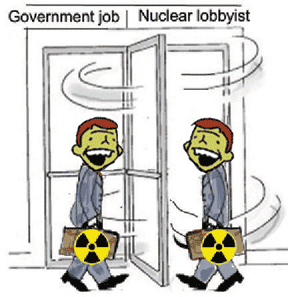
Over 80 civil society organizations from across Canada are speaking out and calling on Prime Minister Justin Trudeau and Governor General Mary Simon to rescind their recent appointment of Mr. Pierre Tremblay, a long time senior nuclear industry executive, as President of the Canadian Nuclear Safety Commission (CNSC).
In a joint letter citing conflict of interest and failure to adhere to International Atomic Energy Agency (IAEA) guidelines, the groups -a range of organizations that include in their ranks scientists and retired nuclear officials- also call on the Federal Government for an urgent reform of the CNSC and nuclear governance in Canada.
Mr. Tremblay has been a long-time senior business executive at Ontario Power Generation (Canada’s largest nuclear operator and contractor of nuclear businesses), reported co-owner of a private nuclear business involved in the Plutonium trade, and most recently president of AECOM Canada Nuclear Services -a key contractor for two questionable projects expected to report billions of dollars to the nuclear businesses involved, and impact populations for centuries: a nuclear waste dump (“Near Surface Disposal Facility”) by the Ottawa river and a project to abandon high-level nuclear waste underground in Northern Ontario, both of them expecting CNSC licenses.
The groups also call on the Federal Government to take the opportunity to initiate a long-needed reform of the CNSC, which has often been described by observers as an “industry-captured regulator”.
The request notes that the CNSC has a communications branch with 60-plus staff but no dedicated human health and environmental protection branch, and has not turned down a single nuclear industry application in more than a decade. It has also actively lobbied to weaken impact assessment legislation to exclude a range of nuclear reactors and processing facilities.
Mr. Tremblay’s appointment follows other appointments to the Commission of industry insiders, and two troubling assessments of the CNSC’s performance by the International Atomic Energy Agency (IAEA) -a June 2024 follow-up to an initial 2019 IAEA mission highlighted several problem areas; despite the CNSC’s positive spin on the IAEA missions, the findings are a cause of deep concern for independent observers and experts.
Given the CNSC’s often-stated priority and legal mandate to protect the environment and the health of Canadians, the groups are requesting the Federal Government consider recruiting CNSC senior ranks from within the health and environmental protection communities, including perhaps Environment and Climate Change Canada and the federal Health Portfolio.
The signatory organizations note that the appointment contravenes both IAEA guidelines and the Federal Government’s own guidance on the independence of regulatory bodies, and compromises the public’s expectation of neutrality, objectivity and independence of Canada’s nuclear regulatory body and reinforces the public perception of industry capture of that body. Rescinding the appointment would be a significant step towards a much-needed reform of the CNSC and towards restoring public trust in that critically important agency.
Quotes: The Canadian Nuclear Safety Commission is supposed to be a neutral body, carefully safeguarding the health of the Canadian public and the environment from the risks associated with the use of nuclear energy. Senior executives from the nuclear industry should be disqualified from positions at the CNSC.” – Dr. Ole Hendrickson.
“Having a nuclear business executive whose companies have pushed for questionable projects placed in charge of the very agency that would now regulate and approve them, is an obvious conflict of interest” – J. P. Unger, science writer and policy analyst. “The Government should abandon any pretense of having a watchdog and true regulator for nuclear matters -or carry out its urgently needed reform.”
Democrats to Keep Unconditional Military Aid to Israel in Party Platform

by Kyle Anzalone | Jul 10, 2024, https://libertarianinstitute.org/news/dems-to-keep-unconditional-military-aid-to-israel-in-party-platform/
A senior Joe Biden administration official explained that the Democratic party has no plans to alter its policy of unconditional arms support for Israel. President Biden has provided Israel with billions of dollars in weapons since October 7, including over ten thousand heavy bombs.
After an internal DNC debate over the party’s plank on arms shipments to Israel, an official explained that President Biden has no plans to change the policy that allows weapons to flow to Tel Aviv with no conditions on how they are used. “The platform will reflect the views of the president of the United States, and cutting aid to Israel is not President Biden’s policy,” the official said.
Over the past nine months, the White House has sent Israel over $6.5 billion in arms, including tens of thousands of bombs. Fourteen thousand of those munitions are massive one-tonne bombs. American-made bombs have contributed to the enormous death toll that has surpassed 38,000.
While American weapons have been documented to have been used in Israeli attacks on civilian targets in Gaza, the White House has maintained that Tel Aviv has not violated US laws. President Biden has no plans to curtail arms shipments except for one shipment of heavy bombs.
A growing number of Democratic voters have broken with the president over his unfettered support for the Israeli onslaught in Gaza. An April poll found about 40% of Democrats believe Biden has given Israel too much support.
Biden is a self-proclaimed Zionist and has been a vocal supporter of Israel for decades. Over his career, the president has frequently claimed that Israel is so vital to American security that if it did not exist, the US would have to create Israel.
However, the argument that Israel contributes to American security is rebuked by the head of the State Department Intelligence agency, Brett Holmgren. The Assistant Secretary of State explained that the Israeli war on Gaza is driving recruitment into jihadist organizations and inspiring lone-wolf terrorists.
Biden signs ADVANCE Act. Now what?

By Dave Kraft/NEIS, Dave Kraft is the founder and director of Nuclear Energy Information Service. https://beyondnuclearinternational.org/2024/07/14/biden-signs-advance-act-now-what/
Congress wants to “accelerate” new reactor build, putting public safety in jeopardy
By Dave Kraft/NEIS
On Wednesday July 10th President Joe Biden signed the “ADVANCE Act,” which stands for “Accelerating Deployment of Versatile, Advanced Nuclear for Clean Energy.”
The controversial bill aggressively promotes the narrow, short-term interests of the U.S. nuclear industry in ways that threaten the long-term national environmental, climate and national/international security interests.
Further, it functionally rewrites the mandate of the federal Nuclear Regulatory Commission (NRC) in ways that potentially cast it into the role of promoter instead of federal regulator of the controversial and moribund nuclear power industry.
To summarize, The ADVANCE Act:
- promotes development of currently experimental, commercially non-existent “small modular nuclear reactors” (SMNRs) and allegedly “advanced” reactors, using tax dollars;
- provides less regulatory oversight by ordering the NRC to “streamline” licensing of currently experimental SMNRs, putting the NRC in a position of becoming a quasi-promoter instead of regulator, in contradiction to its 1975 founding mandate;
- requires development of the infrastructure needed to produce more intensely enriched radioactive fuel called “HALEU” – high-assay, low-enriched uranium — required for the SMNRs to run on. Enrichment would be just below weapons-usable; currently the only source of HALEU is Russia;
- ignores the potential increased risk and harm from having more nuclear reactors large and small;
- produces more high-level radioactive waste without first having a disposal method in place for either current or future reactors;
- permits and encourages export of nuclear technology and materials internationally; and
- for the first time, allows foreign control/ownership of nuclear facilities within the U.S.
Congress cannot be absolved from its role in uncritically swallowing the gaslit promises of nuclear power. The House previously passed its version of the legislation by a margin of 393-13 before sending it to the Senate. There, it stalled, but was procedurally resurrected by attaching the 93-page nuclear Christmas-wish list to a three-page, must pass fire safety bill – S.870, the Fire Grants and Safety Act. It passed in the Senate 88-2, with only Senators Ed Markey (MA) and Bernie Sanders (VT) recognizing the imminent threat it posed to energy, environmental, and international security interests.
Critics of nuclear power and opponents of the ADVANCE Act fail to see:
- how the Act fights climate disruption, when SMNRs are only experimental, may not work at all, and if they work will not be available in sufficient quantities for commercialization before the mid-2030s, according the nuclear industry itself. It is the carbon we remove and keep out of the atmosphere between NOW and the mid-2030s that will determine if we can meet climate goals;
- how SMNRs will enhance currently threatened system reliability and power availability, when they will not be available – assuming they even work – before the mid-2030s;
- how exporting SMNR technology and ~19+% enriched (just below weapons useable) HALEU reactor fuel worldwide improves international security in a world dominated by wars in Ukraine, the Middle East, and potentially in southeast Asia; poorly controlled non-state actors; and well-known corrupt business entities. Equally baffling is how allowing foreign ownership of nuclear facilities in the U.S. proper makes our energy systems safer, more secure, and insulated from economic instability or foreign interference;
- how mandating the NRC to “expedite” SMNR licensing – potentially at the expense of its original and official mandate to “adequately” protect public health and safety and the environment – makes nuclear power and the nation safer. This regulatory approach has demonstrably failed with Boeing; failed with Norfolk Southern in East Palestine; failed with PIMSA in Sartortia; and doubly-failed at Fukushima. NRC is supposed to oversee and regulate an industry that in the past five years has repeatedly displayed corporate and legislative corruption at the highest levels resulting in FBI indictments, convictions and guilty pleas, millions of dollars in fines, and enormous cost overruns born by ratepayers; and
- why viable alternatives to nuclear expansion like renewable energy, energy efficiency, energy storage, and transmission improvements are not prioritized over nuclear expansion, since ALL are cheaper, quicker to implement, reduce carbon emissions, produce no radioactive wastes, have no meltdown potential, create no nuclear proliferation issues, and, most importantly – ALREADY EXIST. Nothing more needs to be invented; just implemented.
For example, the Federal Energy Regulatory Commission (FERC) stated in December, 2023 that roughly 2,600 giga-watts (GW) of electric power projects await grid connection – over twice the entire current electrical output of the US, and roughly 27 times the entire output of all current US reactors combined. The large majority of this backlog are renewable energy projects awaiting connection access to the aging transmission grid.
New EXISTING transmission technologies like reconductoring and improved grid resiliency solutions could double the capacity of the grid in much shorter time and with far greater certainty than chasing speculative nuclear promises, creating greater ease of access for renewables and storage.
By signing the ADVANCE Act, the President and an accomplice Congress have placed the nation’s energy future, climate goals, and even international security at grave risk. Clearly, placing short term, ego-invested interests over the long-term best interests of the nation seem to be a problem extending beyond re-election. As Napoleon once observed, never ascribe anything to malice when there is the least suspicion of incompetence. Perhaps, but in the end, the results are the same.
Dave Kraft is the founder and director of Nuclear Energy Information Service.
Campaigners against Sizewell C hopeful new MPs will take their concerns to parliament

The campaign group Stop Sizewell C says it’s heard from several MPs already
Jasmine Oak, 10th Jul 2024, https://hellorayo.co.uk/greatest-hits/west-norfolk/news/stop-sizewell-c-campaigners-new-mp-hopes/
Campaigners are calling on the new Government to consider scrapping plans to build a nuclear power plant on the Suffolk Coast
Once up and running, it’s thought Sizewell C will power up to six million homes, but activists say it’s going to devastate our countryside
Alison Downes is from ‘Stop Sizewell C’ group – and says Sir Kier Starmer needs to listen to their concerns: “The priority needs to be preventing there being any more unnecessary damage to the local environment.
“We have already seen a fair amount of damage, but that’s nothing compared with what’s to come…
“The government needs to resist any pressure from the nuclear industry for a hasty decision, especially as Sizewell C is going to take a long time, and a lot of money, to build.”
Alison’s hoping the local area’s new MPs will voice their concerns in Parliament: “Our new MP has publicly said that Stop Sizewell C was the first group she met with when she was elected.
“We also have the co-leader of the Green Party, Adrian Ramsay, in Waveney Valley. He’s been very vocal against Sizewell C.”
A spokesperson for EDF Energy has previously told us: “Our proposals for Sizewell C will see the creation of a 3.2 gigawatt power station that will create low-carbon electricity that will supply 6 million homes.
“This will be delivering clean, reliable, and affordable power for generations.”
“Project 2025” is just “Project 1981”

Many sections of Project 2025 could easily have been pilfered from a Democratic think tank
DOD section additionally declares that the US “must regain its role” as the “Arsenal of Democracy” by further ramping up foreign arms sales, ……..despite Biden and Democrats similarly trumpeting the “Arsenal of Democracy” concept as it relates to Ukraine and other conflicts in which “Democracy is on the Line,” just like WW11
MICHAEL TRACEY, JUL 12, 2024,
“……………………………………………………………………………………. What percentage of despondent Dems who have this crippling fear of Project 2025 have actually read the document? I’m not going to claim to have read all 920 pages, but I did read the sections on the Department of Defense, State Department, and “Intelligence Community.” I would love to ask MSNBC anchors if they read these portions, because if they did, they should be celebrating the glorious reaffirmation of “bipartisan consensus” contained therein, rather than fulminating about some despotic nightmare.
Christopher C. Miller, who briefly served as Trump’s “acting” Secretary of Defense, writes in his Project 2025 contribution that the next Conservative Administration must “prevent Beijing’s hegemony over Asia,” including by “modernizing and expanding the US nuclear arsenal.”
……………Miller solemnly declares that in addition to China, “the United States and its allies also face real threats from Russia, as evidenced by Vladimir Putin’s brutal war in Ukraine, as well as from Iran, North Korea, and transnational terrorism.”
Countering these alleged threats, he concludes, “will require more spending on defense, both by the United States and by its allies.” Thus the fearsome Project 2025 envisions a future in which the march of US and “allied” militarization continues apace, just like it has during the Biden Administration.
…………………….Miller says US conventional force planning must be structured in such a manner as to “defeat a Chinese invasion of Taiwan,” so if what you deplore in this document is that bipartisan planning for war with China could accelerate under a second Trump Administration, that may be legitimate — but that does not seem to be what the liberals are whining about. Because the Biden Administration is currently doing the same thing!
Miller amusingly calls for the “acquisition community,” also known as arms manufacturers, to be granted greater flexibility in securing multi-year procurement contracts to spur the “innovation” required for the Defense Industrial Sector to adequately confront all the scary Emerging Threats around the world. Liberals in a state of terror can take solace that this multi-year procurement reform has already been well underway during the Biden Administration, largely to provide armaments for Ukraine (and Taiwan), and these legislative adjustments have been enacted with thoroughly bipartisan support, as usual.
“Replenish and maintain US stockpiles of ammunition and other equipment that have been depleted as a result of US support to Ukraine,” the document advises. Good news: that, again, is already happening, with new artillery factories popping up everywhere from Arkansas to Texas.
Miller’s DOD section additionally declares that the US “must regain its role” as the “Arsenal of Democracy” by further ramping up foreign arms sales, which he says have fallen to unacceptable lows under the Biden Administration — despite Biden and Democrats similarly trumpeting the “Arsenal of Democracy” concept as it relates to Ukraine and other conflicts in which “Democracy is on the Line,” just like WWII.
(Yawn.) Apparently there is firm agreement on this messianic imperative amongst the “Project 2025” crowd. The US has firmly retained its distinction as the world’s number one global arms exporter all throughout the Biden Administration, but this clearly isn’t enough for Project 2025. Weirdly, the MSNBC liberals don’t seem to be particularly troubled by that policy prescription.
Among the “byzantine bureaucracy” that Project 2025 wants to cut is those bureaucratic impediments which prevent the US from exporting arms across the world at an acceptably rapid pace. The Heritage Foundation pinheads also want to eliminate the practice by which the State Department notifies Congress about such arms sales, decrying this already-meager oversight opportunity as a terrible “hinderance” (sp).
As far as the DOD’s “intelligence” assets, Miller advises that they more fulsomely “align collection and analysis with vital national interests (countering China and Russia).” Can someone explain what Democrats find so “existentially” horrifying about this? They support the same exact thing, and in fact often argue that Trump is insufficiently committed to countering Our Big Bad Enemies.
If there’s an “existential threat” contained anywhere in this document, it’s the same one that Democrats are currently promoting at full-blast: a lurch into a hotter-than-Cold War with China and Russia. (Which was just bolstered once again at the Washington NATO Summit this week, having produced an official Declaration that came closer than ever before in designating China an official enemy, by accusing it of providing “material support” to Russia’s war effort in Ukraine.)
Miller wants to “increase the Army budget”; for the Navy, he wants to “build a fleet of more than 355 ships” as well as “produce key munitions at the maximum rate with significant capacity,” because the Navy must be urgently “prepared to expend large quantities of air-launched and sea-launched stealthy, precision, cruise missiles.” If any of this sincerely troubles hysterical Democrats, they would’ve been troubled by the budget-busting Defense expenditures that Biden has ushered in, building on the similarly budget-busting expenditures ushered in by the “dangerous” Trump. But of course they’re not troubled by any of this stuff………………………….
Trump and the mainline GOP seldom ever object to the principle of funding and supplying the Ukrainian war effort. (After all, Trump is the one who started sending Ukraine lethal weaponry in the first place.) They simply call for that funding to be streamlined with a greater emphasis on core military expenditures, rather than the “economic aid” that Democrats are generally more keen to tack on.
…………….Another key prescription in that policy brief was that the US should “descope” its involvement in Ukraine to only that which is necessary for “enabling the killing of Russians on the front lines. That means providing the necessary weapon systems and tactics to win — not to tie.”
If you notice, this proclamation amounts to House Republicans (the group most acutely responsive to Trump’s political influence and dictates) arguing that the Biden Administration has been insufficiently aggressive in supplying Ukraine with weapons. The final War Funding Bill that Trump backed in April thus included a requirement for the Biden Administration to send Ukraine longer-range missile systems, which was then followed by Biden’s authorization for Ukraine to strike territorial Russia with US-provided materiel.
……………..So what exactly are Democrats and liberals blabbering about when they screech that Project 2025 is an “existential threat”? Insofar as it relates to the Ukrainian war effort, which they also fanatically support, the document merely reinforces and solidifies the pro-war bipartisan consensus. (As usual.)
They should therefore be cheering the document, rather than screaming like banshees about it, but of course a rational policy analysis is not what Dems are aiming for with their present bluster. They just want a scary-sounding applause line for revving up anti-Trump voters by making them think Trump is getting ready to barrel into office with some crazed tyrannical plan, while omitting any mention that the “plan” is fully consistent with the foreign policy prescriptions they fervently support.
When it comes to what’s commonly referred to as the “Deep State” in MAGA parlance — aka, the “Intelligence Community” — Project 2025 contains virtually the opposite as what’s being suggested by hysterical libs. (Go figure). Fundamentally, the guidance calls for marginally re-organizing the Intelligence Services so as to empower them……………………………………………………………….
It would also be fascinating to hear exactly what Biden boosters find so objectionable about the document’s exhortation for the next Administration to double down on “ensuring Israel has both the military means and the political support and flexibility to take what it deems to be appropriate measures to defend itself against the Iranian regime and its regional proxies Hamas, Hezbollah, and Palestinian Islamic Jihad.” Yeah, nothing like that going on at the moment.
……. Many sections of Project 2025 could easily have been pilfered from a Democratic think tank………………………..
………………………………………………So yes, there’s plenty to be “alarmed” by in “Project 2025,” but none of it is particularly unique to Trump. Instead, it’s part and parcel of longstanding DC Conservatism, sometimes known as Con Inc., which will inevitably shape the personnel and policy framework of a forthcoming Trump Administration — just like it did with the previous Trump Administration. But of course that’s not the fear being stoked by anguished Dems, who are desperate to inspire the 10 millionth Mega Trump Panic in hopes of salvaging their current electoral prospects. …………………. https://www.mtracey.net/p/project-2025-is-just-project-1981—
Biden’s press conference and the war hysteria of American imperialism

Biden declared rhetorically, “Every American must ask for himself or herself: Is the world safer with NATO? Are you safer? Is your family safer?” The answer to these questions is clearly “no.”
The whole electoral process is dominated by the principle of oligarchy. All decisions, including on Biden’s personal fate, are made by a handful of billionaire donors, along with the figures who dominate the military-intelligence-state apparatus. The interests of the vast majority of the population, the working class, are entirely excluded.
Barry Grey @wswsgrey https://www.wsws.org/en/articles/2024/07/13/tbzo-j13.html
The media commentary following US President Joe Biden’s press conference Thursday has been dominated by discussion over whether or not he proved himself capable of maintaining his position as the Democratic Party’s nominee in the 2024 elections.
Far more significant than the semi-senility of Biden, however, is the political madness expressed in his policies and his statements. But this is a madness shared by the entire ruling class political establishment, along with the corporate media.
Biden began the news conference with an eight-minute war-mongering rant, beneath the banner of NATO, the military alliance that is the spearhead of American imperialism’s global war. He declared the NATO summit in Washington a great success and credited himself with leading it.
The summit effectively ended the pretense that NATO is not directly at war with Russia by establishing a NATO Command based in Germany, placing NATO officers in Kiev, and agreeing to deploy long-range missiles in Germany capable of hitting major cities deep in Russia, including Moscow.
Referring to Putin, Biden declared, “Once again a murderous madman was on the march.” The only solution to countering this “monster,” Biden declared, is massive military escalation. In fact, the Russian invasion of Ukraine was provoked through the relentless expansion of NATO. It has been utilized, as Biden himself boasted, to increase the membership of the military alliance and bring it even further to Russia’s doorstep.
At one point, Biden declared in response to Ukraine’s use of weapons to attack Russian territory, that “we’ve allowed Zelensky to use American weapons in the near term,” but that it wouldn’t make “sense” for Ukraine to strike the Kremlin with them.
Not that a decision to use long-range weapons to attack Moscow would trigger nuclear war and the death of millions, if not billions, but that it does not, at present, make “sense,” that it “wouldn’t be the best use of the weapons he has.” No one in the media bothered to follow up by asking what Biden was doing to prevent the escalation of the war into a nuclear apocalypse.
In fact, the entire policy of the United States, endorsed by the other NATO powers at the summit, seems intended at provoking a response from the Putin government that would be used to justify a further escalation—including the direct deployment of NATO troops into the conflict.
At another point, Biden declared rhetorically, “Every American must ask for himself or herself: Is the world safer with NATO? Are you safer? Is your family safer?” The answer to these questions is clearly “no.” The entire policy of the Biden administration and the NATO powers is driving mankind to the brink. But no one in the press questioned the assertion that escalating global war is in the interests of the “American people.”
While Biden may be senile, his questioners at the conference are blighted by the disease of ignorance and stupidity. They were more concerned about the latest pronouncements of millionaire actor George Clooney and the Democratic Party’s donors than the consequences of the escalation of the war against Russia.
Virtually nothing was said either by Biden or the press about the ongoing genocide in Gaza. There was no mention of the recent article by The Lancet calculating the death toll of Gazans in the US/Israeli war at 186,000 or higher, i.e., at least 8 percent of the pre-war population. However, in response to the question that was asked, Biden reiterated his full support for Israel and made the lying statement, “I’m not building 2,000 pound bombs” for Israel. “They cannot be used in Gaza or any populated area without causing great human damage.”
But just two weeks ago Reuters published an article reporting that Biden has sent Israel more than 10,000 of the city block-destroying 2,000 pound bombs since October.
The press, what used to be called the “Fourth Estate,” is thoroughly integrated into the intelligence apparatus. There was no challenge to Biden’s presentation of the war in Ukraine and the need to “win” it.
Instead, David Sanger, the chief foreign affairs commentator for the New York Times, cited bellicose language directed against China in the NATO communiqué and demanded to know what NATO was doing to “disrupt” the relations between China and Russia and whether a reelected President Biden, three years on, would be able to “hold his own” in a meeting with President Xi.
The press conference had been described as a “make or break” moment for Biden following his debate debacle against Trump two weeks ago. Shortly after it concluded, five more House Democrats issued statements calling on Biden to end his candidacy in order to replace him with a Democrat who could defeat Trump in November. That brought the number as of Friday morning to 18, plus one sitting senator, Peter Welch of Vermont.
Socialist Equality Party presidential candidate Joseph Kishore noted in a statement published on X yesterday, “What is most striking in the discussions over Biden’s fate as the candidate of the Democratic Party in the 2024 elections is the absence of any actual policy differences. All factions support the massive escalation of imperialist war, which threatens catastrophe for all mankind.”
Kishore added:
Particular note should be made of the position of Alexandria Ocasio-Cortez and other members of the Democratic Socialists of America, who have taken the most aggressive position in defense of Biden. Whatever their insincere and hypocritical criticisms of the genocide in Gaza, the DSA is fully behind the policy of American imperialism. It is nothing more than a faction of the Democratic Party.
If the Democratic Party does end up changing its candidate, it will not be to implement a change in policy, but to ensure that the extreme recklessness on display at Biden’s press conference is carried out in a more effective manner.
It is not a matter of glorifying the Democratic Party of the past, but it is worth recalling that in run-up to the 1968 elections, the intense conflict and crisis within the Democratic Party was bound up with conflicts over the course of the Vietnam War. No such differences exist today.
The whole electoral process is dominated by the principle of oligarchy. All decisions, including on Biden’s personal fate, are made by a handful of billionaire donors, along with the figures who dominate the military-intelligence-state apparatus. The interests of the vast majority of the population, the working class, are entirely excluded.
Within this political situation, the essential task for the working class is to articulate its independent interests, in opposition to the Democrats and the Republicans and the entire capitalist system.
The World Socialist Web Site and the Socialist Equality Party are sponsoring a rally and meeting on July 24 in Washington D.C. on the occasion of Israeli Prime Minister Benjamin Netanyahu’s address to a joint session of Congress. The purpose of this rally is to set forward the political orientation and strategy for a mass movement against the Gaza genocide and US imperialism.
We urge all workers and youth to make plans to attend by filling out the form below [0n original]
Joe Biden Just Signed a Popular, Bipartisan Nuclear Power Bill. Advocates Say It’s a Sign of Things to Come.

National Review 12th July 2024
With Congress gridlocked and President Joe Biden’s political career hanging by a thread, Republicans and Democrats came together to pass legislation promoting the development of nuclear power, providing a rare example of bipartisan unity and government action on an issue that lawmakers and policy wonks across the political spectrum agree on — but for different reasons.
President Biden signed the legislation on Tuesday with very little fanfare ………………………………………………
Senators Moore Capito (R., W.Va.) and Carper (D., Del.), and Representatives Cathy McMorris Rodgers (R., Wash.) and Pallone (D., N.J.) were among the ADVANCE Act’s champions.
……………………..The ADVANCE Act requires the NRC to speed up its review process for building nuclear reactors on existing nuclear sites, award a cash prize for successfully building next-generation nuclear technology, and create a plan for faster nuclear construction on abandoned or under-utilized properties known as brownfield sites.
…………………………….. Moving forward, Senators Tim Scott (R., S.C.) and Coons (D., Del.) proposed a measure earlier this year to remove the NRC’s mandatory-hearing requirement for uncontested nuclear-license applications.
Like the ADVANCE Act, the bill shows how the bipartisan enthusiasm for nuclear power, and the old-school dealmaking it brings, has only just begun.
July 12, 2024
NATO: From Cold War Defensive Coalition to Global Military Behemoth
SCHEEPOST, By Editor, JULY 12, 2024
he 75th anniversary celebrating the creation of NATO, the North Atlantic Treaty Organization, creates an opportunity for those in the war machine to double down their commitment to war and for peace advocates to amplify their calls for non-violence. David Swanson, co-founder and executive director of World BEYOND War and long-time peace advocate, joins host Robert Scheer on this episode of Scheer Intelligence. Swanson talks about his new book with Medea Benjamin, “NATO: What You Need To Know,” and how it analyzes what NATO means today as a worldwide enforcer of U.S. led military power, having grown from a 12-member organization to 32 members and “partnerships” with more than 40 non-member countries and international organizations.
According to Swanson, NATO’s original function as a defensive alliance against the Soviet Union has outlived the fall of the communist state and transformed the organization into a rapidly expanding extension of the U.S. war machine. “You don’t have to ask informed historians or intelligent peace activists. The Secretary General of NATO says it; they now wage wars, not just in defense or what they call deterrence.”
What was once envisioned as an adjunct to the United Nations addressing war and peace has now evolved, with NATO extending its reach far beyond the Atlantic to forge partnerships with Asian countries in a militarized response to China’s rise.
Swanson does not make light of what this will mean for the future: “It’s the end of everything. It’s the end of all life on earth. There’s no small nuclear war. There’s no tactical nuclear war, and yet this is where we’re headed.”
Transcript …………………………………………………………………………………………………… https://scheerpost.com/2024/07/12/nato-from-cold-war-defensive-coalition-to-global-military-behemoth/
Scottish NFLA Convenor seeks ‘respect’ for Scotland’s stance on nuclear power.

12th July 2024, https://www.nuclearpolicy.info/news/scottish-nfla-convenor-seeks-respect-for-scotlands-stance-on-nuclear-power/
The Convenor of Scotland’s Nuclear Free Local Authorities has written to the new Secretary of State for Scotland seeking his ‘respect and understanding for devolution’, particularly for the Scottish Government’s ‘explicit policy’ of not supporting the construction of new nuclear power stations.
Councillor Paul Leinster was concerned that Scottish Secretary Ian Murray appeared not to exclude the possibility of imposing unwanted nuclear energy projects on Scotland when he was interviewed on Good Morning Scotland on 9 July. As Councillor Leinster makes plain in his letter to the minister this would be ‘against Scottish planning policy and against the will of the Scottish Government’.
The suspicion that Scotland might be under a nuclear threat has some foundations. The Labour Government is committed to establishing a new body Great British Energy with its headquarters in Scotland. Though this does have the commendable remit of generating clean, green, and cheaper energy, regrettably, in a contradictory move, the new government is committed to including nuclear in the energy mix. And following on from Andrew Bowie, it appears from a blog written by Tom Greatrex, Chief Executive of the Nuclear Industry Association, that another Scottish MP, Michael Shanks, representing Rutherglen has been given the nuclear power portfolio within the Department of Energy Security and Net Zero.[1]
Despite any divergence of opinion over nuclear power, the Convenor of the Scottish NFLAs would still welcome the opportunity to work with the new Scottish Secretary on projects to increase renewable energy generation in Scotland and boost jobs in the sector; for as Cllr Leinster says: ‘I share your ambition of a constructive relationship across these islands, working together for the good of the planet and for achieving our shared climate goals’.
The NFLA Secretary has received an acknowledgement that the letter has been received and we look forward to the Secretary of State’s full response.
Tracking Dissent: US Officials Who Have Resigned Over The War on Gaza
Until Israel’s assault on Gaza ends, this page will be a resource for tracking U.S. government officials and military officers who resign in protest
Support from President Joe Biden’s administration for the Israeli government’s war on Gaza has resulted in an unprecedented surge of dissent within United States agencies.
Several officials and military officers have resigned in opposition since the Israeli military launched a massive bombardment after Hamas fighters stormed Israel on October 7, 2023.
During the week of July 4, 2024, 12 individuals who resigned released a unified statement of opposition.
“America’s diplomatic cover for, and continuous flow of arms to, Israel has ensured our undeniable complicity in the killings and forced starvation of a besieged Palestinian population in Gaza,” the dissenters declared. “This is not only morally reprehensible and in clear violation of international humanitarian law and U.S. laws, but it has also put a target on America’s back.”
While outlining the “current crisis” and what they believe should be done, the dissenters appealed to their former colleagues to “amplify calls for peace” and hold their respective institutions accountable for the violence unfolding in Palestine.
“We recognize the systemic obstacles you face, both as you perform your work, and as you consider leaving it. We particularly embrace those of you representing America’s diversity who feel that your voices have been disempowered, ignored, and tokenized. We are with you, and we know that a better way is possible, but only when we are all brave enough to challenge institutions and outdated forces that attempt to silence us.”
The dissenters further declared, “We encourage you to keep pushing. In our experience, no decision point is too minor to challenge, so while you are in government service, use your voice, write letters to leaders in your agencies, and bring up your disagreements with your team. Speaking out has a snowball effect, inspiring others to use their voice.”
“There is strength in numbers, and we urge you to not be complicit. We encourage you to consult with your Inspectors General, with your legal advisors, with appropriate Members of Congress, and via other protected channels, to question the veracity and/or legality of specific actions or policies. There are resources, and you have advocates, including all of us, who can support you in speaking your truth,” they concluded.
Several of the dissenters are whistleblowers with firsthand knowledge of how Biden administration officials have enabled the Israeli government’s atrocities. All of them are courageous individuals, who have sacrificed their careers for peace, justice, and human rights.
Until the war ends, The Dissenter will keep this page updated and track U.S. officials and military officers who resign in protest. (If anyone is missing, please email newsletter@thedissenter.org)
Below is a list of all the people who have resigned from the U.S. government or military during the war on Gaza as of July 5 and in reverse chronological order.……………………………………………………………………………………
and more videos …………………………………………………more https://thedissenter.org/tracking-dissent-us-officials-resigned-over-war-on-gaza/
New Brunswick’s nuclear-powered rate hikes

Commentary, by Janice Harvey, July 8, 2024, https://nbmediacoop.org/2024/07/08/new-brunswicks-nuclear-powered-rate-hikes/
The abject failure of this and previous governments’ energy policies is on full display these days. In the 1970s, New Brunswick was one of only three provinces that bought into the federal government’s agenda to build out a civilian nuclear power industry. Quebec has since shut its nuclear generators down, leaving only Ontario and New Brunswick as the nuclear flag-bearers. How has that worked out for us?
NB Power has come to the Energy and Utilities Board (EUB) with a request for the biggest rate hikes in the utility’s history. While the details are buried in thousands of pages of documents filed with the EUB, evidence from previous EUB hearings makes it crystal clear that the utility’s single greatest financial liability driving up power rates is the much-vaunted Point Lepreau Nuclear Generating Station.
Point Lepreau has been a financial white elephant since its construction ended up costing three times the original price tag. Its planned 30-year lifespan (over which all this extra cost was to be amortized) was cut short by premature aging of critical reactor components, prompting a decision to undergo an expensive refurbishment, which was to extend the life of the plant by a fantastical 40 years. At the time, the then-PUB determined based on the evidence that refurbishment was too big a financial risk for New Brunswickers to handle and recommended against it. The Lord government went ahead anyway.
Like the original construction, the refurbishment went way over the timeline and budget. The result has been very poor performance, a miserable 60 per cent in 2022 compared to the wildly optimistic 90 per cent capacity assumption that the EUB rejected. The costs of replacement power alone during these shutdowns have repeatedly sabotaged annual financial performance projections. Now, Point Lepreau is facing even more expensive upgrades to fix problems that were not dealt with during the refurbishment.
In short, Point Lepreau is the most unreliable and most expensive power generator on the grid, responsible for the lion’s share of NB Power’s debt. It is not going to get any better. Keeping it afloat until 2040, its new end-of-life target, is going to mean more of the same – throwing scarce money down a deep, black hole paid for by ever-rising power rates.

Despite the overwhelming evidence that New Brunswickers cannot afford nuclear power, the Higgs government has doubled down on nuclear, floating an equally fantastical proposition that the next generation of nukes – so-called small modular reactors – will quarterback New Brunswick’s climate change strategy, while an SMR export industry is expected to drive economic growth. To that end, New Brunswick taxpayers have already fronted a total of $35 million to two private nuclear upstarts, neither of which has designed or built a reactor. This is despite lots of reasons to put their rosy promises of “clean” nuclear-fueled prosperity in the same wishful thinking category as JOI Scientific’s power-from-water scheme that so beguiled NB Power executives.
Just as the EUB rate hearings got underway, an entirely predictable hitch in the Higgs’ nuclear dream occurred. It seems like the SMR upstart ARC Clean Energy is on its way down and out, taking $25 million provincial dollars and $7 million federal with it. If we’re lucky, Moltex Energy, propped up by $10 million in provincial and $50.5 million in federal tax dollars, will be close behind, and we can breathe a sigh of financial relief. The longer this nonsense persists, the more of our tax dollars will go into the nuclear black hole, and the greater the delay in meeting our climate change pollution targets.
Even if Moltex hangs on, or some other SMR promoter replaces them, any electricity that might eventually flow from an SMR will be, like Point Lepreau, the most expensive power on the grid – entirely unaffordable and unnecessary. The Higgs government knows this, passing legislation this spring requiring NB Power to buy electricity from the planned privately-owned SMRs regardless of price, a silent admission that electricity from SMRs, should they ever see the light of day, will be more expensive than any alternative. In other words, SMRs will drive up your power bill.
Meanwhile, the June 22nd issue of The Economist features the exponential growth of solar energy worldwide, the cost of which – even with storage – is falling exponentially. Other than home retrofits, this is the cheapest new power on offer.
The nuclear cost numbers are there for all to see. For elected representatives to support this industry, knowing people cannot tolerate higher power rates, is grossly irresponsible and a betrayal of trust. Renewables naysayers are depriving New Brunswickers of the benefits of this global energy transition. This – and our nuclear-powered rate hikes – need to be on the ballot on October 21.
Janice Harvey is the chair of the Environment and Society program at St. Thomas Universit
Biden signs a big nuclear bill. Can it remake the industry?

EE News, By Zach Bright | 07/10/2024
President Joe Biden signed legislation Tuesday that aims to deploy advanced nuclear reactors more quickly, placing wind at the backs of companies feverishly striving to carve out a bigger niche for nuclear technology as a zero-carbon source of electricity.
The ADVANCE Act, aims to further streamline permitting for new reactor designs, give the Nuclear Regulatory Commission more resources, and promote deployment across the globe.
For the NRC, it’s a chance at redemption. The pace of permitting projects is regarded by nuclear advocates as a major impediment to any future nuclear renaissance. The latest injection of support from Congress builds on the agency’s ongoing effort to sift through applications and put easier safety assessments on faster tracks.
……. close observers of the industry cautioned that it comes down to implementation. A vacant seat on the five-member NRC means the pace of licensing the next generation of reactors could hinge on who occupies the White House in 2025.
Both Biden and former President Donald Trump — with much of the Republican Party in tow — tout a return to nuclear energy as a potential solution to U.S. energy and climate challenges. Biden’s Department of Energy has helped shore up existing reactors and cast a $1.5 billion lifeline to a shuttered nuclear plant in Michigan that aims to restart in 2025. At the global climate summit in Dubai, United Arab Emirates, last December, the United States pledged with more than 20 other countries to triple the world’s nuclear energy capacity by 2050.
The Trump administration also took actions aimed at developing and exporting U.S. nuclear technology.
Yet given the huge financial commitment required to build out the nuclear industry, Trump’s strategy is less clear today. During his previous four years in office, he wanted to eliminate the Department of Energy’s Loan Programs Office. And through political surrogates such as the Heritage Foundation, Trump’s backers have indicated they’d significantly pare DOE spending on nonfossil energy.
The DOE loan program provided support to the $30 billion Vogtle nuclear expansion in Georgia that slogged its way to completion earlier this year.
Changing its mission
The ADVANCE Act passed with bipartisan support. But it’s also the first significant nuclear legislation in almost two decades.
Since 2005, the last time Congress put its foot on the scale hoping to spur more nuclear projects, the energy mix has changed significantly. Natural gas is the largest source of electricity. Solar power is dominating new generation. Battery technology and more transmission are enabling remote wind power to travel longer distances. And investment in technology to pull more carbon pollution out of the air is advancing.
Westinghouse is no longer the only company developing nuclear technology at scale. And the leading companies developing smaller-scale nuclear reactors are rooted in the West Coast tech industry — not Pittsburgh.
The other tough reality is that building a new nuclear reactor from scratch has proven extremely expensive.
Under the ADVANCE Act, Congress directed the NRC to revise its mission statement to ensure it uses its oversight authority “in a manner that is efficient and does not unnecessarily limit” the use of nuclear energy.
……… the tweak to the commission’s mission statement marks a big change for nuclear scientists and public health advocates who say it makes advancing civilian nuclear energy a top priority of the agency.
“It essentially compromises the independence of the NRC’s regulatory authority by forcing the agency to have to consider the health of the nuclear industry in everything it does,” said Edwin Lyman, nuclear power safety director for the Union of Concerned Scientists.
“It essentially compromises the independence of the NRC’s regulatory authority by forcing the agency to have to consider the health of the nuclear industry in everything it does,” said Edwin Lyman, nuclear power safety director for the Union of Concerned Scientists.
“If this mythology that nuclear power is completely safe — that it doesn’t need to be heavily regulated — takes hold, we could see a whole generation of really dangerous experimental nuclear facilities being licensed and built around the world,” Lyman continued. “And the first time that there’s a catastrophe, it’s going to set back the industry for decades.”……………………………… https://www.eenews.net/articles/biden-signs-a-big-nuclear-bill-can-it-remake-the-industry/
Newly Signed Bill Will Boost Nuclear Reactor Deployment in the United States
ENERGyYGOV JULY 10, 2024
President Biden signed the Fire Grants and Safety Act into law chalking up a BIG win for our nuclear power industry.
Included in the bill is bipartisan legislation known as the ADVANCE Act that will help us build new reactors at a clip that we haven’t seen since the 1970s. …………………………………
Incentivizing Competition
The ADVANCE Act builds on the successes of previous legislation to develop a modernized approach to licensing new reactor technologies. ……………………………..
The ADVANCE Act directs the U.S. Nuclear Regulatory Commission (NRC) to reduce certain licensing application fees and authorizes increased staffing for NRC reviews to expedite the process.
It also introduces prize competitions that the U.S. Department of Energy (DOE) can award to incentivize deployment.
These awards are subject to Congressional appropriations but will cover the total costs assessed by the NRC for first movers in a variety of areas, including the first advanced reactor to receive an operating or combined license. …………………………………………………………………………………………………………… https://www.energy.gov/ne/articles/newly-signed-bill-will-boost-nuclear-reactor-deployment-united-states
Masoud Pezeshkian: Iranian reformer who wants to end Tehran’s nuclear stand-off
Heart surgeon turned president pledges reform of system millions of his compatriots believe cannot be changed
Ft.com Najmeh Bozorgmehr in Tehran, 7 July 24
Only four months ago it was unclear whether reformist Masoud Pezeshkian would even be allowed to run for Iran’s parliament: hardliners controlled all the centres of power, with other factions consigned to the political wilderness.
But now Pezeshkian is set to become the Islamic republic’s first reformist president in two decades, after pulling off an unexpected victory in Friday’s election run-off. The 69-year-old defeated his hardliner rival, Saeed Jalili, with promises of change to Tehran’s domestic and foreign policies.
Pezeshkian’s electoral success has rejuvenated the marginalised reformist camp, which was initially amazed that the leadership approved his candidacy following a string of elections in which other reformers were barred………………………………………………….
During the campaign, Pezeshkian vowed to re-engage with the US and European states to negotiate an end to Iran’s nuclear stand-off with the west, and to secure sanctions relief to help the economy……………………………………………..
As president, his ability to push through change will depend heavily on his relations with Khamenei, analysts said, as Pezeshkian is expected to encounter stiff resistance from hardliners elsewhere…………………………………… more https://www.ft.com/content/5e7e80b3-4b46-4cce-a762-c95705201753
Biden: ‘I’m Running the World’.
July 6, 2024
The comment by the sitting U.S. president in Friday’s interview has been ignored by the mainstream, but its megalomania is at the heart of why Joe Biden is defying his party and remaining in the race, writes Joe Lauria.
By Joe Lauria
Special to Consortium News

About midway through what was billed as the most consequential interview of Joe Biden’s political career, he uttered the most consequential words in the interview: “I am running the world.”
Those five words explain why he refuses to withdraw from the race and confirm what most Americans deny, but which most of the world knows: U.S. presidents act as if they were world emperors.
The interview with ABC News’ George Stephanopoulos was supposed to be Biden’s chance to show the country he is mentally fit to remain in the presidency and run for a second term ………………………………………………………………….
PRESIDENT JOE BIDEN: Look. I have a cognitive test every single day. Every day I have that test. Everything I do. You know, not only am I campaigning, but I’m running the world. Not– and that’s not hi– sounds like hyperbole, but we are the essential nation of the world..
1 This Month
26 September – International Day for the Total Elimination of Nuclear Weapons





PLEASE OPPOSE HR 8255 AND S.3639 – bills would accelerate satellite deployment, with no environmental review or safeguards – https://ncstd5li.quorum.us/campaign/169331/
To see nuclear-related stories in greater depth and intensity – go to https://nuclearinformation.wordpress.com
-
Archives
- September 2026 (313)
- August 2026 (330)
- July 2026 (355)
- June 2026 (287)
- May 2026 (306)
- April 2026 (356)
- March 2026 (251)
- February 2026 (267)
- January 2026 (308)
- December 2025 (358)
- November 2025 (359)
- October 2025 (375)
-
Categories
- 1
- 1 NUCLEAR ISSUES
- business and costs
- climate change
- culture and arts
- ENERGY
- environment
- health
- history
- indigenous issues
- Legal
- marketing of nuclear
- media
- opposition to nuclear
- PERSONAL STORIES
- politics
- politics international
- Religion and ethics
- safety
- secrets,lies and civil liberties
- spinbuster
- technology
- Uranium
- wastes
- weapons and war
- Women
- 2 WORLD
- ACTION
- AFRICA
- Atrocities
- AUSTRALIA
- Christina's notes
- Christina's themes
- culture and arts
- Events
- Fuk 2022
- Fuk 2023
- Fukushima 2017
- Fukushima 2018
- fukushima 2019
- Fukushima 2020
- Fukushima 2021
- general
- global warming
- Humour (God we need it)
- Nuclear
- RARE EARTHS
- Reference
- resources – print
- Resources -audiovicual
- Weekly Newsletter
- World
- World Nuclear
- YouTube
-
RSS
Entries RSS
Comments RSS

