Ukraine forces are in retreat and the war is going badly from NATO’s perspective, Biden’s $60+ billion for Kiev is halted in the House, and the Democratic incumbent’s reelection chances are looking grim in November. And as if confirming there’s no light at the end of the tunnel, Victoria Nuland is stepping down as Under Secretary of State for Political Affairs of the United States.
The State Department announced Tuesday morning she is retiring. The Associated Press announcement interestingly enough underscores her hawkish legacy on Russia and Ukraine. “Victoria Nuland, the third-highest ranking U.S. diplomat and frequent target of criticism for her hawkish views on Russia and its actions in Ukraine, will leave her post this month, the State Department said Tuesday,” it wrote.
Her boss Antony Blinken said something a bit ironic on the occasion of unveiling her departure: “But it’s Toria’s leadership on Ukraine that diplomats and students of foreign policy will study for years to come.”
Indeed, many already know her as Victoria-‘Fuck the EU’-Nuland and for essentially running foreign policy in Europe, stretching back through the Obama years as then Assistant Secretary of State for Europe, where many of the problems which sparked the disastrous and tragic Russia-Ukraine war were first set in motion.
According to more praise from Secretary Blinken:
“Her efforts have been indispensable to confronting Putin’s full-scale invasion of Ukraine, marshaling a global coalition to ensure his strategic failure, and helping Ukraine work toward the day when it will be able to stand strongly on its own feet – democratically, economically, and militarily.”
Of course, Blinken’s boldly declaring Russia’s “strategic failure” seems a bit forced and premature (to put it mildly), considering too that even from a propaganda angle leading NATO countries are currently very much on the defensive. Things simply aren’t going well in NATO-land, by many accounts.
Western Europe has no conceivable interest in escalating the Ukraine war through a long-range missile exchange. While it should sustain its logistical support for Ukrainian forces, it has no strategic interest in Kyiv’s desire to drive Russia out of the majority Russian-speaking areas of Crimea or Donbas. It has every interest in assiduously seeking an early settlement and starting the rebuilding of Ukraine.
As for the west’s “soft power” sanctions on Russia, they have failed miserably, disrupting the global trading economy in the process. Sanctions may be beloved of western diplomats and thinktanks. They may even hurt someone – not least Britain’s energy users – but they have not devastated the Russian economy or changed Putin’s mind. This year Russia’s growth rate is expected to exceed Britain’s.
The crass ineptitude of a quarter of a century of western military interventions should have taught us some lessons. Apparently not.
Just over a week ago, she was talking about “tightening the noose” around Putin to CNN…………………………………………………
At this point we might say she’s wisely choosing to “quit while ahead”… but the reality of her disastrous interventionist policies in Eastern Europe is something more like quitting while you’re behind.
Recall too that she ran point for Obama’s regime change “democracy promotion” efforts in Ukraine. In 2014 leaked audio clip posted to YouTube caused deep embarrassment for the State Department amid accusations the US was coordinating coup efforts using the ongoing “Maidan Revolution” to oust then President Viktor Yanukovych.
What’s the Choice between Labour and the Green Party on energy?
Set against the Government’s ever-incredibly shrinking net zero commitments, Labour’s own shrinking net zero commitments in its ‘Green Prosperity Plan’ still look substantially better. But is this a difference big enough for environmentally conscious people to vote Labour? Or is Labour abandoning the climate struggle so much that people should go for the Green Party instead?
These are troubling questions for Labour supporters who put climate policy at the top of their to-do lists. Most troubling is the fact that Labour’s programme seems to ignore the benefit of converting the nation away from using natural gas and towards use of heat pumps…………………………………………………………………………………..
Then there is the clean power plan. This is supposed to have all electricity generated from non-fossil fuels by 2030………………………………………………………….
Nuclear black hole
Indeed, Labour may end up pouring a lot of the money intended for other types of green energy down the black hole that will open as the Government seriously starts the Sizewell C project. That project will be a terrible public spending/consumer bill disaster compared even to Hinkley C. This is because unlike Hinkley C the construction cost overruns will be borne by the UK Government and the UK energy consumers, and not by EDF. Sizewell C may not come online until after 2050. This new nuclear would in practice, anyway, make little difference to the need to balance fluctuating renewable energy supplies. Labour’s proposals mention small modular reactors (SMRs), a fantasy concept that is getting nowhere across the planet. If nuclear reactors were best small, they would not have become bigger! More wasted money!
Green Party and extra spending
The Green Party of England and Wales (GPEW), by contrast, is promising an extensive programme of green energy investment. They will say more in the forthcoming manifesto.
However, in March 2023 they called for £37 billion annual spend to pay for insulation, plus a range of support measures for different types of renewable energy and replacing gas boilers with heat pumps.
True, much of it would rely on borrowing money. However, a significant portion of the funding is based on a promise to raise a new wealth tax as well as the promise held out by Labour for more windfall taxes on oil and gas. In addition, the Green Party has called for carbon taxes to fund measures, the carbon taxes to be levied on ‘the biggest polluters’. Avoiding spending money on nuclear power (which the Green Party opposes) will release a lot of funds for green energy compared to Labour………………………………………………………………….
Public Ownership
The Green Party also supports a lot more public ownership of energy compared to Labour. I certainly support the nationalisation of the domestic energy supply sector. This will cost very little for the state to buy – arguably nothing since the consumer will no longer have to pay bail-outs for bankrupt suppliers. It has always been a nonsense to say that this retail supply market is competitive……………………………………………… more https://davidtoke.substack.com/p/labour-versus-green
SNP ministers are to set out proposals for the armed forces in an independent Scotland, including the removal of nuclear weapons from the country.
Angus Robertson, the external affairs secretary, will launch a new policy paper today focused on an independent Scotland’s “place in the world”.
And it will argue Scotland would gain “a seat at the table at the UN, the EU and other important global and regional forums”.
Mr Robertson said: “Independence would mean that Scotland gets to determine the type of nation it wants to be on the world stage. A nation that acts based on its values and principles, promotes human rights and development, and builds partnerships with other countries and international organisations to address global challenges.
“As an independent country we could renew and strengthen our existing relationships on these islands and around the world – promoting peace, prosperity and climate action, as a good global citizen committed to safeguarding human rights and upholding international law and the rules-based order.
“Scotland has a long history of being an outward-looking nation and I look forward to setting out our proposals in detail.”
It will be the latest in a series of Scottish Government papers, titled Building a New Scotland, which are described as forming a prospectus for an independent Scotland.
The SNP has long backed the removal of nuclear weapons from Faslane. However, there have been questions in the past over what this would mean for possible Nato membership.
Beverley and Holderness MP Graham Stuart said he had secured a commitment from Nuclear Minister Andrew Bowie that a Geological Disposal Facility (GDF) will not come to south Holderness.
The Conservative MP said he was delighted with the confirmation after people from Holderness and local councillors managed to put a stop to the plans..
It comes after Nuclear Waste Services, the Government agency behind the proposals, said it would wind down the South Holderness Working Group after East Riding councillors voted to withdraw.
It followed pressure from local campaigners and South West Holderness ward’s Coun Sean McMaster and Coun Lyn Healing, backed by Mr Stuart, after GDF proposals were announced in January.
They would have seen radioactive nuclear waste transported to south Holderness and stored in a network of vaults and tunnels hundreds of metres underground for up to 175 years.
The establishment of the Working Group began a process that would have lasted at least a decade while also bringing between £1m and £2.5m-a-year in funding to the area.
Nuclear Waste Services said the international consensus was that GDFs were the best long-term solution for disposing of nuclear waste and it would have brought economic benefits to south Holderness
It comes after Nuclear Waste Services, the Government agency behind the proposals, said it would wind down the South Holderness Working Group after East Riding councillors voted to withdraw.
They would have seen radioactive nuclear waste transported to south Holderness and stored in a network of vaults and tunnels hundreds of metres underground for up to 175 years.
The establishment of the Working Group began a process that would have lasted at least a decade while also bringing between £1m and £2.5m-a-year in funding to the area.
Nuclear Waste Services said the international consensus was that GDFs were the best long-term solution for disposing of nuclear waste and it would have brought economic benefits to south Holderness.
But residents and councillors who spoke at East Riding Council’s full meeting on Wednesday, February 21, said it threatened tourism and farming and had caused house sales to fall through.
Former UK Government nuclear waste disposal adviser Paul Dorfman told LDRS putting a GDF in an area at risk of flooding such as south Holderness was ludicrous.
Mr Stuart said Nuclear Minister Mr Bowie had told him Nuclear Waste Services would fully respect the council’s decision to end discussions about the GDF
The Beverley and Holderness MP added the council vote reflected deep opposition in the local community to the plans.
Mr Stuart said: “Many people in Holderness didn’t want nuclear waste to come to the place they call home.
“I always want to see our communities strengthened, and Coun McMaster and Coun Healing did just that through their motion to have the council withdraw from discussions with Nuclear Waste Services.
“I’m delighted that the government minister responsible has confirmed that Nuclear Waste Services will now withdraw from Holderness, and leave us alone for good.”
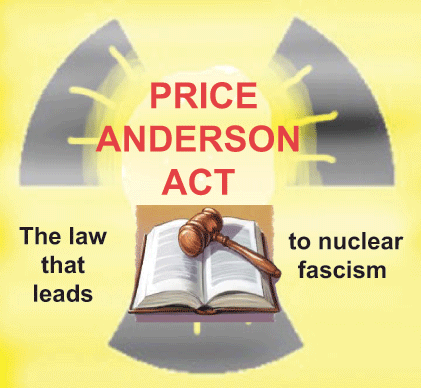
The ADVANCE Act of 2023 (HR6544) with Price-Anderson renewal for 40 years passes US House floor vote
Bipartisan support to extend severe accident liability protection to “inherently safe” new reactors?
The “Price-Anderson Nuclear Industries Indemnity Act”, also known as the “Price-Anderson Act” (PAA), is moving for renewal by Congress. The federal law to shield the nuclear industry from full liability of a nuclear accident is presently scheduled to sunset on December 31, 2025.
However, there is remains little to no transparency of the Act’s extension and expansion process to the public’s scrutiny of its incongruities.
Since 1957, Congress has periodically extended an adjusted upper limit for the nuclear industry’s financial liability protection from the otherwise unpredictably high projected cost in damages from the next severe radiological accident at a commercial nuclear power plant.
Originally, the industry’s limited liability for damages caused by a single nuclear accident was artificially set at $500 million per incident including personal injuries caused by radioactive fallout, population and economic dislocation by prolonged evacuations without re-entry, potentially permanent loss of property (residential, commercial and industrial), agricultural production and the contamination of natural resources with widespread and long-lived radioactivity.
The “Price-Anderson Nuclear Industries Indemnity Act”, also known as the “Price-Anderson Act” (PAA), is moving for renewal by Congress. The federal law to shield the nuclear industry from full liability of a nuclear accident is presently scheduled to sunset on December 31, 2025.
However, there is remains little to no transparency of the Act’s extension and expansion process to the public’s scrutiny of its incongruities.
Since 1957, Congress has periodically extended an adjusted upper limit for the nuclear industry’s financial liability protection from the otherwise unpredictably high projected cost in damages from the next severe radiological accident at a commercial nuclear power plant.
Originally, the industry’s limited liability for damages caused by a single nuclear accident was artificially set at $500 million per incident including personal injuries caused by radioactive fallout, population and economic dislocation by prolonged evacuations without re-entry, potentially permanent loss of property (residential, commercial and industrial), agricultural production and the contamination of natural resources with widespread and long-lived radioactivity.
According to the latest figures provided by the Congressional Research Service (CRS) Report published January 25, 2024, the industry’s financial liability ceiling for a single, severe nuclear accident is now capped at $16.6 billion by federal law. Beyond that ceiling, damages would supposedly be covered by US taxpayers. But the still unrealized total damage costs of a severe nuclear accident as evidenced by ongoing nuclear catastrophes at Fukushima (13 year ago) and Chernobyl (38 years ago) are already running into the hundreds of billions of dollars. The Fukushima Daiichi nuclear catastrophe’s damage is recently updated to surpass ¥15.4trillion ($102.7 billion).
The PAA renewal is part of the controversial“Accelerating Deployment of Versatile, Advanced Nuclear for Clean Energy (ADVANCE) Act of 2023” that is now approved by both the Senate and the House with significant differences including the PAA liability protection extension period.
The US Senate version (SB 1000) extends the PAA by 20 years to December 31, 2045, was passed on July 31, 2023 as a “must pass” inclusion in the National Defense Authorization Act of 2023 without a single public hearing. With Senate passage, the National Defense Authorization Act went to the US House of Representatives for approval where the ADVANCE Act of 2023 along with the PAA renewal on its coattail were instead culled from the military spending bill.
The ADVANCE Act with its the Price-Anderson renewal rider were introduced to the House as stand alone legislation (HR 6544) with the House version extending the industry’s limited accident liability protection to 40 years (December 31, 2065). According to E&ENews, “The House will vote on bipartisan nuclear energy legislation this week (02.26.2024) in hopes of reaching an agreement with the Senate in the coming weeks”—still without a single public hearing. The House floor vote to pass the HR 6544 with broad bipartisan support was confirmed by E&ENews February 29, 2024. The ADVANCE Act with the Price-Anderson extension for 40 years now goes back to the Senate to consider reconciliation.
Both the Senate and House versions intend to expand the government’s limited accident liability coverage beyond the aging, economically distressed and grandfathered commercial nuclear power fleet to now include new and supposedly “inherently safe” Small Modular Reactors and Advanced Non-Light Water reactor designs that incongruently could be licensed without any offsite radiological emergency planning zones.
All of this, thus far, has been accomplished without the transparency of a single congressional hearing in either the US Senate or House to explain the extension and expansion of Price-Anderson Act liability protection to increasingly economically distressed old reactors and new reactors where safety claims have yet to be technically certified.
“And by the way, we have to remember that the bulk of this money is going right back into the US to make those weapons,” Nuland said, pleading in favor of the latest Ukraine aid package “
Ukrainians are a convenient pretext to keep the tax cash flowing in the direction of the US military industrial complex
SOTT, Rachel Marsden, Tue, 27 Feb 2024
US State Department fixture and Under Secretary of State for Political Affairs, Victoria Nuland, aka “Regime Change Karen,” apparently woke up one day recently, took the safety off her nuclear-grade mouth, and inadvertently blew up the West’s Ukraine narrative.
Until now, Americans have been told that all the US taxpayer cash being earmarked for Ukrainian aid is to help actual Ukrainians. Anyone notice that the $75 billion American contribution isn’t getting the job done on the battlefield? Victory in military conflict isn’t supposed to look like defeat. Winning also isn’t defined as, “Well, on a long enough time axis, like infinity, our chance of defeat will eventually approach zero.” And the $178 billion in total from all allies combined doesn’t seem to be doing the trick, either. Short of starting a global war with weapons capable of extending the conflict beyond a regional one, it’s not like they’ve been holding back. The West is breaking the bank. All for some vague, future Ukrainian “victory” that they don’t seem to want to clearly define. We keep hearing that the support will last “as long as it takes.” For what exactly? By not clearly defining it, they can keep moving the goal posts.
But now here comes Regime Change Karen, dropping some truth bombs on CNN about Ukrainian aid. She started off with the usual talking point of doing “what we have always done, which is defend democracy and freedom around the world.” Conveniently, in places where they have controlling interests and want to keep them – or knock them out of a global competitor’s roster and into their own. “And by the way, we have to remember that the bulk of this money is going right back into the US to make those weapons,” Nuland said, pleading in favor of the latest Ukraine aid package that’s been getting the side eye from Republicans in Congress.
So there you have it, folks. Ukrainians are a convenient pretext to keep the tax cash flowing in the direction of the US military industrial complex. This gives a whole new perspective on “as long as it takes.” It’s just the usual endless war and profits repackaged as benevolence. But we’ve seen this before. It explains why war in Afghanistan was little more than a gateway to Iraq. And why the Global War on Terrorism never seems to end, and only ever mutates. Arguably the best one they’ve come up with so far is the need for military-grade panopticon-style surveillance, so the state can shadow-box permanently with ghosts while bamboozling the general public with murky cyber concepts that it can’t understand or conceptualize. When one conflict or threat dials down, another ramps up, boosted by fearmongering rhetoric couched in white-knighting. There’s never any endgame or exit ramp to any of these conflicts. And there clearly isn’t one for Ukraine, either.
Still, there’s a sense that the realities on the ground in Ukraine, which favor Russia, now likely mean that the conflict is closer to its end than to its beginning. Acknowledgements abound in the Western press. And that means there isn’t much time left for Europe to get aboard the tax cash laundering bandwagon and stuff its own military industrial complexes’ coffers like Washington has been doing from the get-go.
Which would explain why a bunch of countries now seem to be rushing to give Ukraine years-long bilateral security “guarantees,” requiring more weapons for everyone. France, Germany, Canada, and Italy have all made the pledge. Plus Denmark, which also flat-out said that it would send all its artillery to Ukraine………………………………………………
A sadly but unsurprising travesty of democracy slid out of Cardiff Bay with the release of the Senedd’s Economy, Trade and Rural Affairs Committee report on “Nuclear Energy and the Welsh Economy” on 21st February.
As a case study in lobbying power, it is surely worthy of inclusion in the Hall of Infamy.
Its recommendations could have been written by the nuclear lobby itself, rather than by our democratically elected Senedd Members.
Despite the collapse of the Wylfa project in 2019, all of the recommendations enthusiastically back the case for nuclear, with a plea to the UK Government to get on with the job. Einstein reportedly said: “Insanity is doing the same thing over and over again and expecting different results”.
Informed voices
If we are to have a credible Senedd, and a real democracy, then it is crucial that informed voices are heard.
This report, pandering to the self-interest of denizens of the nuclear village, merely reinforces the view that politics is about kowtowing to powerful corporate interests.
Meanwhile Cymru bleeds while real and credible solutions to energy and jobs exist.
The blurb preceding the report assures us that: “The Welsh Parliament is the democratically elected body that represents the interests of Wales and its people”. Yet this Committee took oral evidence from nine pro-nuclear individuals, and written evidence from six pro-nuclear organisations, and none from any individual or organisation having an anti-nuclear or indeed a sceptical view.
The rationale for this appears to be that the terms of reference deliberately chose not to include other voices:
“The terms of reference for this one-day inquiry were to consider the potential economic impact of new nuclear developments in north Wales, how to maximise local employment and benefits to local or Wales-based supply chains of new nuclear projects, and the challenges posed by skills shortages and how to overcome them. By its nature the inquiry did not examine the pros and cons of nuclear energy itself, but recognised its place in an overall energy security strategy and net zero targets.”
Apparently the only relevant voices are those backing nuclear.
The committee’s duty is to the people of Cymru, and not to the nuclear industry, or to the desire of the UK to remain a nuclear armed state.
Balanced view
As should be apparent if the Wellbeing of Future Generations Act is taken seriously. This is such a vital matter that evidence should be given to the committee which would enable its members to form a fully informed and balanced view on nuclear energy.
Why wasn’t evidence sought from experts and interested parties on such questions as:
why new nuclear may never happen.
why nuclear can’t be built in time to influence climate change.
why should Cymru support civil nuclear when the UK Government admits its intrinsic links with military nuclear weapons capability?
why should such reliance be placed on the voices of an industry which consistently fails to deliver on cost and on time?
why should Cymru accept nuclear when renewable energy technology can provide 100% of our energy needs?
why should Ynys Môn and Gwynedd become a nuclear dump to satisfy the needs of the nuclear industry and the UK state?
why should we believe that the effects on language, culture, biodiversity can be mitigated?
why have an influx of workers at a time when housing is a major issue for local people, when the NHS is on the point of collapse, when council services are creaking?
why does the Welsh Government not acknowledge that nuclear is in retreat globally?
It’s time to recognise that the priority for Cymru is to look to our own natural resources for energy and job solutions. If fully harnessed, offshore wind has the potential to provide double our energy needs.
And why don’t our Senedd Members look critically at the companies which gave evidence?
In 2020 the American company Bechtel had to pay (with another company) $57.5 million to the US Department of Justice for irregularities at the Hanford Waste Treatment Plant (Hanford is considered to be the most toxic nuclear waste facility in the US). In 2008 it had to pay (with another company) $407 million to the state and federal governments to settle litigation over leaky tunnels and a fatal ceiling collapse in the Boston Big Dig project.
Rolls-Royce make the nuclear engines for Trident submarines which carry nuclear weapons. The company has publicly stated that there are synergies between the civil and military nuclear industries. Its Small Modular Reactor Design is unlicenced and unproven, and as for being small, it is at 470 MW twice the size of the old Trawsfynydd reactors. Rolls-Royce’s new CEO Tufan Erginbilgic described the company as a “burning platform” as 2.500 job cuts were announced in 2023.
Caught up amongst the corporate and academic behemoths, Ynys Môn council leader Llinos Medi inherited the poisoned chalice of support for nuclear from her predecessors. Like many of us on Ynys Môn, she has a burning desire for our youngsters to have a future locally, and for the language to thrive.
Can she be persuaded that another, better, way can be found?
The Council’s support for a future project at Wylfa is “based on confirmation that the development is sustainable and that it should not be at the expense of the island’s communities”. Nowhere on the globe is nuclear sustainable, and communities worldwide have paid the price. Not only in Chernobyl and Fukushima, but in many countries where uranium is mined and land, water and workers are poisoned.
On Saturday 16th March PAWB (People Against Wylfa B), backed by other concerned organisations, is holding an open meeting called “Green Revolution – Opportunity Knocks” to open minds to the possibilities of truly sustainable economic and community growth in Ynys Môn and Gwynedd. Perhaps members of the Economy, Trade and Rural Affairs Committee should attend!
Robat Idris is a member of PAWB. He is also vice-chair of Cymdeithas y Cymod, member of CND Cymru and past chair of Cymdeithas yr Iaith. He contributed a chapter on “Atomic Wales” in “The Welsh Way”.
Under cost-plus or cost-reimbursement contracts, the government pays contractors for allowed expenses, plus an agreed upon profit margin. In fixed-price agreements, the contractor is paid a negotiated amount regardless of expenses incurred.
the development will move forward with the government absorbing the inherent risks.
Space Force bucks fixed-price trend for nuclear command satellites
Acquisition executive Frank Calvelli said the Space Force will award cost-plus contracts for the upcoming Evolved Strategic Satellite Communications System
WASHINGTON — In a departure from recent guidance, the Space Force will use cost-plus contracts for its high-priority strategic communications satellite program.
Space Force acquisition executive Frank Calvelli said Feb. 23 that the service has decided to not use fixed-price contracts for the Evolved Strategic Satellite Communications System (ESS), a critical component of the U.S. military’s nuclear command, control, and communications (NC3) network that provides nuclear-survivable communications.
Calvelli has previously indicated a preference for fixed-price contracts as a means to control costs and incentivize efficiency in satellite procurements. However, he said that an exception will be made for the ESS program.
Boeing and Northrop Grumman were selected in 2020 to build ESS satellite prototypes but Calvelli suggested that these designs are not mature enough to transition to fixed-price production.
“It’s not as far along as I would like for us to probably use fixed price,” Calvelli said at an event hosted by the Center for Strategic and International Studies.
The ESS program is estimated to be worth $8 billion. These new satellites are intended to augment and eventually replace the Advanced Extremely High Frequency (AEHF) network of nuclear-hardened satellites made by Lockheed Martin.
Draft solicitation in the works
Calvelli said the Space Systems Command is still working on a draft solicitation for ESS proposals, expected to be released this year.
He said he had expected the ESS payload designs to be more mature by now and nearing the prototyping stage. ESS was one of the programs selected for rapid-prototyping under a Pentagon initiative known as “middle tier acquisition”
“But it seems like we spent a lot of time in MTA just doing tech risk reduction or technology maturity,” said Calvelli. “Had we built a real payload or actually built the prototype, then maybe we could actually go off and do something fixed-price.”
Under cost-plus or cost-reimbursement contracts, the government pays contractors for allowed expenses, plus an agreed upon profit margin. In fixed-price agreements, the contractor is paid a negotiated amount regardless of expenses incurred.
Cost-plus contracts are used in higher risk projects where technical requirements are uncertain or unknown and the work involves “non-recurring engineering.” These are upfront costs associated with the design and development of a new product.
“Given the amount of NRE that still has to go into the ESS program, and feedback I’ve gotten from industry, we are probably looking more towards the traditional cost-plus model for something like that,” Calvelli said.
The use of cost-plus versus fixed-price contracts has been a contentious issue recently, with some defense companies experiencing significant losses on fixed-price contracts. Executives from major defense contractors, including Boeing, Northrop Grumman and Lockheed Martin, have warned that they would be reluctant to bid on some fixed-price programs due to the financial risk.
Calvelli has said the preference is to use fixed-price vehicles once new systems are proven but ESS does not meet that threshold so the development will move forward with the government absorbing the inherent risks.
Many elements of the traditional DIB have yet to adopt advanced manufacturing technologies, as they struggle to develop business cases for needed capital investment.
In other words, while adopting advanced manufacturing technologies would fulfill the purpose of the US Department of Defense, it is not profitable for private industry to do so.
Despite virtually all the problems the report identifies stemming from private industry’s disproportionate influence over the US DIB, the report never identifies private industry itself as a problem.
If private industry and its prioritization of profits is the central problem inhibiting the DIB from fulfilling its purpose, the obvious solution is nationalizing the DIB by replacing private industry with state-owned enterprises. This allows the government to prioritize purpose over profits. Yet in the United States and across Europe, the so-called “military industrial complex” has grown to such proportions that it is no longer subordinated to the government and national interests, but rather the government and national interests are subordinated to it.
US defense industrial strategy built on a flawed premise
Beyond private industry’s hold on the US DIB, the very premise the NDIS is built on is fundamentally flawed, deeply rooted in private industry’s profit-driven prioritization.
The report claims:
The purpose of this National Defense Industrial Strategy is to drive development of an industrial ecosystem that provides a sustained competitive advantage to the United States over its adversaries.
The notion of the United States perpetually expanding its wealth and power across the globe, unrivaled by its so-called “adversaries” is unrealistic.
China alone has a population 4-5 times greater than the US. China’s population is, in fact, larger than that of the G7 combined. China has a larger industrial base, economy, and education system than the US. China’s education system not only produces millions more graduates each year in essential fields like science, technology, and engineering than the US, the proportion of such graduates is higher in China than in the US.
China alone possesses the means to maintain a competitive advantage over the United States now and well into the foreseeable future. The US, attempting to draw up a strategy to maintain an advantage over China (not to mention over the rest of the world) regardless of these realities, borders on delusion.
Yet for 60 pages, US policymakers attempt to lay out a strategy to do just that.
Not just China, but also Russia
While China is repeatedly mentioned as America’s “pacing challenge,” the ongoing conflict in Ukraine is perhaps the most acute example of a shifting balance of global power.
Despite a combined population, GDP, and military budget many times greater than Russia’s, the collective West is incapable of matching Russian production of even relatively simple munitions like artillery shells, let alone more complex systems like tanks, aircraft, and precision-guided missiles.
While the US and its allies appear to have every conceivable advantage over Russia on paper, the collective West has organized itself as a profit-driven rather than purpose-driven society.
In Russia, the defense industry exists to serve national security. While one might believe this goes without saying, across the collective West, the defense industry, like all other industries in the West, exists solely to maximize profits.
To best serve national security, the defense industry is required to maintain substantial surge capacity – meaning additional, unused factory space, machines, and labor on standby if and when large surges in production are required in relatively short periods of time. Across the West, in order to maximize profits, surge capacity has been ruthlessly slashed, deemed economically inefficient. Only rare exceptions exist, such as US 155 mm artillery shell production.
While the West’s defense industry remains the most profitable on Earth, its ability to actually churn out arms and ammunition in the quantities and quality required for large-scale conflict is clearly compromised by its maximization of profits.
The result is evident today as the West struggles to expand production of arms and ammunition for its Ukrainian proxies.
The NDIS report would note:
Prior to the invasion, weapon procurements for some of the in-demand systems were driven by annual training requirements and ongoing combat operations. This modest demand, along with recent market dynamics, drove companies to divest excess capacity due to cost. This meant that any increased production requirements would require an increase in workforce hours in existing facilities—commonly referred to as “surge” capacity. These, in turn, were limited further by similar down-stream considerations of workforce, facility, and supply chain limitations.
Costs are most certainly a consideration across any defense industry, but costs cannot be the primary consideration.
A central element of Russia’s defense industry is Rostec, a massive state-owned enterprise under which hundreds of companies related to national industrial needs including defense are organized. Rostec is profitable. However, the industrial concerns organized under Rostec serve purposes related to Russia’s national interests first and foremost, be it national health, infrastructure or security.
Because Russia’s defense industry is purpose-driven, it produced military equipment because it was necessary, not because it was profitable. As a result, Russia possessed huge stockpiles of ammunition and equipment ahead of the Special Military Operation (SMO) in February 2022. In addition to this, Russia maintained large amounts of surge capacity enabling production rates of everything from artillery shells to armored vehicles to expand quickly over the past 2 years.
Only relatively recently have Western analysts acknowledged this.
“military industrial complex” has grown to such proportions that it is no longer subordinated to the government and national interests, but rather the government and national interests are subordinated to it.
the collective West has organized itself as a profit-driven rather than purpose-driven society………………………………across the collective West, the defense industry, like all other industries in the West, exists solely to maximize profits.
The first-ever US Department of Defense National Defense Industrial Strategy (NDIS) confirms what many analysts have concluded in regard to the unsustainable nature of Washington’s global-spanning foreign policy objectives and its defense industrial base’s (DIB) inability to achieve them.
The report lays out a multitude of problems plaguing the US DIB including a lack of surge capacity, inadequate workforce, off-shore downstream suppliers, as well as insufficient “demand signals” to motivate private industry partners to produce what’s needed, in the quantities needed, when it is needed.
In fact, the majority of the problems identified by the report involved private industry and its unwillingness to meet national security requirements because they were not profitable.
For example, the report attempts to explain why many companies across the US DIB lack advanced manufacturing capabilities, claiming:
Many elements of the traditional DIB have yet to adopt advanced manufacturing technologies, as they struggle to develop business cases for needed capital investment.
In other words, while adopting advanced manufacturing technologies would fulfill the purpose of the US Department of Defense, it is not profitable for private industry to do so.
Despite virtually all the problems the report identifies stemming from private industry’s disproportionate influence over the US DIB, the report never identifies private industry itself as a problem.
If private industry and its prioritization of profits is the central problem inhibiting the DIB from fulfilling its purpose, the obvious solution is nationalizing the DIB by replacing private industry with state-owned enterprises. This allows the government to prioritize purpose over profits. Yet in the United States and across Europe, the so-called “military industrial complex” has grown to such proportions that it is no longer subordinated to the government and national interests, but rather the government and national interests are subordinated to it.
US defense industrial strategy built on a flawed premise
Beyond private industry’s hold on the US DIB, the very premise the NDIS is built on is fundamentally flawed, deeply rooted in private industry’s profit-driven prioritization.
The report claims:
The purpose of this National Defense Industrial Strategy is to drive development of an industrial ecosystem that provides a sustained competitive advantage to the United States over its adversaries.
The notion of the United States perpetually expanding its wealth and power across the globe, unrivaled by its so-called “adversaries” is unrealistic.
China alone has a population 4-5 times greater than the US. China’s population is, in fact, larger than that of the G7 combined. China has a larger industrial base, economy, and education system than the US. China’s education system not only produces millions more graduates each year in essential fields like science, technology, and engineering than the US, the proportion of such graduates is higher in China than in the US.
China alone possesses the means to maintain a competitive advantage over the United States now and well into the foreseeable future. The US, attempting to draw up a strategy to maintain an advantage over China (not to mention over the rest of the world) regardless of these realities, borders on delusion.
Yet for 60 pages, US policymakers attempt to lay out a strategy to do just that.
Not just China, but also Russia
While China is repeatedly mentioned as America’s “pacing challenge,” the ongoing conflict in Ukraine is perhaps the most acute example of a shifting balance of global power.
Despite a combined population, GDP, and military budget many times greater than Russia’s, the collective West is incapable of matching Russian production of even relatively simple munitions like artillery shells, let alone more complex systems like tanks, aircraft, and precision-guided missiles.
While the US and its allies appear to have every conceivable advantage over Russia on paper, the collective West has organized itself as a profit-driven rather than purpose-driven society.
In Russia, the defense industry exists to serve national security. While one might believe this goes without saying, across the collective West, the defense industry, like all other industries in the West, exists solely to maximize profits.
To best serve national security, the defense industry is required to maintain substantial surge capacity – meaning additional, unused factory space, machines, and labor on standby if and when large surges in production are required in relatively short periods of time. Across the West, in order to maximize profits, surge capacity has been ruthlessly slashed, deemed economically inefficient. Only rare exceptions exist, such as US 155 mm artillery shell production.
While the West’s defense industry remains the most profitable on Earth, its ability to actually churn out arms and ammunition in the quantities and quality required for large-scale conflict is clearly compromised by its maximization of profits.
The result is evident today as the West struggles to expand production of arms and ammunition for its Ukrainian proxies.
The NDIS report would note:
Prior to the invasion, weapon procurements for some of the in-demand systems were driven by annual training requirements and ongoing combat operations. This modest demand, along with recent market dynamics, drove companies to divest excess capacity due to cost. This meant that any increased production requirements would require an increase in workforce hours in existing facilities—commonly referred to as “surge” capacity. These, in turn, were limited further by similar down-stream considerations of workforce, facility, and supply chain limitations.
Costs are most certainly a consideration across any defense industry, but costs cannot be the primary consideration.
A central element of Russia’s defense industry is Rostec, a massive state-owned enterprise under which hundreds of companies related to national industrial needs including defense are organized. Rostec is profitable. However, the industrial concerns organized under Rostec serve purposes related to Russia’s national interests first and foremost, be it national health, infrastructure or security.
Because Russia’s defense industry is purpose-driven, it produced military equipment because it was necessary, not because it was profitable. As a result, Russia possessed huge stockpiles of ammunition and equipment ahead of the Special Military Operation (SMO) in February 2022. In addition to this, Russia maintained large amounts of surge capacity enabling production rates of everything from artillery shells to armored vehicles to expand quickly over the past 2 years.
Only relatively recently have Western analysts acknowledged this.
Billionaire mining magnate Andrew “Twiggy” Forrest has rubbished a push to develop a local nuclear energy industry, even as fresh polling showed growing voter support for the proposal.
Dr Forrest took a veiled swipe at the opposition over its soon-to-be-unveiled nuclear energy policy, saying its push was “misinformed”, would act to sustain coal and gas powered generation for another two decades, and ultimately would lead to higher power prices.
“If we swallow this new lie that we should stop the rollout of green energy and that nuclear energy will be our fairy godmother, we will be worse off again,” the chair of mining and green energy firm Fortescue told the National Press Club on Monday.
“These misinformed, unscientific, uneconomic, plucked-out-of-thin-air, bulldust nuclear policies of politicians – masquerading as leaders – help no one.”
Dr Forrest, who in 2023 ranked as Australia’s third richest person, made his billions mining iron ore but in more recent years has aggressively pursued investments in renewable energy technologies and fuel, particularly green hydrogen.
Claiming he was “agnostic” on nuclear energy, Dr Forrest said the economics of such a proposal did not stack up when compared with renewable generation.
“Who is going to pay their nuclear electricity bill when it is 4-5 times more expensive than the renewables next door, even ignoring the decade plus it takes to develop nuclear?” Dr Forrest asked.
“With wind and solar, you’re up and running, lowering electricity costs and eliminating pollution within one to three years.”
The Coalition is yet to release a costed nuclear energy policy but has committed to do so ahead of the next federal election, due by May 2025 at the latest.
A Newspoll released by The Australian on Monday revealed 55 per cent of Australians support the replacement of coal-fired power plants with small modular nuclear reactors.
However, such technology is still in development, is yet to prove commercially viable, and would not be deliverable until the mid-2030s at the earliest.
The Albanese government has similarly disparaged the Coalition’s nuclear push, and has retained a ban on nuclear power and banking.
In his address, Dr Forrest also advocated for a “renewable energy-led economy”, recommending the government establish a “climate trigger” to assess the impact of carbon pollution in granting environmental approvals, rapidly expand firmed renewable energy, and introduce a levy on carbon emissions extracted from mining or imported into Australia.
“If we make the right decisions today, it will deliver the most profound and enduring economic growth opportunities ever seen, particularly in regional Australia,” he said.
Calling out the diesel fuel rebate, which costs the federal budget billions annually, Dr Forrest said the subsidy towards mining and fossil fuel companies should be scrapped.
“Massive taxpayer-funded financial support for huge mining companies, including Fortescue, to use imported diesel is indefensible,” Dr Forrest said.
Last week, Fortescue – of which Dr Forrest and his family own a 33 per cent stake – reported a 41 per cent increase in its first-half profit, beating analysts’ estimates and bucking a growing trend of sliding profitability among other major mining firms.
The Coalition is leaving the door open to building nuclear reactors in the Latrobe Valley and Anglesea using land from retired coal-fired power stations as a solution to Victoria’s energy troubles.
But locals warn there would be significant opposition to nuclear reactors being built in their towns, even if the huge legal hurdles to constructing and running them could be overcome.
With Victoria’s energy security under scrutiny after a wild storm earlier this month left hundreds of thousands of homes without power and triggered the shutdown of the state’s largest coal-fired generator, the federal opposition has confirmed it is now in the “advanced stages” of developing an energy policy. Nuclear is set to be a key part of the mix.
Opposition energy spokesman Ted O’Brien told The Age potential locations remained a “work-in-progress”, but he had been advised that “communities with experience hosting coal plants could be ideal potential hosts for zero-emissions nuclear plants”.
That leaves Victoria’s three remaining coal-fired power plants, plus the now decommissioned site of the Hazelwood mine and power station, as strongly preferred locations – with existing connections to the energy grid, and a ready-made workforce preparing for the end of coal-fired generation over the next 15 years.
“We have been very transparent about the fact we are considering zero-emissions nuclear energy as part of Australia’s future energy mix, and we will remain open about the details of our policy when it is announced,” O’Brien said.
The state opposition remains more cautious about the prospect of nuclear in the Latrobe Valley, but it too is not ruling out the idea. Asked about using retired coal-fired power stations as sites for nuclear energy, Opposition Leader John Pesutto said a commonsense approach was needed.
“But for any new industry to succeed it would first need detailed inquiries and thorough examination,” Pesutto told The Age. “It would also require bipartisan support, as this is crucial for investment certainty and to eliminate sovereign risk.”
Other sites in Victoria have also been flagged. Federal Opposition Leader Peter Dutton recently hinted at the possibility of a small modular reactor on the Surf Coast at Anglesea, on the site of Alcoa’s former mine and power station.
“It’s zero emissions, you can put it into an existing brownfield site, so when the coal-fired generation comes to an end, you can put the nuclear modular reactors into that facility,” Dutton said in September.
O’Brien has previously pointed to a September 2022 study for the US Department of Energy that found using the infrastructure of an existing coal plant could reduce a nuclear plant’s capital costs by up to 35 per cent. He suggested Australia should look to the US state of Wyoming, which is planning to replace its coal-fired generators with nuclear by about 2030.
But any move towards nuclear power in Victoria would likely encounter strong resistance from communities worried about safety, waste disposal and the cost.
Voices of the Valley president Wendy Farmer said nuclear power would face major opposition from communities worried about the risks.Farmer said residents in the Latrobe Valley had already suffered the consequences ofthe Hazelwood mine fire in 2014, which burned for 45 days and caused health concerns for those living amid the smoke.
“I would be surprised if there would be any enthusiasm for a reactor,” she said.
Deputy Mayor Mike Bodsworth, who represents the Anglesea ward, said residents were excited by the potential for renewable power generation at the former Alcoa site.
“But nobody I know has ever mentioned nuclear,” he said. “Knowing the general preferences of the local population, I doubt it would be supported.”
The Coalition has been talking up the potential to use small-scale modular reactors to generate power, and argue this, along with gas, will be a key part of Australia’s future energy mix to provide so-called base-load generation along with variable renewables.
In May last year, US company Westinghouse released plans for a small modular reactor. Reuters reported Westinghouse planned to begin building the reactor by 2030.
But many experts say this approach would be prohibitively expensive in Australia, particularly if forced to compete against lower-cost renewable wind and solar generators now being installed at a rapid rate across the country.
The CSIRO’s best guess is that in 2030 the capital cost of a small modular reactor will be $15,844 per kilowatt of electricity generated, compared to $1078 for solar and $1989 for wind.
That suggests replacing Victoria’s three remaining coal-fired plants, which combined to produce up to 4730 megawatts of electricity, with nuclear would involve a capital cost of about $74.9 billion, before even considering the ongoing running, maintenance and waste disposal costs.
The Coalition would also need to get the numbers in state parliament to repeal existing state and federal laws, including Victoria’s Nuclear Activities (Prohibitions) Act of 1983, which bans the construction and operation of nuclear facilities in Victoria.
Victorian Energy Minister Lily D’Ambrosio said nuclear energy was “toxic, risky, will take years to develop and [is] the most expensive form of energy there is”.
“Not only are the sites of our former coal plants privately owned, but there is currently no regulatory framework for approving a nuclear power plant in Australia, there are no nuclear waste storage sites in Australia, and no modular nuclear reactors have made it past the trial phase,” she said.
Federal Energy Minister Chris Bowen said claims of a boom in small modular reactors was a myth, and suggested Dutton should explain to the people around Gippsland why they should accommodate multiple reactors “for no good reason”.
“Anyone who has done their homework knows nuclear is not viable,” Bowen said. “The alleged boom in small modular reactors is a furphy. It’s striking that a party that once prided itself on economic rationalism could embrace a frolic so spectacularly uneconomic.”
In the US, a project run by NuScale Power to build the first commercial small modular reactor was scrapped last year because of soaring costs, leaving taxpayers facing a significant bill. Other projects promising commercially competitive nuclear energy have similarly failed to materialise.
Last month, UK energy secretary Claire Coutinho declared in the government’s Civil Nuclear Roadmap policy document that “Our nuclear industry is re-awakening”. That document pledges the UK to build 24 gigawatts of new nuclear power capacity over the next two decades. That is equivalent to six times the capacity of the one nuclear plant now under construction. Thus, at least one more massive nuclear plant is envisaged for an as yet unidentified location (although Wylfa in Anglesey, North Wales looks to be the most probable site).
There is currently one nuclear power plant under construction in the UK – Hinkley Point C – and one planned – Sizewell C. But the latest news on these is discouraging. Last month the French majority state-owned energy company EDF announced that the first reactor Hinkley Point C in Somerset would not come onstream until 2029 at the earliest, and probably more like 2031. There is no date set as yet for the second reactor. The final cost of the project, it said, could rise to £46 billion – as compared to an initial budget back in 2016 when contracts were signed of £18-24 billion.
EDF has encountered problems in the construction of other nuclear plants which use the European Pressurised Reactor (EPR) technology deployed at Hinkley Point at Olkiluoto, Finland and Flamanville, France. Some engineers have spoken about a design flaw in this technology. While they were designed for maximum safety – especially in the wake of the radiation leak at Fukushima,……….
To make matters worse, the French finance minister, Bruno Le Maire, began to press the case for the UK government to cough up more funds to finish the project. Worse still, EDF cast doubt over its commitment to build the new reactor at Sizewell C in Suffolk, in which it will have a 20 percent stake, unless the funding issue over Hinkley Point were satisfactorily resolved.
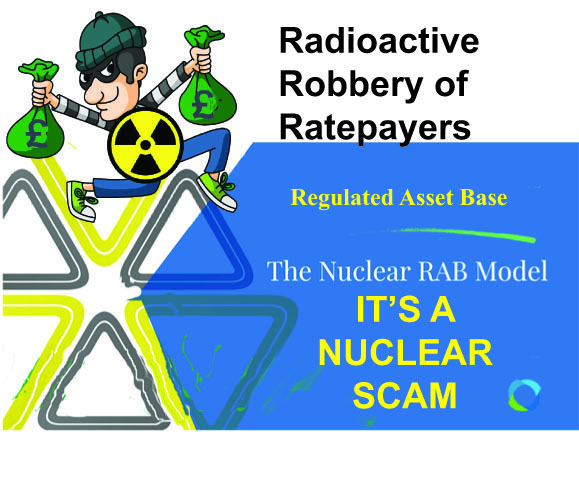
The funding structure devised for Sizewell C envisaged that consumers would pay a levy on their electricity bills to help pay for construction costs. This is the so-called Regulated Asset Base (RAB) model. Opponents of the project have dubbed this a “nuclear tax” which will endure for decades.
In contrast, Hinkley Point C will operate on the old contracts for difference model where the developers enjoy a guaranteed strike price once the reactors are operational. The original £89.50 per megawatt hour strike price has already been adjusted up to £125 in view of inflation. This means that British consumers of nuclear energy will be paying amongst the highest prices for electricity in the world.
The construction of Hinkley Point C was contracted by the UK government to EDF and China General Nuclear (CGN). Both Hinkley Point C and Sizewell C will have the capacity to power about six million households and will have an economic life of up to 60 years. The two plants could be producing 14 percent of Britain’s total electricity output in the late 2030s.
Ms Coutinho rushed out a press release on the evening of 23 January, saying: “Hinkley Point C is not a government project and so any additional costs or schedule overruns are the responsibility of EDF and its partners and will no way fall on [British] taxpayers”. This comment annoyed EDF and its main shareholder, the French government, to prompt a further statement. The substance of that was that unless the UK government offered something towards the shortfall at Hinkley Point, Sizewell C would simply not happen.
Eventually, the UK Department for Energy Security and Net Zero pledged an additional £1.8 billion of taxpayers’ money. The Minister for Nuclear and Renewables, Andrew Bowie MP, later admitted that he needed to raise an additional £20 billion of private finance to ensure that Hinkley Point C is completed…………………………………………………………………………………………………………………………………………
there has been no coherent political consensus around the need for nuclear power in the UK. The 2003 energy white paper published under Tony Blair’s government described nuclear power as an “unattractive option” – although Labour later changed its mind. There is still vocal opposition to nuclear power generation on safety grounds – and even more to the disposal of nuclear waste. The Low Level Waste Repository (LLWR) in Cumbria, operated by British Nuclear Fuels has been especially contentious. Many environmental and political activists associate nuclear energy production with nuclear weapons production. Moreover, there have been nine different energy secretaries sitting in cabinet since 2010. With such a level of turnover of people at the top, it has proven difficult to fashion policy.
Navalny’s ‘ideal’ image conflicts with his past remarks, McGlynn tells Euronews, pointing to his controversial views on Muslims in the Caucasus, Georgians and Central Asian migrants in Russia.
“Immigrants from Central Asia bring in drugs [to Russia],” Navalny said in an interview in 2012, defending what he described as a “realist” visa requirement for “wonderful people from Tajikistan and Uzbekistan.”
While he has reflected on some of these past remarks, they frequently re-surface, causing some to question if Navalny is what many in the Western world think he is.
Navalny’s controversial statements stem from his political origins in the nationalist movement, according to McGlynn.
“He used to attend the Russian march, a very far-right nationalist group generally behind the slogan of ‘Russia for ethnic Russians’. Anybody who expects Navalny to be an ideal Western liberal Democrat has been mistaken,” she tells Euronews.
His ultra-nationalist sentiment was prominent in a video dating back some 17 years filled with xenophobic comments.
His ultra-nationalist sentiment was prominent in a video dating back some 17 years filled with xenophobic comments.
“Everything in our way should be carefully but decisively removed through deportation,” Navalny said in the video dressed as a dentist, comparing immigrants to dental cavities.
Amnesty International stripped the opposition leader of the “prisoner of conscience” status based on this clip. It reversed this decision in 2021, recognising an “individual’s opinions and behaviour may evolve over time” in a statement. ………………………………………………………….
His incendiary comments on immigrants and Georgians re-surfaced when Navalny’s daughter, Dasha Navalnaya, was invited to speak at Georgetown University in May 2023.
Students filed a petition against the speaker selection, calling for a meritocratic appointment and that “being anti-Putin doesn’t imply being a pro-democratic, anti-war, and liberal leader.”
Following the backlash, two new speakers were added by the university to diversify perspectives, refusing to “disinvite” Navalnaya. ……………………………………..
Whatever you think of Alexei Navalny, he didn’t deserve what was done to him. I’ve written before on how the USA government prefers to kill people slowly, with finesse – as in the case of Julian Assange, (.and way way back, Wilfred Burchett.)
The czarist way is more blunt and definite, as in the case of Alexander Litvinenko – a cruel poisoning.
Now Alexei Navalny, a determined opponent of Vladimir Putin, has died suddenly at 47. We’re supposed to believe “of natural causes” – yeah, right, when you’ve been persecuted and ill-treated for years, you might die of a heart problem, anyway. But who believes the Kremlin?
Navalny fought courageously against corruption, and the rule of Putin. He has the guts to come back to Russia, and keep up the fight, even after a previous near-fatal poisoning.
There is another side to the Navalny story. He was an ultra-right racist and Russian nationalist, who railed against immigration and compared Muslims to “flies and cockroaches”. He joined in the fascist “Russian March” along with Monarchist, fascist, anti-Semitic and anti-immigrant organizations.
In earlier years he worked on the stock market, aligning himself with the liberal pro-market party “Yabloko” (The Apple), known for its long-standing relations with Washington’s State Department and the CIA. He had close links with influential bankers, and the support of a wealthy right-wing movement against Putin, which would be aimed at installing a pro-US puppet regime.
So, the traditional Czarist cruel and clumsy removal of Alexei Navalny has played right into the hands of the USA government. A very timely occasion for much propaganda for Ukraine’s irrational and doomed military fight against Russia, – and for buckets of crocodile tears.
Well, the pro Russisan propagandists will keep bleating about Navalny as a puppet of the USA.
And the “respectable” corporate English-language press will regurgitate the glorious pro – Zelensky and Ukraine stuff coming from Biden etc, (the Navalny death a boon to their story)
But the truth must be somewhere in between, and Navalny has to be remembered as a brave man, who fought for what he believed in, – but by no means as a model of a true democrat.
Despite its lack of promise for civilian use, the Energy Department and the White House have used the Livermore controlled fusion experiment results to boost the effort to harness fusion power for civilian purposes. In December 2022, Energy Secretary Jennifer Granholm announced with great fanfare that a laser pulse ignited a fusion reaction that produced more energy than was supplied by the light beams
In her energy balance, however, the energy secretary forgot to account for the energy it took to create the laser beams. This energy input, when added, drastically reverses her conclusion
Recent White House and Energy Department pronouncements on speeding up the “commercialization” of fusion energy are so over the top as to make you wonder about the scientific competence in the upper reaches of the government.
In April 2022, the White House launched what it called a “bold decadal vision” for a 10-year program to “accelerate the realization of commercial fusion energy.” The “bold” part is the proposal, in questionable analogy with high-speed computing, to do in parallel all the development steps that are typically done sequentially to bring a new technology to the market. According to the White House, this parallel processing would include: technology development, preparing a regulatory system (including rules for fusion reactor exports), securing the supply chain, identifying high-value markets, training a diverse workforce, and gaining public support, all “to support the rapid scale-up of fusion energy facilities.”
The special attraction of fusion is of course that it offers a potential source of abundant carbon-free energy that does not generate radioactive nuclear waste. But just because it would be nice if controlled fusion could work doesn’t mean it’s on the verge of doing so. The hard truth is that scientists and engineers don’t even know yet whether controlled fusion can be achieved to make useful work, at least anywhere outside the sun (and other stars, of course).
A historical perspective is useful to understand where the hype about commercial fusion is coming from.
We have known about fusion powering the sun since Hans Bethe explained it in 1939. This was also almost exactly when Otto Hahn and Fritz Strassmann discovered uranium fission (and Lise Meitner and her nephew Otto Frisch explained it). Then in 1942, Enrico Fermi and a small number of co-workers demonstrated a controlled fission chain reaction in a squash court at the University of Chicago. Fermi spent about $50 million in today’s dollars on building his 20-foot-tall atomic pile.
More than 80 years later, the corresponding control-of-fusion principle has yet to be demonstrated experimentally and the US government already made $35 billion in cumulative fusion expenditure—with probably a comparable investment abroad—without yet knowing what works.
The White House’s approach to attain success appears based on the idea that enthusiasm and coordination of all diverse stakeholders backed up with enough money can solve a so-far-unsolved scientific problem. Administration spokespersons mention projects that were successfully accelerated in this way, like the 1969 trip to the moon. Sure, this was indeed a hugely successful monumental project at the time, but no one involved doubted it was possible to do. All the necessary component technologies, like rockets and communications, were in hand on a smaller scale. In the case of fusion power reactors, no one is yet sure what they would look like, let alone if they will turn out to be possible and practicable.
The main research track today in fusion energy is “magnetic confinement”—configuring magnetic fields to keep in place a plasma of thermonuclear fuel 10 times hotter than the sun’s core within a donut-shaped magnetic “bottle.” Dozens of such machines—known as “tokamaks,” a Russian-language transliteration for toroidal chamber with axial magnetic field—have been built around the world since the 1950s, but none got close to demonstrating a net energy gain. Controlled fusion, it turns out, is an extremely difficult problem. To solve it, fusion experts have concluded the key is to have a large enough facility.
The world’s largest experimental fusion machine—ITER (initially the International Thermonuclear Experimental Reactor, also meaning “the way” in Latin)—is nearing completion in France. It is a highly complex scientific and engineering project. ITER publicity describes the building housing the reactor as “slightly taller than the Arc de Triomphe in Paris,” and that the building foundation will support some 400,000 metric tons—“more than the weight of New York’s Empire State Building.” Started in 2006, ITER is a 35-country megaproject that was supposed to be completed in 2016 at a cost of $6 billion. The reactor is currently projected to start up in 2025, but even that appears to be an optimistic date, as is the total budget estimate of about $22 billion.
The initial design objective is to produce a fusion plasma with thermal power 10 times greater than the injected thermal power. Even if successful, this net power output would not yet be the fusion equivalent of Fermi’s 1942 experimental nuclear pile, which proved the controlled fission concept. Nor would ITER’s more ambitious subsequent goal of maintaining this plasma for eight minutes. To get to proof of principle would likely take another step or an upgrading of ITER.
The Lawrence Livermore National Laboratory’s weapons laboratory pursued another approach of “internal confinement,” to create a fusion reaction at its National Ignition Facility (NIF) and claimed it could have power application. NIF uses light pulses from a concentric battery of powerful lasers to heat a small target containing a tiny bead of frozen thermonuclear fuel. This is, in effect, a miniature (secondary) thermonuclear bomb, with the lasers playing the role of the triggering fission reactions (primary). The light heats the container material sufficiently to ablate and swiftly compress the fuel to the point of detonation, which lasts some billionths of a second. The experiment was directed primarily at developing a useful diagnostic tool for weapons research. In power application, you would have to repeat the explosions at an extraordinarily fast rate, which is a tall order.
Despite its lack of promise for civilian use, the Energy Department and the White House have used the Livermore controlled fusion experiment results to boost the effort to harness fusion power for civilian purposes. In December 2022, Energy Secretary Jennifer Granholm announced with great fanfare that a laser pulse ignited a fusion reaction that produced more energy than was supplied by the light beams: “This milestone moves us one significant step closer to the possibility of zero carbon abundant energy powering our society … a huge step forward to the president’s goal of achieving commercial fusion within a decade.” (Update: In less than nine years from now.)
In her energy balance, however, the energy secretary forgot to account for the energy it took to create the laser beams. This energy input, when added, drastically reverses her conclusion, with the fusion output then amounting to only about one percent of the input. This is not disqualifying from a scientific point of view, but it obviously is in a power generating application. Still, this hasn’t stopped the Energy Department from including Livermore’s fusion ignition experiment in a promotional video on the “7 moments that changed nuclear energy history.” The clip claims “[t]he Lab was the first to produce more energy from a fusion reaction than was used to start the process,” again forgetting the energy it took to power the lasers.













 nuclear-news