Kazakhstan’s Nuclear Power Vote: Many Questions, But Just One On The Ballot

Radio Free Europe 5th Oct 2024
ALMATY, Kazakhstan — Kazakh voters will head to the polls on October 6 to decide whether to approve the construction of the first nuclear power plant in Kazakhstan — the world’s largest producer of uranium.
And the question on the ballot will be just that: “Do you agree to the construction of a nuclear power plant in Kazakhstan?”
But the debate surrounding nuclear energy is far more complex, taking in the heavy legacy of Soviet-era nuclear tests, long-standing nuclear-phobia, and unanswered questions around the companies — and countries — that would build the plant if voters endorse it.
Ahead of the first referendum in Central Asia on nuclear power, RFE/RL takes a closer look at that conversation.
What The Government Says
In many countries, national referendums can divide governing coalitions and spark cabinet resignations, but there is no sign of anything like that in Kazakhstan — the political elite is firmly behind the plan to build a nuclear power plant.
That extends from the government to the legislature, where all six parties support the idea, and where at least one lawmaker who initially opposed the plan now says he changed his mind.
The government’s main argument is that only nuclear power has the capacity to provide near-zero carbon energy on the scale required to cover a power deficit that grows year-on-year, especially in the southern half of the country.
Why Not Renewables?
While wind and solar’s overall share of the fossil-fuel-heavy national energy mix has grown to around 6 percent in recent years, Energy Minister Almasadam Satkaliev argues that renewables’ dependence on “natural and climatic conditions” make them too “unpredictable” on a large scale.
President Qasym-Zhomart Toqaev first floated the idea of using nuclear power in 2019.
Like other officials, he has assured Kazakhs that a future nuclear plant will be built with the latest technology to ensure the highest safety standards.
As the world’s largest uranium producer, he says it is time for Kazakhstan to move up the nuclear-fuel cycle.
Why Hold A Referendum?
That is a good question, given that any sort of popular vote carries a protest risk, and Kazakhstan’s authoritarian regime has only recently held parliamentary elections (March 2023) and a presidential election (November 2022).
But the country’s leadership knows that the issue is contentious — not least because the nation’s introduction to nuclear power began with the Soviet Union’s first nuclear bomb test in 1949, with hundreds more taking a terrible human and environmental toll in the northeastern Semei region……………………………………….
Is There A ‘No’ Campaign?
To the extent that Kazakhstan allows such things, there is.
But nuclear naysayers have been repeatedly blocked from holding demonstrations against the plan in various cities, and most recently found that a hotel in the largest city, Almaty — where they had earlier agreed to hold an event — was suddenly unwilling to host them.
At least five Kazakh activists opposed to nuclear power have been placed in pretrial detention on charges of plotting mass unrest early this month, while others have faced administrative punishment. https://www.rferl.org/a/kazakhstan-nuclear-power-referendum/33146657.html
Donald Trump encourages Israel to strike Iran’s nuclear sites
During a rally in North Carolina, Republican presidential nominee Donald Trump took the opposite approach to Joe Biden, encouraging Israel to strike Iran’s nuclear sites.
“They ask him (Joe Biden) what do you think about Iran? Would you hit Iran? And he goes as long as they don’t hit the nuclear stuff – that’s the thing you want to hit,” Mr Trump said.
“I think he’s got that one wrong – isn’t that what you’re supposed to hit?”
Hey Australia, Ontario is no model for energy and climate policy
Energy and climate strategy should prioritize options with lowest economic, environmental, technological and safety risks. Ontario’s does the opposite.
by Mark Winfield October 4, 2024, https://policyoptions.irpp.org/magazines/october-2024/ontario-energy/
Over the past few weeks, word has begun to reach Ontario of a series of stories in the Australian media in which the province is being held up as a model for climate and energy policy Down Under.
It seems that Peter Dutton, the leader of the federal opposition Liberal (the conservative party in Australian politics), has been promoting Ontario’s nuclear heavy energy plans as a pathway for Australia.
For those in the province familiar with the ongoing saga of its energy and electricity policies, the reactions to the notion of Ontario being an example of energy and electricity policymaking have ranged from “bizarre” to “you couldn’t make this up.”
Poor maintenance and operating practices led to the near-overnight shutdown of the province’s seven oldest reactors in 1997, leading to a dramatic rise in the role of coal-fired generation and its associated emissions of greenhouse gases (GHGs) and smog precursors. The refurbishment of the “laid-up” reactors themselves went badly. Two ended in write-offs, and the others ran billions over budget and years behind schedule, accounting for a large portion of the near doubling of electricity rates in the province between the mid-2000s and 2020.
Towards a $100-billion nuclear binge?
Only two other provinces followed Ontario’s lead on nuclear. Quebec built two reactors and New Brunswick one, each of them completed in the 1970s or the early 1980s. The Gentilly-1 facility in Quebec was barely ever operational and closed in 1977. The Gentilly-2 facility was shut down in 2012, and assessed as uneconomic, particularly in light of Ontario’s experiences in attempting to refurbish its own. The construction and then refurbishment of the Point Lepreau facility has repeatedly pushed New Brunswick Power to the brink of bankruptcy.
The current government of Ontario, led by Conservative Premier Doug Ford, has seemed determined to ignore the nuclear experiences of these provinces, and its own history of failed nuclear megaprojects. The government’s July 2023 energy plan includes the refurbishment of six reactors at the Bruce nuclear power facility (owned by OPG), and four reactors at the OPG’s Darlington facility. It subsequently added the refurbishment of four more reactors at OPG’s Pickering B facility, an option that had previously been assessed as unnecessary and uneconomic. The plant had originally been scheduled to close in 2018. There are also proposals for four new reactors totaling 4,800 MW in capacity at Bruce and four new 300MW reactors at Darlington. (The current capacity is 6,550 MW at Bruce, and 3,512 MW at Darlington.)
The total costs of these plans are unknown at this point, but an overall estimate in excess of $100 billion would not be unrealistic:
- $13 billion for the refurbishment at Darlington;
- approximately $20 billion for the refurbishment at Bruce;
- $15 billion for Pickering B (based on Darlington costs and plant age for both this case and Bruce);
- about $50 billion for the new build at Bruce, based on previous new build proposals;
- and the Darlington new build (unknown, but likely $10 billion or more).
Even this 100$-billion figure would assume that things go according to plan, which rarely happens with nuclear construction and refurbishment projects.
The government’s ambitious nuclear plans have not been subject to any form of external review or regulatory oversight in terms of costs, economic and environmental rationality, or the availability of lower-cost and lower-risk pathways for meeting the province’s electricity needs. Rather, the system now runs entirely on the basis of ministerial directives that agencies in the sector, including the putative regulator, the Ontario Energy Board, are mandated to implement.
The province’s politically driven policy environment is very advantageous to nuclear proponents. When previous nuclear expansion proposals had been subject to meaningful public review, the plans collapsed in the face of soaring cost estimates and unrealistic demand projections. This was the case in the early 1980s with the Royal Commission on Electric Power Planning – aka the Porter commission, at the turn of the 1990s with the Ontario Hydro demand and supply plan environmental assessment, and in the late 2000s, with the Ontario Power Authority’s integrated power system plan review.
A halt to renewable energy
There is a second dimension to Ontario’s electricity plans that also should not be overlooked. Upon arriving in office the Ford government promptly terminated all efforts at renewable energy development, including having completed wind turbine projects quite literally ripped out of the ground at a cost of hundreds of millions of dollars. It then scrapped the province’s energy efficiency strategy for being too effective at reducing demand. Repeated offers of low-cost electricity from the hydropower-rich neighbouring province of Quebec were ignored. The results of studies by the province’s own electricity system operator on energy efficiency potential and the possible contributions of distributed generation, like building and facility-level solar photovoltaics (PV) and storage, have been largely disregarded.
These choices have left the province with no apparent option but to rely on natural gas-fired generation to replace nuclear facilities that are being refurbished or retired. With existing facilities dramatically ramping up their output, and new facilities being added, GHG and other emissions from gas-fired generation have more than tripled since 2017, and are projected to continue to increase dramatically over the next years. On its current trajectory, gas-fired generation will constitute a quarter of the province’s electricity supply, the same portion provided by coal-fired plants before their phase-out, completed in 2013. The province has recently announced a re-engagement around renewable energy, but the seriousness of this interest has been subject to considerable doubt.
Given all of this, it would be difficult to see Ontario as a model for Australia or any other jurisdiction to follow in designing its energy and climate strategy. The province has no meaningful energy planning and review process. Its current nuclear and gas-focussed pathway seems destined to embed high energy costs and high emissions for decades to come. And it will leave a growing legacy of radioactive wastes that will require management of timescales hundreds of millennia.
A rational and transparent process would prioritize the options with the lowest economic, environmental, technological and safety risks. Higher-risk options, like new nuclear, should only be considered where it can be demonstrated that the lower-risk options have been fully optimized and developed in the planning process. Ontario’s current path goes in the opposite direction. To follow its example would be a serious mistake.
‘Environmental impact’ of Hinkley Point C debate due
2nd October, By Seth Dellow https://www.somersetcountygazette.co.uk/news/24624674.environmental-impact-hinkley-point-c-debate-due/
A PARLIAMENTARY debate has been secured by Bridgwater’s MP Ashley Fox to address the ‘environmental impact’ of the proposed salt marshes at Pawlett Hams and other sites.
The Westminster Hall Debate will take place in Parliament on Wednesday, October 9 at 11am. It will enable concerns to be raised about the impact of Hinkley Point C’s water intake system. The securing of the debate follows ongoing concerns about the recently scrapped proposal to create a 800-acre salt marsh at Pawlett Hams, as part of mitigation efforts for marine life in the Severn Estuary.
Hinkley Point C requires effective environmental measures to protect fish from being harmed by its water intake pipes, which are located 2km offshore. Originally, a range of mitigation efforts were agreed upon, including the installation of an Acoustic Fish Deterrent (AFD). However, after years of study, EDF Energy deemed the AFD impractical due to safety concerns.
Therefore, as an alternative, the creation of a salt marsh was proposed, with Pawlett Hams identified as a potential site. But this plan has since been halted following strong local opposition.
Ashley Fox will use the debate to recognise the efforts of residents in advocating for the protection of Pawlett Hams, question why the AFD was recommended without precedent, and to urge the Environment Agency to commit to maintaining vital flood defences along the River Parrett. Mr Fox will also caution against environmental measures that may cause unintended damage to local ecology.
The debate will compel a government minister to respond to these concerns and can be watched live on October 9 online at Parliament TV.
Ashley Fox said: “I supported the campaign to protect Pawlett Hams when I was running to be the local MP. I am pleased to have this opportunity to highlight the effective advocacy of the action group at the highest level.”
US government provides $1.52 billion loan to resurrect Michigan nuclear plant

US closes $1.52 billion loan to resurrect Michigan nuclear plant, By Timothy Gardner October 1, 2024
WASHINGTON, Sept 30 (Reuters) – The U.S. on Monday said it closed a $1.52 billion loan to resurrect Holtec’s Palisades nuclear plant in Michigan, and a senior Biden administration official said it could take two years to reopen the plant, which is longer than the company predicted.
President Joe Biden’s administration has called for a tripling of U.S. nuclear power capacity as U.S. power demand surges and worries about climate change mount.
The push could include the potential reopening of some commercial reactors that have been shut for decommissioning, including one at Three Mile Island, site of the worst nuclear accident in U.S. history. Restarting shut nuclear plants is a complicated and expensive process never before accomplished in the country.
“Palisades is a climate comeback story,” Ali Zaidi, the White House climate adviser, told reporters in a call, adding that nuclear power supports high-paying union jobs
The $1.52 billion in financing from the Department of Energy’s Loan Programs Office, was accompanied by funding for nonprofit electric cooperatives to purchase power from Palisades. Deputy U.S. Energy Secretary Xochitl Torres Small announced more than $1.3 billion in public funding to power cooperatives Wolverine and Hoosier Energy.
Nuclear reactors generate virtually emissions-free power, which is valued as electricity demand soars for the first time in decades on growth in artificial intelligence, electric vehicles and cryptocurrencies. Nuclear critics, however, point out that the U.S. has not agreed on a permanent place to bury radioactive nuclear waste.
Palisades still needs licensing from regulators and the senior U.S. official said that means it could take “a couple of years to turn back on”. Holtec has estimated a comeback in the fourth quarter next year…………….
O’Brien has said Holtec does not expect delays or additional costs. https://www.reuters.com/business/energy/us-closes-152-billion-loan-resurrect-michigan-nuclear-plant-2024-09-30/
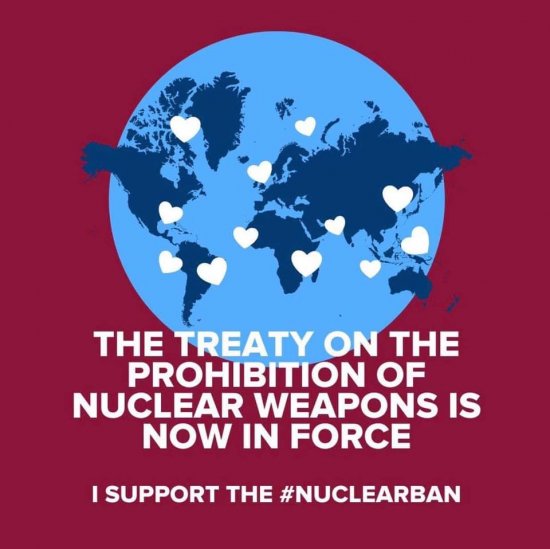
Question for the candidates: Will the United States sign and ratify the Treaty on the Prohibition of Nuclear Weapons?
By Alicia Sanders-Zakre | September 20, 2024 Alicia Sanders-Zakre is the Policy and Research Coordinator at the International Campaign to Abolish Nuclear Weapons. https://thebulletin.org/2024/09/will-the-united-states-sign-and-ratify-the-treaty-on-the-prohibition-of-nuclear-weapons/?fbclid=IwY2xjawFoiE5leHRuA2FlbQIxMQABHXWHz4dPKx6qA6gXNV_3JCT1LqSA4SpW4InKnv6GP0M0A5RzBvtaJMfokw_aem_nT8dnPTOYgkrNFm4kOHKTA
Before the 2016 US presidential election, Princeton physicist Zia Mian wrote an essay asking then-candidates Hillary Clinton and Donald Trump in the Bulletin whether they would be ready to start talks to ban nuclear weapons. Eight years and two presidents later, both the Trump and Biden administrations have rebuffed the 2017 UN Treaty on the Prohibition of Nuclear Weapons (TPNW) and chosen instead to persist with current US policies to maintain and upgrade nuclear weapons—despite a legal obligation to disarm, public support for the TPNW, and the existential threat to humanity of adherence to the debated theory of nuclear deterrence.
The TPNW is the first international treaty banning all nuclear weapons activities, including nuclear use and threat of use, testing, stationing, and development. The treaty’s Article 4 provides a verifiable pathway for nuclear-armed states to join and disarm. And Articles 6 and 7 create the first international regime to provide assistance and remediation to people and environments harmed by nuclear weapons use and testing; an effort led by countries that have been bombarded by Soviet and British nuclear detonations. This treaty currently has 93 signatory states and 70 states parties from every region of the world.
The United States—like other nuclear-armed countries—has chosen to undermine and dismiss this good faith effort by nearly half the world’s governments, including US allies, to rid the world of nuclear weapons. In 2020, the Trump administration even urged states to withdraw their instruments of ratification. Meanwhile, the United States has failed to implement the obligation it undertook more than half a century ago under Article VI of the Treaty on the Non-Proliferation of Nuclear Weapons (NPT) to pursue nuclear disarmament and instead spent $51.5 billion in 2023 alone to upgrade its nuclear arsenal. The continued investment of nuclear powers in maintaining and rebuilding their nuclear arsenals, while paying mere lip service to disarmament, is a source of contention within the NPT and undermines the nuclear non-proliferation regime.
Foreign policy goals aside, US presidential candidates should adhere to democratic principles and align their policies with public opinion and support for the treaty among local governments to join the TPNW: According to a 2022 study, 65 percent of the US population supports joining the TPNW. Cities and towns across the country—from Washington, D.C. to Los Angeles to Yellow Springs, Ohio—have adopted local resolutions calling on their government to join, alongside five US states. Members of the US Congress, as well as local and state politicians, have also called on the United States to join the ban treaty.
Support for the TPNW is based on a clear-eyed assessment of the risks that nuclear weapons pose as long as they exist—and an understanding of the naiveté of relying on the rationality of statemen like Russian President Vladimir Putin, Israeli Prime Minister Benjamin Netanyahu, North Korean leader Kim Jong-un, or former US president Donald Trump to decide the fate of humanity.
Scholars have shown that the reason humanity has escaped nuclear annihilation since the dawn of the nuclear age may have more to do with sheer luck than with any successful strategy.
No one will want to be around when luck runs out.
We know all too well what that would look like and the incapacity of humanitarian organizations to respond. A new report by the International Campaign to Abolish Nuclear Weapons documents in gut-wrenching detail the harm that nuclear weapons have done to children and the threat they continue to pose to them, including those bombed by the United States in Hiroshima and Nagasaki. Some of those children survived and now give testimony to—and remind leaders of—the urgent need to abolish these weapons. This report adds to the robust body of literature on the devastating humanitarian and environmental consequences of nuclear weapons.
Under both Republican and Democratic administrations, the United States and the world have continued to face the threat of accidental or intentional nuclear annihilation, a threat that has continued to grow in recent years. It is time to chart a new course and to eliminate nuclear weapons, which is the only fail-safe way to eliminate the threat of their use.
Presidential candidates Kamala Harris and Donald Trump should be asked: If elected President, will you sign and submit to the Senate for ratification the Treaty on the Prohibition of Nuclear Weapons?
Australian Defence Minister Marles, with all pretension, flogging a dead seahorse

By Paul Keating, Sep 28, 2024, https://johnmenadue.com/marles-with-all-pretention-flogging-a-dead-seahorse/
Richard Marles and his mate, the US defence secretary, are beginning to wilt under the weight of sustained comment in Australia critical of the AUKUS arrangement.
Marles, unable to sustain a cogent argument himself, has his US friend propping him up in London to throw a 10,000-mile punch at me – and as usual, failing to materially respond to legitimate and particular criticisms made of the AUKUS arrangement.
The US Defence Secretary, Lloyd Austin, claims AUKUS would not compromise Australia’s ability to decide its own sovereign defence issues, a claim made earlier by Richard Marles and the prime minister.
But this would only be true until the prime minister and Marles got their phone call from the president, seeking to mobilise Australian military assets – wherein, both would click their heels in alacrity and agreement. The rest of us would read about it in some self-serving media statement afterwards. As my colleague, Gareth Evans, recently put it, “it defies credibility that Washington will ever go ahead with the sale of Virginias to us in the absence of an understanding that they will join the US in any fight in which it chooses to engage anywhere in our region, particularly over Taiwan”.
In London, Marles claimed that the logic behind AUKUS matched my policy as prime minister, in committing to the Collins class submarine program. This is completely untrue.
The Collins class submarine, at 3,400 tonnes, was designed specifically for the defence of Australia – in the shallow waters off the Australian continental shelf.
The US Virginia class boats at 10,000 tonnes, are attack submarines designed to stay and stand on far away station, in this case, principally to wait and sink Chinese nuclear weapon submarines as they exit the Chinese coast.
At 10,000 tonnes, the Virginias are too large for the shallow waters of the Australian coast – their facility is not in the defence of Australia, rather, it is to use their distance and stand-off capability to sink Chinese submarines. They are attack-class boats.
When Marles wilfully says “AUKUS matches the Collins class logic” during the Keating government years, he knows that statement to be utterly untrue. Factually untrue. The Collins is and was a “defensive” submarine – designed to keep an enemy off the Australian coast. It was never designed to operate as far away as China or to sit and lie in wait for submarine conquests.
And as Evans also recently made clear, eight Virginia class boats delivered in the 2040s-50s would only ever see two submarines at sea at any one time. Yet Marles argues that just two boats of this kind in the vast oceans surrounding us, materially alters our defensive capability and the military judgment of an enemy. This is argument unbecoming of any defence minister.
As I said at the National Press Club two years ago, two submarines aimed at China would be akin to throwing toothpicks at a mountain. That remains the position.
The fact is, the Albanese Government, through this program and the ambitious basing of American military forces on Australian soil, is doing nothing other than abrogating Australia’s sovereign right to command its own continent and its military forces.
Marles says “there has been demonstrable support for AUKUS within the Labor Party”. This may be true at some factionally, highly-managed national conference — like the last one — but it is utterly untrue of the Labor Party’s membership at large – which he knows.
The membership abhors AUKUS and everything that smacks of national sublimation. It does not expect these policies from a Labor Government.
Nuclear Weapons and the U.S. Presidential Elections

by beyondnuclearinternational, https://beyondnuclearinternational.org/2024/09/29/nuclear-weapons-and-the-u-s-presidential-elections/
Whoever becomes the next US president, we’ll need to redouble our efforts for nuclear abolition, writes Jackie Cabasso
Nuclear weapons policy is not an issue in the presidential election. In fact, U.S. foreign policy, with the exception of some controversy over ongoing U.S. arms provisions to Israel, is barely an issue. Even though nuclear weapons are in the media more than they have been for many years—due mainly to the Russian government’s nuclear threats, and to some extent, North Korea’s, there is basically no public discussion or political debate about nuclear weapons in the United States.
The political situation in the U.S. is more volatile and uncertain than at any time in my life. Predicting who is going to be elected president in November is impossible. In the short weeks since President Biden withdrew from the campaign and threw his support behind his vice president Kamala Harris, there has been an extraordinary outpouring of enthusiasm for her campaign, especially among young people and people of color, and a massive surge of financial support from a wide range of constituencies. But at this point, the outcome of the presidential election is too close to call.
What I can say is that U.S. national security policy has been remarkably consistent in the post-World War II and post-Cold War eras. “Deterrence” – the threatened use of nuclear weapons – has been reaffirmed as the “cornerstone” of U.S. national security policy by every president, Republican or Democrat, since 1945, when President Harry Truman, a Democrat, oversaw the atomic bombings of Hiroshima and Nagasaki.
If Kamala Harris is elected in 2024, we can expect more of the same. As confirmed in an August 20, 2024, New York Times story that attracted some notice, an initiative is quietly underway by the Biden administration to beef up the U.S. nuclear arsenal. As reported by the Times, in March, President Biden approved a highly classified “Nuclear Employment Guidance” plan that seeks to prepare the United States for possible coordinated nuclear challenges from China, Russia and North Korea. This comes as the Pentagon believes China’s nuclear arsenal will rival the size and diversity of the U.S.’ and Russia’s over the next decade.
This plan was hinted at by Vipin Narang, a top Department of Defense nuclear policy official, who recently stated that, while current modernization plans — estimated to cost at least $350 billion over the next two decades — are “necessary,” they “may well be insufficient” to meet current and future threats. According to Narang, in the face of growing threats from Russia, China and North Korea, “We have begun exploring options to increase future launcher capacity or additional deployed warheads on the land, sea and air legs that could offer national leadership increased flexibility, if desired, and executed.”
According to the head of the National Nuclear Security Administration, Jill Hruby, the U.S. is launching a new nuclear arms race to catch up with and outsmart Russia and China. “We now have seven systems that should be developed and put into production by the mid-2030s. This program is not only a major modernization of all three components of the nuclear triad, but also adds new deterrence capabilities that do not currently exist,” she said.
Donald Trump’s likely nuclear policy is spelled out in a manifesto by Project 2025, a coalition of far-right groups led by the Heritage Foundation. Its 900-page book, “Mandate for Leadership,” is a blueprint for the most dramatic takeover and transformation of U.S. democracy in history and is widely seen as the playbook for a possible second Trump administration.
Trump himself, and a number of Republican members of Congress, have attempted to distance themselves from Project 2025, in some cases, claiming they haven’t even heard of it. This is not plausible. Speaking at a 2022 Heritage Foundation event, Donald Trump declared, “[T]his is a great group. And they’re going to lay the groundwork and detail plans for exactly what our movement will do and what your movement will do when the American people give us a colossal mandate to save America and that’s coming.”
Project 2025 proposes that a second Trump administration prioritize nuclear weapons programs over other security programs, accelerate the development and production of all nuclear weapons programs, increase funding for the development and production of new and modernized nuclear warheads, and prepare to test new nuclear weapons.
Separately, Robert O’Brien, an ex-adviser to former President Trump, has written that in order to counter China and Russia’s continued investments in their nuclear arsenals, the U.S. should resume nuclear testing.
While she did not mention nuclear weapons in her presidential nomination acceptance speech, Kamala Harris chillingly pledged, “As Commander-in-Chief, I will ensure America always has the strongest, most lethal fighting force in the world.” A Harris administration would undoubtedly be far more progressive on domestic issues, but whoever wins the U.S. presidency, our redoubled efforts to press for nuclear abolition will remain an urgent necessity.
Scottish National Party blasts Labour for ‘frittering away’ money on nuclear plant instead of winter fuel payment
The party’s energy spokesperson Dave Doogan said Labour “is more concerned with funding needless nuclear projects… than it is with supporting hard-pressed pension
Andrew Quinn, Westminster Reporter, 28 SEP 2024.
https://www.dailyrecord.co.uk/news/politics/snp-blasts-labour-frittering-away-33767683
The SNP has claimed the Labour Government is “frittering away” £5 billion on a nuclear power plant while cutting the Winter Fuel Payment.
The party’s energy spokesperson Dave Doogan said the party is “more concerned with funding needless nuclear projects… than it is with supporting hard-pressed pensioners.”
The UK Government announced earlier this month that an extra £5.5bn is being made available to the Sizewell C nuclear power plant.
The plant is being built in Suffolk and the UK Government has said it will help secure the country’s energy independence. It will supply up to seven per cent of the UK’s energy needs but won’t start generating electricity until the 2030s.
t comes after the Labour Government decided to make the Winter Fuel Payment means-tested. Nearly 900,000 Scots pensioners will now miss out on the benefit.
Doogan said: “When Labour frittered away more than £5bn to the blackhole that is Sizewell C nuclear plant, what they did was fund a French owned company that will have no benefit to Scotland all the while picking the pockets of Scottish pensioners by robbing them of their Winter Fuel Payment.
“England’s Sizewell C will cost the tax payer some £30bn, yet just £1.4bn was deemed too high a price to keep 880,000 pensioners Scottish warm this winter – Sir Keir Starmer’s priorities are all wrong.
“The British Government is more concerned with funding needless nuclear projects and defending indefensible designer clothing funds than it is with supporting hard-pressed pensioners as the frost bites this winter and heating bills rise.
“Scotland is energy rich and our future is in renewables, but instead the Labour Government is choosing to pump money into English nuclear power plants and letting Scottish pensioners go cold – the SNP will always put Scotland’s interests first and that includes our pensioners in the face of swingeing Labour cuts.”
“Given the dire state of the public finances we have inherited, it’s right we target support to those who need it most. Over a million pensioners will still receive the Winter Fuel Payment, while many others will also benefit from the £150 Warm Home Discount to help with their energy bills over winter.
“We are also committed to helping the UK achieve energy security and net zero and new nuclear power stations such as Sizewell C will help us achieve that, while securing thousands of good, skilled jobs.”
Weatherwatch: Labour’s stance on nuclear power is worryingly familiar
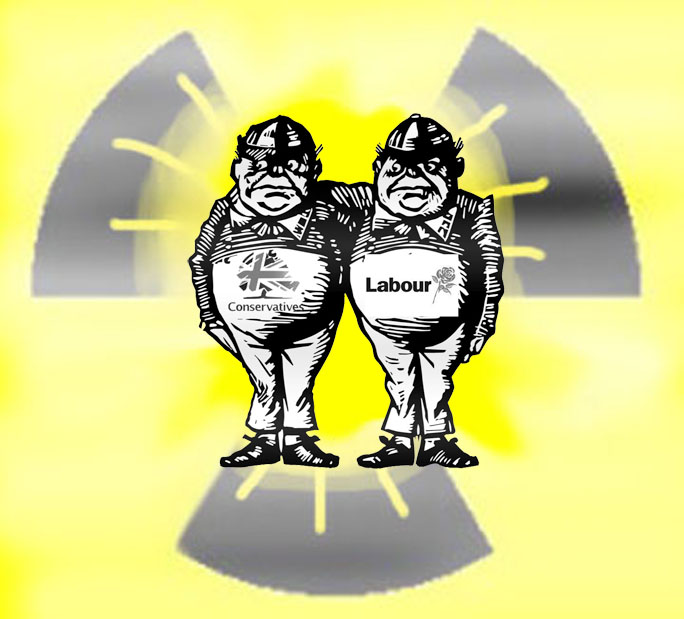
There is little difference between this government’s and its Conservative predecessor’s policies on expansion
Paul Brown, Fri 27 Sep 2024, https://www.theguardian.com/news/2024/sep/27/weatherwatch-labour-nuclear-power-conservative-policies
There seems to be no difference between Conservative and Labour policies on nuclear power. Both support the current building of Hinkley Point C in Somerset, the planned Sizewell C station in Suffolk, an unspecified number of small modular reactors all over Britain as well as the far-off dream of nuclear fusion.
However, few scientists serious about the threat of the climate crisis believe new nuclear power stations are part of the solution in reducing carbon output. Building them is too slow and costly, while solar and wind are quicker and cheaper in making a dent in fossil fuel consumption and eliminating it.
While supporting nuclear expansion seems to be politically expedient, the reality on the ground appears to be different. As the 2024 World Nuclear Status report published this month points out, if Britain gets anywhere near its plan to double onshore wind, triple solar power and quadruple offshore wind by 2030, it will be producing more electricity from these sources than the country consumes.
The experts also say if Rolls-Royce’s “heroic assumption” of the cost of electricity from small modular reactors was correct, any planned construction of large stations would immediately be abandoned.
A push for compensation for U.S. nuclear testing fallout resumes on Capitol Hill
Claudia Grisales, September 24, 2024, https://www.npr.org/2024/09/24/g-s1-24270/nuclear-testing-compensation-congress?fbclid=IwY2xjawFgMcFleHRuA2FlbQIxMQABHaoow4FFmd5Ia__F-BpVC_tgR2mpWKfNIVdqg30GD9-0BUfjjDMrp1DJnQ_aem_QzuWFWxPV8Pxo44ykAqKIg
Dozens of advocates are blanketing Capitol Hill this week to continue their push for Congress to revive a program that provided compensation for people suffering long-standing impacts from U.S. nuclear testing programs.
A group of Indigenous Americans and people suffering effects from the downwind effects of atomic testing are calling on Congress to revive the Radiation Exposure Compensation Act, or RECA, a 34-year-old federal program that expired on June 7.
Advocates say the program was a lifeline for individuals sickened by the U.S. atomic testing program, including so-called atomic veterans. A group of about 50 people boarded a bus in Albuquerque early this week to make a 30-hour drive to Washington, D.C., to make their case.
They are focused on convincing House Speaker Mike Johnson, R-La., to hold a vote on a bill that passed the Senate in March that would renew and expand the program. They are facing resistance from some House Republicans who have raised concerns about the program’s cost.
“What’s really difficult for us is that when Speaker Johnson blocks this bill, he’s saying no to over 50 Republican House districts that would benefit from RECA,” advocate Tina Cordova told NPR. “They make it out to be this issue of money … while we’ve been paying for it with our lives.”
RECA advocates who will be on Capitol Hill this week include members of the Navajo Nation, Laguna Pueblo, Acoma Pueblo and Hopi tribes, as well as former uranium workers and a group of St. Louis women affected by contamination issues in their community.
Advocates say those sickened by the tests have suffered from a multitude of radiation-related illnesses, including thyroid cancer and lung disease.
“So many in my family have suffered from radiation-related cancers,” said Maggie Billiman, one of the trip’s organizers, in a statement from the group.
Billiman and Cordova are described as downwinders, or people who have suffered effects of atomic radiation that was blown from the original testing site to other areas in the vicinity.
Billiman’s father, a Navajo Code Talker in World War II and a downwinder, died from stomach cancer. She was part of a group that made a similar trip to Capitol Hill earlier this year.
The group will be in Washington, D.C., for several days, kicking off events with a briefing followed by a march to the Capitol on Tuesday morning. They’ll also join members who have pushed for the plan, including Sens. Ben Ray Lujan, D-N.M., and Josh Hawley, R-Mo., and several members in the House. They’ll also hold demonstrations at the Capitol, including prayers, songs, dance and a vigil for several days.
On Wednesday, the group hopes to deliver medical documents to Johnson showing expenses incurred by survivors and their families to treat radiation-related illnesses, followed by a wreath-laying ceremony on the Capitol steps that evening.
“We go into financial ruin … having been basically subject to a bomb by our own government, and then left to deal with the consequences on our own,” Cordova said. “We regularly hold bake sales and garage sales to meet our expenses. In the greatest nation on earth, that’s what we’re left with. We were bombed as American citizens. … And for Speaker Johnson to say it’s going to cost too much is totally unconscionable.”
Israel’s Collapse Is Imminent Amid Escalation In Lebanon
September 22, 2024, By Mnar Adley / MintPressNews, https://www.mintpressnews.com/scott-ritter-lebanon-pager-attack-hezbollah-brics/288312/
It sometimes feels like the world is on the brink of war. Israel has just escalated the conflict in the Middle East with a massive attack on Lebanon, implanting bombs in hundreds of pagers and other electronic devices, killing many and injuring thousands.
Around the world, the action has been condemned as an act of terror.
Today’s guest, Scott Ritter, unequivocally denounced the move. “This is something that is unjustifiable under any circumstances. There is no element of the law of war that would allow this kind of indiscriminate attack,” he said. Ritter is a former United States Corps Intelligence Officer and UN Weapons Inspector in Iraq. He is an author and a geopolitical analyst, whose work you can find at ScottRitter.com. He has closely followed the wars in Ukraine and the Middle East.
The attack, he said, will have widespread implications, not least for Western corporations, who were caught unaware. “This is going to create a crisis of confidence among consumers that could end up costing Western companies billions of dollars,” he explained, adding:
Anybody with any shred of common sense will immediately throw away their Western-made electronic device and source one from a country such as China, where Israel is not going to be able to infiltrate and corrupt the integrity of the electronic device to achieve either intelligence collection goals or assassination [goals].”
While the Israeli military is vastly better armed and funded than Hamas, Ritter claimed that it was actually the Palestinian force that has come out on top after 12 months of fighting, stating:
“Hamas right now, in my opinion, is winning this conflict. They are winning it strategically. They are paying a horrible price for it. But on October 6, nobody was talking about the creation of a Palestinian state. Today, it is on the tip of the tongue of so many people around the world. Why? Because the world has seen the truth about Israel.”
Not only that, but Israel is eating itself from within. Its military is seriously depleted; its economy has been shattered by rocket attacks, and by 12 months of war economy; and its society is beginning to fragment.
The United States, too, has been damaged. It is increasingly isolated on the world stage, and its prestige is slipping. Fewer nations look to Washington for leadership and, instead, see organizations such as BRICS as the future.
Later this month, a BRICS summit will be held in Kazan, Russia, bringing its core member nations together with its new invitees. Palestine will be a key issue, and no doubt countries such as Saudi Arabia and the United Arab Emirates will be put under pressure to stop covertly aiding Israel and come to a solution to end the war.
BRICS has already succeeded in helping to lessen tensions between Iran and Saudi Arabia, and it is possible that the new bloc can act to bring about peace in a manner that many hoped the United Nations would be able to do.
Whatever happens, it is clear that October 7 fundamentally changed the situation for Israel and Palestine forever.
Labour backs nuclear – but at what cost?

for the UK consumer, nuclear new building means expensive electricity and offers little in terms of addressing climate change.
With new funding announced for the prospective Sizewell C plant, the government seems committed to nuclear power.
However, the cost of nuclear newbuild in the UK is staggering and,
even if built, sufficient new capacity will not arrive soon enough to help
mitigate climate change.
UK electricity consumers should hope that the
target of 24 GW of nuclear capacity by 2050 slips into obscurity. “We
will ensure the long-term security of the sector, extend the lifetime of
existing plants, and we will get Hinkley Point C over the line.” That was
Labour’s manifesto commitment to nuclear power, and the government has
already put money on the line.
In late August, it announced additional
funding of up to £5.5 billion for the proposed Sizewell C plant, which
would be only the UK’s second nuclear construction project since the
completion of Sizewell B in 1995, if built.
However, for the UK consumer, nuclear new building means expensive electricity and offers little in terms of addressing climate change. The UK’s operable nuclear capacity declined
from 12.2 GW in 1996 to 5.8 GW in 2023. Only nine reactors are still
generating power and two are under construction. Eight of the operable
reactors came online between 1983 and 1989, making the youngest 45 years
old. Last year, the Hartlepool and Heysham 1 plants gained modest life
extensions to 2026, and operator EdF hopes to extend the lives of its other
Advanced Gas Cooled (AGRs) reactors to 2028.
However, there is little likelihood that the eight remaining AGRs can continue in service beyond these dates. They were initially designed to last about 30 years, with the
decision to decommission based on the deterioration of irreplaceable
components such as the graphite core and boilers. Three AGRs – two built
in 1976 and one in 1983 – are already defueling, a preliminary step to
decommissioning. As a result, by 2030 at the latest, all of the UK’s AGRs
will be out of service.
Decommissioning costs the consumer money, and the
Nuclear Liabilities Fund has not kept up with the cost of decommissioning.
In its third report of 2022-23, the House of Commons Committee of Public
Accounts noted that the government had already been forced to provide
additional funding of £10.7 billion and that there remained “a strong
likelihood that more taxpayers’ money will be required”.
In addition, despite the first nuclear reactors coming into service in the 1950s, there
is still no clear plan for the permanent storage of the most hazardous
forms of radioactive waste.
The government’s most recent energy and
emissions projections, published in November 2023, forecast the
volume-weighted wholesale electricity price in 2030 at between £36.6/MWh,
in a low fuel price scenario, and £58.5/MWh in a high fuel price scenario.
The UK’s latest licensing round for renewable energy, the results of
which were announced in September, returned CfD prices for solar projects
of £50.07/MWh, onshore wind at £50.90/MWh and offshore wind at
£58.87/MWh (2012 prices).
At over £100/MWh in today’s money, even
without a further five years of inflation, Hinkley Point C is a chronic
deal for the UK electricity consumers. EdF wants a new funding model for
both the construction of Sizewell C and the lifetime extension of Sizewell
B, indicating that even the large CfD strike price for Hinkley Point C is
not enough to build new nuclear in the UK. This will almost certainly mean
UK consumers bearing more of the risk. The adoption of the proposed
Regulated Asset Base (RAB) model would see consumers paying for nuclear
plants years before they actually generate electricity.
Energy Voice 18th Sept 2024.
Biden’s Grand Alliance against Russia in Ukraine beginning to recognize the N word…Negotiations

Walt Zlotow, West Suburban Peace Coalition, Glen Ellyn IL, 20 Sept 24
The US 32 month long proxy war against Russia is not quite over. But everyone in America’s important NATO allies knows America’s Ukraine proxy is losing badly with its military near collapse. The two hundred billions the US and NATO have poured into Ukraine have made not a dent in achieving the ‘good guys’ war aims of taking back the Donbas and Crimea, receiving reparations from Russia, and gaining NATO membership.
While President Biden betrays nary a hint of that stark reality, his European NATO allies, greatly more affected by the economic consequences of this than America, certainly are.
German Chancellor Olaf Scholz recently said, “I believe that now is the time to discuss how to arrive at peace from this state of war, indeed at a faster pace.” Scholz further stated that he will impose a limit on open ended aid to Ukraine and is working on a diplomatic settlement that will include Ukraine ceding territory to Russia.
A senior French diplomat recently told Le Figaro the same thing, citing that the Donbas and Crimea are beyond Ukraine’s military capability and that France lines up with Germany that only a negotiated settlement will end the war.
Insulated from the economic angst of its Western European allies, the US sees no need to deal with reality. For President Biden and his war cabinet including VP Harris, the words ‘negotiated settlement’ and ‘ceding territory’ dare not pass the lips of US diplomats acting more like war generals than statespersons.
Biden and company are still running around like Chicken Little, chirping ‘The Russians are coming, the Russians are coming, to take over Poland on their march to the English Channel.’
That includes presidential candidate Kamala Harris who repeated that delusional meme in her presidential debate.
The US proxy war against Russia, with Ukrainians doing all the dying and the country in ruins, is headed to a negotiated settlement in spite of President Biden’s intransigence.
World demands end to Israel’s illegal occupation of Palestine, in landslide UN vote
The vast majority of the world voted at the UN General Assembly to demand an end to Israel’s unlawful occupation of Palestinian territory within 12 months, with 124 countries (64%) in favor, 14 (7%) against, and 43 (22%) abstentions.
GeoPOliticalEconomy, By Ben Norton, 19 Sept 24
The countries that voted against the resolution, in effect supporting Israel’s illegal occupation, were the United States, Israel, Argentina, Czechia, Hungary, Malawi, Papa New Guinea, and Paraguay, plus the tiny Pacific island nations of Fiji, Micronesia, Nauru, Palau, Tonga, and Tuvalu.
These small island countries that consistently echo Washington’s unpopular votes in the UN are essentially unofficial US colonies, and mostly use the US dollar or Australian dollar as their currencies. Together, the six have a combined population of just over 1 million people, making them some of the smallest nations on Earth.
Among the large countries that abstained were India, Australia, Canada, the Democratic Republic of the Congo, and Ethiopia.
However, in a break with Washington, a few longtime US allies voted in support of the resolution, most notably Japan, as well as France, Ireland, Portugal, and Spain…………………………….
The resolution was not controversial; it simply called for the implementation of a decision by the International Court of Justice (ICJ), the UN’s top legal body.
On July 19, the ICJ issued a historic ruling stating:
– the State of Israel’s continued presence in the Occupied Palestinian Territory is unlawful;
– the State of Israel is under an obligation to bring to an end its unlawful presence in the Occupied Palestinian Territory as rapidly as possible;
– the State of Israel is under an obligation to cease immediately all new settlement activities, and to evacuate all settlers from the Occupied Palestinian Territory;
– the State of Israel has the obligation to make reparation for the damage caused to all the natural or legal persons concerned in the Occupied Palestinian Territory;
– all States are under an obligation not to recognize as legal the situation arising from the unlawful presence of the State of Israel in the Occupied Palestinian Territory and not to render aid or assistance in maintaining the situation created by the continued presence of the State of Israel in the Occupied Palestinian Territory.
The US government is essentially the only obstacle standing in the way of the implementation of international law, and the recognition of Palestine as a full UN member state.
In May, 143 countries voted in the General Assembly to admit Palestine as a full UN member. At present, it is only an observer state.
This May General Assembly vote came after an April session of the Security Council, in which the US used its veto power to kill a resolution that requested full membership for Palestine.
Since war broke out in Gaza in October 2023, Washington has repeatedly vetoed Security Council resolutions that call for peace and a ceasefire.
US President Joe Biden has strongly supported Israel as it has brutally bombed civilians in Gaza, in what UN experts say is a campaign of genocide.
In a press conference in Tel Aviv in October, Biden asserted that “if Israel didn’t exist, we’d have to invent it”, given how strategic the colonial state is for US imperial interests. https://geopoliticaleconomy.com/2024/09/19/end-israel-occupation-palestine-un-vote/
1 This Month
23-25 October – on Zoom – World BEYOND War’s annual global conferenc


Shut down the radiation-damaged Heysham nuclear reactors now
To see nuclear-related stories in greater depth and intensity – go to https://nuclearinformation.wordpress.com

Say No to NASA’s Reckless Nuclear Reactor on the Moon
Say No to NASA’s Reckless Nuclear Reactor on the Moon
-
Archives
- October 2026 (160)
- September 2026 (339)
- August 2026 (330)
- July 2026 (355)
- June 2026 (287)
- May 2026 (306)
- April 2026 (356)
- March 2026 (251)
- February 2026 (267)
- January 2026 (308)
- December 2025 (358)
- November 2025 (359)
-
Categories
- 1
- 1 NUCLEAR ISSUES
- business and costs
- climate change
- culture and arts
- ENERGY
- environment
- health
- history
- indigenous issues
- Legal
- marketing of nuclear
- media
- opposition to nuclear
- PERSONAL STORIES
- politics
- politics international
- Religion and ethics
- safety
- secrets,lies and civil liberties
- spinbuster
- technology
- Uranium
- wastes
- weapons and war
- Women
- 2 WORLD
- ACTION
- AFRICA
- Atrocities
- AUSTRALIA
- Christina's notes
- Christina's themes
- culture and arts
- Events
- Fuk 2022
- Fuk 2023
- Fukushima 2017
- Fukushima 2018
- fukushima 2019
- Fukushima 2020
- Fukushima 2021
- general
- global warming
- Humour (God we need it)
- Nuclear
- RARE EARTHS
- Reference
- resources – print
- Resources -audiovicual
- Weekly Newsletter
- World
- World Nuclear
- YouTube
-
RSS
Entries RSS
Comments RSS

