Scotland’s First Minister Swinney condemns Jack’s menacing idea for nuclear plant in Scotland

The First Minister was clear that the Scottish Government will not back the construction of such a facility north of the border.
John Swinney has insisted the Scottish Government will have “nothing to do” with a suggested new nuclear power station – as he hit out at the “menacing” behaviour of the Scottish Secretary.
The First Minister reacted angrily after Alister Jack revealed he has instructed UK ministers to start planning work for a nuclear plant in Scotland.
It comes despite the longstanding opposition from the SNP to the construction of such facilities north of the border.
Jack told a Lords committee on Wednesday he believes there will be a “unionist regime again in Holyrood” in 2026, and with the SNP out of power it will be possible to “move forward” with the construction plan.
Speaking about the prospect of a small nuclear reactor, Jack said he has asked the UK energy minister to “plan for one in Scotland”.
But Swinney told MSPs on Thursday that Jack has “made no mention of this proposal to the Scottish Government” – which has powers over planning north of the border.
The First Minister added: “This is utterly and completely incompatible with good intergovernmental working and is illustrative of the damaging behaviour, the menacing behaviour, of the Secretary of State for Scotland.”
He was asked about Jack’s comments by SNP backbencher Rona Mackay, who noted the UK minister’s suggestion came despite “opposition from the democratically-elected Scottish Government” to new nuclear power.
Speaking at First Minister’s Questions, Swinney was clear: “The Scottish Government will not support new nuclear power stations in Scotland.”
He said his Government instead supports investment in “the renewable energy potential in Scotland”, adding “massive investments” in this sector could “bring jobs and opportunities to the Highlands and islands and deliver green, clean energy for the people of Scotland”.
Swinney said: “That’s the policy agenda of this Government and we will have nothing to do with nuclear power.”
Top Labour donor joins campaign to stop Hinkley nuclear plant

Government wasting billions of taxpayers’ money on power station, warns Dale Vince
Jonathan Leake 16 May 2024
Millionaire Labour donor Dale Vince has joined a campaign to block
Britain’s biggest nuclear power station project. The entrepreneur, who
founded green energy company Ecotricity, has emerged as a patron to Stop
Hinkley after accusing the Government of wasting billions of pounds.
He said the decision to use taxpayer money to fund Hinkley Point C, which is
under construction in Somerset, was flawed because nuclear technology is
“hugely expensive and slow to develop”. His comments will be sure to
raise questions for Ed Miliband, Labour’s shadow energy secretary, who
has vowed to invest in nuclear energy.
The Opposition has accepted around
£1.5m in donations over the past decade from Mr Vince, who severed ties
with Just Stop Oil last year as part of his commitment to Labour. A
spokesman for Stop Hinkley said: “At a time when nuclear power is rapidly
losing ground to the astonishing growth in renewables, it’s great to have
someone onboard who founded a company which allows ordinary members of the
public to actually vote on the nuclear question with their electricity
bill.”
Telegraph 16th May 2024
https://www.telegraph.co.uk/business/2024/05/16/top-labour-donor-joins-campaign-stop-hinkley/
Nuclear Free Local Authorities welcome commitment to recruit new Theddlethorpe GDF Community Partnership Chair at less cost who is local

After a prolonged period of paid tenure, the Interim Chair of the Theddlethorpe GDF Community Partnership is finally making way for a successor – and the Nuclear Free Local Authorities have welcomed the commitments made to appoint a local person to the post at a significantly lower cost to the taxpayer.
Jon Collins has acted as Chair since being appointed by Nuclear Waste Services at the inception of the Theddlethorpe GDF Working Party. Mr Collins is the former leader of Nottingham City Council without strong roots within the Theddlethorpe Search Area. The NFLAs have been especially critical of the renumeration package attached to the post, which initially comprised a payment of £1,000 a day for two days per week, since reduced to £750. This day rate is many times higher than the average salary received in the local community.
Now the Community Partnership is recruiting a candidate for the ‘challenging but rewarding role’ to manage the meetings and business of the partnership. Although the NFLAs reject the hyperbole that the GDF represents the ‘biggest environmental protection project of our lifetime’, creditably the advertisement states that members of the partnership ‘have expressed a preference to recruit a Chair who lives or works in the Search Area’ and that renumeration has now been reduced to a more modest annual honorarium of £10,000.
By contrast, in West Cumbria, both Community Partnership Chairs have always been local Councillors and worked solely for expenses rather than salary.
With the Theddlethorpe Community Partnership now moving to public meetings, the appointment of a new independent and impartial Chair at this time will be a welcome move, but it remains to be seen whether a local person is in fact appointed to the role or if the appointee will ‘act independently and not represent either themselves or any organisation of which they are a member’.
The advert also states that the Independent Chair must ensure ‘the work of the Partnership is fair, unbiased and reflects the needs of the community’. This must pose the appointee with a dilemma for clearly the local community does not share the belief of Nuclear Waste Services that the GDF represents the ‘biggest environmental protection project of our lifetime’.
By contrast, in West Cumbria, both Community Partnership Chairs have always been local Councillors and worked solely for expenses rather than salary.
With the Theddlethorpe Community Partnership now moving to public meetings, the appointment of a new independent and impartial Chair at this time will be a welcome move, but it remains to be seen whether a local person is in fact appointed to the role or if the appointee will ‘act independently and not represent either themselves or any organisation of which they are a member’.
The advert also states that the Independent Chair must ensure ‘the work of the Partnership is fair, unbiased and reflects the needs of the community’. This must pose the appointee with a dilemma for clearly the local community does not share the belief of Nuclear Waste Services that the GDF represents the ‘biggest environmental protection project of our lifetime’.
The last thing that Scotland needs is new nuclear power, small or otherwise
Pete Roche, Edinburgh,
The last thing that Scotland needs is new nuclear power, small or otherwise. (Scotsman Editorial 16th May 2024). It is perfectly feasible to supply 100 per cent of Scotland’s energy (not just electricity) from renewable sources. In fact, a recent study [1] by renowned energy modelling academics at the LUT University in Finland, showed that not only is a 100 per cent renewable energy mix feasible for the whole UK but it would save well over £100 billion in achieving net zero by 2050, compared to the UK Government’s current strategy.
It’s true that renewable energy output is variable, and there are times when wind and solar are producing almost nothing. But there are also times when they produce too much power, and we have to pay wind to turn off. The UK could waste more than £3.5bn per year by 2030 this way.[2] The answer is flexibility, not “always on” nuclear power stations which will just end up wasting more power when renewables are plentiful.
Firstly, we need to: reduce overall demand (helping tackle fuel poverty in the process); introduce more flexibility with new smart technologies (for instance making use of demand-response aggregators like Edinburgh-based company Flexitricity), and vehicle to grid technology; build more energy storage – not just batteries, but pumped hydro storage (with several schemes in Scotland awaiting approval), gravity storage (developed in Edinburgh), compressed air storage; and thermal storage (developed in East Lothian).
These are just some of the ways we can make better use of the renewable resources we already have. Nuclear power is too slow and too inflexible and too expensive to play a role in cutting carbon emissions.
UK government planning nuclear site in Scotland – Jack
https://www.bbc.com/news/articles/c9eze1dzy5no 15 May 24
The UK government is planning to build a new nuclear reactor in Scotland despite opposition from Holyrood, according to Scottish Secretary Alister Jack.
He told a House of Lords committee he had asked the UK energy minister to plan for such a site as part of a UK-wide strategy.
The Conservative minister also called for the Lords to be allowed to scrutinise Scottish laws.
The Scottish government has rejected calls to end an effective ban on new nuclear power stations.
The UK government has committed to developing larger-scale nuclear plants south of the border, as well as developing a new generation of smaller reactors.
Its ambitions for up to a quarter of all electricity to come from nuclear power by 2050 are being led by government-backed body Great British Nuclear body.
Mr Jack told the Lords committee: “On the small nuclear reactors, I have asked the energy minister to plan for one in Scotland.
“I believe that in 2026 we’ll see a unionist regime again in Holyrood and they will move forward with that.”
The Scottish secretary added that he did not “see any point in having a great fight over it” given the “timescales in front of us” – a likely reference to the upcoming general election.
Scotland’s last nuclear power plant – at Torness in East Lothian – is scheduled to be shut down by 2028.
Although energy policy is largely set at Westminster, the Scottish government is able to block projects it opposes as planning powers are devolved.
‘Patronising’
The Scottish Secretary went on to suggest a “grand committee” of the House of Lords should be allowed to scrutinise Holyrood legislation.
“Devolution is not a bad thing,” he told the committee. “Where it has failed is bad governance.”
Mr Jack said the Scottish Parliament’s committee structure was “not right” and that the “knowledge and wisdom” of the House of Lords could be used to help review Scottish laws.
SNP MP Tommy Sheppard said the Tory minister was “undermining and patronising our democratically-elected government”.
He added: “His comments and the decision to ignore the Scottish government on building new nuclear reactors in Scotland show exactly how this Westminster government sees Scotland and its people – a nation that should get in line and know its place.
“Scotland doesn’t need expensive nuclear power – we already have abundant natural energy resources, we just need full powers over energy so Scotland can take full advantage of the green energy gold rush.”
China urges US, UK and Australia to stop AUKUS nuclear submarine deal: FM spokesperson

By Global Times May 15, 2024 https://www.globaltimes.cn/page/202405/1312342.shtml
China will continue to utilize platforms such as the International Atomic Energy Agency (IAEA) and the Nuclear Non-Proliferation Treaty (NPT), review process to thoroughly discuss the political, legal, and technical issues related to the AUKUS nuclear submarine deal, a spokesperson from China’s Ministry of Foreign Affairs said on Wednesday. Until the international community reaches a clear conclusion, the US, UK, and Australia should halt the advancement of the initiative, the spokesperson noted.
The remarks were made by Wang Wenbin, spokesperson for China’s foreign ministry, when asked to comment on a workshop titled “AUKUS: A Case Study about the Development of IAEA Comprehensive Safeguards” organized by the Permanent Mission of China in Vienna recently.
On May 10th, the Permanent Mission of China in Vienna hosted a seminar on AUKUS. Representatives from nearly 50 countries’ permanent missions in Vienna, the International Atomic Energy Agency (IAEA) Secretariat, and experts think tanks from both China and other countries attended the meeting, with over 100 participants in total, said Wang, noting that the participants engaged in lively discussions on the supervision and security of AUKUS, highlighting the widespread attention and concern of the international community on this issue.
The AUKUS nuclear submarine deal undermines efforts to maintain regional peace and security. US, UK and Australia are forming a trilateral security partnership, advancing cooperation on nuclear submarines and other cutting-edge military technologies, stimulating an arms race, undermining the international nuclear non-proliferation regime, stirring up blocs, and opposing and disrupting regional peace and stability, Wang said.
The spokesperson said China and other relevant countries in the region have repeatedly expressed serious concerns and strong opposition.
Wang stated that AUKUS also triggered widespread concern about nuclear proliferation internationally. It involves the transfer of nuclear propulsion technology and a large volume of weapons-grade highly enriched uranium, which the existing safeguards and supervision system of the IAEA cannot effectively implement.
There is a significant controversy in the international community over the interpretation and application of relevant safeguards and monitoring clauses. If the three countries insist on advancing cooperation on nuclear submarines, it will create a huge risk of nuclear proliferation and have far-reaching negative impacts on the resolution of nuclear hotspots in other regions, said Wang.
Wang said China has called on the international community to take seriously the impact of AUKUS on the authority and effectiveness of NPT, as well as the deal’s negative effects on the institutional safeguards and oversight mechanisms. China will continue to utilize platforms such as the IAEA and the NPT review process to thoroughly discuss the political, legal, and technical issues related to the trilateral nuclear submarine cooperation. Until the international community reaches a clear conclusion, the US, UK, and Australia should halt the advancement of their nuclear submarine cooperation.
Nuclear power station risks hitting taxpayers with £20bn bill

Plans for a power station at Wylfa could be derailed by government rules
Telegraph, Matt Oliver, INDUSTRY EDITOR, 13 May 2024
Plans for a large nuclear power station on the Welsh island of Anglesey risk being derailed by government rules that will add an estimated £20bn to the national debt, insiders have warned.
Efforts to develop a gigawatt-scale scheme at Wylfa are on the agenda this week as Andrew Bowie, the minister for energy security, meets representatives from the South Korean state nuclear company Kepco.
The company is among several thought to be in the running to build a plant at Wylfa, with a consortium that includes US nuclear giant Westinghouse also putting forward proposals.
But one senior industry source warned there were concerns about the willingness of ministers to sign off on such a large project ahead of the general election, with the next government expected to be saddled with challenging budgetary constraints.
They blamed accounting rules which will force the British state to add the project’s full cost to the national debt, even if it only holds a minority stake in the scheme.
This is owing to the Government’s position as the ultimate guarantor if the project goes wrong.
There are fears it could put ministers off from backing a scheme at the Wylfa site, which has just been reacquired by the Government.
No decisions about the potential project have been taken yet but the scheme’s budget is widely expected to be in the region of £20bn. Britain’s debt pile is currently 98.3pc of GDP, or almost £2.7 trillion, as high interest rates push up the cost of Government borrowing.
The industry source said: “The main barrier right now is that if you build gigawatt-scale units, you have to put them on the Government balance sheet.
“Whoever is in power after the next election is going to have to grapple with that balance sheet – and are they really going to do this?
“It is something that is being looked at now.”………………….. https://www.telegraph.co.uk/business/2024/05/13/anglesey-nuclear-plant-risks-saddling-taxpayers-with-bill/
Dominic Cummings: Zelensky’s no Churchill and Ukraine’s corrupt
Former Brexit campaign chief says the West is ‘getting f**ked’ by supporting Ukraine.
BY NOAH KEATE, MAY 9, 2024 https://www.politico.eu/article/dominic-cummings-volodymyr-zelenskyy-ukraine-war-corruption/
LONDON — Boris Johnson’s former top adviser Dominic Cummings launched a sweary attack on Western support for Ukraine Thursday.
In an interview with the i newspaper, Cummings — who led Britain’s Vote Leave Brexit campaign and spectacularly fell out with Johnson in 2020 — declared that the West “should have never got into the whole stupid situation” and claimed sanctions against Russia have had a greater impact on European politics than in Moscow.
The former adviser was scathing of Ukrainian President Volodymyr Zelenskyy and comparisons with World War II.
“This is not a replay of 1940 with Zelenskyy as the Churchillian underdog,” he said.
“This whole Ukrainian corrupt mafia state has basically conned us all and we’re all going to get f**ked as a consequence. We are getting f**ked now right?”
In a follow-up tweet, Cummings later branded Zelenskyy a “potemkin” leader — but denied he’d called him a “pumpkin” as originally quoted in the interview.
He argued that war would only strengthen the relationship between Russia and China, saying Western nations “pushed [Russia] into an alliance with the world’s biggest manufacturing power.”
Cummings has long been critical of support for Ukraine, a stance that puts him sharply at odds with his old boss Johnson, a vocal supporter of Zelenskyy and Ukraine’s war effort.
He told the paper the West had failed to send Russian President Vladimir Putin a worthwhile signal which would deter him from invading another country.
“What lesson have we taught him? The lesson we’ve taught Putin is that we’re a bunch of total f**king jokers,” Cummings asserted, saying the war had “broadcast it to the entire world what a bunch of clowns we are.”
It comes as the former Vote Leave Brexit campaign chief tests the water for a new political party to replace the Tories.
POLITICO reported on Thursday that Cummings has organized a series of focus groups to get the public’s views about a new anti-establishment outfit.
Cummings told the i his “Start Up Party” would be “ruthlessly focused on the voters not on Westminster and the old media.”
Amidst genocide and war, anti-Zionism protesters are demonised as ‘extremists’
Independent Australia, By Martin Hirst | 13 May 2024
As human rights experts warn of an ongoing genocide in Gaza, any opposition to Zionism is being egregiously labelled as extremism, Dr Martin Hirst writes.
STUDENT PROTESTERS around the world are being demonised by politicians, bureaucrats and the news media for taking a stand against genocide.
This is just an updated version of the moral panic playbook that conservatives use to demonise young people who don’t toe the establishment line.
In the last six weeks, student protests have exploded around the world on a scale not seen since the Vietnam Moratorium almost 60 years ago. These students are protesting against what human rights experts are not hesitating to call a genocide in Gaza.
This reporter knows some of the Australian leaders of these protests quite well, organising politically with them as a long-term member of Left-wing group Socialist Alternative and a writer for its newspaper, Red Flag.
We know that none of these outstanding young activists are antisemitic. We know they are better educated about Palestine from a contemporary and historical perspective than our Prime Minister and most politicians…………………………………………………
We know that these young people are on the right side of history.
We also know that attempts by political leaders, intelligence agencies, Zionist hacks, the police and some university administrators to brand these brave students as violent, dangerous and antisemitic is a bald lie.
It is the lie itself that is dangerous because it actually emboldens Zionist thugs to launch ever-more violent attacks on student encampments, causing injury and mayhem.
It is also dangerous because it is a serious attempt – carried out with planning and intent – to criminalise anti-genocide activists and to criminalise their right to political speech.
What is happening in Australia, across Europe and in the United States is the creation of a state of emergency based on these dangerous lies. Right in front of our eyes, pro-Israel elements of the ruling class are establishing the conditions for a new wave of moral panic.
Students are being demonised as the 21st-Century version of the “folk devil“. The protests are being compared to 1930s Germany – which most people who make this comparison know absolutely fuck-all about – and they are being used to launch a McCarthyite witch hunt against students and academics who stand up for Palestine.
There’s nothing new about moral panics — the phrase was coined by British sociologist Stanley Cohen in the 1970s to describe the clamour for the state to take action against “Mods” and “Rockers” — two rival youth subcultures that enjoyed different types of music.
Interestingly, the Pogroms against Jews that swept Europe in the 1920s were a form of moral panic…………………………………………………………………………………………………
A moral panic only works when those in power – who feel threatened by resistance from below – can enlist loyal handmaidens in the media to prosecute their case and amplify their fear-mongering. Now, these tactics of intimidation are aimed at silencing dissent and any vocal opposition to the Israeli slaughter in Gaza.
Make no mistake, it is happening. Take it seriously because the Zionists and the political establishment are taking it seriously……………………………………………………
Failed Liberal Minister Josh Frydenberg helped to produce a “documentary” helpfully explaining to Sky News audiences how Australia is sliding into Nazi-era pogroms because of the threat to civil order posed by the student encampments and the wider anti-genocide movement.
In the last week alone, there has been a slew of opinion columns and news pieces in The Australian slandering student encampments while ignoring the attacks mounted on them by Zionist thugs.
Andrew Bolt and the usual list of suspects are apoplectic with rage that university administrators haven’t (yet) moved to shut down the protests.
However, the universities are beginning to move. The administration at Monash University in Melbourne is demanding students remove ‘Zionists not welcome’ signs from around their encampment because of some spurious “legal advice” that it is vilification.
Police have been allowed to install surveillance cameras overlooking the Monash encampment. Vice Chancellors from the Group of Eight — Australia’s richest universities — have asked Attorney-General Mark Dreyfus to advise them if the slogans used in the encampments are “hate speech”.
This is particularly egregious because Dreyfus himself is a Zionist. Dreyfus declined to provide legal advice but urged people who feel offended to lodge complaints under Section 18a of the Racial Discrimination Act. …………………………………………………..
It is too early to tell where all of this will end, but we can confidently predict that the Labor Party will support Sarah Henderson’s call for a Senate inquiry.
Anthony Albanese is fuelling the moral panic with apparent joy. He is reported to have told a room full of senior Zionist elders and student leaders that he believes the campus protests are led by outside agitators.
Helpfully, he was able to name them too. It’s all “the Trots‘ fault”.
This is deeply ironic for two reasons:
Russian revolutionary leader Leon Trotsky was a Jew and when he fell foul of the Stalinist regime, his Jewish heritage was used against him to launch a moral panic that even spread to Australia and poisoned the minds of many good Communist Party members, including the artist Noel Counihan who famously called Trotsky a “fascist gangster”.
Albanese has also been demonised as a Trotskyist by Murdoch hacks and (former Liberal MP Bronwyn Bishop) “Kerosene Bronny“…………….. https://independentaustralia.net/politics/politics-display/amidst-genocide-and-war-anti-zionism-protesters-are-demonised-as-extremists,18594
US bans China crypto-miner from nuclear base area
Yahoo! News, João da Silva – Business reporter, Tue, 14 May 2024
US President Joe Biden has ordered a Chinese-owned cryptocurrency miner and its partners to sell land they own near a US nuclear missile base, citing spying concerns.
MineOne Partners, which the White House says is majority-owned by Chinese citizens, has been given 120 days to sell the property, where it runs a crypto-mining operation.
The land is less than a mile (1.6km) away from an air force base in Wyoming, where intercontinental ballistic missiles are stored.
BBC News has contacted MineOne Partners and China’s embassy in the US for comment.
“The proximity of the foreign-owned Real Estate to a strategic missile base… and the presence of specialised and foreign-sourced equipment potentially capable of facilitating surveillance and espionage activities, presents a national security risk”, the White House said in a statement.
Francis E. Warren Air Force Base in Wyoming is home to Minuteman III nuclear intercontinental ballistic missiles.
MineOne bought the land close to the military base in 2022 and later installed cryptocurrency mining equipment.
The Committee on Foreign Investment in the US (CFIUS), a powerful body that scrutinises deals for national security security threats, was not notified about the purchase by the company, the White House said………………………………….. https://au.news.yahoo.com/us-bans-china-crypto-miner-011028473.html
Ontario’s nuclear option is the wrong path to meet green energy targets

The province should focus on cost-efficient wind, solar and hydro expansion, as well as increased interprovincial transmission.
by Quinn Goranson May 13, 2024, https://policyoptions.irpp.org/magazines/may-2024/ontario-nuclear-option/
Ontario is failing in its strategy to reduce emissions to meet the province’s climate commitment of reducing emissions by 2030 to 30 per cent below 2005 levels (which is already 10 to 15 per cent below the current federal target).
The province’s auditor general released a report in 2021 stating the Ford government’s policies for reducing greenhouse gas (GHG) emissions were already falling short by 14.2 megatons.
Fast-forward three years and the situation is likely to get worse.
Plans to meet the province’s possible 1.7-per-cent annual increase in electricity demand include the addition of natural gas-powered turbines, refurbishing old nuclear reactors and developing small modular reactors (SMRs).
This presents a dual problem. First, burning natural gas produces CO2, so expanding capacity using new gas turbines will increase emissions. Second, nuclear power generation cannot successfully help meet 2030 targets

Ontario’s nuclear hopes out of step with reality
SMRs are a class of nuclear reactor, built in a factory and shipped to a site, designed to generate up to 300 megawatts (MW) of electrical power per unit. By comparison, larger conventional reactors in Ontario have a capacity of roughly 900 MW.
Ontario Power Generation (OPG) states it is “leading the way in the advancement of SMR technology in Canada” and that SMRs are “the future of nuclear power generation.”
This position collides head-on with technological realities.
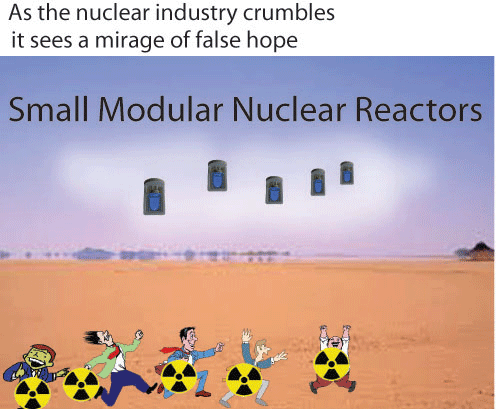
SMRs are a futuristic technology at best. The only operational SMRs anywhere in the world are in Northeast Russia and in Shidao Bay, China.
Both reactors faced construction delays, primarily due to cost overruns and poor economics., The Canadian Nuclear Safety Commission has yet to fully approve a single SMR licence.
SMRs cannot be built in time to help meet Ontario’s 2030 emission targets. Worse, by betting on them, OPG has committed to making Ontario’s electricity grid dirtier.
Nuclear power a costly option
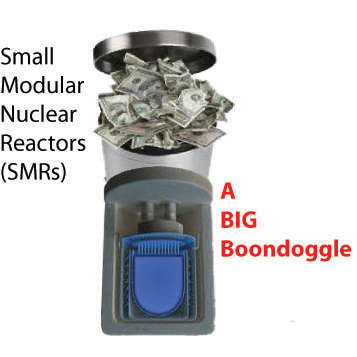
In addition to being largely unproven, SMRs will not be cheap. While their absolute cost may be lower than conventional nuclear reactors, their lower electricity output means they become significantly more expensive per megawatt to operate.
Beyond the fact that every single new nuclear project in Ontario’s history has gone over budget, gas and nuclear energy now contribute the most to increasing energy bills for Ontario residents.
A 2018 report from the Canadian SMR roadmap steering committee, a group of provincial and territorial governments and power utilities, estimated the baseline cost of electricity from SMRs would be 16.3 cents per kilowatt hour (kWh). Comparatively, according to the International Renewable Energy Agency renewable alternatives are less expensive:
- Onshore wind electricity costs consumers an average of 4.5 cents per kWh;
- Offshore wind costs an average of 10 cents/kWh;
- Solar PV farms cost an average of 6.6 cents/kWh;
- Hydropower costs an average of 5 cents/kWh.
In North America, the only SMR design certified by the United States Nuclear Regulatory Commission was cancelled due to “lack of interest” once rising costs deterred potential customers. Originally announced in 2015 at the equivalent of $4.1 billion Cdn, estimates rose to $5.6 billion (2018), then $8.4 billion (2020) and finally $12.7 billion (2023).
Time keeps on ticking
New nuclear projects are taking on average of 10 to 15 years to become operational. Ontario’s first SMR designated for the Darlington Nuclear Generating Station is planned for 2028.
Meanwhile, the Ontario government says additional SMRs could come online between 2034 and 2036. In reality, nuclear projects typically exceed time estimates by 64 per cent and given a strong trend of delays for such projects globally, new SMRs are unlikely to come online before 2042, if ever.
So, in addition to the speculative viability of SMRs, likely delays even under the best of circumstances mean this technology is unable to help meet Ontario’s emissions reduction targets.
Radioactive waste another key factor
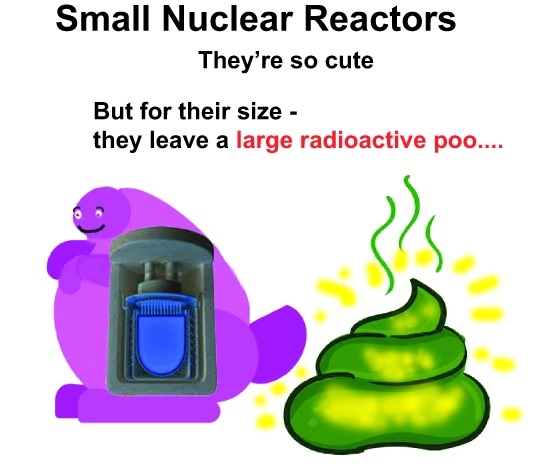
The “green” label often applied to nuclear energy should be viewed with scepticism. While no fossil fuel is burned to generate nuclear power, the industry produces radioactive waste and is not “renewable.”
In fact, there is evidence to suggest SMRs will produce a greater volume of radioactive waste per unit of electricity generated than existing large reactors.
Radioactive waste remains hazardous for tens of thousands of years and there are no demonstrated solutions to managing this risk. According to the Nuclear Waste Management Organization, which is owned by Canada’s nuclear power companies, radioactive nuclear waste must be fully isolated from people and the environment for one million years or more.
Committing to new nuclear projects in Ontario as a climate solution is essentially trading one intergenerational threat for another.
The green path toward Ontario’s emissions targets
A report from the David Suzuki Foundation in 2022 found that “reliable, affordable, 100 per cent emissions-free electricity in Canada by 2035 is entirely possible.”
In 2020, the International Energy Agency declared wind and solar the “cheapest sources of new electricity in history.”
In 2018, Ontario cancelled 758 signed contracts for smaller renewable energy projects, many of them in Indigenous communities Only recently, the province’s Independent Electricity System Operator (IESO) has announced it seeks to procure 5,000 MW of new non-emitting (wind, solar, hydropower or bioenergy) energy.
Utility-scale solar costs plummeted by 90 per cent between 2009-21. Wind energy costs declined 72 per cent. This presents an important opportunity given Ontario’s more than 1,500 kilometres of Great Lakes shoreline and abundant sunshine.
The already low cost of hydropower in Ontario through existing infrastructure, combined with the potential for integration with Hydro-Québec, can help Ontario convert its “intermittent wind and solar energy into a firm 24/7 source of baseload electricity,” according to the Ontario Clean Air Alliance.
Likewise, offshore wind-generating potential in Atlantic Canada far exceeds energy needs in the region and could be exported to Ontario via existing mainstream high-voltage direct-current transmission lines.
By cancelling SMR development and focusing on cost-efficient wind, solar and hydro expansion, as well as increased interprovincial transmission, Ontario can reclaim leadership when it comes to green energy development now and for future generations.
Sen. Lindsey Graham suggests nuking Gaza, says nuking Hiroshima was ‘the right decision’
Amanda YenSun, The Daily Beast, Sun, 12 May 2024, https://www.sott.net/article/491372-Sen-Lindsey-Graham-suggests-nuking-Gaza-says-nuking-Hiroshima-was-the-right-decision
Sen. Lindsey Graham (R-SC) offered a baffling comparison of Israel’s war on Gaza to the U.S. decision to drop atomic bombs on Japan during World War II, telling Israel to “do whatever you have to do” to finish the military campaign.
Speaking to NBC’s Kristin Welker on Meet the Press Sunday morning, Graham made the argument that Israel would be justified in slaughtering civilians in Gaza by likening the situation to the U.S.’s war with Japan eight decades ago. He suggested Israel would be right to flatten the Gaza strip — home to 2.2 million Palestinians, half of whom are children — simply because the U.S. did it to Hiroshima and Nagasaki in the 1940s.
“So when we were faced with destruction as a nation after Pearl Harbor, fighting the Germans and the Japanese, we decided to end the war by bombing Hiroshima, Nagasaki, with nuclear weapons,” Graham began.
The senator continued to call the bombings of Hiroshima and Nagasaki “the right decision” by the U.S. That decision ended the war with Japan, but killed hundreds of thousands of Japanese civilians between the initial blasts and the deadly radiation that followed.
“Give Israel the bombs they need to end the war they can’t afford to lose, and work with them to minimize casualties,” Graham insisted.
It was unclear how he believed the U.S. and Israel could work to “minimize casualties,” since bombs tend not to discriminate between civilians and militants upon detonation.
Graham’s comments were so extreme that even Welker was taken aback, unsuccessfully attempting to interject as the senator talked over her.
“Can I say this?” Graham continued. “Why is it okay for America to drop two nuclear bombs on Hiroshima and Nagasaki to end their existential threat war? Why is it okay for us to do that? I thought it was okay.”
Of course, the presumption that the U.S. was justified in nuking Japan to end World War II has been contested by historians and other critics for decades. Those bombs also decimated nearly all of Hiroshima’s and Nagasaki’s medical infrastructures, making it nearly impossible to deliver aid to the injured and dying, according to the International Campaign to Abolish Nuclear Weapons.
Graham’s comments came as Israel appears poised to launch a full-scale invasion of Rafah, which the U.N. and the Biden administration have warned would be catastrophic for the 1.4 million people sheltering there. On Sunday, as Graham went on national television to suggest incinerating Gaza, the U.N. secretary general pleaded once more to prevent the area from spiraling into all-out devastation.
Comment: Is it any wonder that Russia is running nuclear drills when Western governments are riddled with liabilities like Graham?
China and the U.S. Are Numb to the Real Risk of War.

Like China, the United States is mired in jingoism and confusion. Like China, it has no idea what it would do if things go wrong.
With the 2024 U.S. presidential election heating up, the one thing every candidate, Democrat or Republican, has done is to show how tough they could get on China.
Like China, the United States is mired in jingoism and confusion. Like China, it has no idea what it would do if things go wrong. With the 2024 U.S. presidential election heating up, the one thing every candidate, Democrat or Republican, has done is to show how tough they could get on China.
The pair are dangerously close to the edge of nuclear war over Taiwan—again.
May 12, 2024, By Sulmaan Wasif Khan, the Denison chair of international history and diplomacy at Tufts University’s Fletcher School. https://foreignpolicy.com/2024/05/12/china-us-taiwan-strait-war-nuclear-weapons-military-biden-xi-history/
On the morning of April 5, 2023, Taiwan’s president, Tsai Ing-wen, met with then-U.S. House Speaker Kevin McCarthy in Simi Valley, California. This was a meeting Beijing had warned against in the strictest of terms. It was therefore a meeting that both sides found necessary to have. China had to be shown that it could not dictate whom either Taiwan or the United States met with. On this, both Taipei and Washington were agreed.
China delivered on its promised forceful response by engaging in military drills and sending warships and planes scudding around Taiwan. The median line and Taiwan’s air defense identification zone were breached. One aircraft carrier, the Shandong, entered the waters just south of Japan. Violations of the “One China” principle, Beijing had to make clear, were not going to be taken quietly. And in seeking to make that clear, it deepened the risk of war.
This article is adapted from The Struggle for Taiwan: A History of America, China, and the Island Caught Between by Sulmaan Wasif Khan,
Commentators dismissed Beijing’s response to the Tsai-McCarthy meeting as less intense than the one that had attended then-U.S. House Speaker Nancy Pelosi’s visit to Taiwan in 2022. But the dismissal itself highlighted the gravity of the problem. A certain level of military activity had become normalized. It was as though the world now took for granted the presence of missiles and aircraft carriers, the shows of force that demanded a response in kind. The week after the meeting in California, the United States and the Philippines launched their largest joint military exercise to date. It was a way of showing China that there were other militaries that could operate in the region. The new normal meant more ships and planes operating in close proximity to one another, mutual recrimination, and mutual suspicion.
Beijing and Washington have become desensitized to the risk these circumstances pose. But in the militarization of foreign policy and the failure to grasp the full significance of that militarization, the pair are one accident and a bad decision removed from a catastrophic war. Mathematicians speak of the “edge of chaos”: the final point separating order from doom. A system operating at this edge has no room for error. This is where the accumulated weight of the past has brought the United States, China, and Taiwan. They walked right up to the edge of a war that could go nuclear several times in the past: in 1954-55, 1958, and 1996. Now, they seem to be living on that edge permanently.
In recent years, China’s policy has alienated Taiwan completely. As China has bullied, threatened, and displayed force at home and abroad, it has made unification unacceptable to much of the Taiwanese electorate. And it has enjoyed only mixed success in trying to isolate Taiwan diplomatically. It has managed to buy off many of Taiwan’s erstwhile allies, but its conduct over COVID-19 and support for Russia despite the invasion of Ukraine have cost it friends, too—and those former friends have turned to the island across the strait.
Since at least 2021, Taiwan has had a seemingly endless parade of visitors, from Germany’s education minister to Liz Truss, the former U.K. prime minister. In November 2021, the European Parliament sent its first official delegation to the island; the head of the delegation, Raphaël Glucksmann, told Tsai, “We in Europe are also confronted with interference from authoritarian regimes and we came here to learn from you.” In October 2022, Tsai received lawmakers from Lithuania and Ukraine; the former had recently established a representative office in Taiwan despite Beijing’s anger, while the latter was making a gesture of solidarity with a country that, unlike China, had been sharp in its criticism of Moscow. A Japanese parliamentary delegation that arrived in December 2022spoke glowingly of Tsai’s defense plans and emphasized Japan’s own determination to keep the status quo in the region from being “changed by force or unilaterally.” China has warned against or condemned many of these visits.
Beijing has only itself to blame for Taiwan’s strengthened diplomatic position. Its wolf warrior nationalism and reluctance to break with Moscow have cost it European support. If visits from foreign politicians were to translate into condemnation of China at the United Nations, Beijing could veto a Security Council resolution. In this case, like Russia, China would find itself a pariah state—and unlike Russia, China cares about how it is seen by the world. China’s own corrosive nationalism has eaten into its body politic, too It has not torn itself apart in a bout of political bloodletting, but it has certainly let loose the kind of jingoism that would allow that to happen. What it will decide to do in a crisis is uncertain. Beijing itself does not know.
The United States, meanwhile, seems intent on reviving a defense treaty with Taipei that it once spent more than a decade trying to break. Taiwan has become a means of showing China just how tough the United States can get. Washington is not clear on how getting tough will alter Beijing’s conduct, but “deterrence” is the concept invoked most often. A show of force, the thinking goes, will deter China from aggression. But what if deterrence fails? What if the show of force backs China into a corner from which it feels it has no option but to lash out? To this, Washington has few answers beyond preparing for war.
Some U.S. pundits have waxed lyrical about how they would fight a war with China. Taiwan, they opined, will be turned into a “porcupine” with hardened defenses. One former defense official suggested the use of “low-yield tactical nuclear weapons” in the event of a conflict with China. (The bombs dropped on Hiroshima and Nagasaki qualify as low yield.) The possibility of Russian President Vladimir Putin using such weapons sent shock waves of horror through the world, but the idea of employing them in a war with China became normal in some circles. There was no guarantee that, once the nuclear taboo was breached, the weapons would stay “low yield.” But the question of what would happen if the two powers escalated to higher-yield arms and plunged the world into nuclear holocaust has been left unresolved.
It is as though the United States is being haunted by all the ghosts of its long past with China and Taiwan, forcing it to relive questions it had once thought resolved. U.S. military leader Douglas MacArthur wanted to wage war against China in 1950. President Dwight D. Eisenhower considered using nuclear weapons against China in 1955 and 1958. Today, Washington abides by the “One China” principle, but it wants Taiwan to enjoy “self-determination.” It vows that it does not dispute the formulation that Taiwan is a part of China, but it will help Taiwan resist Chinese coercion. It wishes to promote Taiwan’s presence in international organizations, but it remains unwilling to recognize Taiwan itself. The United States has shifted from pure ambiguity to ambiguity with a tilt in favor of Taiwan—and it has done so because it decided China is an enemy.
Like China, the United States is mired in jingoism and confusion. Like China, it has no idea what it would do if things go wrong. With the 2024 U.S. presidential election heating up, the one thing every candidate, Democrat or Republican, has done is to show how tough they could get on China. Republicans vying for the nomination got in on the act early; former President Donald Trump has denounced French President Emmanuel Macron for “kissing Xi’s ass,” referring to Chinese leader Xi Jinping. Joe Biden, with the power of the incumbent, has not stopped at rhetoric. Whether supporting a TikTok ban unless the app is sold or calling for increased tariffs on Chinese goods, his policies are calibrated to demonstrate toughness on China.
Taiwan’s own presidential elections, held on Jan. 13, showed just how deeply the island’s electorate had turned against unification. At first, William Lai, the candidate from Tsai’s Democratic Progressive Party (DPP), vowed not to alter the status quo, though he accused Beijing of doing so. Taiwan, he argued, was already sovereign. There was no need to change what worked. But his caution soon vanished. While campaigning, Lai defined success for Taiwan as its leaders being able to visit the White House. This was a gauntlet thrown down—Taiwanese officials are blocked from visiting Washington. The Biden administration immediately demanded an explanation. This was not, U.S. officials made clear, how the relationship worked. Where Tsai had been prudent, Lai was willing to push his luck.
The Kuomintang (KMT), the main opposition party, was not leaning toward Beijing, either. Its nominee, Hou You-yi, the mayor of New Taipei City, said that he would reject both “one country, two systems” and a formal move for independence, but that if Taiwan were attacked, he would face the challenge. Taiwan, according to Hou, needed to be ready to defend itself. On the crucial question of how to deal with China, there was little difference between the policies Lai and Hou espoused.
A third candidate, Ko Wen-je of the Taiwan People’s Party, was calculatedly vague on China policy. His campaign made clear that he was depending on votes from traditional KMT supporters: those who would have favored a closer relationship with China. He claimed that he would find the middle ground between the KMT’s appeasement of China and the DPP’s provocation of it; he would make Taiwan a bridge for Sino-American communication rather than a front in a Sino-American war. How he proposed to do all this was left undefined.
Lai eventually won the presidency, but it was not the ringing triumph Tsai had won four years earlier. Lai scraped through with a mere 40 percent of the vote, his victory made easier by the fact that Hou and Ko had failed to join forces. As he prepares to take office on May 20, Lai faces a deeply divided, volatile populace and a legislature in which the DPP is bereft of a majority.
This is a point China has been quick to underline. The DPP, it huffed after the election, is not representative of “majority public opinion.” What is lost on Beijing is that the other candidates made clear that unification was not something they were willing to countenance either. Hou had made a point of not inviting Ma Ying-jeou, the last KMT member to serve as Taiwan’s president, to his rallies; he knew that to associate himself with Ma’s embrace of China would have doomed his candidacy. Beijing still does not understand Taiwan. Meanwhile, the United States continues to disavow support for Taiwanese independence while making plans for further delegations to the island. With the U.S. presidential election going into fifth gear, the risk of miscalculation will only rise.
At the edge of chaos, a single choice can make the difference between order and catastrophe. More than 80 years on from the Cairo Declaration, which held that Taiwan would be “restored to the Republic of China” at the end of World War II, we can see that there were myriad moments that could have yielded different outcomes, for better or for worse. If President Franklin D. Roosevelt had insisted on self-determination for Taiwan after World War II, if the Korean War had not happened, if Beijing had made “one country, two systems” work, if Taiwan had developed a nuclear weapon, if Pelosi’s plane had indeed been shot at—if someone had made a different decision at any of those moments, the world would be a radically different place.
When deterrence, toughness, and pride drive policy, the room for error diminishes to virtually nil. China, Taiwan, and the United States are at a point where the choices they make could spell the difference between peace and nuclear holocaust. Those choices are best made with the historical record—and all its unrealized possibilities—firmly in mind.
Fixation on UK nuclear power may not help to solve climate crisis
Waste and cost among drawbacks, as researchers say renewables could power UK entirely
Paul Brown 10 May 24, https://www.theguardian.com/environment/article/2024/may/10/fixation-on-nuclear-power-in-uk-may-not-help-to-solve-climate-crisis
In the battle to prevent the climate overheating, wind and solar are making impressive inroads into the once dominant market share of coal. Even investors in gas plants are increasingly seen as taking a gamble.
With researchers at Oxford and elsewhere agreeing that the UK could easily become entirely powered by wind and solar – with no fossil fuels required – it seems an anomaly that nuclear power is still getting the lion’s share of taxpayer subsidies to keep the ailing industry alive.
Politicians on both sides of the Atlantic are backing as yet unproven small modular reactors (SMRs) as an indispensable part of the answer to the climate crisis and are running competitions to get this industry started. These reactors, from tiny ones of the type that power nuclear submarines, to scaled-up versions that can, in theory, be factory produced and built in relays to provide steady power, are all still in the design stage.
As the Union of Concerned Scientists in the United States points out, whichever model is chosen they have all the drawbacks of existing nuclear power stations; expensive, even without cost overruns, and the still unsolved waste problem. The biggest disadvantage, the group says, is that even if the technology worked it would be too little, too late, to keep the climate safe.
1 This Month
10 March A LIVE WEBINAR THE REAL EFFECTS OF NUCLEAR POWER
What the Industry Isn’t Telling Us
1:00 PM Mountain, 2 pm Central, 3 pm Eastern. Live on the Keepers of the Water Facebook page

18 March Webinar @ 1 PM EST: An Assessment of SMR Projects: The Case of Canada
register for the zoom:
https://us02web.zoom.us/webinar/register/WN_o8BIIOUvQ2ONJR1nta65DQ#/registration


of the week – STOP SMALL MODULAR REACTORS IN CANADA
To see nuclear-related stories in greater depth and intensity – go to https://nuclearinformation.wordpress.com
-
Archives
- February 2026 (268)
- January 2026 (308)
- December 2025 (358)
- November 2025 (359)
- October 2025 (376)
- September 2025 (258)
- August 2025 (319)
- July 2025 (230)
- June 2025 (348)
- May 2025 (261)
- April 2025 (305)
- March 2025 (319)
-
Categories
- 1
- 1 NUCLEAR ISSUES
- business and costs
- climate change
- culture and arts
- ENERGY
- environment
- health
- history
- indigenous issues
- Legal
- marketing of nuclear
- media
- opposition to nuclear
- PERSONAL STORIES
- politics
- politics international
- Religion and ethics
- safety
- secrets,lies and civil liberties
- spinbuster
- technology
- Uranium
- wastes
- weapons and war
- Women
- 2 WORLD
- ACTION
- AFRICA
- Atrocities
- AUSTRALIA
- Christina's notes
- Christina's themes
- culture and arts
- Events
- Fuk 2022
- Fuk 2023
- Fukushima 2017
- Fukushima 2018
- fukushima 2019
- Fukushima 2020
- Fukushima 2021
- general
- global warming
- Humour (God we need it)
- Nuclear
- RARE EARTHS
- Reference
- resources – print
- Resources -audiovicual
- Weekly Newsletter
- World
- World Nuclear
- YouTube
-
RSS
Entries RSS
Comments RSS
 nuclear-news