Starmer’s “anti-democratic” push to put Nuclear Reactors incommunities without consultation
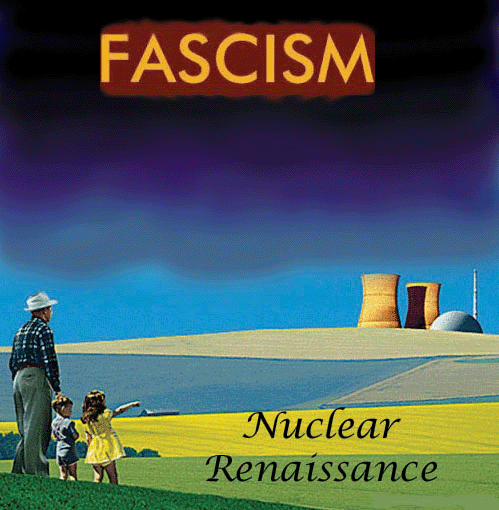
Starmer has announced plans to reform the
planning system around nuclear power. Under plans proposed on Wednesday,
nuclear development will not be restricted to the eight current designated
nuclear sites, but opened up to the general planning process.
Starmer, speaking in the commons, vowed to “break through” resistance by
utilising the party’s majority to ensure there is no dissent. These plans
are part of a package announced to encourage AI datacentres to be
established in the UK, with SMRs (small modular nuclear reactors) to power
them.
SMRs are an unproven technology sold as an alternative to massive
reactor sites such as those currently being built in Hinkley Point C and
proposed at Sizewell C. SMR development is often reliant on government
funding to do the R&D and eventual construction work – often funded by
“nuclear levies” via the RAB (Regulated Asset Base) on local
communities.
Communities charged by RAB models are often promised returns
in the form of lower bills, a claim hotly disputed. Research in Going
Nuclear, a book by CND Cymru chair Mabon ap Gwynfor MS shows that when
Trawsfynydd was operational in Gwynedd, the area paid some of the highest
per-unit cost of electricity anywhere in Britain. CND Cymru has already
recently raised concerns about inappropriate nuclear development in
Bridgend.
Last Energy, a US-based company, is currently consulting on a bid
to build 4 SMnRs in a site on the old Llynfi Power Station. CND Cymru
National Secretary, Dylan Lewis-Rowlands, said “If the proposals from
Westminster are to be believed, then not only could plans similar to this
pop up anywhere in Wales or England, but could also be pushed through
against community will from the UK Government.
The current ultimaten planning authority for projects under 300MW of generation, which includes this proposal, currently lies with Welsh Government Ministers – are the
plans here also a proposal to run roughshod over devolution?”
CND Cymru
vice-chair, Brian Jones, added: “This is not just a question of nuclear
development, but of democracy. The intention of this move by Starmer seems
to be something that the nuclear power and weapons industry has only dreamt
of before – the ability to ignore communities wishes and focus their vast
lobbying budgets on getting the central government to allow them to build
wherever they want, without opposition. It is fundamentally putting profit
before people and planet, and turning Britain into a nuclear power test
site for SMRs. It is, in one word, anti-democratic”.
CND Cymru 6th Feb 2024 Starmer has announced plans to reform the
planning system around nuclear power. Under plans proposed on Wednesday,
nuclear development will not be restricted to the eight current designated
nuclear sites, but opened up to the general planning process. Starmer,
speaking in the commons, vowed to “break through” resistance by
utilising the party’s majority to ensure there is no dissent. These plans
are part of a package announced to encourage AI datacentres to be
established in the UK, with SMRs (small modular nuclear reactors) to power
them. SMRs are an unproven technology sold as an alternative to massive
reactor sites such as those currently being built in Hinkley Point C and
proposed at Sizewell C. SMR development is often reliant on government
funding to do the R&D and eventual construction work – often funded by
“nuclear levies” via the RAB (Regulated Asset Base) on local
communities. Communities charged by RAB models are often promised returns
in the form of lower bills, a claim hotly disputed. Research in Going
Nuclear, a book by CND Cymru chair Mabon ap Gwynfor MS shows that when
Trawsfynydd was operational in Gwynedd, the area paid some of the highest
per-unit cost of electricity anywhere in Britain. CND Cymru has already
recently raised concerns about inappropriate nuclear development in
Bridgend. Last Energy, a US-based company, is currently consulting on a bid
to build 4 SMnRs in a site on the old Llynfi Power Station. CND Cymru
National Secretary, Dylan Lewis-Rowlands, said “If the proposals from
Westminster are to be believed, then not only could plans similar to this
pop up anywhere in Wales or England, but could also be pushed through
against community will from the UK Government. The current ultimate
planning authority for projects under 300MW of generation, which includes
this proposal, currently lies with Welsh Government Ministers – are the
plans here also a proposal to run roughshod over devolution?” CND Cymru
vice-chair, Brian Jones, added: “This is not just a question of nuclear
development, but of democracy. The intention of this move by Starmer seems
to be something that the nuclear power and weapons industry has only dreamt
of before – the ability to ignore communities wishes and focus their vast
lobbying budgets on getting the central government to allow them to build
wherever they want, without opposition. It is fundamentally putting profit
before people and planet, and turning Britain into a nuclear power test
site for SMRs. It is, in one word, anti-democratic”.
CND Cymru 6th Feb 2024 Starmer has announced plans to reform the
planning system around nuclear power. Under plans proposed on Wednesday,
nuclear development will not be restricted to the eight current designated
nuclear sites, but opened up to the general planning process. Starmer,
speaking in the commons, vowed to “break through” resistance by
utilising the party’s majority to ensure there is no dissent. These plans
are part of a package announced to encourage AI datacentres to be
established in the UK, with SMRs (small modular nuclear reactors) to power
them. SMRs are an unproven technology sold as an alternative to massive
reactor sites such as those currently being built in Hinkley Point C and
proposed at Sizewell C. SMR development is often reliant on government
funding to do the R&D and eventual construction work – often funded by
“nuclear levies” via the RAB (Regulated Asset Base) on local
communities. Communities charged by RAB models are often promised returns
in the form of lower bills, a claim hotly disputed. Research in Going
Nuclear, a book by CND Cymru chair Mabon ap Gwynfor MS shows that when
Trawsfynydd was operational in Gwynedd, the area paid some of the highest
per-unit cost of electricity anywhere in Britain. CND Cymru has already
recently raised concerns about inappropriate nuclear development in
Bridgend. Last Energy, a US-based company, is currently consulting on a bid
to build 4 SMnRs in a site on the old Llynfi Power Station. CND Cymru
National Secretary, Dylan Lewis-Rowlands, said “If the proposals from
Westminster are to be believed, then not only could plans similar to this
pop up anywhere in Wales or England, but could also be pushed through
against community will from the UK Government. The current ultimate
planning authority for projects under 300MW of generation, which includes
this proposal, currently lies with Welsh Government Ministers – are the
plans here also a proposal to run roughshod over devolution?” CND Cymru
vice-chair, Brian Jones, added: “This is not just a question of nuclear
development, but of democracy. The intention of this move by Starmer seems
to be something that the nuclear power and weapons industry has only dreamt
of before – the ability to ignore communities wishes and focus their vast
lobbying budgets on getting the central government to allow them to build
wherever they want, without opposition. It is fundamentally putting profit
before people and planet, and turning Britain into a nuclear power test
site for SMRs. It is, in one word, anti-democratic”.
CND Cymru 6th Feb 2024 https://www.cndcymru.org/en/about-us2/
Starmer pledges to ‘build, baby, build’ as green groups criticise nuclear plans
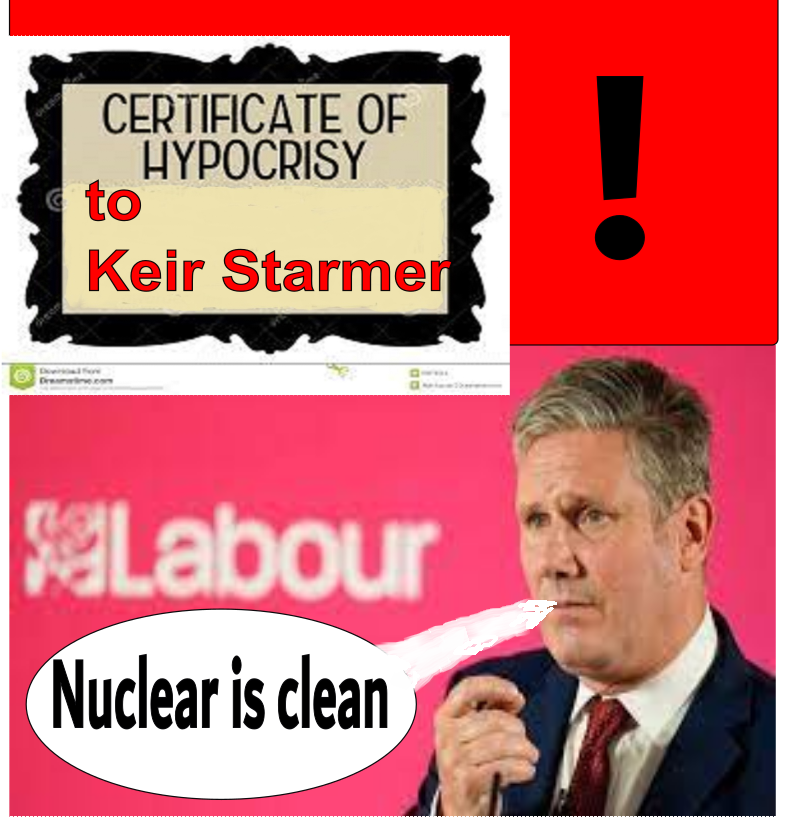
Greenpeace says PM has ‘swallowed industry spin whole’ after plans unveiled to expand in England and Wales
Peter Walker and Matthew Taylor, Guardian 6th Feb 2025
Keir Starmer has channelled his inner Donald Trump and promised to “build, baby, build” in his push for more nuclear power stations, despite warnings from environmental groups about the industry’s record for soaring costs and long delays.
A day after the prime minister unveiled his plans to revamp planning rules to bring in a series of small modular reactors (SMRs) across England and Wales, Greenpeace said Starmer had “swallowed the nuclear industry spin whole”, and Friends of the Earth described the plans as “overblown, costly hype”.
Formally announcing the plans on Thursday, however, Starmer insisted the recent glacial pace of nuclear power development was precisely why things had to change.
Asked if, much like Trump’s pro-fossil fuels mantra of “drill, baby, drill”, he now advocated “build, baby, build”, Starmer replied: “I say: build, baby, build. I say: we’re going to take on the blockers so that we can build.”………………………………………………………………………………………………..
However ambitious, the project faces obstacles, including likely local opposition, despite hints from Starmer that people could get lower bills if they lived near a new reactor. The technology also remains untested, there is not a single commercial SMR operating in the world, and the sector is heavily reliant on government support.
Dale Vince, a green electricity entrepreneur and a major donor to Labour under Starmer, said even large nuclear power stations made “the most expensive power known to mankind”, adding: “And the widely understood and experienced concept of economies of scale is all about things getting cheaper as they get bigger. The opposite is true in the other direction – miniaturisation always costs more.”
Doug Parr, Greenpeace UK’s policy director, said Starmer’s plan was unrealistic. “The Labour government has swallowed nuclear industry spin whole, seemingly without applying so much as a pinch of critical scrutiny or asking for a sprinkling of evidence,” he said.
“They present as fact things which are merely optimistic conjecture on small nuclear reactor cost, speed of delivery and safety, which is courageous – or stupid – given that not a single one has been built, and with the nuclear industry’s record of being over time and over budget unmatched by any other sector.”
Mike Childs, the head of policy for Friends of the Earth, said nuclear power was “extremely expensive and creates a legacy of radioactive waste that lasts for thousands of years”.
“The Hinkley C nuclear plant in Somerset, which is a decade late and almost £30bn over budget, makes HS2 look like a runaway success,” he said. “If ministers want to build a clean, affordable and energy-secure future they should focus on renewables, such as wind and solar, and better energy storage – not the overblown, costly hype offered by the nuclear industry.” https://www.theguardian.com/environment/2025/feb/06/starmer-pledges-to-build-baby-build-as-green-groups-criticise-nuclear-plans
Trump’s attack on Biden’s IRA spending could complicate Palisades restart effort

https://beyondnuclear.org/trumps-attack-on-bidens-ira-spending-could-complicate-palisades-restart-effort/ January 24, 2025
Trump’s executive order regarding the Inflation Reduction Act of 2022, and similar action against the Infrastructure Investment and Jobs Act (IIJA, or Bipartisan Infrastructure Law) of 2021, could starve the Palisades zombie reactor of massive taxpayer funding requested by Holtec International for its unprecedented restart. Holtec is looking to various troughs of funding from both laws, totaling a shocking $8+ billion (with a B!) in mostly federal, but also State of Michigan, bailouts.
Palisades is located in Covert Township, just south of the City of South Haven, in Van Buren County, s.w. Michigan. It is immediately upon the beach of Lake Michigan, drinking water supply for 16 million people along its shores, including the City of Chicago.
Palisades was permanently shut down by its previous owner, Entergy, on May 20, 2022, supposedly for good. But Palisades took over the site, supposedly to decommission it, only to instead secretively apply to the U.S. Department of Energy and State of Michigan for many billions of dollars in taxpayer funds, to restart the more than half-century old, extremely problem-plagued reactor.
NIRS’s analysis of the IRA revealed that more than $380 billion (with a B!) in nuclear power subsidies had been authorized therein. The analysis also addressed additional billions of dollars in nuclear power subsidies contained in the IIJA.
Another $7.4 billion in federal funds, in the form of loan guarantees, for so-called “Small Modular Reactor” (SMR) design certification, construction, and operation, would come from the Energy Policy Act of 2005, and the follow on December 23, 2007 appropriations. Holtec has targeted Palisades for two SMR-300s (300 Megawatts-electric each), which would nearly double the tiny 432-acre site’s nuclear Mega-wattage. Holtec has also targeted Palisades’ sibling nuclear site, the closed and decommissioned Big Rock Point hundreds of miles north, in Hayes Township, between Charlevoix and Petoskey, likewise on the Lake Michigan shore. Whether Trump will order a freeze on these funds as well, remains to be seen.
Self-inflicted steam tube degradation, due to two years of neglect by the inexperienced and incompetent company, also puts in doubt Holtec’s late 2025 restart plans at Palisades.
The article quotes Beyond Nuclear’s radioactive waste specialist, Kevin Kamps:
Kevin Kamps, an activist with Maryland-based Beyond Nuclear who grew up near the plant, said that safety assurances are “very dubious, as [the] NRC is completely captured by the industry it is supposed to regulate.”
To learn more about Beyond Nuclear’s and our allies’ resistance to the Palisades zombification, see our one-stop-shop for related website posts, dating back to 2002:
“Newest Nuke Nightmares at Palisades.”
Somerset Green councillor slams Sir Keir Starmer over Hinkley Point C comments
Why should UK environmental protection be sacrificed for the profit of the French nationalised electricity industry?”
Sir Keir Starmer is trying to make it harder to oppose major infrastructure projects
By Daniel Mumby, Local Democracy Reporter, Somerset Live 28th Jan 2025, https://www.somersetlive.co.uk/news/somerset-news/somerset-green-councillor-slams-sir-9900421
The leader of the Green Party on Somerset Council has attacked the prime minister following his recent comments on Hinkley Point C. EDF Energy has courted controversy over plans to create new saltmarshes in the Severn estuary to offset the environmental impact of Somerset‘s new nuclear power station.
In an article for Mail Online, prime minister Sir Keir Starmer lambasted efforts to block major infrastructure projects, singling out opposition to the acoustic fish deterrent which EDF had originally proposed for Hinkley Point C. These comments have drawn the ire of Councillor Martin Dimery, who warned Mr Starmer that his stance would lose him support across the south west.
Mr Starmer’s comments came as the government announced reforms to the judicial review system, restricting the grounds on which such reviews could be lodged to “stop blockers getting in the way” of infrastructure projects. He said in his article: “There are countless examples of nimbys and zealots gumming up the legal system often for their own ideological blind spots to stop the government building the infrastructure the country needs……………………………………
In an open letter to Mr Starmer, he said: “I wish I was joking when I point out that the sonar device due to be installed at Hinkley Point C was agreed from the outset to avoid the mass carnage of fish being sucked into the reactor’s mechanism, thus destroying huge quantities of the Bristol Channel’s fish stock. Fish remnants can also cause blockage and mechanical failure in nuclear power plants.
“Last year, EDF applied to Somerset Council to scrap the sonar device in an attempt to cut construction costs. As chairman of the climate and place scrutiny committee, I refused to sign off this appalling attempt to disregard the natural environment and the region’s fishing industry for the sake of EDF’s profits. Why should UK environmental protection be sacrificed for the profit of the French nationalised electricity industry?”
Reports recently resurfaced in the national press that Mr Starmer stated “I hate tree-huggers” at a shadow cabinet meeting in July 2023, at which current net zero secretary Ed Miliband MP unveiled new energy policies to combat climate change.
Mr Starmer denied using this phrase, telling BBC correspondent Laura Kuennsberg that his comments about green energy had been taken out of context.
Mr Dimery added, in direct reference to these claims: “‘Tree hugger’ I may be, prime minister, but if you’re so appalled at the prospect of individuals standing for the environment and against disreputable business practice, then you may find you lose a great deal of support from elected councillors of all political persuasions.”
Heysham power station debate sparks questions on safety and incidents
By Robbie Macdonald, Lancaster Guardian 24th Jan 2025
Heysham nuclear power station safety, public health, waste, jobs, clean energy and the roles of councillors, from scrutiny to enthusiastic support, were raised in a Lancaster City Council debate.
It followed a recent announcement by the government and EDF about extending the generating lives of Heysham’s two nuclear reactors and the possibility of smaller reactors being there in the future.
Labour Coun Phillip Black, the former city council leader who resigned in November, put forward a motion backed by others, welcoming the news about extending Heysham 1’s and Heysham 2’s generating lives to 2027 and 2030.
Labour councillors and some others also wanted the council to state it had ‘confidence’ in the safety considerations underpinning the date extensions. And they also wanted the council to state support for new nuclear’ activity at Heysham in future.
However, others including many Greens, said Labour was irresponsible with the motion, given the wide spectrum of responsibilities councillors were supposed to consider.
Green Coun Gina Dowding said: “It’s really irresponsible to bring these two issues into one motion. Both are really important and deserve separate consideration.
“I recently asked a qualified architect, who has spent her working life on nuclear issues, about this. She said it would be deeply irresponsible for the council to ‘welcome’ the extensions. Extending the operating dates beyond the sites’ lifetimes should be questioned by the council – that is our role,” she emphasised. “These buildings were built in the 1980s based on reactor designs in the 1970s.”
She added: “We should also look at anomalies, such as an unforeseen circumstances , which are increasingly happening. There have been unplanned shut-downs. There was one last week. A loud bang was heard and a cloud seen, which concerned residents and the fire brigade was called.”
She also highlighted the proximity of the Heysham nuclear site, along with one at Hartlepool in the north-east, to areas with populations of over 100,000. She added: “At Heysham, the majority of people would be down-wind of any incident. So any motion saying this is ‘great for the future’ is not appropriate. Just because nothing has happened so far does not mean it couldn’t happen in future.
“Of course, there are skills and jobs in nuclear energy. But there are also skills and jobs in the decommissioning stages. Also in renewable energy, along with the potential to create more jobs and generate electricity for less cost.”
…………………………………….Fellow Green Tim Hamilton-Cox said. “Small modular reactors are still beyond the horizon and we have not yet got a permanent solution for nuclear waste. Some councillors have been against having that discussion. Speaking personally, I am not against nuclear power per se. But there are still many considerations and still no permanent solution for waste.”
Lib-Dem Peter Jackson, a member of the city council’s new cabinet, said: “I invite Labour councillors to bring forward a separate discussion about future Heysham questions as soon as possible.”
Morecambe Bay Independent Martin Bottoms, also on the new cabinet, also argued the extensions and any future developments should be treated separately. New modular reactors would not be on the horizon until at least 2025……………………………………
But Labour councillors opposed separating current and future topics. https://www.lancasterguardian.co.uk/news/national/heysham-power-station-debate-sparks-questions-on-safety-and-incidents-4958881
Trump says he will approve power plants for AI through emergency declaration.

Spencer Kimball, https://www.cnbc.com/2025/01/23/trump-says-he-will-approve-ai-power-plants-using-emergency-declaration.html
- President Donald Trump said he will expedite the construction of power plants for artificial intelligence through an emergency declaration.
- Trump said the plants can use whatever fuel they want, including coal.
President Donald Trump said Thursday he will expedite the construction of power plants for artificial intelligence through an emergency declaration, as the U.S. races against China for dominance in the industry.
“We’re going to build electric generating facilities. I’m going to get the approval under emergency declaration. I can get the approvals done myself without having to go through years of waiting,” Trump said in a virtual address to the World Economic Forum in Davos, Switzerland.
The plants can use whatever fuel they want, the president said, making clear that his administration won’t hold the AI industry to any climate targets.
There are some companies in the U.S. that have coal sitting right by the plant so that if there’s an emergency, they can go to that,” the president said.
Trump declared a national energy emergency on his first day in office, directing federal agencies to use whatever emergency authorities they have at their disposal to expedite energy infrastructure projects.
One day later, Trump unveiled a joint venture with OpenAI, Oracle and SoftBank to invest billions of dollars in AI infrastructure through a project called Stargate.
Power demand from artificial intelligence data centers is forecast to surge in coming years. The tech companies building the centers that support AI have primarily focused on procuring renewable energy, though they have shown a growing interest in nuclear power to meet their growing electricity needs.
While the tech sector has invested in carbon-free power to meet its climate goals, analysts believe natural gas will play a pivotal role in powering AI because it’s plentiful, is more reliable than renewables and can be deployed faster than nuclear.
Trump said he wants power plants to connect directly to data centers rather than supplying electricity through the grid.
“You don’t have to hook into the grid, which is old and could be taken out,” Trump said. This arrangement, called co-location, has faced opposition from some utilities, who are worried about losing fees and have warned that taking power off the grid could lead to supply shortages.
Legal challenges to infrastructure plans to be blocked in Starmer growth push
Dr Ruth Tingay, a prominent environmental campaigner and a co-director of Wild Justice, said: “It sounds like Starmer is auditioning for a role in Trump’s cabinet.
Prime minister hopes his plan to ‘take the brakes off Britain’ will send a message to business to build more
Pippa Crerar, Kiran Stacey, Sandra Laville and Patrick Barkham. Guardian 23rd Jan 2025
Legal challenges to infrastructure plans to be blocked in Starmer growth push
Prime minister hopes his plan to ‘take the brakes off Britain’ will send a message to business to build more
Pippa Crerar, Kiran Stacey, Sandra Laville and Patrick BarkhamThu 23 Jan 2025 11.01 AEDTShare
Campaigners will be blocked from “excessive” legal challenges to planning decisions for major infrastructure projects including airports, railways and nuclear power stations as part of the government’s drive for economic growth.
High court judges will be given the power to rule that judicial reviews on nationally significant projects that they regard as “totally without merit” – and which can currently be brought to the courts three times – will be unable to go to appeal.
Keir Starmer said the change would “take the brakes off Britain” by reforming the planning system, sending a message to business to build more national infrastructure, as ministers desperately pursue opportunities to improve the economy.
“For too long, blockers have had the upper hand in legal challenges – using our court processes to frustrate growth,” he said.
“We’re putting an end to this challenge culture by taking on the nimbys and a broken system that has slowed down our progress as a nation.”
It is one of a range of measures being considered by the government as part of an all-encompassing dash for growth, which has caused alarm among environmental groups.
With GDP figures barely moving since the election, Rachel Reeves is looking at proposals from airport expansion to widespread deregulation in an effort to improve the UK’s economic outlook.
Government sources said the chancellor was “deeply unimpressed” with the pro-growth ideas presented by a number of the country’s biggest regulators when she met them last week, and has since instructed them to improve their plans………………………………………………………………………….
However, some environmentalists have expressed unease with the government’s drive to curtail legal challenges to infrastructure projects, of which they have promised to deliver 150 this parliament………………….
In February 2020, Starmer tweeted “congratulations to the climate campaigners” when plans for a third runway at Heathrow airport were ruled illegal by the court of appeal after a judicial review.
“There is no more important challenge than the climate emergency. That is why I voted against Heathrow expansion,” he said then…………………………………
The current first attempt – known as the paper permission stage – will be scrapped. Primary legislation will be changed so that where a judge in an oral hearing at the high court deems the case “totally without merit”, it will not be possible to ask the court of appeal to reconsider. A request to appeal second attempt will be allowed for other cases………………………………….
Green groups also have voiced concerns over plans to overrule environmental protections to free up the planning system with a new Nature Restoration Fund which, the government said, would not allow protected species such as newts and bats to be deemed more important than homes or infrastructure.
Niall Toru, senior lawyer at Friends of the Earth, said: “No one is above the law, not even the government.
“Friends of the Earth only brings cases we think are strong and necessary to protect people and nature from unlawful harm – and considering our string of recent legal wins, so do the courts.
“It is deeply concerning that Labour is attempting to scapegoat claimants. If ministers don’t want to be challenged in the courts, they should act within the law, because already cases aren’t allowed to proceed unless they have merit.”
Dr Ruth Tingay, a prominent environmental campaigner and a co-director of Wild Justice, said: “It sounds like Starmer is auditioning for a role in Trump’s cabinet.
“This proposal doesn’t make any sense whichever way you look at it. First, campaigners can only take judicial reviews if their case does have merit, as judged by the high court.
“So to then allow another judge to block an appeal on the basis that the case is ‘totally without merit’ is nonsensical and will lead to problems of accountability and lack of scrutiny.
“Second, and more importantly, economic growth based on environmental and climate degradation is a loser’s game, and we’ll all be paying the price of that.” https://www.theguardian.com/politics/2025/jan/23/legal-challenges-to-infrastructure-projects-to-be-blocked-in-push-for-growth
Suffolk Coastal MP said priority to hold Sizewell to account.
24th January, By Dominic Bareham, East Anglian Daily Times
A Suffolk MP has written to the developers of the new Sizewell C nuclear power station expressing concerns raised by her constituents about the current construction.
Jenny Riddell-Carpenter, MP for Suffolk Coastal, said her priority was to hold Sizewell C to account on its “social valuable and charitable investments, employment opportunities and environmental actions”.
Campaigners from action group Together Against Sizewell C (TASC), which is opposed to the power station, have written to her asking her to call a halt to the project due to the “huge amount of environmental damage being inflicted by the project”.
………………………………………………………………In the letter, TASC raised concerns works associated with the Sizewell C project were causing environmental damage, including a new link road, access road, five roundabouts and park and ride sites.
It said: “These projects have resulted in the felling of thousands of trees, grubbing out miles of hedging and covering vast areas under concrete and tarmac, devastating the biodiversity-rich environment, Heritage Coast and the Area of Outstanding Natural Beauty landscape in the process.
“This amounts to wholesale environmental vandalism, especially when the project still not only lacks a final investment decision but also a final design of the all-important sea defences, has no guaranteed sustainable supply of potable water essential for its 60 years of operation and with the nuclear site’s ground stabilisation trials remaining unfinished.” https://www.eadt.co.uk/news/24876996.suffolk-coastal-mp-said-priority-hold-sizewell-account/
Labour Minister concedes no new nuclear power stations will be built in Scotland

Michael Shanks said the SNP Government’s opposition to new nuclear would see plants blocked
Paul Hutcheon, Political Editor, Daily Record, 21st Jan 2025
The UK Energy Minister has said there will be no new nuclear plants in Scotland because they would be blocked by the SNP Government. Michael Shanks said he disagreed with the Edinburgh administration’s position but said their stance was “legitimate”.
Shanks made his comments in an evidence session to Holyrood on the Labour Government’s plan for GB Energy. The publicly-owned company will be headquartered in Aberdeen and is aimed at spearheading a clean energy revolution.
But nuclear appears to have no future in Scotland as the SNP Government is opposed and can exercise a veto through the planning system.
………..“They’ve set a very clear statement that there will be no new nuclear in Scotland. I might disagree with that but that is the landscape they operate in and therefore there is no plans, there will be no engagement on that issue because it is very clear that those applications would be blocked by the Scottish Government and that is the legitimate position that the Scottish government [takes] on planning matters.”
He added that there was no “confrontation” and said GB Energy has to comply with the rules, regulations and planning statements in each part of the UK.
https://www.dailyrecord.co.uk/news/politics/labour-minster-concedes-no-new-34522820
It is only a matter of time before nuclear development at Bradwell falls by the wayside.

Energy and the role of nuclear power
7 January 2025, Andrew Blowers, Emeritus Professor of Social Sciences, Open University and Chair of BANNG considers this topic in the January 2025 column for Regional Life magazine
At the beginning of 2024, the Conservative Government published its Civil Nuclear: Road Map to 2050, proclaiming its commitment to recovering the UK’s global leadership in nuclear power. The Road Map was gung-ho for big nuclear at Hinkley Point C (still unfinished) and Sizewell C (still looking for investors just to get started); plus a fleet of Small (in fact rather large) Modular Reactors chosen by competition (still awaiting the winning design); and the (vanishingly) distant prospect of a raft of Advanced Modular reactors, including fusion (that tantalisingly evanescent Holy Grail of nuclear fulfilment)
It was the accompanying New approach to siting beyond 2025 which most attracted our attention. The Government proposed a developer-led approach, in effect a market free-for-all where developers are invited to find suitable sites for new nuclear power stations. At the same time, six sites identified back in 2011, including Bradwell, were carried forward as having ‘inherent positive attributes’ potentially suitable for consideration.
BANNG commented that developers would be unlikely to ‘identify sites beyond those that are being dangled in front of them already’. Yet again, we were at pains to stress that the Bradwell site is simply unsuitable and does not possess any of these ‘positive attributes’, least of all widespread public support. At a meeting with the then Minister for Energy, I made it crystal clear that there is widespread deep and extensive opposition from the local communities around the Blackwater.
A change of Government brought no change in nuclear policy; if anything Labour is even more effusive in its support for nuclear as essential in providing clean, stable and reliable power.
Once again, BANNG took up the challenge. With Stephen Thomas, Emeritus Professor of Energy Policy at Greenwich University, I wrote a paper exposing the ‘Great British Nuclear Fantasy’ which formed the basis of a discussion with the Minister for Energy, Lord Hunt.
We stressed that any expansion of nuclear power would be ‘too expensive, unrealistic but above all, simply unachievable’. There were no sites yet available for nuclear projects, least of all Bradwell. In response Lord Hunt reassured us that we were not ‘blockers’ and had presented a reasoned, professional argument which, to give him credit, he listened to.
Climate Change
As the impacts of Climate Change (CC) are becoming more evident it is ever more obvious that sites like Bradwell are wholly unsuitable for major infrastructures like nuclear power stations or big transformers. During the year BANNG helped to lead a series of workshops with the Office for Nuclear Regulation (ONR), responsible for the safety of nuclear plants, on the implications of CC for nuclear regulation.
The ONR confirmed that our work had been a significant influence on its understanding of CC. BANNG asserted that CC makes Bradwell the least suitable of all the sites currently in the ring for nuclear development. BANNG has urged the Chief Executive of ONR ‘to resist the presumption that Bradwell is an acceptable site and to declare that it should be withdrawn from further consideration’.
BANNG ended the year with a further challenge, this time to Great British Nuclear
(GBN), the body responsible for pushing forward nuclear development, inviting
it to confirm that any proposals ‘will be subject to scrutiny and consultation through
the open, democratic and participative processes of public engagement.’
Our conclusion is that despite all the rhetoric, the nuclear programme is stuttering
and Climate Change may well seal its fate. It is only a matter of time before
nuclear development at Bradwell falls by the wayside.
Memo to Trump: Modify the US policy of sole authority to launch nuclear weapons

Bulletin, By Lisbeth Gronlund | January 17, 2025
Mr. President, as you know, as president, you must approve any use of nuclear weapons—whether first or in retaliation. This would be a momentous decision for any one person to make. While any use would be devastating, the future of the world would hang in the balance because it might lead to an all-out nuclear war, immediately killing hundreds of millions of people, many of these Americans. Many more deaths—in the United States and globally—would occur within a year from a lack of medical services for the injured and radioactive fallout. The Earth’s temperature would change and severely lower agricultural production, resulting in widespread starvation. Such a war would leave the United States and other countries barely functional, with destroyed infrastructures and defunct societies.
The United States should adopt a better approach that avoids placing this responsibility on one person, take advantage of the wisdom and perspective of other officials, and reduce the risk of nuclear war. The global community would welcome a US policy that does not rely on just one person to decide to use nuclear weapons.
Ordering the Pentagon to adopt a modified policy that incorporates the input of a few other officials would bolster your international credibility as a real leader who made tough decisions to reduce the risk of nuclear war. Moreover, once the new Trump policy is in place, it would be difficult for future presidents to return to the old, more dangerous approach. You would be remembered for significantly reducing the risk of inadvertent nuclear use, and you would set a new standard for all future administrations.
Background
If the Pentagon detected an incoming Russian nuclear attack aimed at US missile silos, it would consider launching these missiles before Russian missiles could destroy them. And it would need your approval to do so. Because the Russian missiles would land quickly following their detection, you would have about 10 minutes for the Pentagon to brief you and lay out a small number of launch plans for your decision and approval. You could also decide to not launch any missiles. Any modified policy to involve other people in the decision-making process would need to function under such severe time constraints………………………………………………………………………………………………………………………………………………
Options
— Option 1: This option could be used for either a first or retaliatory strike. Any nuclear attack plan would require a presidential order and agreement by the next two people in the presidential chain of succession. Under normal circumstances, these would be the vice president and Speaker of the House. You alone would have the authority to order a specific attack, but either of the other two could veto your order. If for some reason the other people could not be reached, the procedure could default to the current one………………………………………..
Recommendation
You should immediately adopt Option 1. I also recommend discussing Option 3 with your advisers and members of Congress to determine, among other things, the precise steps required and the length of time such approval would likely take………………………………………………………………….. more https://thebulletin.org/2025/01/memo-to-trump-modify-the-us-policy-of-sole-authority-to-launch-nuclear-weapons/?utm_source=ActiveCampaign&utm_medium=email&utm_content=Memos%20to%20Trump%20%28he%20might%20actually%20like%29&utm_campaign=20250120%20Monday%20Newsletter
Over time, over budget… will our new nuclear plants ever be built?

A damning report on EDF, the French company aiming to construct Sizewell C,
has thrown the project into doubt, while Hinkley Point C faces soaring
costs and delays.
The cost of nuclear power in the UK came roaring back
into the headlines last week after reports that the final bill for Sizewell
C, the planned new power station on the Suffolk coast, would be £40
billion — twice what was initially expected. This was followed by a
damning report on EDF, the French state-backed company that is proposing to
build Sizewell, which laid bare its financing problems, raising questions
about whether the plant will be built at all.
Hinkley is running years late and is massively over budget, prompting critics to wonder whether this is a model we should be copying. EDF had originally envisaged that [Hinkley]
would be in operation by this year; its most optimistic scenario now puts
the start date for the first of its two reactors at 2029. Meanwhile,
Hinkley’s original £18 billion cost on the eve of its construction has
ballooned to up to £35 billion in 2015 prices — or £46 billion in
today’s money.
Unfortunately, the financing for both plants is far from
settled. It is estimated that cost overruns at Hinkley mean it needs to
find another £5 billion to finish the work. This shortfall has been
exacerbated by EDF’s partner in the project, China General Nuclear Power,
refusing to put in more money after being excluded from Sizewell on
national security grounds.
Alison Downes of the Stop Sizewell C campaign
said: “We’ve no faith this project is being looked at objectively, so
it’s vital that the Office for Value for Money [the new government
agency] launches an immediate inquiry before ministers sleepwalk into a
disastrous decision.”
Having allocated £5.5 billion to Sizewell in the
budget, most observers expect Labour to give the green light at the
spending review. Some argue that the “sunk-cost fallacy” — a
reluctance to abandon projects in which a lot of money has been invested,
even if that would ultimately be a more cost-effective option — has
kicked in, and that cancelling it now would trigger a large and galling
write-down for the government. Nor are there obvious alternative vendors of
large nuclear projects — at least not yet. Bull, of Manchester
University, said axing Sizewell would send a terrible signal: “I think
the real cost of not doing Sizewell C is that we end up with another failed
project, and investors start to think we are just not serious.”
Times 19th Jan 2025 https://www.thetimes.com/business-money/companies/article/whats-happening-with-britains-nuclear-plants-and-when-will-they-be-built-tr6v0986f
Report: Israel and Hamas Agree ‘in Principle’ to Ceasefire and Hostage Deal

According to media reports, the deal on the table doesn’t commit Israel to a permanent ceasefire
by Dave DeCamp January 14, 2025, https://news.antiwar.com/2025/01/14/report-israel-and-hamas-agree-in-principle-to-ceasefire-and-hostage-deal/
CBS News reported Tuesday that both Israel and Hamas have agreed “in principle” to a draft hostage and ceasefire deal that could be finalized this week.
The report, which cited US, Arab, and Israeli officials, said if the final details are worked out and the Israeli government approves it, the deal could be implemented as soon as this weekend, before the January 20 inauguration of President-elect Donald Trump.
The Associated Press had a similar report that said Hamas had accepted a draft deal and that details were still being finalized before Israeli approval. The deal is largely based on a proposal President Biden put forward in May 2024, which Hamas accepted months ago.
According to Israeli media reports, pressure on Netanyahu from Trump’s incoming Middle East envoy, Steve Witkoff, is the reason why there’s been progress in recent days.
The deal involves three phases, but according to AP, it would not commit Israel to a permanent ceasefire or full withdrawal from Gaza.
The AP report reads: “Details of the second phase still must be negotiated during the first. Those details remain difficult to resolve — and the deal does not include written guarantees that the ceasefire will continue until a deal is reached. That means Israel could resume its military campaign after the first phase ends.”
According to media reports, the first phase involves a 42-day ceasefire, and during that time, Hamas would release 33 Israeli hostages, including women, children, the elderly, and five female IDF soldiers. Some of the hostages released in the first phase may be dead, but Israeli officials said they believe most are still alive. In exchange, Israel is expected to release hundreds of Palestinian prisoners.
During the first phase, Israeli troops will withdraw from population centers in Gaza, and Palestinians will be able to return to north Gaza, although there is nothing for them to return to since IDF has destroyed nearly every building in sight. Aid deliveries will also be surged, with 600 trucks per day expected to enter the Strip.
The second phase of the deal would involve the release of all male Israeli hostages from Gaza and a full IDF withdrawal, with many details still needing to be worked out. The third phase would involve the exchange of bodies and the start of the reconstruction of Gaza.
Sizewell C’s future in doubt as EDF told to prioritise French nuclear power
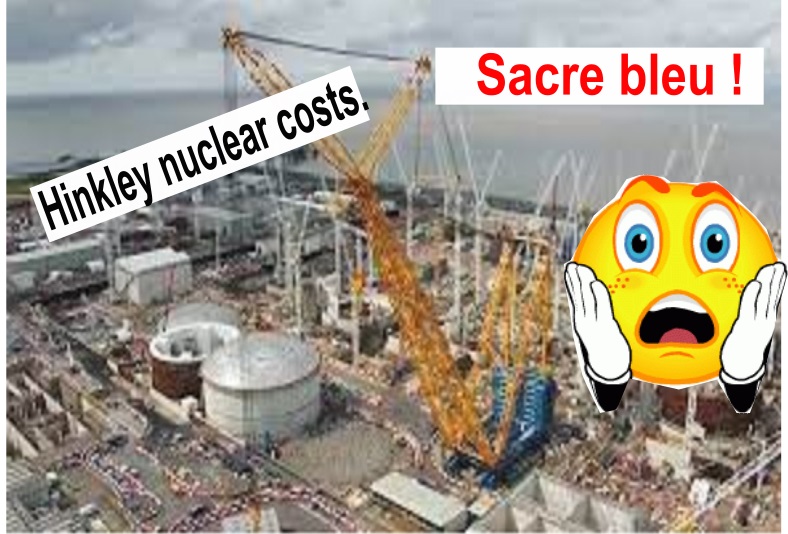
Auditor warns against costly foreign projects as energy giant considers investment decision into the plant
The future of Sizewell C has been thrown into doubt after EDF, the company
behind the project, was told to prioritise supporting nuclear power in
France. In a rare intervention, the French state auditor warned the
state-owned energy giant against backing risky new projects abroad, which
include plans to build a new nuclear power station in Suffolk.
Instead, the Cour de Comptes said EDF should focus on making a success of
multibillion-euro projects at home, ensuring they were profitable and built
on time. It comes as EDF prepares to make a final investment decision on
Sizewell C, which will increase its exposure in the UK given it is already
building Hinkley Point C in Somerset.
However, that project has been hit by
surging costs and delays, with the most recent forecasts saying it will
open after 2030 and cost around £45bn. Industry sources are also predicting
Sizewell C will cost £40bn to build, double EDF’s initial estimates in
2020.
EDF is working alongside the Government on Sizewell C, with £4bn of
taxpayer cash already spent on the project. However, the French auditor has
released a report saying EDF should not make a final investment decision on
the Sizewell project before cutting its financial exposure to Hinkley.
Telegraph 14th Jan 2025,
https://www.telegraph.co.uk/business/2025/01/14/sizewell-c-future-doubt-edf-told-prioritise-french-nuclear/
The Great British Nuke Off

by beyondnuclearinternational, https://beyondnuclearinternational.org/2025/01/12/the-great-british-nuke-off/
It’s time to expose the sham plan for new nuclear power, write Andy Blowers and Stephen Thomas in their new report
The following is the introduction and the conclusion from the report, “It is time to expose the Great British Nuclear Fantasy once and for all”. Read the full report.
In April 2022, the then UK Prime Minister, Boris Johnson, set a target of 24GW (equivalent to eight stations like Hinkley Point C) of new nuclear capacity to be completed in Great Britain by 2050. At the heart of the proposal was the creation of a new government owned entity, Great British Nuclear (GBN), with a mission of ‘helping projects through every stage of the development process and developing a resilient pipeline of new builds’ designed to ensure energy security and to meet the UK’s commitment to achieving net zero.
The new Labour Government, elected in July 2024, has been emphatic about the scaling up of renewables, and has confirmed that nuclear power ‘will play an important role in helping the UK achieve energy security and clean power’. While not explicitly committing to the 24GW target, the new Government expressed its belief that a scale expansion of new nuclear projects was a necessary part of the energy mix for the transition to achieving net zero carbon by 2050.
The Government is expected to continue with GBN but in a clearly subordinate role to its new creation, Great British Energy, its vehicle for driving development and investment into projects that will enable the energy transition to achieve net zero by 2050.
There has, so far, been little government recognition of the sheer difficulty of achieving a vast expansion of nuclear energy. As so often in the past, the nuclear programme has barely got off the ground and the flagship project of the new nuclear programme, Sizewell C, had, by October 2024, yet to receive a Final Investment Decision (FID) apparently because of the lack of interested investors.
In an attempt to keep the project from collapsing while it tries to find investors, Government has chosen to invest £8bn in the project, in addition to Electricité de France’s (EDF’s) contribution of about £700m, just to get it to FID, a process budgeted by EDF in 2016 to cost only £458m. Small Modular Reactors in which much hope is vested barely exist beyond the drawing boards and by the time they could be deployed, if all goes to plan, it will be too late for SMRs and Sizewell C to make any significant contribution to achieving ‘Net Zero’.
The recipe for expanding nuclear and overcoming the problems that have meant previous large nuclear programmes came to little remains the same as that of the previous government: create a flow of large nuclear projects starting with an FID for Sizewell C; bring Small Modular Reactors to commercial availability by 2029 and start ordering them then; and streamline the planning and regulatory processes.
Achieving these objectives in whole or in part will be impossible. In addition, the nuclear programme remains encumbered by its traditional ethical and sustainability problems, if anything, more so. The prevailing fear of nuclear accidents and radiation risks has intensified as nuclear is increasingly exposed to cyber-attack and the palpable threats from terrorism and warfare.
The accidents at Chernobyl and Fukushima, and the threats to Zaporizhzhia in Ukraine and Russia’s Kursk plant at the heart of the Russo-Ukraine war provide chilling evidence of dangers that are likely to materialise sometime somewhere.
With its embedded relationship to the bomb, nuclear energy is implicated in existential catastrophe. The other existential threat comes from accelerating Climate Change which will inundate some coastal sites, create problems of cooling water and, render the legacy of wastes scattered at vulnerable sites an unmanageable problem for generations far into the future.
We may well ask why, in the face of such deficiencies and dangers and with evidence of flagging momentum, this fantastical project is still proceeding? The answer lies in a powerful combination of political ambition, nuclear industry and trade union lobbying purveying the promise of skills, jobs investment, export markets and wealth associated with nuclear development and its supply chain. A mainstream discourse of nuclear as a mainstay of base load supply, energy security and the goal of net zero has been nurtured, to which powerful interests unthinkingly subscribe. Inertia ensures the persistence of the fantasy.
Yet, all the evidence in terms of renewables competition, the opportunity costs and long term economic and security risks of a swerve to new nuclear indicates a vast gulf between rhetoric and reality. In this paper it is our purpose to address the realities and to demonstrate why new nuclear expansion is not only impossible but acts as a barrier to achieve a rapid energy transition powered by renewable technology, storage and energy efficiency.
In the face of the evidence, we consider it reasonable to conclude that any expansion of civil nuclear power in the UK beyond that already committed is unachievable.
The history of nuclear power worldwide is of ambitious programmes falling far short of plans, with huge delays and time overruns. The impact of these failures has been masked by less than expected electricity demand growth and the availability of quicker and cheaper alternatives.
However, there has been a significant opportunity cost to money wasted on these ill-fated policies. For decades UK governments have been seduced by claims from the nuclear industry that, this time, a major nuclear programme will go to plan. More than ever before, the latest programme will be dependent on huge quantities of public money with financial risks falling squarely on the public.
It strains credibility that, with a massive hole in the finances and urgent priorities in health and welfare, the justice system, education and infrastructure, the idea of plugging the nuclear black hole will be met with universal enthusiasm.
The signs are all too clear, the rhetoric has no concrete foundations and the programme will vaporise slowly, perhaps but with inevitable termination. Future demand is again being over-estimated and cheaper, quicker alternatives exist.
The real cost of nuclear power continues to rise and the delays increase, while the cost of alternatives continues to fall. The latest prices for off-shore and onshore wind, and solar photovoltaic are about half the likely price for new nuclear. The IEA reported that over the 10 years from 2013-23, battery costs fell by more than 80%.
Authoritative analysis by an Oxford University team found that UK energy demand could be halved by 2050 with substantial welfare benefits in terms of reducing fuel poverty.
While government documents on nuclear invariably speak of things moving ‘at pace’, the reality is that in the period since the 24GW programme was announced, delays have mounted. In only two years, the completion date for Hinkley Point C went back up to four years and Sizewell C’s FID has been delayed by at least three years.
By October 2024, more than two years after it was announced, GBN barely exists. It has no permanent executive, no premises and no independent budget and its staff are temporary secondees.
GBN’s first substantive task was to complete the SMR competition and award contracts. In October 2023, it expected this to happen in spring 2024. It now seems likely this will not happen until the end of 2024, so a task expected to take about 6 months will, if there are no more delays, take 15 months.
The new Labour administration has yet to say whether GBN will remain as a separate body or whether it will be absorbed into its own new creation, Great British Energy. This uncertainty could delay the decision further.
Despite the sound and fury, the GBN project is bound to fail. Its contribution to achieving net zero by 2050 will be nugatory. No amount of political commitment can overcome the lack of investors, the absence of credible builders and operators or available technologies let alone secure regulatory assessment and approval.
Moreover, in an era of climate change there will be few potentially suitable sites to host new nuclear power stations for indefinite, indeed unknowable, operating, decommissioning and waste management lifetimes.
And there are the anxieties and fears that nuclear foments, the danger of accidents and proliferation and the environmental and public health issues arising from the legacy of radioactive waste scattered on sites around the country.
Abandoning Sizewell C and the SMR competition will lead to howls of anguish from interest groups such as the nuclear industry and trade unions with a strong presence in the sector. It will also require compensation payments to be made to organisations affected. However, the scale of these payments will be tiny in comparison with the cost of not abandoning them.
It is our hope that sanity and rationality may prevail and lead to a future energy policy shorn of the burden of new nuclear and on a pathway to sustainable energy in the pursuit of net zero.
Professor Andy Blowers is a British geographer and environmentalist and Emeritus Professor of the Faculty of Arts & Social Sciences at the Open University. Professor Stephen Thomas is a professor at the University of Greenwich Business School, working in the area of energy policy.
1 This Month
23-25 October – on Zoom – World BEYOND War’s annual global conferenc

To see nuclear-related stories in greater depth and intensity – go to https://nuclearinformation.wordpress.com

Say No to NASA’s Reckless Nuclear Reactor on the Moon
Say No to NASA’s Reckless Nuclear Reactor on the Moon
-
Archives
- October 2026 (160)
- September 2026 (339)
- August 2026 (330)
- July 2026 (355)
- June 2026 (287)
- May 2026 (306)
- April 2026 (356)
- March 2026 (251)
- February 2026 (267)
- January 2026 (308)
- December 2025 (358)
- November 2025 (359)
-
Categories
- 1
- 1 NUCLEAR ISSUES
- business and costs
- climate change
- culture and arts
- ENERGY
- environment
- health
- history
- indigenous issues
- Legal
- marketing of nuclear
- media
- opposition to nuclear
- PERSONAL STORIES
- politics
- politics international
- Religion and ethics
- safety
- secrets,lies and civil liberties
- spinbuster
- technology
- Uranium
- wastes
- weapons and war
- Women
- 2 WORLD
- ACTION
- AFRICA
- Atrocities
- AUSTRALIA
- Christina's notes
- Christina's themes
- culture and arts
- Events
- Fuk 2022
- Fuk 2023
- Fukushima 2017
- Fukushima 2018
- fukushima 2019
- Fukushima 2020
- Fukushima 2021
- general
- global warming
- Humour (God we need it)
- Nuclear
- RARE EARTHS
- Reference
- resources – print
- Resources -audiovicual
- Weekly Newsletter
- World
- World Nuclear
- YouTube
-
RSS
Entries RSS
Comments RSS

