Starmer’s latest con job
The government’s nuclear power expansion plan is a hollow betrayal of working people that panders to wealthy corporations and will rip off consumers, writes LINDA PENTZ GUNTER

No nuclear reactor, small or otherwise, will ever be built in time, affordably or in enough quantities to address the climate crisis that is already upon us.
February 15, 2025,
https://morningstaronline.co.uk/article/starmer%E2%80%99s-latest-con-job
IS KEIR STARMER really so desperate to bask in the orange glow of omnipotence radiating from the monomaniacal US president that he feels compelled to parrot Donald Trump’s catchphrases?
Apparently yes. Starmer really did say “build, baby build.”
The context for this abhorrent utterance was his announcement that mini-nuclear power plants — known as small modular reactors — would proliferate across Britain until they are “commonplace.”
According to Starmer, they would be smaller and cheaper than current nuclear power plants. Those living near nuclear construction sites could be compensated for this inconvenience with lowered electricity rates. New reactors would be in place by 2032.
All of this is completely unsubstantiated by any shred of empirical evidence, but more on that in a moment.
Starmer’s “fast forward on nuclear” would, he claims, deliver a supply of good jobs as well as “homegrown power.” (If you are searching a UK map for the “homegrown” uranium mines that would supply the fuel for these reactors, keep looking.)
The restriction on building new reactors on existing nuclear sites is to be lifted so they could be built anywhere and everywhere and people who “hadn’t thought there’s going to be anything nuclear near me” will simply “get used to the idea of it,” Starmer said.
Oddly, the first new site doesn’t appear to be adjacent to Number 10 Downing Street.
The whole thing is of course a massive con that would, if such a plan ever materialised, dramatically raise electricity rates, further fleece taxpayers, impede real progress on climate by diverting money away from already available renewable energy solutions, and put countless communities in danger.

And of course, what will become of the radioactive waste these “small” reactors would still produce? A recent Stanford study found that small modular reactors will actually generate more radioactive waste than conventional nuclear power plants.
Unions should not be fooled. Promising jobs that will likely never materialise and would be better created immediately in industries such as renewable energy that are here now and have a long-term future, isn’t a boon to working people, it’s yet another betrayal.
Further, nuclear power, as the industry has itself demonstrated over and over, is the slowest and most expensive energy choice among the so-called low-carbon options.
No nuclear reactor, small or otherwise, will ever be built in time, affordably or in enough quantities to address the climate crisis that is already upon us.
Study after study shows that greater carbon emissions can be achieved far faster by investing the same amount in renewable energy instead of nuclear power.
The Starmer government is deliberately ignoring that to pander to big corporations rather than invest in the public good.
Nuclear power is in any case not low-carbon, and certainly not carbon-zero as the industry often brags.
The Hinkley Point C two-reactor site on the Somerset coast will have used between 200,000 to one million tons of steel by the time the two reactors are complete, according to various estimates, and will consume the equivalent electrical power of a small country.
Further, nuclear power, unlike the renewable energy industry, has demonstrated negative learning by actually becoming slower to build and more expensive over time.
In October 2021, Lazard, one of the world’s leading financial advisory and asset management firms, calculated that the average construction cost of a utility-scale photovoltaic plant in the US was £695 per kilowatt of generation capacity. A nuclear plant, it said, would cost around £8,185 per kilowatt — almost 12 times as much.
A Sussex University study looking at 180 nuclear construction projects around the world found that 175 of them took, on average, 64 per cent more time than anticipated with final costs 177 per cent higher than originally predicted.
Small modular reactor projects will be more expensive than conventional nuclear plants because, being so small, they have poor economies of scale, requiring massive upfront orders to make a factory producing them financially viable.
Small reactors also require an equally massive deployment in order to generate the equivalent amount of energy currently produced by large-sized reactors. It’s why the industry has rejected small modular reactors for decades.
Wealthy corporations such as Rolls-Royce, one of the companies eager to build small modular reactors in Britain, are not willing to shoulder any of this risk. But, under Starmer’s scheme, the high costs of new reactor development and construction will be passed on to consumers and taxpayers.
In fact, this is already in place. A new Regulated Asset Base (RAB) funding model came into force in the UK in May 2022. RAB incentivises private investment in new nuclear projects by charging consumers through their electricity bills — with no guarantee that the nuclear plant will ever be completed.
This is precisely the fate that befell ratepayers in South Carolina in the US, where a similar law is in place and where two planned reactors were abandoned in 2017, by which time ratepayers had paid £1,6 billion for reactors that would never deliver a watt of electricity.
The extent to which the nuclear choice is a bad deal for Britain was made plain back in 2020, when the UK Department for Business, Energy and Industrial Strategy estimated that a large-scale solar project targeted to become operational in the UK in 2025 would produce electricity with a levelised cost of £44 per megawatt hour. Its estimate for nuclear power was £102 per megawatt hour. (Levelising takes into account all variable costs from licensing, construction, operation and eventual decommissioning and waste management.)
No nuclear corporations — not even multibillionaire Bill Gates’s nuclear reactor company Terrapower — will build new nuclear plants without charging both consumers and taxpayers to do it. Gates has asked the US government — ie US taxpayers — to foot half of his project’s likely underestimated £3.2 billion cost.
As physicist MV Ramana points out in his new book Nuclear Is Not The Solution, corporations only embark on new nuclear projects “when the public can be made to bear a large fraction of the high costs of building nuclear plants and operating them, either in the form of higher power bills or in the form of taxes.”
Starmer’s aspirations of empire that would make little Britain “one of the world’s leaders on nuclear” are no more than a craven capitulation to Rolls-Royce and other corporations, which have been complaining for years that the process in place is too arduous and slow, with too many regulatory hurdles. (Let’s not forget that Rolls Royce is an integral part of Britain’s nuclear weapons complex. Late last month the company got a new £9bn eight-year deal to support Britain’s nuclear submarine programme, the most lethal destructive force on Earth. This is not a coincidence.)
Cue Starmer’s Nuclear Regulatory Taskforce announced with a brazen headline on the government’s own website: “Government rips up rules to fire-up nuclear power.”
The taskforce mandate is ostensibly to fast-track and streamline approval of new reactor design and development. But despite Starmer’s protestations that there would be “no compromise on safety,” the phrases “fast-track” and “streamline” are code for precisely that; safety shortcuts.
Ripping up the rules is exactly what this is about — the rules concerning safety. They were there for a reason, given nuclear power is the most lethal method yet discovered by which to boil water. And reducing safety oversight is a particularly dangerous drift given that none of the current small modular reactors — still effectively just drawings on paper — have proven safety records.
Indeed, quite the opposite. Whether they are based on miniature versions of the traditional pressurised water reactor, such as those being built at Hinkley Point C, or “fast reactors,” none are new designs and all have significant known safety flaws.
Even the US Nuclear Regulatory Commission, a willing industry lapdog, declined the design submitted by Oklo for its 15-50 megawatt Aurora micro reactor because the company could not answer fundamental safety questions.
“Oklo’s application continues to contain significant information gaps in its description of Aurora’s potential accidents as well as its classification of safety systems and components,” the NRC wrote.
That should be a warning for the British public who are not being asked but told by the Starmer government that they must accept a nuclear reactor in their community for the good of the country’s “energy security.”
This threat is perhaps the most sinister part of the entire new nuclear announcement. There will be no dissent. The Starmer government will “push past nimbyism,” “take on the blockers” and “break through” any line of resistance from MPs minded to prevent a mini-Chernobyl happening in their constituents’ backyards.
While his autocratic idol in Washington DC continues to fling out a daily stream of fascistic executive orders like a hippopotamus with diarrhoea, Starmer is seemingly striving to match him at every turn.
Whether it’s stripping pensioners of life-saving winter fuel allowances, keeping children in poverty by refusing to lift the two-child benefit cap, autocratically arresting peaceful protesters on climate or Palestine, or misleading the British public with false promises about nuclear power, Starmer is consistent in at least one regard: making one bad decision after another.
The new nuclear plan is a “great opportunity” for Rolls-Royce, a company so deserving it ranks as “among the best in the world,” crowed Starmer. Maybe he’s just looking for a shiny new car to go with those free designer suits and A-level crash pads?
Linda Pentz Gunter is a writer based in Takoma Park, Maryland, and the founder of Beyond Nuclear, a non-governmental anti-nuclear advocacy group.
Germany has no realistic way back to nuclear power.
Germany has no realistic way back to nuclear power, the vice-chancellor
and energy minister has said. In an interview with The Times, Robert Habeck
also said the country’s economic model was in jeopardy because it had
mistakenly clung on to 20th-century technologies and assumptions about
global politics.
The future of German energy is one of the most contentious
issues in the country’s Bundestag election, which will be held on
February 23. Costs rose dramatically after the Kremlin’s full-scale
invasion of Ukraine in 2022 forced Berlin to jettison its dependency on
Russian gas imports at the same time as it switched off its last three
nuclear power stations.
Habeck, 55, who is the Green party’s candidate
for the chancellorship and has presided over the sprawling energy and
economics ministry since the end of 2021, has faced heavy criticism and a
parliamentary commission of inquiry for refusing to extend the lifespan of
the remaining reactors in the midst of the crisis. The conservative
Christian Democratic Union (CDU), which is leading in the polls and is
likely to dominate the next government, has promised to look into reviving
nuclear power. The hard-right Alternative for Germany (AfD) has gone
further, pledging to bring the reactors back online “as quickly as
possible”.
However, Habeck said: “A return to nuclear energy is not a
realistic option. Nor do I know anyone in the energy industry who seriously
wants it.” Executives in the German energy sector, including the firms
that used to operate the reactors, broadly agree with Habeck that they have
passed the “point of no return”. Most German officials balk at the long
construction times and the costs, which according to one recent estimate
from the Fraunhofer institute in Munich would be anything from two to ten
times as expensive as the equivalent amount of wind power.
Times 12th Feb 2025 https://www.thetimes.com/world/europe/article/germany-wont-turn-back-to-nuclear-power-nobody-wants-it-9pdxfkqg2
Why are young people like this 18-year-old fronting the pro-nuclear push in Australia?

SBS News, 13 February 2025
The regional sessions were not publicised beforehand on Nuclear for Australia’s social media accounts or the tour page on its website — you could only register for tickets if you knew the URL for the event’s webpage.
Campaigns director for the Conservation Council of Western Australia, Mia Pepper, said when she tried to get tickets for the Perth event online, she was denied. She said a colleague also failed to get tickets using their real name, but able to get in using an alias.
Shackel said Nuclear for Australia Googles people’s names beforehand to determine whether they are “likely going to cause a disruption or a threat”
Some polling suggests older Australians are more supportive of nuclear power than their younger counterparts. So why are young people fronting a pro-nuclear push?
SBS News, By Jennifer Luu, 13 February 2025
In a function room at Brisbane’s The Gabba sports ground, around 600 people have gathered to hear Miss America 2023 try to convince Australians nuclear power is a good idea.
Sporting a blue cocktail dress, blonde hair and a wide smile, 22-year-old Grace Stanke looks the part of a beauty pageant contestant.
She’s also a nuclear engineer touring the country with Nuclear for Australia: a pro-nuclear lobby group founded by teenager Will Shackel and funded by donors that include entrepreneur Dick Smith.
The event — billed as an information evening featuring a panel of experts — is off to a rocky start. A protester steps in front of the audience and speaks into a microphone.
“All of the organisers, presenters and sponsorship of this event tonight has a very deep vested interest — ” he says, before he’s drowned out in a chorus of boos and the mic is seized from his hand.
Audience members continue to disrupt last month’s event, raising their voices and speaking to the crowd before being herded out by security.
Among them is Di Tucker, a retired psychologist concerned about climate change. She said she became upset after submitting half a dozen questions online to be answered by the panel — and felt like they were being deliberately ignored.
“I felt so frustrated by the lack of factual information in that so-called information session forum on the safety, the timescale and the reality of nuclear energy,” Tucker told The Feed.
“I did stand up and I addressed the crowd, and I said something like: ‘You people need to go away and do your own research … it’s glossing over facts’.”
Nuclear for Australia founder Will Shackel, who was emceeing, estimated there were 20 to 30 protesters heckling the room.
He labelled their behaviour “simply unacceptable and … not in the interest of a fair discussion”.
“They were yelling abuse at us on stage. We had people come up to Grace at the end, call her a clown,” he claimed.
Shackel told The Feed: “We had people [who] had to be physically dragged out because they were resisting security … it was pretty ugly and pretty disturbing.”
Tucker disputes this: “Nobody I saw leave the room was hostile or aggressive, physically aggressive towards the security guards.”
“In fact, it was the opposite. The security guards were shoving the people outside.”
Outside, a separate group of protesters wields banners warning against the dangers of radioactive waste.
The words “Nuclear energy distracts from the climate emergency” are projected onto The Gabba over the image of a red herring.
The teen and the beauty queen
Tucker said the audience was mostly male and over 60. So why are two young people fronting the pro-nuclear movement in Australia?………………………….
As well as launching Nuclear for Australia — which describes itself as “the largest nuclear advocacy organisation in Australia” with over 80,000 supporters — he’s addressed a Senate committee and interviewed French President Emmanuel Macron for his organisation’s social media at the COP28 climate conference in Dubai in 2023.
Shackel first became fascinated with the nuclear debate while in high school in Brisbane.
“I’d just done a school assignment on nuclear energy when I realised it was banned. And that, as a 16-year-old kid, was pretty shocking to me,” he said.
Australia is one of the few countries where using nuclear energy to produce electricity is illegal. The ban was introduced in 1998, when the Howard government made a deal with the Greens in order to build a nuclear reactor in Sydney for research purposes.
At 16, Shackel launched a petition calling on Australia to lift its nuclear energy ban, garnering a flurry of media attention……….
As well as launching Nuclear for Australia — which describes itself as “the largest nuclear advocacy organisation in Australia” with over 80,000 supporters — he’s addressed a Senate committee and interviewed French President Emmanuel Macron for his organisation’s social media at the COP28 climate conference in Dubai in 2023……………………………
Nuclear power is still a contentious topic, but more Australians have become supportive of the idea over time.
A 2024 Lowy Institute poll of 2,028 Australians
indicates 61 per cent support Australia using nuclear power to generate electricity, while 37 per cent were opposed.
Among the 18- to 29-year-olds surveyed, 66 per cent supported nuclear power while 33 per cent were opposed.
In contrast,
a December 2024 poll of 6,709 people conducted for the Australian Conservation Foundation suggests young people were less likely to agree that nuclear is good for Australia, compared to older respondents. For example, 42 per cent of males aged 18-24 agreed, while 56 per cent of males over 54 agreed.
There’s also a gender gap — in the same poll, just over a quarter of women thought nuclear would be good for Australia, compared to half of men.
Nuclear for Australia hopes Grace Stanke can convince the sceptics. Dubbed “the real-life Barbenheimer”, she works for the operator of the largest fleet of nuclear power plants in the US, Constellation. (The company operates 21 of the US’s 94 nuclear reactors).
Now 18, Shackel suggests young Australians are more open-minded towards nuclear power than older generations and are more likely to support parties that are concerned about climate change……..
Physicist Ken Baldwin speculates the rise in support for nuclear power is due to shifting demographics.
He said older generations are more likely to have historical hangups around the dangers of nuclear power, having lived through the British and French weapons tests in the Pacific and nuclear catastrophes like the 1986 accident in Chernobyl and the 2011 accident in Fukushima. ……
“The younger generation … doesn’t have that particular historical baggage, and perhaps they’re more attuned to thinking about the need to do something about climate change,” he said.
Nuclear for Australia hopes Grace Stanke can convince the sceptics. Dubbed “the real-life Barbenheimer”, she works for the operator of the largest fleet of nuclear power plants in the US, Constellation. (The company operates 21 of the US’s 94 nuclear reactors)…………….
Nuclear for Australia has been drumming up public support for nuclear power over the past fortnight, touring every capital city (except Darwin) and holding a parliamentary briefing in Canberra.
It also targeted regional areas near the Coalition’s proposed sites for future nuclear power stations — including Morwell in Victoria, Collie WA, Port Augusta SA, Callide and Tarong in Queensland and Lithgow in NSW. The Coalition says its taxpayer-funded plan is for five large and two smaller reactors, with the smaller ones to come online in 2035 and the rest by 2037.
Nuclear for Australia was slow to reveal all the names for a total number of regional locations for the tour. During the first week of the tour, Nuclear for Australia told The Feed there would only be two regional stops.
The regional sessions were not publicised beforehand on Nuclear for Australia’s social media accounts or the tour page on its website — you could only register for tickets if you knew the URL for the event’s webpage.
Campaigns director for the Conservation Council of Western Australia, Mia Pepper, said when she tried to get tickets for the Perth event online, she was denied. She said a colleague also failed to get tickets using their real name, but able to get in using an alias.
She accused Nuclear for Australia of blacklisting known anti-nuclear activists and trying to avoid criticism by attempting to “creep around the country”.
“If they were really genuine about having a mature debate, they would do their best to invite some people like myself that have engaged really respectfully in the debate over many years to answer the tough questions,” she said.
Shackel said Nuclear for Australia Googles people’s names beforehand to determine whether they are “likely going to cause a disruption or a threat”, and that regional events aren’t publicised on social media because they are not relevant to city-based audiences.
“We care about the safety of our attendees, we care about the safety of our experts,” Shackel said.
“If we believe that someone is a known protester … someone who could cause a physical threat to people in there, we will not allow them in.”
Pepper said: “I have never been physically aggressive to anybody in my entire life.”
“The idea that because you are opposed to nuclear power, you somehow would be aggressive or violent is absolutely outrageous.”
Locals left with more questions than answers
South of Perth, around 100 of the 9,000 residents of the tiny coal mining town of Collie showed up to the Nuclear for Australia event, hoping to learn more about how living next to a nuclear reactor could affect them.
The Coalition has proposed converting Collie’s coal-powered station into a nuclear power plant. But the state government is vowing to phase out coal by 2030 and there’s little chance nuclear power could come online by then, leaving coal workers in limbo.
Resident Jayla Anne Parkin said the information session was “an utter waste of time”, and she came away with more questions than answers. “Their whole speech was very generic. They were probably using the same speech for every single area,” she said.
Parkin asked one of the experts where the water for a nuclear power plant would come from — with large amounts needed to cool the radioactive core.
“He gave a long-winded speech about how we can take any body of water, whether it be the ocean, the river, pool, sewage, and treat it and turn it into the water. But at the end of him answering it, he still didn’t tell me what source of water in Collie they were going to use,” she said.
“We’re very limited with water here as it is.”……………………………………………
there have been reports about Shackel’s alleged political ties.
A 2024 research report from progressive activist group GetUp on nuclear disinformation in Australia
analysed Shackel’s LinkedIn connections and reported that their political party affiliation leant heavily towards Liberal Party MPs, Senators and advisors.
GetUp reported at least 36 of Shackel’s connections, including 11 current or former politicians, were directly linked to the Liberal Party — with the party having the highest concentration of current employees from a single organisation in his network…………………………………..
Lobby groups are allowed to have political party affiliations. While registered charities can participate in campaigning and advocacy, they “cannot have a purpose of promoting or opposing a particular political party or candidate”, according to the Australian Charities and Not-for-profits Commission.
……………………………………………………… Professor Ken Baldwin said nuclear is “not really viable” as an option for decarbonising Australia by 2050, as it would take 15 years at the very minimum to develop the necessary regulations and build a nuclear power station.
“We will have, according to the current plans, converted our current energy system to almost an entirely renewable energy system by that time,” Baldwin said.
“Australia is at the leading edge of the renewable energy transition. We’re installing solar and wind at one of the fastest rates per capita of any country in the world.”…………… https://www.sbs.com.au/news/the-feed/article/will-shackel-australia-pro-nuclear-movement-young-people/gucu0iefz
Nuclear waste site plans in Midlands face major setback as council withdraws
Proposals for a massive underground hazardous nuclear waste site in the
Midlands have hit a setback after a council withdrew from a major
partnership, ignited because the agency behind the scheme are now looking
at putting the entrance close to a national beauty spot rather than a
disused gasworks.
Yesterday (wed) the leader of East Lindsey District
Council announced it was leaving a community partnership with Nuclear Waste
Services (NWS), the government agency which is behind the project to
dispose of Britain’s radioactive waste in a Ground Disposal Facility (GDF).
Insider Media 13th Feb 2025, https://www.insidermedia.com/news/midlands/nuclear-waste-site-plans-in-midlands-face-major-setback-as-council-withdraws
South Korea increases support for domestic nuclear industry
The Ministry of Trade, Industry and Energy has announced KRW150 billion
(USD103 million) of financial support this year to companies within South
Korea’s nuclear power industry – an increase of KRW50 billion compared with
last year.
World Nuclear News 10th Feb 2025,
https://www.world-nuclear-news.org/articles/south-korea-increases-support-for-domestic-nuclear-industry
The £40bn nuclear project at risk of becoming another British white elephant.
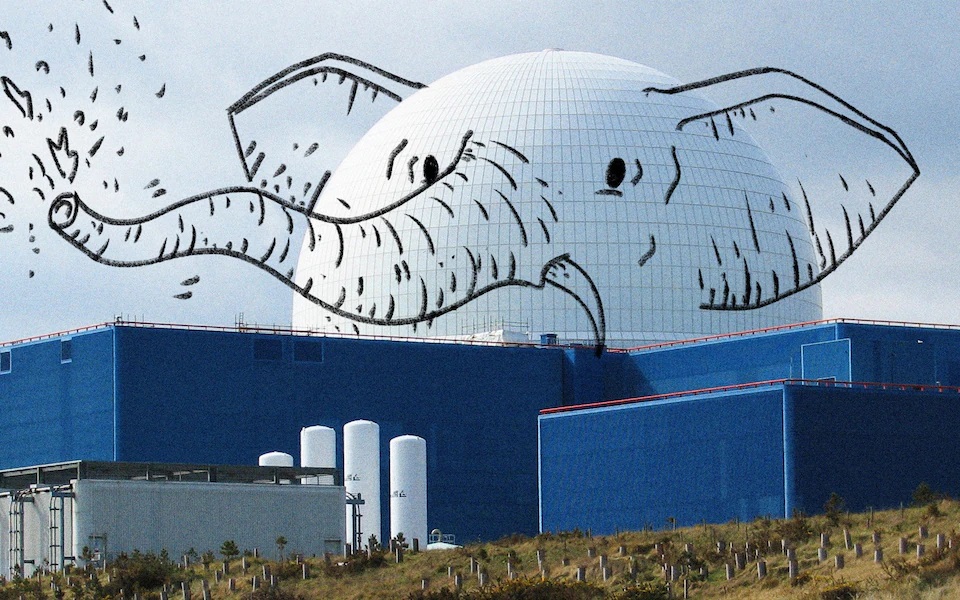
Telegraph 9th Feb 2025, Matt Oliver. Industry Editor,
On the Suffolk coast, an army of yellow diggers and dump
trucks are levelling fields and preparing the ground for one of Britain’s
biggest infrastructure projects. It is here that thousands of workers plan
to raise Sizewell C, a multibillion-pound nuclear power station, in the
late 2030s, eventually providing power for some 6m homes. If approved in
the coming months, the scheme would replace capacity lost elsewhere over
the next decade as other nuclear plants from the 1970s and 80s gradually
shut down.
Yet that is still a big “if”, with Labour ministers
currently weighing up whether the benefits of Sizewell C are worth the
gargantuan costs, which will reportedly exceed £40bn (the original budget
given to HS2). On one hand, it is a shovel-ready project that promises to
boost energy security and economic growth – something Rachel Reeves, the
Chancellor, is in desperate need of.
Hanging over the project, however, is
the shadow of its sister scheme: Hinkley Point C in Somerset, which is
running years behind schedule and has gone dramatically over-budget.
Should Sizewell C spiral into disaster, like Hinkley, it could easily become a
white elephant that kills off the prospects of any future successors. And
unlike its sister scheme, which was funded entirely by EDF and other
investors, British taxpayers will be on the hook if things go wrong, with
the Government playing the role of anchor investor.
“There is no transparency around Sizewell C,” says spokesman Alison Downes, who lives
nearby. “Why, despite government support, does its likely eye-watering
cost and impact on households remain shrouded in secrecy? Hinkley has
morphed into the most expensive nuclear power station ever built, by some
distance. Originally budgeted at £18bn, it is now estimated to cost
£46bn. Miliband quietly initiated a review of the nuclear programme last
year and there is speculation he could soon axe the Wylfa proposal in
favour of focusing on mini nuclear plants known as small modular reactors
(SMR) instead.
https://www.telegraph.co.uk/business/2025/02/09/sizewell-c-becoming-another-british-white-elephant/
Anatomy of an AI Coup

It is political offloading, shifting the messy work of winning political debates to the false authority of machine analytics. It’s a way of displacing the collective decision-making at the core of representative politics.
Tech Policy Press, Eryk Salvaggio / Feb 9, 2025
DOGE is gutting federal agencies to install AI across the government. Democracy is on the line, writes Tech Policy Press fellow Eryk Salvaggio.
Artificial intelligence (AI) is a technology for manufacturing excuses. While lacking clear definitions or tools for assessment, AI has nonetheless seized the imagination of politicians and managers across government, academia, and industry. But what AI is best at producing is justifications. If you want a labor force, a regulatory bureaucracy, or accountability to disappear, you simply say, “AI can do it.” Then, the conversation shifts from explaining why these things should or should not go away to questions about how AI would work in their place.
We are in the midst of a political coup that, if successful, would forever change the nature of American government. It is not taking place in the streets. There is no martial law. It is taking place cubicle by cubicle in federal agencies and in the mundane automation of bureaucracy. The rationale is based on a productivity myth that the goal of bureaucracy is merely what it produces (services, information, governance) and can be isolated from the process through which democracy achieves those ends: debate, deliberation, and consensus.
AI then becomes a tool for replacing politics. The Trump administration frames generative AI as a remedy to “government waste.” However, what it seeks to automate is not paperwork but democratic decision-making. Elon Musk and his Department of Government Efficiency (DOGE) are banking on a popular but false delusion that word prediction technologies make meaningful inferences about the world. They are using it to sidestep Congressional oversight of the budget, which is, Constitutionally, the allotment of resources to government programs through representative politics.
While discussing an AI coup may seem conspiratorial or paranoid, it’s banal. In contrast to Musk and his acolytes’ ongoing claims of “existential risk,” which envision AI taking over the world through brute force, an AI coup rises from collective decisions about how much power we hand to machines. It is political offloading, shifting the messy work of winning political debates to the false authority of machine analytics. It’s a way of displacing the collective decision-making at the core of representative politics.
The Cast
We can set the stage by describing the cast. In Elon Musk’s part-time job at DOGE, he takes the lead role. His team aims to use generative AI to find budget efficiencies even as he eviscerates the civil service. The DOGE entity has already attempted to take over the Treasury Department’s computer system to distribute funds and effectively disbanded USAID. Musk hopes to deliver an “AI-first strategy” for government agencies, such as GSAi, “a custom generative AI chatbot for the US General Services Administration.”
…………………………Then there is the supporting cast. ………………………………………………………………….
The Plan
Amidst the chaos in Washington, Silicon Valley firms will continue to build their case that they are the answer…………………………………………………………………………………. The solution will be a “centralized data repository” hooked to a chatbot and a suite of promises.
………………………………………………………….. OpenAI’s ChatGPTGov is a prime example of a system that is ready to come into play. By shifting government decisions to AI systems they must know are unsuitable, these tech elites avoid a political debate they would probably lose. Instead, they create a nationwide IT crisis that they alone can fix.
Weaken the Opposition
As the technical elite embeds generative AI into hollowed-out institutions, the administration will carry on its effort to eviscerate independent research institutions. Trump campaigned in 2023 for an “American University,” an online resource presenting “study groups, mentors, industry partnerships, and the latest breakthrough in computing” that “will be strictly non-political, and there will be no wokeness or jihadism allowed.” Trump proposed that American University would be funded by “taxing, fining, and suing excessively large private university endowments.”
………………………………………….. Eventually, this would create a crisis through which higher education, with its commitments to diversity already neutered, could be starved to death. A weakened university research ecosystem would strengthen the private sector by luring scientists to their labs, diminishing independent research oversight.
……………………………………………….DOGE aims to replace government bureaucracy with technical infrastructure. Reversing and dismantling dependencies embedded in infrastructure is slow and difficult, especially when efforts to study systemic bias are prohibited. The ingredients for “technofascism” will be assembled.
Generating a Crisis
Eventually, the shoddy infrastructure of these automated government agencies and services will produce language or code that creates an AI-driven national crisis. Because no AI system is presently suited to the complex task of governance, failure is inevitable. Deploying that system anyway is a human decision, and humans should be held accountable.
The designers of AI have repeatedly told us that it poses a threat akin to the atomic bomb.
……………………………………….. Years of bipartisan lobbying by groups focused narrowly on AI’s “existential risks” have positioned it as a security threat controllable only by Silicon Valley’s technical elite. They now stand poised to benefit from any crisis……………………………………………….
Algorithmic Resistance
The AI coup emerged not just from the union of Donald Trump and Elon Musk. It is born of practices and beliefs now standard among Silicon Valley ideologues that are obscure to most Americans. However, the tech industry’s weakness is that it has never understood the emotional and social complexity of actual human beings.
…………………….Speed is essential to their work. They know they cannot create a public consensus for this effort and must move before it takes shape. By moving fast and breaking things, DOGE forces a collapse of the system where unanswered questions are met with technological solutions. Shifting the conversation to the technical is a way of locking policymakers and the public out of decisions and shifting that power to the code they write.
…………………………………..Do not fall for the trap. Democratic participation and representative politics in government are not “waste.” Nor should arguments focus on the technical limits of particular systems, as the tech elites are constantly revising expectations upward through endless promises of exponential improvements. The argument must be that no computerized system should replace the voice of voters. Do not ask if the machine can be trusted. Ask who controls them.
https://www.techpolicy.press/anatomy-of-an-ai-coup/
Labour’s growth policy is fantasy fiction
Richard J Murphy, Tax Research 9th Feb 2025
Labour is promising growth based on carbon capture and storage, new nuclear power stations and sustainable flying, and none of them are known to work. They’re gambling on economic fantasies.
Labour’s economic policies are increasingly based upon fantasy. I wish I didn’t have to say that, but let me explain.
Labour says it’s going to deliver economic growth in the UK, and at the same time, it’s going to deliver net zero. I don’t believe them. On the basis of their policies, I think they’re talking utter rubbish, and their ideas are based upon economic fantasies.
There are three issues that illustrate this point, and I’m going to try and keep them as simple as possible.
Those three issues are carbon capture and storage, which they are planning to use to control the emissions of big business and therefore achieve net zero, and nuclear power, which is based upon the idea that there can be a new series of at least ten nuclear power stations built in the UK, and a third runway for Heathrow.
Let’s run through those. Carbon capture and storage was announced first of these three, so perhaps I will pick it for that reason.
Carbon capture and storage is a relatively simple idea. What it says is that we don’t have to stop industry from producing carbon, which we all know is polluting the atmosphere and, therefore, creating climate change. Instead, we capture the carbon that is created by business in its industrial processes, and then store it underground, in the case of the UK, almost certainly in the old oil and gas fields under the North Sea. There’s just one little problem with this idea: nobody’s actually done it. ……………………………………………………………
What else could he have done with that money? He could have talked about putting insulation into UK houses and cutting the demand for energy.
He could have literally talked about putting solar panels on the roofs of hundreds of thousands, if not millions, of households.
But no, he didn’t want to do that. He instead wants to undertake an economic fantasy; something that has not been proven to be possible, is what he’s choosing over actual deliverables that would create jobs in streets throughout the UK, for real people in the UK, in every constituency in the UK, and which would work. This is what I mean by economic fantasy.
And the nuclear program, to which he has also signed up, which is supposedly going to deliver clean energy from ten new nuclear power stations, is just as fantastical as is carbon capture and storage. The reason why is that these are all based upon a technology created by Rolls Royce called the Small Modular Reactor. And absolutely nobody has any idea whether they will work or not. The technology is, once again, totally unproven. But we are apparently going to have ten of them.
Will they work? Who knows.
How will the waste be managed? Who knows.
What will be the cost from managing the waste from ten new nuclear power stations? Who knows? But I do know that the cost of clearing the first ever nuclear establishment in Scotland – Dounreay – a tiny little reactor built in the 1950s, has recently been increased from £2 billion to £8 billion, and it won’t be clean for another century as yet, which actually means nobody knows when or if it will ever happen.
So, this isn’t clean energy. It is actually about creating long-term, dangerous waste that we don’t know how to manage and at what cost. And yet, Labour is pursuing it because this is another economic fantasy on its part. Growth is apparently all that matters. The fact that we might destroy significant parts of the countryside that can never be used again as a consequence of doing so is neither here nor there.
And then we come to Heathrow………………………………………………………………………..
So, what is Labour up to here? They are living with the most extraordinary short-term thinking, which is totally based upon fantasy because Heathrow Airport hasn’t actually asked for a third runway yet, Rolls Royce hasn’t proved that their reactors work as yet, and absolutely nobody on the planet knows whether carbon capture and storage work as yet. But Labour is putting all its faith into these unproven situations to supposedly create the economic growth which is going to let us have nurses and education and everything else.
They could, of course, do something else. They could, of course, simply fund nurses and education and whatever else it is, because they have the power to do so because they create the money in this country and direct how it is used. Instead, they want to play games of economic fantasy.
And I don’t trust them for that reason.
These are dangerous games. They should not be being pursued.
They are playing with our planet.
They’re putting lives at risk.
They’re putting futures at risk.
They aren’t going to deliver growth, and they are threatening the well-being of generations to come. They’re dangerous people, and I really don’t think they deserve to be in office. https://www.taxresearch.org.uk/Blog/2025/02/09/labours-growth-policy-is-fantasy-fiction/
‘Build baby build’, says PM as he sets out nuclear plan
BBC 6th Feb 2025, Hafsa Khalil. BBC News, Becky Morton, Political reporter,
https://www.bbc.co.uk/news/articles/c805mjxe2y9o
Sir Keir Starmer has pledged to “build baby build”, as he announced plans to make it easier to construct mini nuclear power stations in England and Wales.
The prime minister told the BBC the government was going to “take on the blockers” and change planning rules so new reactors could be built in more parts of the country.
Sir Keir said he wanted the country to return to being “one of the world leaders on nuclear”, helping to create thousands of highly skilled jobs and boosting economic growth.
Unions and business groups welcomed the move, but some environmentalists criticised the government, saying it had “swallowed nuclear industry spin whole”.
Currently, progress building nuclear power stations in the UK can be slow – to get from planning to “power on” can take nearly 20 years.
Speaking on a visit to the UK National Nuclear Laboratory in Lancashire, Sir Keir said the process was too long and that changes announced by the government would speed it up.
Asked by the BBC’s Chris Mason if “build baby build” was his mantra like US President Donald Trump’s “drill baby drill”, Sir Keir said: “I say build baby build. I say we’re going to take on the blockers so that we can build.”
He said the government had already changed the rules to allow onshore wind farms and was now acting to ensure “we can fast forward on nuclear”.
Pressed over whether people who live near nuclear infrastructure could get money off their electricity bills, the prime minister said while this was not part of the announcement the government had already backed the idea of benefits for local communities hosting energy infrastructure.
In the 1990s, nuclear power generated about 25% of the UK’s electricity but that figure has fallen to around 15%, with no new power stations built since then and many of the country’s ageing reactors due to be decommissioned over the next decade.
Mini nuclear power stations – or small modular reactors (SMRs) – are smaller and cheaper than traditional nuclear power plants, and produce much less power.
However, while there are some 80 different designs under development globally, according to the International Atomic Energy Agency, the concept has yet to be proven commercially.
The plans announced on Thursday mark the first time SMRs will be included in planning rules. A list of the only places a nuclear reactor could be built – made up of just eight sites – will also be scrapped.
Sir Keir said the plans would improve the country’s energy security by increasing the supply of clean, homegrown power.
He added that Britain had been “held hostage” by Russian President Vladimir Putin for “too long”, which has resulted in energy prices “skyrocketing at his whims”.
The process of choosing to loosen rules on where nuclear reactors could be built began under Rishi Sunak’s Conservative government with a consultation in January 2024.
Ministers said Britain is considered one of the world’s most expensive countries in which to build nuclear power, and a new Nuclear Regulatory Taskforce will be established to speed up the approval of new reactor designs and stream line how developers engage with regulators.
Conservative shadow energy secretary Andrew Bowie said it was “about time” Labour followed his party’s lead in recognising the benefits “of stable, reliable, baseload nuclear power”.
But Doug Parr, policy director of Greenpeace UK, claimed the government had not applied “so much as a pinch of critical scrutiny or asking for a sprinkling of evidence”.
“The Labour government has swallowed [the] nuclear industry spin whole,” he said, adding: “They present as fact things which are merely optimistic conjecture on small nuclear reactor cost, speed of delivery and safety.”
While the overall cost of nuclear power is comparable with other forms of energy, nuclear plants are extremely expensive to build.
The head of the Nuclear Industry Association, Tom Greatrex, said the changes would give investors certainty and enable them to get on with building new plants.
Gary Smith, GMB’s general secretary, said the union has repeatedly said “there can be no net zero without new nuclear”.
The previous Conservative government gave the go-ahead for a new nuclear reactor on the Suffolk coast – Sizewell C – in 2022.
The new Labour government committed a further £2.7bn to the project in October but a final decision on its future is not due to come until the spending review later this year.
Two new nuclear reactors are also being built at Hinkley Point C in Somerset, which are due to open in 2030.
NUCLEAR NIGHTMARE: SOLAR REVOLUTION

Sir Jonathon Porritt, 7 Feb 25
So, what was Keir Starmer’s response to news yesterday that not only was 2024 the hottest year ever, but that January 2025 was the hottest January ever – when it had been widely predicted that it would be a lot cooler than January 2024: we’re going to double down on our endlessly recycled nuclear fantasies as the best way of achieving instant economic growth.
At the same time, the once-quite-sensible Ed Miliband was reduced to mouthing growthist inanities: “build, baby, build”.
OMG! What drugs are these pro-nuclear politicians on? Was their mothers’ milk radioactive? Do they really have to regurgitate every last gobbet of the nuclear industry’s manic and mostly dishonest hype?
Here’s what this nuclear growth agenda looks like in reality.
Over the next decade, both the big stuff (another of EDF’s Hinkley Point look-alikes at Sizewell C on the Suffolk coast) and the small stuff (as in the spectacularly over-hyped Small Modular Reactors) will make zero difference to consumers’ energy bills; zero difference to UK energy security; and zero difference to achieving our Net Zero targets .
During that time, new nuclear’s contribution to economic growth will be marginal at best, non-existent at worst. Sizewell C is may never get a Final Investment Decision – after six years of “best efforts” to sign up investors by both the Tories and Labour. Contrary to what you might think, Small Modular Reactors do not, at the moment, actually exist outside of the fevered brains of the nuclear industry. And even if the investment required, for either big or small, was somehow cobbled together, any new nuclear projects are GUARANTEED to be massively over-budget (good for growth, I agree, but disastrous for taxpayers) and massively delayed.
Which is why, dear Keir and dear Ed, easing planning conditions for new nuclear projects will make literally ZERO difference to achieving any additional economic growth.
To mitigate the despair you might now be feeling, thinking about the nuclear-powered Starmer/ Reeves/ Miliband troika, here’s a quick pick-me-up to end the week on a cheerier note.
Just a week ago, a consortium of financial institutions (led by the World Bank and the African Development Bank) agreed the biggest roll out of solar energy in the continent of Africa’s history: $35 billion in loans (at below-market interest rates) to provide electricity for roughly half of the 600 million Africans who are currently deprived of that basic necessity. And roughly half of that $35 billion will be invested in solar mini-grids at the village level. All to be rolled out over the next five years.
It’s so much easier to stay hopeful when one can deal in reality not fantasy.
With calls for nuclear, are Scottish Labour stuck in the 70s?
BE careful what you wish for. I’ve dreamt all my life of the harnessing of robots
and artificial intelligence, enabling a wondrous and liberated human
civilisation. And now you tell me their power needs mean we must build more
domestic nuclear reactors? Sometimes the big narratives really don’t line
up.
We live in a country where renewable energy provided 113% of
Scotland’s overall electricity consumption in 2022 – and it’s set to
ascend over the coming decades. It’s an infrastructural build-out which
is, rightly, one solid plank in the economic and societal case for
independence.
The sense that a Scottish national future is desirable comes
significantly from the vigour, the virtue – and the permanence – of our
renewables sector. So it was jarring, as well as embarrassing, to hear Anas
Sarwar deride John Swinney in Holyrood on Thursday as “trapped in the
1970s”, as the First Minister resisted Labour’s calls for a new wave of
nuclear power plants across the UK. What could be more 70s than
atomics+computers = progress!
The National 8th Feb 2025 https://www.thenational.scot/politics/24920161.calls-nuclear-scottish-labour-stuck-70s/
Trump Says He’ll Audit the Pentagon-Will it prove to be a bridge too far?
Bill Astore, Feb 09, 2025, https://bracingviews.substack.com/p/trump-says-hell-audit-the-pentagon?utm_source=post-email-title&publication_id=1156402&post_id=156757346&utm_campaign=email-post-title&isFreemail=true&r=c9zhh&triedRedirect=true&utm_medium=email
President Donald Trump says he’s ready to tackle the Pentagon, which has failed seven audits in a row. He says America might save “trillions” after effective audits. Will it happen?
The Pentagon budget currently sits at roughly $900 billion for this fiscal year, representing more than half of federal discretionary spending. This vast sum doesn’t include (among other things) Homeland Security, nuclear weapons covered by the Department of Energy, the VA (Veterans Administration), and interest on the national debt due to wasteful failed wars in places like Afghanistan and Iraq.
A successful audit of the Pentagon would be a monumental victory for what’s left of American democracy. It may also prove to be a bridge too far for Trump. The National Security State is America’s unofficial fourth branch of government and arguably its most powerful. It is a colossus that hides malfeasance and corruption behind a “top secret” security classification. It deters and prevents efforts at transparency by crying that those who try to expose its crimes are endangering national security. It expects your obedience and praise, not your questions and criticism.
Presidents, of course, are supposed to serve as the commander-in-chief of the U.S. military. They rarely do. Not nowadays. The U.S. system may in theory rest on civilian control of the military, but the military has been out of control since at least 1947, when it rebranded itself the “Department of Defense” instead of the old War Department. Not coincidentally, every war America has fought since then has been undeclared, i.e. lacking a formal Congressional declaration of war.
America has fought a mind-blowing number of wasteful and illegal wars that have been sold to the people through lies, whether in Vietnam (“The Pentagon Papers”), Iraq (No WMD), Afghanistan (“The Afghan War Papers”), and elsewhere. Few things are needed more in America than an honest reckoning of Pentagon spending—and future Pentagon war plans.
Such a reckoning could very well save our lives—indeed, the world, if done honestly and transparently by true patriots. It could also prove to be a bridge too far—for any president.
Is “Bad Faith”‘s Council for National Policy the Atlas Network’s half-brother?

Ed COMMENT. I put this article up on the Australian website. You might think that it has nothing to do with Australia.
But it does! The fascist chaos now developing in the USA could spread to Australia, as the Atlas Network promotes its Australian off-shoot “Advance”. Advance will funnel $millions into Trumpian-style propaganda, to influence the coming Australian federal election.
The long game of the Mont Pelerin Society that spawned the Atlas Network became colonising government and the law, to make them the servants of the largest players in the economy.
February 6, 2025 Lucy Hamilton, https://theaimn.net/is-bad-faiths-council-for-national-policy-the-atlas-networks-half-brother/
The Council for National Policy is the ultra-secret body tracked in the documentary Bad Faith. Are the Mont Pelerin Society fingerprints there just by chance?
The chaos that is erupting from the people around Trump was forecast in the 900 pages of Project 2025 for those paying attention. The firehose of brutality and stupidity is coming too fast for observers to encompass. Whether it’s 25 year olds with the power to alter code in the Bureau of Fiscal Service or a Christian Nationalist-driven freeze on all public spending or trying to deport Navajo people, the whole project reeks of reckless cruelty and apparent irrationality.

Just as Ronald Reagan implemented 2/3 of the first Mandate for Leadership, Donald Trump implemented 2/3 of his first iteration. Now the Mandate is known as Project 2025 and it’s no longer just a “business republican” project. It’s a Christian Nationalist project too. And 2/3 of the first executive orders of this Trump administration came from Project 2025.
The man likely to take the helm of the Office of Management and Budget, Russell Vought, was revealed as the Christian Nationalist radical he is in this undercover sting operation last year. The chaos is intended to continue. He has said he intends to put career civil servants “in trauma.” He also intends to use the military to crush protests.
This domestic chaos will be deadly; the freeze on USAID spending will kill people sooner. These radicals around Trump do not care: their eugenicist beliefs run deep. It’s a longterm goal: this 2006 annual Atlas Network report contains an essay repeating disdain for foreign aid as a failed concept by (MPS member since 1984, erstwhile president and critical figure in the growth of Atlas and several junktanks), Leonard Liggio. There is no reflection on how many nations need foreign aid because of MPS-driven restructuring and neoliberal interventions to keep those nations impoverished and dependent.
Ronald Reagan, the first de facto Atlas Network US president said: “The nine most terrifying words in the English language are: I’m from the Government, and I’m here to help.” The Trump apparatchiks are trying to make that a vicious reality.
The long game of the Mont Pelerin Society that spawned the Atlas Network became colonising government and the law, to make them the servants of the largest players in the economy. They sold the mission as “freedom” in a “free market,” with “small government” staying out of the little guy’s way. That was not the real intent. Democratic projects, rights or a decent life for the individual (below enabler class) were intended by few in the project. Neofeudalism is a more apt label. You are not even to be allowed to protest your (or others’) immiseration.
People committed to the neoliberal project have a firm commitment to making government look ineffective and wasteful. It may be that government efforts to tackle the pandemic risked making people trust government. The steps towards a UBI might have stung badly for people who believe government spending should only serve the already rich. It is likely also that coercive measures like lockdowns, mask wearing and vaccine mandates triggered their socialism-alarms. There is extensive evidence of junktank partners’ investmentin pandemic disinformation and the fighting of public health measures including masking.
It’s possible that the greater inclusivity of a pluralist society might have been enough on its own to repulse the narrow-minds of this machinery; it could be that the pandemic broke them.
Either way, after the worst of the pandemic, one of the Atlas Network’s most pivotal junktanks appointed a Rad Trad Catholic extremist with connections to Opus Dei as its president, in September 2021. Kevin Roberts was an Atlas operative before this. He used to run the Atlas Texas Public Policy Foundation.
He was also however, by 2022, already on the Council for National Policy board.
The Bad Faith (2024) documentary reveals in grim detail how the Council for National Policy (CNP) was the theocratic machine that built the Moral Majority. It was the network that brought together the extremist Evangelical preachers of that movement, media organisations and funders with some of the Republican Party’s most effective strategists. The documentary is based on journalist Anne Nelson’s extensive investigations in Shadow Network.

Key figures amongst the Republican Party strategists that founded the CNP belonged to the Mont Pelerin Society, just as the key operators in the Atlas Network did – and do.
(Atlas has, since it was founded in 1981, vacuumed up other junktanks and networks into its web of shared strategies and personnel connections: whether they are Atlas spawned or interlinked can be complex to disentangle. Whether CNP was in part an MPS project at its foundation is opaque. It could be that class interests of a small band of operatives led to overlaps in strategising. The two networks are, however, overtly operating in concert now with both strongly represented in the Project 2025 Advisory Board.)

Catholic zealot Paul Weyrich co-founded the Heritage Foundation in 1973. Many historic clips of Weyrich uttering his extreme beliefs are to be viewed in Bad Faith. In 1981, the CNP was founded to galvanise the 1978 undertaking to use the issue of abortion to create a Christian Republican voter bloc. (In 1978, abortion was a fringe Catholic issue, of little interest to Evangelicals.)
Weyrich’s co-founder at Heritage was Catholic Edwin Feulner, later an MPS president, but a member from 1972. He is also a CNP member.
The CNP’s Republican founders included Episcopalian (Anglican) Morton Blackwell, an MPS member from 2007, who created the Atlas Network-and-CNP’s Leadership Institute founded in 1979. It aims to increase “the number and effectiveness of conservative leaders in the public policy process. More than 300,000 conservatives have become leaders through Leadership Institute training.”
Fellow CNP founder was Evangelical? Edwin Meese III who worked with Atlas’s Ronald Reagan from 1966, and was later one of his attorney-generals. Meese was involved with Heritage from 1988. A third was Catholic Richard Viguerie who invented the direct mail scam that fostered the demonising of Democrats to scare grannies out of their pittance.
Both Atlas and the CNP receive funding from Charles Koch and his circle including the Bradleys. On the CNP leaked membership list, Lawson Bader is identified. He is an MPS member and has been president and CEO of Donors Trust and Donors Capital Fund since 2015. Donors Trust is known as the “dark money ATM of the right.” The Mercer family, that funded Breitbart and Cambridge Analytica, is also listed as a CNP donor. The united Devos and Prince families are key donors. Betsy DeVos has roles at several Atlas junktanks. Peter Thiel, tech plutocrat, is now a significant funder of Donors Trust.
Boeing, Coors, Cinemark, Forbes media and Morgan Stanley all have senior figures affiliated with CNP. (Coors money was central to the Heritage Foundation’s funding, with Joseph Coors, Evangelical and white supremacist, a co-founder.)
Currently the CNP and Atlas share several critical partner organisations apart from Heritage and Leadership such as the Federalist Society which has been described as creating the imperial juristocracy around Donald Trump’s second presidency. Another is the American Legislative Exchange (ALEC) that produces reactionary and anti-labour model bills for state legislatures to reproduce. A thirdis Americans For Tax Reform, which Grover Norquist (CNP member) founded at Ronald Reagan’s “request.”
The Acton Institute, Media Research Center, Capital Research Center, Buckeye Institute, National Center for Public Policy Research, Center for Security Policy, Young America’s Foundation, American Conservative Union (parent of CPAC), Discovery Institute and Americans for Prosperity are other joint members. Tea Party Patriots is a CNP member that is spawned as an astroturf outfit out of Atlas’s Freedomworks.
The CNP’s members include the Club for Growth, which is another Koch-supported entity. It funds Republican candidates who fight labour rights. The farce of fighting for the working man that Trump’s campaign feigns is exposed by the many junktanks here strategising to suppress workers.(1)
The CNP is a particularly ugly partner for the Atlas Network which advertises itself as “strengthening the worldwide freedom movement.” It unites the NRA with Turning Point USA with a range of hate groups promoting Islamophobia and homophobia. Its Christofascist members fight rights for women as well.
A key member is the Alliance Defending Freedom which the SPLC summarises as having supported “the recriminalization of sexual acts between consenting LGBTQ adults in the U.S. and criminalization abroad; has defended state-sanctioned sterilization of trans people abroad; has contended that LGBTQ people are more likely to engage in pedophilia; and claims that a “homosexual agenda” will destroy Christianity and society.” Not much freedom there.
The Conservative Partnership Institute (CPI) founded by Senator Jim DeMint, former Heritage Foundation president, in 2017, is a CNP member since 2020. This sub-network has spawned a range of extreme election denial and reactionary policy junktanks. One notable CPI entity is America First Legal, white supremacist Stephen Miller’s critical creation. It is largely funded by Bradley donations.
One of the significant names on the CNP list is Steve Bannon. He has been fighting for the “deconstruction of the administrative state” for years. His esoteric traditionalist beliefs call for the destruction of the age of slaves (democracy) to be replaced by the age of priests. His ally Curtis Yarvin, inspiration of many of the tech-fascist oligarchs, argues a CEO-monarch should replace the democratic experiment. It looks like Elon Musk thinks that should be him.
Many of the Christofascist organisations and individuals in the CNP are anti-democratic, believing that a theocracy is the answer to America’s ills. There is, at minimum, no freedom of religion allowed.
The destruction around Trump is a genuine threat to American’s democratic experiment.
That Reagan’s Mandate for Leadership should have become Project 2025 is startling on its own. The linking of Atlas’s ostensible campaign for freedom with the CNP’s campaign for theocratic coercion illustrates starkly that the freedom is only for a few.
* * * * *
Mont Pelerin is a secretive, invitation only organisation, but some of its leaked members can be found here. The Council for National Policy is ultra-secretive but its leaked members can be found here.
(1) (Business donors who had captured former Democrat Kirsten Sinema years back seem to have sent her back from early retirement to vote down Biden’s choice for a Labor Relations Board that might have been able to protect workers’ rights into the Trump era.)
This research is supported by an Australian Government Research Training Program Scholarship.
Planners recommended against nuclear plant in 2019 citing fears for Welsh language
the inspectors’ report concluded that “the matters weighing against the proposed development outweigh the matters weighing in favour of it” and that despite planned mitigations the project could “adversely affect tourism, the local economy, health and wellbeing and Welsh language and culture”
Industry figures say fate of Anglesey facility to have been built by Hitachi shows problems with planning system
Guardian, Eleni Courea 7 Feb 25
Planning inspectors recommended against a Hitachi-built nuclear power plant in Anglesey on the basis that it could dilute the island’s Welsh language and culture, it has emerged.
Hitachi scrapped plans to build a £20bn nuclear power plant at Wylfa in 2020 over cost concerns after failing to reach a funding agreement with UK ministers.
Keir Starmer’s government has vowed to make it easier to build major infrastructure projects by reforming the planning system and stopping campaigners from launching “excessive” legal challenges.
The prime minister unveiled plans for a historic expansion in nuclear power this week, vowing to “push past nimbyism” and make sites across the country available for new power stations.
Nuclear industry figures believe that the fate of Hitachi’s proposed plant at Wylfa demonstrates the problems with the UK’s planning system.
Planning inspectors appointed by the UK government recommended that the project be rejected in 2019, warning of its impact on biodiversity, the local economy, housing stock and the Welsh language.
The inspectors’ 906-page report said the additional workers required by the project would put pressure on local housing and schools and that “given the number of Welsh-speaking residents, this could adversely affect Welsh language and culture”.
Hitachi carried out a Welsh language impact assessment as part of its application, which found that the project would need to bring 7,500 workers from outside the area. Anglesey has 70,000 residents and one of the highest concentrations of Welsh speakers in the country.
The impact assessment concluded the extra workers “could have a major adverse effect on the balance of Welsh and non-Welsh speakers” in the area and “could adversely affect the use and prominence of the Welsh language within communities”.
But the assessment also found that by creating high-skilled jobs for young people, the project would help preserve the Welsh language on the island. It would have created more than 2,000 local construction jobs for nine years, and about 85% of the plant’s workforce would be local under the plans.
Nevertheless, the inspectors’ report concluded that “the matters weighing against the proposed development outweigh the matters weighing in favour of it” and that despite planned mitigations the project could “adversely affect tourism, the local economy, health and wellbeing and Welsh language and culture”
It also found that the developers had not put forward enough evidence to demonstrate that the arctic and sandwich tern populations around the Cemlyn Bay area, where the plant was going to be built, would not be disturbed by construction. There were fears that the birds would abandon the area as a result.
The last Conservative government revived plans for a large-scale nuclear power station at Wylfa and bought the site from Hitachi for £160m. In its election manifesto, Labour pledged to “explore the opportunities for new nuclear at Wylfa”………………………………..
Linda Rogers of the campaign group People Against Wylfa B said Hitachi withdrew “because the government wasn’t able to provide adequate funding as far as they were concerned”.
She added: “[The plans] broke environmental regulations – which this present government is laughing at, at a time when we need to increase biodiversity – and affected very much the local wildlife, particularly terns. And it was bad for the Welsh language. There were a lot of issues why it was not appropriate to build at Wylfa.” https://www.theguardian.com/politics/2025/feb/07/planners-recommended-against-nuclear-plant-in-2019-over-welsh-language-and-cultural-concerns-hitachi
The twelve ideal sites for mini nuclear reactors, according to an expert.
The Government might be pushing SMRs hard and they may be based on existing technology but they are still unproven.
A new generation of smaller nuclear reactors could be based on
decommissioned sites, speeding up the process considerably, a Government
adviser argues. The first generation of new mini nuclear reactors planned
by the government could be built on the sites of previous decommissioned
nuclear power stations, a leading expert has said.
The stations include 12
of the earliest nuclear sites in the UK, some of which date back to the
1960s and were much smaller than later nuclear power stations. Using a type
of reactor called Magnox, these first-generation nuclear sites were found
in counties such Gloucestershire, Essex, Kent, Oxfordshire, Dumfriesshire
in Scotland and Snowdonia in Wales – and are well placed to be used again
for so-called small modular reactors (SMRs), according to Dr Simon
Harrison, a member of the Government’s new advisory commission on hitting
its net zero target.
SMRs, or small nuclear reactors, are typically about a
tenth or a quarter of the size of a traditional nuclear power plant –
roughly the size of a school bus but six stories high.
The Government might be pushing SMRs hard and they may be based on existing technology but they are still unproven. While they are being promoted as quick and cheap there
is a risk that they could end up running over time and budget.
There are also questions over how SMRS could be financed, given that SMR projects
around the world need financial support from governments. The UK is
expected to use a ‘funding framework’, known as a regulated asset base
(RAB) model, which puts part of the upfront cost on to household energy
bills before the plants start generating electricity, effectively putting
households on the hook for any delays.

The Government is to loosen planning
regulations to allow SMRs to be built in the countryside, with Starmer
insisting he would use Labour’s massive majority to push through the
changes. Dr Harrison, of the Mott MacDonald engineering consultancy, told
The i Paper: “To get the first small modular reactors deployed quickly I
would expect there to be a focus on the old Magnox sites in the first
instance. Dr Harrison said the amount of space available on some of these
Magnox could limit the size of the SMR deployed. And he pointed out
“there has also been interest in old coal power station sites”, meaning
the list can’t be taken to represent the 12 best options. Which sites are
ideally suited to small nuclear reactors. Berkeley, Bradwell, Chapelcross
Dungeness, Harwell, Hinkley Point A, Hunterston A, Oldbury, Sizewell,
Trawsfynydd, Winfrith and Wylfa.
iNews 6th Feb 2025 https://inews.co.uk/news/environment/sites-mini-nuclear-reactors-experts-3522717
1 This Month
23-25 October – on Zoom – World BEYOND War’s annual global conferenc

To see nuclear-related stories in greater depth and intensity – go to https://nuclearinformation.wordpress.com

Say No to NASA’s Reckless Nuclear Reactor on the Moon
Say No to NASA’s Reckless Nuclear Reactor on the Moon
-
Archives
- October 2026 (160)
- September 2026 (339)
- August 2026 (330)
- July 2026 (355)
- June 2026 (287)
- May 2026 (306)
- April 2026 (356)
- March 2026 (251)
- February 2026 (267)
- January 2026 (308)
- December 2025 (358)
- November 2025 (359)
-
Categories
- 1
- 1 NUCLEAR ISSUES
- business and costs
- climate change
- culture and arts
- ENERGY
- environment
- health
- history
- indigenous issues
- Legal
- marketing of nuclear
- media
- opposition to nuclear
- PERSONAL STORIES
- politics
- politics international
- Religion and ethics
- safety
- secrets,lies and civil liberties
- spinbuster
- technology
- Uranium
- wastes
- weapons and war
- Women
- 2 WORLD
- ACTION
- AFRICA
- Atrocities
- AUSTRALIA
- Christina's notes
- Christina's themes
- culture and arts
- Events
- Fuk 2022
- Fuk 2023
- Fukushima 2017
- Fukushima 2018
- fukushima 2019
- Fukushima 2020
- Fukushima 2021
- general
- global warming
- Humour (God we need it)
- Nuclear
- RARE EARTHS
- Reference
- resources – print
- Resources -audiovicual
- Weekly Newsletter
- World
- World Nuclear
- YouTube
-
RSS
Entries RSS
Comments RSS

