Let’s vote on uranium mining, say Nunavut hunters
 Nunavut hunters’ organization calls for uranium referendum http://www.cbc.ca/news/canada/north/story/2013/07/15/north-uranium-referendum-call-nunavut-hunters.html Baker Lake HTO critical of recent consultations with Areva Resources Jul 15, 2013
The chair of the Baker Lake Hunters and Trappers Organization said it’s time for a Nunavut-wide referendum on uranium mining. Hugh Ikoe said a referendum is the only way to determine how people in the community feel.
“We really need to have a system where we can try and find out just exactly how all people of Nunavut really feel about uranium mining,” said Ikoe.
 In a letter to the Nunavut Impact Review Board, Ikoe said recent consultations in Baker Lake may have given the wrong impression of community support for Areva Resources’ proposed Kiggavik uranium mine. He said Areva Resources was allowed to dominate the meetings.
Ikoe said they should be allowed to ask questions of the regulatory agencies and other interveners without the mining company present. He said that would have resulted in a much more critical discussion of the proposed mine. He said community members were told to ask Areva questions, but he said that’s not an adequate way to get at the truth.
“I think most everybody knew that regardless of what kinds of questions you ask any mining company, they’re not going to give you a negative answer and say, ‘oh, it’s going to be bad for the wildlife, environment or anything else for that matter’. They will always give you a positive answer.”
Ikoe said many residents of Baker Lake are still concerned about uranium mining in the area. He said many people feel they’ve been ‘consulted to death’ on this topic, and they’re not sure their concerns have been heard. He said many feel the mine will go ahead no matter what they say.
India: wind energy production is beating nuclear
 “Since 2007, with almost 100% investment from the private sector, wind energy production is more than that of nuclear energy,”
 Why nuclear when wind energy is better? http://www.dnaindia.
 com/bangalore/1861294/report-why-nuclear-when-wind-energy-is-better , Jul 15, 2013, : Bangalore | Agency: DNA Malavika Velayanikal Members of Parliament interact with renewable energy experts at the Climate Parliament meet in the city. What happens when a bunch of intelligent and well-informed Members of Parliament get thrown into a room full of renewable energy experts?
This, in nutshell, is what happened at the first day on Climate Parliament meet in Bangalore on Saturday.
“When both nuclear energy and wind energy each contribute 3% of the total energy production in the country, why is the government promoting and investing in nuclear energy, and not wind energy, which is almost entirely funded by the private sector?” This was one of the hard questions that came up during the meet. Continue reading
Success for Chinese anti nuclear protestors, as government scraps plans for uranium processing plant
 China cancels $6 billion uranium plant after protest SATURDAY JUL 13, 2013 | CHEN AIZHU, QI DING FOR REUTERS BEIJING (Reuters) – China has abruptly canceled plans to build its largest uranium processing plant in a southern Chinese city, a day after hundreds of protesters took to the streets demanding the project be scrapped, a local government website said on Saturday.
The proposed 230-hectare complex in the heart of China’s Pearl River delta industrial heartland in Guangdong province had also sparked unease in neighboring Hong Kong and Macau.
Authorities in the gambling enclave had formally raised the issue with their Guangdong counterparts, the South China Morning Post reported.
A one-line statement published on the Heshan city government’s website said that “to respect people’s desire, the Heshan government will not propose the CNNC project”.
State-run China National Nuclear Corporation and China Guangdong Nuclear Power Corp (CGNPC) had planned to build the 37 billion yuan ($6 billion) project.
Officials from both companies could not be reached for comment……..
The surprisingly swift decision to cancel the project came after hundreds marched to city offices on Friday that forced officials to pledge an extension of public consultation by 10 days. Locals had planned more protests on Sunday.
Chinese authorities are becoming increasingly sensitive to local protests over environmental issues, having canceled, postponed or relocated several major petrochemical and metals plants…….http://www.newsdaily.com/article/dea9628fb2b26f48d30394204db3e45a/china-cancels-6-billion-uranium-plant-after-protest
Why UK wants nuclear submarines in Scotland, and Scotland doesn’t
The UK’s military were highly ambivalent about acquiring nuclear weapons, not least because they could not be launched without US permission. Nuclear bases on British soil have always been de facto US bases and we pay US firms for provision and maintenance. But politicians wanted them. Being a nuclear power is almost as good as still having an empire.
 Trident, the UK’s current nuclear weapon system, is in Scotland because London isn’t. That’s one of the reasons why Trident is hugely unpopular with Scots. Faslane is a deep-water port that keeps mildly unstable weapons far from the politicians disastrously wedded to the idea that if enough civilians of the right type die, almost anything is achievable.
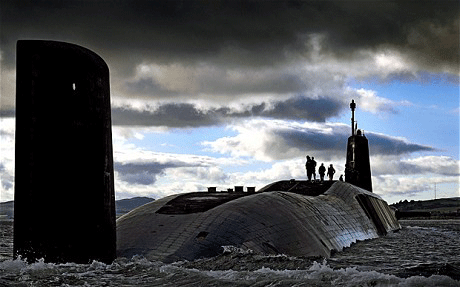 Faslane: this was a nuclear weapon for the SNP, Guardian UK, 12 July 13, The rumoured plans for the naval base were a reminder of how deeply unpopular Trident is among Scots The MoD’s, or Whitehall’s, or whoever’s plans to designate Trident’s Faslane base “sovereign UK territory” earlier this week seemed, at best, petty – an attempt at humiliation timed to balance Andy Murray’s cheering victory. It was a gift to the SNP, now denied and passed from hand to hand like a vomiting baby. That the idea was ever floated offers us another reminder of the colonial attitudes so catastrophically embedded in nuclear policy; a fundamental, fatal dismissal of “ordinary” people.
Once, it was relatively easy to acquire a colony if you had access to industrialised military production when the people you were invading didn’t. But by the end of the 19th century there was nowhere desirable left to steal, and industrialised armies finally faced each other. The results were intolerable: massive national debt and casualties that could mount by tens of thousands a day.
But then, in the 1920s, Britain’s airforce successfully bombed undefended Iraqi villages into quiescence. Italy followed suit in Ethiopia, and Germany in Spain. The age of “intimidation by bomb” was born, and with it the dream that killing a high enough percentage of a civilian population from the air would destroy a country and win a war with low military casualties……… Continue reading
Global maritime environment threatened by Russia’s floating nuclear plants
 Tow cables snap, Arctic conditions can be unpredictable, ships sink. As the ocean is the common heritage of humanity, perhaps the international community might evince a tad more interest in this project.
Chernobyl At Sea? Russia Building Floating Nuclear Power Plants http://www.zerohedge.com/node/476304 submitted by Tyler Durden 07/11/2013 by John Daly via OilPrice.com,So much for the lessons of Fukushima. Never mind oil spills, the Russian Federation is preparing an energy initiative that, if it has problems, will inject nuclear material into the maritime environment.
Speaking to reporters at the 6th International Naval Show in St. Petersburg, Baltiskii Zavod shipyard general director Aleksandr Voznesenskii said that the Russian Federation’s first floating nuclear power plant “should be operational by 2016.” Continue reading
UK might make nuclear base in Scotland a ‘sovereign United Kingdom territory”
 Trident nuclear base on banks of the Clyde ‘could be designated as UK territory’ if Scotland votes for independence
- Idea floated as a contingency if Scotland breaks away from the UK
- But Number 10 says it is not ‘credible or sensible’
- SNP accused Westminster of trying to bully Scotland
By MATT CHORLEY, MAILONLINE POLITICAL EDITOR, 11 July 2013 The nuclear deterrent base in Scotland would be designated as sovereign United Kingdom territory under plans drawn up by the Ministry of Defence.
The move comes amid warnings of the ‘enormous’ costs of trying to relocate the Trident missile system away from Faslane if Scotland breaks away from the rest of the UK.
But David Cameron today moved to quash the idea, warning it was not a ‘credible or sensible’. The future of Britain’s nuclear deterrent has become a key area of dispute in the run up to the referendum on Scottish independence next year.
The submarines and missiles are housed at a naval base on the Clyde but the SNP wants rid of the system.
Officials in Whitehall have been looking at alternatives to ensure Britain can maintain its at sea deterrent.
Under the plan to reclassify Faslane, the base would be given the same status as the British sovereign military bases in Cyprus, the Guardian reported. Continue reading
Guaranteed money from UK for new nuclear – not a subsidy, REALLY?
 Ed Davey ‘will not give an inch’ on nuclear power price As a former nuclear sceptic, energy secretary says he regards the negotiations over Hinkley Point as a personal test The Guardian, Patrick Wintour 6 July 2013 The energy secretary on Saturday intervenes in the debate over nuclear power by insisting he will not budge a further inch in his offer of long-term guaranteed fixed prices for nuclear electricity. Ed Davey [Liberal Democrats] says he regards the negotiations as a test for his commitment to produce nuclear energy at an affordable price and without subsidy by the taxpayer.

The government is locked in lengthy talks with its preferred supplier, the French energy firm EDF, over a planned nuclear plant at Hinkley Point in Somerset, which would be the first in almost two decades. Continue reading
Dodgy tax deals by uranium companies in Africa: Paladin under investigation
Advocacy group ActionAid claims poor countries are losing more than $130 billion in tax revenues a year by giving generous tax breaks to big companies, including Australian miners. There are about 240 Australian mining companies with operations in Africa.
Perth-based uranium miner Paladin Energy, came under scrutiny for its tax arrangements in Malawi where it runs a mine in Karonga. A report by the group Norwegian Church Aid alleges there are discrepancies between Paladin’s reported tax and its tax paid. It also alleges other payments by Paladin in Malawi are lower than the company reports.
Paladin has subsidiaries registered in Mauritius and the British Virgin Islands, both tax havens. Last year’s annual report showed the company accumulated losses that mean it will need to make profits totalling $208 million in Australia before paying any tax.
 Tax man takes scalpel to energy and resources firms http://www.theage.com.au/national/tax-man-takes-scalpel-to-energy-and-resources-firms-20130705-2phat.html July 6, 2013 Georgia Wilkins The Tax Office will open 60 cases of suspected tax dodging by Australian and international companies amid global pressure to crack down on profit shifting.
The investigations will add to the 26 cases of offshore restructuring already under review  by the government body.
Under scrutiny are companies that deliberately restructure their business to route profits through low-tax jurisdictions or tax havens to avoid paying higher taxes in Australia, often through the use of post box companies or marketing hubs that have little real substance. Continue reading
Nuclear power forces get France’s Environment Minister sacked

 Sacked French minister lays blame on nuclear power, fracking groups SMH, Tara Patel July 6, 2013 France’s former environment minister Delphine Batho, who was sacked on Tuesday, has blamed the fracking and nuclear power industries for her dismissal.
Ms Batho, who held the energy and the environment portfolios, was fired by President Francois Hollande after she called his 2014 spending plans ”bad” because they cut her department’s funds by about 7 per cent.
These forces that I am talking about wanted my scalp.
Mr Hollande announced her sacking via Twitter.
But Ms Batho said on Thursday that her support for France’s ban on shale gas drilling and reducing its dependence on nuclear power were the real reasons behind her departure. ”The battle crystallised notably on the question of shale gas and more discreetly on the reduction of nuclear in France,” she said at a news conference at the National Assembly in Paris. ”These forces that I am talking about wanted my scalp.”
She left at a critical time as the nation debates its future energy mix after Mr Hollande pledged to lower the proportion of power France derives from nuclear energy, the highest in the world.
An energy law was to be formulated in coming months and sent to parliament early next year.The stakes are high for Electricite de France SA, operator of the country’s 58 nuclear reactors, because it wants to extend the lives of its generators rather than have any of them shut down.
Socialist Philippe Martin was named to replace Ms Batho……… Mr Hollande has pledged to lower the dependence on nuclear energy to 50 per cent of total output by about 2025 from the present 75 per cent. http://www.smh.com.au/world/sacked-french-minister-lays-blame-on-nuclear-power-fracking-groups-20130705-2phc7.html#ixzz2YIsVQFKn
Germany’s Chancellor Merkel got it right, on switch from nuclear to renewables
 Nuclear Cuts Vindicate Merkel as RWE Profit Dips, Bloomberg By Julia Mengewein – Jul 5, 2013 Germany’s $710 billion green-energy drive is cutting production at nuclear reactors, the nation’s most profitable large-scale plants, as power prices slump to a six-year low. The proportion of hours during which electricity traded at less than 30 euros ($39) a megawatt-hour, the level at which UBS AG says reactors start losing money, rose to 50 percent last month, the most since 2007 and 92 percent more than a year ago, data from the Epex Spot SE exchange show. RWE AG (RWE) cut output at its Gundremmingen plant near Munich 31 times in the first half as solar and wind output jumped, compared with 18 times in 2012, according to data compiled by Bloomberg.
The reductions, which typically last for hours at a time, underscore how Chancellor Angela Merkel’s plan to replace atomic power with renewable energy within a decade is gaining ground at the expense of profit at utilities from RWE to EON SE. The boom in green power, coupled with the lowest demand in 10 years, sent the average operating margin at 15 European utilities to the lowest since 2002, company data compiled by Bloomberg show.
“We will see more of those situations where renewable output is so high, that spot prices collapse below the level of the cash costs for nuclear plants,” Patrick Hummel, an analyst at UBS in Zurich, said July 2 by e-mail. “This really is a double-whammy for power producers. Fewer running hours means less power is sold and that happens at a lower price.”….. Continue reading
Tepco rushes effort to restart two nuclear reactors, ignores local councils
TEPCO gets harsh response from Niigata gov. over restarting reactors Global Post 5 July 13 Tokyo Electric Power Co. faced a harsh response on Friday from Niigata Gov. Hirohiko Izumida in its attempt to swiftly apply for a state safety assessment of two reactors there as a step toward resuming their operations.
After meeting with Izumida and the mayors of two municipalities that the Kashiwazaki-Kariwa plant straddles, TEPCO President Naomi Hirose admitted it is “difficult” to join other utilities’ moves to apply for safety assessment of reactors next Monday, when a set of new regulations for atomic power plants take effect.
Izumida said TEPCO did not offer any explanation to local people before announcing the company’s plan to file for the assessment of the plant’s Nos. 6 and 7 reactors.
“Why did you rush (to make a decision to file for application)?” the governor said in the meeting, while also refusing to accept a paper in which TEPCO sought approval on a plan to install a safety system which is essential to restart the two units under the new safety standards…… http://www.globalpost.com/dispatch/news/kyodo-news-international/130705/tepco-gets-harsh-response-niigata-gov-over-restarting-
Fukushima Prefecture voters stress the reality of the nuclear crisis
Fukushima voters urge politicians to face reality of nuclear crisis Global Post 5 July 13 Voters in Fukushima Prefecture, where about 150,000 people are still living as evacuees from their homes due to the nuclear disaster triggered by the 2011 earthquake and tsunami, urged politicians to face the reality of the crisis as official campaigning for the July 21 House of Councillors election got under way Thursday…….
Yasuo Yoshida, a 46-year-old fisherman in Iwaki, a coastal city in the prefecture, said politicians should visit the areas affected by the nuclear disaster more often and listen to the local people.
“Now we face a moment of truth in trying to rebuild Fukushima’s fishing industry and I want politicians to ensure that the central government will take responsibility” for the revival of fishing, he said. Continue reading
Japanese political party to campaign for abolishing nuclear power
Your Party stands against tax hike, nuclear plants Japan Times, 3 July 13 BY REIJI YOSHIDA Your Party will stress its call to freeze the upcoming consumption tax hike and promise to abolish all nuclear power plants by 2030 when the campaign for the Upper House officially starts Thursday, party leader Yoshimi Watanabe
said. Continue reading
Japan’s nuclear industry hope to restart, but delay safety upgrades
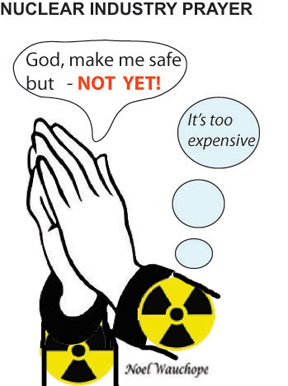
I couldn’t help being reminded of Saint Augustine’s famous prayer – “God make me pure – but not yet!”
The cost of upgrading all of the nuclear power plants is expected to exceed ¥1 trillion.
Nuclear safety rules put onus on utilities Japan Times, BY KAZUAKI NAGATA , 1 July 13, The Nuclear Regulation Authority on July 8 will begin enforcing new safety standards at atomic power stations, more than two years after Tokyo Electric Power Co.’s Fukushima No. 1 plant experienced three reactor core meltdowns…………
Utilities are meanwhile hoping that the regulators will be lenient with reactor restarts as long as they agree
to upgrade their plants to the new safety regime over time……
A major difference is that it will now be mandatory for utilities to install defenses that can prevent meltdowns from being caused by natural disasters — such as earthquakes, tsunami and tornadoes — as well as defenses against terrorist attacks…… Continue reading
USA House Republicans want more weapons money, less money for renewable energy
 House Republicans Think $911 Million In 2014 Renewable Energy Funding Should Go To Military Clean Technica July 1, 2013 This past Tuesday, President Obama unveiled his second-term plan for cutting carbon emissions, and delivered a bracing call for the American economy to advance into a clean energy future. This past Wednesday, House Republicans responded by moving a bill out of the Appropriations Committee that would cut investments in renewables by nearly a billion dollars.
The legislation in question is the Energy and Water appropriations bill, which is the fifth of twelve spending bills the House must pass to establish the discretionary budget for 2014. Sequestration — the across-the-board spending cuts that went into effect earlier this year — set a top-line level of $967 billion for that spending. But Republicans are attempting to ease the cuts to the military by slicing even deeper into other programs. That led to a party-line vote in the committee to cut renewable investments in the bill by $911 million from their level in 2013……http://cleantechnica.com/2013/07/01/house-republicans-think-911-million-in-2014-renewable-energy-funding-should-go-to-military/
1 This Month
23-25 October – on Zoom – World BEYOND War’s annual global conferenc


Shut down the radiation-damaged Heysham nuclear reactors now
To see nuclear-related stories in greater depth and intensity – go to https://nuclearinformation.wordpress.com

Say No to NASA’s Reckless Nuclear Reactor on the Moon
Say No to NASA’s Reckless Nuclear Reactor on the Moon
-
Archives
- October 2026 (180)
- September 2026 (339)
- August 2026 (330)
- July 2026 (355)
- June 2026 (287)
- May 2026 (306)
- April 2026 (356)
- March 2026 (251)
- February 2026 (267)
- January 2026 (308)
- December 2025 (358)
- November 2025 (359)
-
Categories
- 1
- 1 NUCLEAR ISSUES
- business and costs
- climate change
- culture and arts
- ENERGY
- environment
- health
- history
- indigenous issues
- Legal
- marketing of nuclear
- media
- opposition to nuclear
- PERSONAL STORIES
- politics
- politics international
- Religion and ethics
- safety
- secrets,lies and civil liberties
- spinbuster
- technology
- Uranium
- wastes
- weapons and war
- Women
- 2 WORLD
- ACTION
- AFRICA
- Atrocities
- AUSTRALIA
- Christina's notes
- Christina's themes
- culture and arts
- Events
- Fuk 2022
- Fuk 2023
- Fukushima 2017
- Fukushima 2018
- fukushima 2019
- Fukushima 2020
- Fukushima 2021
- general
- global warming
- Humour (God we need it)
- Nuclear
- RARE EARTHS
- Reference
- resources – print
- Resources -audiovicual
- Weekly Newsletter
- World
- World Nuclear
- YouTube
-
RSS
Entries RSS
Comments RSS

