Few barriers between Nevada and nation’s nuclear waste
….That view was not unanimous in the 2-1 decision. Judge Merrick B. Garland wrote a dissent scoffing at the assumed import of the decision, chiding that an order to send $11 million would do more than “order the commission to spend part of those funds unpacking its boxes, and the remainder packing them up again.”….
Published Tuesday, Aug. 13, 2013
The pressure on Nevada lawmakers to see a new nuclear waste disposal act through Congress this session just skyrocketed.
The U.S. Court of Appeals in Washington, D.C., decided Tuesday that the Nuclear Regulatory Commission must continue reviewing plans for a nuclear waste dump at Yucca Mountain until they have zero funds to continue.
That leaves only two barriers to Nevada getting dumped with the nation’s nuclear waste: Sen. Harry Reid’s ability to block funding – which depends entirely on Democrats keeping a majority in the Senate – or a scientific determination that Yucca Mountain is unfit.
Neither is as sure a thing as a law that simply designates a new destination for nuclear waste.
But it may take a small miracle to get such legislation passed.
“We’re not going to get any laws passed to change this,” Reid told reporters during a summit on clean energy in Las Vegas on Tuesday, blaming Tea Party opposition for stymieing any positive momentum toward siting a new repository.
In fact, the problem runs far deeper than that.
Last month, Congress began considering a bill to site new temporary and permanent repositories to store spent nuclear fuel by a consent-based process. Such a process, which would rely on the host community agreeing to the project, won tentative approval of members of the Nevada delegation, including Sen. Dean Heller, who got a whole lot more vocal about his support for the legislation immediately after the appeals court decision.
“Today’s decision serves as yet another example of why Yucca Mountain needs to be taken off the table once and for all,” Nevada Sen. Dean Heller said in a statement released after the ruling. “Instead of continuing to try to force Yucca Mountain on the people of Nevada, my colleagues should focus on moving toward a new process that will allow for consent-based siting.”
But last month, lawmakers in the House of Representatives also overwhelmingly rejected amendments presented by Rep. Joe Heck, R-Nev., to divert money appropriated for the Yucca Mountain licensing process by a vote of 335 to 81.
Votes like that – which occur on an annual basis – make it clear that support for Yucca is strong in both the Republican and Democratic parties.
Entergy’s finances being probed by Nuclear Regulatory Commission
 NRC to probe Entergy’s nuclear plant finances Rutland Herald, By Susan Smallheer
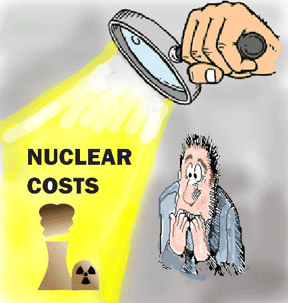
Deb Katz, executive director of the Citizens Awareness Network, said Saturday that the NRC accepting the petition for review was a major accomplishment for the groups. She said she hoped the NRC would get answers to many people’s questions about Entergy’s financial status.
Katz made her remarks during the “Flotilla 2013” rally and protest Saturday on the banks of the Connecticut River, directly across from the Vermont Yankee plant in Vernon, Vt. Entergy, the corporate parent of Vermont Yankee, announced last month it was laying off 800 employees out of its workforce of 15,000 nationwide. The cuts translate to a 4.6 percent staff cut at Yankee, which will lose 30 employees out of a total of 650.
Earlier in the year, the company announced it had been forced to write down the value of Vermont Yankee from $517 million to $162 million due to ongoing financial problems.
The NRC announced late last week that it was accepting the petition and would delve into Entergy’s finances. Continue reading
Japan getting ready to officially discharge radioactive water to Pacific Ocean?
The government’s expanded role will likely be led by the Ministry of Economics, Trade and Industry, or METI, which has been criticized for its close ties to TEPCO and the rest of the nuclear industry
Other aspects of the Fukushima plant’s decommissioning have also been dominated by other members of Japan’s collusive “nuclear village,” as the close-knit industry is called, including reactor makers and politically connected large construction companies.

 Japanese government intervenes to shore up crippled Fukushima Daiichi nuclear plant, The Globe and Mail, MARTIN FACKLER TOKYO — The New York Times News Service , Aug. 08 2013,“……….As the scope of the latest crisis became clearer Wednesday, Japan’s popular prime minister, Shinzo Abe, ordered his government to intervene in the cleanup of the plant – taking a more direct role than any government since the triple meltdowns in 2011 qualified Fukushima as the world’s second worst nuclear disaster after Chernobyl.
Abe, a staunch defender of the country’s nuclear program, appears to have calculated that he needed to intervene to rebuild public trust and salvage a pillar of his economic revival plan: the restarting of Japan’s many idled nuclear plants………Some experts suggested Wednesday that the government’s intervention may be the first step in attempts to win public acceptance for what they say is an increasing inevitability: the dumping into the ocean of some of the less contaminated of the huge amount of water being stored in hulking tanks that are overwhelming the plant.
At a news conference last week, Shunichi Tanaka, chairman of Japan’s Nuclear Regulation Authority, seemed to lay the groundwork, saying eventually “it will be necessary to discharge water,” a possible solution likely to raise concerns not only in Japan but in other Pacific Rim countries. Continue reading
UK’s Liberal Democrats about to sell out on their anti nuclear policy
 Lib Dems may be set to relax trademark anti-nuclear stance Opposition to building a new generation of nuclear power stations has been one of the Liberal Democrats’ most distinctive policy positions
The Independent, DEPUTY POLITICAL EDITOR SUNDAY 04 AUGUST 2013 Liberal Democrats could ditch their long-standing antipathy to nuclear energy next month in a conference debate that will cause deep
divisions within the party.
Opposition to building a new generation of nuclear power stations has been one of the Liberal Democrats’ most distinctive policy positions although they have watered it down in the Coalition Government.
At their conference in Glasgow, delegates will be asked whether they want to adopt a new policy of accepting that nuclear energy has its place in electricity generation.
The move is understood to have the backing of Nick Clegg, the party leader, and Ed Davey, the Energy and Climate Change Secretary, although they are unlikely to speak directly on the issue……….. Continue reading
Secrecy in South Africa, as government mulls subsidies for nuclear power
 Regardless of how the financing will be structured it is clear that most of the money will come from debt, which South Africans will ultimately pay for through higher electricity tariffs or increased taxes. The details of these financing structures are also unlikely to be transparent.
 SA still in the dark over nuke money, Mail and Guardian, South Africa 02 AUG 2013 NEWS ANALYSIS LYNLEY DONNELLY Vendor financing is a possibility, but questions remain over the country’s finances. The government appears intent on hitching its star to a big nuclear wagon, despite serious misgivings within its own ranks over whether the need for nuclear power is as urgent as once believed, the possibility of emerging alternatives and the continued opposition from business and civil society.
Chief among the reasons for a rethink of South Africa’s nuclear ambitions is the ability to pay for it, according to energy experts and economists, although there are international financing models.
The state has so far refused to pronounce on the cost, but it is estimated that it will be between R400-billion and R1-trillion. Continue reading
South Africa’s poor will not be able to afford nuclear electricity
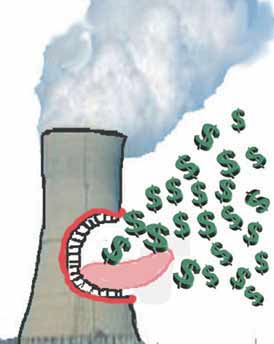
Direct and associated coal, nuclear and other fossil fuel costs continue to rise, while solar and wind costs continue to drop………… Through smart planning and a move away from energy-intensive economic sectors, South Africa can decouple electricity demand from economic growth.
This will enable us to replace coal, fossil fuel-based and nuclear power plants as they retire with renewable energy technologies.
New power plan jeopardises electricity access for poor 02 AUG 2013 Mail and Guardian, South Africa ROBERT FISCHER The cost of electricity is the subject of talks around every table in every home in the country.
These costs are heavily influenced by the cost of generating electricity.
Now the Mail & Guardian tells us that President Jacob Zuma is pushing ahead with plans for nuclear plants, “despite uncertainty about the affordability of nuclear energy and the availability of sufficient expertise” (“Zuma slips into nuclear driver’s seat”, July 25). Eskom told the National Energy Regulator of South Africa that it “need[s] to recover the cost of producing electricity, which includes operating costs as well as the costs of financing new capacity,” through its tariffs. An extremely expensive nuclear programme could seriously jeopardise the crucial social investment of providing electricity.
When you consider that the poorest households spend 32% of their income on electricity, housing, water, gas and other fuels (excluding transport), turning on the lights becomes an expensive option. Continue reading
Plan to subsidise nuclear power is prohibited under European rules
-
EU Commission intends state aid for nuclear power FT.com July 29, 2013 11:11 pm
Andrea Carta. Sir, Your report on the European Commission’s plans to allow direct state aid for nuclear power (“EU to allow state aid for nuclear power”, July 20) has prompted a somewhat confusing reply from the commission. Antoine Colombani, the EC spokesman for competition, goes to great lengths to argue (“EU rules do not prohibit state aid for nuclear power”, Letters, July 23) that the commission is still sitting on the fence on the issue, but his claims are flawed
Under EU competition rules, state aid is prohibited and only justified if it supports a common EU interest. The leaked commission guidelines on state aid describe subsidies to nuclear energy as a “common EU objective”. Given the divergence of policies on nuclear power in Europe, this definition can only be interpreted as a signal that the commission intends to carve out specific state aid provisions for nuclear power. Reactions to the leak from Germany and Austria’s leaders confirm this reading.
In the absence of guidelines on state aid for nuclear power, EU member states need to prove that aid measures clearly meet a common EU interest and that the aid is necessary – something they may struggle to do. In this respect at least, the leaked new guidelines would leave the commission little alternative but to find in favour of any future applications for state aid for nuclear power.
The subsidised construction of nuclear plants would perpetuate the fragmentation of the EU energy market, exacerbating the clash between inflexible and wasteful energy from nuclear power and flexible energy from renewables. It threatens investments in smarter interconnection between different parts of the power grid, capable of integrating renewable energy sources. And it could pit the UK against Germany in a battle for Europe’s energy future.
Fight looming in Taiwan over referendum on nuclear power
Showdown looms in legislature over nuclear plant vote, Focus Taiwan 2013/08/01 Taipei, Aug. 1 (CNA) Leaders of the ruling Kuomintang (KMT) caucus in the Legislative Yuan vowed Thursday to push for a vote on holding a referendum to decide the fate of Taiwan’s fourth nuclear power plant, as opposition lawmakers prepared to block the procedure.
DPP caucus whip Wu Ping-jui said his caucus made a decision to enter the floor early in order to occupy the podium overnight. Wu said his colleagues will not “give an inch” if a motion is called Friday, as announced by the KMT majority…………
Meanwhile, as a showdown loomed in the Legislature, activists stepped up their anti-nuclear protests around Taipei Thursday……
It mentioned the Fukushima Daiichi nuclear disaster in Japan as an example, saying that compensation for the 2011 disaster has so far reached 2.64 trillion yen (US$26.77 billion). The nationalization of the Tokyo Electric Power Co. means that taxpayers have to cover the losses, it added.
Taipower, on the other hand, would not be able to cover such losses, the groups said……….. http://focustaiwan.tw/news/asoc/201308010027.aspx
Doubts on whether nuclear energy has a future in South Africa
Russia’s state energy group Rosatom and the French Areva – will be watching upcoming developments in South Africa with interest. In addition to safety and financial viability, concern has also been raised around the opacity of the government’s nuclear plans. All of these issues are discussed in a recent Occasional Paper titled, “South Africa’s Nuclear Future”, published by the South African Institute of International Affairs (SAIIA). The paper argues that unless South Africa’s nuclear planners meet the concerns mentioned above head-on, their programmes will fail to inspire confidence, both at home and abroad.
Africa: Nuclear Future Requires Urgent Clarity ALL AFRICA BY MARI-LISE DU PREEZ, 22 JULY 2013 Observers hoping to gain insights into South Africa’s nuclear energy plans have had their hopes dashed. Two International Atomic Energy Agency (IAEA) conferences have recently taken place in quick succession. The first, an International Ministerial Conference on Nuclear Power in the 21st Century held in St Petersburg Russia from 27 to 29 June 2013, saw the last minute withdrawal of both the Energy Minister and the CEO of Eskom.
This seemed to indicate that the tussle between the Department of Energy (DoE) and the National Planning Commission (NPC) on the future of nuclear energy in South Africa is yet to be resolved. Continue reading
France’s Fessenheim nuclear plant to be shut down by 2016
 France’s oldest nuclear plant to shut down by 2016: minister PARIS, July 21 (Xinhua) — French Environment Minister Philippe Martin on Sunday confirmed the closure of the country’s oldest nuclear plant of Fessenheim by the end of 2016, a local paper reported.
In an interview with the weekly Le Journal de Dimanche (JDD), the newly-appointed minister said “Francois Hollande’s nuclear commitments will be held in the five-year period.”
“I have a warrant, I shut Fessenheim by 31 December 2016,” he stressed……http://news.xinhuanet.com/english/world/2013-07/22/c_132560534.htm
|
|
European plan for taxpayer subsidy to nuclear power industry
 EU draws up plans to allow state aid for nuclear power FT.com By Jim Pickard in London and Joshua Chaffin in Brussels 19 July 13 The EU has drawn up plans to change state aid rules to make it easier for member countries to subsidise nuclear power, in a move that looks set to trigger a political row across the continent.
By exempting all nuclear projects from the general restrictions on state aid – subject to certain conditions – the EU’s competition commission will prompt relief in UK and France but fury in Germany and Austria.
The commission had planned to delay unveiling its proposal to wait until after the autumn elections in Germany, where there is huge political resistance to nuclear. But a leaked copy of the draft guidelines on energy aid, obtained by the Financial Times, shows the criteria that would allow member states to offer state aid for nuclear power as a matter of course. Continue reading
USA farmers increasingly support renewable energy mandates
 supporting renewable energy mandates, and thus ensuring that states uphold that portion of climate mitigation, makes sense for farmers, who are increasingly threatened by the effects of climate change.
Down On The Farm, Clean Energy Requirements Are Opportunities, Not Burdens http://thinkprogress.org/climate/2013/07/18/2320481/farmers-support-clean-energy-requirements/ By Katie Valentine on Jul 18, 2013 American farmers aren’t usually seen as champions of climate causes — in fact, they’re often known for their  climate change skepticism. But farmers across the country have begun standing up for clean energy mandates in their states because they see them as an opportunity for profit in an increasingly uncertain industry.
This year, at least 14 of the 29 states with renewable energy mandates, which require utility companies to purchase a certain amount of their energy from renewable sources, have considered bills to weaken or repeal the requirements, none of which have passed. That’s due in part to farmers, who have teamed up with environmentalists and other pro-green energy groups to push legislators to keep the mandates. Their voices, along with the voices of some local businesses and the prospect of new clean energy jobs, have made it difficult for local lawmakers to repeal the standards.
“It’s hard to be conservative when it affects your district,” Rep. Mike Hager, the majority whip in the North Carolina House, told the Wall Street Journal. Continue reading
UK’s new nuclear plants – subsidies to the French seller, bribes to UK villages
The government is still in negotiations with EDF Energy over a “strike price” that would provide a guaranteed long-term income for new reactors at Hinkley Point.
The government has already committed itself to a £10bn loan to the French-owned company but has repeatedly ruled out any subsidy for the Somerset project that is seen as a test case for any future atomic plants being built here
Hinkley Point C nuclear plant £128m windfall dismissed as ‘social bribe’ Terry Macalister guardian.co.uk, Thursday 18 July 2013 Government proposals to compensate Somerset towns and villages near planned nuclear plant rejected by campaigners Campaigners have dismissed proposed government £128m windfall for towns local to Hinkley Point nuclear power station, saying it is really worth only £3.3m  per year.
Towns and villages around a proposed new nuclear plant at Hinkley Point C in Somerset could be in line to receive a £128m windfall under new proposals outlined by the government.
Campaigners opposed to the project dismissed the funding as a “social bribe” that only amounted to £3.3m annually over 40 years while wind farm developers complained they had to pay five times more in community benefits.
People living around eight potential nuclear sites in England and Wales could be eligible for a package of benefits worth up to £1,000 per megawatt of power once a facility starts, the government said…… Continue reading
Nuclear promoter Ernest Moniz announces more funding for new nukes
More funding for advanced nuclear power reactors R&D, 17 July 13 the Energy Department announced $3.5 million for four advanced nuclear reactor projects that go beyond traditional light water designs. These projects — led by General Atomics, GE Hitachi, Gen4 Energy and Westinghouse -…. “Public-private research in advanced nuclear reactors will help accelerate American leadership in the next generation of nuclear energy technologies and enable low-carbon nuclear power to be a significant contributor to the U.S. energy economy,” said Energy Secretary Ernest Moniz….
 The four projects selected for negotiation will receive up to $3.5 million in total, with a 20 percent private cost share:
GE Hitachi Nuclear Energy (Wilmington, North Carolina) – GE Hitachi’s project will develop high temperature insulation materials and robust analysis tools to help design and manufacture electromagnetic pumps for liquid-metal-cooled nuclear reactors. Electromagnetic pumps have less moving parts than traditional mechanical pumps – improving reliability and safety, while reducing maintenance needs.
Gen4 Energy (Denver, Colorado) – Gen4 Energy will conduct research and development on natural circulation designs for advanced nuclear reactors that utilize a lead bismuth coolant. The project will develop computer models that will help visualize natural circulation flow and integrate it into safe, reliable reactor designs.
Westinghouse Electric Company (Pittsburgh, Pennsylvania) – Westinghouse’s project will conduct analysis on sodium thermal hydraulics to support advanced nuclear reactor design. The project will provide analytical tools to help quantify heat exchanger performance and improve component engineering for sodium-cooled reactor designs. http://www.rdmag.com/news/2013/07/more-funding-advanced-
Nuclear dilemma facing Japan
Japan’s nuclear energy dilemma Alex Thomson, 17 July 13 Everything about nuclear power is divisive…..
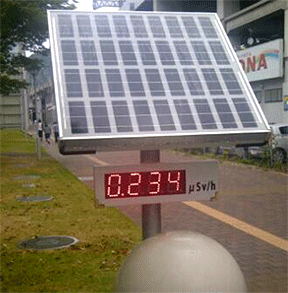 (at left – Japan- solar-powered radiation monitor) ….even as they continue to pour tonnes of water daily into the reactor fuel rods at Fukushima to stop a full-scale meltdown; even as they struggle to isolate why the place is leaking radioactive water into the Pacific; even as they cannot explain why caesium levels near to Reactor 2 are now higher than at any time since the earthquake struck the plant – even as all this is gong on, the Japanese nuclear industry is rousing itself from idling offline and looking to generate power once again.
Ten nuclear power plants are actively lobbying to restart full operations, and most are sited at or near the coast, as is the Japanese way. Many – like Fukushima – are old plants now and desperate to get back into the game after sitting offline for this long period of national Japanese soul-searching.
Yet a recent demonstration against the nuclear industry brought more than 30,000 onto the streets of Tokyo. That is a big number in Japan…… Even as they struggle to contain what is going on in the plant (and nobody really knows the full extent of that) debate rages across Japan and beyond……
For now though, they are still crisis-managing at the stricken plant itself. Indeed whether they really are managing it at all is another level altogether of raging debate. Meanwhile, there are permanent-looking radiation monitors which have spring up for miles around the plant itself, displaying to the public the background radiation levels twenty-four seven.
Nobody much notices them nowadays. But I cannot help seeing they are powered by solar panels. http://blogs.channel4.com/alex-thomsons-view/japans-nuclear-energy-dilemma/5381
1 This Month
23-25 October – on Zoom – World BEYOND War’s annual global conferenc


Shut down the radiation-damaged Heysham nuclear reactors now
To see nuclear-related stories in greater depth and intensity – go to https://nuclearinformation.wordpress.com

Say No to NASA’s Reckless Nuclear Reactor on the Moon
Say No to NASA’s Reckless Nuclear Reactor on the Moon
-
Archives
- October 2026 (180)
- September 2026 (339)
- August 2026 (330)
- July 2026 (355)
- June 2026 (287)
- May 2026 (306)
- April 2026 (356)
- March 2026 (251)
- February 2026 (267)
- January 2026 (308)
- December 2025 (358)
- November 2025 (359)
-
Categories
- 1
- 1 NUCLEAR ISSUES
- business and costs
- climate change
- culture and arts
- ENERGY
- environment
- health
- history
- indigenous issues
- Legal
- marketing of nuclear
- media
- opposition to nuclear
- PERSONAL STORIES
- politics
- politics international
- Religion and ethics
- safety
- secrets,lies and civil liberties
- spinbuster
- technology
- Uranium
- wastes
- weapons and war
- Women
- 2 WORLD
- ACTION
- AFRICA
- Atrocities
- AUSTRALIA
- Christina's notes
- Christina's themes
- culture and arts
- Events
- Fuk 2022
- Fuk 2023
- Fukushima 2017
- Fukushima 2018
- fukushima 2019
- Fukushima 2020
- Fukushima 2021
- general
- global warming
- Humour (God we need it)
- Nuclear
- RARE EARTHS
- Reference
- resources – print
- Resources -audiovicual
- Weekly Newsletter
- World
- World Nuclear
- YouTube
-
RSS
Entries RSS
Comments RSS

