Sweden’s Social Democrats call for scrapping of nuclear power
Scrap nuclear power in Sweden: Social Democrat The Local 11 Sep 2013 A leading Social Democrat has emphasized her party’s wish to abolish nuclear power in Sweden in favour of greener alternatives, a move critics say would be “devastating” for the Swedish industrial sector.
Party leader Stefan Löfven was previously a strong supporter of nuclear power in his role as chairman of the IF Metall trade union. However, since becoming the leader of the opposition last year, Löfven has changed his stance on the issue. …… http://www.thelocal.se/50186/20130911/
Britain’s Olympic chairman shows a sly way to subsidise nuclear power
 Olympian effort for nuclear build World Nuclear News 09 September 2013 The chairman of Britain’s Olympic Delivery Authority has suggested that a similar body could be set up to construct nuclear power plants before selling them to the private sector. The proposal for a new way to finance nuclear power plants as well as other kinds of key national infrastructure came from Sir John Armitt in an interview with Construction News. His ideas relate to his UK infrastructure experience, but would be equally applicable in other markets…….
an alternative approach would be to create a body rather like the Olympic Delivery Authority (ODA), which would be responsible for getting the first, maybe second, maybe third nuclear power plants built.”
The ODA is a government body not affiliated to any department. It coordinated with several other large public bodies to manage the construction of the facilities for the London 2012 Olympic Games. This was seen as a success, and the ODA continues to manage the conversion and development of the Olympic sites for the long term. In the power sector a similar organisation could use a mix of public funds and business taxes to build a power plant, bring it to operation and then sell to a private company for profit………
The suggestion follows a trend across the global nuclear sector to find new ways to raise the funds for construction and share construction risk. Russia’s state corporation Rosatom is constructing a nuclear power plant at Akkuyu in Turkey on a build-own-operate basis and plans to do the same in Vietnam. More usual is government support in the form of a loan guarantee for part of the construction cost …http://www.world-nuclear-news.org/C_Olympian_effort_for_nuclear_build_0909131.html
The world wills crutinise the costs and hazards of Tokyo’s Olympic Games plan
Some have questioned the merits of embarking on such a costly exercise before Japan has addressed its huge public debt – now more than twice the size of its gross national product – and when so little progress has been made toward rebuilding its tsunami-hit northeast coast and decommissioning Fukushima Daiichi.
Having intervened to calm fears about radiation levels in Tokyo, Abe appears to recognize that, for the next seven years, the world will be scrutinizing his response to the nuclear plant’s myriad challenges even more closely than before.
 Tokyo 2020: No nuclear worries for IOC, Christan Science Monitor, Tokyo was awarded the 2020 summer Olympics, with the International Olympic Committee convinced that continued leaks from a nuclear power plant in Fukushima are no threat to safety. By Justin McCurry / September 8, 2013 “………..It took an intervention by Japan’s prime minister, Shinzo Abe, who left the G20 summit in Russia early to attend the vote in Buenos Aires, to offer the strongest assurance yet that Tokyo is safe. The situation at the plant was “under control,” he said.
“It has never done and will never do any damage to Tokyo,” he added. “There are no health-related problems until now, and nor will there be in the future. I say this to you in the most emphatic and unequivocal way.”
Leaking concerns Continue reading
Shutdown of nuclear reactor leaves Japan with only one functioning nuclear reactor

 Japan shuts down nuclear reactor for inspections , channel news Asia, 2 Sept 13,
Workers will switch off one of Japan’s two working reactors Monday, with the other set for shutdown later this month and no restarts in sight amid continued public hostility to nuclear power. TOKYO: Workers will switch off one of Japan’s two working reactors Monday, with the other set for shutdown later this month and no restarts in sight amid continued public hostility to nuclear power.
Kansai Electric Power will start reducing generating power at its Unit No 3 at the Oi plant, Fukui prefecture, western Japan, shortly before 5:00 pm (0800 GMT), a company spokesman said.
The reactor will be fully shut down by early Tuesday in readiness for inspections legally mandated within 13 months of the start of commercial operations, he said.
The reactor is one of the only two still generating power in Japan. The other one, Unit No 4 at Oi, is to be switched off on September 15.
It is not known when they will resume operations because they will be assessed under a set of guidelines recently drawn up by the nuclear watchdog, according to Kansai Electric.
The two reactors were restarted — despite public opposition — in July last year after passing safety tests, ending a brief period in which no atomic power was generated in Japan.
They were the only units to be brought back online after undergoing such tests in the aftermath of the disaster in March 2011 at Fukushima……. The company said Sunday it had found highly radioactive water dripping from a pipe connecting two coolant tanks at one of four radiation hotspots http://www.channelnewsasia.com/news/asiapacific/japan-shuts-down-nuclear/798834.html
Fukushima’s fishermen form a serious obstacle to TEPCO’s plans to release water into the Pacific
Fishing culture has deep historical roots in Japan. The country imports more seafood than any other
“If you run roughshod over the fishermen” it will backfire when Abe asks the public for support of his economic agenda and nuclear restarts,”
Fukushima Fishermen Ruined by Tepco Now Key in Radiation Fight, Bloomberg, By Yuriy Humber, Chisaki Watanabe & Masumi Suga – Aug 29, 2013 ”……… Japan’s government promised “to take drastic measures to the maximum extent possible” to contain the radiated water leaks. That has so far amounted to Prime Minister Shinzo Abe and the ruling Liberal Democrats instructing Tepco to win over the fishermen before proceeding.
Tepco, Optics
“Despite its support for nuclear power, the Cabinet and LDP politicians know that the public dislikes atomic power and holds Tepco in contempt,” Robert Dujarric, director of the Institute of Contemporary Asian Studies at Temple University, said by e-mail. “They realise that the ‘optics’ of going over the objections of the fishermen would be very bad.” Continue reading
Huge federal subsidies to nuclear power, but few to renewables
Ask Saint Onofrio discusses the significance of the Price-Anderson Nuclear Industries Indemnity Act, which limits the costs for nuclear plants by shifting a portion of the liability for an accident from plant operators to taxpayers. Also discussed are decommissioning costs, which fall largely on ratepayers. In the case of San Onofre, closing estimates are in the range of $4.1 billion.
New Report Finds California Nuclear Energy Has Received $8.2 Billion in Federal Subsidies http://www.heraldonline.com/2013/08/26/5149320/new-report-finds-california- nuclear.html DBL Investors examines rationale for subsidizing mature, declining energy sources By DBL Investors SAN FRANCISCO, AUG. 26, 2013 — /PRNewswire/ – DBL Investors, a double bottom line venture capital firm, today announced a report revealing that the California nuclear industry has received $8.21 billion in federal subsidies over the last 50 years. The report, Ask Saint Onofrio: Finding What Has Been Lost in A Tale of Two Energy Sources, compares federal subsidies for nuclear energy to those provided for distributed solar energy.
“In keeping with our nation’s tradition of supporting the emergence of new energy sources, federal subsidies were necessary and highly-effective for the early growth of the nuclear industry and have been vital to the recent growth of the nascent distributed solar industry,” said report co-author and Managing Partner of DBL Investors Nancy E. Pfund,
Nuclear energy has received four times more federal support than distributed solar over a period six times as long. While solar is beginning to comprise a significant portion of installed capacity in California, it has received less support than nuclear did in its earliest years. At the same time, the closure of the San Onofre Nuclear Generating Station (SONGS) has reduced California’s in-state nuclear generation by almost 50 percent.
Pfund adds, “The difference is that despite the declining role of nuclear power in the Golden State, federal subsidies for nuclear have become a perpetuity. Meanwhile, solar subsidies are at risk of ending during the industry’s infancy, even as solar creates thousands of California jobs.” Continue reading
Republican Congressman Steven Palazzo opposes nuclear waste dump for Mississippi
 Miss. nuclear waste plan sparks early opposition http://www.miamiherald.com/2013/08/26/3587346/miss-nuclear-waste-plan-sparks.html BY JEFF AMY ASSOCIATED PRESS JACKSON, Miss. –– The Mississippi Energy Institute is pushing for more exploration of storing and reprocessing used nuclear fuel in Mississippi at the same time that one of the state’s congressmen is coming out against it.
Leaders of the institute, which promotes energy development, pitched ideas Monday to the state Senate Economic Development Committee. Jason Dean, who works for a unit of the Butler Snow law firm, says Mississippi should explore interim storage and reprocessing of fuel rods.
The Energy Institute also touts Mississippi’s “unique geologic salt domes.” That’s an echo of a proposal to entomb nuclear waste in the Richton salt dome that sparked public opposition starting in the 1980s.
Congressman Steven Palazzo, a Biloxi Republican who represents Richton, is voicing opposition. “Not now, not ever,” Palazzo says in a Monday statement.
UK Labour has an electoral asset – opposition to Trident nuclear replacement
 New nuclear weapons for the UK: a challenge Labour can’t dodge REBECCA JOHNSON 50-50, 23 August 2013 Labour could turn opposition to the billion pound Trident replacement into an electoral asset, but instead appears to be sleepwalking to oblivion. Rebecca Johnson makes the case for challenging Trident replacement, and says it’s time to mobilise civil society
The 2015 general election may be this country’s last chance to avoid wasting billions of pounds on new nuclear weapons that one of Labour’s greatest Foreign Secretaries, Robin Cook, condemned as “worse than irrelevant” for addressing 21st century security challenges. Following the sham Trident Alternatives Review, it is clear that we need to mobilise civil society pressure to scrap Trident and elect a new government that is willing and able to participate in multilateral disarmament negotiations to rid the world of the scourge of nuclear weapons for all time.
The rational case was won a long time ago, even with many Conservatives. Across most of the world, nuclear weapons are recognised to be clumsy, outdated weapons that carry residual risks but cannot be used for dealing with the real world security challenges we might face in the 21st century and beyond. Replacing the current submarines with another Trident system is a foolish project driven by the economic interests of a handful of British and American defence contractors well versed in manipulating political fears, vanity, and inertia among our politicians and civil servants. Tony Blair’s memoirs reveal that despite recognising that there was no military or security case for replacing Trident, he felt it would be easier to carry on nuclear business as usual than to initiate the political arguments at home and be accused of “downgrading our status”. Now this shortsighted procurement is being taken forward by David Cameron. Nick Clegg – having been outmanoeuvred by Cameron over the Review – is bent on overcoming Liberal Democrat scepticism and getting his Party to back Trident replacement. Labour could turn opposition to Trident replacement into an electoral asset, but instead appears to be sleepwalking to oblivion…… http://www.opendemocracy.net/5050/rebecca-johnson/new-nuclear-weapons-for-uk-challenge-labour-can%E2%80%99t-dodge
Australia’s old Has-Been Hawke – in the grip of the nuclear lobby
Greens condemn plan to turn Australia into the world’s nuclear waste dump Australian Greens spokesperson on nuclear policy, Senator Scott Ludlam. 24 August 2013. The Greens have strongly rejected the proposal by former Labor Prime Minister Bob Hawke to turn Australia into a dump for the world’s nuclear waste.
Greens spokesperson Senator Scott Ludlam said the plan was “the worst imaginable way to raise revenue”.
“What Mr. Hawke is proposing is criminal activity. The Parliament passed Greens amendments last year to prohibit the importation of nuclear waste.

“Mr Hawke seems to think the way to fill the Budget hole is to fill a hole in Australia with the world’s nuclear waste. The Labor Party and the Coalition must rule out this dangerous proposal immediately.
“Having seen both the Howard and Rudd-Gillard Governments make an absolute mess of trying to force a dump for Australian nuclear waste on Tenant Creek in the Northern Territory, heaven help us if they were trying to deal with nuclear waste from around the world as well.
“The question is – is Mr Hawke expressing this view as a hobby or as an earner on the side? If he has any commercial interests in a waste management company he should make that clear now
Prime Minister Abe’s plan to restart Japan’s nuclear reactors is now under threat
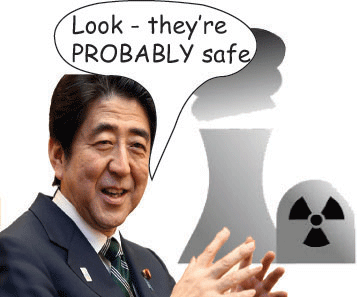 Calls for Japan nuclear switch-off threaten ‘Abenomics’ Ft.com By Ben McLannahan in Tokyo , 23 Aug 13, Yumi Murakami began her weekly vigils not long after the tsunami-induced meltdowns at Japan’s Fukushima Daiichi nuclear plant almost two and a half years ago. The 64-year-old housewife was at her usual spot outside the ministry of economy, trade and industry in Tokyo on Friday evening, bedecked in “No Nuke” badges, about to join a protest march to the prime minister’s house.
This week’s demonstration was vital, she said, following the disclosure from Fukushima’s operator that it had discovered a 300-tonne leak from one of the hundreds of jerry-built tanks holding contaminated water used to keep melted fuel cool.
“We can’t keep ruining people’s lives”, said Ms Murakami. Switching Japan’s reactors back on would be “hell”.
Shinzo Abe, beginning a five-day trip to the Middle East, was not there in person to see Friday’s protest. But the prime minister is acutely aware of the tensions between economic need and civil unease that elections have done little to resolve.
Mr Abe’s Liberal Democrats – the only party not calling for the elimination of nuclear power – comfortably won last month’s contest for control of the upper house of parliament. But turnout was low, as it was in December for the lower-house election that put the LDP in charge.
Opinion polls show significant shares of Japanese opposed to restarting the 50 reactors shut down in the wake of the Fukushima crisis, all but two of which remain idled. A survey this month by state broadcaster NHK found only 24 per cent of Japanese were in favour of restarting nuclear plants.
For Mr Abe, however, restoring nuclear power is a vital part of the grand project to pull Japan out of the deflation that has dogged it for much of the past 20 years……. Continue reading
Rapid City Council votes for water security, and against uranium mining
Council passes resolution opposing uranium mining, Rapid city Journal, 21 Aug 13 The Rapid City Council passed a resolution late Monday night opposing a uranium mining operation near Edgemont, saying it “poses an unacceptable risk” to the city’s primary water supply.
The 9-1 vote came after council member Steve Laurenti sought to continue the discussion until state hearings for mining and water rights permits for Powertech concluded.
“I will tell you that this issue ranks in the top handful of issues that have generated public concern,” Mayor Sam Kooiker said. “This has really gotten peoples’ interest and there is a lot of concern in the community, and I believe that people have the right to ask questions about this issue.” Kooiker encouraged Laurenti to join the rest of the council in its decision to oppose the mine.
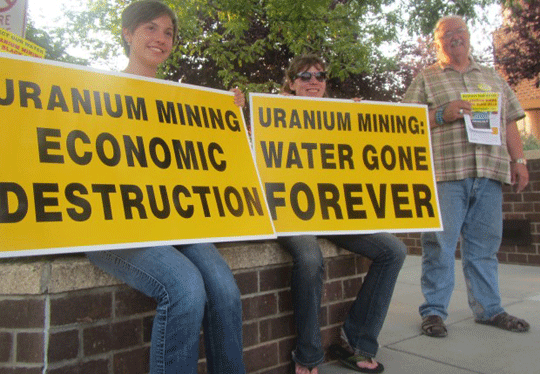
However, Laurenti stood firm with his vote against the resolution, maintaining that more information was needed before he could take a stand against the operation.
“The problem I have, from a logical standpoint, is to oppose something or even to have grave concern, grave meaning that I have a fear for my life,” Laurenti said. “I don’t fear for my life over this issue at this point.”…… The mine would draw up to 9,000 gallons of water per minute from the Inyan Kara and Madison aquifers. The Madison Aquifer supplied Rapid City with 60 percent of its water resources in 2012, according to city officials. http://rapidcityjournal.com/news/council-passes-resolution-opposing-uranium-mining/article_2253d74c-8890-58cc-9688-4bea869afbe9.html
Czech Republic’s new anti renewable energy law
Activists criticise law on renewable energy, industry hails it, Prague Daily Monitor Prague, Aug 16 (CTK) – Environmentalist groups and solar industry associations in the Czech Republic have expressed criticism of the amended law on renewable sources, approved by the Chamber of Deputies Friday, but representatives of industrial companies have welcomed the bill.
Environmentalists say the law will end support to environmentally friendly production of electricity while maintaining subsidies to burning coal, gas and waste.
In contrast, representatives of industrial companies focusing on energy-intensive production welcome the bill, saying it will help to maintain competitiveness of Czech businesses.
“The law brings no end to subsidised electricity. It only ends support to projects of pure renewable energy for municipalities and households, while it continues to subsidise large companies which operate waste incinerators and coal-fired power plants,” Jiri Kozelouh of environmentalist movement Hnuti Duha (Friends of the Earth) said.
“If the law is approved by the Senate too, it will give more power to fossil fuel barons who get billions of crowns from the sale of gas, oil and coal whose prices continue to rise. The law will secure further state subsidies for them, but will complicate the possibility to abandon fossil fuels for families and municipalities,” Kozelouh added.
The Alliance for Energy Self-Sufficiency and Czech Photovoltaic Industrial Association (CZEPHO) said in a joint statement that the law aimed to boost the start of production of clean energy will paradoxically turn into a subsidy mechanism for coal and gas burning and for the construction of waste incinerators because of the gradual drop in support to new renewable sources…… http://praguemonitor.com/2013/08/19/activists-criticise-law-renewable-energy-industry-hails-it
Some American Republican advice on nuclear radiation, and climate change
 Oregon’s GOP Chair Wants to Sprinkle Nuclear Waste From Airplanes Mother jones, —By Tim Murphy Fri Aug. 16, 2013 After months of in-fighting, the beleaguered Oregon Republican Party elected a new chairman last weekend. His name is Art Robinson, and he wants to sprinkle radioactive waste from airplanes to build up our resistance to degenerative illnesses. …. Robinson, who has a Ph.D. in chemistry, has marketed himself for the last three decades as an expert on everything from nuclear fallout to AIDS to climate science in the pages of a monthly newsletter, Access to Energy, which he published from his compound in the small town of Cave Junction……
Democrats AND Republicans want tax reform to further renewable energy

 Raul Ruiz urges tax reforms to benefit renewable energy Aug. 16, 2013 Erica Felci The Desert Sun PALM DESERT — Calling renewable energy development a “critical area of economic growth,” Rep. Raul Ruiz on Friday called on his fellow lawmakers to reform the federal tax code in a way that benefits wind, solar and other green industries.
The Palm Desert Democrat joined two fellow representatives — Republican Jon Runyan of New Jersey and Democrat Earl Blumenauer of Oregon — in a letter that was sent to the House Committee on Ways and Means.
The letter said the United States saw a 34 percent decrease in renewable energy investments last year because of “policy uncertainty.” To stop that, officials are urging the committee to include “policies that promote America’s renewable energy economy” as part of much-discussed tax reform.
Such change could benefit the Coachella Valley and the rest of Ruiz’s district, which hosts geothermal, solar and wind developments from Palm Springs to the Salton Sea. It’s also home to the the Riverside East Solar Zone that runs along Interstate 10 from Joshua Tree National Park to Blythe.
The letter was signed by 60 Democrats and Republicans.
“The race to develop renewable energy is widely considered one of the most important areas of economic growth for the 21st century,” the letter states. “Maintaining policies in the tax code that promote investment in and deployment of renewable energy technologies will help ensure that the American consumer continues to benefit from renewable energy innovations while also reaping the benefits of a diverse energy economy.”….. http://www.mydesert.com/article/20130816/BUSINESS0302/308160004/Ruiz-urges-tax-reforms-benefit-renewable-energy?nclick_check=1
Squabble in Europe over subsidies for nuclear power

Opponents of nuclear power, including environmental groups, say government funding for atomic power would be a breach of EU legal principles and would mark a major shift in policy.
Under EU law, state aid is designed to address problems that the market cannot solve and must not cause unfair competition. It is in principle reserved for technology in its infancy, such as renewable energy. Nuclear generation began more than half a century ago.
Picking up the nuclear energy bill divides the EU Planet Ark, Date: 15-Aug-13 Country: UK/BELGIUM Author: Barbara Lewis and Karolin Schaps European Union rules to be published over the coming weeks could make it easier to justify using taxpayers’ money to fund new nuclear power, which would pitch major EU powers against each other.
The European Commission, the EU executive, says its mind is still open on the topic, but it is under pressure to set a legal framework for state aid to nuclear projects after several member states, including Britain, sought its guidance.
Whatever it lays down, as part of a wider modernization of state aid rules, is likely to widen a rift between anti-nuclear nations, such as Germany and Austria, and those willing to support the technology, including Britain and the Czech Republic.
A Commission spokesman said the executive is not planning to encourage nuclear state aid, but lawyers said a leaked draft of its proposal last month indicated it was leaning towards allowing nuclear financing….. Continue reading
1 This Month
23-25 October – on Zoom – World BEYOND War’s annual global conferenc


Shut down the radiation-damaged Heysham nuclear reactors now
To see nuclear-related stories in greater depth and intensity – go to https://nuclearinformation.wordpress.com

Say No to NASA’s Reckless Nuclear Reactor on the Moon
Say No to NASA’s Reckless Nuclear Reactor on the Moon
-
Archives
- October 2026 (180)
- September 2026 (339)
- August 2026 (330)
- July 2026 (355)
- June 2026 (287)
- May 2026 (306)
- April 2026 (356)
- March 2026 (251)
- February 2026 (267)
- January 2026 (308)
- December 2025 (358)
- November 2025 (359)
-
Categories
- 1
- 1 NUCLEAR ISSUES
- business and costs
- climate change
- culture and arts
- ENERGY
- environment
- health
- history
- indigenous issues
- Legal
- marketing of nuclear
- media
- opposition to nuclear
- PERSONAL STORIES
- politics
- politics international
- Religion and ethics
- safety
- secrets,lies and civil liberties
- spinbuster
- technology
- Uranium
- wastes
- weapons and war
- Women
- 2 WORLD
- ACTION
- AFRICA
- Atrocities
- AUSTRALIA
- Christina's notes
- Christina's themes
- culture and arts
- Events
- Fuk 2022
- Fuk 2023
- Fukushima 2017
- Fukushima 2018
- fukushima 2019
- Fukushima 2020
- Fukushima 2021
- general
- global warming
- Humour (God we need it)
- Nuclear
- RARE EARTHS
- Reference
- resources – print
- Resources -audiovicual
- Weekly Newsletter
- World
- World Nuclear
- YouTube
-
RSS
Entries RSS
Comments RSS

