TEPCO applies to restart Kashiwazaki Kariwa nuclear plant
Mr Izumida, a strident critic of TEPCO, said he was allowing the utility to apply for safety approval, but withholding final judgment on restarting the plant.
“Kashiwazaki Kariwa nuclear power plant may be halted, but it is a living facility, and safety must be ensured at the plant,” he said in a statement.
He had previously denounced TEPCO as unfit to run a nuclear plant and has called for the company’s liquidation.

 Fukushima operator TEPCO seeks restart of Japan’s Kashiwazaki Kariwa nuclear plant http://www.abc.net.au/news/2013-09-27/fukushima-operator-seeks-reactor-restart/4985444 27 Sept 13 TEPCO has applied to restart a nuclear plant in north-western Japan, an initial step on its planned recovery from the Fukushima nuclear disaster.
But final approval to resume power generation at the Kashiwazaki Kariwa facility, the world’s largest nuclear plant, 300 kilometres north west of Tokyo, is uncertain and any decision would take many months at best. Continue reading
If Indian Point Nuclear Reactor melted down – who would pay ?

 NEW YORK WONDERS WHERE NUCLEAR CLEANUP FUNDS WOULD COME FROM, Next Gov 25 Sept 13 Who — and what pot of money — would drive cleanup after a severe nuclear-power-plant incident is a question still left unanswered by the federal government, New York state officials say in a recent legal filing with the Nuclear Regulatory Commission.
Under the Price-Anderson Act, which Congress first passed in 1957 and has renewed several times since, the nuclear-power industry’s liability in the event of a catastrophe at one of its facilities is limited. The industry pays into an insurance account — which NRC officials say has a current value of $12 billion — that would be used to compensate the public for various damages incurred as the result of an incident. Those costs could be related to hotel stays, lost wages and property replacement.
However, how actual cleanup of the contaminated area surrounding a compromised facility would be paid for remains unclear, the New York state attorney general’s office notes in the Sept. 13 filing with the commission. In 2009, NRC officials informed their counterparts at the Homeland Security Department and the Environmental Protection Agency that the Price-Anderson money likely would not be available to pay for offsite cleanup — a revelation made public a year later when internal EPA documents were released under the Freedom of Information Act.
Another three years have gone by and the federal government has yet to provide a clear answer, the New York AG office says. Last year, NRC Commissioner William Magwood acknowledged in a presentation to the Health Physics Society that “[t]here is no regulatory framework for environmental restoration following a major radiological release.”……….
In the new filing, the state again asks the commission to identify which federal agency would be responsible for cleaning up radiation released by the Indian Point reactors and spent-fuel pools, as well as whether Price-Anderson funds would be available to support such a cleanup.
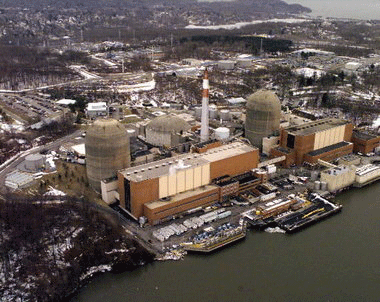
“Given the unique characteristics of Indian Point, the State believes it is especially important that the public have access to this information,” the New York AG office says, adding that more than 17 million people live within 50 miles of the facility.
“The communities within the 50-mile radius around Indian Point also contain some of the most densely-developed and expensive real estate around the country, critical natural resources, centers of national and international commerce, transportation arteries and hubs, and historic sites,” the state says. “Thus, the decontamination costs of a severe accident at Indian Point have the potential to be larger than an accident at any other reactor in the country.”
Asked to comment, NRC spokesman Scott Burnell said the commission’s general counsel office would respond directly to the New York AG office “as appropriate.” http://www.nextgov.com/defense/2013/09/new-york-wonders-where-nuclear-cleanup-funds-would-come/70800/?oref=ng-dropdown
Even right wing Cato Institute getting worried about USA’s massive, unnecessary, nuclear arsenal
 Reassessing U.S. Nuclear Weapons Policy By CHRISTOPHER A. PREBLE Cato Institute Sept 24 13 Today Cato released a new white paper, “The End of Overkill? Reassessing U.S. Nuclear Weapons Policy.” I am proud to have contributed to this effort with lead author Benjamin Friedman of Cato, and Matt Fay, a former Cato research assistant now enrolled in the History PhD program at Temple University. We argue that U.S. security does not require nearly 1,600 nuclear weapons deployed on a triad of systems—bombers, land-based intercontinental ballistic missiles (ICBMs), and submarine-launched ballistic missiles (SLBMs)—to deliver them. We estimate that a smaller arsenal deployed entirely on submarines would save roughly $20 billion annually while deterring attacks on the United States and its allies.
The paper is part of a broader project, “From Triad to Dyad: Rationalizing U.S. Nuclear Weapons Delivery Systems,” made possible by the generous support of the Ploughshares Fund. The project began as a top-line review of the triad, but expanded into a more comprehensive study of U.S. nuclear strategy and policy. Over the last year, we presented our preliminary findings at over a dozen public events in ten different cities, as well as several engagements here in Washington, D.C. This process generated useful feedback along the way.
Here are a few excerpts from “The End of Overkill?”:…..http://www.cato.org/blog/reassessing-us-nuclear-weapons-policy
Republican heresy? Religious conservatives promoting renewable energy
As conservatives, we believe that increasing our use of renewable energy will improve public health and help protect the lives of the most vulnerable among us. Study after study demonstrates the negative health effects on people who live near coal plants. They are, by and large, people who are too poor to move. The quality of our air and water impacts not just your health and mine and people across Michigan. They also affect the health and life of the unborn.
As conservatives, we believe that using more renewable energy will reduce the amount of fuel we import from other nations

Conservatives should lead on renewable energy as way to protect God’s creations http://www.mlive.com/politics/index.ssf/2013/09/keith_den_hollander_ renewable.html By Keith den Hollander State Committee Member at Michigan Republican Party Chairman, MI Chapter at Christian Coalition, 22 Sept 13 In the next few days, Michigan Governor Rick Snyder unveiled the first of four reports on renewable energy that could potentially reshape Michigan’s energy economy.
Conservatives have a real opportunity to lead in the area of renewable energy and we should applaud Governor Snyder for his leadership in the energy sector……. Opinions like those expressed by the Mackinac Center’s Ken Braun (9/14/2013), who downplays the importance of renewable energy to Michigan, do not fully reflect the conservative viewpoint on energy.
Humankind has a moral obligation to be good stewards of the Earth and the resources that God has put on this planet for our responsible use. We are free to use coal, natural gas and oil – and also the wind, sun, manure and any other resource that can be economically and responsibly used or harnessed to create energy.
An “all of the above” approach to energy generation is beneficial to our state, economy, and long-term sustainability. This approach can help reduce the amount of energy derived from fossil fuels, and increase the amount generated from renewable sources. Continue reading
Japanese government considers taking over the Fukushima radiation cleanup
J apan LDP Plan Would Put Government in Control of Fukushima Cleanup, WSJ, Proposal Would Reduce Tepco’s Financial Burden By MARI IWATA, 20 Sept 13 TOKYO—Japan’s ruling Liberal Democratic Party is considering a plan that would give the government sole responsibility for containing and cleaning up contamination from the stricken Fukushima Daiichi nuclear-power plant, allowing its operator, Tokyo Electric Power Co., 9501.TO -2.28% to focus its dwindling resources more efficiently on decommissioning the facility……..
The government had already effectively nationalized Tepco by buying a majority of its shares, but the stock still trades on the Tokyo Stock Exchange, and Prime Minister Shinzo Abe’s administration is eager to see the cash-strapped company return to financial health, a significant challenge, given lost revenue from the idling of all of the company’s nuclear reactors, as well as the costs of the cleanup and purchasing of more liquefied natural gas than before the accident to fuel thermal-power plants to make up for lost nuclear generation.
Tepco has posted two straight years of large net losses since the accident. It swung to a profit in the April-June quarter, solely on the back of a large government subsidy to help it pay compensation to Fukushima victims but it carries Y800 billion ($8.14 billion) in debt that should be refinanced this fall. On top of that, Tepco estimates it must borrow an additional Y300 billion by the end of December if it wants to stay afloat, a spokesman said……..
Tepco President Naomi Hirose said Thursday that the company would prepare Y1 trillion ($10 billion) to decommission the entire plant in addition to Y960 billion it had reserved for the work by the end of June. This doesn’t include costs associated with handling contaminated water at the site. There hasn’t been any estimate on the total cost of decommissioning the stricken plant…….Japan’s Nuclear Regulation Authority Chairman Shunichi Tanaka has urged the government and Tepco to intensify the decommissioning effort, saying “the deadliest risk is another huge natural disaster,” which would “destroy all these makeshift tanks and water processing systems, releasing all the radioactive materials there into the environment.” http://online.wsj.com/article/SB10001424127887324492604579086742989825408.htm
Japan’s power struggle over electricity and nuclear energy
It will not prove so simple. For one, a new, strengthened nuclear agency, the Nuclear Regulation Authority (NRA), must declare any plant safe before it starts—and several sit on or near active faults (Japan accounts for a fifth of the world’s big earthquakes). In addition, the law gives towns and villages a say over nearby plants, and most Japanese want to ditch nuclear power for good. To cap it all, news of the mess at the stricken Fukushima plant gets no better.
Electricity in Japan Power struggle The Economist, Sep 21st 2013 | TOKYO The shadow of Fukushima, the world’s worst nuclear disaster after Chernobyl, hangs over Japan’s energy future
THIS week Japan’s last working nuclear reactor was switched off. At Oi, on the west coast of the country’s main island, the closure was supposedly for routine maintenance and safety checks. Yet no firm date is in sight for reopening Oi or any other of Japan’s 50 reactors, shut in the wake of the triple meltdown at the Fukushima Dai-ichi plant. Before the earthquake and tsunami of March 2011 turned so much of Japan’s world upside down, the country counted on nuclear power for 30% of its electricity—one of the highest proportions in the world. Now it is entirely without nuclear power for only the second time since 1970.
In government since December, the Liberal Democratic Party (LDP) warns of the economic costs of mothballed plants. The industry ministry says that the need to import extra oil, gas and coal to fire conventional power stations will have cost Japan an extra ¥9.2 trillion (about $93 billion) by the end of 2013. A sharply weaker yen and higher oil prices have not helped, and Japan is now running trade deficits for the first time in three decades. Businesses and consumers face much higher electricity costs in Japan than in many countries.

The cosy community of electricity utilities, bureaucrats, academics and heavy industry, known in Japan as the “nuclear village”, is urging the LDP to restart the reactors. The prime minister, Shinzo Abe, would love to oblige. Continue reading
USA’s Energy Secretary Moniz promoting nuclear industry
UNM, LANL reap funds for nuclear energy pushhttp://www.bizjournals.com/albuquerque/news/2013/09/20/unm-lanl-reap-nuclear-research-funds.html The U.S. Department of Energy on Friday announced major grants to New Mexico institutions that total $2.2 million. Secretary of Energy Ernest Moniz announced that the state will receive the money as part of a $60 million initiative to invest in nuclear energy research at the university level. Dan Mayfield Reporter-Albuquerque Business First U.S. Department of Energy on Friday announced major grants to New Mexico institutions that total $2.2 million.
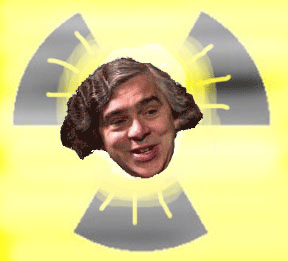 Secretary of Energy Ernest Moniz announced that the state will receive the money as part of a $60 million initiative to invest in nuclear energy research at the university level.
“By supporting cutting-edge nuclear science and engineering across our universities, national labs and industry, we can strengthen the foundation for a continuing important role for nuclear energy in America’s low carbon future,” said Moniz. “Training and educating the next generation nuclear energy workforce plays a critical role in ensuring American leadership in the safe, secure and efficient use of nuclear power worldwide.”
The announcement included two grants for the University of New Mexico totaling $1.2 million for research into fuel cycle technologies. The DOE is awarding schools a total of $42 million to develop new technologies for energy.
Also, the DoE is supporting Los Alamos National Laboratory with $1 million to research advanced materials for reactors.
India’s Opposition Party critical of PM’s gift to US nuclear companies
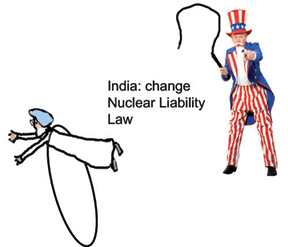 PM compromising on nuclear act is India’s gift to US companies: BJP http://www.firstpost.com/politics/pm-compromising-on-nuclear-act-is-indias-gift-to-us-companies-bjp-1120813.html?utm_source=ref_article Sep 19, 2013 New Delhi: The BJP today said reports of India compromising on crucial clauses in the Nuclear Liability Act regarding fixing of liability is “worrisome” and alleged Prime Minister Manmohan Singh has allowed this to give a gift to American companies during his forthcoming visit to the US.
The main opposition insisted a decision on the issue should be taken after due diligence and no step should be taken that imperils the safety of Indians or compromises the nation’s security.
“The reported media observation that government is trying to compromise the importance of Section 17 (b) of the Nuclear Liability Act passed by Parliament is very worrisome and a cause of serious concern,” Deputy Leader of BJP in Rajya Sabha Ravi Shankar Prasad told PTI.
He maintained that Section 17 (b) of the Nuclear Liability Act specifically fixes the responsibility of the manufacturer of nuclear reactors and provides for their liability in the event of an accident involving design or manufacturing fault. The Opposition parties, including the Left, have been up in arms against an opinion of Attorney General Goolam Vahanvati to the Department of Atomic Energy that it is for the operator of a nuclear plant in India to decide whether it wished to exercise the “right of recourse” provided under Section 17 of the Act. “By this, the whole liability of the manufacturer is sought to be compromised and the entire mandate of Parliament is being disobeyed,” Prasad said.
USA’s fossil fuel friendly politicians don’t like pro renewable energy Ron Binz
US energy regulator nominee criticised for pro-renewables stance Climate Spectator 19 Sep, 1 Reuters Republicans and some Democrats criticised Ron Binz in a hearing on Tuesday on his nomination to lead a key US energy regulatory agency as being non mainstream because his views on the nation’s energy future support renewable sources like wind over coal and natural gas.
Chairman of the Colorado Public Utilities Commission from 2007 to 2011 and currently a regulatory consultant, Binz was nominated by President Barack Obama in July to lead the Federal Energy Regulatory Commission .
His nomination was considered by the Senate Committee on Energy and Natural Resources Committee in an often contentious three-hour hearing. No date has been set for a vote.
Some conservative and free-market groups have opposed Binz, citing comments that, among other things, natural gas is a “dead end” energy source, and saying Binz would orchestrate a push for renewable energy sources like wind over coal and natural gas.
A bipartisan group of 12 former FERC commissioners are among those who have spoken in favor of Binz. Sen. Lisa Murkowski, the committee’s ranking Republican, ended the hearing by saying that she “reluctantly” could not support the nomination. The Alaskan said she was “not convinced” that Binz’s views were compatible with FERC’s mission……..http://www.businessspectator.com.au/news/2013/9/19/renewable-energy/us-energy-regulator-nominee-criticised-pro-renewables-stanc
Move away from nuclear power – Head of Japan’s Ministry of Economy, Trade and Industry METI
Japan Govt. “Wants To Lower Dependence On Nuclear Power” http://www.fukuleaks.org/web/?p=11428 September 17th, 2013 Not what anyone expected to hear out of the current LDP government in Japan. The current head of METI made this statement to the press that Japan should lower their dependence on nuclear power. This is an unusual statement considering the utterly pro-nuclear agenda of the current government.
Call on America’s EPA to withdraw its weakened guidelines on ionising radiation
 More than 100 Groups Call on EPA to Withdraw Dramatically Weakened Radiation Guides http://www.enewspf.com/latest-news/science/science-a-environmental/46251-more-than-100-groups-call-on-epa-to-withdraw-dramatically-weakened-radiation-guides.html 2013 WASHINGTON–(ENEWSPF)–September 16 – Over 100 environmental organizations today called on U.S. Environmental Protection Agency (EPA) Administrator Gina McCarthy to withdraw EPA’s controversial new Protective Action Guides (PAGs), which would allow exposure to very high doses from radiation releases before government would take action to protect the public. The PAGs are intended to guide the response to nuclear power reactor accidents (like Fukushima in Japan, Chernobyl in Ukraine and Three Mile Island in the U.S.), “dirty bomb” explosions, radioactive releases from nuclear fuel and weapons facilities, nuclear transportation accidents, and other radioactive releases.
Although official estimates of health risks from radiation have gone up substantially (even higher for women) since promulgation of the old PAGs, the new EPA guidance contemplates radically increased “allowable” exposures in the intermediate and long-term periods after radiation releases.
The new PAGs
- propose five options for drinking water which would dramatically increase the permitted concentrations of radioactivity in drinking water, by as much as 27,000 times, compared to EPA’s current Safe Drinking Water Act limits;
- suggest markedly relaxing long-term cleanup standards;
- incorporate very high and outdated allowable food contamination levels;
- eliminate requirements to evacuate people threatened with high projected radiation doses to the thyroid and skin;
- eliminate limits on lifetime whole body doses; and
- recommend dumping radioactive waste in municipal garbage dumps not designed for such waste.
“Rather than requiring protective actions to limit public radiation exposures, EPA is now saying it would allow the public to be exposed to doses far higher than ever before considered acceptable,” said Daniel Hirsch, president of Committee to Bridge the Gap.
“Even though EPA now admits radiation is more harmful than previously thought, it is weakening rather than tightening radiation protections,” said Diane D’Arrigo of the Nuclear Information and Resource Service.
The full letter is at http://committeetobridgethegap.org/GroupPAGltr9-16-13.pdf
###NIRS/WISE is the information and networking center for people and organizations concerned about nuclear power, radioactive waste, radiation, and sustainable energy issues.Source: commondreams.org
UK: Liberal Democrats sold out their principles on nuclear power
Nuclear fuel on the bonfire of Liberal Democrat principles http://www.theguardian.com/politics/2013/sep/16/nuclear-bonfire-liberal-democrat-principles The Guardian, Caroline Lucas MP, Tuesday 17 September 2013 As Liberal Democrat opposition to nuclear power joins opposition to secret courts and tuition fees on the bonfire of Lib Dem commitments, voters could be forgiven for wondering whether the party has any “red lines” of policy or principle left (Climate fears bring U-turn on nuclear power generation, 16 September).
The weasel-worded capitulation on nuclear power suggests it has a role to play “providing concerns about safety, disposal of radioactive waste and cost are adequately addressed and … without allowing any public subsidy for new build”.
As the Lib Dem leadership well knows, the new energy bill has been crafted precisely to give generous subsidies to nuclear through so-called contracts for difference. It is thought likely that, for Hinkley C alone, a transfer of £30bn-£50bn from British householders and businesses to the French company EDF will be required. Moreover, it is proposed that nuclear operators’ liability be capped at just £1bn per plant, when the total costs of the Fukushima disaster, for example, may well exceed £300bn.
There are far cheaper, safer, quicker, more efficient ways of addressing the climate challenge than pursuing nuclear power. Accelerating the deployment of energy-efficiency measures, demand-response, demand-reduction and distributed-generation policies, and renewable technologies, would help drive wholesale electricity costs down and deliver more value for money as a pathway to decarbonising electricity generation.
The Green New Deal Group, of which I am part, outlined just such an approach in a report last week. Investment in renewables, alongside a nationwide project to make every building in the country energy-efficient, would create hundreds of thousands of high-quality jobs across the country, as well as reducing both fuel bills and emissions.
Japan’s Prime Minister Abe losing credibility over his statements about Fukushima radiation
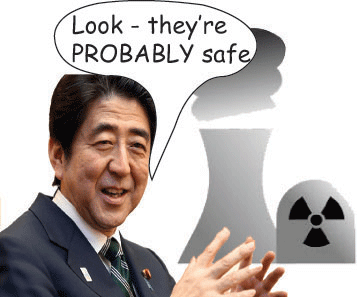 Japan PM’s Fukushima remark backfires HERALD SUN, MARI YAMAGUCHI AAP SEPTEMBER 15, 2013 JAPANESE Prime Minister Shinzo Abe’s reassurance to the International Olympic Committee that contaminated water leaks from the crippled Fukushima nuclear plant are “under control” has backfired at home
Just hours before Tokyo was chosen September 7 to host the 2020 Olympics, Abe gave an emphatic speech declaring that radioactive contaminants from the leakage had no impact to waters outside the bay near the plant and “will never do any damage to Tokyo”.
The Japanese media and opposition lawmakers have suggested that Abe’s comments were overkill.
“Contaminated water ‘control’ running astray,” the nationwide Asahi newspaper said in its front-page top story on Saturday.
“Credibility of prime minister’s message to overseas is shaking.”……….In a meeting with opposition Democratic Party of Japan lawmakers on Friday, senior TEPCO official Kazuhiko Yamashita said the water situation was “not under control,” contradicting Abe.
DPJ leaders said they will demand Abe clarify his IOC speech……….http://www.heraldsun.com.au/news/breaking-news/japan-pms-fukushima-remark-backfires/story-fni0xqll-1226719338622
Britain’s Liberal Democrats join pro nuclear cause
 “If it looks like a subsidy and smells like a subsidy, it is a subsidy,”
(at left – Chris Huhne, the Liberal Democrat who led the party over to the pro nuclear side)
Lib Dems’ green boast under threat as party votes for nuclear Members accept limited role for atomic power at Glasgow conference in historic reversal of policy Rowena Mason, political correspondent The Guardian, Monday 16 September 2013 The Liberal Democrats have embraced nuclear power for the first time in their 25-year history on the grounds that it will help Britain tackle climate change.In a historic reversal of policy, hundreds of members on Sunday voted in favour of accepting a “limited” role for atomic power plants in a safe and affordable way……..

On shale gas, the party agreed to accept fracking in “controlled” circumstances, with an amendment that would ensure it takes place under stricter regulation.
The acceptance of nuclear power, however, was the most significant U-turn. The party backed atomic plants following an impassioned speech by Ed Davey, the Liberal Democrat energy secretary, and several hours of tense debate about the role of nuclear power in green politics.
Davey argued it would be reckless to reject such a large low-carbon source of energy, which would help wean Britain off fossil fuels. Green groups reacted with fury to the change, arguing the party had moved further towards Tory positions……..
An anti-nuclear stance has helped the Liberal Democrats develop an image as the most environmentally aware of the main parties, with the 2010 manifesto rejecting a new generation of plants, mostly because of the cost.
However, Chris Huhne, the first Lib Dem energy secretary, began the process of accepting nuclear by saying the party could accept it as long as there would be no taxpayer subsidy. Since Davey took over the reins, he has been negotiating with EDF, the French nuclear giant, over the extra amount it can charge people for electricity to cover the cost of building the first plants……..
Fiona Hall, a Liberal Democrat MEP, also argued the motion is based on a false premise because the coalition’s plans to make voters pay for nuclear power through their energy bills is tantamount to a subsidy.
“If it looks like a subsidy and smells like a subsidy, it is a subsidy,” she said.
Others argued that abandoning the party’s long-held opposition to nuclear power would risk alienating core voters, who were first attracted to the party because of that environmental issue…….
Craig Bennett, policy director at Friends of the Earth, said: “The change punches a huge hole in the Liberal Democrats’ fast-sinking green credibility.”
“Nuclear power comes with massive costs attached,” he said. “Ed Davey is deluded if he thinks new reactors can go ahead without public subsidy – building them will result in the Liberal Democrats, yet again, breaking their promises.”
Dr Doug Parr, chief scientist at Greenpeace, added: “The vote shows how far the Liberal Democrats have slid from their previously principled position on energy and climate.” He added: “The party now seems prepared to thrust the issues of nuclear waste and funding on to future generations, rather than take on vested interests and put us on the road to dealing with the climate crisis in a clean, safe way.”….. http://www.theguardian.com/politics/2013/sep/15/lib-dems-vote-nuclear-conference
UK government by-passing County Councils on nuclear waste dump decisions

 County councils sidelined from nuclear waste dump site decisions http://www.theguardian.com/environment/2013/sep/12/county-councils-nuclear-waste-dump-sites Energy department policy makes district councils lead authority on locating waste dumps, which Cumbria county council says abandons big society Terry Macalister theguardian.com, Friday 13 September 2013 The government has been accused of “astonishingly undemocratic” behaviour after it moved to cut out county councils from deciding the site of a national nuclear waste dump.
The stinging criticism came from the leaders of Cumbria county council, who have been sidelined months after scuppering ministers’ plans by voting against a £12bn high-level waste repository near the Sellafield nuclear complex. Continue reading
1 This Month
23-25 October – on Zoom – World BEYOND War’s annual global conferenc


Shut down the radiation-damaged Heysham nuclear reactors now
To see nuclear-related stories in greater depth and intensity – go to https://nuclearinformation.wordpress.com

Say No to NASA’s Reckless Nuclear Reactor on the Moon
Say No to NASA’s Reckless Nuclear Reactor on the Moon
-
Archives
- October 2026 (180)
- September 2026 (339)
- August 2026 (330)
- July 2026 (355)
- June 2026 (287)
- May 2026 (306)
- April 2026 (356)
- March 2026 (251)
- February 2026 (267)
- January 2026 (308)
- December 2025 (358)
- November 2025 (359)
-
Categories
- 1
- 1 NUCLEAR ISSUES
- business and costs
- climate change
- culture and arts
- ENERGY
- environment
- health
- history
- indigenous issues
- Legal
- marketing of nuclear
- media
- opposition to nuclear
- PERSONAL STORIES
- politics
- politics international
- Religion and ethics
- safety
- secrets,lies and civil liberties
- spinbuster
- technology
- Uranium
- wastes
- weapons and war
- Women
- 2 WORLD
- ACTION
- AFRICA
- Atrocities
- AUSTRALIA
- Christina's notes
- Christina's themes
- culture and arts
- Events
- Fuk 2022
- Fuk 2023
- Fukushima 2017
- Fukushima 2018
- fukushima 2019
- Fukushima 2020
- Fukushima 2021
- general
- global warming
- Humour (God we need it)
- Nuclear
- RARE EARTHS
- Reference
- resources – print
- Resources -audiovicual
- Weekly Newsletter
- World
- World Nuclear
- YouTube
-
RSS
Entries RSS
Comments RSS

