Bad manners: Japanese lawyer’s letter to Emperor about Fukuhsima
 Anti-nuclear letter handed to Japan’s Emperor Akihito causes uproar, news.com.au, NOVEMBER 07, 2013 A NOVICE Japanese lawmaker who wanted to draw attention to the Fukushima nuclear crisis has caused an uproar by doing something taboo: handing a letter to the emperor.
The ruckus began at an annual autumn Imperial Palace garden party last week. As Emperor Akihito and his wife, Michiko, greeted a line of guests, outspoken actor-turned-lawmaker Taro Yamamoto gave the emperor the letter – a gesture considered both impolite and inappropriate…….. Yamamoto’s action drew criticism from both ends of the ideological spectrum and left many Japanese baffled by what they consider to be a major breach of protocol: reaching out to the emperor in an unscripted act………Many conservatives still consider the emperor and his family divine (“the people above the clouds”) and believe a commoner shouldn’t even talk to him…….The Imperial Household Agency vice chief said that Yamamoto’s action was “inappropriate,” and that the incident could affect operation of future palace public events. He said the agency has the letter, and Akihito hasn’t read it.
Yamamoto’s anti-nuclear stance makes him a target for conservatives in the ruling Liberal Democratic Party, which is pushing for a return to nuclear power. Education Minister Hakubun Shimomura called for Yamamoto’s resignation……
Nakano [ Koichi Nakano, a political scientist at Sophia University in Tokyo] said Yamamoto has at least drawn some public attention to the potential health risks faced by children from the Fukushima area and plant workers. ”After all, he might have achieved part of his goals, ” Nakano said. http://www.news.com.au/world/anti-nuclear-letter-handed-to-japans-emperor-akihito-causes-uproar/story-fndir2ev-1226755434400
EDF has passed UK nuclear costs on to the British taxpayer

 Deutsche Bank notes that EdF has effectively handballed the risk of new nuclear to consumer and the UK government. The consumer is picking up the tab through higher electricity bills, and the UK government is using taxpayers money to guarantee 65 per cent of the project cost. With the involvement of Chinese nuclear interests, that leaves EdF with an exposure of just £3.5 billion. http://reneweconomy.com.au/2013/nuclear-part-2-36006

Japan’s taxpayers to cop huge expense in fukushima radiation clean-up
State to spend over ¥1 trillion of taxpayer money for Fukushima decontamination work http://www.japantimes.co.jp/news/2013/11/02/national/state-to-spend-over-%C2%A51-trillion-of-taxpayer-money-for-fukushima-decontamination-work/?utm_source=rss&utm_medium=rss&utm_campaign=state-to-spend-over-%25c2%25a51-trillion-of-taxpayer-money-for-fukushima-decontamination-work#.Unli23Bwo7o KYODO NOV 2, 2013
In a major policy shift, the government will use more than ¥1 trillion in public funds to clean up contaminated areas around the Fukushima No. 1 plant, according to sources.
The plan revealed Friday to alleviate the financial burden Tokyo Electric Power Co. was supposed to shoulder is in line with a ruling Liberal Democratic Party proposal compiled Thursday on ways to accelerate the sluggish recovery from one of the world’s worst nuclear crises.
Tepco is still expected to stump up to some ¥3 trillion because the government has no intention of exempting it from decontamination payments that have already been planned by the state and local governments.
The central government, for its part, plans to use taxpayers’ money to respond to additional decontamination needs for infrastructure restoration, such as cleaning schools, parks and other public facilities that have been left to go to seed after residents fled from their homes. It will also use public funds to build interim storage facilities to keep radioactive soil and other waste from the cleanup efforts.
The Environment Ministry has earmarked a total of ¥1.5 trillion for radioactive decontamination through fiscal 2013, ending next March, and has asked Tepco to pay back ¥40 billion of the funds it has so far used. But the utility has only returned ¥6.7 billion, citing delays in clerical work and tough business conditions.
Tepco is struggling amid soaring costs for fuel imports to boost thermal power generation to cover the loss of all its nuclear plants. It also needs funds to compensate people and companies affected by the nuclear crisis and to decommission the crippled reactors of the Fukushima No. 1 plant.
Climaye change denial specialists – the American Tea Party Republicans
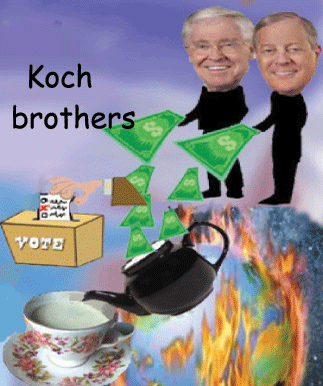 Tea party Republicans are biggest climate change deniers, new Pew poll finds WP, BY JULIET EILPERIN AND SCOTT CLEMENT November 1 Tea party Republicans are now the only group of Americans who think the Earth is not warming, according to a new poll by the Pew Research Center, with just 25 percent of tea party Republicans saying global warming is happening. By contrast, 67 percent of all Americans say there is evidence climate change is underway, including 61 percent of non-tea party Republicans.
Democrats and independents are more confident about global warming: 88 percent of Democrats and 62 percent of independents say there is solid evidence climate change has taken place over the past few decades.
Despite broad belief in warming overall, fewer than half the public believes human activity is to blame (44 percent), a number hardly changed from last year (42 percent). That’s despite a significant rise in the share of Americans who believe scientists generally agree the Earth is getting warmer because of human activity, from 45 percent last year to 54 percent now…….http://www.washingtonpost.com/blogs/the-fix/wp/2013/11/01/only-tea-party-members-believe-climate-change-is-not-happening-new-pew-poll-finds/?tid=hpModule_ba0d4c2a-86a2-11e2-9d71-f0feafdd1394
Lawmaker tells Japan’s Emperor the truth about Children affected by Fukushima radiation
Lawmaker warns emperor of reality facing Japan: “Children are suffering from health problems” — Another official reveals “the incidence of cancer in children has been increasing” and is heckled (VIDEO) http://enenews.com/lawmaker-warns-emperor-of-reality-facing-japan-children-are-suffering-from-health-problems-another-official-reveals-the-incidence-of-cancer-in-children-has-been-increasing-and-is-heckled
Kyodo News, Nov. 1, 2013: “I wrote the letter because I wanted the emperor to know the situation of children who have suffered from radiation exposure, the appalling labor conditions for workers at the nuclear plant, and the poor way radiation (exposure) is being managed,” [Japanese lawmaker Taro] Yamamoto said. When the emperor came near him, Yamamoto expressed fear that the children are suffering from health problems, saying, “The future of the children is in danger” and gave the letter to the emperor […]
Asahi Shimbun, Nov. 1, 2013: “I, as an individual, only wanted to tell the emperor the truth about the health hazard posed to children and the workers who are exposed to radiation and being abandoned” […] “I wanted to explain the plight of children exposed to radiation […] From a common sense point of view, handing a letter to His Majesty may be rude. However, even though it is, I could not contain my desire to have him understand what is happening,” the lawmaker said.
Asahi Shimbun, Nov. 2, 2013: “I wanted to explain the plight of children exposed to radiation released after the nuclear accident and the health condition of people who are working at the facility in the worst conditions”
Reuters, Nov. 1, 2013: “I wanted him to know about the children who have been contaminated by radiation”
Jiji Press,, Nov. 2, 2013: […] he wanted to inform the Emperor of the real situation facing the nation following the March 2011 nuclear crisis […]
Watch footage of Yamamoto handing the letter to the emperor here
MP Katsumasa Suzuki, Oct. 17, 2013: “In Fukushima, the incidence of cancer in children there has been increasing.” Watch Suzuki’s speech at the Diet here
UK’s subsidy to nuclear providers will hit British consumers hard
With the guaranteed price already well above what solar and wind power cost (and their costs continuously declining), the taxpayer commitment for this power plant is so crazily high that it seems this story should be coming from The Onion rather than reality.
 The UK’s move to subsidize nuclear power to such an insane degree is simply astonishing.
Hinkley C Nuclear Power Plant To Get Twice The Rate As Solar PV From UK Government Clean Technica 30 Oct 13, In a demonstration of how out of touch the UK government is with public opinion, it intends to pay approximately twice as much for electricity from the proposed Hinkley C nuclear power plant near Bristol than is paid for electricity from solar power in Europe. With high public support for solar PV and low support for nuclear, that’s quite absurd. It’s also very absurd from an economic standpoint.
Dr David Toke of the University of Aberdeen writes: “Looming large over the UK Government’s EU state aid application for Hinkley C is the charge that this deal will distort the EU’s internal market, in particular to undercut solar pv arrays in Germany over 10 MW in size. Such arrays are no longer eligible to receive premium prices under the German feed-in tariff system. Such plant will only receive the wholesale electricity price, which is less than half the rates to be paid to Hinkley C.” Continue reading
Tepco’s ‘institutionalized lying’ might prevent restart of huge nuclear power plant
 TEPCO must address ‘institutionalized lying’ before it restarts world’s biggest nuclear power plant – governor Rt.com October 28, 2013 Tokyo Electric Power Co must give a more thorough account of the Fukushima disaster and address “institutionalized lying” in the company, before it will be permitted to restart the Kashiwazaki Kariwa plant, according to a local governor.
“If they don’t do what needs to be done, if they keep skimping on costs and manipulating information, they can never be trusted,” Niigata Prefecture Governor Hirohiko Izumida told Reuters on Monday, adding that these limitations need to be overcome before the plant is restarted. It is up to Izumida to approve plans to restart the reactor at the TEPCO-run Kashiwazaki Kariwa – the world’s biggest nuclear complex, located on the Japan sea coast, north-west of Tokyo. His personal commission would examine both the causes and handling of the disaster at Fukushima and lay them alongside existing regulatory safeguards to ensure a similar crisis could not reoccur.
If Japanese nuclear safety regulators do lend their approval to the restart plans, Izumida remains able to essentially block TEPCO’s plans for the plant as the facility requires the backing of local officials, allotting Izumida some leverage. …….
Izumida suggested that TEPCO should be fully stripped of responsibility for decommissioning the destroyed Fukushima reactors, and the company subjected to a taxpayer-funded bankruptcy program. Presently, the company remains primarily concerned with funding the process, along with the frequently-occurring and very immediate issue of contaminated water leaking rather than overall nuclear safety.
“Unless we create a situation where 80-90 percent of their thinking is devoted to nuclear safety, I don’t think we can say they have prioritized safety,” he said. ……..
In September, a senior utility expert at Fukushima, Kazuhiko Yamashita, said that the plant was “not under control.” TEPCO downplayed his comments, saying that he had only been talking about the plant’s waste water problem – not the facility as a whole. … http://rt.com/news/tepco-address-lying-governor-879/
Niigata Prefecture Governor not ready to allow Tepco to restart world’s biggest nuclear plant
Tepco can’t yet be trusted to restart world’s biggest nuclear plant: governor (Reuters) 28 Oct 13,– Tokyo Electric Power Co must give a fuller account of the Fukushima disaster and address its “institutionalized lying” before it can expect to restart another nuclear station, the world’s largest, said a local government official who holds an effective veto over the utility’s revival plan.
“If they don’t do what needs to be done, if they keep skimping on costs and manipulating information, they can never be trusted,” Niigata Prefecture Governor Hirohiko Izumida told Reuters in an interview on Monday.
Izumida must approve the embattled utility’s plans to restart the reactors at Kashiwazaki Kariwa, the world’s biggest nuclear complex on the Japan Sea coast some 300 kms (180 miles) northwest of Tokyo.
A former economy and trade ministry bureaucrat who has emerged as a leading critic of Tokyo Electric, or Tepco, Izumida said he would launch his own commission to investigate the causes and handling of the Fukushima crisis and whether strengthened regulatory safeguards were sufficient to prevent a similar disaster.
Izumida, 51, declined to provide a timetable for completing that review – a process that could force the utility to scrap or abandon one of the key assumptions behind its turnaround plan…….http://www.reuters.com/article/2013/10/28/us-japan-nuclear-tepco-idUSBRE99R0KR20131028
Damian Carrington on UK’s new nuclear delusional dream

The nuclear industry has captured the government as comprehensively as the big six energy companies have captured the domestic energy market. Don’t forget that just 48 hours after the Fukushima catastrophe, government officials were working with the industry to play down the terrible events – before they had even unfolded.
Nuclear power’s broken promises means EDF deal is a delusional dream http://www.theguardian.com/environment/damian-carrington-blog/2013/oct/21/nuclear-power-energy-edf-deal The cost of nuclear energy has tripled in just five years, while the cost of renewable energy is falling fast, making the UK government’s deal a truly terrible one Energy efficiency is cheapest and the cost of renewable energy is falling. In contrast, gas prices have risen by 50% in five years and the cost of nuclear energy has trebled since 2008. Yet the UK government today staked a large part of the nation’s energy future on the latter, by agreeing a deal with EDF which might lead to them building a new nuclear power station. Ministers have not backed the favourite, or even a speedy but erratic outsider: they have backed a horse running in reverse.
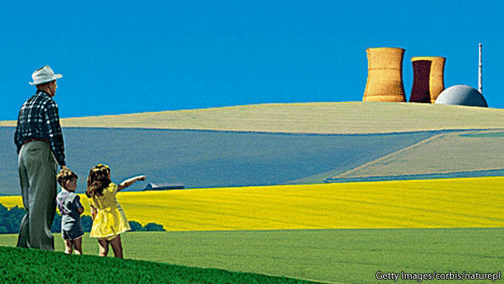
The 60-year history of the nuclear industry is one unblemished by promises kept. From “too cheap to meter” to safe as houses, every pledge has been broken. When the UK government once again fell for the renewed vows of the nuclear industry in 2008, they were promised reactors would cost £2.8bn to build. Today’s deal shows the cost is now £8bn. They were promised electricity for £31-42 per megawatt-hour: today’s price is £92.50/MWh.
The trashed guarantees stack up as steadily as the toxic waste pile that already costs billions a year to store. In 2007, David Cameron said: “The problems of nuclear waste have to be dealt with to make any new investment possible.” In January 2013, Cumbria, the only place in the running for a permanent disposal site rejected the idea.
The government pledge that the private sector would build the new reactors has collapsed too: EDF is owned by the French state and can only move ahead itself with about 40% of the money stumped up by China.
The final crushed commitment comes from the 2010 coalition agreement: New nuclear power stations “will receive no public subsidy”. If forcing energy consumers to pay roughly £38bn above the current cost of electricity is not a subsidy, what is? If a government package of insurance against accidents and loan guarantees is not a subsidy, what is?
This farrago of fictions matters. EDF and the government say the deal protects the public against the near-certainty of broken promises on costs. But read the small print: “The strike price could be adjusted, upwards or downwards, in relation to operational and certain other costs.” Perhaps the government could bail out of the deal if the costs soared? No: “Hinkley Point C would be protected from being curtailed without appropriate compensation.” If new risks came to light increasing the cost of insurance, could we get out then? No: “Protection would be provided for any increases in nuclear insurance costs as a result of withdrawal of government cover.” No wonder opponents are terrified by the lack of any independent scrutiny to date of the deal struck by the government. Continue reading
UK government heavily subsidises new nuclear power project
Critics say the new plant in Somerset will be heavily subsidised and cushioned from financial reality
- The signing of a nuclear deal between EDF and the government is a landmark event for power generation. Today’s go-ahead for the Hinkley Point C plant shows ministers are prepared to commit Britain to provide decades of guaranteed financial returns (paid for by you and me as energy users) to companies in return for winning huge slugs of investment for new power stations…..
- Ministers insist that the commitment to provide Hinkley Point with a guaranteed price of around double the market rate is not a subsidy. The final figure of £92.50 is a considerable step up from the £80 per MWhr said to be on the table when negotiations began in earnest, and that figure is said by some calculations to be worth around £80bn in guaranteed revenues, the cost of nine Olympics.
- Critics will accuse the government of providing subsidies to an old technology that should not need handouts, while pointing out the safety dangers and the unsolved waste disposal problems raised by new nuclear. Questions will also be asked about the wisdom of providing a country alleged to be involved in cyber-spying, access to sensitive energy infrastructure via the involvement of a state-owned firm……..
- Supporters of nuclear in Britain were keen to ensure that an existing industry – that arguably first started here and had operated largely trouble free since the 1950s – could gain a new lease of life. The expectations of Blair and others in the early days have been fulfilled then, even after the Fukushima accident in Japan – but only in principle. In practice, new nuclear was meant to be built by the private sector, without subsidy and only after a solution was found about where to store high-level nuclear waste.
- A decision on which community would be willing to host a deep-level waste repository is as far away as ever after plans for the north west were scotched by Cumbria County Council. The new plant in Somerset will be owned, built and operated by EDF – 85% owned by the French state – with the help of China General Nuclear Power Group, which is 100% owned by the Beijing government. It will be capable of generating 3,200 MW, around one seventh of UK needs, compared to say the London Array off the coast of Kent, the world’s biggest wind farm, which has a maximum capacity of 1,000 MW.
- The subsidy levels for onshore wind (£100 per MWhr) is close to that for the new Hinkley Point plant and much higher for offshore wind (£150). But these figures are set to fall. Craig Bennett, director of policy at Friends of the Earth, said it was astonishing that the government was planning such a long-term subsidy for foreign nuclear operators. “This is just another big bailout. Its an unbelievable wasted opportunity to spend this money in this way when the UK itself is an acknowledged leader in energy efficiency. Why give subsidies to an industry where we are not the leader any more?” he said.
Other supporters of renewable energy point out that public support is needed because these are new technologies which are coming down in price all the time. Nuclear cannot claim either, they say, and there are still questions on whether the European Commission will accept these payments.
The government has also already committed itself to providing financial guarantees of £10bn to cover the building of Hinkley Point, something not available to builders of solar or wind arrays.
Even Nick Butler, a former energy adviser to No 10 and a supporter of nuclear, believes the price is far too high. In a recent blog he warned: “Lower sources of power are available and have been rejected. When deals do not match the interests of both sides – producers and consumers – at a point of mutual advantage, they tend to unravel.”…..http://www.theguardian.com/environment/2013/oct/21/china-nuclear-power-britain-outdated-technology
Ontario govt has no idea of the costs of refurbishing nuclear reactors
Ontario Liberals flying blind on nuclear reactor file, NDP says CBC News 23 Oct 13, Horwath charges Liberals ‘haven’t learned’ from $1.1-billion gas-plant fiasco The Canadian Press Oct 23, 2013 The provincial Liberal government “learned nothing” from the $1.1-billion cost of killing two gas plants and is ready to refurbish nuclear reactors without knowing the final price, NDP Leader Andrea Horwath charged Wednesday.
‘Apparently the sky is the limit when it comes to the price’ –NDP Leader Andrea Horwath on proposed nuclear refurbishments
The Liberals recently abandoned plans to build two new nuclear reactors, after spending $180 million in preparatory work, but said they would refurbish existing reactors at the Darlington power station east of Toronto to extend their service life until 2055.
“The procurement for it is going to take place in stages, and the final cost is not known at this particular point in time,” Energy Minister Bob Chiarelli said.
The NDP released a statement from the Ministry of Energy showing “a final timeline and cost will not be known until the regulatory and technical scope is determined” and contracts are signed, sometime in
Check out CBC’s special report on electricity in Canada, including this profile of power in Ontario.
“We were shocked when the minister responded to our request by saying, ‘We’re spending $950 million on contracts we’ve already signed but we can’t tell you what the final cost is going to be,’ ” Horwath said. “That is frightening.”
It’s hard to believe the Liberals are prepared to waste more money on the electricity file after the auditor general reported the costs of their decisions to cancel gas plants in Oakville and Mississauga could top $1.1 billion, added Horwath….. http://www.cbc.ca/news/canada/toronto/ontario-liberals-flying-blind-on-nuclear-reactor-file-ndp-says-1.2187519
European Union studying UK nuclear deal
EU to examine govt aid for UK nuclear deal France 24 22 Oct 13 AFP – The European Commission said Tuesday it would examine British government support for a massive 19-billion-euro nuclear plant to be built by French and Chinese firms…….
Colombani said the Commission would shortly update its guidelines covering state aid for the energy market in general.
These “will not include specific guidelines as concerns nuclear power,” he said, and will instead feature “case-by-case assessments.”
The deal has angered anti-nuclear activists.
“Instead of subsidising nuclear energy production, the government should be investing more in safe, clean and affordable renewable energy,” said Kate Hudson, general secretary of the Campaign for Nuclear Disarmament (CND).
The EU is divided over the future of nuclear energy, with some member states even arguing that it should be considered as a renewable. http://www.france24.com/en/20131022-eu-examine-govt-aid-uk-nuclear-deal
Iran pauses uranium enrichment
Iran temporarily halts 20% uranium enrichment: Tehran (AFP) – 7 News 24 Oct 13 Iran has temporarily halted its production of enriched uranium to 20 percent purity as it has sufficient stocks to fuel its Tehran research reactor, a lawmaker was quoted Thursday as saying.
“There is no production at all … as right now there is no need for the production of 20 percent (enriched) uranium,” the parliament website reported conservative MP Hossein Naqavi Hosseini as saying.
Iran’s nuclear enrichment programme is at the core of its dispute with world powers, who suspect it masks a drive for atomic weapons despite repeated denials by the Islamic republic….. Demands that the programme be halted were again put forward earlier this year in the Kazakh city of Almaty, in talks between Iran and the P5+1 group — the United States, Britain, France, China and Russia plus Germany.
The halting of the sensitive work could be crucial in resolving the long-running showdown in the negotiations, which were revived last week in Geneva and are set to resume in November.
In the talks, Iran is seeking the lifting of international sanctions which have damaged its struggling economy. World powers for their part are seeking to ensure that Tehran is not able to develop nuclear weapons. http://au.news.yahoo.com/a/19538233/iran-temporarily-halts-20-uranium-enrichment-report/
Japanese govt considering putting all nuclear reactors into one company
Nuclear industry amalgamation mulled LDP examining idea to bring all reactors under one company, Japan Times, 23 Oct 2013. BLOOMBERG The government is discussing a radical overhaul of the nuclear power sector that would combine the nation’s 50 operating reactors into a single company to rebuild an industry that’s been effectively halted by the Fukushima disaster that started in March 2011.
The company would be owned by the nine regional utilities, along with wholesalers Japan Atomic Power Co. and Electric Power Development Co., while the government and reactor makers would give financial and technical support, Taku Yamamoto, who chairs the Liberal Democratic Party’s energy committee, said in an interview.
Part of the profit from sales of the new company’s electricity would be funneled toward the cleanup of the Fukushima No. 1 power plant and victim compensation, which combined may cost more than ¥11 trillion. The plan would keep Tokyo Electric Power Co. alive to shoulder Fukushima costs……
None of the idled reactors may be restarted by the end of March 31, as preparations by power companies for the Nuclear Regulation Authority’s safety review are behind schedule, the Sankei Shimbun reported Monday.
LDP lawmakers have discussed other options to restructure Tepco. Tadamori Oshima, head of the party’s 2011 quake reconstruction task force, proposed to Prime Minister Shinzo Abe that Tepco form a separate company to deal with decommissioning Fukushima No. 1 and the government provide financial aid, Kyodo News reported Sept. 21.
The Abe administration is seeking the Diet’s endorsementthis month for a bill designed to end the 60-year-old monopolies of the regional utilities, led by Tepco.
The other entities — which like Tepco dominate electricity generation and transmission in their respective regions — are Hokkaido Electric Power Co., Tohoku Electric Power Co., Chubu Electric Power Co., Kansai Electric, Hokuriku Electric Power Co., Chugoku Electric Power Co., Shikoku Electric Power Co. and Kyushu Electric Power Co.
The draft bill would unbundle generation and transmission operations and allow households to choose power suppliers for the first time. In theory, 60 percent of the electricity market has been deregulated, though in practice the dominance of the regional utilities stands in the way…… http://www.japantimes.co.jp/news/2013/10/23/business/ldp-mulls-amalgamating-all-nuclear-plants-under-one-firm/#.UmnhNnBwo7o
Even George Monbiot condemns UK government’s new nuclear power plan
The farce of the Hinkley C nuclear reactor will haunt Britain for decades The Guardian, George Monbiot, Monday 21 October 2013 “………… the government has plumped for outdated technology at the worst price imaginable “…..Nils Pratley warned in the Guardian last week that “if Hinkley Point’s entire output is tied to the rate of inflation for 40 years, we could be staring at a truly astronomical cost by the end of the contract.” The City analyst he consulted reassured him that “the government surely can’t be that dumb”. Oh yes? Payment to the operators, the government now tells us, will be “fully indexed to the consumer prices index”. Guaranteed income for corporations, risk assumed by the taxpayer: this deal looks as bad as any private finance initiative contract.
That’s not the only respect in which the price is too high. A fundamental principle of all development is that we should know how the story ends. In this case no one has the faintest idea. Cumbria – the only local authority which seemed prepared to accept a dump for the nuclear waste from past and future schemes – rejected the proposal in January. No one should commission a mess without a plan for clearing it up….
1 This Month
23-25 October – on Zoom – World BEYOND War’s annual global conferenc


Shut down the radiation-damaged Heysham nuclear reactors now
To see nuclear-related stories in greater depth and intensity – go to https://nuclearinformation.wordpress.com

Say No to NASA’s Reckless Nuclear Reactor on the Moon
Say No to NASA’s Reckless Nuclear Reactor on the Moon
-
Archives
- October 2026 (180)
- September 2026 (339)
- August 2026 (330)
- July 2026 (355)
- June 2026 (287)
- May 2026 (306)
- April 2026 (356)
- March 2026 (251)
- February 2026 (267)
- January 2026 (308)
- December 2025 (358)
- November 2025 (359)
-
Categories
- 1
- 1 NUCLEAR ISSUES
- business and costs
- climate change
- culture and arts
- ENERGY
- environment
- health
- history
- indigenous issues
- Legal
- marketing of nuclear
- media
- opposition to nuclear
- PERSONAL STORIES
- politics
- politics international
- Religion and ethics
- safety
- secrets,lies and civil liberties
- spinbuster
- technology
- Uranium
- wastes
- weapons and war
- Women
- 2 WORLD
- ACTION
- AFRICA
- Atrocities
- AUSTRALIA
- Christina's notes
- Christina's themes
- culture and arts
- Events
- Fuk 2022
- Fuk 2023
- Fukushima 2017
- Fukushima 2018
- fukushima 2019
- Fukushima 2020
- Fukushima 2021
- general
- global warming
- Humour (God we need it)
- Nuclear
- RARE EARTHS
- Reference
- resources – print
- Resources -audiovicual
- Weekly Newsletter
- World
- World Nuclear
- YouTube
-
RSS
Entries RSS
Comments RSS

