Japan’s nuclear regime slides towards fascism
 Japan’s New ‘Fukushima Fascism’ Eco Watch, 12 Dec 13, Harvey Wasserman Fukushima continues to spew out radiation. The quantities seem to be rising, as do the impacts.
The site has been infiltrated by organized crime. There are horrifying signs of ecological disaster in the Pacific and human health impacts in the U.S.
But within Japan, a new State Secrets Act makes such talk punishable by up to ten years in prison.
 Taro Yamamoto, a Japanese legislator, says the law “represents a coup d’etat” leading to “the recreation of a fascist state.” The powerful Asahi Shimbun newspaper compares it to “conspiracy” laws passed by totalitarian Japan in the lead-up to Pearl Harbor, and warns it could end independent reporting on Fukushima.
Prime Minister Shinzo Abe has been leading Japan in an increasingly militaristic direction. Tensions have increased with China. Massive demonstrations have been renounced with talk of “treason.”
But it’s Fukushima that hangs most heavily over the nation and the world.
 Tokyo Electric Power has begun the bring-down of hot fuel rods suspended high in the air over the heavily damaged Unit Four. The first assemblies it removed may have contained unused rods. The second may have been extremely radioactive.
But Tepco has clamped down on media coverage and complains about news helicopters filming the fuel rod removal.
 Under the new State Secrets Act, the government could ban—and arrest—all independent media under any conditions at Fukushima, throwing a shroud of darkness over a disaster that threatens us all.
By all accounts, whatever clean-up is possible will span decades. The town of Fairfax, CA, has now called for a global takeover at Fukushima. More than 150,000 signees have asked the UN for such intervention.
As a private corporation, Tepco is geared to cut corners, slash wages and turn the clean-up into a private profit center.
 It will have ample opportunity. The fuel pool at Unit Four poses huge dangers that could take years to sort out. But so do the ones at Units One, Two and Three. The site overall is littered with thousands of intensely radioactive rods and other materials whose potential fallout is thousands of times greater than what hit Hiroshima in 1945.
Soon after the accident, Tepco slashed the Fukushima workforce. It has since restored some of it, but has cut wages. Shady contractors  shuttle in hundreds of untrained laborers to work in horrific conditions. Reuters says the site is heaving infiltrated by organized crime, raising the specter of stolen radioactive materials for dirty bombs and more.
Thousands of tons of radioactive water now sit in leaky tanks built by temporary workers who warn of their shoddy construction. They are sure to collapse with a strong earthquake.
Tepco says it may just dump the excess water into the Pacific anyway. Nuclear expert Arjun Makhijani has advocated the water be stored in supertankers until it can be treated, but the suggestion 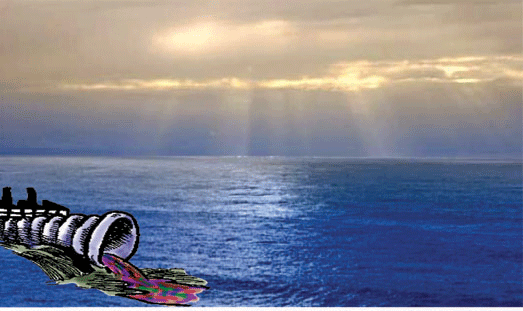 has been ignored.
Hundreds of tons of water also flow daily from the mountains through the contaminated site and into the Pacific. Nuclear engineer Arnie Gundersen long ago asked Tepco to dig a trench filled with absorbents to divert that flow. But he was told that would cost too much money.
 Now Tepco wants to install a wall of ice. But that can’t be built for at least two years. It’s unclear where the energy to keep the wall frozen will come from, or if it would work at all.
Meanwhile, radiation is now reaching record levels in both the air and water.
The fallout has been already been detected off the coast of Alaska. It will cycle down along the west coast of Canada and the U.S. to northern Mexico by the end of 2014. Massive disappearances of sea lion pups, sardines, salmon, killer whales and other marine life are being reported, along with a terrifying mass disintegration of star fish. One sailor has documented a massive “dead zone” out 2,000 miles from Fukushima. Impacts on humans have already been documented in California and elsewhere.
Without global intervention, long-lived isotopes from Fukushima will continue to pour into the biosphere for decades to come.
 The only power now being produced at Fukushima comes from a massive new windmill just recently installed offshore.
Amidst a disaster it can’t handle, the Japanese government is still pushing to re-open the 50 reactors forced shut since the melt-downs. It wants to avoid public fallout amidst a terrified population, and on the 2020 Olympics, scheduled for a Tokyo region now laced with radioactive hot spots. At least one on-site camera has stopped functioning. The government has also apparently stopped helicopter-based radiation monitoring.
A year ago a Japanese professor was detained 20 days without trial for speaking out against the open-air incineration of radioactive waste.
Now Prime Minister Abe can do far worse. The Times of India reports that the State Secrets Act is unpopular, and that Abe’s approval ratings have dropped with its passage.
 But the new law may make Japan’s democracy a relic of its pre-Fukushima past.
It’s the cancerous mark of a nuclear regime bound to control all knowledge of a lethal global catastrophe now ceaselessly escalating.
Visit EcoWatch’s NUCLEAR page for more related news on this topic.
South Korea cutting back on nuclear expansion plans

 S. Korea scales back nuclear expansion plans The West Australian, 11 Dec 13, Seoul (AFP) – South Korea is scaling back its commitment to nuclear energy after safety concerns prompted a series of reactor shutdowns, officials said Tuesday……The Ministry of Trade, Industry and Energy said it has accepted recommendations from a government advisory group in September to scale back the nuclear expansion plans…..
Safety concerns that were already high in the wake of the 2011 Fukushima crisis in Japan have been heightened by revelations of widespread corruption and faulty equipment.
Nuclear reactors have been abruptly shut down 128 times over the past decade because of malfunctioning parts, officials admitted in October. Public prosecutors have charged about 100 people after discovering that documents relating to some parts in 20 working reactors, and eight under construction, had been forged…….http://au.news.yahoo.com/thewest/world/a/20257649/s-korea-scales-back-nuclear-expansion-plans/
Japan’s state secrets law criminalises investigative journalism

 Japan enacts state secrets law late Friday night amid revolt — “It criminalizes investigative journalism” — Terrorism defined as “imposing one’s opinions on others”http://enenews.com/secrets-law-passes-late-friday-night-amid-revolt-mushrooming-opposition-it-criminalizes-investigative-journalism-terrorism-defined-as-imposing-ones-opinions-on-others-protesto
Japan Times, , Dec. 6, 2013: Following political turmoil that rocked the Diet over the past week, ruling block Upper House members finally enacted the contentious state secrets bill late Friday night. Earlier in the day, opposition parties intensified their protests in vain over a law that’s being criticizing for not creating an independent oversight body capable of preventing the government from hiding inconvenient information at its discretion.
Businessweek, Dec. 6, 2013: Prime Minister Shinzo Abe secured final passage of a bill granting Japan’s government sweeping powers to declare state secrets, a measure aimed at shoring up defense ties with the U.S. that prompted a public backlash and revolt by the opposition.
Asahi Shimbun, , Dec. 6, 2013: Kazuo Shii, chief of the Japanese Communist Party, described the ruling coalition’s behavior as “tyrannical, arrogant and disorderly.” The ruling coalition believed prolonging the Diet debate any longer could backfire, only fueling the mushrooming opposition to the bill, and lead to a further decline in approval ratings for Abe’s Cabinet and hold on power. An Asahi Shimbun survey taken between Nov. 30-Dec. 1 showed the Cabinet’s approval rating at 49 percent, dipping below 50 percent for the first time since he took power in December 2012. Officials in the Abe administration foresee the public eventually forgetting about the controversy, once the legislation is approved.
GlobalPost,, Dec. 6, 2013: Here are four disturbing ways the bill could be a democracy muzzler. It defines terrorism as imposing one’s opinions on others […] According to Article 12, terrorism is partially defined as an activity that forces “political and other principles or opinions on the state or other people.” In other words, throw up a rowdy anti-government protest, and the judiciary can find a reason to lock you away. It criminalizes investigative journalism […] Journalists can be prosecuted for “improperly accessing” classified documents or “conspiring” to leak them. Even asking an official to take a look at classified documents could constitute “conspiracy,” leading to up to five years in prison. “Instigating” the release of government secrets, meanwhile, carries up to 10 years in the dock. […] Basically, anything can be a secret […] administrators can make the opaque decisions to classify a document even if their work hardly relates to national security. That effectively allows them to hide any embarrassing piece of evidence, and then pursue the journalists and bloggers who make it public. […]
Plan for Fukushima nuclear plant to get UK style decommissioning agency
Japan may set up UK-style decommission agency for Fukushima plant BY YOSHIFUMI TAKEMOTO TOKYO Thu Dec 5, 2013 (Reuters) – Japan’s ruling party could set up a British-style agency to shut down the wrecked Fukushima nuclear plant, taking control of a project now managed by the station’s embattled operator, a senior party policymaker said on Thursday…… Tepco, de facto nationalized after 2011, is still responsible for the ambitious decommissioning of the plant as well as for paying compensation to evacuees and cleaning up affected areas.
A plan to set up a decommissioning agency is controversial as it would reduce Tepco’s responsibility and increase the burden on taxpayers.
Prime Minister Shinzo Abe has so far pledged half a billion dollars in government funds to help stem the flow of contaminated water at the plant after a highly radioactive water leak in August triggered international alarm………http://in.reuters.com/article/2013/12/05/us-japan-fukushima-ldp-idINBRE9B407C20131205
Call for a priority removal of Florida’s nuclear ‘advance fee’
 AARP seeks repeal of nuclear ‘advance fee’ as a priority in 2014 Ivan Penn, Tampa Bay Times, 9 Dec 13 In its December newsletter, the AARP pledged that one of its 2014 legislative goals is the repeal of the state law that allows utilities to charge customers in advance for new nuclear projects.
AARP said it is backing a small but growing coalition of lawmakers who believe the law is an unfair tax on consumers who may get nothing from the charges. The Nuclear Cost Recovery Clause or so-called “advance fee” has been a growing point of contention since Duke Energy and Florida Power & Light began using the statute for proposed nuclear plants that may never get built.
In August, Duke canceled its proposed project in Levy County after running up $1.5 billion in costs that customers still must pay. In addition, the utility spent hundreds of millions as part of the failed upgrade of the Crystal River nuclear plant that permanently closed in February……http://www.tampabay.com/news/business/energy/aarp-seeks-repeal-of-nuclear-advance-fee-as-a-priority-in-2014/2156258
EU probe into Britain’s nuclear subsidy could take until 2020
 EU state aid probe likely over British plan for EDF nuclear plant 7 News, December 3, 2013, By Barbara Lewis and Foo Yun Chee BRUSSELS (Reuters) – EU regulators are likely to open a formal investigation into whether Britain’s offer of state guarantees, to help finance a nuclear plant to be built by France’s EDF , conform with the bloc’s rules, its competition commissioner said on Monday.
Britain in October signed a deal with EDF to build a nuclear plant at Hinkley Point in southwest England and became the first European country to offer a guaranteed power price over 35 years for a new nuclear project.
“Two to three weeks ago we received notification from the UK,” EU Competition Commissioner Joaquin Almunia told a Brussels conference organised by Eurelectric, which represents the EU electricity industry.
“We are starting to analyse what is in the British proposal. Probably we will open a formal investigation because many people are asking the same question as you do,” he said when asked whether the British proposal for 35 years of a guaranteed energy price was too long under the terms of EU rules on state aid………The Commission is revising its state aid guidelines and is expected to finalise the rules for 2014-2020 next year.
It has said they will not specifically include nuclear energy, dealing another blow to Britain’s hopes of early certainty. Instead, each project will be assessed on its own merits………http://au.news.yahoo.com/world/a/20120325/eu-state-aid-probe-likely-over-british-plan-for-edf-nuclear-plant/
Inconvenient questions in Parliament about Sellafield’s £70bn clean-up costs
 Talk of building a new mixed-oxide (Mox) fuel reprocessing plant has been undermined by a report out this summer that concluded a previous Mox facility, which closed two years ago, had left taxpayers with a £2.2bn bill rather than the healthy profit that had been promised when it was first constructed.
Sellafield executives to face MPs as nuclear clean-up bill rises over £70bn http://www.theguardian.com/environment/2013/dec/01/sellafield-nuclear-clean-up-cost-rises Public accounts committee to scrutinise private consortium accused of spending cash ‘like confetti’ Terry Macalister The Guardian, Monday 2 December 2013 The bill for cleaning up the huge Sellafield nuclear plant in Cumbria will rise even higher than its current estimated level of £70bn as operators struggle to assess the full scale of the task, according to sources close to the project.
The warning comes just days before private sector managers face a grilling from the public accounts committee, which is investigating activities at the facility.
It was hoped that the huge bill – eight times the cost of staging the London Olympics – would be capped at £70bn, but well-placed sources have told the Guardian that the operators are convinced they are still “not at the top” of the cost curve.
Sellafield is regarded as the most dangerous and polluted industrial site in western Europe, not least because it houses 120 tonnes of plutonium, the largest civilian stockpile in the world.
The cost of decommissioning the Calder Hall reactor plus a magnox fuel reprocessing plant at Sellafield has been rising steeply, but the biggest task comes from “ponds” and “silos” filled with old equipment and deteriorating, highly toxic waste. Continue reading
The road to fascism – Japan’s new secrecy law
Secrecy law approved in Japan — AP: Prison for ‘inappropriate reporting’ — Official: We’re on path to be fascist state — Fear Fukushima cover-ups to worsen http://enenews.com/secrecy-law-approved-by-japan-lawmakers-ap-prison-for-inappropriate-reporting-official-were-on-path-to-be-fascist-state-fear-of-more-fukushima-cover-ups
 Associated Press, Nov. 26, 2013: Japan’s more powerful lower house of Parliament approved a state secrecy bill late Tuesday […] Critics say it might sway authorities to withhold more information about nuclear power plants […] The move is welcomed by the United States […] lawyer Hiroyasu Maki said the bill’s definition of secrets is so vague and broad that it could easily be expanded to include radiation data […] Journalists who obtain information “inappropriately” or “wrongfully” can get up to five years in prison, prompting criticism that it would make officials more secretive and intimidate the media. Attempted leaks or inappropriate reporting, complicity or solicitation are also considered illegal. […] Japan’s proposed law also designates the prime minister as a third-party overseer.
BBC, Nov. 26, 2013: Japan approves new state secrecy bill to combat leaks […] The bill now goes to the upper house, where it is also likely to be passed.
The Australian, Nov. 25, 2013: Japanese press baulks at push for ‘fascist’ secrecy laws Continue reading
Japan opposition parties fail [fulfill?] their duty
Scotland independence: Lizzie Windsor can stay – nukes gotta go
 Independent Scotland would keep queen, dump nuclear deterrent
Yahoo 7 News November 27, 2013,Glasgow (AFP) – An independent Scotland would keep the pound and the British monarchy but establish its own defence force, First Minister Alex Salmond said Tuesday as he unveiled detailed proposals ahead of next year’s referendum……In a key commitment, the blueprint says an independent Scotland would no longer host Britain’s Trident nuclear missile deterrent…….http://au.news.yahoo.com/world/a/20030691/independent-scotland-would-keep-queen-dump-nuclear-deterrent/
UK government turning its back on renewable energy industries
 David Cameron’s attack on green policies threatens £12bn renewable sector, say Greenpeace, Express, By: Owen Bennett – Political Reporter November 21, 2013 DAVID CAMERON has been accused of risking jobs and investment in the renewable energy sector after reports claimed he had told aides to “get rid of all this green c**p”. It was claimed the Prime Minister was making a major U-turn on environmental issues, and ordering aides to strip out green levies which push up energy bills.
Prior to the 2010 election, Mr Cameron had urged Britain to “vote blue, go green” as he promised to lead the “greenest government ever.”
Downing Street deny the Prime Minister is turning his back on environmentalism, but Greenpeace said the comments show Mr Cameron is trying to claw back support with green sceptics in his party.
Greenpeace’s deputy political director Joss Garman said: “If David Cameron thinks the road to electoral victory will be found in attacking the very policies that he once passionately advocated then he is sorely mistaken.
“The British electorate are a sophisticated bunch who will see through his chameleon tendencies and conclude this attack is not an act of leadership but one of cowardice as he panders to the extreme wing of his own party and tries to claw back support from Ukip.
“The real crime is that every time David Cameron reaches for the dog whistle playbook he undermines thousands of jobs in the green energy sector and threatens future investment. Now that really is crap.” Continue reading
Unlike UK, Sweden will not subsidise new nuclear power
Sweden rejects British model for new nuclear plant deals http://au.news.yahoo.com/world/a/19936540/sweden-rejects-british-model-for-new-nuclear-plant-deals/ November 21, 2013, By Michel Rose PARIS (Reuters) – Sweden, reviving its nuclear power, will not follow Britain’s example of offering state guarantees to fund the construction of new plants, its energy minister said on Wednesday. Last month, Britain signed a deal with France’s EDF to build a new nuclear plant, becoming the first European country to guarantee a company a feed-in tariff for an atomic energy project. Sweden’s biggest power group Vattenfall has touted Britain’s price guarantee system to help companies commit to build new nuclear power plants in a market with low power prices.
“We won’t address any direct or indirect subsidies for new nuclear power production in Sweden, which means that we will not introduce any feed-in tariff for nuclear,” Swedish Energy Minister Anna-Karin Hatt told reporters in Paris. Continue reading
High Alert Time for Japan and nuclear power
 Japan and nuclear power High alert The riskiest part yet of the Fukushima clean-up is soon to begin The Economist, Nov 16th 2013 | FUKUSHIMA AMONG the twisted metal and random debris that litter much of the Fukushima Dai-ichi nuclear power plant, the fourth reactor looks in relatively good condition. A new structure covers the damage from a hydrogen explosion that blew its roof off days after a massive earthquake and tsunami hit the plant in March 2011. But the building is still unstable, and its spent-fuel storage pool highly dangerous. This month Tokyo Electric Power (TEPCO) will start plucking out over 1,500 radioactive rods from the pool in order to store them more safely. Over the pool a crane waits to start the procedure, and a yellow radiation alarm stands at the ready. Experts call the operation the riskiest stage of the plant’s clean-up so far.
Even the pro-nuclear ruling Liberal Democratic Party (LDP) wants to take TEPCO in its current form out of the decommissioning process, which will take 40 or more years. A new entity, including the utility’s staff but separate from its commercial side, would take charge……..Junichiro Koizumi, a popular LDP former prime minister, has stepped in, calling for an immediate end to nuclear power. After he broadcast his views at a press conference, a poll showed that three-fifths of those who were surveyed backed his plan.
Mr Koizumi still knows how to rouse the public, says Jeff Kingston of Temple University in Tokyo, but there is little chance that Mr Abe’s commitment to nuclear power will change. His government’s links to the “nuclear village” are too strong. Big business is clamouring for the power stations to restart. Mr Koizumi’s style is certainly more orthodox than Taro Yamamoto’s. At a garden party, the new member of parliament dared to hand a letter to the emperor, Akihito, about the impact of the Fukushima catastrophe. Such direct contact with a near-divine was considered an outrage by everybody in the establishment (except Akihito, who carried on chatting with him). Japan’s nuclear-energy drama is far from over. http://www.economist.com/news/asia/21589912-riskiest-part-yet-fukushima-clean-up-soon-begin-high-alert
Another $5 billion borrowed by Japan for Fukushima nuclear cleanup
Japan readies additional $30 billion for Fukushima clean-up: sources BY YOSHIFUMI TAKEMOTO TOKYO Tue Nov 12, (Reuters) – Japan’s government is finalizing plans to borrow an additional 3 trillion yen ($30 billion) to pay for compensating Fukushima evacuees and cleaning up the area outside the wrecked nuclear plant, said people with knowledge of the situation.
The additional borrowing would mark both a recognition of the project’s mounting costs and the difficulty of hitting initial targets for reducing radiation levels in the towns and villages hardest hit by the fallout from the worst nuclear accident since Chernobyl.
The new government borrowing program would increase the amount earmarked for Fukushima-related expenses to the equivalent of just over $80 billion, according to government officials with knowledge of the developing plan who asked not to be named.
That $80 billion excludes the cost of decommissioning Fukushima’s six reactors, a process expected to take decades.
The new funding, which is being reviewed as part of the regular budget-setting process, would increase the amount earmarked for paying for work crews to decontaminate Fukushima towns and villages by about $500 million, according to the sources.
The rest of the extra funding raised by the government would be used to defray the cost of creating a storage facility for the radioactive waste, including topsoil and leaves collected from the evacuated zone, and would be available to pay compensation to more than 50,000 nuclear evacuees who remain shut out of their homes more than two and a half years after a massive earthquake and tsunami in March 2011 triggered meltdowns and explosions at the Fukushima plant…… http://in.reuters.com/article/2013/11/12/us-japan-fukushima-borrowing-idINBRE9AB0H520131112
Consortium cleaning up Sellafied radioactive mess has been wildly over-spending
 Sellafield nuclear complex clean-up contract winner criticised on spending Margaret Hodge and KPMG, working for the Nuclear Decommissioning Authority, accuse group of overspending Terry Macalister The Guardian, Saturday 9 November 2013 A five-year extension to the Sellafield nuclear decommissioning contract worth £5bn was handed to a private consortium even though its performance had been fiercely criticised by accountants.
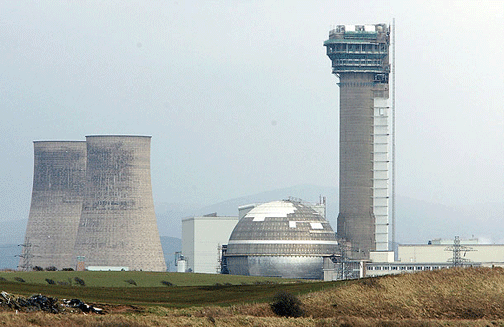 KPMG, working for the Nuclear Decommissioning Authority, accused the clean-up group of overspending, failure to reach operational targets and weak leadership at the atomic complex in Cumbria, according to documents seen by the Guardian.
Margaret Hodge, who chairs the parliament’s public accounts committee, said that in the light of the critical review it was “inexplicable” that the NDA was prepared to reward the Nuclear Management Partners (NMP) consortium for spending cash “like confetti”.
She also complained the critical KPMG report was not shown to her committee or the National Audit Office until the last minute. It had only been sent to the spending watchdogs via a member of the public who conducted a freedom of information request. “But having looked at the report it is inexplicable that the NDA would continue with this consortium after such a hugely critical assessment,” she added.
The NMP decommissioning consortium comprises Areva, the French engineering firm that is also working on the new Hinkley Point power station, in Somerset, which also includes URS of the US and Amec of Britain.
KPMG says it went through 28 out of 154 “bid commitments” at Sellafield and found 30% were deemed fully achieved and 4% partially achieved. KPMG added: “There is still considerable uncertainty in schedules and costs of the projects that account for 26% of annual spending” while the site manager “does not bear risks for delays and cost increases”.
There had been widespread speculation that the consortium would either see the renewal time shortened or be stripped of the work, which would be handed back to the public sector. But the decommissioning authority nevertheless gave the go-ahead to a further five years in October….http://www.theguardian.com/politics/2013/nov/08/sellafield-nuclear-margaret-hodge-kpmg-overspending
1 This Month
23-25 October – on Zoom – World BEYOND War’s annual global conferenc


Shut down the radiation-damaged Heysham nuclear reactors now
To see nuclear-related stories in greater depth and intensity – go to https://nuclearinformation.wordpress.com

Say No to NASA’s Reckless Nuclear Reactor on the Moon
Say No to NASA’s Reckless Nuclear Reactor on the Moon
-
Archives
- October 2026 (180)
- September 2026 (339)
- August 2026 (330)
- July 2026 (355)
- June 2026 (287)
- May 2026 (306)
- April 2026 (356)
- March 2026 (251)
- February 2026 (267)
- January 2026 (308)
- December 2025 (358)
- November 2025 (359)
-
Categories
- 1
- 1 NUCLEAR ISSUES
- business and costs
- climate change
- culture and arts
- ENERGY
- environment
- health
- history
- indigenous issues
- Legal
- marketing of nuclear
- media
- opposition to nuclear
- PERSONAL STORIES
- politics
- politics international
- Religion and ethics
- safety
- secrets,lies and civil liberties
- spinbuster
- technology
- Uranium
- wastes
- weapons and war
- Women
- 2 WORLD
- ACTION
- AFRICA
- Atrocities
- AUSTRALIA
- Christina's notes
- Christina's themes
- culture and arts
- Events
- Fuk 2022
- Fuk 2023
- Fukushima 2017
- Fukushima 2018
- fukushima 2019
- Fukushima 2020
- Fukushima 2021
- general
- global warming
- Humour (God we need it)
- Nuclear
- RARE EARTHS
- Reference
- resources – print
- Resources -audiovicual
- Weekly Newsletter
- World
- World Nuclear
- YouTube
-
RSS
Entries RSS
Comments RSS

