Uncompetitive nuclear industry is rigging regulations and “spinning” media in order to survive
 Killing the Competition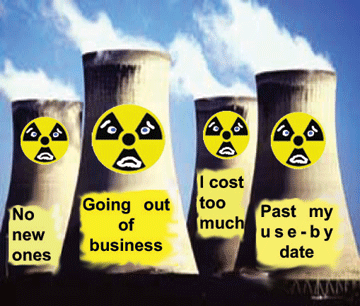
Exelon and Entergy see sustainable energy solutions—renewable energy, efficiency, conservation, etc.—as a long-term threat to
their profits. This is not because of excessive regulations or safety requirements on nuclear power: the industry has not had to implement a single safety upgrade due to the Fukushima meltdowns and faces less regulatory enforcement than it did twenty years ago. The closure of a record number of reactors since 2013 has exposed fundamental economic problems facing the industry, and a growing number of nuclear plants simply cannot compete with modern, efficient, cost-effective
energy resources.
Scotland’s independence movement makes UK’s nuclear Trident programme look unsustainable
in the face of such opposition from Scotland — even in the possible wake of a decided No vote — it will remain difficult for the UK government to continue its absurd and costly pursuit of renewing the Trident nuclear weapons system against the backdrop of international negotiations to ban nuclear weapons.
Britain’s wee nuclear problem, IFP.com Erika Simpson and Bill Kidd, Special to QMI Agency Friday,  September 12, 2014″…..The SNP pledges it will negotiate the removal of the UK’s Trident nuclear weapon system from the Faslane naval base, 40 km from Glasgow. The UK’s four Vanguard submarines are stationed on the Firth of Clyde, a series of rivers, estuaries and sea lochs.
A Yes vote would mean Britain’s 20-billion-pound replacement of the four Trident submarines during the next decade could not go ahead.
It also could mean the UK’s commitment to nuclear weapons would need to be rethought.
The UK government has assumed since 1968 that the Nuclear Non-Proliferation Treaty gives it some kind of right to possess nuclear weapons.
If an independent Scotland fulfills its policy to remove the submarine-based Trident nuclear weapons system from its territory, the UK will need, within four years, to find another stationing location for all its sea-based nuclear warheads, since it costs too much to deploy them at sea for months at a time.
This will be a difficult task, almost as tough as it would be for Vladimir Putin to find another home for Russia’s Black Sea fleet stationed in the Crimean Peninsula.
If the UK wants to maintain its nuclear-armed submarines, it would need to find another deep-water port, preferably on British turf and not on another colony’s territory….. The UK government says other potential locations in England are unacceptable due to their proximity to population centres, although the UK has housed nuclear submarines and loaded nuclear weapons onto them not far from Glasgow since 1969. If Westminster does decide to relocate the weapons, cost estimates vary enormously.
Some argue building a new base would cost merely 2.5 billion to 3.5 billion pounds ($4.47 billion to $6.26 billion), while others say moving the Tridents will cost closer to 50 billion pounds. Certainly, it would be a lot extra for English and Welsh taxpayers to pay for in the wake of their country’s partition and probable economic decline……..
if an independent Scotland decided to join the alliance, it could follow the example of other NATO states such as Canada, Norway and Lithuania, which do not allow nuclear weapons on their soil. Furthermore, if an independent Scotland spearheaded initiatives to establish more international treaties to prohibit nuclear weapons, its approach could have a major impact on other NATO members, despite the inclination to erect a new central front in Europe to protect the Baltic states.
Even if not enough Scots vote Yes to win independence, their voting patterns could provide an opportunity for Britons as a whole to rethink their approach to nuclear weapons. The very high costs of replacing the submarines, coupled with the logistical challenges of relocating the weapons, means there is a strong opportunity to reject the nuclear option, should a Westminster political party adopt such a policy.
For their part, representatives of the SNP are prepared to participate actively in the humanitarian initiative on nuclear weapons and support negotiations on an international treaty to prohibit nuclear weapons, even without the participation of the nuclear-armed states. Such a treaty would make the possession of nuclear weapons unambiguously illegal for all, putting them on the same footing as biological and chemical weapons.
In the face of such opposition from Scotland — even in the possible wake of a decided No vote — it will remain difficult for the UK government to continue its absurd and costly pursuit of renewing the Trident nuclear weapons system against the backdrop of international negotiations to ban nuclear weapons. Scotland’s vote this Thursday could go either way, but it is already sure to push Mother England to overcome her Cold War thinking about security by undermining traditional arguments in favour of maintaining these weapons of mass destruction.
— Bill Kidd is the Scottish Member of Parliament for Glasgow Anniesland and a member of the Scottish National Party, which supports an independent and non-nuclear Scotland.
— Erika Simpson is an associate professor of international relations in the politics department of Western University. http://www.lfpress.com/2014/09/12/britains-wee-nuclear-problem
Obstacles in the way of nuclear restart for Japan’s Sendai reactors
 Seriously? Japan Plans to Restart Nuclear Reactors http://inhabitat.com/seriously-japan-plans-to-restart-nuclear-reactors/ by Colin Payne, 09/10/14 Despite the devastation wreaked by the Fukushima meltdown in 2011, Japan wants to restart two nuclear reactors that were shut off in the wake of the disaster. According to the Guardian, Japan’s nuclear watchdog has said the reactors can be started up again, as long as the operator can convince the local communities they are safe. That might not be an easy task as the Japanese public has been wary of nuclear power since Fukushima, which was the worst atomic disaster since Chernobyl.
Japan’s Nuclear Regulatory Authority (NRA) only gave permission to open the Sendai plant in southern Japan after a 400-page safety report and months of public consultation. Plant operator, Kyushu Electric Power still needs to get two more NRA approvals for other facilities at the plant, as well as the all-important public approval. So it’s unlikely the plants will open until sometime in 2015.
Newly-appointed Japanese Industry Minister, Yuko Obuchi will have to be persuasive to restart the plant, and she acknowledges she has a tough road ahead of her. “If people say they are worried, I think it’s only natural,” she told the Guardian. “If you are a mother, I think it is a kind of feeling that everyone has. The central government must offer a full explanation to these sentiments.” She added that it’s important to earn the “understanding of hosting communities” who might not like nuclear facilities operating in the backyard, despite the new safety rules.
But Greenpeace Japan is campaigning to have the country abandon nuclear power altogether. The organization says the government is ignoring the fact that Japan has done just fine without nuclear power over the past year, and that it favors dangerous nuclear energy over renewable sources. “The government . . . is ignoring the lessons of Fukushima and attempting to prevent the renewable energy revolution, trying to take the nation back to its dependence on dangerous and unreliable nuclear power,” Kazue Suzuki of Greenpeace Japan said in the Guardian.
Closure of uranium mines by State in East Singhbhum
Uranium Corporation stops mining at Jadugora after 47 years B Sridhar,TNN | Sep 8, 2014 JAMSHEDPUR: Uranium Corporation of India stopped all mining activities at Jadugora in East Singhbhum from Sunday after 47 years. following a ministry order in July.
The Centre, following a Supreme Court order in May on amendment of Mineral Concession Rules, 1960, issued a directive to all mineral-rich states on July 12 asking them to stop mining by corporate entities under deemed extension. The state then ordered closure of the decades-old uranium mines. “We have served the notice to UCIL (Uranium Corporation of India) informing the company about the directive of the state government,” said district mining officer Ratnesh Kumar Sinha…….http://timesofindia.indiatimes.com/city/ranchi/Uranium-Corp-stops-mining-at-Jadugora-after-47-years/articleshow/41970997.cms
Japan’s Nuclear Regulator stands firm on need to close reactor sited over earthquake fault
 Regulatory panel in Japan affirms decision that will force decommissioning of Tsuruga reactor, Enformable, Lucas W Hixson, 5 Sept 14
On Thursday, a panel of experts organized by Japan’s Nuclear Regulation Authority (NRA) determined that it will not change its 2013 judgment that an active geologic fault exists under the Unit 2 reactor at the Tsuruga nuclear power plant.
The determination means that the Japan Atomic Power Company (JAPC), the utility which operates the Tsuruga nuclear power plant, will be forced to decommission one of the two reactors at the nuclear site.
During the meeting, officials from the JAPC attempted to present new data, which they said challenged the decision made by NRA, but many experts at the meeting debated the validity and objective nature of the data and the ability of the new findings to support claims made by the utility.
After hearing the panel’s decision, the vice president of Japan Atomic Power demanded more discussion on the issue, but was rebuffed by NRA Commissioner Kunihiko Shimazaki who stated that “Enough scientific debates have been done.”…….
After NRA experts determined that the D-1 fault zone of pebbles and sediments under the Unit 2 reactor is an active fault in May 2013, the JAPC began actively working to change the regulator’s decision, and the meetings between the two parties have been known to be contentious.
The secretariat of the NRA has told reporters that it plans to file a protest with Japan Atomic Power Company over inappropriate and threatening remarks made by Hiroshima University professor Koji Okumura, who is affiliated with the utility……..
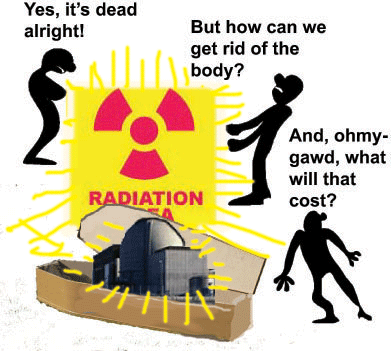 Experts estimate that the costs to decommission a reactor like the Unit 2 reactor at the Tsuruga nuclear site will cost in excess of $650 million.
Japan’s nuclear regulators pushing for permanent closure of aging reactors
 Aging Nuclear Reactors May Close in Japan http://www.scientificamerican.com/article/aging-nuclear-reactors-may-close-in-japan/ TOKYO (Reuters) 5 Sept 14 – Japan will push nuclear operators to draft plans to scrap a quarter of the country’s 48 reactors, which are either too old or too costly to upgrade to meet new standards imposed after the Fukushima disaster, the Nikkei reported on Friday.
The government is betting that by forcing older units considered more vulnerable to disaster to shut down it may gain public support to restart newer units, the Nikkei reported.
North Korea’s Yongbyon may be restarting
 North Korean nuclear reactor may be operational, DW 5 Sept 14 A new report by the United Nations nuclear watchdog says North Korea may be operating a reactor at its main nuclear facility in Yongbyon. The site has previously been associated with the production of nuclear weapons. In the document seen by news agencies on Friday, the International Atomic Energy Agency (IAEA) said it had detected signs the reactor in the country’s north was undergoing tests that suggested it was being prepared for a restart.
The agency said it had “observed, through analysis of satellite imagery, steam discharges and the outflow of cooling water” at the reactor since late August 2013, adding that these were “consistent with the reactor’s operation.”
However, the IAEA stopped short of saying the facility was fully operational, as it has had “no access to the five megawatt reactor since April 2009.” The IAEA relies mainly on satellite images in its assessments of North Korea’s nuclear activities because Pyongyang does not allow the agency’s inspectors into the country………http://www.dw.de/north-korean-nuclear-reactor-may-be-operational/a-17904551
Greenland public becoming aware of disinformation promoting Australian uranium mining company
the people of Greenland are “split down the middle regarding the repeal of the ban.”
Hooge explains that the “mineral authorities” have fed the public disinformation over the last years but the tide may be turning, with growing concerns over environmental effects and the leftist party Inuit Ataqatigiit pledging to roll back the repeal if it wins back power.
The prospect of a relatively unknown Australian company exploiting massive untapped resources in Greenland deserves a robust public and political debate. It has thus far received nothing in Australia, and little in Denmark and Greenland.
In an age of worsening climate change, mining uranium is an arguably unsafe and potentially explosive answer to the problem
Australian uranium mining in Greenland is tearing the country in half jagadees.wordpress.com August 23, 2014 Antony Loewenstein. source theecologist.org
This is a story about an Australian company you’ve never heard of, operating in a nation that rarely enters the global media: Greenland. It’s a story about the intense search for energy sources in a world that’s moving away from the dirtiest fossil fuels.
Aleqa Hammond, the prime minister of Greenland, is the first woman to lead this autonomous country within the Kingdom of Denmark. She also welcomes the financial opportunities from climate change and a melting Arctic Circle……..
In October last year, Hammond pushed legislation through Greenland’s parliament to overturn a 25 year old ban on the extraction of radioactive materials, including uranium, despite countless leading environmental NGOs urging otherwise. Continue reading
The presence of openly Nazi militias attacking ethnic Russians in Ukraine creates extreme anger in Russia
“The Russian Aggression Prevention Act” (RAPA): A Direct Path to Nuclear War with Russia The Russian Aggression Prevention Act”, introduced to Congress by U.S. Senator Bob Corker (R-Tenn.), will set the US on a path towards direct military conflict with Russia in Ukraine. Global Research, By Steven Starr , Senior Scientist, Physicians for Social Responsibility August 22, 2014

 “……………RAPA intensifies support for ethnic cleansing in Eastern Ukraine In Russia, Putin now is under intense domestic political pressure to send Russian forces into Eastern Ukraine, in order to stop the attacks by the Ukrainian military on the cities there, which were once part of the Soviet Union.These attacks have created an absolute humanitarian catastrophe.
On August 5, 2014, the Office of the United Nations High Commissioner for Refugees reported that740,000 Eastern Ukrainians had fled to Russia. They go there because Russia is close, and because most of the refugees are ethnic Russians, a fact that explains why the Russophobes in Kiev have been quite willing to indiscriminately bombard their cities.
What is taking place in Eastern Ukraine amounts to “ethnic cleansing,” the forced removal of ethnic Russians from Eastern Ukraine. This is a process that is fully supported by the US; RAPA would greatly enhance this support.
Ukrainian military forces have surrounded Donetsk – a city of almost one million people – and have for weeks conducted daily attacks against it using inaccurate multiple-launch rockets, heavy artillery fire, ballistic missiles carrying warheads with up to 1000 pounds of high explosive, and aerial bombardments. Water supplies, power plants, train stations, airports, bridges, highways, and schools have all been targeted, along with the general population. In Lugansk, a city of more than 440,000 people, a humanitarian crisis has been declared by its mayor, because the siege of the city has left it with little medicine, no fuel,intermittent power, and no water since August 3 (three weeks at the time of this writing).
After the separatists of Eastern Ukraine demanded autonomy from Kiev, and then reunion with Russia, the government in Kiev branded them as “terrorists”, and sent its military forces against them in what they euphemistically call an “anti-terrorist operation.” Framing the conflict this way makes it politically acceptable to refuse to negotiate with the separatists, and easier to justify in the US and Europe, which have grown accustomed to “the War on Terrorism.” However, the thousands of Ukrainians being killed and hundreds of thousands of being driven from their homes are just ordinary people, trying to live ordinary lives.
The New York Times reports the Ukrainian military strategy has been to bombard separatist-held cities and then send paramilitary forces to carry out “chaotic, violent assaults” against them. Many of the Ukrainian paramilitary forces were recruited from ultra-nationalist, neo-Nazi political parties; theAzov battalion flies the “Wolfs Hook” flag of Hitler’s SS divisions. Considering that more than 20 million Russians died fighting the Nazis during World War II, the presence of openly Nazi militias attacking ethnic Russians in Ukraine creates extreme anger in Russia……….http://www.globalresearch.ca/the-russian-aggression-prevention-act-rapa-a-direct-path-to-nuclear-war-with-russia/5397171
Bill in USA Congress supports plans in Kiev for an attack on Crimea
“The Russian Aggression Prevention Act” (RAPA): A Direct Path to Nuclear War with Russia
The Russian Aggression Prevention Act”, introduced to Congress by U.S. Senator Bob Corker (R-Tenn.), will set the US on a path towards direct military conflict with Russia in Ukraine. Global Research, By Steven Starr , Senior Scientist, Physicians for Social Responsibility August 22, 2014
“………..RAPA supports plans in Kiev for an attack on Crimea
The Russian Aggression Prevention Act demands that Russia “withdraw from the eastern border of Ukraine,” which is by definition, the Russian border. In other words, RAPA provocatively demands that Russia remove its own military forces away from its own borders, while Ukrainian military forces are meanwhile massed on the other side, attacking predominantly Russian cities.
RAPA also demands that “Russian forces must have withdrawn from Crimea within seven days of the enactment of the Act.” Not likely to happen, given that
(1) Crimea was part of the Russian empire from 1783 until 1954,
(2) withdrawal from Crimea would require Russia to abandon its only warm water port at Sevastopol, where Russian forces have been based, by internationally recognized treaty, since 1997, and
(3) more than three-quarters of all Crimeans voted “yes” to reunify with Russia, a vote which Russia accepted by its subsequent annexation of Crimea.
Thus, in the eyes of Russia, the requirement to “withdraw from Crimea” amounts to a US demand that Russia surrender Russian territory. Putin has just taken the entire Russian Duma (the Russian House of Representatives) to Crimea, to address them there and strongly make the point that there will be no withdrawal from Crimea.
RAPA, however, stipulates that the US does not recognize the Russian annexation of Crimea, and creates sanctions and legal penalties for anyone who does. RAPA therefore provides both military and political support for Ukrainian President Poroshenko’s stated goat that Ukraine will retake Crimea.
This goal was recently echoed by the Ukrainian defense minister, who was applauded by the Ukrainian Parliament when he told them that the Ukrainian army will “have a victory parade in Sevastopol“. These statements are taken seriously in Moscow, where they are viewed as a promise to attack Russia. Thus, Putin’s advisers are telling him he must fight today in Eastern Ukraine, or tomorrow in Crimea.
Any Russian military intervention in Eastern Ukraine would certainly be described in the West as Russian aggression in pursuit of empire, which would trigger deafening demands that US/NATO forces act to support Ukraine. Should NATO intervene, subsequent Russian military action against any NATO member would trigger the alliance’s Chapter 5 mutual defense clause, committing it to war with Russia.
Any major Ukrainian attack upon Crimea would make war with Russia inevitable. Ukraine appears to be preparing for such an assault by drafting all men of ages 18 to 60 years, in a forced mobilizationof its armed forces, which also includes calling up its active reserves of one million men, and bringing more than 1000 battle tanksout of storage. Putin is being told by his close advisers thatUkraine will have an army of half a million men in 2015.
RAPA would provide hundreds of millions of dollars to train and arm the rapidly expanding Ukrainian armed forces, and position US/NATO forces for rapid intervention on the side of Ukraine in the event of a Ukrainian-Russian war. Thus, the many political and military provisions of RAPA would certainly act to fully encourage Ukraine to carry out its stated policy to retake Crimea. The Republic of Georgia attacked Russian forces in 2008 with far fewer US promises of aid. Of course, RAPA would also arm Georgia, too………..http://www.globalresearch.ca/the-russian-aggression-prevention-act-rapa-a-direct-path-to-nuclear-war-with-russia/5397171
Propping up Japan’s nuclear industry – with guaranteed electricity prices?
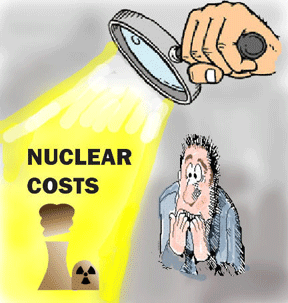 Japan may guarantee price for nuclear power to prop up industry TOKYO Aug 21 (Reuters) – Japan will consider guaranteeing prices for electricity generated by nuclear plants to help the country’s struggling utilities, which have lost about $35 billion in the three years since the Fukushima disaster saddled them with extra costs.
Japan’s nuclear plants are in shutdown with no schedule for restarts after the meltdown at Fukushima in 2011, leading the country’s utilities to turn to expensive fossil fuel imports.
But even if they can get their reactors running they face higher costs to meet new safety requirements just as the government is pushing through plans to allow more competition in the industry. They also face possible costs for decommissioning older units that are too costly to upgrade.
The move was floated by a trade ministry panel as an example of supporting the nuclear industry financially like Britain’s “Contracts for Difference” scheme, which guarantees nuclear operators fixed rates for power.
The panel, which is in charge of making detailed policies in line with the government’s basic energy plan, did not give a schedule for finalising the scheme.
Propping up nuclear power, promoted for decades by Japan’s ruling Liberal Democratic Party as cheap, safe and reliable, is likely to be at odds with public sentiment which has turned against atomic energy since Fukushima. If the market price of electricity falls below a pre-set level, consumers would pay the gap to the utilities, according to the British example discussed on Thursday at the panel……… http://af.reuters.com/article/commoditiesNews/idAFL4N0QR1G120140821
 |
Click here to Reply or Forward
|
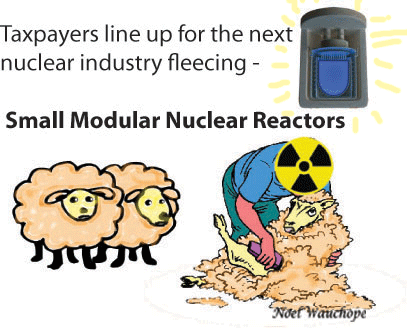
USA Tax-payers once more funding nuclear industry’s boondoggles
 DOE GRANTS TOTAL $67M FOR 83 NUCLEAR TECH R&D, ENGINEERING PROJECTS; ERNEST MONIZ COMMENTS http://www.executivegov.com/2014/08/doe-grants-total-67m-for-83-nuclear-tech-r-ernest-moniz-comments/ ANNA FORRESTER · AUG 21ST, The Energy Department has awarded an estimated $67 million in total to fund 83 research and infrastructure enhancement projects on nuclear technology in support of the administration’s Climate Action Plan.
DOE said Wednesday that the projects are expected to bolster energy security, clean energy and energy efficiency initiatives across the country.
“These awards not only provide crucial funding for research and development, but also for the training and education of the next-generation nuclear energy workforce that will enhance American leadership in the safe, secure and efficient use of nuclear energy here and around the world,” Energy Secretary Ernest Moniz said.
The department distributed the grant across the following:
$30 million for 44 university-led nuclear energy R&D projects;
$4 million for 19 research reactor and infrastructure improvement projects;
$20 million for five integrated research projects;
$11 million for 12 R&D projects by DOE national laboratories, industry and U.S. universities; and
$1 million for two infrastructure enhancement projects.
DOE said research coverage includes fluoride high-temperature reactor technology development and nuclear fuel storage, while the engineering projects focus on infrastructure upgrades, reactor materials and instrumentation.
Nuclear security cuts opposed by US Democrat Senators
White House faces Democratic Senate revolt over nuclear security cuts Yahoo News 21 Aug 14, , Twenty-six members of the Senate are calling on the Obama administration to increase planned spending on programs to secure or reduce global stocks of nuclear weapons materials in the upcoming 2016 White House budget, even as they are challenging an administration decision to significantly shrink these programs in 2015.
“The recent spate of terrorism in Iraq, Pakistan, and Kenya is a harrowing reminder of the importance of ensuring that terrorist groups and rogue states cannot get their hands on the world’s most dangerous weapons and materials,” the senators wrote………http://news.yahoo.com/white-house-faces-democratic-senate-150503823.html
Finland’s government in angst over nuclear power plant and Ukraine crisis
Ukraine divides MPs over Fennovoima nuclear plant ownership Yle uutiset 19 Aug 14 According to an Yle poll, two Finnish party leaders say they could back the construction of the Fennovoima nuclear plant in Pyhäjärvi if Finnish ownership were at 50-53 percent. Four leaders declined to comment and four stand against the plant on principle. The uncertainty is partly due to the Ukrainian crisis.
Minister of Economic Affairs Jan Vapaavuori of the National Coalition Party said that the proposed Fennovoima nuclear plant would have to be under “clear domestic ownership”.
Neither Vapaavuori nor the Ministry of Economic Affairs have announced how much of the plant should specifically be owned by Finnish interest groups.
One reason behind the uneasiness of some MPs is the escalating situation in Ukraine, and the repercussions on Finnish-Russian ties. Russia enforced EU-wide sanctions as a countermeasure to EU and US sanctions in early August……..
Ownership figures misleading
The Russian national nuclear power company Rosatom currently owns 34 percent of the Pyhäjoki plant. According to Fennovoima, the Finnish stake is at 52 percent.
However, the company fails to discount two companies – Rautaruukki and Kestra – in their calculations. Kestra announced in March that it washes its hands of the power plant issue, while Rautaruukki was acquired by the Swedish SSAB in July.
As Kestra owns 4.5 percent of Fennovoima and SSAB owns 3.3 percent, a simple equation will show that the Finnish ownership of the power plant is actually only at 44.2 percent. http://yle.fi/uutiset/ukraine_divides_mps_over_fennovoima_nuclear_plant_ownership/7420930
NO, Prime Minister Abe: Japan can and must choose the path to a nuclear-free world.
EDITORIAL: Japan must pursue a path to a nuclear-free world Asahi Shimbun,August 11, 2014 Prime Minister Shinzo Abe visited Hiroshima and Nagasaki this month, both of which marked the 69th anniversaries of the atomic bombings. In the ceremonies in both cities, he emphasized determination to realize a world without nuclear weapons.
However, it seems that the gap between Abe and the cities that were struck by atomic bombs has increased since last year.
In a meeting with Abe in Hiroshima, 85-year-old hibakusha Yukio Yoshioka said, “(The Cabinet’s approval of the exercise of the right to collective self-defense) will make Japan a country that repeats its (past) mistake and can wage a war.”
Miyako Jodai, 75, who served as the representative of atomic bomb survivors in the ceremony in Nagasaki, said, “I want the government not to forget or deny the sufferings of atomic bomb survivors.”
They apparently demanded that Abe withdraw the Cabinet’s approval of the exercise of the right to collective self-defense.
DIFFERENT FROM DESIRES
There are also other causes of concern.
One is the exports of nuclear power generation infrastructure to emerging countries. Another is negotiations to conclude a nuclear power agreement with India, which has conducted nuclear tests without joining the Nuclear Nonproliferation Treaty (NPT). Both could lead to nuclear proliferation.
The Abe administration also plans to maintain the policy of removing plutonium from spent nuclear fuels and reusing it in nuclear power plants. After the March 2011 nuclear disaster in Fukushima Prefecture, the future of nuclear power generation remains unclear. In addition, Japan already holds stocks of more than 40 tons of plutonium whose use has yet to be decided. Anti-nuclear groups in Japan and abroad suspect that Japan has the intention of arming itself with nuclear weapons.
Why are the moves of the government of A-bombed Japan so different from the desires for anti-nuclear policies?………..
TRUST AND DIALOGUE
In the Hiroshima Peace Declaration, Mayor Kazumi Matsui called for the establishment of “a new security system based on trust and dialogue.”
In the world, the Obama administration is losing its centripetal force, and its relations with Russia have cooled due to the Ukrainian situation. China’s maritime advances have intensified friction with neighboring countries. The road to the “new security system based on trust and dialogue” is steep. But is it just a dream?
The Nagasaki Peace Declaration this year again advocated an idea of establishing “nuclear-weapon-free zones.” In the proposal, Japan and the Korean Peninsula are denuclearized, and nuclear powers promise not to attack the areas with nuclear weapons.
The Japanese government is negative to the idea on the grounds that relations of trust, which serve as a prerequisite, do not exist in the areas partly because North Korea has repeatedly conducted nuclear tests. North Korea counters the view, saying that what is a threat is the U.S. nuclear umbrella.
Relations of trust will be established through dialogue. To realize the nuclear-weapon-free zones, Japan should first show its intentions to set up the zones and leave the U.S. nuclear umbrella. Then, it should urge the United States to accept the zones. After that, showing a joint goal, Japan should strongly urge North Korea to take part in the negotiations.
The improvement of relations with China is also indispensable. A council of experts from five countries in the Asia and Pacific region, including former Australian Foreign Minister Gareth Evans, asked Japan and China to hold a summit meeting in its proposal compiled in Hiroshima.
It is not easy to untangle a thread. Unless there is a dialogue, however, nothing will start. http://ajw.asahi.com/article/views/editorial/AJ201408110020
1 This Month
23-25 October – on Zoom – World BEYOND War’s annual global conferenc


Shut down the radiation-damaged Heysham nuclear reactors now
To see nuclear-related stories in greater depth and intensity – go to https://nuclearinformation.wordpress.com

Say No to NASA’s Reckless Nuclear Reactor on the Moon
Say No to NASA’s Reckless Nuclear Reactor on the Moon
-
Archives
- October 2026 (170)
- September 2026 (339)
- August 2026 (330)
- July 2026 (355)
- June 2026 (287)
- May 2026 (306)
- April 2026 (356)
- March 2026 (251)
- February 2026 (267)
- January 2026 (308)
- December 2025 (358)
- November 2025 (359)
-
Categories
- 1
- 1 NUCLEAR ISSUES
- business and costs
- climate change
- culture and arts
- ENERGY
- environment
- health
- history
- indigenous issues
- Legal
- marketing of nuclear
- media
- opposition to nuclear
- PERSONAL STORIES
- politics
- politics international
- Religion and ethics
- safety
- secrets,lies and civil liberties
- spinbuster
- technology
- Uranium
- wastes
- weapons and war
- Women
- 2 WORLD
- ACTION
- AFRICA
- Atrocities
- AUSTRALIA
- Christina's notes
- Christina's themes
- culture and arts
- Events
- Fuk 2022
- Fuk 2023
- Fukushima 2017
- Fukushima 2018
- fukushima 2019
- Fukushima 2020
- Fukushima 2021
- general
- global warming
- Humour (God we need it)
- Nuclear
- RARE EARTHS
- Reference
- resources – print
- Resources -audiovicual
- Weekly Newsletter
- World
- World Nuclear
- YouTube
-
RSS
Entries RSS
Comments RSS

