Nuclear industry must be worried, when top UK atomic advocate suggests renewables are a better bet!
 Nuclear power may not be needed, says top atomic advocate,Telegraph, UK, 22 Nov 14 Sir David King, former chief scientist and champion of the nuclear newbuild, says the top priority must be to develop storage for renewable energy, reports Geoffrey Lean ……. I was riveted as Prof Sir David King, the former government Chief scientist,ranged over subjects from population growth to water resources, the growth of cities to commodity prices, spewing out new information and insights.
But while he said a lot about the promise of renewable energy, he said almost nothing about nuclear power – despite for long having been one of its foremost and most influential advocates in Britain, describing it, for example, as a “massive economic opportunity” for the country.
So I got up and asked him about it, expecting the same pro-nuclear response as I had heard from him many times before. Instead he amazed me by suggesting that Britain “might well” be able to do without atomic power altogether, and that the real priority should be on developing ways of storing electricity so as to be able to depend on famously intermittent sun and wind.
“We have to keep reassessing the situation”, he said. “I believe that what we need, more than anything, is a surge of activity to develop energy storage capability …. Once we can do that technologically, why would we not just keep with renewables.”
For a country like India, with plenty of sunlight and deserts where it can be collected, he went on, “there’s no reason” for it not to go “directly wholesale into solar energy”. After all it was already “three to four times” cheaper to provide villages unconnected to the grid in India and China with solar electric panels and batteries than to connect them up……….
later he came back to the question …: “if we can get the costs down we might well manage our future basically on renewable energy and energy storage”.…….http://www.telegraph.co.uk/earth/energy/nuclearpower/11244499/Nuclear-power-may-not-be-needed-says-top-atomic-advocate.html
Shareholder crisis brings more doubts about UK’s Hinkley Point C nuclear plant’s future
 Hinkley Point C nuclear plant’s future in doubt as crisis hits shareholder Guardian UK, Terry Macalister, 20 Nov 14, Questions over new Somerset power station after Areva’s nuclear projects in Finland and France run into difficulties The future of the Hinkley Point C nuclear plant in Somerset is under a cloud amid a financial crisis at Areva, a shareholder in the project and the designer of the proposed reactors.
 Shares in the French engineering business plunged by almost a quarter after Areva warned it must suspend future profit predictions because of problems centred on a similar power station project in Finland.
Both that scheme at Olkiluoto and another at Flamanville in France are massively over-budget and over-schedule, forcing Areva to consider whether it needs an injection of new cash to survive.
Peter Atherton, a leading energy company analyst at Liberum Capital in the City, said Areva appeared to be in deep trouble and this must be a matter of grave concern to the British government.
“If I was sitting in Whitehall this would scare the daylights out of me. Areva is designing and building the first two EPRs [European Pressurised Reactors] inEurope and both projects have gone disastrously wrong.
“The [UK] government has commissioned the most expensive power station in history and the only company that can provide the equipment is in trouble. That is a big problem for Hinkley.”
As well as providing the design, Areva currently holds 10% of the equity in the Hinkley Point C project, which has been predicted by the European commission to cost almost £25bn – if it is built on time by 2023. EDF holds 45%-50%, with Chinese state nuclear companies holding the remainder…………http://www.theguardian.com/environment/2014/nov/19/hinkley-point-c-nuclear-plant-future-doubt-areva
UK government secretly questioning whether Hinkley Point C nuclear power project will even go ahead at all
 The trouble with Hinkley’s reactor design, Energy Desk, 20TH NOV 2014 Doug Parr I am beginning to feel a bit like the Kremlinologists of old, who used to try to work out what was really going on in the heart of the massive Soviet empire – the Kremlin – from the crumbs of news or gnomic statements that emerged from the edifice.
Except the focus is (as the Financial Times christened it) the biggest and most controversial infrastructure project in Europe, Hinkley Point C nuclear power project.
Given UK consumers are on the hook for an undiscounted £37billion of subsidy to this project, you’d think democratic principles would require that all developments were subject to full public scrutiny. But no; it’s all happening behind closed doors and we have to do the Kremlinology thing.
A few new scraps of information have emerged that do suggest the project is far from going swimmingly. There are 3 main points.
First, the reactor design, the European Pressurised water Reactor (EPR) isn’t very good. A nuclear engineer now affiliated to University of Cambridge recently described it as ‘unconstructable’.
Further understanding of the weakness of the EPR design come from the actual experience of trying to build it. The French project in Flamanville has announced further delays and will now take a decade to build instead of the original timetable of 5 years.
The other EPR under construction in Europe is in Finland at Olkiluoto. Construction started in 2005 was originally scheduled complete in 2009, but earlier this Autumn it was announced it will now be almost a decade late in 2018, if there are no more delays. It’s not easy building an EPR.
Secondly, the other observation the Cambridge engineer had was that the Chinese – who are experimenting with building several models of reactor – appear to have rejected it for their future nuclear programme. This is a little hard to square with what the Chinese view of the Hinkley project is, because the Chinese state-backed companies China General Nuclear and China National Nuclear Corporation reportedly want a greater share of the supply chain contracts……..
EDF are turning to other potential investors such as Saudi Arabian state-controlled Saudi Electric………..
. Questions have already been raised about the how an independent regulator would police standards with Chinese company involvement………
it turns out that without telling anyone, the UK government has been quietly questioning whether Hinkley will go ahead after all, or worrying if it does go ahead that it might be years late (that Kremlinology thing again)…….http://www.greenpeace.org.uk/newsdesk/energy/analysis/trouble-hinkley
Delay after delay , and soaring coasts, for Britain’s new nuclear build plans
How the UK’s nuclear new-build plans keep getting delayed 20 Nov 2014, The Carbon Brief Simon Evans When will the UK get a new generation of nuclear power plants? Doubts surfaced again today with the Times reporting a “secret government review” into French firm EDF’s plan to build a new plant at Hinkley Point in Somerset.
The review is costing tens of millions, the Times says, and is trying to establish whether EDF can complete the new plant by 2023 as it has promised.
The news follows an announcement from EDF that its Flamanville plant in Normandy is facing further delays. The project uses identical designs to the Hinkley scheme.
Flamanville was supposed to take five years to build and begin operating by 2012. Instead it will now take 10 years, and open in 2017. A third identical project at Olkiluoto in Finland is nearly a decade behind schedule.
New nuclear capacity is a key part of UK government plans for decarbonisation. So why is it proving so hard to predict when the UK’s first new nuclear plant for a generation will start operating?
Predicting the future
The Department for Energy and Climate Change (DECC) makes annual projections of the future of the UK’s energy and emissions. It has been publishing these projections for a number of years. We’ve trawled the data going back to 2007 to find out how DECC’s predictions about when we’ll get new nuclear have changed.
First, some history. ………..
It’s worth emphasising of course that the Hinkley Point reactors are not yet under construction. EDF had originally said it would finish building them in 2017, indeed chief executive Vincent de Rivaz said some people would be cooking their 2017 christmas dinner using new nuclear power.
De Rivaz now says the project will be finished in 2023. Preparatory groundwork has already started. Carbon Brief asked EDF when construction of the plant itself will begin and how long it will take to finish. EDF said that level of detail was not yet available.
The cost of UK new nuclear
It isn’t only the finish date that has changed for the UK’s new nuclear plans. The costs have also skyrocketed.
Back in 2008 the white paper on new nuclear in the UK suggested it would cost £2.8 billion to build a first of its kind 1.6 gigawatt plant, with a range of between £2 and £3.6 billion.
The government later said in 2013 that the the Hinkley C project of two 1.6 gigawatt reactors would cost £16 billion. When the European Commission gave the deal the green light in October it said the project would cost £24 billion……….. EDF has delayed its final decision on whether to build at Hinkley Point until after this review has given it the all-clear. Until then, it will not divulge detailed timelines for its plans. http://www.carbonbrief.org/blog/2014/11/how-the-uks-nuclear-new-build-plans-keep-getting-delayed/
2015 the deadline for EDF to start closing nuclear reactors in France

 EDF must start French nuclear closure in 2015 despite delay on replacement http://www.reuters.com/article/2014/11/19/france-nuclear-idUSL6N0T93HX20141119 PARIS Wed Nov 19, 2014 Nov 19 (Reuters) – EDF will still need to start shutting down some nuclear capacity in 2015 despite a new delay in finishing a replacement in northern France, the official in charge of the closure of France’s oldest plant said on Wednesday.
The French utility announced on Tuesday that it expects 1,600-megawatt Areva-designed EPR nuclear reactor in Flamanville,France, to be connected to the grid in 2017, instead of 2016.
That pushed back the production of the first megawatt of electricity to the last year of President Francois Hollande’s mandate, which terminates in May 2017. Closing the Fessenheim plant on the German border was a campaign pledge of Hollande’s.
The delay gave rise to talk that EDF could avoid closing the Fessenheim nuclear plant altogether if anew centre-right government came to power in May 2017 and repealed the energy transition law that caps nuclear capacity at 63.2 gigawatts.
But Jean-Michel Malerba, who is in charge of closing the 1,600-MW reactor, told Reuters that EDF will still have to request a production permit for Flamanville some 18 months before start-up and will also have to request a production withdrawal permit for the equivalent capacity in 2015.
“EDF will have to ask for a production authorisation for Flamanville in 2015, even if the start-up date is a bit delayed, and on that occasion they will have to declare which reactors they want to shut to obtain that authorisation,” he said.
The official said Article 55 of the energy transition bill, which won approval from the lower house of parliament last month, requires EDF to request a production authorisation no later than 18 months before April 2017.
Energy Minister Segolene Royal suggested in September that keeping Fessenheim open, where half a billion euros ($630 million) of maintenance investment has been made in recent years, was a possibility. (Reporting by Michel Rose)
How the South African government shafts renewables, in its policy fixated on nuclear power
 Nuclear fixation shafts renewables, Mail &Guardian, Africa 21 NOV 2014 00:00 SIPHO KINGS The third window is waiting to be signed off but the energy department is preoccupied elsewhere Within two years, South Africa could have a further 1 200 megawatts (MW) of renewable energy entering the grid. The bidders have been selected and the companies are waiting for financial sign-off so they can start building.
But policy uncertainty and a new focus on nuclear energy are responsible for a nearly 18-month delay in the government giving them the go-ahead, industry insiders say.
In the wake of the 2009 energy crisis, the energy department set out an ambitious renewable energy programme: independent power producers (IPPs) would build the capacity to produce 3 725MW of electricity. This was split into three bidding opportunities, or windows, with companies bidding for a certain allocation in each.
The first two were hailed as great successes and, for the past three years, South Africa has been listed as one of the top five destinations for investment in renewable energy. Wind energy is already producing 660MW. Updated plans envision 9?800MW of solar, 3 300MW of concentrated solar and 4 400MW of wind energy by 2030.
But the third window has been delayed repeatedly. Several concerned individuals, working for renewable companies and unwilling to disclose their names for fear of jeopardising their relationship with the government, said political considerations were to blame.
“We have been told that the new minister’s [Tina Joemat-Pettersson] mandate is strongly towards nuclear energy,” said one………..
The renewable energy companies, the majority of which provide wind and photovoltaic power, are incurring costs all the time. These include leasing the land on which the power stations will be built, which is spread out across the Eastern, Western and Northern Cape.
If the delays continued, the sources said, there would be a point beyond which companies would be unable to recoup their costs, even if they started producing power soon. “We are not far from that point,” warned one renewable company employee. ………
A chance to reindustrialise
Groups such as Cosatu have hailed renewable energy as a chance to “reindustrialise” the country and companies are required to spend up to 70% of their budgets locally. Hundreds of millions of rands have been spent building factories to produce parts locally, such as the R300-million wind tower factory in Atlantis outside Cape Town. Solar panel factories alone have created 500 jobs.
This week the South Africa Renewable Energy Council said delaying the third window would have “extremely adverse consequences” for the industry and could also jeopardise the planned fourth renewable window.
Unlike South Africa’s centralised and state-owned power plants, renewables are financed by the private sector. The government, through Eskom, signs an agreement to buy their electricity at the rate presented in their bid. But they carry the risk.
The owner of one solar company said: “The worst thing for investors is uncertainty. The first two windows attracted so much investment and goodwill because the government was decisive. That is being thrown out of the window.”
If the third window was delayed, and there was another window to come, companies would hesitate to gamble with their money, they said………
Policy uncertainty
Twenty-six renewable energy projects have already been connected to the grid. The more than 60 projects have brought in R120-billion in foreign direct investment. Many of these are ahead of schedule, such as the 96MW Jasper solar plant near Upington in the Northern Cape.
It is the continent’s largest solar photovoltaic power plant. It has been built in the time that costs of the coal-fired Medupi and Kusile power stations, which are currently five years behind schedule, have nearly tripled.
But industry insiders are adamant that, if the policy uncertainty is not cleared up, the initial promise shown by the renewable programme will falter.
The department of energy was not available to respond to questions. http://mg.co.za/article/2014-11-20-nuclear-fixation-shafts-renewables
Nuclear power promoter DOE to run research into health effects of radiation
 House passes bill to study low-dose radiation http://thehill.com/blogs/floor-action/house/224411-house-passes-bill-to-study-low-dose-radiation
By Cristina Marcos November 17, 2014,The House on Monday passed legislation by voice vote to authorize Department of Energy research on the risks of low-dose ionizing radiation.
Under the measure, H.R. 5544, the Department of Energy’s Office of Science would conduct research on low-dose radiation. Rep. Paul Broun (R-Ga.), the bill’s sponsor, said there isn’t enough scientific data regarding exposure to low levels of radiation.
The director of the Energy Department’s Office of Science would be required establish an agreement with the National Academies on a long-term strategy for low-dose radiation research within 60 day’s of the bill’s enactment. Such a study would have to be completed within 18 months.
The measure encountered no opposition during House floor debate.
Japan’s Prime Minister Abe is banking on getting a new voter mandate
Abe is banking on getting a new voter mandate BY REIJI YOSHIDA, JAPAN TIMES 18 NOV 14 “…….Abe would never admit in public what is widely believed to be the real reason for the snap election: A campaign as early as next month will likely strengthen the ruling camp and Abe himself.
The prime minister plans to submit controversial bills to the Diet in the spring, including those based on his reinterpretation of the Constitution to expand Self-Defense Forces’ missions overseas.
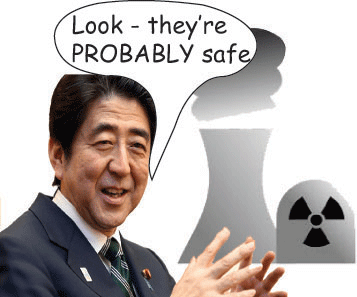 Next year, Abe also plans to reactivate some of the nuclear reactors that have mostly sat idle since the Fukushima meltdowns, a hotly contested move that would likely sap support from the Liberal Democratic Party in a national election next year……..
There is little doubt that the LDP-Komeito ruling camp will retain power, and Abe could even strengthen his political base within the LDP.
“An (early) election will basically give an advantage to the ruling parties,” Sasaki said.
The situation, however, might not be as good as Abe thinks………http://www.japantimes.co.jp/news/2014/11/18/national/politics-diplomacy/abe-dissolve-lower-house-friday-dec-14-election/#.VG0mpzTF8nl
Uk’s new nuclear reactor designs likely to become a financial drain, warns Stephen Chu

“Unless we can learn to build nuclear on schedule and on budget it will be a financial drain. ………
“That is true of all industries. If you build exactly the same its get cheaper, cheaper, cheaper. ……..
Atomic plants being built in Finland and France are much more expensive than forecast and are suffering significant delays but EDF, the company planning to build Hinkley Point C reactors in Somerset, says it will learn from those mistakes. While EDF plans to use an “EPR” design at Hinkley and possibly at Sizewell in Suffolk, other developers in Britain are planning different models……….
An embarassment to Shinzo Abe if anti nuclear candidate wins Okinawa election

 Anti-nuclear critic of US base set to win key Japan election http://www.euronews.com/2014/11/16/anti-nuclear-critic-of-us-base-set-to-win-key-japan-election/ In Japan a former mayor opposed to nuclear power and the presence of a US military base in his region is on course to win a key local election.
Takeshi Onaba’s likely victory in Okinawa according to opinion polls will embarrass Prime Minister Shinzo Abe’s party.
There have been plans to relocate the base on the island but many residents want it removed entirely.
US tax-payer money going to nuclear lobby’s latest gee-whiz gimmick
 GE Hitachi Receives Federal Funds To Assess New Nuclear Technology, Wilmington Biz BY JENNY CALLISON, NOV 6, 2014 GE Hitachi Nuclear Energy (GEH) will perform a comprehensive safety assessment of its PRISM sodium-cooled fast nuclear reactor, thanks to a multi-million-dollar federal investment from the U.S. Department of Energy (DOE), the company announced Thursday.
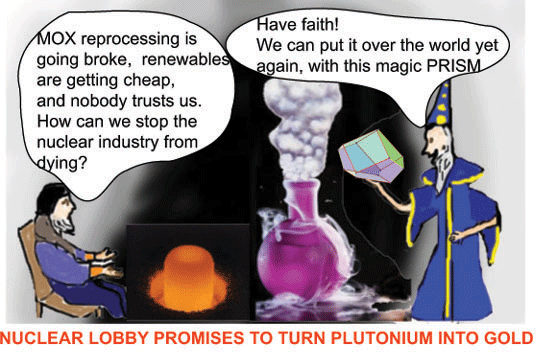
GEH officials are not sure yet of the exact amount of federal funds allocated to the project, company spokesman Jon Allen said Thursday…….The technology on which PRISM is based was developed in the 1980s and, unlike other nuclear reactors, it can use spent nuclear fuel and surplus plutonium to generate electricity. Since the early 1990s, however, no risk assessments have been done on the technology……..
Worrying outlok for USA, as Climate Change Denier likely to head senate environment committee
Prominent climate change denier likely to head US senate environment committee, SMH, Tom Hamburger,November 6, 2014If approved, Inhofe would replace Chairman Barbara Boxer, D-Calif., an avowed environmentalist, producing one of the most stark post-election changes in the Capitol. Committee assignments will not be made until Senate party caucuses meet in Washington after the election recess………
Republican control of Congress a boost for nuclear power companies

 Nuclear Power, Banks Seen Gaining in Republican Congress, Bloomberg, By Todd Shields and Jim Snyder Nov 5, 2014 Republican control of Congress may boost nuclear power and give banks eased enforcement of consumer laws, though it’s unlikely to yield a rollback of Obamacare over objections of a veto-wielding president.
Resolving where the nation sends nuclear waste may be an issue that brings Democrats and Republicans together after Obama and Harry Reid, the Nevada senator and until January majority leader, blocked funding for the proposed nuclear waste site at Yucca Mountain in Nevada.
Solutions such as promoting on-site storage or establishing regional waste sites may now be possible, said Colin Hayes, a lobbyist at McBee Strategic and former Senate energy committee Republican aide.
That would be a boon for nuclear producers such as Chicago-based Exelon Corp. (EXC)……..http://www.bloomberg.com/news/2014-11-05/nuclear-power-banks-seen-gaining-in-republican-congress.html
End failed nuclear loan program – 35 organisations urge USA Dept of Energy
 35 clean energy organizations urge DOE to end nuclear loan program Green World, Michael Mariotte November 3, 2014 Today, 35 clean energy organizations from across the country submitted formal comments to the Department of Energy (DOE) urging it to end its nuclear loan program. The comments are in response to a DOE solicitation seeking to revive the failed program which, after seven years, has succeeded only in providing one loan to a nuclear project (the Vogtle reactors in Georgia) whose executives publicly said they didn’t need it and offering a loan to another project (Calvert Cliffs-3 in Maryland) for which it would have been illegal for its principal to receive it.
Given that record, which the 35 groups termed an “abject failure,” DOE is now attempting to reframe its program–in direct conflict with its intent under the 2005 Energy Policy Act that created the program–to allow it to provide loans to “small modular reactors” that don’t yet exist and to bail out uneconomic reactors by providing low-interest loans to nuclear utilities to enable power uprates and to meet NRC-required safety upgrades.
In short, DOE still has $10.2 Billion available in this program that clearly has not worked as either its Congressional or DOE supporters had expected, or at least hoped. At this point, you’d think DOE would just want to cut its losses; instead, like a child with a dollar in a candy store, that money is burning a hole in DOE’s pocket.
The groups, however, were kind enough not to lay the blame on DOE for the program’s inability to spark the “nuclear renaissance” it was intended to do.
Instead, they wrote:
The DOE’s nuclear loan program has been an abject failure, even on its own terms. The reasons for that are many, and for the most part have been out of the control of DOE. They include increased competition in the electricity generation marketplace; the explosive growth in renewables as costs for renewable technology continue to plummet—a trend expected to continue for years if not decades; and, unfortunately, the rise in fracking-produced natural gas…………
The full comments are available here.
http://safeenergy.org/2014/11/03/35-clean-energy-organizations/
Germany to speed up the phase-out of coal, as well as of nuclear power

 Germany looks to fast-track exit from coal, as well as nuclear http://reneweconomy.com.au/2014/germany-looks-dump-coal-well-nuclear-16716 By Giles Parkinson on 5 November 2014 Germany is looking to achieve exactly what Australia says is not possible – and wean one of the world’s largest manufacturing economies off coal – as well as shutting down nuclear.
The conservative government of Chancellor Angela Merkel last week issued a discussion paper proposing to implement the strictest controls on coal fired generation yet to be seen in Europe, and to redesign its energy system around renewables, which will account for around two thirds of supply within two decades.
The discussion paper has been prompted by the need to deal with massive over-capacity in its energy system, and as Germany commits to phasing out the remainder of its nuclear generators by 2022 and sourcing nearly half of its electricity supply from renewables – hydro, biomass, wind and solar – within a decade.
The government discussion paper said too many fossil-fired power plants are in the system and overcapacities “have to be cut” to help meet climate targets. The response is in stark contrast to the situation in Australia, where the conservative government of Tony Abbott is using the argument of “overcapacity” to shut down the pipeline of new renewable energy projetcs, rather than forcing coal to exit the market. Continue reading
1 This Month
23-25 October – on Zoom – World BEYOND War’s annual global conferenc


Shut down the radiation-damaged Heysham nuclear reactors now
To see nuclear-related stories in greater depth and intensity – go to https://nuclearinformation.wordpress.com

Say No to NASA’s Reckless Nuclear Reactor on the Moon
Say No to NASA’s Reckless Nuclear Reactor on the Moon
-
Archives
- October 2026 (170)
- September 2026 (339)
- August 2026 (330)
- July 2026 (355)
- June 2026 (287)
- May 2026 (306)
- April 2026 (356)
- March 2026 (251)
- February 2026 (267)
- January 2026 (308)
- December 2025 (358)
- November 2025 (359)
-
Categories
- 1
- 1 NUCLEAR ISSUES
- business and costs
- climate change
- culture and arts
- ENERGY
- environment
- health
- history
- indigenous issues
- Legal
- marketing of nuclear
- media
- opposition to nuclear
- PERSONAL STORIES
- politics
- politics international
- Religion and ethics
- safety
- secrets,lies and civil liberties
- spinbuster
- technology
- Uranium
- wastes
- weapons and war
- Women
- 2 WORLD
- ACTION
- AFRICA
- Atrocities
- AUSTRALIA
- Christina's notes
- Christina's themes
- culture and arts
- Events
- Fuk 2022
- Fuk 2023
- Fukushima 2017
- Fukushima 2018
- fukushima 2019
- Fukushima 2020
- Fukushima 2021
- general
- global warming
- Humour (God we need it)
- Nuclear
- RARE EARTHS
- Reference
- resources – print
- Resources -audiovicual
- Weekly Newsletter
- World
- World Nuclear
- YouTube
-
RSS
Entries RSS
Comments RSS

