Questioning independence of Polish Nuclear Energy Agency
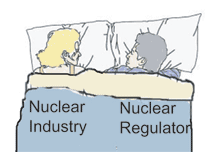 The thin ice under nuclear regulatory independence Greenpeace, by Jan Haverkamp – December 19, 2013 In this space I have written before about the importance of nuclear regulatory agencies being fully independent. Fukushima showed that a lack of independence leads to complacency and that complacency adds to the complexity of nuclear accidents when they happen.
In 2009, the Euratom Treaty adopted a rule on regulatory independence: Section 5(2) of the Nuclear Safety Directive (2009/71/Euratom) says: “Member States shall ensure that the competent regulatory authority is functionally separate from any other body or organisation concerned with the promotion, or utilisation of nuclear energy, including electricity production, in order to ensure effective independence from undue influence in its regulatory decision making.” The nearest you can get to violating this rule is by promoting nuclear yourself.
Yet promoting nuclear seems to be what the president of the Polish Nuclear Energy Agency (PAA) Janusz Włodarski is doing. Currently, he faces a push from Polish politicians and the nuclear lobby to introduce nuclear power in what is now a nuclear-free country. Quotes attributed to Mr. Włodarski in the Japanese magazine “Rising” are more than sufficient reason for concern: “Nuclear energy is clean energy, environmentally friendly. Even if something like the Fukushima disaster were to happen [again], Poland wants to implement nuclear power.”….
Mr. Włodarski has used the arguments that Polish politicians use to try to massage the opinion of the majority of Poles who know that nuclear energy is not clean and not environmentally friendly, and that Fukushima is an ongoing catastrophe……
What we need at PAA is someone who can prevent the Polish nuclear industry from getting away with a nuclear power station that is built on propaganda rather than hard fact. Because such a nuclear power station could well become the next Fukushima.http://www.greenpeace.org/international/en/news/Blogs/nuclear-reaction/weak-nuclear-regulatory-independence/blog/47755/
Japan’s govt keeps TEPCO afloat with huge funding aid
 TEPCO government aid to be increased to almost 10 trillion yen http://japandailypress.com/tepco-government-aid-to-be-increased-to-almost-10-trillion-yen-1941261/ Dec 19, 2013 Maan Pamintuan The Japanese government’s financial assistance to Tokyo Electric Power Co(TEPCO), the operator of the crippled Fukushima Daiichi nuclear plant, is set to be raised from 5 trillion yen to around 9 to 10 trillion yen to help rebuild the troubled company. The additional funds will be used to guarantee payment to the victims of the 2011 nuclear crisis of Fukushima, most of whom are still displaced due to radiation and decontamination issues in the plant, the site of the world’s worst nuclear accident since Chernobyl.
In July 2012, after donating 1 trillion yen to increase TEPCO’s capital, the government acquired 50.1 % shares of the company, which essentially placed the operator under state control eligible for government-funded rehabilitation. Plans to sell all shares by the 2030s to pay for decontamination work on areas within the nuclear plant are to be decided on a meeting of the Nuclear Emergency Response Headquarters on Friday along with other factors of the company’s special business plan, which includes the Kashiwazaki-Kariwanuclear power plant in Niigata Prefecture that is targeted to go back online by July 2014. This assumes the company a 107 billion yen ordinary profit in 2014 and around 150 billion yen annually, thereafter.
While huge profits are expected to come in next year for TEPCO, the 50 billion yen a year to be paid to the Nuclear Damage Liability Facilitation Fund andcompensation for victims of the nuclear accident for a period of time, made the government decide to raise the upper limit of financial assistance to the company.
Profits left after paying the fund will be spent on refurbishing thermal power plants. Other parts of the new business reconstruction plan include joint procurement of fuel with gas companies and oil wholesalers and a construction of a new coal-powered thermal power plant.
Controversy over Entergy’s quest for approval to extend Indian Point nuclear license
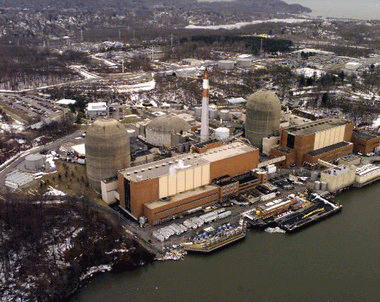 Entergy Sees Nuclear License Renewal for New York’s Indian Point Bloomberg, By Mark Chediak Dec 19, 2013 Entergy Corp. (ETR), the second biggest U.S. nuclear operator, expects federal approval to extend the operating life of its Indian Point reactors, Chairman and Chief Executive Officer Leo Denault said.
“It is our belief that we can get through the process and be successful,” Denault said in an telephone interview today. “We also think it’s going to take a while and we really don’t see it getting it resolved before 2018.”
State officials and environmental groups are fighting Entergy’s application with the U.S. Nuclear Regulatory Commission for a 20-year license renewal for Indian Point, a two-unit nuclear plant located about 24 miles (39 kilometers) north of New York City.
The NRC has said Entergy may continue to operate Indian Point’s 1,028-megawatt Unit 2 while it reviews the renewal request. The reactor’s license expired in September and the license for the 1,041-megawatt Unit 3 reactor expires in December 2015.
New York Governor Andrew Cuomo has said Indian Point should be closed because it isn’t feasible to evacuate the metropolitan area’s 20 million residents in the event of an accident. Entergy, based in New Orleans, has said the reactors are safe……
The company’s 838-megawatt James A. FitzPatrick reactor on New York’s southern shore of Lake Ontario is in a “more challenged market” and has a design similar to Vermont Yankee, which the company decided to shut earlier this year due to lower prices……http://www.bloomberg.com/news/2013-12-19/entergy-sees-nuclear-license-renewal-for-new-york-s-indian-point.html
UK nuclear subsidies may be unnecessary, and could cost £17bn
 Subsidies for UK nuclear plant could reach £17bn and ‘may be unnecessary’ http://www.telegraph.co.uk/finance/newsbysector/energy/10525538/Subsidies-for-UK-nuclear-plant-could-reach-17bn-and-may-be-unnecessary.html
European Commission probes whether subsidies are needed for EDF’s Hinkley Point plant in Somerset and warns they could cost £17bn – more than the plant itself By Emily Gosden, Energy Editor
18 Dec 2013 British consumers could pay £17bn in potentially unnecessary subsidies to fund construction of the country’s first new nuclear plant in a generation, the European Commission has said.
The EC said it was assessing whether the planned subsidies for Hinkley Point in Somerset – which could exceed the £16bn cost of the plant itself – were needed at all, or whether energy companies would build the plant anyway without a penny of public support.
Ministers in October signed a landmark deal with energy giant EDF to fund the construction of the plant, which would see consumers pay billions of pounds in subsidies to the French company for decades to come.
On Wednesday the Commission opened a formal investigation into “whether the construction of a nuclear power station could not be achieved by market forces alone, without state intervention”. The Commission said its investigation, which threatens to delay or derail the plant altogether, will assess whether UK plans “to subsidise the construction and operation” of the plant are in line with EU state aid rules.
Taxpayer money for UK nuclear from French, as well as British?
 Areva may use French fund to help pay for UK nuclear plant –paper http://uk.reuters.com/article/2013/12/16/uk-areva-hinkleypoint-funds-idUKBRE9BF0KS20131216 (Reuters) – Areva is in talks with the French
  government to release some funds set aside for dismantling its nuclear installations in France to help the company finance a new British nuclear reactor, a newspaper reported.
 Britain signed a deal with France’s state-owned utility EDF in October to build a 16-billion pound nuclear power plant at Hinkley Point in southwest Britain, the first new plant in Europe since the Fukushima disaster.d to help pay for UK nuclear plant – paper
PARIS Mon Dec 16, 2013 State-owned Areva is taking a 10 percent stake in the consortium that will build the facility, which also includes EDF’s Chinese partners China General Nuclear Corporation (CGN) and China National Nuclear Corporation (CNNC).
Japan on the way towards totalitarianism
Abe shows totalitarian bent The “old” Liberal Democratic Party that former Prime Minister Junichiro Koizumi is supposed to have destroyed is making a strong resurgence as is the traditional “triangle” of the LDP, the Ministry of Economy, Trade and Industry (METI) and the Japan Business Federation (Keidanren).
When Prime Minister Shinzo Abe goes abroad, he is often accompanied by as many as 100 business leaders as he busies himself with exporting nuclear reactors and other infrastructural items through “top-level sales campaigns.” Furthermore, defying the traditional practice of determining wage levels through labor-management negotiations, Abe has asked Keidanren Chairman Hiromasa Yonekura to raise the wages of workers and this request has been handed down to Keidanren member corporations. His intervention in wage negotiations clearly indicates that Japan is a nation of highly controlled state capitalism, transcending a free market economy. Moreover, should a constitutional revision come to restrict freedom of speech, Japan would become a de facto totalitarian state http://www.japantimes.co.jp/opinion/2013/12/16/commentary/abe-shows-totalitarian-bent/#.UrBsOWRDtD5
Japanese government panel urges “embracing of nuclear power”
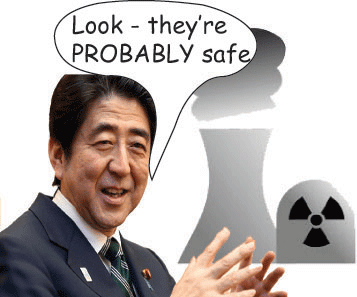 Japan should embrace nuclear power, government panel says Asahi Shimbun, 14 Dec 13 Japan should embrace nuclear power as an “important and fundamental” energy source, a government panel said on Dec. 13, in advice that looks almost certain to be accepted, despite widespread anti-nuclear feeling after the Fukushima disaster. Continue reading
India is sticking to its Nuclear Liability Law
 No proposal to relax liability clause in nuclear act: Govt http://zeenews.india.com/news/nation/no-proposal-to-relax-liability-clause-in-nuclear-act-govt_896399.html 13 Dec 13 New Delhi: The government on Thursday said there was no proposal to relax the liability clause of the Civil Liability for Nuclear Damages Act 2010, as demanded by foreign collaborators assisting the country in its nuclear power generation pursuit. Responding to questions over the issue, V Narayanasamy, Minister of State in the Prime Minister’s Office, said there is no proposal to relax the provisions of the Civil Liability for Nuclear Damage Act, 2010 to benefit American firm Westinghouse Corporation or any other company. The Department of Atomic Energy (DAE) is negotiating with Westinghouse Corporation to build nuclear plant reactors in Mithi Virdhi, Gujarat.
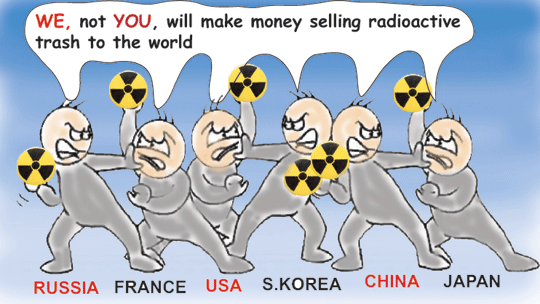
Many foreign collaborators, like France and Russia, have been pressing for relaxation of the liability clause of the act, which enables the operators (NPCIL) to sue the suppliers (the foreign collaborators) in case of any nuclear disaster.
US govt chooses small Oregan company for grant for small nuclear reactors
Small Oregon Nuclear Power Plant Company Gets Massive Federal Backing OPB | Dec. 12, 2013 Portland, Oregon NuScale Power, a spin-off business out of Oregon State University, will receive up to $226 million from the U.S. Department of Energy.
NuScale Power is designing a small nuclear reactor — about the size of a semi-trailer standing on its head.
Chief commercial officer Mike McGough says the money will be spent getting the Nuclear Regulatory Commission to certify the design — a task that’s expected to cost about $1 billion……
If NuScale secures certification, a reactor isn’t expected to be up and running until at least 2023.It would be built in Idaho.
Oregon has tight restrictions on the construction of nuclear power facilities. For example, it would have to be approved by voters and builders would need to be able to demonstrate the safe disposal of high level waste….http://www.opb.org/news/article/small-oregon-nuclear-power-plant-company-gets-massive-federal-backing/
US government not funding Westinghouse, Ameren , for little nukes
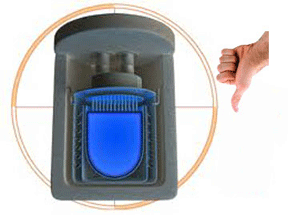 Westinghouse, Ameren lose out in nuclear reactor funding By Tim Bryant tbryant@post-dispatch.com 314-340-8206 Government funding of up to $226 million to develop small modular nuclear reactor technology will go to an Oregon firm instead of a group that included Ameren Missouri.
The Energy Department funding was awarded Thursday to NuScale Power of Portland, Ore.
NuScale and the government will move next to negotiate an agreement that lays out a five-year funding program………
Ameren Missouri and Westinghouse said in April they would pursue federal funding of a small-scale nuclear reactor that could be built in central Missouri. The companies sought a similar grant last year. But the Energy Department chose then to fund a consortium led by Babcock & Wilcox, known for making nuclear reactors for ships and submarines.
Japan’s nuclear regime slides towards fascism
 Japan’s New ‘Fukushima Fascism’ Eco Watch, 12 Dec 13, Harvey Wasserman Fukushima continues to spew out radiation. The quantities seem to be rising, as do the impacts.
The site has been infiltrated by organized crime. There are horrifying signs of ecological disaster in the Pacific and human health impacts in the U.S.
But within Japan, a new State Secrets Act makes such talk punishable by up to ten years in prison.
 Taro Yamamoto, a Japanese legislator, says the law “represents a coup d’etat” leading to “the recreation of a fascist state.” The powerful Asahi Shimbun newspaper compares it to “conspiracy” laws passed by totalitarian Japan in the lead-up to Pearl Harbor, and warns it could end independent reporting on Fukushima.
Prime Minister Shinzo Abe has been leading Japan in an increasingly militaristic direction. Tensions have increased with China. Massive demonstrations have been renounced with talk of “treason.”
But it’s Fukushima that hangs most heavily over the nation and the world.
 Tokyo Electric Power has begun the bring-down of hot fuel rods suspended high in the air over the heavily damaged Unit Four. The first assemblies it removed may have contained unused rods. The second may have been extremely radioactive.
But Tepco has clamped down on media coverage and complains about news helicopters filming the fuel rod removal.
 Under the new State Secrets Act, the government could ban—and arrest—all independent media under any conditions at Fukushima, throwing a shroud of darkness over a disaster that threatens us all.
By all accounts, whatever clean-up is possible will span decades. The town of Fairfax, CA, has now called for a global takeover at Fukushima. More than 150,000 signees have asked the UN for such intervention.
As a private corporation, Tepco is geared to cut corners, slash wages and turn the clean-up into a private profit center.
 It will have ample opportunity. The fuel pool at Unit Four poses huge dangers that could take years to sort out. But so do the ones at Units One, Two and Three. The site overall is littered with thousands of intensely radioactive rods and other materials whose potential fallout is thousands of times greater than what hit Hiroshima in 1945.
Soon after the accident, Tepco slashed the Fukushima workforce. It has since restored some of it, but has cut wages. Shady contractors  shuttle in hundreds of untrained laborers to work in horrific conditions. Reuters says the site is heaving infiltrated by organized crime, raising the specter of stolen radioactive materials for dirty bombs and more.
Thousands of tons of radioactive water now sit in leaky tanks built by temporary workers who warn of their shoddy construction. They are sure to collapse with a strong earthquake.
Tepco says it may just dump the excess water into the Pacific anyway. Nuclear expert Arjun Makhijani has advocated the water be stored in supertankers until it can be treated, but the suggestion  has been ignored.
Hundreds of tons of water also flow daily from the mountains through the contaminated site and into the Pacific. Nuclear engineer Arnie Gundersen long ago asked Tepco to dig a trench filled with absorbents to divert that flow. But he was told that would cost too much money.
 Now Tepco wants to install a wall of ice. But that can’t be built for at least two years. It’s unclear where the energy to keep the wall frozen will come from, or if it would work at all.
Meanwhile, radiation is now reaching record levels in both the air and water.
The fallout has been already been detected off the coast of Alaska. It will cycle down along the west coast of Canada and the U.S. to northern Mexico by the end of 2014. Massive disappearances of sea lion pups, sardines, salmon, killer whales and other marine life are being reported, along with a terrifying mass disintegration of star fish. One sailor has documented a massive “dead zone” out 2,000 miles from Fukushima. Impacts on humans have already been documented in California and elsewhere.
Without global intervention, long-lived isotopes from Fukushima will continue to pour into the biosphere for decades to come.
 The only power now being produced at Fukushima comes from a massive new windmill just recently installed offshore.
Amidst a disaster it can’t handle, the Japanese government is still pushing to re-open the 50 reactors forced shut since the melt-downs. It wants to avoid public fallout amidst a terrified population, and on the 2020 Olympics, scheduled for a Tokyo region now laced with radioactive hot spots. At least one on-site camera has stopped functioning. The government has also apparently stopped helicopter-based radiation monitoring.
A year ago a Japanese professor was detained 20 days without trial for speaking out against the open-air incineration of radioactive waste.
Now Prime Minister Abe can do far worse. The Times of India reports that the State Secrets Act is unpopular, and that Abe’s approval ratings have dropped with its passage.
 But the new law may make Japan’s democracy a relic of its pre-Fukushima past.
It’s the cancerous mark of a nuclear regime bound to control all knowledge of a lethal global catastrophe now ceaselessly escalating.
Visit EcoWatch’s NUCLEAR page for more related news on this topic.
South Korea cutting back on nuclear expansion plans

 S. Korea scales back nuclear expansion plans The West Australian, 11 Dec 13, Seoul (AFP) – South Korea is scaling back its commitment to nuclear energy after safety concerns prompted a series of reactor shutdowns, officials said Tuesday……The Ministry of Trade, Industry and Energy said it has accepted recommendations from a government advisory group in September to scale back the nuclear expansion plans…..
Safety concerns that were already high in the wake of the 2011 Fukushima crisis in Japan have been heightened by revelations of widespread corruption and faulty equipment.
Nuclear reactors have been abruptly shut down 128 times over the past decade because of malfunctioning parts, officials admitted in October. Public prosecutors have charged about 100 people after discovering that documents relating to some parts in 20 working reactors, and eight under construction, had been forged…….http://au.news.yahoo.com/thewest/world/a/20257649/s-korea-scales-back-nuclear-expansion-plans/
Japan’s state secrets law criminalises investigative journalism

 Japan enacts state secrets law late Friday night amid revolt — “It criminalizes investigative journalism” — Terrorism defined as “imposing one’s opinions on others”http://enenews.com/secrets-law-passes-late-friday-night-amid-revolt-mushrooming-opposition-it-criminalizes-investigative-journalism-terrorism-defined-as-imposing-ones-opinions-on-others-protesto
Japan Times, , Dec. 6, 2013: Following political turmoil that rocked the Diet over the past week, ruling block Upper House members finally enacted the contentious state secrets bill late Friday night. Earlier in the day, opposition parties intensified their protests in vain over a law that’s being criticizing for not creating an independent oversight body capable of preventing the government from hiding inconvenient information at its discretion.
Businessweek, Dec. 6, 2013: Prime Minister Shinzo Abe secured final passage of a bill granting Japan’s government sweeping powers to declare state secrets, a measure aimed at shoring up defense ties with the U.S. that prompted a public backlash and revolt by the opposition.
Asahi Shimbun, , Dec. 6, 2013: Kazuo Shii, chief of the Japanese Communist Party, described the ruling coalition’s behavior as “tyrannical, arrogant and disorderly.” The ruling coalition believed prolonging the Diet debate any longer could backfire, only fueling the mushrooming opposition to the bill, and lead to a further decline in approval ratings for Abe’s Cabinet and hold on power. An Asahi Shimbun survey taken between Nov. 30-Dec. 1 showed the Cabinet’s approval rating at 49 percent, dipping below 50 percent for the first time since he took power in December 2012. Officials in the Abe administration foresee the public eventually forgetting about the controversy, once the legislation is approved.
GlobalPost,, Dec. 6, 2013: Here are four disturbing ways the bill could be a democracy muzzler. It defines terrorism as imposing one’s opinions on others […] According to Article 12, terrorism is partially defined as an activity that forces “political and other principles or opinions on the state or other people.” In other words, throw up a rowdy anti-government protest, and the judiciary can find a reason to lock you away. It criminalizes investigative journalism […] Journalists can be prosecuted for “improperly accessing” classified documents or “conspiring” to leak them. Even asking an official to take a look at classified documents could constitute “conspiracy,” leading to up to five years in prison. “Instigating” the release of government secrets, meanwhile, carries up to 10 years in the dock. […] Basically, anything can be a secret […] administrators can make the opaque decisions to classify a document even if their work hardly relates to national security. That effectively allows them to hide any embarrassing piece of evidence, and then pursue the journalists and bloggers who make it public. […]
Plan for Fukushima nuclear plant to get UK style decommissioning agency
Japan may set up UK-style decommission agency for Fukushima plant BY YOSHIFUMI TAKEMOTO TOKYO Thu Dec 5, 2013 (Reuters) – Japan’s ruling party could set up a British-style agency to shut down the wrecked Fukushima nuclear plant, taking control of a project now managed by the station’s embattled operator, a senior party policymaker said on Thursday…… Tepco, de facto nationalized after 2011, is still responsible for the ambitious decommissioning of the plant as well as for paying compensation to evacuees and cleaning up affected areas.
A plan to set up a decommissioning agency is controversial as it would reduce Tepco’s responsibility and increase the burden on taxpayers.
Prime Minister Shinzo Abe has so far pledged half a billion dollars in government funds to help stem the flow of contaminated water at the plant after a highly radioactive water leak in August triggered international alarm………http://in.reuters.com/article/2013/12/05/us-japan-fukushima-ldp-idINBRE9B407C20131205
Call for a priority removal of Florida’s nuclear ‘advance fee’
AARP seeks repeal of nuclear ‘advance fee’ as a priority in 2014 Ivan Penn, Tampa Bay Times, 9 Dec 13 In its December newsletter, the AARP pledged that one of its 2014 legislative goals is the repeal of the state law that allows utilities to charge customers in advance for new nuclear projects.
AARP said it is backing a small but growing coalition of lawmakers who believe the law is an unfair tax on consumers who may get nothing from the charges. The Nuclear Cost Recovery Clause or so-called “advance fee” has been a growing point of contention since Duke Energy and Florida Power & Light began using the statute for proposed nuclear plants that may never get built.
In August, Duke canceled its proposed project in Levy County after running up $1.5 billion in costs that customers still must pay. In addition, the utility spent hundreds of millions as part of the failed upgrade of the Crystal River nuclear plant that permanently closed in February……http://www.tampabay.com/news/business/energy/aarp-seeks-repeal-of-nuclear-advance-fee-as-a-priority-in-2014/2156258
1 This Month
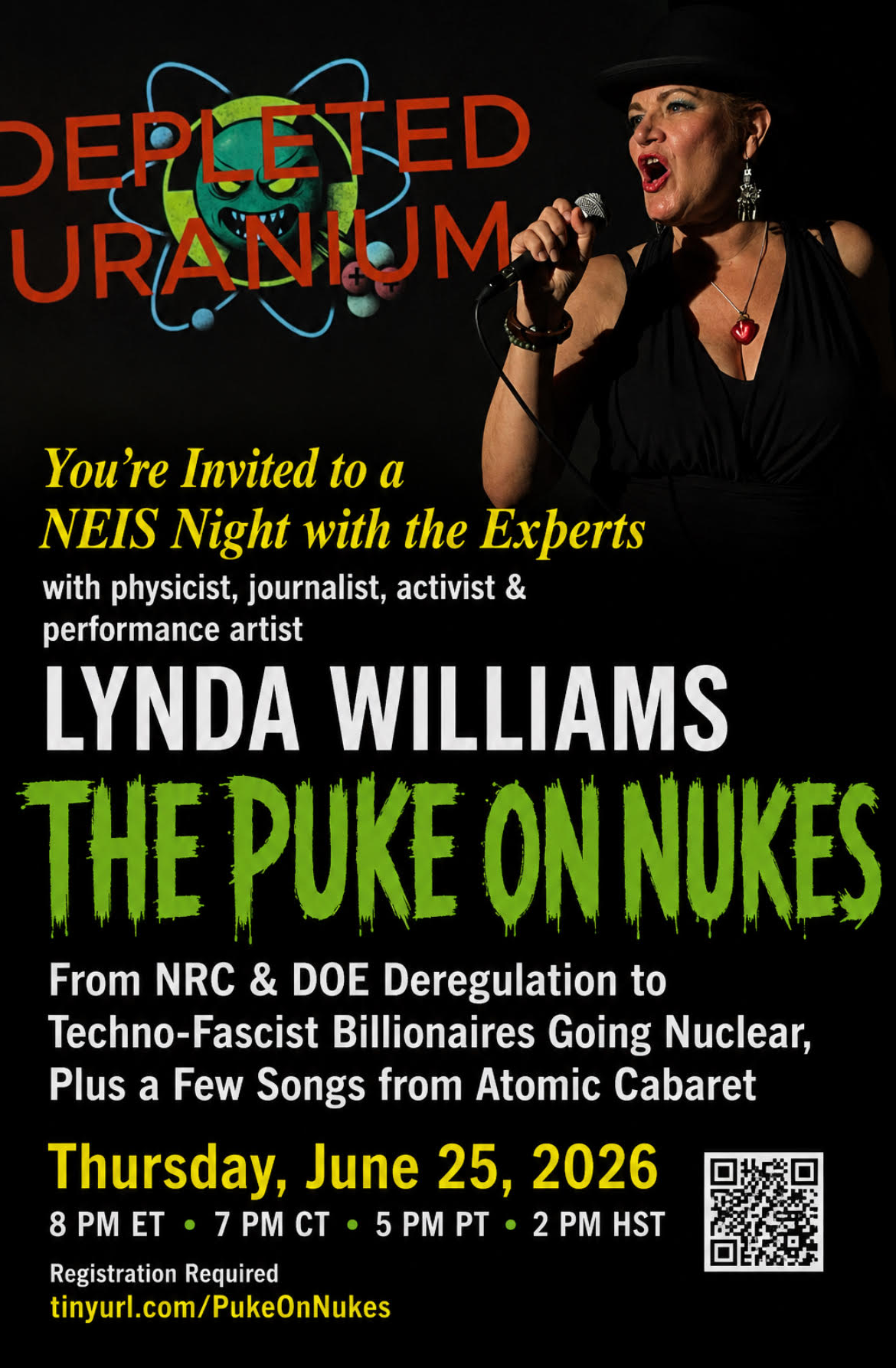
25 June- THE PUKE ON NUKES
Thursday, June 25, 2026
7pm Central Time (8pm ET, 6pm MT, 5pm PT) UTC – 5
From NRC & DOE Deregulation to Techno-Fascist Billionaires Going Nuclear, Plus a Few Songs from Atomic Cabaret REGISTER
26 June – Radiation Trainwreck at the NRC / Join the Protect Better Campaign – https://us02web.zoom.us/meeting/register/4ZlZ5_qLSHGiLSCg8FF6Bg#/registration

1st July – Webinar Waste of Space: The Environmental Harm of Military and Civil Space Activity st July, 7 pm

Report Launch Online: We are seeing an increasing exploitation of space for military and commercial purposes. This must change.

Protect Sazan Island from the Trump family! https://secure.avaaz.org/campaign/en/protect_sazan_island_from_the_trump_family_loc/?bqFCVab&v=174511&cl=22707147157&_checksum=5e9dde668860e8231c33699735e16a1fbf22ab2cb01da50c999fe8732b9775ef&utm_source=email&utm_medium=blast_email&utm_campaign=174511


Cuba Is Not a Failed State – It Is a Besieged State
PETITION: “Global Appeal to Endorse Palestinian Right of Return of Refugees”
To see nuclear-related stories in greater depth and intensity – go to https://nuclearinformation.wordpress.com
-
Archives
- June 2026 (241)
- May 2026 (306)
- April 2026 (356)
- March 2026 (251)
- February 2026 (268)
- January 2026 (308)
- December 2025 (358)
- November 2025 (359)
- October 2025 (376)
- September 2025 (257)
- August 2025 (319)
- July 2025 (230)
-
Categories
- 1
- 1 NUCLEAR ISSUES
- business and costs
- climate change
- culture and arts
- ENERGY
- environment
- health
- history
- indigenous issues
- Legal
- marketing of nuclear
- media
- opposition to nuclear
- PERSONAL STORIES
- politics
- politics international
- Religion and ethics
- safety
- secrets,lies and civil liberties
- spinbuster
- technology
- Uranium
- wastes
- weapons and war
- Women
- 2 WORLD
- ACTION
- AFRICA
- Atrocities
- AUSTRALIA
- Christina's notes
- Christina's themes
- culture and arts
- Events
- Fuk 2022
- Fuk 2023
- Fukushima 2017
- Fukushima 2018
- fukushima 2019
- Fukushima 2020
- Fukushima 2021
- general
- global warming
- Humour (God we need it)
- Nuclear
- RARE EARTHS
- Reference
- resources – print
- Resources -audiovicual
- Weekly Newsletter
- World
- World Nuclear
- YouTube
-
RSS
Entries RSS
Comments RSS
 nuclear-news