Powerful criticisms of Japan’s handling of the Fukushima nuclear crisis
 (NaturalNews), March 27, 2014 by: Ethan A. Huff, staff writerThe three-year anniversary of the Fukushima Daiichi nuclear disaster recently passed, and a prominent nuclear expert has come out in protest of the way both the Japanese government and the country’s nuclear industry continue to handle the situation. During a recent episode of the Nuclear
  Hotseat podcast, celebrity and lawmaker Taro Yamamoto lamented how the Tokyo Electric Power Company (TEPCO) is still downplaying the threat of radiation, which he believes will end up “sacrificing” 99.99 percent of the Japanese population. In Japan, stated Yamamoto, it is still taboo to even talk about radiation, even though its effects have been felt throughout the country and even beyond its borders. Insinuating that the country as a whole has essentially buried its head in the sand on this important issue, Yamamoto called out the nuclear industry in particular for minimizing the radioactive impact of Fukushima, which many now believe to be the worst nuclear accident in recorded history.
“Idiotic ideas — like restarting the nuclear plants — are being considered here in Japan,” stated Yamamoto during the interview. “I think it is wrong that people’s lives are being sacrificed because of money and the company profits… 99.99 percent of the people are being sacrificed.”
You can listen to this podcast episode here:
http://www.nuclearhotseat.com.
“[R]adioactive water is still leaking, there is still a very long way to go until it can be decommissioned, and we must be prepared for a long term battle which will go beyond the present generation,” wrote Fukushima resident Arao Shunsuke in a letter posted at DiaNuke.org. “Even now over 100,000 people from Fukushima are still living in miserable conditions in temporary housing.”
You can read Shunsuke’s full letter here:
http://www.dianuke.org………… http://www.naturalnews.com/044478_Japan_nuclear_industry_radiation.html#
Britain’s contradictory nuclear policies
the problem is that while the Home Office pursues various ways to minimise the dangers from and impact of failures in nuclear security, the Department for Energy and Climate Change is promoting the indigenous development of a new nuclear programme, with the attendant plutonium-based nuclear fuel cycle.
 Britain’s Flawed Nuclear Policy http://www.morningstaronline.co.uk/a-9771-Britains-flawed-nuclear-policy#.UzNRm_2gHDZ Under-informed ministers don’t seem to understand the impact of their twin-track policies of nuclear promotion and nuclear controls, writes DAVID LOWRY
At the biennial Global Nuclear Summit in The Hague this week ministers did not see their own policies as promoting nuclear proliferation.
But proliferators they are, just as ministers in the predecessor Labour government were.
It is part of the problem that underinformed ministers do not always recognise the the impact of their policies. But they urgently need to.
Perhaps they suffer from acute cognitive dissonance when pursuing their twin-track policies of nuclear promotion and nuclear controls. This is a term used by social psychologists when “incongruent relations among cognitions (thought and understanding)… result in excessive mental stress and discomfort.
“Individuals who hold two or more contradictory beliefs frequently experience cognitive dissonance.”
That’s a rather dangerous condition for senior decision-makers dealing with a technology that carries the twin dread threats of major accidents and malevolent misuse by determined terrorists.
In January at Lancaster House in London the Home Office, supported by the Ministry of Defence, Foreign Office and Atomic Weapons Establishment, hosted a major international conference of the Global Initiative to Combat Nuclear Terrorism, which Britain co-chairs.
Home Office Minister James Brokenshaw noted that “the impact of a terrorist attack involving chemical, biological, radiological or nuclear materials would be potentially catastrophic. Our focus is to ensure that the UK remains a hard target for any terrorist.
“National security is the first priority of this government,” he stressed.
Is it really? Brokenshaw said that the likelihood of terrorists obtaining a “functioning radiological or nuclear device” to attack Britain is “low,” though he provided no evidence of this.
And he did warn that “the International Atomic Energy Agency’s incident-tracking database records incidents of radiological and nuclear materials being found outside of regulatory control – and between 1993 and 2012 the trafficking database recorded 419 incidents of unauthorised possession and criminal activity relating to radiological or nuclear material. “The availability of nuclear material could increase as more nations adopt nuclear energy.”
The Global Initiative to Combat Nuclear Terrorism aimed to “strengthen global capacity to prevent, detect and respond to nuclear terrorism by conducting multilateral activities that strengthen the plans, policies, procedures and interoperability of partner nations,” the minister said.
Eighty-five nations are signed up to the Global Initiative, alongside four official observers – the EU, IAEA, Interpol and UNODC.
Britain had now developed a nuclear forensics capability which would allow it to investigate criminal acts involving nuclear materials, Brokenshaw claimed.
And he pointed out that nuclear forensics is just part of an interconnected picture.
Expertise had to be embedded and integrated into existing enforcement systems “to provide a seamless end-to-end capability for managing nuclear security incidents.”
Keeping us safe from nuclear accidents would require co-ordinated efforts across government, from the Foreign Office “leading counter-proliferation work overseas” and the Department for Energy and Climate Change ensuring that “robust security architecture exists at our civil nuclear sites.”
He went on to describe the Home Office’s Cyclamen programme, which aims to detect the illicit import of radioactive material.
It sounds impressive – using a combination of fixed and mobile equipment to screen vehicles, containers, freight and pedestrians for the presence of nuclear materials and operating at points of entry to the country 24 hours a day.
But the problem is that while the Home Office pursues various ways to minimise the dangers from and impact of failures in nuclear security, the Department for Energy and Climate Change is promoting the indigenous development of a new nuclear programme, with the attendant plutonium-based nuclear fuel cycle.
At the same time the Department for Business, Innovation and Skills (BIS) is pursuing the export of nuclear explosive materials in new nuclear fuels.
In so doing they are following the strategy initiated by the Labour government, which in 2009 published a document which claimed to “lay out a credible road map to further disarmament” but also proposed increasing the civilian nuclear trade across the world.
A year ago BIS published a suite of documents supporting the expansion of civil nuclear power in Britain and the nuclear export trade abroad.
The 128-page Nuclear Energy Research and Development Roadmap: Future Pathways document “assesses the needs and opportunities for nuclear energy R&D in the context of new build of nuclear generation capacity to levels required.”
It sets out “R&D pathways” to getting nuclear contributions to electricity generation up to 75 gigawatts by the middle of the century – “equivalent to approximately seven times the current level of installed nuclear power capacity.”
The perfect pro-proliferation model for would-be proliferators. At the start of the year the Washington DC-based Nuclear Threat Initiative (NTI) published its latest annual report.
The NTI is a non-profit, non-partisan organisation dedicated to strengthening global security by reducing the risk of nuclear weapons being used and by preventing the spread of nuclear, biological and chemical weapons.
NTI published a table in its report that ought to set alarm bells ringing in Whitehall, whatever Brokenshaw’s claims.
It assessed the nuclear materials security provisions of the 25 countries identified as having the technologies and materials necessary to produce nuclear weapons of mass destruction.
It placed Britain bottom. That should worry ministers. But they are fixated on promoting the growth of nuclear – and thus the risk of proliferation.
That way insanity and disaster lies.
Negligence of USA govt in not testing seafood for Fukushima radiation
School Science Project Reveals High Levels Of Fukushima Nuclear Radiation in Grocery Store Seafood Investment Watch By Michael Snyder March 27th, 2014 “……..Meanwhile, PBS reporter Miles O’Brien has pointed out the extreme negligence of the U.S. government when it comes to testing seafood for Fukushima radiation. The following comes from a recent EcoWatch article…
O’Brien also introduces us to scientists from the Woods Hole Oceanographic Institute who have been testing waters around the reactors—as well as around the Pacific Rim—to confirm the levels of Fukushima fallout, especially of cesium.
These scientists are dedicated and competent. But they are also being forced to do this investigation on their own, raising small amounts of money from independent sources. They were, explains lead scientist Ken Buesseler, turned down for even minimal federal support by five agencies key to our radiation protection. Thus, despite a deep and widespread demand for this information, no federal agency is conducting comprehensive, on-the-ground analyses of how much Fukushima radiation has made its way into our air and oceans.
In fact, very soon after Fukushima began to blow, President Obama assured the world that radiation coming to the U.S. would be minuscule and harmless. He had no scientific proofthat this would be the case. And as O’Brien’s eight-minute piece shows all too clearly, the “see no evil, pay no damages” ethos is at work here. The government is doing no monitoring of radiation levels in fish, and information on contamination of the ocean is almost entirely generated by underfunded researchers like Buesseler.
A video news report in which O’Brien discusses these issues is posted below https://www.youtube.com/watch?v=QIjJlK5EWOw
Fishing for data in the radioactive waters off Fukushima It is the job of the authorities to keep us safe, and the Fukushima nuclear disaster was the worst nuclear disaster in human history.
So why aren’t they doing testing?
Why aren’t they checking to make sure that this radiation is not getting into our food chain? Continue reading
UK socialises nuclear risk, privatises nuclear profits
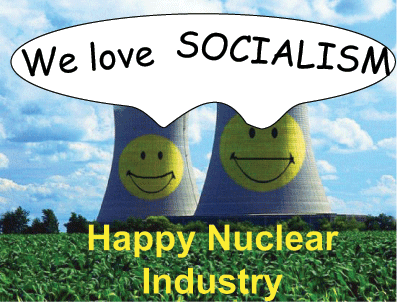 UK’s nuclear obsession will add costs to bills http://www.snp.org/media-centre/news/2014/mar/uks-nuclear-obsession-will-add-costs-bills Westminster’s damaging obsession with nuclear power will add “considerable costs” to consumer energy bills for decades to come – according to a leading energy firm.
A report by Scottish and Southern Energy (SSE) has said that the UK Government’s deal for the construction of two reactors at the Hinkley Point nuclear power station will see increased energy bills for the next 35 years.
The report also states: “One leading analyst, Peter Atherton, described it as “the most expensive conventional power station in the world” and a ‘clear case of socialising risk and privatising profits’.”
The new SSE report echoes warnings in a December report led by Dr David Toke from the University of Aberdeen – which also pointed to the increased costs to consumer bills from new nuclear power.
Scotland’s Future makes clear that after a Yes vote, the Scottish Government proposes to permanently transfer the responsibility for the Energy Company Obligation and the Warm Homes Discount from consumer bills to the government – reducing energy bills by around £70 per year on an ongoing basis, but also ensuring that vital energy efficiency measures go ahead – unlike under UK Government policy.
The taxpayer subsidy that the new Hinkley Point nuclear power station could receive dwarfs the amount offered to renewables. Hinkley Point could receive an estimated £35bn subsidy – over four times the cost of support to all renewable development across the UK over the last ten years.
The SNP has previously called upon the UK Government to provide appropriate investment and support for the renewables industry – rather than continuing to direct support at nuclear energy.
Commenting, SNP MSP Mike Mackenzie said:
“SSE has confirmed that the UK Government’s investment in nuclear will add costs to energy bills for the next 35 years– people in Scotland will be lumbered with the bill for Westminster’s obsession with nuclear power.
“As SSE points out, energy experts have highlighted the risks and costs associated with nuclear energy – and last year the European Commission has also warned that nuclear power could push up energy prices for consumers.
“Scotland has the potential to be the renewables powerhouse of Europe – a Yes vote will allow Scotland to take action to prioritise our incredible renewable resources, and cut energy bills by around £70 a year on a permanent basis.”
SSE’s report can be found here: http://sse.com/media/204699/SSE-RESPONSE-TO-LABOUR-PARTY-GREEN-PAPER-MARCH-2014.pdf
The paper states: “the deal which the UK government has reached with EdF over the construction of two reactors at Hinkley Point, which will add considerable costs to consumer energy bills for 35 years. One leading analyst, Peter Atherton, described it as “the most expensive conventional power station in the world” and a ‘clear case of socialising risk and privatising profits’.”
The Scottish Government’s plans to reduce energy bills by 5% are set out on Page 516 of Scotland’s Future.
Previous SNP calls for the UK Government to support renewables rather than nuclear can be found here:http://www.snp.org/media-centre/news/2014/jan/uk-government-urged-support-offshore-renewables
On 18 December 2013, the European Commission stated that new nuclear costs will likely push up consumer bills, stating Hinkley C “could hardly be argued to contribute to affordability – at least at current prices, when it will instead and most likely contribute to an increase in retail prices.”
Report: “Is an Independent Scottish Electricity System now a good solution for renewable energy?” Led By David Toke (University of Aberdeen), 4 December 2013
“We previously argued that, relative to remaining with the Union, Scottish Independence could substantially increase the cost to Scottish consumers of achieving its renewable energy targets. However, having reviewed the impact of the [UK] Government’s recent decisions on nuclear power and incentives for renewables, we believe that this is no longer the case.
Barack warns of nuclear terrorism, but Homeland Security cuts NYPD bomb detection funding
Homeland Security To Cut NYPD Bomb Detection Funding After Obama Says NYC Nuclear Blast Bigger Concern Than Russia NEW YORK (CBSNewYork/AP), 26 Mar 14, – Less than 24 hours after President Barack Obama said he’s more concerned about the prospect of a nuclear weapon exploding in New York City than Russia’s recent actions, Homeland Security officials announced plans to cut the NYPD’s bomb detection funding by 50 percent….. http://newyork.cbslocal.com/2014/03/26/obama-nuclear-blast-in-nyc-bigger-concern-than-russia/
‘Americans For Prosperity’ sabotaging renewabl energy
 How can renewable-energy supporters compete with Kochs? We Blog, 27 March 14 “……the Senate approved a bill revoking the state’s renewable portfolio standard. The standard has helped generate billions of dollars of investment in Kansas and is overwhelmingly supported by the public, according to a recent survey. But the standard is opposed by the Koch-backed Americans for Prosperity and Kansas Chamber of Commerce, which spent more than a million dollars last election purging moderates from the state Senate.
How can supporters of renewable energy, which includes faith groups, compete with those resources? http://blogs.kansas.com/weblog/2014/03/how-can-renewable-energy-supporters-compete-with-kochs/
Nuclear power is getting just too expensive for South Africa
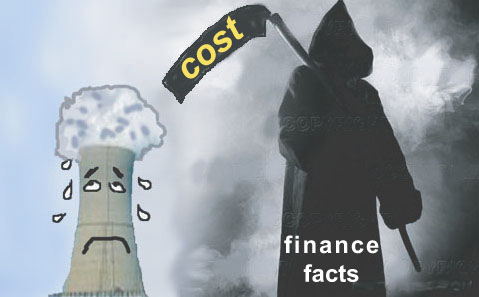 Nuclear development in South Africa likely on hold unless funds incorporated from private sector, Enformable Lucas W Hixson 19 Mar 14 South African President Jacob Zuma and Energy Minister Ben Martins have continuously committed the nation to build up a nuclear industry.
The government has adopted a 20-year Integrated Resource Plan (IRP) which says that coal, nuclear, hydro, shale gas, and renewable energy are all included in potential generation methods of increasing the nation’s power supply. The IRP is revised every two years, the latest update proposes that the nation delay construction of more nuclear plants and instead focus more on coal, hydro and gas.
Energy Minister Martins has said that South Africa’s goal is to be self-sufficient in all aspects of the nuclear energy industry, but there are concerns about whether South Africa’s construction industry is even large enough to handle the additional resources and manpower which would be required.
President Zuma announced that the South African government would work to procure 9,600 MW of energy from nuclear power, based on the IRP released in 2010. The new IRP said that little or no nuclear power will be required.
If President Zuma’s goal of installing 9,600 MW of nuclear energy, the government must find at least 1 trillion rand ($93.2 billion USD), to support a nuclear fleet of three new nuclear power plants in South Africa.
On Tuesday, Rob Adam, president of the Nuclear Industry Association of South Africa and director of the construction group Aveng, spoke at an energy conference in Johannesburg and told attendees that the government would likely be forced to incorporate funds from the private sector to invest in the nuclear industry in South Africa…….
Eskom is not currently fiscally stable enough to finance a nuclear power plant. According to experts in South Africa, given the nation’s tight fiscal budget, it is extremely unlikely that the government would be able to allocate any funds for the proposed nuclear build.
The nuclear proposal is seemingly causing a rift in the South African government. Some agencies like the departments of energy, public enterprises, trade and industry to name a few are big proponents of a nuclear build, while other agencies like the National Planning Commission and the treasury are concerned with the high costs of nuclear energy. http://enformable.com/2014/03/nuclear-development-south-africa-likely-hold-unless-funds-incorporated-private-sector/
EDF and others set to make big profits from Britain’s tax-payer subsidised nuclear power
 Returns on EDF’s UK nuclear deal much higher than usual: report BY KAROLIN SCHAPS LONDON Mon Mar 17 (Reuters) – Returns for French utility EDF (EDF.PA) and other investors in Britain’s first new nuclear plant in two decades, supported by the government, are much higher than for other projects, according to a report by a cross-party think-tank.
EDF plans to start operating the first new nuclear reactor at the Hinkley Point C site in southern England in 2023. The British government will guarantee a loan to finance the project as well as a fixed minimum price for the electricity it generates for 35 years.
The investors could earn a return of up to 21 percent over the lifetime of the project, Carbon Connect analysts said in a report, which was chaired by a former British conservative energy minister, Charles Hendry.
“Expected equity returns on Hinkley Point C are around 19 to 21 percent, substantially higher than expected equity returns on Private Finance Initiative (PFI) projects and regulated electricity network assets,” the report said on Tuesday.
By comparison, returns are typically 12 to 15 percent for PFI projects and 8 to 10 percent on regulated networks, it said.
The European Commission is investigating whether Britain’s support for nuclear complies with European Union state aid rules. Continue reading
Plutonium rush in Japan, as ‘Nuclear Village’ still in control
Plutonium fever blossoms in Japan Cronyism, influence-buying and a stifling of dissenting voices have kept the Japanese nuclear industry going strong after the Fukushima disaster,  critics say Center for Public Integrity By Douglas Birch
 R. Jeffrey SmithJake Adelstein 12 Mar TOKYO — When Taro Kono was growing up as the son of a major Japanese political party leader, he had what he calls a “fever for the atom.”
  Like many of his countrymen, he regarded nuclear power plants as his country’s ticket to postwar prosperity, a modern, economical way to meet huge energy needs on an island with few natural resources. pro-nuclear sentiment led Japan to build the world’s third largest fleet of nuclear reactors. Its officials spent more than two decades and $22 billion building a factory to create plutonium-based nuclear reactor fuel, the largest ever to be subject to international monitoring. The facility is slated for completion in October at Rokkasho on Japan’s northeast coast,
  kicking off a new phase in the country’s long-term plan to increase energy independence.
The government of Prime Minister Shinzo Abe, who leads Kono’s party, announced in February its support for restarting some reactors and possibly building new ones, designed specifically to burn plutonium-based fuel.
Abe did so with apparent confidence that he has the enduring support — if not of the public — of the so-called “nuclear power village,” a tightly-woven network of regulators, utility industry executives, engineers, labor leaders and local politicians who have become dependent on nuclear power for jobs, income, and prestige.
Kono, a fluent English-speaker who received his undergraduate degree from Georgetown University, said in an interview that he has been talking about nuclear power “for the last 16 to 17 years,” but “no one really paid attention, right?”
Kono was unable to defeat the plutonium fuel program, he said, because its powerful constituency includes not only members of the ruling party, but bureaucrats, media leaders, bankers and academics. They were, he wrote in a 2011 book, “all scrambling for a place at the table” where nuclear-related funds are distributed. The louder he complained, the more these elites turned their backs on him. Just 60 legislators out of 722 in the parliament’s lower and upper chambers have joined the anti-nuclear caucus he helped organize………http://www.publicintegrity.org/2014/03/12/14394/plutonium-fever-blossoms-japan
Like Japan, UK seems to be developing an academic ‘Nuclear Village’
The nuclear industry has control of policy in Japan. That’s for sure. I’m just wondering how many other countries are falling under the spell of nuclear industry’s money and influence. Looks as if Britain is well on the way

Closer collaboration announced between the University of Bristol and the National Nuclear Laboratory , University of Bristol 12 Mar 14 The University of Bristol and the UK’s National Nuclear Laboratory have signed a statement of intent to work more closely to explore opportunities in joint research, R&D and training, which will provide support to industry aligned with the Government’s Nuclear Industrial Strategy……..
The Nuclear Research Centre (NRC), formed by the University in partnership with Oxford University in 2011, aims to strengthen nuclear energy related research and teaching in the region to support the delivery of the Government’s strategy on low-carbon, secure energy.
Recently the University has been re-establishing its existing relationships with a number of strategic industrial partners, and this includes the recent signing of a ‘Statement of Intent’ with NNL to support the growing need for a physical research hub in the South West…….http://www.bristol.ac.uk/news/2014/march/national-nuclear-laboratory.html
USA not happy about Japan’s plutonium plan
- Key findings: http://www.publicintegrity.org/2014/03/12/14406/key-findings
Japan’s nuclear industry has taken a beating in public opinion due to cost overruns, technical glitches and accidents like the Fukushima disaster two years ago next week. - Despite this, support for the Rokkasho plant among the country’s leaders remains high because of a tightly-woven network of regulators, utilities, labor leaders and local politicians who are dependent on a continuing stream of funding for nuclear power.

- Japan’s enthusiasm for nuclear power has been nurtured by the utilities, which spent $27 billion on advertising over the past four decades and lavished contributions on members of the leading Japanese political party.
- Although the government’s policy has long ruled out the production or possession of nuclear arms, some Japanese politicians have supported the production of additional plutonium on grounds that it sends a useful signal to potential aggressors about Japan’s capability to make such weapons.
- Eager to block that development, the U.S. has brought a stream of Japanese diplomats and military officers into highly restricted nuclear weapons centers to remind them of the robustness of the U.S. nuclear deterrent. They also have gently urged Japan not to take steps that would add to its existing plutonium stocks. But neither of these steps amounts to firm advice that Rokkasho should not be opened.

‘Atomic Abe’ taking Japan into a dangerous nuclear situation
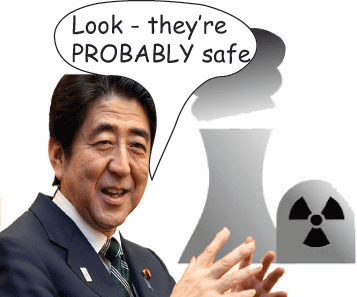 Nuclear energy costs still rising, three years on from Fukushima, SMH, 11 Mar 14 #……Atomic Abe The arrival of Abe as prime minister in December 2012, gave a boost to the pro-nuclear camp. Cutting energy costs is part of his plan to revitalize the economy.
Abe’s push on nuclear shows how polarizing the issue is in Japan.
At least three former prime ministers have publicly opposed the current premier on reactor restarts, including Junichiro Koizumi, Abe’s mentor and one of Japan’s most-popular postwar leaders. Naoto Kan, prime minister at the time of the 2011 quake, is another.
“The reason I’m against nuclear is that people cannot fully control it,” Kan told reporters in a briefing in December.
Industrial accidents can happen, but nothing on the scale of nuclear, he said. A worst-case scenario for Fukushima would have made a third of Japan’s land uninhabitable, Kan said. Opponents also point to the cost of nuclear accidents. The government has estimated it’ll take 11 trillion yen and 40 years to clean up the Fukushima site.
Japan Inc
The former prime ministers find themselves in an unusual place on the opposite side of the argument from Japan Inc.,……..http://www.smh.com.au/environment/nuclear-energy-costs-still-rising-three-years-on-from-fukushima-20140311-34ii6.html
Senator Markey introduces Bill to cut $100 billion in nuclear weapons spending
 Markey Files Bill to Cut $100 Billion in Nuclear Arms Fundshttp://www.nationaljournal.com/global-security-newswire/markey-files-bill-to-cut-100-billion-in-nuclear-arms-funds-20140228 By Rachel Oswald February 28, 2014
A high-profile U.S. Senate critic of nuclear-weapons spending on Friday introduced a bill that would cut $100 billion over the next decade in arsenal outlays.
The Smarter Approach to Nuclear Expenditures — or “SANE” — Act, filed by Senator Edward Markey (D-Mass.), is co-sponsored by Senator Jeff Merkley (D-Ore.). Companion legislation has been introduced in the House by Representative Earl Blumenauer (D-Ore.).
“America faces a real choice: spend billions on nuclear weapons we no longer need or fund programs that educate our children and help find cures to deadly diseases,” Markey said in provided comments. Continue reading
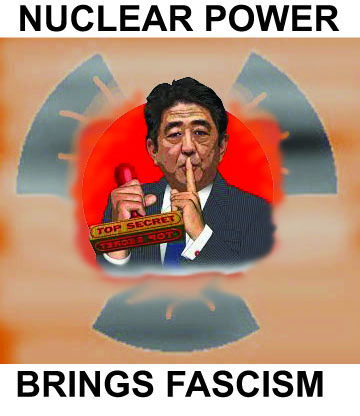
Nuclear power destroying democracy in Japan. And Beyond?
 “Shock & Outrage”: Japan TV host reveals being told he cannot discuss nuclear power until pivotal Tokyo election ends — “Somebody needs to bring these issues into the media” — #2 in trending news http://enenews.com/shock-outrage-japan-tv-host-reveals-being-told-he-cannot-discuss-nuclear-power-until-pivotal-tokyo-election-ends-somebody-needs-to-bring-these-issues-into-the-media
TokyoReporter’s tweet, Jan. 22, 2014: Radio host Peter Barakan says broadcasters told him to avoid nuclear issues till after poll
Nuclear Power Brings Fascism
 Is Nuclear Experimentation Fascism? OpEdNews Op Eds 1/22/2014 opednews.com By Ethan Indigo Smith Contributing Writer for Wake Up World “…..The United States was formerly one of the few anti-institutional, anti-oligarchical nations in the world, but we have succumbed to the oligarchical corporaculture that has been pushed for the last couple of hundred years, whether fused by labels like the divine rite of kings or by corporate personhood. The United States used to push for individual rights, but now we yield to violent fascism just like the rest of the intolerant world. Hell, we were once so anti-fascist and anti-oligarchy that it used to be illegal to do business in more than one American state, now the police and political system seems to only serve and protect business interests. But at what cost?
Imagine if this culture of anti-fascism were still the case, perhaps none of us would ever question our water supply, hijacked for a nuke plant or polluted by a petroleum conglomerate”.
Learning from History
Recent events at Fukushima have highlighted the uncontainable dangers of nuclear experimentation. If one examines trends, there are bound to be more accidents, spills and “unprecedented events’ within the nuclear industry.
The first nuclear power generation experiment began at Oak Ridge in 1948, and first massive one began in the Soviet city of Obninsk in 1954. In the 65 years that followed, there have been numerous known meltdowns at nuclear facilities around the world, as well as environmental, human and political destruction at other sites that did not (by luck only) experience full meltdown.
HANFORD, USA, 1943 — 1987…….
BIKINI ATOLL, NORTHERN PACIFIC OCEAN, 1946…….
WINDSCALE FIRE, UK, 1957….
SANTA SUSANA, USA, 1959…….
THREE MILE ISLAND, USA, 1979…….
CHERNOBYL, UKRAINE, 1986…..
ROCKY FLATS PLANT, USA 1987…..
FUKUSHIMA DAIICHI, JAPAN 2011….
WHO IS NEXT?
The list goes on. And while this is a short summary of some of the nuclear industry’s worst failings — both environmental and political — what it does not take into account that there are now over four hundred nuclear power generation experiments in operation worldwide, and more being built, each one representing another potential disaster. Now factor in the endless radioactive pollution and dumped material (buried and sunken near you) involved in the process even when things go “right’ (by nuclear industry standards) and you get a clearer view of the impact of nuclear experimentation.

Under the terms of current policy, the US Federal Government simply incurs the financial costs and burden of dealing with nuclear “events'”. and by the “Federal Government’ I mean the U.S. taxpayer.
Regimentation of Industry
Today, the United States of America is fascist. So is China, Japan, Russia, France, England, Japan and every single nuclear nation. Australia is de facto fascist, being a major extractor of uranium for the nuclear fuel chain. The United States of America is fascist by way of one single act: The Price Anderson Nuclear Industries Indemnity Act. There are many more acts and laws that strengthen nuclear fascism in the United States, but The Price Anderson Act seals the deal. Its main purpose is to indemnify the nuclear industry against liability claims arising from nuclear incidents. And other countries have their own nuclear deals which also guarantee that those who profit from the nuclear industry are not held accountable for their work………
Clearly nuclear experimentation does not co-exist alongside freedom of speech or transparent access to information. It can only exist in a fascist state, which suppresses information and opposition.
Severely Nationalistic Policies
The only part of the definition of fascism that nuclear experimentation does not technically fit is that nuclear experimentation operates on an international level, not just a nationalistic one. However it seems even nuclear disaster rings opportunity bells for nationalistic governments.
As reported by Bloomberg in 2013, “Japan will receive international help with the cleanup at the Fukushima atomic station once it joins an existing treaty that defines liability for accidents at nuclear plants, U.S. Energy Secretary Ernest Moniz said.” This means that the United States’ “offer” of assistance is conditional upon Japan signing onto an international convention known as the Convention on Supplementary Compensation for Nuclear Damage, designed only to protect US nuclear interests from liability in the event of an accident. The U.S. Government has lobbied for the international adoption of the convention for many years, and now it seems it has Japan over a barrell. Surely this political opportunism qualifies as “severely nationalistic’ behaviour. Yet it in the United States, it seems we can barely distinguish this kind of fascism from the actions of true democratic government…….
Nuclear experimentation is destructive on a level that supersedes our common understanding of time and space. The nuclear industry is risking the unriskable. Nuclear experimentation is political and it’s fascism. I’m only left to wonder”. did the institutions involved in nuclear experimentation design themselves according to the definition of fascism, or do they naturally fit the definition that perfectly?…..http://www.opednews.com/articles/Is-Nuclear-Experimentation-by-Ethan-Indigo-Smith-Fukushima_Nuclear-Cover-up_Nuclear-Meltdown_Nuclear-Waste-140122-627.html
1 This Month
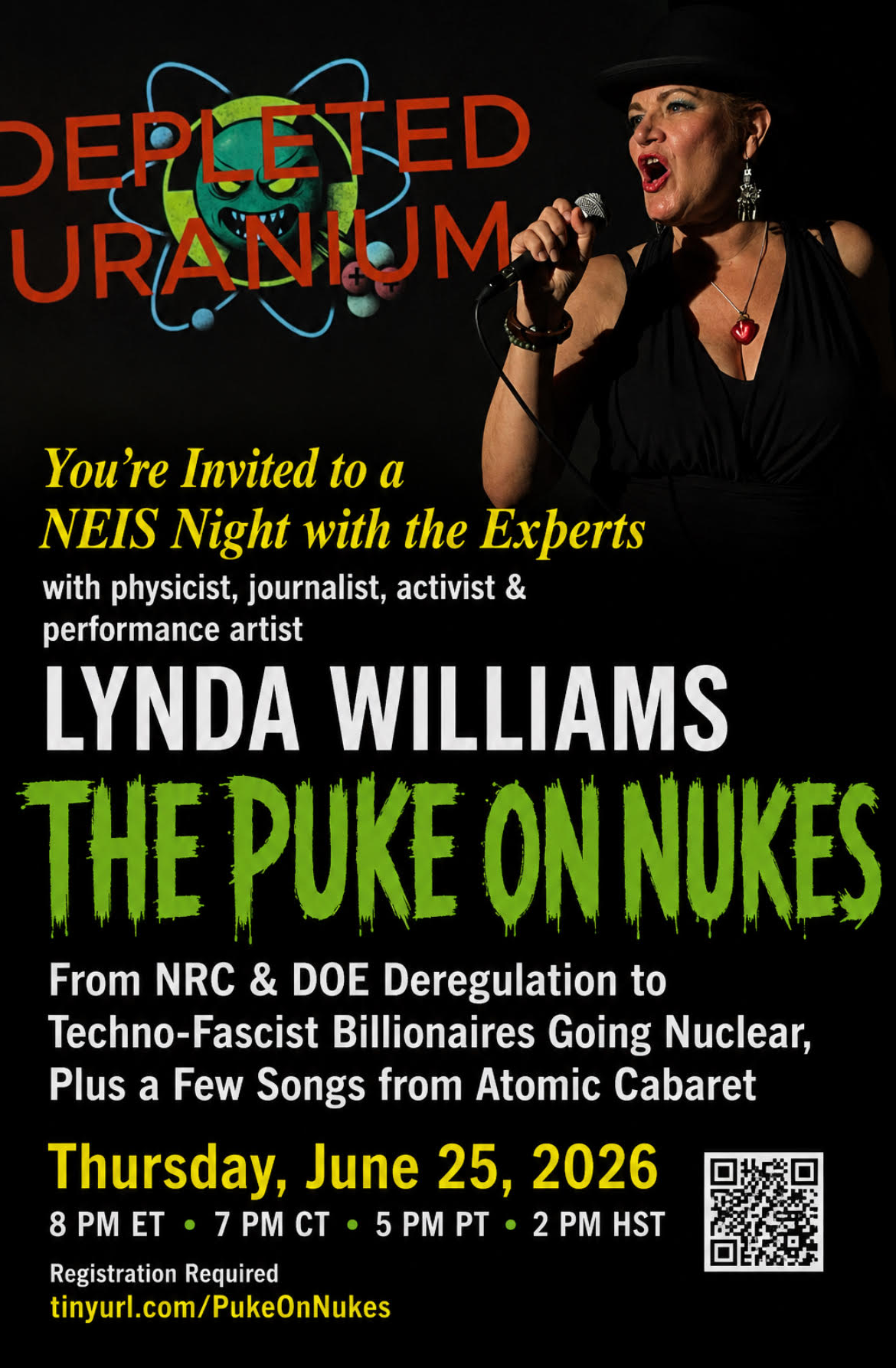
25 June- THE PUKE ON NUKES
Thursday, June 25, 2026
7pm Central Time (8pm ET, 6pm MT, 5pm PT) UTC – 5
From NRC & DOE Deregulation to Techno-Fascist Billionaires Going Nuclear, Plus a Few Songs from Atomic Cabaret REGISTER
26 June – Radiation Trainwreck at the NRC / Join the Protect Better Campaign – https://us02web.zoom.us/meeting/register/4ZlZ5_qLSHGiLSCg8FF6Bg#/registration

1st July – Webinar Waste of Space: The Environmental Harm of Military and Civil Space Activity st July, 7 pm

Report Launch Online: We are seeing an increasing exploitation of space for military and commercial purposes. This must change.

Protect Sazan Island from the Trump family! https://secure.avaaz.org/campaign/en/protect_sazan_island_from_the_trump_family_loc/?bqFCVab&v=174511&cl=22707147157&_checksum=5e9dde668860e8231c33699735e16a1fbf22ab2cb01da50c999fe8732b9775ef&utm_source=email&utm_medium=blast_email&utm_campaign=174511


Cuba Is Not a Failed State – It Is a Besieged State
PETITION: “Global Appeal to Endorse Palestinian Right of Return of Refugees”
To see nuclear-related stories in greater depth and intensity – go to https://nuclearinformation.wordpress.com
-
Archives
- June 2026 (241)
- May 2026 (306)
- April 2026 (356)
- March 2026 (251)
- February 2026 (268)
- January 2026 (308)
- December 2025 (358)
- November 2025 (359)
- October 2025 (376)
- September 2025 (257)
- August 2025 (319)
- July 2025 (230)
-
Categories
- 1
- 1 NUCLEAR ISSUES
- business and costs
- climate change
- culture and arts
- ENERGY
- environment
- health
- history
- indigenous issues
- Legal
- marketing of nuclear
- media
- opposition to nuclear
- PERSONAL STORIES
- politics
- politics international
- Religion and ethics
- safety
- secrets,lies and civil liberties
- spinbuster
- technology
- Uranium
- wastes
- weapons and war
- Women
- 2 WORLD
- ACTION
- AFRICA
- Atrocities
- AUSTRALIA
- Christina's notes
- Christina's themes
- culture and arts
- Events
- Fuk 2022
- Fuk 2023
- Fukushima 2017
- Fukushima 2018
- fukushima 2019
- Fukushima 2020
- Fukushima 2021
- general
- global warming
- Humour (God we need it)
- Nuclear
- RARE EARTHS
- Reference
- resources – print
- Resources -audiovicual
- Weekly Newsletter
- World
- World Nuclear
- YouTube
-
RSS
Entries RSS
Comments RSS
 nuclear-news