Fukushima disater recovery funds to be used for Olympic events?
 Tokyo Gov. Masuzoe wants to use disaster recovery funds for Olympic events in Tohoku Mainichi, 18 Feb 15 Tokyo Gov. Yoichi Masuzoe says he will ask the central government to use part of the Tohoku tsunami disaster reconstruction budget to cover the costs of staging some events for the 2020 Tokyo Olympics and Paralympics in areas that were severely affected by the 2011 disaster……..
There is a rough road ahead for Masuzoe’s plan, however, as some Tohoku residents say that spending the reconstruction budget on the Olympics will not win support from the local community……http://mainichi.jp/english/english/newsselect/news/20150213p2a00m0na016000c.html
Many a slip before there’s any Takahama nuclear restart
Local approval is no given for Takahama nuclear restarts , Japan Times 17 Feb 15 FUKUI – Kansai Electric Power Co. wants to fire up its Takahama nuclear plant as soon as possible, but it has cleared only one hurdle in securing a green light from regulators. The next could be difficult: obtaining the consent of local officials.
Areas within 30 km of the plant must have evacuation plans for all residents. Although the plant is located in Fukui Prefecture, the evacuation zone sweeps into Kyoto and Shiga prefectures, and they fear for a repeat of a crisis like the Fukushima meltdowns.
The Nuclear Regulation Authority declared last week that the No. 3 and No. 4 reactors of the Takahama plant meet safety standards.
But Yutaka Nose, mayor of Takahama, called on the NRA to explain what that green light means. He suggested that it record a video for town residents to watch via a local cable television network.
Nose said he himself will only decide whether to approve the restarts after consulting residents.
Fukui Gov. Issei Nishikawa plans to decide in line with the recommendations of a panel of experts conducting an independent assessment at the prefectural government’s behest. He will also, he said, consider sentiment in the town and the prefectural assembly.
Along with the NRA’s safety certificate, Kansai Electric needs to win approval for the systems and facilities it would deploy in the event of an accident.
Nishikawa said he will take everything into account in deciding what to do.
It is unlikely that there will be much progress before April’s gubernatorial election.
If the Sendai nuclear plant in Kagoshima Prefecture is anything to go by, approval could be months away at least. Approval is still pending for a resumption of life at that plant’s No. 1 and No. 2 reactors, even though the NRA gave a thumbs-up in September……..
Taizo Mikazuki, governor of Shiga Prefecture, part of which also falls within the 30-km radius, maintains that he will not endorse the restart of the reactors unless the Takahama plant introduces an “effective” safety system.
Mikazuki was elected last July on a pledge of seeking to phase out nuclear power.
He has warned that in the event of an accident, the fallout won’t respect prefectural boundaries. He believes reactivating nuclear plants should be a matter for other prefectures, not just the one that hosts the plant……
Nishikawa recognizes that there is concern in the Kyoto and Shiga prefectural governments, and therefore he has called on the central government to explain why the reactors need to be restarted. http://www.japantimes.co.jp/news/2015/02/17/national/local-approval-given-takahama-nuclear-restarts/#.VOPwQOaUcnk
South Africa’s secretive and super- expensive nuclear power plans
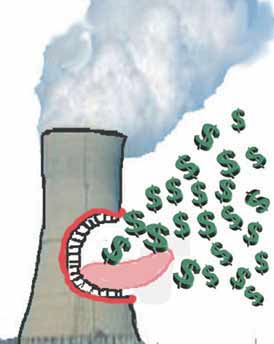
 Govt in R1trillion nuclear strategy, Business Report South Africa February 16 2015 Paul Burkhardt, Mike Cohen and Franz Wild THE GOVERNMENT is forging ahead with plans to spend as much as R1 trillion on new nuclear plants, ignoring objections from environmental activists, opposition parties, unions and even its own advisers.
Bids would be sought from the US, China, France, Russia and South Korea to add 9 600 megawatts of atomic power to the national grid to address energy shortages in Africa’s second-largest economy, President Jacob Zuma said in his annual State of the Nation address on Thursday. The first output was targeted for 2023, he said.
“We know exactly what we need,” Zuma said on Friday. “We are now well-informed. We are moving ahead.”……..
Detractors of the nuclear plan argue that the plants will be too costly, take too long to build and that the bidding process will be vulnerable to corruption. The National Development Plan, the government’s blueprint for growing the economy, recommended that alternatives be investigated, including the use of gas plants, which would be easier to finance and build.
More expensive
“Nuclear is not a wise choice for South Africa,” Anton Eberhard, a member of the National Planning Commission that advises on implementing the development plan and a professor at the University of Cape Town on February 11. “Nuclear energy will not enable us to resolve our immediate power crisis. It is more expensive than other energy options.”
A 20-year plan published by the energy minister in December 2013 said the decision on whether to build new nuclear plants could be delayed until at least 2025 to allow for a proper assessment of alternatives and likely power demand.
Areva, EDF, Toshiba’s Westinghouse, China Guangdong Nuclear Power, Rosatom and Korea Electric Power have expressed interest in building new plants in South Africa.
The DA said the nuclear bidding process had been clouded by secrecy and had the potential for corruption. The party called on Zuma to abandon it. The National Union of Mineworkers, an ally of the ruling ANC, said nuclear power was not a priority and more focus should be placed on completing two new coal-fired power stations that were running behind schedule.
Greenpeace, an environmental activist group, staged a protest against nuclear energy at an industry meeting in Cape Town on Thursday.http://www.iol.co.za/business/international/govt-in-r1trillion-nuclear-strategy-1.1818515#.VOPqeuaUcnk
Nuclear subsidies for Hinkley Point facility will cost far more than is claimed
 Nuclear Subsidies NuClear News, Feb 2015 The Energy Fair group has examined (1) the findings by the Directorate General for Competition of the European Commission (EC) (2) that, with regard to the proposed new nuclear power plant at Hinkley Point, “the package of measures notified by the UK involves State aid which, as amended by the commitments provided, is compatible with the internal market.
Crumbling Davis-Besse Nuclear Plant to be kept alive by Ohio public $billions?
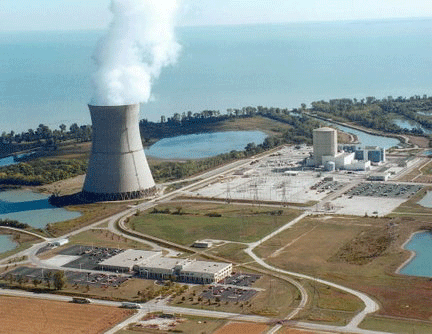 Will Ohioans Be Forced to Pay the Bill to Keep the Crumbling Davis-Besse Nuke Plant Alive? http://ecowatch.com/2015/02/14/ohioans-pay-bill-keep-davis-besse-alive/
Now the plant’s owners are asking the Ohio Public Utilities Commission to force the public to pay billions of dollars over the next 15 years to subsidize reactor operations.
But Davis-Besse’s astonishing history of near-miss disasters defies belief. Its shoddy construction, continual operator error and relentless owner incompetence would not be believed as fiction, let alone as the stark realities of a large commercial reactor operating in a heavily populated area.
Time and again Davis-Besse has come within a fraction of an inch and an hour of crisis management time. Today its critical shield wall is literally crumbing, with new cracks opening up every time the northern Ohio weather freezes (like this week).
The company’s owners have blacked out the entire Northeast including 50 million customers—the largest such disaster in world history.
They allowed boric acid to eat within 3/16th of an inch of a Chernobyl-scale disaster that would’ve permanently irradiated the Great Lakes region. They have set the record for fines by the Nuclear Regulatory Commission, and continue to drain billions of ratepayer dollars from Ohio’s bleeding economy.
Now they want those ratepayers to fork over billions more to keep this reactor running beyond the brink.
Hear about Davis-Besse’s astonishing story, by listening to this incredible hour-long interview with local attorney Terry Lodge and Kevin Kamps of Beyond Nuclear, along with Tim Judson of the Nuclear Information and Resource Service, three of the key expert activists working to get Davis-Besse shutdown.
Many wild stories have been told about atomic power over the decades, but it’s hard to top the true tales from Davis-Besse. In this case, hearing is believing—and holding your head in dismay:
Those of you who want Davis-Besse shut can write the Public Utilities Commission of Ohio at docketing@puc.state.oh.us. Use this label in the subject line of the email, as well as the body of the email message, so PUCO can route the public comments to the correct proceeding: OPPOSITION COMMENT UNDER CASE # 14-1297-EL-SSO.
Political factors and funding problems delay South Africa’s new nuclear reactor
 Nuclear reactor now delayed until 2025 IOL February 13 2015 Cape Town – The nuclear industry says “political delays” have pushed the completion date for the country’s first new nuclear reactor from 2023 to 2025.
Nuclear Industry Association of South Africa (Niasa) managing director Knox Msebenzi told delegates at the 2nd Nuclear Industry Congress in Africa 2015 in Sea Point yesterday that the association had met some nuclear vendors wanting to sell their technology to South Africa, and would meet others. The vendors the industry was talking to were Areva, Westinghouse, Rosatom, Kepco (Korea Electric Power Corporation) and China’s State Nuclear Power Technology Corporation (SNPTC).
“The first plant was due in 2023, but it’s been very delayed. Part of the delay has to do with politics. The latest date is 2025, but there may be other delays. Maybe we’re perceived by government as not ready. We’ve got many vendors wanting to participate,” Msebenzi said…….
Msebenzi quoted International Atomic Energy Agency director-general Yukiya Am-ano, who said the two biggest challenges facing any country that embarked on a nuclear energy programme were funding and human resource capability. He dismissed the funding issue: “Funding is not up to the industry, it is really for government to look after,” Msebenzi said……..
National Treasury said this month no money had been budgeted for the nuclear build programme in the next three years. http://www.iol.co.za/scitech/technology/news/nuclear-reactor-now-delayed-until-2025-1.1818031#.VN5jT-aUcnk
More approvals still needed for restart of two Japanese nuclear reactors
 Two more Japan nuclear reactors get safety clearance TOKYO Thu Feb 12, 2015 (Reuters) – Japan’s atomic regulator on Thursday cleared a second set of reactors for restart, another step towards returning the country to nuclear power after the Fukushima disaster of 2011 led to the shutdown of all units.
Two reactors at the Takahama nuclear station operated by Kansai Electric Power, Japan’s most nuclear-reliant utility before Fukushima, passed the basic standards for operation, Nuclear Regulation Authority (NRA) commissioners said at a meeting.
They must still get approval from the NRA on design upgrades and go through operational checks, as well as get the greenlight from local authorities to restart……..
Japan’s public remains opposed to atomic power, but Prime Minister Shinzo Abe’s government has been pushing to restart nuclear reactors that meet strict rules set after the Fukushima disaster. http://in.reuters.com/article/2015/02/12/japan-nuclear-restarts-idINKBN0LG07C20150212
Chicago Mayor Rahm Emanuel joins coalition for renewable energy, and against nuclear

 Emanuel lines up with Exelon critics to push clean-power agenda, Crains, Chicago Business 4 Feb 15 By STEVE DANIELS Chicago Mayor Rahm Emanuel is joining a new coalition of environmentalists, renewable energy companies and labor leaders to lobby Springfield for stronger policies favoring wind and solar power, as well as energy efficiency.
The Illinois Clean Jobs Coalition, whose formation was announced today at Testa Foods on the Southwest Side, notably didn’t include Exelon, the state’s largest power generator, which is preparing to lobby state lawmakers for a financial rescue plan for its six nuclear plants in Illinois.
Emanuel’s unusual participation in the group potentially sets up the mayor as a political foe of Exelon, which in the past has counted on Chicago politicians, notably Emanuel’s predecessor, Richard M. Daley, for political support at the state level.
Speaking at a press conference, Emanuel endorsed the group’s call to boost the state’s already-ambitious renewable energy goal to 35 percent of the power generated in the state by 2030. Current state law calls for 25 percent renewable power by 2025.
The coalition also wants state lawmakers to boost energy efficiency standards to a 20 percent reduction in power consumption by 2025. State law now calls for annual improvements in efficiency, with a mandate to cut power consumption by 2 percent this year.
Finally, the group calls for “market-based strategies” to reduce carbon. One way to do that would be with a new system of charging carbon emitters for the pollution they generate. “A new revenue stream could be used to invest in areas such as workforce development, low-income bill assistance and research and development into new clean energy technology,” the coalition says in a statement.
Adoption of this agenda will create tens of thousands of jobs in Illinois over the next decade, the group claimed……….http://www.chicagobusiness.com/article/20150204/NEWS11/150209897/emanuel-lines-up-with-anti-exelon-crowd-to-push-clean-power-agenda
In a controversial move, Japan’s govt aims to restart a nuclear reactor in June
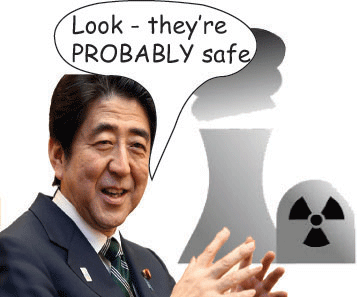 Japan aims to restart nuclear reactor in June: sources BY AARON SHELDRICK TOKYO Fri Feb 6, 2015 (Reuters) – Japan’s government is aiming to restart a nuclear reactor by around June following a lengthy and politically-sensitive approval process in the wake of the Fukushima disaster, sources familiar with the plans said……..
But the move would be controversial in a nation where most oppose nuclear power, with memories still fresh of the worst atomic crisis since Chernobyl in 1986……..
Kyushu Electric Power Co will be given the greenlight to restart two nuclear units in southwestern Japan, with June penciled in for the first unit, according to three sources familiar with the government’s thinking. They declined to be identified as they were not authorized to speak with media.
By June, Japan’s Nuclear Regulatory Authority is expected to have completed the final checks and appraisal of the reactors at Kyushu Electric’s Sendai station, letting Abe give the final go-ahead after local authority approval late last year.
A June restart would also mean local elections scheduled for April would be out of the way, giving the government some leeway to take such a potentially unpopular step…….
“We urge the government to take into full consideration the tremendous suffering from the nuclear power plant accident and make sure that future policy ensures the safety and peace of mind of all citizens,” Fukushima Governor Masao Uchibori said, when asked about restarts………
there is a chance restarts could be delayed as the units have been shut for more than three years and may need further maintenance. http://www.reuters.com/article/2015/02/06/us-japan-nuclear-restart-idUSKBN0LA08320150206
Nuclear industry fears shift to decentralized electricity system – fights renewables, not gas
“One thing to understand about the nuclear industry is that nuclear is also the coal and natural gas industry”
These days natural gas-fired power is cheap, but wind is even cheaper.
 Even if renewables make up only a small amount of generation, they represent a shift to a more decentralized energy system, less reliant on big baseload coal or nuclear power plants
Why the nuclear industry targets renewables instead of gas, Midwest Energy news, on 02/06/2015 by Kari Lydersen
Why attack renewables?……..“The fact of the matter is natural gas and wind power both compete with Exelon’s nuclear generation,” said Environmental Law & Policy Center director Howard Learner. “Exelon can’t do anything about the market price for natural gas, so Exelon is training its fire on trying to stop and hold off wind power and solar energy development.”
Some companies that own nuclear generation are also heavily invested in natural gas. Continue reading
Nuclear companies lobby USA States to legislate against renewables and energy efficienct
Why the nuclear industry targets renewables instead of gas, Midwest Energy news, on 02/06/2015 by Kari Lydersen Cheap natural gas has upended the nation’s energy landscape and made aging nuclear power plants increasingly uncompetitive.
Yet the nuclear industry, which generates almost a fifth of the nation’s energy, has declared war not on gas but on wind and solar, which represent about 4 and 0.2 percent of our energy mix, respectively.
Nuclear generators have successfully fought against renewable and energy efficiency standards on the state level, and lobbied against tax incentives for wind and solar on the federal level. They’re in the process of securing changes in regional capacity markets that would benefit nuclear and harm solar and wind.
And as states develop their Clean Power Plans to fulfill the federal mandate to reduce carbon emissions, nuclear is often pitted against renewables.
In deregulated states like Illinois, Ohio, Michigan and Pennsylvania, nuclear generators have found it increasingly difficult to sell their power at a profit on open markets, because of competition primarily from gas but also from wind.
Meanwhile, energy efficiency and distributed solar generation have reduced demand for electricity and are part of a fundamental shift which could significantly shrink the role of large, centralized power plants……..
Chicago-based Exelon, the country’s largest nuclear generator, has said that three of its six Illinois plants could close if state lawmakers don’t provide “market-based solutions” to help them become more profitable. Continue reading
Dismantling nuclear weapons industry could become a political possibility in Britain
It is not just the SNP who oppose the continuation and renewal of Trident. The Green Party of England and Wales also support the abolishment of weapons and are rising steadily in the polls and could play a part in the waking-up of arapidly-rising share of the population’s younger voters to green issues, including the abolishment of these weapons. The Campaign for Nuclear Disarmament (CND) has for decades looked to end the madness and recently attracted tens of thousands of protestors to London for their“Wrap-up Trident” demo.
 There is a will there amongst many same-minded people and organisations and if given a chance they could help force an unprecedented move; the willing disarmament by a world power of their nuclear arsenal.

 Putting Nuclear Abolition on the Table The Nuclear Option for the British Elections, CounterPunch
 There is a chance that at the end of voting come the 2015 General Election in the United Kingdom, the nation’s nuclear “deterrent” and its renewal may become central to the formation of a coalition government. Imagine it, one of the biggest nuclear powers in the world committing to the dismantling of its nuclear weapons industry. How could this happen? Continue reading
UK Tax-payers fleeced by the nuclear industry – Sellafield the perfect example
This is an extraordinary and detailed article. I regret that I have here just picked out significant parts and headings (in order to get across the main points) . This is a perfect example of how a government can be captured by vested corporate interests. This process is certainly not new – for Sellafield, for Britain, for the world. The author has carefully researched and detailed the way the government, Parliament, UK
 “The use of cost reimbursement contracts for Sellafield Limited and its subcontractors means the financial risks are borne by the taxpayer.”
Sellafield – how the nuclear industry fleeced taxpayers, Ecologist, David
 Lowry 19th January 2015 Last week the consortium holding a £22bn contract to clean up the Sellafield nuclear site was sacked, writes David Lowry. But this is just the end of a long and scandalous tale of corporate
profit at taxpayers’ expense, and the active collusion of ministers and senior officials in fighting off Parliamentary scrutiny. Continue reading
Majority of US Republicans support action on Climate Change
 Most Republicans Say They Back Climate Action, Poll Finds, NYT By CORAL DAVENPORT and MARJORIE CONNELLY JAN. 30, 2015WASHINGTON — An overwhelming majority of the American public, including half of Republicans, support government action to curb global warming, according to a poll conducted by The New York Times, Stanford University and the nonpartisan environmental research group Resources for the Future.
67 percent of respondents, including 48 percent of Republicans and 72 percent of independents, said they were less likely to vote for a candidate who said that human-caused climate change is a hoax.
The results came as climate change was emerging as a source of debate in the coming presidential campaign.
In 2012, all the Republican presidential candidates but one — Jon M. Huntsman Jr. — questioned or denied the science that determined that humans caused global warming, and opposed policies to curb greenhouse gas emissions. But over the past year, President Obama has proposed aseries of Environmental Protection Agency regulations intended to reduce carbon pollution from coal-fired power plants, which Republicans in Congress have attacked as a “war on coal.”……..
And while the poll found that 74 percent of Americans said that the federal government should be doing a substantial amount to combat climate change, the support was greatest among Democrats and independents. Ninety-one percent of Democrats, 78 percent of independents and 51 percent of Republicans said the government should be fighting climate change…….
among those who support the Tea Party, 49 percent said they would be more likely to vote for a candidate who said “I’m not a scientist” or a variant……..http://www.nytimes.com/2015/01/31/us/politics/most-americans-support-government-action-on-climate-change-poll-finds.html?ref=us&_r=1
Renewable energy a more practical option than nuclear, for Pakistan
 Generating energy from alternative resources more feasible than nuclear plants: speakers, Pakistan Today, 1 Feb 2015 Physicists, architects, engineers, economists and civil society activists on Sunday emphasized the need to adopt alternative energy sources like solar and wind instead of nuclear power plants for generation of electricity in Pakistan as it is not cheaper as claimed by the Atomic Energy Commission of Pakistan.
Instead of providing nuclear reactors, China should be asked to provide money for power generation through solar and wind, said the experts while speaking at a workshop on ‘proposed karachi nuclear power plants: preparing for the environmental impact assessment and public hearing’ jointly organised by the Pakistan Institute of Labour Education and Research (PILER) and the Pakistan Fisherfolk Forum (PFF) at a local hotel.
“The citizens of Karachi should take part in a large number in the expected public hearing for the Environmental Impact Assessment (EIA) by the government after the orders by Sindh High Court,” said Dr AH Nayyar, Professor of Physics at Quaid-e-AzamUniversityIslamabad. It is for the first time that an EIA and public hearing is being held for a nuclear power plant.
They stressed the need to sensitise the local communities especially fishermen about dangers of radiations which may be great threat to their lives.
Dr Nayyar said the present government was setting up two nuclear power plants, K2 and K3, along Karachi coast without acquiring the mandatory EIA report. The SHC order has asked the government to arrange a public hearing for the EIA. But for that the EIA document should be made available for the general public much before the actual hearing so they can study and understand.
He pointed out that some concerned citizens had gone to the court against the nuclear power plants and during the hearing, the PAEC had confessed that earlier it had done the EIA process in a “wrong way,” without following the legal process. It had acquired the EIA from Sindh Environmental Protection Agency without holding public hearing……………….http://www.pakistantoday.com.pk/2015/02/01/city/karachi/generating-energy-from-alternative-resources-more-feasible-than-nuclear-plants-speakers/
1 This Month
23-25 October – on Zoom – World BEYOND War’s annual global conferenc


Shut down the radiation-damaged Heysham nuclear reactors now
To see nuclear-related stories in greater depth and intensity – go to https://nuclearinformation.wordpress.com

Say No to NASA’s Reckless Nuclear Reactor on the Moon
Say No to NASA’s Reckless Nuclear Reactor on the Moon
-
Archives
- October 2026 (170)
- September 2026 (339)
- August 2026 (330)
- July 2026 (355)
- June 2026 (287)
- May 2026 (306)
- April 2026 (356)
- March 2026 (251)
- February 2026 (267)
- January 2026 (308)
- December 2025 (358)
- November 2025 (359)
-
Categories
- 1
- 1 NUCLEAR ISSUES
- business and costs
- climate change
- culture and arts
- ENERGY
- environment
- health
- history
- indigenous issues
- Legal
- marketing of nuclear
- media
- opposition to nuclear
- PERSONAL STORIES
- politics
- politics international
- Religion and ethics
- safety
- secrets,lies and civil liberties
- spinbuster
- technology
- Uranium
- wastes
- weapons and war
- Women
- 2 WORLD
- ACTION
- AFRICA
- Atrocities
- AUSTRALIA
- Christina's notes
- Christina's themes
- culture and arts
- Events
- Fuk 2022
- Fuk 2023
- Fukushima 2017
- Fukushima 2018
- fukushima 2019
- Fukushima 2020
- Fukushima 2021
- general
- global warming
- Humour (God we need it)
- Nuclear
- RARE EARTHS
- Reference
- resources – print
- Resources -audiovicual
- Weekly Newsletter
- World
- World Nuclear
- YouTube
-
RSS
Entries RSS
Comments RSS

