Nuclear scientists press for more tax-payer money for research into nuclear energy

 Scientists Outline Research Wish List for Nuclear Energy, abc news, ALBUQUERQUE, N.M. — Mar 5, 2015, By SUSAN MONTOYA BRYAN Associated Press “……Groups gathered at the University of New Mexico, the Massachusetts Institute of Technology and a few other sites around the country as part of an effort by the U.S. Department of Energy to narrow the list of critical research problems the nation needs to address when it comes to nuclear energy.
The findings outlined by the six groups are meant to guide decisions on what research to fund…….
Participants outlined numerous recommendations and areas where the U.S. could do better to boost innovation in nuclear energy. Everything from stable funding and safety to regulatory changes, new reactor designs, the availability of water and the public’s perception of nuclear power was discussed during the three-day workshops……
Environmental groups that have been pushing for more solar and wind power have raised concerns about the potential environmental effects of nuclear generation and the cleanup and decommissioning costs…..
TerraPower, a Washington-based company chaired by billionaire Bill Gates, hopes to build a next-generation, prototype reactor by 2025 and have commercial plants ready a decade later.http://abcnews.go.com/US/wireStory/scientists-outline-research-list-nuclear-energy-29426621
Competition from clean energy results in Illinois Bill to help Exelon nuclear corporation
Consumer advocates and business groups, however, quickly questioned the need for legislation that would benefit a single company.
Exelon, critics gird for battle as pro-nuclear bill is filed in Ill. Jeffrey Tomich, E&E reporter EnergyWire: Friday, February 27, 2015 The stage is set for an energy policy showdown in Illinois after lawmakers from both parties introduced a bill aimed at aiding three Exelon Corp. nuclear plants that have struggled in recent years in the face of increasing competition from wind energy and natural-gas-fired generation.
The legislation filed in the House and Senate would replace the Illinois renewable energy standard with a low-carbon portfolio standard requiring 70 percent of electricity used in areas served by large investor-owned utilities to come from low-carbon sources of generation……. Continue reading
Illinois energy Bill increases public costs, but benefits nuclear company Exelon
Exelon accused of seeking nuclear bailout http://www.fierceenergy.com/story/exelon-accused-seeking-nuclear-bailout/2015-02-27 February 27, 2015 | By Barbara Vergetis Lundin Exelon yesterday introduced its “Low Carbon Portfolio Standard” — legislation that is receiving opposition from groups like AARP Illinois and the BEST (Better Energy Solutions for Tomorrow) Coalition who are urging state lawmakers to reject this legislation, saying it would increase electric bills in order to “bail out Exelon’s nuclear plants.”
A 2014 analysis by Crain’s Chicago Business found that Exelon’s Illinois nuclear fleet is profitable and Exelon CEO Chris Crane even stated “Exelon had a strong year, both operationally and financially…our generation fleet and utilities continued to perform at high levels.”
For Exelon’s part, it says it is not seeking a bailout. Exelon made more than $2 billion in 2014.
This bill rewrites Illinois energy policy to increase costs for public and private entities statewide and benefits only Exelon,” said Steve Davis, legislative co-chair for Illinois Association of Wastewater Agencies, a BEST Coalition member. “Policy like this will increase the cost of doing business in Illinois and make Illinois less competitive.”
The organizations attempting to block Exelon’s Low Carbon Portfolio Standard claim that even if Exelon has financial issues with its Illinois nuclear fleet, although contrary to publicly available information, those issues will be resolved, in part, by a recently approved rate increase for Exelon’s subsidiary ComEd that will increase ComEd revenue by approximately $232 million.
For more:
– visit this website
Overriding public protests, South Korea renews license of second-oldest nuclear plant,

 South Korea renews license of second-oldest nuclear plant, Japan Times, 28 Feb15 SEOUL – The South Korean nuclear regulator said Friday it renewed the operating license of the country’s second-oldest nuclear power plant until 2022, overriding the objections of residents and anti-nuclear groups.
The Nuclear Safety and Security Commission said that seven of nine commissioners voted to restart the Wolsong No. 1 reactor located in Gyeongju city, 275 kilometers (170 miles) south of Seoul……..
South Koreans were sharply divided over the fate of the Wolsong No. 1 plant that had operated for 30 years until its license expired in 2012. Residents of Gyeongju and members of environmental groups staged protests near the nuclear watchdog’s office when the commissioners discussed the restart in three meetings since January.
The decision to restart Wolsong No. 1 could galvanize opponents and residents living in the areas of current and future plants, said Suh Kune-yull, nuclear engineering professor at Seoul National University.
“I think there could be a backlash to the nuclear energy industry,” Suh said. “It will become increasingly difficult to extend the life span of other nuclear plants or to build new ones.”…….
Opponents of the Wolsong restart said the plant failed to meet the latest safety standards that came into effect after the reactor first went into operation, and that residents near the power plant want it shut down. …..http://www.japantimes.co.jp/news/2015/02/27/asia-pacific/south-korea-renews-license-of-second-oldest-nuclear-plant/#.VPDfBXyUcnk
Washington State Senator Sharon Brown enthusiastically pushing for Small Modular Nuclear Reactors
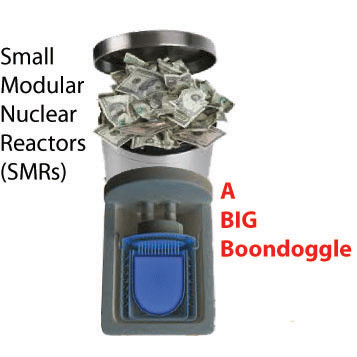 Nuclear Advocate Pushes For Modular Reactor Presence In Washington State http://www.icontact-archive.com/uY4CWN-9Ks3su6iHyVeY7nHzrprAq8_d?w=1 Feb 25 2015 A state senator in Washington, Sharon Brown, R-Kennewick, is promoting nuclear energy with a focus on technology that has yet to be put into operation.
Bills that Brown have sponsored nudge the state towards acceptance of modular, factory-built nuclear reactors, The Olympian reported Tuesday.
Brown has called for a relatively modest $176,000 study to identify sites for nuclear power reactors that are in frequent discussions, but have yet to be built – reactors with a generation capacity of 300 MW or less.
In neighboring Oregon, NuScale Power is developing reactors that will built in one location and shipped by truck or rail to their final destination
“We need to make sure we’re not left behind,” said Brown at a hearing Tuesday. She also said, “It’s really important that as a state we get our arms around small nuclear reactors.”
Brown, who is pushing the state to nudge the federal government on construction of a federal waste repository, has sponsored other nuclear power-friendly bills that cleared a critical deadline last week. These include a bill to provide sales tax relief for small reactor production and one that mandates the Commerce Department support small reactors development for commercial use.
She has also sponsored measures that would allow energy from modular reactors to count as part of the state’s renewable energy targets, although these initiatives have strong opposition from environment groups.
The initiatives follow up on a previous state study, completed in September, that said a modular reactor facility was feasible for the Hanford Site nuclear facility.
Trouble in nuclear France: AREVA and EDF in financial distress
 France Warns of Nuclear Industry Shake-Up After Areva Loss NYT, By DAVID JOLLY and STANLEY REEDFEB. 23, 2015 PARIS — France’s energy minister said on Monday that an overhaul of the country’s state-controlled nuclear energy industry was imminent, after one of the country’s main builders of nuclear power plants warned of a loss that could hamper its ability to continue operating independently……
EDF has been facing its own problems, including lengthy delays and steep cost overruns on a flagship plant that it is building at Flamanville, in the northwest of the country. There are also uncertainties about whether a showcase project in Britain will proceed — one in which both EDF and Areva would participate.
The French nuclear industry’s travails underline the gloomy state of the nuclear industry since the Fukushima disaster in Japan in 2011. Moreover, the French industry, though long a world leader, has in recent years been threatened by its own mistakes……..
The loss that Areva warned of on Monday would be substantially larger than its stock-market value of about €3.7 billion, suggesting that the troubled company, plagued by cost overruns and write-downs, may need new funds to continue operating. Areva’s capabilities are vital to France’s ambitions to remain a world provider of nuclear plants and services like supplying fuel.
With few new nuclear plants being planned to replace the older ones that are being phased out in the West, “Europe will see a gradual decline in nuclear’s share of electricity supply,” said Antony Froggatt, an analyst at Chatham House, a London-based research organization…….
Areva shares closed down 2.1 percent in Paris trading on Monday.
The company, which is based in Paris, had previously warned that it was facing trouble; it said in November that it was suspending its financial guidance for 2015 and 2016. Standard & Poor’s cut the company’s debt rating to junk soon after that, citing the company’s “limited headroom.”http://www.nytimes.com/2015/02/24/business/international/areva-nuclear-results.html?_r=0
Terms of Reference for South Australia’s ill-conceived rush into Royal Commission on Nuclear Power


- whether there is any potential for the expansion of the current level of exploration, extraction or milling of minerals containing radioactive materials in South Australia, any circumstances necessary for such an increase to occur and to be viable, any risks and opportunities created by expanding the level of exploration, extraction and milling, and the measures that might be required to facilitate and regulate that increase in activity.
- the feasibility of the further processing of minerals and processing and manufacture of materials containing radioactive and nuclear substances (but not for, or from, military uses) including conversion, enrichment, fabrication or re-processing in South Australia, any circumstances necessary for that further processing or manufacture to be viable, any risks and opportunities associated with establishing and undertaking that further processing or manufacture, and any measures that might need to be taken to facilitate and regulate the establishment and carrying out of further processing or manufacture
- the feasibility of establishing and operating facilities to generate electricity from nuclear fuels in South Australia, any circumstances necessary for that to occur and to be viable, the relative advantages and disadvantages of generating electricity from nuclear fuels as opposed to other sources, including with regard to greenhouse gas emissions, any risks and opportunities associated with that activity (including its impact on renewable sources and the electricity market), and any measures that might need to be taken to facilitate and regulate their establishment and operation.
- the feasibility of establishing facilities in South Australia for the management, storage and disposal of nuclear and radioactive waste from the use of nuclear and radioactive materials in power generation, industry, research and medicine (but not for, or from, military uses), any circumstances necessary for those facilities to be established and to be viable, the risks and opportunities associated with establishing and operating those facilities, and any measures that might need to be taken to facilitate and regulate their establishment and operation.
Even the nuclear industry itself takes a bleak view of its future
IEA/NEA Technology Roadmap: Nuclear Energy – Nuclear Energy Agency 2015 Edition The 2015 edition of the Technology Roadmap: Nuclear Energy jointly prepared by the International Energy Agency (IEA) and the Nuclear Energy Agency (NEA), has just been published.
 The nuclear energy landscape has changed since the previous edition of the roadmap in 2010, with a number of events affecting its development: the Fukushima Daiichi accident, which heightened public concern over the safety of nuclear energy in many countries, and the subsequent safety reviews and development of new safety requirements to ensure even higher levels of safety for existing and future nuclear power plants; the shift towards Generation III reactors for nuclear new build; and the economic and financial crises that have both lowered energy demand and made the financing of capital-intensive infrastructure projects more challenging, especially in liberalised electricity markets
Renewable energy for South Africa – not the cost, secrecy, corruption that goes with nuclear and coal
Next comes nuclear. The cost of $100 billion for 9 600 new MW of power – a guestimate at this stage – does not include ongoing expenses for uranium, transport and permanent safe storage. Illustrating the financial risk, the main French company bidding for SA’s attention is Areva, the world’s largest nuke builder – a company facing potential bankruptcy after its credit rating was cut to junk status in November.
Another huge risk is obvious: corruption
After an explosive start to his State of the Nation Address last week, South Africa’s President Jacob Zuma turned to nuclear, coal, fracking and offshore drilling projects – but what about the country’s free sunshine, wind and tides?
Last Thursday night in Cape Town’s Parliament hall, South Africa’s newest and cheekiest political party, the Economic Freedom Fighters (EFF), fought gamely but lost their two-dozen seats for the evening. They were expelled during the State of the Nation speech when making what they termed a ‘point of order’: asking whether President Jacob Zuma would ‘pay back the money’ (about $20 million) that the state illegitimately spent on upgrading his rural mansion. As police ushered them out with extreme force, seven were hospitalised, one with a broken jaw.
The society only saw the fracas on journalists’ cellphones later, because the SABC public broadcaster refused to screen the floor, panning only a small area where the Parliamentary leadership were gesticulating for police action. Showing surprising technical prowess but extremely weak political judgment, Zuma’s security officials had jammed cellphone and Wifi signals in the hall just before the event began, creating outrage by opposition Members of Parliament (MPs) and journalists alike. The centre-right Democratic Alliance then walked out in protest against armed police having cleared out the EFF MPs.
The dust settled 45 minutes later, with Zuma chortling and African National Congress (ANC) MPs cheering, and most observers sickened by the spectacle. Still, much more important news would follow, though in the dull tone that Zuma reserves for formal speeches. Given the country’s fury at electricity load-shedding – near daily outages of 2-4 hours – many were relieved that a substantial 14 percent of Zuma’s talk was dedicated to this theme: ‘We are doing everything we can to resolve the energy challenge.’
Listen more closely, though. Aside from building three huge coal-fired power plants, two of which are mired in construction crises, the other long-term supply strategy, accounting for one in six of his words on energy, is nuclear. By 2030 a fleet of reactors is meant to provide 9600 MW. Today we have 42 000 MW installed, of which 39 000 comes from coal. But the economy uses just 30 000 at peak. What with so much capacity unavailable, load-shedding is set to continue for at least the next three years.
To truly ‘resolve’, not defer, the challenge will require a huge roll-out of public investment. ………….
Next comes nuclear. The cost of $100 billion for 9 600 new MW of power – a guestimate at this stage – does not include ongoing expenses for uranium, transport and permanent safe storage. Illustrating the financial risk, the main French company bidding for SA’s attention is Areva, the world’s largest nuke builder – a company facing potential bankruptcy after its credit rating was cut to junk status in November.
Another huge risk is obvious: corruption. Last Thursday, Zuma proclaimed ‘a fair, transparent, and competitive procurement process to select a strategic partner or partners to undertake the nuclear build programme.’ Hmmmm. Replies Moulana Riaz Simjee of the Southern African Faith Communities’ Environment Institute, ‘This nuclear deal poses an enormous corruption risk. It is happening in secret and will make the arms deal look like a walk in the park.’
With prescient timing, the Mail&Guardian last week exposed a Moscow foreign ministry website which provides details about the extent of the nuclear deal that Zuma had already cut with Vladimir Putin six months ago. The contract indemnifies Russian suppliers from any nuclear accident liabilities and gives ‘special favourable treatment’ for taxes.
A durable concern with nuclear energy is safety because three of the world’s most technically advanced countries – Japan, Russia and the US – conclusively demonstrated its catastrophic danger at Fukushima (2011), Chernobyl (1996) and Three Mile Island (1979)……..
Greenpeace continues vibrant anti-nuke protests, this month bringing the ship Rainbow Warrior to local ports and last week, once again unveiling its opponents’ security lapses by disrupting the opening session of Cape Town’s 2nd Nuclear Industry Congress Africa with a banner hang declaring, ‘Nuclear investments cost the earth.’
Such citizen advocacy helped halt South Africa’s zany Pebble Bed nuclear experiments, in which a generator was meant to be collapsed on top of pebble storage units after its life span, saving storage costs. But regrettably $1.5 billion of taxpayer funding was wasted, mostly under Finance Minister Trevor Manuel’s nose (his successor Pravin Gordhan pulled the plug)……….
We really don’t need this risky behaviour. In three years from 2013-15, at least 2500 MW of renewable energy capacity will have been constructed in South Africa. According to Simjee, ‘Eskom itself has completed the construction of the Sere Wind Farm, which is already delivering 100 megawatts to the grid, well ahead of its intended launch in March this year.’ Sere’s cost is just $2.3 million/MW, far below all competitors, with no operating expenses aside from occasional maintenance.
These are supply-side enhancements, and will take time. For more rapid relief, on the demand side it appears Eskom is overdue in addressing wastage by the minerals and smelting corporations. The Energy Intensive Users Group’s 31 members use 44% of our electricity, and their Resource Curse has diminished the integrity of South African politics, economics, society, public health and environment.
Instead of endorsing nuclear-powered corruption, the moment is surely nearing for the state’s phase-out of subsidised energy to foreign corporations? The capital-intensive, high-energy guzzling firms need to be replaced by civil society’s low-energy, high-employment ‘Million Climate Jobs’ campaign alternatives…………..
for those aiming to breed a herd of nuclear White Elephants in coming years, maybe the opening theatrics before Zuma’s speech can resonate; maybe the EFF’s insistent call to, ‘pay back the money’, will prove a deterrent to those with nuclear fantasies.
Prof Patrick Bond directs the University of KwaZulu-Natal Centre for Civil Society in Durban. http://allafrica.com/stories/201502201281.html
International concern that Japan’s nuclear regulator will lose its independence from government

 Japan nuclear regulator advisers fear loss of its ‘essential’ independence TOKYO Wed Feb 18, 2015 (Reuters) by Aaron Sheldrick; and Kentaro Hamada – International advisers to Japan’s atomic regulator have raised concern a mandatory review of its performance could lead to a loss of independence for the body, which was set up in the wake of the 2011 Fukushima nuclear disaster.
A lack of independent regulatory oversight of Tokyo Electric Power Co’s Fukushima Daiichi nuclear station north of Tokyo was to blame for the meltdowns after an earthquake and tsunami, an official inquiry into the disaster found.
After the disaster, the Nuclear Regulation Authority (NRA) was created under the environment ministry with more autonomy but legislation provided for a review after three years of operation with a proviso to consider placing it under the Cabinet Office, involving closer political oversight.
While welcoming a review of the NRA, the advisers, who include the chairman of the International Atomic Energy Agency’s International Nuclear Safety Group, Richard Meserve, were concerned about political interference, they said in a document dated Wednesday and posted on the regulator’s website.
“We … are concerned about any transfer of authority that would serve to compromise the regulator’s independence,” the document said…….
The review of NRA operations started in September but no decisions have been made on whether the Cabinet Office will assume oversight……
The Cabinet Office coordinates planning and policy on issues of crucial national importance and works as the “place of wisdom” in support of the Prime Minister and Cabinet, according to its website.
Prime Minister Shinzo Abe is a strong proponent of nuclear power and wants to restart reactors that pass the new safety regime, after all units were shut down gradually in the wake of the Fukushima crisis, the worst nuclear disaster since Chernobyl in 1986……http://www.reuters.com/article/2015/02/18/us-japan-nuclear-concerns-idUSKBN0LM0I420150218
Nuclear Regulatory Commission to take over environmental review of Yucca project
 Energy Secretary Ernest Moniz recently reiterated that Yucca Mountain doesn’t have public support and is not a workable solution, a point that three Nevada lawmakers — Senate Democratic Leader Harry Reid and Republicans Sen. Dean Heller of Nevada and Gov. Brian Sandoval — hammered home in a letter to The Washington Post this week.
“If Yucca Mountain has taught us anything, it is that continuing to try to force the repository on Nevada only gets the nation further away from a real solution,” the senators and Sandoval wrote.
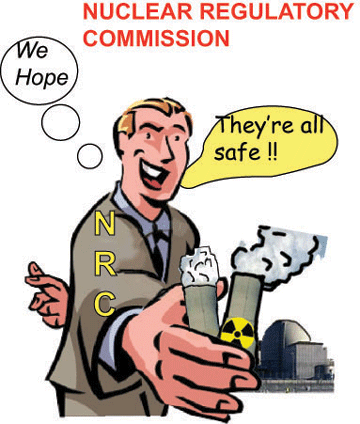 NRC will complete environmental review of Yucca project — chairman http://www.eenews.net/stories/1060013577 Hannah Northey, E&E reporter Greenwire: Tuesday, February 17, 2015 The Nuclear Regulatory Commission intends to complete an environmental review of the contentious waste repository under Yucca Mountain in Nevada because the Energy Department has refused to do so, the NRC’s chairman said today.
“The decision is we will do that since [the Department of Energy] told us they won’t be doing it,” NRC Chairman Stephen Burns told reporters at the Platts 11th Annual Nuclear Energy Conference in Washington, D.C., today. “We have the funds that are left over from the carryover for high-level waste, will cover the preparation of the supplemental [environmental impact statement].” Continue reading
Nuclear power is a hot political issue in South Korea
The main opposition New Politics Alliance for Democracy, which has more than 40% of the seats in the national parliament, has taken a negative stance on the use of nuclear power. In 2013, the alliance specified a “zero-nuclear” goal in its basic policy.
If the nuclear commission overturns the judgment about the safety of the Wolsong reactor, opposition parties and civic groups will certainly gather momentum.
 Debate heats up over aging nuclear reactor http://asia.nikkei.com/print/article/76444 KENTARO OGURA, Nikkei staff writer EOUL — Nuclear power is generating intense debate in South Korea.
At the center of the storm is the Wolsong No. 1 nuclear reactor in the city of Gyeongju, which is now offline as it reached the end of its 30-year design life. Some say it should be allowed to resume operations.
If its restart is not approved, the reactor will become the first such facility in South Korea to be decommissioned.
The Nuclear Safety and Security Commission has already delayed a decision on the issue twice — on Jan. 15 and Feb. 12. Attention is now focused on the South Korean nuclear watchdog’s next meeting, scheduled for Feb. 26.
The nuclear commission is acting on an application for an extension of the nuclear reactor’s operational life span, which was filed by Korea Hydro & Nuclear Power, a subsidiary of Korea Electric Power.
Mixed results Continue reading
USA’s Tea Party – 85 groups join movement for solar energy!
Floridians for Solar Choice, the group behind the initiative, is an inchoate alliance of libertarians, Christian Coalition conservatives, liberal environmentalists, and eighty-five Tea Party groups
 Greening the Tea Party, New Yorker BY CAROLYN KORMANN 18 Feb 15 The solar-energy business is booming. The average cost of installing solar panels has dropped by half since 2010, and a new solar electric system is now installed somewhere in the United States every four minutes.
The growth extends well beyond the rooftops of American homes and small businesses; last week, Apple announced that it is investing in an eight-hundred-and-fifty-million-dollar solar farm in Monterey County, California, which it says will power its operations in the state by the end of 2016. Although solar is still small, supplying less than one per cent of the country’s electricity, its growth has alarmed the energy industry’s old guard—coal, oil, and utility companies. Continue reading
Nuclear industry revving up campaign to win public support and public money
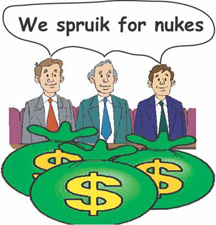 NRC will complete environmental review of Yucca project — chairman http://www.eenews.net/stories/1060013577 “……..’Right-sizing’ the NRC Burns is taking the agency’s reins at a critical time for both the NRC and the U.S. nuclear industry, which has embarked on a public campaign to tout the financial and climate benefits of reactors struggling in competitive power markets.
The industry is facing stiff competition from cheap gas, weak demand in the power markets, and new safety regulations after the 2011 Fukushima Daiichi nuclear disaster in Japan. While five new reactors are under construction and the NRC staff today recommended that another project move forward at DTE Energy Co.’s Fermi nuclear plant in southeastern Michigan, the industry has seen a recent spate of plant closures in California, Wisconsin, Florida and Vermont.
Touching on those closures, a number of executives from nuclear giants Exelon Corp. and FirstEnergy Corp. spoke at the conference about the need for market fixes to bolster struggling reactors.
Donald Moul, vice president of commodity operations for FirstEnergy Solutions, said at least 40,000 megawatts of baseload power — mostly older coal plants but also reactors — could be forced to prematurely retire in the Midwest and Mid-Atlantic, and grid operators and U.S. EPA need to do more to credit reactors under its Clean Power Plan. Moul said nuclear plants are facing a “lack of revenue certainty,” and their closure will only make it more difficult for states to comply with the Obama administration’s climate goals.
David Brown, senior vice president of government affairs for Exelon, the nation’s largest operator of commercial reactors, said there are no “silver bullets,” but market reforms in the PJM Interconnection are a “big start.” On the state level, Brown said, Illinois has developed a handful of options, and a low-carbon energy standard is most likely to gain traction.
“A lot of people thought [EPA’s Clean Power Plan] would be a real savior for the industry, but … that rulemaking was off the mark,” Brown said.
Burns signaled that the NRC in coming weeks and months intends to slim down to match a declining lot of license applications.
NRC senior staff, he said, is focused on “right-sizing” the agency — streamlining operations, making more timely decisions and establishing clearer agencywide priorities through a program dubbed “Project AIM 2020” that began last year.
NRC commissioners will be briefed on staff’s recommendations for slimming the agency tomorrow, and the proposal will be made public soon, he added.
Burns also noted that the agency’s fiscal 2016 budget proposal reflects a reduction of 140 full-time workers and of $27.3 million from the prior year’s request. Burns said the agency’s fiscal 2015 fee rule — expected in coming months — will also likely reflect a dip in licensee fees.
“No organization can remain static,” Burns said.
Twitter: @HMNorthey | Email: hnorthey@eenews.net
“Clean Coal” not a goer, for White House – support withdrawn
 The White House Walks Away from Clean Coal A $1 billion Illinois project, meant to be the poster child for coal’s climate-friendly future, gets scuttled. Bloomberg, Feb 15, 2015 Jim Snyder Mark Drajem Matthew Philips
The resurrection was short-lived. On Feb. 3, the Department of Energy announced it was withdrawing support. Environmentalists who want investment in renewable power technologies rather than fossil energy cheered the decision. “We don’t need it, and we can’t afford it,” Bruce Nilles, head of the Sierra Club’s Beyond Coal campaign, says of carbon-capture projects……
The Illinois project, called FutureGen, was supposed to be a model for coal’s climate-friendly future. It was backed by some of the world’s biggest coal mining companies, who created a nonprofit, the FutureGen Industrial Alliance, to oversee the plant’s conversion. The White House saw FutureGen as a way to show leaders in China and India, where coal fuels more than half of electricity generation, that they can address their own carbon emissions without compromising economic growth. About 40 percent of man-made carbon emissions come from power plants……http://www.bloomberg.com/politics/articles/2015-02-14/the-white-house-walks-away-from-clean-coal
1 This Month
23-25 October – on Zoom – World BEYOND War’s annual global conferenc


Shut down the radiation-damaged Heysham nuclear reactors now
To see nuclear-related stories in greater depth and intensity – go to https://nuclearinformation.wordpress.com

Say No to NASA’s Reckless Nuclear Reactor on the Moon
Say No to NASA’s Reckless Nuclear Reactor on the Moon
-
Archives
- October 2026 (170)
- September 2026 (339)
- August 2026 (330)
- July 2026 (355)
- June 2026 (287)
- May 2026 (306)
- April 2026 (356)
- March 2026 (251)
- February 2026 (267)
- January 2026 (308)
- December 2025 (358)
- November 2025 (359)
-
Categories
- 1
- 1 NUCLEAR ISSUES
- business and costs
- climate change
- culture and arts
- ENERGY
- environment
- health
- history
- indigenous issues
- Legal
- marketing of nuclear
- media
- opposition to nuclear
- PERSONAL STORIES
- politics
- politics international
- Religion and ethics
- safety
- secrets,lies and civil liberties
- spinbuster
- technology
- Uranium
- wastes
- weapons and war
- Women
- 2 WORLD
- ACTION
- AFRICA
- Atrocities
- AUSTRALIA
- Christina's notes
- Christina's themes
- culture and arts
- Events
- Fuk 2022
- Fuk 2023
- Fukushima 2017
- Fukushima 2018
- fukushima 2019
- Fukushima 2020
- Fukushima 2021
- general
- global warming
- Humour (God we need it)
- Nuclear
- RARE EARTHS
- Reference
- resources – print
- Resources -audiovicual
- Weekly Newsletter
- World
- World Nuclear
- YouTube
-
RSS
Entries RSS
Comments RSS

