Pro nuclear expert replaces safety conscious seismic expert on Japan’s Nuclear Safety Agency
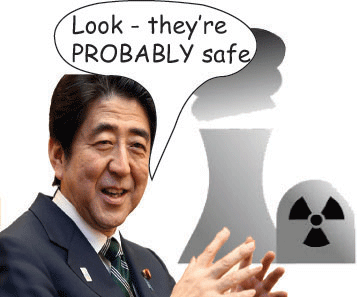 Pro-nuclear expert replacing NRA commissioner who raised flag on quake risk THE ASAHI SHIMBUN 29 May 14, http://ajw.asahi.com/article/behind_news/politics/AJ201405280023 Replacements for two outgoing commissioners of the Nuclear Regulation Authority suggest the Abe administration will find it easier to gain approval for restarts of the nation’s nuclear reactors.Few people in government circles and the nuclear industry will be sorry to see Kunihiko Shimazaki go. His successor is expected to more quickly give the green light to reactivate nuclear power plants.
Shimazaki, who is 68 and a professor of seismology, proved to be a thorn in the side of electric power companies with his calls for a reassessment of the force with which seismic waves and tsunami could pummel nuclear plants being considered for restarts. Kenzo Oshima, 71, a former undersecretary-general at the United Nations, is also stepping down. Both men are leaving because their terms expire in September.
USA Congress Bill to take money from nuclear weapons, and to care of veterans
 House Bill Would Tap Into Nuclear Weapons Fund to Aid Veterans National Journal, By Douglas P. Guarino 23 May 14 The version of the fiscal 2015 defense authorization bill that the House approved Thursday would cut some controversial nuclear weapons spending in a bid to help veterans. Continue reading
Problems in nuclear reactor decommissioning thrashed out in US Senate hearing
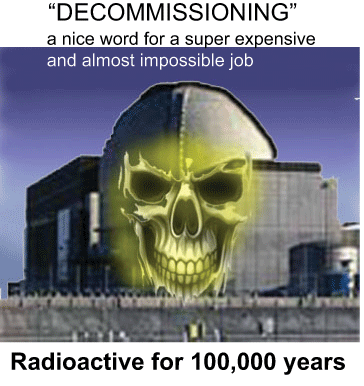 Senate Hearing on Nuclear Reactor Decommissioning Challenges Energy Collective May 22, 2014 Bemnet Alemayehu, Project Scientist, Nuclear Program, Washington, D.C.
U.S. Senator Barbara Boxer’s Environment & Public Works Committee held a hearing on Wednesday, May 14th, 2014 to assess the challenges of nuclear reactor decommissioning nationwide. Panelists called to testify at Wednesday’s senate hearing included Christopher Recchia, Public Service Department Commissioner of Vermont, Geoffrey Fettus, Senior attorney of NRDC, Donald Mosier, Council Member of the City of Del Mar, Michael Weber, Deputy Executive Director for Compliance Programs of NRC and Marvin Fertel, President & Chief Executive Officer of NEI.
Christopher Recchia’s testimony to the senate opposed a request by operators of the Vermont Yankee nuclear power plant to discontinue off-site emergency planning after the reactor shuts down. He argued that the off-site emergency planning should continue after the reactor shuts down until all of the plant’s spent fuel rods are removed from pools and placed in dry cask storage. ……… Continue reading
Politicians oppose nuclear power in seismic zone in India
 Left parties turns up heat on Kovvada nuclear plant, The Hindu NATIONAL » ANDHRA PRADESH SRIKAKULAM, May 23, 2014 Setting up the plant in seismic zone a threat to people, they say. CITU leader D. Govinda Rao said that workers, residents of Ranasthalam would launch massive agitations soon to oppose the construction activity in Kovvada.
The Left parties have turned the heat on the construction of a nuclear power project in Kovvada of Ranasthalam mandal again after mild tremor rattles the district on Wednesday saying that the project site comes under highly seismic zone and it would be dangerous for the people.
 Representatives of the Left Parties have asked the government to reconsider its decision over the establishment of the nuclear plant in the district. Senior CPI (M) leader V.G.K. Murthy said that the government should clarify over the dangers posed with the setting up the nuclear plant in a seismic zone. “The Nuclear Power Corporation of India officials always say that adequate precautions would be taken up to avoid disasters during natural calamities. We feel that such disasters can’t be avoided even in highly advanced countries. So, the government should come up with scientific data to clear the doubts of people,” he added.
CITU leader D. Govinda Rao said that workers, residents of Ranasthalam would launch massive agitations soon to oppose the construction activity in Kovvada. He said that several nuclear experts including Surendra Gadekar had already expressed doubts over the safety of the project. Mr. Surendra Gadekar on Sunday cautioned that Srikakulam town would be affected badly with the establishment of nuclear power plant at Kovvada, which is 35 km away from the district headquarters.
According him, Srikakulam, which is very close to Kovvada, would face radiation problem with the establishment of the nuclear power plant with an installed capacity of 10,000 Megawatts…..http://www.thehindu.com/news/national/andhra-pradesh/left-parties-turns-up-heat-on-kovvada-nuclear-plant/article6037482.ece
Environmental law puts a stumbling block in front of nuclear power for Poland
Poland’s nuclear energy programme stumbles again: Has PGE lost control of its sub-contractors? Greenpeace, Jan Haverkamp – May 22, 2014 In late February, during one of our regular strolls through the Lubiatowo dunes where the Polish government and the utility PGE are planning to build 3,000 MW of nuclear capacity, we found something peculiar. Bright orange sticks – exactly on the locations where the PGE subcontractor, Worley Parsons, wants to drill 20- to 200-meter-deep holes for their site assessment. Such drilling directly next to two Natura2000 areas, in a unique dune landscape with wet valleys, could easily cause irreversible damage to this home of red deer, white-tailed and lesser spotted eagles. The EU Habitat Directive and the Aarhus Convention do not leave much space for interpretation: when irreversible damage to Natura2000 sites is possible, an environmental impact assessment has to be made with full public participation.
Taiwan’s nuclear dilemma – a return to authoritarian past?
 Taiwan’s Nuclear Future and Authoritarian Past The intense debate in Taiwan over nuclear power has echoes of a less democratic past. The Diplomat, By Brent Crane May 21, 2014 Last August, chaos erupted in Taiwanese parliament. Opposing lawmakers thrust hard-clenched fists at one another while fervent activists tossed opened water-bottles from the stands like Molotov cocktails. Politicians and otherwise civilized men wrestled like teenage boys on the floor amid shouts, screams and camera flashes.
The Legislative Yuan had initially assembled to discuss the conditions of a national referendum deciding the fate of Taiwan’s fourth nuclear power plant in Gongliao, New Taipei City. The controversial plant, known ominously throughout the country as Nuke 4, remains a rallying cry for opponents of one of Taiwan’s most charged political subjects: nuclear power. The debate has been energized in recent weeks after former opposition party leader and staunch nuclear energy opponent Lin Yi-hsiung went on hunger-strike in protest of the government’s unwillingness to make concessions with Taiwan’s antinuclear lobby. On the surface, the conflict appears rather black-and-white: it’s the safety-conscious, environmentalists and academics versus the pragmatic economists and government bureaucrats. But the nuclear power debate in Taiwan is about much more than just safety and economics. It’s about reconciling Taiwan’s autocratic past with its democratic present……….
On the Taiwanese political front today, only reunification is as hotly debated as nuclear energy. The antinuclear camp, which polls suggest finds support from up to 70 percent of the 23 million Taiwanese, advocates full denuclearization of the island. Simply put, their biggest beef with nuclear power in Taiwan is that it poses too great a safety risk. The disaster at Japan’s Fukushima Daiichi Nuclear Power Plant in 2011 represents the type of nightmare scenario that antinuclear activists conjure up when they denounce the energy source. After all, Taiwan is highly prone to typhoons, tsunamis and earthquakes. In late September 1999, for instance, a 7.9 magnitude earthquake killed 2,415 people in central Taiwan, injuring more then 11,000. Last September, Typhoon Usagi left Taiwan with 35 dead and with more than $4.33 billion in damages. The list goes on. And Taiwan’s compact size ensures that any plant destruction or malfunction on the scale of the Fukushima fiasco would be disastrous for the island, whose densely packed urban centers are never too far from any of the country’s four plants.
Yet despite the risks, the ruling KMT party remains firmly pro-nuclear, and has proven resilient in weathering the antinuclear storm. ……In true Jeffersonian fashion, the electorate, though hollering at an often unresponsive government, are demanding that their voices be heard. And with the ebb and flow of the youth-led Sunflower Movement, a government accountability project akin to Occupy Wall Street, Taiwan’s political atmosphere has been particularly energized lately………
Opposition to Nuke 4 has galvanized tens of thousands of Taiwanese to hold demonstrations throughout the country in recent years. Clearly, the anti-nuclear camp is no longer a fringe element. On the contrary, opposition to nuclear power has become a household inclination, with some studies showing 55 percent to 70 percent of the population anti-nuclear………
Of course, shifting an entire country from autocracy to democracy is no easy task. But Taiwan’s nuclear energy debate is a reminder that its transition isn’t yet wholly complete. http://thediplomat.com/2014/05/taiwans-nuclear-future-and-authoritarian-past/
NextGen Climate, – a progressive, pro-environment counterbalance to the wealthy oil and gas industry
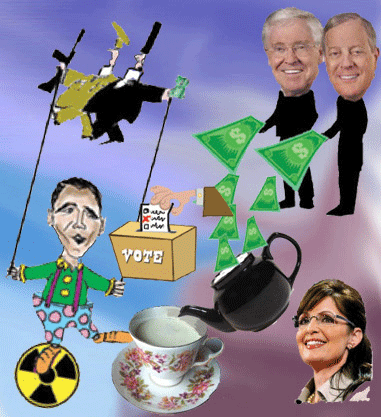 Green billionaire prepares to attack ‘anti-science’ Republicans By Peter Hamby, CNN National Political Reporter May 22, 2014 Washington An environmental advocacy group backed by hedge fund tycoon Tom Steyer is set to unleash a seven-state, $100 million offensive against Republican “science deniers” this year, a no-holds-barred campaign-style push from the green billionaire that could help decide which party controls the Senate and key statehouses come November.
The Steyer-backed outside group, NextGen Climate, has billed itself as a progressive, pro-environment counterbalance to the wealthy oil and gas industry — as well as the primary foil to the pro-business Koch brothers and their well-funded conservative donor network.
The outfit, launched last year by the San Francisco billionaire, has already pledged to spend heavily this midterm year in Iowa to assist the Democratic Senate nominee Bruce Braley, and in Florida, where Gov. Rick Scott is facing a difficult re-election fight against Democrat Charlie Crist……….
GOP candidates in the NextGen cross hairs — Scott in Florida, Terri Lynn Land in Michigan, Scott Brown in New Hampshire and Cory Gardner in Colorado — hew closely to the “Republican troglodyte brand,” Lehane argued.
“They are anti-immigrant, anti-women, anti-science,” he said. “It’s a tough brand to win elections around.”
The group said that climate can be successfully used as a wedge issue — Lehane framed it as a moral clash between “right and wrong” — to boost turnout among Democratic voting groups that tend not to show up in midterm election years, specifically young voters, Hispanics and African-Americans……….
he primary difference between Steyer and conservative mega-donors, Lehane said, is that Steyer is not personally profiting from his political efforts. “He is giving all the money away,” he said. “He doesn’t have stand to gain some economic benefit by spending money that translates into his own personal economics.”
Lehane added, “We are spending a drop in the big oil bucket as compared to the fossil fuel industry, especially the Koch brothers. All Tom is trying to do is try to balance and level the playing field. We are never going to have as much money as the other side.” http://edition.cnn.com/2014/05/22/politics/steyer-climate-change-campaign/
German government will not pay costs of burying dead reactors
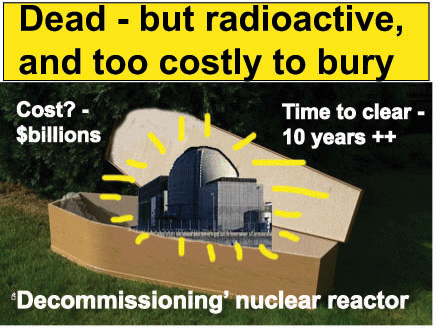 Germany’s Gabriel says state won’t pay for nuclear decommissioning http://uk.reuters.com/article/2014/05/18/uk-germany-energy-nuclear-idUKKBN0DY0EM20140518 BERLIN Sun May 18, (Reuters) – Germany‘s economy minister has joined Angela Merkel in rejecting talk that utilities might hand over responsibility for decommissioning Germany’s nuclear powerplants to a new public entity, as the projected costs of decommissioning rise.
“It should not be tax payers who pay for the clean-up of atomic waste but rather those who made money for decades through running nuclear power stations,” Sigmar Gabriel told the newspaper Bild am Sonntag in an interview published on Sunday.
Two sources told Reuters last weekend that utilities were in talks with the government about setting up a “bad bank” for nuclear plants, in response to Chancellor Angela Merkel’s decision to close them all by 2022 after the Fukushima disaster.
The foundation would use provisions earmarked by the nuclear plant operators but would also take on the risk of unforeseen extra costs, effectively capping the utilities’ liability.
The Environment Ministry said last week the utilities bore full responsibility for safely decommissioning and dismantling the nine nuclear power plants still on the grid.
One of the sources had told Reuters that if the state takes over responsibility for the decommissioning, the utilities might be willing to drop their legal claims against the government for compensation for having to shut the plants. The four operators of nuclear plants in Germany – the German companies E.ON (EONGn.DE), RWE (RWEG.DE) and EnBW (EBKG.DE) and Sweden’s Vattenfall VATN.UL – have set aside total provisions of around 36 billion euros (29.3 billion pounds) for dismantling the plants and disposing of nuclear waste.
Germany’s Spiegel magazine reported on Sunday that government experts predicted a possible shortfall of 3.5 billion euros for the clean up, as costs had risen sharply. (Reporting by Alexandra Hudson; Editing by Larry King)
Nigeria to get nuclear power plant. Is this a GOOD idea?
Nigeria to get $6bn nuclear plant in 2022 – commission PUNCH, MAY 15, 2014 BY OLUSOLA FABIYI The Nigeria Atomic Energy Commission has revealed that the country will get a nuclear plant in 2022 at a cost of $6b dollars.
The Director, Human Resources of the commission, Professor Simon Mallam, who stated this on Thursday when he appeared before the national conference committee on Energy, also urged the Federal government to explore and develop all sources of energy available in the country…..Mallam further advised that although the country wasted a little time in the nuclear arena, it would still be able to deliver nuclear power by 2022 if the enabling environment and support could be given….http://www.punchng.com/news/nigeria-to-get-6bn-nuclear-plant-in-2022-commission/
Lawmakers press for stronger safety regulations for spent nuclear fuel rods
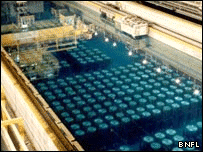 Bills would beef up safety regs for spent nuclear fuel http://thehill.com/regulation/205962-bills-would-beef-up-safety-regs-for-spent-nuclear-fuel By Benjamin Goad – 05/13/14 Lawmakers are pressing to bolster regulations for spent nuclear fuel, contending that pools left to languish for decades at decommissioning plants could prove disastrous in the event of an accident or terrorist attack.
Sens. Barbara Boxer (D-Calif.), Ed Markey (D-Mass.) and Bernie Sanders (I-Vt.) on Tuesday introduced a trio of bills meant to tighten safety and security at plants winding down operations around the country.
“Experts agree that a spent fuel pool accident could have consequences that are every bit as bad as an accident at an operating reactor,” Markey said.
Spent fuel can produce heat and radiation threats long after it is removed from a nuclear reactor’s electricity generating operation. Too dangerous to ship away from the plant altogether for as long as seven years, the spent fuel is left in pools at the plants.
A leak — whether due to accident or attack — could lead to fire and widespread contamination, the lawmakers said, citing various reports. Yet current Nuclear Regulatory Commission (NRC) rules allow for spent fuel to remain in the pools until the reactor completes decommissioning, which can take as long as 60 years, they said.
The Safe and Secure Decommissioning Act of 2014 would bar the NRC from exempting reactor licensees from any safety or security requirements at decommissioning plants until all fuel stored at the site is transferred into safer dry casks.
The lawmakers contend that the NRC has granted every exemption request it has ever received from decommissioning reactors, despite the agency’s own determination that an earthquake could result in a devastating breach. The Dry Cask Storage Act of 2014 is designed to force nuclear reactor operators to adhere to an NRC-approved plan for the transfer of spent fuel to dry cask storage within 7 years of the time the plant’s decommissioning plan is submitted.
Under the lawmakers’ Nuclear Plant Decommissioning Act of 2014, states and local communities would be guaranteed a meaningful role in the preparation of decommissioning plans for retired nuclear plants.
The legislation would require the NRC to publicly approve or reject every proposed decommissioning plan.
“Every state with a nuclear power plant has a strong interest in how that plant is decommissioned,” Sanders said. “This is about making sure that states and local communities can play a meaningful role in a decision.”
Taiwan officials brush off worries about nuclear power plant flaws
Officials downplay nuclear plant flaws GLOSSING OVER FAULTS:A ‘Liberty Times’ report said a Taipower employee alleged that a report on the safety of the Fourth Nuclear Power Plant omitted the plant’s flaws Taipei Times By Lee I-chia / Staff reporter, with CNA 12 May 14, Officials yesterday sought to play down leaked test results indicating possible flaws in a containment structure of the Fourth Nuclear Power Plant, saying the problem will be fixed as part of ongoing tests and inspections.
Taiwan Power Co (Tai-power, 台電) chairman Hwang Jung-chiou (黃重球) said that finding and sealing leaks in the primary containment structure of the plant’s first reactor were normal steps in safety inspection procedures.
Hwang said similar leaks were discovered during inspections carried out on the nation’s first, second and third nuclear power plants, all of which are operated by the state-run Taipower.
The company is also responsible for the nearly completed Fourth Nuclear Power Plant in New Taipei City’s Gongliao District (貢寮).
Answering questions at a meeting of the legislature’s Education and Culture Committee, Atomic Energy Council (AEC) Minister Tsai Chuen-horng (蔡春鴻) said the council would strictly review Taipower’s safety reports on the plant to ensure the leakage rates of the reactor containment building are within safety standards.
Tsai’s remarks came in response to a report by the Chinese-language Liberty Times (the Taipei Times’ sister newspaper) yesterday which said it received an anonymous report from a person who identified himself as a worker at the plant saying that during the integrated leak rate test (ILRT) and structure integral test (SIT) conducted at the plant’s No. 1 reactor from Feb. 26 through March 5, leakage rates were found to be too high.
The company had reported them as normal.
Meanwhile, outside the committee meeting room, Green Citizen Action Alliance deputy secretary-general Hung Shen-han (洪申翰) criticized Taipower for claiming that the structure had no problems in its publicized safety test report on its Web site last month.
He alleged that the company only reported the good parts, but not flaws, which he said should be considered lying to the public…….http://www.taipeitimes.com/News/front/archives/2014/05/13/2003590217
Conservative financier stresses energy security importance of renewable energy
 Guy Hands: Ukraine crisis underlines importance of UK renewable energy http://www.theguardian.com/environment/2014/may/12/guy-hands-calls-for-government-action-on-renewable-energy
 Guy Hands, one of the City’s most flamboyant deal-makers, warns on Monday that the Ukraine crisis has underlined the importance of the UK’s renewable energy sector, and attacks those wanting to phase out onshore wind subsidies.
The financier, who has close links to the Conservative party, says energy security cannot be achieved by markets alone and that the government needs to play a decisive role. “We should be grateful to President Putin for bringing energy security back to the top of the political agenda inEurope. But it is up to us to ensure we understand and act on the long-term threat. And that is certainly not by turning our backs on renewable energy, no matter how persistent or loud the voices against it,” Hands argues in an article on the Guardian website.
The intervention by Hands, who runs the Terra Firma private equity firm, comes at a time when instability in Crimea has been used as a major argument in favour of shale gas – most notably by a House of Lords committee last week.
Hands, whose best man at his wedding was the foreign secretary, William Hague, expresses astonishment that there has been speculation the Tory election manifesto could contain a commitment to end financial help for onshore wind, given it is the “most affordable” of all green power technologies.
Hands’s Terra Firma invests in onshore wind but also landfill gas and other green schemes through a business called Infinis. The financier said Vladimir Putin’s actions in Crimea had done Britain an indirect favour by putting energy security at the top of the agenda. “We have a large industry of successful and enterprising renewable energy businesses which are ready to rise to the challenge of powering homes and businesses from clean and sustainable sources. But politicians are being pressed by a coalition of opponents of renewable energy to ignore this potential.”
He argues that the subsidy debate has been dominated by those who believe energy is a market like any other, and that all efforts should be focused on prices.
“This is nonsense. Energy is not just another commodity but the lifeblood of an economy. No responsible government can step away from a market which is at the heart of a nation’s security and prosperity. Security of supply as well as affordability are critical. So too are environmental impact and public acceptance.”
Germany’s nuclear industry fights to make tax-payers pay for cleanup
 German utilities and government clash over nuclear ‘bad bank’ By Jeevan Vasagar in Berlin http://www.ft.com/intl/cms/s/0/49c5b222-d926-11e3-837f-00144feabdc0.html#axzz31XFPjIHH 11 May 14,
Germany’s nuclear industry is fighting Berlin over a plan to transfer the risks of shutting down facilities to a publicly owned foundation that would act as a “bad bank”.
 The power companies are engaged in a decommissioning exercise with an estimated cost of more than €30bn after Berlin announced an accelerated exit from nuclear energy following the Fukushima disaster in 2011. The work includes demolishing nuclear plants and disposing of radioactive waste.
German utilities Eon, RWE and EnBW have discussed the creation of a state-owned foundation to oversee the decommissioning process. Under their plan, the utilities would transfer to the foundation billions of euros in reserves that they have built up to pay for demolition and disposal. In return, the German government would shoulder the risk for any cost overruns.
But that proposal, first reported in Der Spiegel on Sunday, was rejected by German environment minister Barbara Hendricks. She said: “The full responsibility for the safe phasing out, closure, decommissioning and interim storage of nuclear waste lies with the energy companies.”
One German energy executive said on Sunday that while the idea had been discussed, there were no concrete plans. Eon, RWE and EnBW all declined to comment.
The proposal is the latest sign of strain between Berlin and utilities, which have clashed in the courts over the closure of nuclear plants and the validity of a nuclear fuel tax.
The fight comes at a time when German power companies are struggling because the favourable treatment given to renewable energy has battered the profitability of their conventional electricity plants.
The country’s seven oldest nuclear plants were all taken offline immediately after the Japanese disaster, while an eighth plant that was offline at the time stayed shut: the remaining nine are to be closed down by 2022.
Eon said in March that it intended to shut the Grafenrheinfeld nuclear plant in Bavaria seven months before schedule because of its lack of profitability.
That plant, in a state that is home to some of Germany’s most successful manufacturers, will now close in May 2015.
Berlin’s abrupt decision to phase out nuclear energy represented a U-turn on a 2010 deal to extend the lives of nuclear plants. The companies agreed, in that deal, to a tax on nuclear fuel, which was introduced at the start of 2011 – and remains in place, despite the change of policy.
A court in Hamburg ruled in April that the German state should repay more than €2.2bn in nuclear fuel taxes to the utilities.
However, this decision is not legally binding and the case has been referred to the European Court of Justice.
RWE is pursuing a civil claim for damages over the decision by the state government of Hesse to order the closure of the Biblis nuclear power plant after Fukushima.
Hawkish orders from Iran’s Supreme Leader Ayatollah Ali Khamenei
 Nuclear talks in jeopardy: Khamenei orders Rev Guards to mass-produce missiles – regardless DEBKAfile Special Report May 11, 2014, Iran’s Supreme Leader Ayatollah Ali Khamenei threw a large spanner in the works of nuclear diplomacy Sunday, May 11. Less than a week before the next round of talks with the six powers, he said: “The Revolutionary Guards should definitely… not be satisfied with the present level [of missile production]. They should mass produce.”
Referring to Western concerns that Iran is designing missiles able to carry nuclear warheads, Khamenei said: “They [the West] expect us to limit our missile program while they constantly threaten Iran with military action. So this is a stupid, idiotic expectation.”
Khamenei spoke during a visit to the aeronautics fair organized by the Revolutionary Guards (IRGC), which are responsible for Iran’s missile and nuclear programs………
President Rouhani calls for more clarity in the nuclear debate
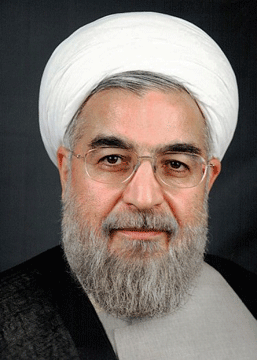 Iranian president calls for more open, better-informed nuclear debate https://au.news.yahoo.com/world/a/23426769/iranian-president-calls-for-more-open-better-informed-nuclear-debate/ May 11, 2014, By Michelle Moghtader and Mehrdad Balali DUBAI (Reuters) – President Hassan Rouhani said on Sunday he wanted Iran to do a better job of explaining its nuclear programme to prevent “evil-minded” people misleading world opinion, two days before Tehran resumes talks with world powers on its disputed atomic activity.
Iran and the United States, France, Germany, Britain, China and Russia will reconvene in Vienna to try to iron out differences over how to end a long standoff over suspicions that Tehran has sought the means to develop nuclear weapons.
Western powers have long demanded greater openness from Iran to address those concerns and head off the risk of a downward spiral towards a new Middle East war, with Israel threatening to attack its arch-foe if diplomacy does not rein it in.
“What we can offer the world is greater transparency,” Rouhani, a relative moderate who replaced a conservative hardliner who antagonised the West – said in a speech at a ceremony celebrating Iran’s scientific achievements.
In his remarks, Rouhani reiterated that Iran was not seeking nuclear weapons and would never halt its atomic programme, which was for peaceful purposes. He also repeated a denial of Western charges that Iran has carried out any secret nuclear bomb work.But along with achieving scientific progress, Rouhani added, Iran ought to develop its abilities in the legal, political and information realms to prevent “the enemy” making problems for its nuclear developments.
“If one engages in a technological endeavour but is not doing good legal and political work, then the enemy might come up with a fictional excuse to cause trouble for you,” he said.
The Islamic Republic’s leaders normally use the term “the enemy” to refer to the United States and Israel.
“If you don’t have good public relations and are not able to communicate well, then you might find other evil-minded people misleading world public opinion,” Rouhani said.
“So our effort today is to even out our efforts on multiple levels … We don’t want to retreat one step from our pursuit of technology, but we want to take a step forward on the political front.”
His comments appeared to be a criticism of hostile statements from within the hardline conservative establishment, including his predecessor Mahmoud Ahmadinejad, who called U.N. resolutions against Iran on the nuclear dispute a “worthless piece of paper”………..
“RIGHT DIRECTION”
Ahmadinejad’s strident rhetoric during his eight years in office on issues like the Holocaust and Israel served to shore up international resolve to curb Iran’s nuclear programme.
Iran in January halted its most sensitive nuclear operations under a preliminary deal with world powers, winning some relief from painful economic sanctions that have damaged its oil-dependent economy by forcing a sharp reduction in crude exports.
Rouhani said Iran if it so chose could resume enrichment of uranium gas to a fissile purity of 20 percent – its most sensitive nuclear activity because it is a relatively short technical step away from the level required for nuclear weapons.
“We wanted to tell the world that our activities are moving in the right direction: If we say we can enrich to 3.5 percent, we can do it. If necessary we will do (it to) 20 percent,” he said.
Iran agreed under its Nov. 24 deal to shelve enrichment to 20 percent. It has since diluted some of its 20 percent-enriched stockpile to a lower concentration and converted some into an oxide less suited to processing into bomb-grade material.
Iran has justified its 20 percent enrichment drive by saying it was meant to replenish the fuel supply of a Tehran medical research reactor. But Western officials are sceptical, saying Iran had refined far more than it required for such a purpose.
While Iran stopped 20 percent enrichment in January, it is allowed under the November pact to keep producing uranium refined to up to 5 percent, the level required for fuelling civilian nuclear power stations.
1 This Month
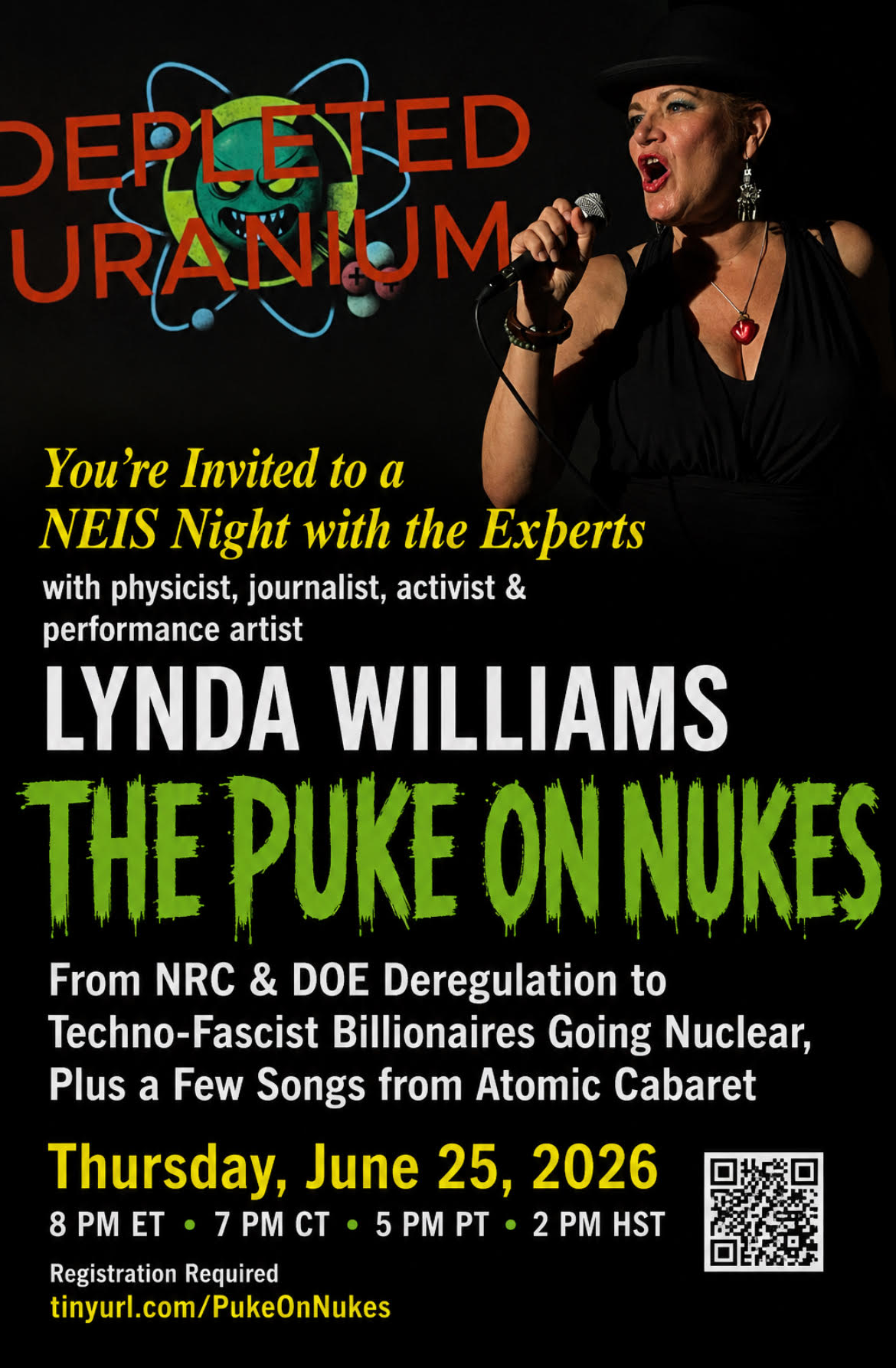
25 June- THE PUKE ON NUKES
Thursday, June 25, 2026
7pm Central Time (8pm ET, 6pm MT, 5pm PT) UTC – 5
From NRC & DOE Deregulation to Techno-Fascist Billionaires Going Nuclear, Plus a Few Songs from Atomic Cabaret REGISTER
26 June – Radiation Trainwreck at the NRC / Join the Protect Better Campaign – https://us02web.zoom.us/meeting/register/4ZlZ5_qLSHGiLSCg8FF6Bg#/registration

1st July – Webinar Waste of Space: The Environmental Harm of Military and Civil Space Activity st July, 7 pm

Report Launch Online: We are seeing an increasing exploitation of space for military and commercial purposes. This must change.

Protect Sazan Island from the Trump family! https://secure.avaaz.org/campaign/en/protect_sazan_island_from_the_trump_family_loc/?bqFCVab&v=174511&cl=22707147157&_checksum=5e9dde668860e8231c33699735e16a1fbf22ab2cb01da50c999fe8732b9775ef&utm_source=email&utm_medium=blast_email&utm_campaign=174511


Cuba Is Not a Failed State – It Is a Besieged State
PETITION: “Global Appeal to Endorse Palestinian Right of Return of Refugees”
To see nuclear-related stories in greater depth and intensity – go to https://nuclearinformation.wordpress.com
-
Archives
- June 2026 (241)
- May 2026 (306)
- April 2026 (356)
- March 2026 (251)
- February 2026 (268)
- January 2026 (308)
- December 2025 (358)
- November 2025 (359)
- October 2025 (376)
- September 2025 (257)
- August 2025 (319)
- July 2025 (230)
-
Categories
- 1
- 1 NUCLEAR ISSUES
- business and costs
- climate change
- culture and arts
- ENERGY
- environment
- health
- history
- indigenous issues
- Legal
- marketing of nuclear
- media
- opposition to nuclear
- PERSONAL STORIES
- politics
- politics international
- Religion and ethics
- safety
- secrets,lies and civil liberties
- spinbuster
- technology
- Uranium
- wastes
- weapons and war
- Women
- 2 WORLD
- ACTION
- AFRICA
- Atrocities
- AUSTRALIA
- Christina's notes
- Christina's themes
- culture and arts
- Events
- Fuk 2022
- Fuk 2023
- Fukushima 2017
- Fukushima 2018
- fukushima 2019
- Fukushima 2020
- Fukushima 2021
- general
- global warming
- Humour (God we need it)
- Nuclear
- RARE EARTHS
- Reference
- resources – print
- Resources -audiovicual
- Weekly Newsletter
- World
- World Nuclear
- YouTube
-
RSS
Entries RSS
Comments RSS
 nuclear-news