A nuclear revival in Japan is by no means a sure thing
Japan restarts reactor – A nuclear revival? , DW, 11 Aug 15 “…….The government’s nuclear energy program, however, remains controversial in Japan……..PM Abe’s decision to ignore the prevailing public opinion can be explained by the huge amount of influence exercised by regional electricity lobbies on politicians, said Franz Waldenberger, Japan expert at the Tokyo-based German Institute for Japan Studies (DIJ).
“Major media outlets in the country have also been unable to escape this influence, making it extremely difficult for opponents to make themselves heard,” he told DW. Added to this is the lack of any real opposition for Abe either within or outside his Liberal Democratic Party, Waldenberger noted.
Clever tactics
Abe has also maneuvered skillfully in terms of his energy policy. At first, he promised to reduce Japan’s high-reliance on nuclear power as much as possible. This was followed by the PM’s announcement of making nuclear power part of the “main sources of electricity,” and ultimately by raising the intended share of nuclear power in the country’s energy mix from 20 to 22 percent……….
Sakurajima, one of Japan’s active volcanoes, is only 50 kilometers away. Several volcanologists have contradicted the inspectors who argue that the mountain poses no threat. TheAsahi newspaper criticized the ongoing “systemic vulnerability” of the nuclear reactors given that nothing had changed in terms of their classification into groups.
Other experts even think that restarting the reactors after such a long period of time is dangerous. According to the World Nuclear Association, the restart of 14 nuclear reactors around the world after four years of idleness led to emergency shutdowns and technical failures.
An unrealistic goal?
There is significant opposition in Japan to bringing the reactors back online
There are also big doubts about a renaissance of nuclear energy in the East Asian country. “There is just too much happening in terms of renewable energy sources which are becoming increasingly competitive in Japan,” said Waldenberger, adding that this is already being reflected in the country’s energy mix…….
Furthermore, operators will also have to deal with the consequences of the deregulation of the Japanese energy market, which will allow consumers to switch to “green energy” from 2016. And they will also have to face the fact that they are running out of storage space for used nuclear fuel elements. Japan doesn’t even have temporary storage facilities for this purpose. http://www.dw.com/en/japan-restarts-reactor-a-nuclear-revival/a-18640138
Most Japanese oppose nuclear power restart; support drops for PM Shinzo Abe
Japan PM Abe’s support slips, majority oppose nuclear restart http://www.dailymail.co.uk/wires/reuters/article-3191885/Japan-PM-Abes-support-slips-majority-oppose-nuclear-restart.html By REUTERS, 10 August 2015 TOKYO, Support for Japanese Prime Minister Shinzo Abe has slipped to just over 30 percent and a majority oppose the planned restart of a nuclear reactor that went offline after the 2011 Fukushima disaster, a poll by the Mainichi newspaper showed on Monday.
The three-point decline to 32 percent – the lowest since Abe returned to office in December 2012 – comes as voters fret over a shift in security policy that would end a ban on the military fighting overseas to defend a friendly country. That could let Japan’s troops fight abroad for the first time since World War Two.
Abe’s ratings began dropping sharply after scholars told a parliamentary panel in June the legislation would violate Japan’s post-war, pacifist constitution. Abe says the change will boost deterrence and make war less likely but critics fear Japan could get embroiled in a U.S.-led conflict.
Fifty-seven percent of respondents to the weekend survey opposed Kyushu Electric Power Co’s restart of a reactor at its Sendai plant in southwest Japan, set for Tuesday. Thirty percent supported the reboot, the first in nearly two years, which will reopen the nuclear sector.
Opposition to Abe was higher among women than men. Only 26 percent of female voters backed his government compared to 40 percent of men.
Japan’s fragmented opposition parties, however, are not benefiting from Abe’s woes. Support for the ruling Liberal Democratic Party (LDP) was flat at 28 percent but that of the main opposition Democratic Party was just 9 percent.
Nor has any LDP rival so far indicated a desire to challenge Abe in a party leadership election that must be held next month. (Reporting by Linda Sieg; Editing by Alan Raybould)
Nunavat hunters want Federal govt not to overrule Nunavut Impact Review Board uranium decision
Nunavut hunters want feds to stay out of uranium mine decision ‘This would be a political disaster for Nunavut, and for Canada,’ Kivalliq Wildlife Board By Sima Sahar Zerehi, for CBC News Posted: Aug 11, 2015 Hunters in Nunavut say if the federal government overrides a recent uranium mining decision from the Nunavut Impact Review Board if will seriously erode the confidence of the Inuit in the regulatory system.
“This would be a political disaster for Nunavut, and for Canada,” states the Kivalliq Wildlife Board in a letter they sent to the minister of Aboriginal Affairs and Northern Development yesterday.
“Residents and institutions of Nunavut have spent considerable time and resources participating in the NIRB screening and review of Areva’s proposal,” states the letter, “If you reject the NIRB report and recommendation, residents of Nunavut will question what the point of their participation in this process was.”
This spring, the Nunavut Impact Review Board issued its final report on a proposed uranium mine near Baker Lake. The report rejected Areva’s proposed Kiggavik mine on the grounds that it lacks a definite start date and a development schedule. The review board concluded that without this information it was impossible to assess the environmental and social impacts of the uranium mine.
The French mining company Areva, has asked the minister of Aboriginal Affairs and Northern Development to reject that decision. And the region’s hunters and trappers don’t want to see that happen.
“For a company that says they are in support of Inuit organizations to turn around and ask for this was very offensive to our organizations,” says Leah Muckpah, the regional coordinator of the Kivalliq Wildlife Board.
Muckpah says the hunters in Nunavut see the board’s rejection of Areva’s proposal as “a gain to the region.” She says without a clear start date and a land use plan to protect the caribou calving ground, the risks of the project are too high……..
The $2.1 billion project calls for one underground and four open-pit mines just west of Baker Lake.
Areva is in financial turmoil. With the declining market for uranium, even if the project gets the green light, mining may not start for another 10 to 20 years. http://www.cbc.ca/news/canada/north/nunavut-hunters-want-feds-to-stay-out-of-uranium-mine-decision-1.3186753
UK energy analysts unhappy with super costly Hinkley nuclear project
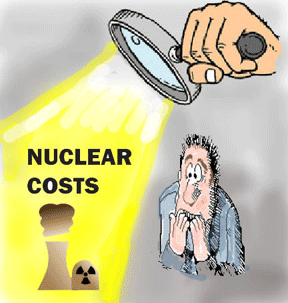
 Planned Hinkley Point nuclear power station under fire from energy industry, Guardian, Nils Pratley and Sean Farrell, 10 Aug 15 Energy analyst says that for same price as Hinkley Point C, providing 3,200MW of capacity, almost 50,000MW of gas-fired power capacity could be built. Hinkley Point, the planned £24.5bn nuclear power station in Somerset, is under intensifying criticism from the energy industry and the City, even as the government prepares to give the final go-ahead for the heavily subsidised project.
The plant, due to open in 2023, will cost as much as the combined bill for Crossrail, the London 2012 Olympics and the revamped Terminal 2 at Heathrow, calculated Peter Atherton, energy analyst at investment bank Jefferies. He said that, for the same price as Hinkley Point C, which will provide 3,200MW of capacity, almost 50,000MW of gas-fired power capacity could be built.
“This level of new gas build would effectively replace the entire thermal generation fleet in the UK – much of which is old and inefficient – with brand new, highly efficient, low carbon, gas generation,” said Atherton.
Doubts about Hinkley Point have deepened after a detailed report by HSBC’s energy analysts described eight key challenges to the project, which will be built by the state-backed French firm EDF and be part-financed by investment from China.
These challenges include: declining demand for power in the UK, currently falling at 1% a year as energy-saving measures take effect; a three-fold jump in the UK’s interconnection capacity with continental Europe by 2022, massively increasing the country’s ability to import cheaper supplies; and “a litany of setbacks” in Finland, France and China for EdF’s European Pressurised Reactor (EPR) model, the same type as planned for Hinkley Point.
HSBC’s analysts described the EPR model as too big, too costly and still unproven, saying its future was bleak. They also pointed out that wholesale power prices have fallen by 16% since November 2011 when the government agreed a “strike price” for Hinkley Point’s output – effectively a guaranteed price of £92.50 per megawatt hour, inflation-linked for 35 years and funded through household bills. “With the problems encountered by France’s EPR model and a strike price likely to be double the UK wholesale price at the scheduled 2023 time of opening of the proposed Hinkley C EPR, we see ample reason for the UK government to delay or cancel the project,” they said…….. http://www.theguardian.com/environment/2015/aug/09/planned-hinkley-point-nuclear-power-station-energy-industry
Iran nuclear deal is supported by Jews in Iran

 Iran’s Jewish community gets behind nuclear deal with U.S.USA Today, 7 Aug 15 Reese Erlich, GlobalPost TEHRAN, Iran — Tapo, one of six kosher restaurants in Tehran, has become an informal hangout for the city’s small Jewish community. During a lunchtime rush last week customers ate savory kebabs while excitedly discussing the signing of the U.S.-Iran nuclear accord.
“There was lots of joy for us,” said Horiel, a Jewish customer who declined to give his last name. “It was not only the Jewish community that was happy. The nation was happy.”
Most Iranian Jews strongly disagree with Israeli Prime Minister Benjamin Netanyahu’s denunciations of the accord. Horiel said his ancestors came from Jerusalem, “but I’m an Iranian Jew. Israel will get nothing with threats and war.”
Israeli leaders and conservative politicians in the U.S. have denounced the accords as too weak, saying they’ll allow Iran to eventually develop atomic weapons.
Iranians argue that they never built a nuclear bomb and have no intention of doing so. They broadly support the accord in hopes that the U.S. will lift economic sanctions and the economy will improve.
But the agreement also lessens international tensions, says Homayoun Sameyah Najafabadi, chair of the Tehran Jewish Committee, the country’s main Jewish organization. “There was the possibility of war,” he said. “With the deal signed, it will take war off the table and bring stability to the region.”
Najafabadi said that Israel’s opposition to the accord “has no impact on the Jewish community in Iran.”…….. Jewish leaders estimate there are between 12,000 and 30,000 Jews here today, making Iran’s the second-largest Jewish population in the Middle East after Israel.
But those who have chosen to stay in Iran have a long history of opposition to hawkish Israeli governments. Many consider themselves Jews but not Zionists.
The Islamic Republic of Iran allows freedom of worship for Jews and Christians, according to Siamak Morsedegh, the Jewish representative to Iran’s parliament. He points out that unlike some other countries in the region and in Europe, Jewish templesin Iran have not been attacked.
“There (is) no need for guards in front of our synagogues,” he said………..
GlobalPost Special Correspondent Reese Erlich received a grant from the Pulitzer Center on Crisis Reporting for his reporting from Iran. His latest book is “Inside Syria: The Back Story of Their Civil War and What the World Can Expect.”
This article originally appeared on GlobalPost. http://www.usatoday.com/story/news/world/2015/08/07/globalpost-iran-jewish-community-nuclear-deal/31277653/
Britain’s nuclear power and nuclear weapons plans intrinsically linked
 Shining a light on Britain’s nuclear state, Guardian, Phil Johnstone and Andy Stirling, 7 Aug 15
Debates over Trident and energy policy are rarely joined up. But are there deeper links between Britain’s nuclear deterrent and its commitment to nuclear power? Two momentous issues facing David Cameron’s government concern nuclear infrastructure. The new secretary of state for energy, Amber Rudd, recentlyconfirmed her enthusiasm for what is arguably the most expensive infrastructure project in British history: the Hinkley Point C power station. At the same time, a decision is pressing on a similarly eye-watering commitment to renew Britain’s nuclear deterrent.
Ostensibly distinct, both of these issues are intensely controversial, extremelyexpensive, agonisingly protracted, and often accompanied by vicious political rhetoric. Yet commentators rarely ask how these decisions might be connected. Could such links help to explain the strength of the UK’s nuclear lobby? Britain remains one of only a handful of countries committed to a “nuclear renaissance”, with senior government figures asserting the manifest falsehood that there is “no alternative” to nuclear power. Meanwhile, support for renewables and energy efficiency has been cut.
It seems that Whitehall is in denial about the widely acknowledged performance trends of nuclear power and renewables. The reality is that renewables manifestly outperform nuclear power as low carbon energy sources. Successive UK andinternational studies show they are already more competitive than nuclear. And renewables costs continue to fall. Yet after more than half a century of development (and far greater levels of cumulative public support), nuclear costs keep rising. The performance gap just keeps on growing.
Nor is there any good excuse for ignoring such overblown nuclear promises. Problems of reactor safety, nuclear waste and weapons proliferation remain unsolved. Nuclear security risks are uniquely grave. With finance in question andtechnical difficulties mounting, the deteriorating prospects of the Hinkley project are the latest episode in a familiar pattern.
So why is the UK so persistent in pursuing new nuclear power? If the nuclear lobby is driving this, why have other countries with stronger nuclear industries nonetheless developed far more sceptical positions? In the case of Germany, this has meant the country with the world’s most successful nuclear industry and a less attractive renewable resource than the UK, nonetheless undertaking a wholesale shift from one to the other.
One striking factor is an apparently strong correlation between those countries most eager to construct new nuclear with those expressing a desire to maintain nuclear weapons. But care is needed before jumping to conclusions. Historically,links between enthusiasms for nuclear power and nuclear weapons are well-explored. Almost all the attention here has focused on possibilities for diverting nuclear weapons materials like highly enriched uranium and plutonium. These connections were crucial in early nuclear developments, and remain so in contemporary proliferation threats. But it is highly doubtful they explain the UK situation. An elaborate global nuclear safeguards regime introduces formidable barriers. And the UK has since the end of the Cold War maintained enormous gluts of key weapons materials………
the links between UK civilian nuclear power and military interests in nuclear submarines run deep. What is remarkable is the complete lack of discussion these provoke in the media, public policy documents, or wider critical debate. Yet the stakes are very high. Does the commitment to a submarine based nuclear deterrent help to explain the intensity of high-level UK support for costly, risky and slow nuclear power, rather than cheaper, quicker and cleaner renewable technologies?
If so, the conclusions are not self-evident. For some supporters of a nuclear deterrent, the additional burdens of nuclear power may seem entirely reasonable. But the almost total silence on these connections raises crucial implications for democracy. Imminent decisions that the government must take over nuclear power and the nuclear deterrent are hugely significant. There is a responsibility on all involved to be open and accountable. Otherwise, it will not just be electricity consumers and taxpayers that pay the price, but British democracy itself.
Phil Johnstone is a research fellow and Andy Stirling is a professor of science and technology policy at the Science Policy Research Unit (SPRU), University of Sussex. http://www.theguardian.com/science/political-science/2015/aug/07/shining-a-light-on-britains-nuclear-state
UK government just quietly funding Small Modular Nuclear Reactors
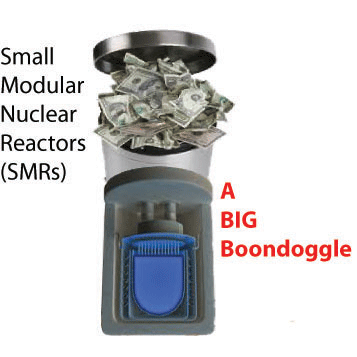 UK invests in advanced nuclear fuel research, World Nuclear News, 7 Aug 15 “……The Department of Energy and Climate Change (DECC) has awarded £1.5 million ($2.3 million) to the NNL and £1.0 million ($1.6 million) to the University of Manchester to fund new capital equipment for nuclear fuel and manufacturing research……..
USA government makes rules on ionising radiation in water more lax

 EPA raises permissible levels of radiation in drinking water https://thewrongblogg.wordpress.com/2015/08/04/epa-raises-permissible-levels-of-radiation-in-drinking-water/ The White House has given final approval for dramatically raising permissible radioactive levels in drinking water and soil following “radiological incidents,” such as nuclear power-plant accidents and dirty bombs. The final version, slated for Federal Register publication as soon as today, is a win for the nuclear industry which seeks what its proponents call a “new normal” for radiation exposure among the U.S population, according Public Employees for Environmental Responsibility (PEER).
Issued by the Environmental Protection Agency, the radiation guides (called Protective Action Guides or PAGs) allow cleanup many times more lax than anything EPA has ever before accepted. These guides govern evacuations, shelter-in-place orders, food restrictions and other actions following a wide range of “radiological emergencies.” The Obama administration blocked a version of these PAGs from going into effect during its first days in office. The version given approval late last Friday is substantially similar to those proposed under Bush but duck some of the most controversial aspects: Continue reading
Illusion of rational choice, in Czech government’s plans for nuclear power
The Czech Nuclear Illusion ČEŠTINA 29. Jul. 2015 by Martin Sedlák In the first week of June the Czech government adopted an action plan that is supposed to lead to the construction of four new reactors in the country—first in Dukovany and then in Temelín. The government’s decision, however, is not the product of a rational political debate; it is the result of the long-term erosion of responsible governing. Therefore, the Czech Republic can serve as a textbook case of how decisions about the future of energy should not be made.
An Open-Ended Nuclear Action Plan
The National Action Plan for the Development of Nuclear Energy was drafted by the Ministry of Industry and Trade (MIT) along with the Ministry of Finance (MF). It is based on this year’s updated State Energy Policy, which is supposed to lead to the Czech Republic increasing its share of nuclear energy to up to 50% by 2040. “In 2040 the fuel mix for electricity generation will comprise 46 to 58% nuclear, 18 to 25% renewables and secondary sources, 5 to 15% natural gas, and 11 to 21% brown and black coal,” claimed Minister of Industry and Trade Jan Mládek (Social Democrat) upon publicly presenting the new energy policy. If the scenario envisioned in the State Energy Policy actually plays out, nuclear energy will become the dominant source of electricity in the Czech Republic for a long time to come. In the decision-making process the Czech government rejected a policy based on renewables or natural gas. Politicians were particularly opposed to renewable energy due to its high price. However, as this paper demonstrates, Czech politicians’ rejection of green energy was not founded on economic data but on ideology, as the high price of nuclear energy seems to pose no problem………..
A Radiant Heritage
In the Czech Republic we call the MIT’s methods salami tactics: The current government is having a project drawn up for the construction of new reactors in which billions of Czech crowns will be invested. There is thus a real threat that future politicians will inherit a grim inheritance from which they will have to complicatedly work their way out of. Or they will have to commit themselves to massive subsidies from public sources—which (at least according to available public documents) have not yet been consulted with the European Commission over adherence to business competition rules.
Calculations made by independent analysts suggest that there may be a substantial threat to consumers in the future. Continue reading
Fennovoima the last hurrah for nuclear industry in Finland
Regional daily: PM Sipilä says Fennovoima could be Finland’s last nuclear project http://yle.fi/uutiset/regional_daily
Prime Minister Juha Sipilä says it’s unlikely that his government will approve any new nuclear power plants after the Fennovoima project, reports the regional daily Keskisuomalainen. In an interview with Keskisuomalainen, Prime Minister Juha Sipilä stated that the Fennovoima project could be Finland’s last nuclear power plant. However Sipilä stressed that no firm decisions had been made on the issue.
Sipilä said that it seemed unlikely that any new proposals for nuclear power plants would come up for consideration during the current government’s term in office.
Sipilä added that during government formation talks he had conducted a straw poll among prospective coalition partners. It was on this basis that he said it was “very unlikely that anything further would happen on this front.”
“There are no applications or any discussions ongoing about nuclear power permits,” Sipilä remarked.
Sipilä’s government programme has made no mention of nuclear power; rather, it has highlighted the possibilities of the bio-energy sector……..http://yle.fi/uutiset/regional_daily_pm_sipila_says_fennovoima_could_be_finlands_last_nuclear_project/8206696
Obama props up a failing nuclear industry, with nuclear energy a centerpiece of his climate push!
 For starters, nuclear energy isn’t clean. Although nuclear fission is itself a low-carbon process, the lifecycle carbon cost of nuclear energy production is anything but, with greenhouse gas emissions stemming from uranium mining, milling, processing, enrichment, and transportation, not to mention the years-long—sometimes decades-long—process of actually constructing nuclear reactors.
Rather than prop-up a struggling industry, the Obama administration, and whichever administration follows, should eliminate nuclear from its all-of-the-above energy arsenal, relegating it to the category of dirty energies that, if we don’t curtail now, will leave future generations cleaning up our environmental mess.

Obama Sells Out Human Health and the Environment By Making Nuclear Energy a Centerpiece of Climate Policy http://www.globalresearch.ca/obama-sells-out-human-health-and-the-environment-by-making-nuclear-energy-a-centerpiece-of-climate-policy/5467030By Washington’s Blog Global Research, August 04, 2015
In reality, nuclear is NOT a low-carbon source of energy … and funding nuclear crowds out the development of better sources of alternative energy.
Mark Jacobson – the head of Stanford University’s Atmosphere and Energy Program, who has written numerous books and hundreds of scientific papers on climate and energy, and testified before Congress numerous times on those issues – notes that nuclear puts out much more pollution (including much more CO2) than windpower, and 1.5% of all the nuclear plants built have melted down. Jacobson alsopoints out that it takes at least 11 years to permit and build a nuclear plant, whereas it takes less than half that time to fire up a wind or solar farm. Between the application for a nuclear plant and flipping the switch, power is provided by conventional energy sources … currently 55-65% coal.
No wonder a former Commissioner for the U.S. Nuclear Regulatory Commission says that building nuclear plants to fight global warming is like trying to fight global hunger by serving everyone caviar. More information here, here and here.
Zoe Loftus-Farren explained in the New Republic in January
The EPA’s proposed power-plant regulation provides a carbon credit to states for maintaining nuclear energy production at current levels: in other words, a carbon subsidy for maintaining the nuclear status quo. Following the release of the draft rules, EPA administrator Gina McCarthy made clear that the credit is meant, in part, to help the struggling nuclear industry. “There are a handful of nuclear facilities that, because they are having trouble remaining competitive, they haven’t yet looked at re-licensing,” she said at a roundtable discussion with business leaders in Chicago. If nuclear energy plants begin closing, she warned, “It’s a lot of carbon reduction that needs to be made up for a long period of time.”
Maintaining nuclear power production at current levels isn’t the EPA’s only goal. “Nuclear power is part of an all-of-the-above, diverse energy mix and provides reliable baseload power without contributing to carbon pollution,” the EPA said in a emailed statement. “Nuclear power from current and future plants can help the U.S. meet its goals.”
***
Why is this worrying? In the fight against climate change, anything is better than dirty coal, right?
For starters, nuclear energy isn’t clean. Although nuclear fission is itself a low-carbon process, the lifecycle carbon cost of nuclear energy production is anything but, with greenhouse gas emissions stemming from uranium mining, milling, processing, enrichment, and transportation, not to mention the years-long—sometimes decades-long—process of actually constructing nuclear reactors. “From our perspective, the longstanding problems with nuclear waste, nuclear nonproliferation [and] safety really set nuclear apart from other low carbon energy sources,” says Matthew McKinzie, director of the Natural Resources Defense Council’s Nuclear Program.
***
Rather than prop-up a struggling industry, the Obama administration, and whichever administration follows, should eliminate nuclear from its all-of-the-above energy arsenal, relegating it to the category of dirty energies that, if we don’t curtail now, will leave future generations cleaning up our environmental mess.
The odds of a melt-down at a U.S. nuclear power plant are higher than you might assume.
And even a little radiation can be very harmful to your health. And see this.
Postscript: The Onion parodies Obama’s climate plan by pretending that it:
Creates $500 tax credit for homeowners who install rooftop nuclear reactors
New nuclear reactor technologies benefit from the U.S. Environmental Protection Agency’s Clean Power Plan
 New Nuclear Power Seen as Winner in Obama’s Clean Power Plan, Bloomberg by Jonathan CrawfordMark Chediak , 4 Aug 15, The Obama administration gave the struggling U.S. nuclear industry a glimmer of hope this week by allowing new reactors to count more toward meeting federal emissions limits.
States can take more credit for carbon-free electricity to be generated by nuclear power plants under construction as they work to comply with emission-reduction targets set in the U.S. Environmental Protection Agency’s Clean Power Plan released Monday. Cuts from existing reactors won’t count, casting the fate of units at risk of premature retirement in doubt………
“We tend to view new rules as potentially the first bit of good news for the struggling nuclear industry,” Julien Dumoulin-Smith, an analyst for UBS, wrote on Monday in a research note…….
Existing Reactors
The Nuclear Energy Institute, a Washington-based trade group, said it was “pleased” that the EPA recognized that nuclear plants under construction “should count toward compliance when they are operating.”
Marvin Fertel, president of the group, said by e-mail that the industry was disappointed that existing reactors won’t get credit for their carbon-reduction value, given that some are at risk of early retirement. States would have been allowed to count 6 percent of nuclear generation toward clean energy targets under the EPA’s draft rule released last year.
“The final rule does not incorporate the carbon-abatement value of existing nuclear power plants…..
New Reactors
New reactor projects, the first in decades, have been plagued by delays and cost increases.
Beneficiaries of the rule changes would include Southern Co. and Scana Corp., which are building new reactors in Georgia and South Carolina, respectively. The Tennessee Valley Authority, which is building a reactor at its Watts Bar facility near Spring City, Tennessee, would also get a boost.
“Nuclear facilities will be credited because it’s new, zero-carbon generation that will be credited as part of a compliance strategy,” said U.S. EPA Administrator Gina McCarthy. “That’s entirely consistent and appropriate.”……… http://www.bloomberg.com/news/articles/2015-08-03/new-nuclear-power-seen-as-big-winner-in-obama-s-power-plan
President Obama’s Clean Power Plan does not support existing nuclear reactors
Final Clean Power Plan Drops Support For Existing Nuclear Plants, Forbes, Jeff McMahon, 3 Aug 15 vThe final version of President Obama’s Clean Power Plan does not include aid to existing nuclear power plants at risk of closing because they can’t compete with cheaper natural gas and renewables—a list that includes some of the nation’s most controversial reactors, including Indian Point and Three Mile Island.
In the draft version, EPA had proposed allowing states to count 6 percent of existing nuclear generation toward their clean energy goals, a provision designed to rescue the 6 percent of nuclear capacity considered at risk.
“On further consideration, we believe it is inappropriate to base the BSER (Best System of Emission Reduction) on elements that will not reduce CO2 emissions from affected electric generating units below current levels,” EPA states in the final rule.
“Existing nuclear generation helps make existing CO2 emissions lower than they would otherwise be, but will not further lower CO2 emissions below current levels. Accordingly… the EPA is not finalizing preservation of generation from existing nuclear capacity as a component of the BSER.”
Accordingly, states will not be able to meet their clean energy goals by extending the licenses of existing nuclear plants…………
In 2013, Morningstar identified six nuclear plants that could be next to shut down because of economic conditions:
2. Ginna, NY, Exelon
3. Fitzpatrick, NY, Entergy
4. Three Mile Island, PA, Exelon
5. Davis Beese, OH, FirstEnergy
6. Pilgrim, MA, Entergy
Exelon has also identified its Byron, Quad Cities, and Clinton plants in Illinois as at risk and has campaigned against tax credits for wind energy.
The nuclear industry had campaigned for stronger support for nuclear power in the Clean Power Plan…..http://www.forbes.com/sites/jeffmcmahon/2015/08/03/final-clean-power-plan-drops-support-for-existing-nuclear-plants/
Smart economics: Germany’s decision to phase out nuclear power
Why Germany’s decision to phase out nuclear power is smart economics , REneweconomy, By Erik Gawel & Sebastian Strunz on 4 August 2015 London School of Economics
Germany has made a formal commitment to phase out the use of nuclear power by 2022. Erik Gawel and Sebastian Strunz write on the implications of the strategy for Germany’s future energy mix and whether the approach adopted in the country could function as a model for other European states. They argue that while the target is undeniably challenging, long-term it is economically sensible and feasible to phase out both fossil fuels and nuclear energy in favour of renewables.
Political responses to climate change and other negative consequences of conventional energies within Europe (e.g. oil spills, radioactive waste, open pit coal mining) are highly diverse. While the UK is promoting nuclear as a carbon-free energy source, for instance, Germany has embarked on a completely different path with its plan to phase out nuclear energy altogether. What is the background of Germany’s phase-out decision and how sensible is it from an economic point of view?
In order to fully answer this question, several aspects need to be acknowledged. First, the phase-out is no impulsive reaction to the Fukushima incident, which came out of the blue. Germany’s powerful anti-nuclear movement dates back to the 1970s; it bred the Green Party which entered the Parliament in 1983 and ascended to the government in 1998 by forming a coalition with the Social Democrats. In 2000 this centre-left coalition put a nuclear phase-out into law for the first time. The early 2020s were identified as the target date for a nuclear free energy system. While subsequent revisions of the law have changed the specifics, the currently stipulated year for the last plant to be shut down, 2022, is well in line with this original perspective. Thus, the phase-out project has always been crafted as a long-term and step-wise process.
Second, the Fukushima disaster effectively killed the narrative that nuclear power was necessary as a ‘bridging technology’ toward a renewables-based energy system. While conservatives had previously argued in line with this logic (and the government led by Chancellor Merkel in 2010 diluted the first phase-out law from 2000 by extending the running times of nuclear plants), they reversed their position after Fukushima. The most immediate consequence of Merkel’s shift on nuclear was the prompt shutdown of seven nuclear power plants in spring 2011. Due to overcapacities, this drop has neither proven to be problematic for the security of supply (contrary to the conservatives’ claims before 2011) nor has it led to an enduring increase of wholesale prices or a requirement to import foreign nuclear power. In fact, Germany is still a net exporter of electricity.
Third, Germany is not alone in phasing out nuclear power. As can be seen from Table 1, [in original] there are several countries in Europe that do not rely on nuclear power or have also declared their intention to stop nuclear energy production. While some of the countries without nuclear are smaller EU member states, it is noteworthy that Italy, another highly industrialised economy and member of the G7, has never used nuclear power. The highly diverse picture of nuclear energy in Europe becomes complete when the huge differences in nuclear-shares among countries are considered, as well as the fact that countries such as Poland intend to enter this form of energy………..
Is nuclear power a necessary part of a future energy mix?
All things considered, is nuclear power necessary for decarbonising the energy supply while also ensuring security of supply? The German experience shows that renewable energies may contribute major shares of the electricity supply – without jeopardising energy security in a highly industrialised economy and even under challenging natural frame conditions in Germany for renewables, provided that there is a long-term transition perspective and a stable political consensus.
Moreover, it may be questioned whether the long-term risks associated with nuclear power really fit the requirements of any sustainable energy system which demands being more than simply carbon-free. But even apart from such sustainability issues, the apparent need for heavy subsidies to render new nuclear plants economically viable undercuts the claim that nuclear is cheaper than renewable energy sources, even in terms of financial costs only. On the contrary, a recent Prognos study estimates that “new wind and solar can provide carbon-free power at up to 50 per cent lower generation costs than new nuclear”. Accounting for backup requirements in times without wind or sun, a combined system of wind, solar and gas is still 20 per cent cheaper than a system of nuclear and gas.
Sure enough, Germany has to cope with the side-effects of the transition (e.g. current rises in retail electricity prices) and interactions with other developments (e.g. increasing electricity production from lignitemainly due to high gas prices and the record low emission allowance prices). Yet, nuclear energy is rarely an inevitable part of decarbonising energy provision. Until now, Germany’s political consensus is very solid in this respect – and while the transition effort is indeed challenging, this does not diminish its merits from an economic point of view: in the long run, it seems both sensible and feasible to phase out fossil and nuclear energies in favour of renewables, thus treading a long but well-considered path towards comprehensive sustainability of energy provision, including long-term cost-effectiveness.
Source: This article was first published at the LSE’s Europblog http://reneweconomy.com.au/2015/why-germanys-decision-to-phase-out-nuclear-power-is-smart-economics-49500
Top bank advises UK government to delay or cancel Hinkley nuclear project
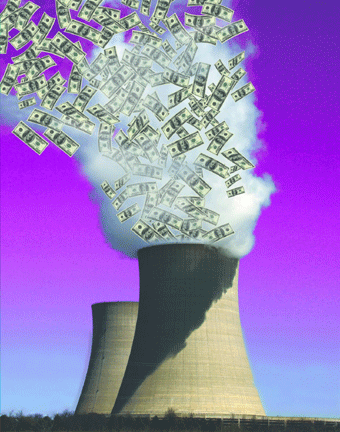 Too expensive…Not needed…top bank report hits out at plans for £25bn Hinkley C nuclear plant, This is Money, By NEIL CRAVEN FOR THE MAIL ON SUNDAY, 2 August 2015 Plans for Britain’s first nuclear reactor in almost 30 years have come under sustained attack from politicians and City bankers.
A report from a top bank this weekend warned that the cost of the £25billion Hinkley Point C plant was ‘becoming harder to justify’. HSBC concluded: ‘We see ample reason for the UK Government to delay or cancel the project.’
And former Tory Energy Secretary Lord Howell of Guildford – the self-described ‘pro-nuclear’ architect of a drive into nuclear power under Margaret Thatcher – has told the House of Lords that the reactor plan in Somerset was ‘one of the worst deals ever for British households and British industry’.
He added that he would ‘shed no tears if it was abandoned’.
Plans for Hinkley Point C have been controversial from the start with the Government guaranteeing what many saw as a sky high price electricity generated at the site.
The Department of Energy and Climate Change shrugged off HSBC’s report and the criticism seems unlikely to stop the nuclear plan. The Secretary of State for Energy, Amber Rudd, said on Friday that Britain could sign a deal as early as October during a visit by China’s President Xi Jinping.
EDF announced on the same day that it had chosen preferred suppliers for £1.3billion worth of work linked to the new plant.
But with the chorus of disapproval growing louder the Government and nuclear industry are set to be under huge pressure throughout the project to prove it is value for money for British energy users.
Key to the criticisms levelled by HSBC’s analysts is that the electricity produced by the reactor is likely to be too expensive, as European wholesale prices are expected to fall along with demand for energy from UK users. It warned of ‘huge difference between UK forward prices and the Hinkley price’.
Among HSBC’s eight key concerns is that the reactor will be economically unviable due in part to a rising number of electricity grid links with the Continent providing a ready source of cheaper supply.
At the same time it said projections by National Grid to 2025 all point to flat or declining demand. HSBC said its demand estimates are for a fall of one per cent a year.
HSBC also highlighted the ‘bleak’ future of large nuclear reactors which have a history of escalating costs and sliding deadlines. ……..
The Austrian and Luxembourg governments launched a legal complaint last month, followed by a challenge from ten German and Austrian green energy firms.
The complainants say the UK Government’s subsidies may reach £76 billion and are in breach of European rules relating to state aid. Some observers say the dispute could lead to delays of six years.: http://www.thisismoney.co.uk/money/news/article-3182406/Too-expensive-Not-needed-bank-report-hits-plans-25bn-Hinkley-C-nuclear-plant.html#ixzz3hhFWKFaE
1 This Month
23-25 October – on Zoom – World BEYOND War’s annual global conferenc

To see nuclear-related stories in greater depth and intensity – go to https://nuclearinformation.wordpress.com

Say No to NASA’s Reckless Nuclear Reactor on the Moon
Say No to NASA’s Reckless Nuclear Reactor on the Moon
-
Archives
- October 2026 (160)
- September 2026 (339)
- August 2026 (330)
- July 2026 (355)
- June 2026 (287)
- May 2026 (306)
- April 2026 (356)
- March 2026 (251)
- February 2026 (267)
- January 2026 (308)
- December 2025 (358)
- November 2025 (359)
-
Categories
- 1
- 1 NUCLEAR ISSUES
- business and costs
- climate change
- culture and arts
- ENERGY
- environment
- health
- history
- indigenous issues
- Legal
- marketing of nuclear
- media
- opposition to nuclear
- PERSONAL STORIES
- politics
- politics international
- Religion and ethics
- safety
- secrets,lies and civil liberties
- spinbuster
- technology
- Uranium
- wastes
- weapons and war
- Women
- 2 WORLD
- ACTION
- AFRICA
- Atrocities
- AUSTRALIA
- Christina's notes
- Christina's themes
- culture and arts
- Events
- Fuk 2022
- Fuk 2023
- Fukushima 2017
- Fukushima 2018
- fukushima 2019
- Fukushima 2020
- Fukushima 2021
- general
- global warming
- Humour (God we need it)
- Nuclear
- RARE EARTHS
- Reference
- resources – print
- Resources -audiovicual
- Weekly Newsletter
- World
- World Nuclear
- YouTube
-
RSS
Entries RSS
Comments RSS

