Will UK government lock Britain into Hinkley Nuclear White Elephant?

while these might be reasons for the Government to pull out of the project, it won’t be able to once the deal has been signed. And if the problem is that the strike price is too high, it’s unlikely that EDF or the other funders will want to pull out either.
At the Hinkley point of no return, is this a nuclear white elephant? The Independent, A  deal for the £24.5bn power plant in Somerset could be signed in October after the Government agreed terms with the energy giant EDF. But, writes Tom Bawden, environmentalists are far from alone in opposing an ‘expensive mistake’ TOM BAWDEN 27 August 2015 One of Britain’s most controversial energy projects for decades – the £24.5bn nuclear power development at Hinkley Point in Somerset – is poised to get the green light.
The Department of Energy and Climate Change (DECC) has gone so far as to say households will be £74 a year better off in today’s money by 2026-30 than they would be without Hinkley Point C.
But the detractors are not in the least bit convinced, with analysts, politicians and even some rival power companies dismissing the project as a colossal waste of money. Shortly before his sudden departure from RWE Npower this week, the chief executive of the big six provider, Paul Massara, said future generations would look back on Hinkley Point C as an “expensive mistake”.
Despite the strength of opposition to the project, David Cameron is expected to sign a final deal in October during Chinese President Xi Jinping’s visit to the UK; the Chinese are big backers of the project….
We look at some of the main challenges to completion.
The political justification
An in-depth report into Hinkley Point C by HSBC bank saw “ample reason for the UK Government to delay or cancel the project”. It argued that the justification for the plant was “receding” because the UK’s energy consumption is falling just as a threefold rise in the number of giant interconnectors, hooking the country up with mainland Europe, means we could import energy much more cheaply than generating it at Hinkley Point.
Furthermore, while UK electricity generation is set to fall, capacity looks set to hold up surprisingly well, in part because of rising wind and solar power. As a result, the strike price is very difficult to justify, HSBC argued.
But while these might be reasons for the Government to pull out of the project, it won’t be able to once the deal has been signed. And if the problem is that the strike price is too high, it’s unlikely that EDF or the other funders will want to pull out either.
Engineering problems
The new reactors at Hinkley Point will use the EPR – European Pressurised Reactor – model, a highly sophisticated new design that is supposed to be safer and more efficient than older reactors, but which has been fraught with problems and is not yet up and running at any site in the world.
The three other sites planning to use the new model have all suffered huge delays – in Finland, France and China – and Hinkley Point would be the fourth. Concerns about EPRs have mounted this year after a potentially catastrophic mistake was identified in the construction of an identical EPR power plant in Flamanville, Normandy……….
Problems at Areva
Areva, the French state-owned reactor designer behind the EPR model, has fallen deep into the red. It has not sold a new reactor since 2008 as problems with its reactors have pushed plants in France and Finland billions of euros over budget.
But EDF and the French government have moved to address Areva’s financial weakness, meaning it is unlikely to cause problems for the Hinkley Point project by going bust. EDF has agreed to take control of Areva’s main reactor division in a deal orchestrated – and with the implicit financial support of – the French government.
Legal problems
Austria has launched a legal challenge to the European Commission’s ruling that the guaranteed price for the new Hinkley Point reactors amounts to legal state aid. The case is expected to drag on for two to three years…… http://www.independent.co.uk/news/business/analysis-and-features/at-the-hinkley-point-of-no-return-is-this-a-nuclear-white-elephant-10475849.html
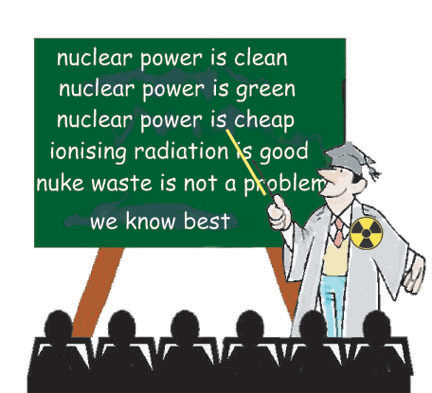
Nuclear lobby working hard at education – 5 centres in Nigeria
5 Nigerian universities host nuclear energy centres of excellence —NAEC August 28, 2015 Premium Times Franklin Osaisai, chairman of the Nigerian Atomic Energy Commission, NAEC, has said that five Nigerian universities now host nuclear energy centres of excellence.
Mr. Osaisai, who disclosed this in an interview with newsmen on Friday in Abuja, said that the Nuclear Technology Centre, Sheda, was also a part of the nuclear centres of excellence.
He said the first two were the Centre for Energy Research and Training (CERT), Ahmadu Bello University (ABU), Zaria and Centre for Energy Research and Development (CERD), Obafemi Awolowo University (OAU), Ile-Ife.
He listed the latest centres as the Centre for Nuclear Energy Research and Training (CNERT), University of Maiduguri, and Centre for Nuclear Energy Studies (CNES), University of Port Harcourt.
The other is the Centre for Nuclear Energy Studies and Training (CNEST), Federal University of Technology, Owerri.
According to him, the establishment of these centres without a corresponding increment in the allocation to NAEC led to the reduction in funding of CERT and CERD.
“It is the mandate of NAEC to develop nuclear technology for the economic development of the country and produce and dispose atomic energy.
“To carry out research into matters connected with the peaceful uses of atomic energy, among others.
“CERT and CERD are arms of NAEC but in order to boost capacity of nuclear research and training, government created a lot of other centres.
“Remuneration, compensation, allowances are part of the public service and everything is paid according to guidelines.
“We have tabled the challenges of funding the centre to before the appropriate authorities; everything is now paid through IPPIS.’’……….http://www.premiumtimesng.com/news/more-news/189141-5-nigerian-universities-host-nuclear-energy-centres-of-excellence-naec.html
UK’s Hinkley Point C nuclear station is now officially mothballed
Hinkley C Mothballed – Is it in its Death Throes? http://www.no2nuclearpower.org.uk/news/comment/hinkley-c-mothballed-is-it-in-its-death-throws/ Two very recent articles in Click Green and Professional Engineer indicate that Hinkley Point C is now officially mothballed. Indeed the project seems to be in its death throes.

We already knew that site preparation work at Hinkley Point C was stopped in April 2015, up to 400 construction workers were laid off, and the Final Investment Decision was delayed until the autumn. (1) What wasn’t clear at the time was that NNB Genco – the consortium planning to build the reactors which consists of EDF Energy, China General Nuclear Corp and other investors – put a cap on future spending on the project. (2)
On 1st July the site entered Care and Maintenance which means that activity at the site is limited to the management of material stockpiles and water management zones, remediation of asbestos contaminated land and archaeological surveys. (3)
The budget cap seems to have been greater than the Office for Nuclear Regulation (ONR) was expecting. ONR, of course, charges NNB Genco for all the work it carries out to regulate its activities.
ONR says it has taken the decision to suspend the production of future inspection reports until a Final Investment Decision is made. It has also suspended attendance at the local liaison committee – the Cannington Forum. These suspensions are most likely because NNB Genco no longer has the budget to pay for them, so the consortium will have asked ONR to stop visiting the site to do inspections and stop attending the forum because it can’t afford to pay. In retaliation ONR says it is “monitoring the impact of the budget constraint upon NNB Genco’s competency and capability”. In other words NNB Genco had better watch out or it will lose its status as an organisation competent and capable of holding a nuclear license.
ONR says its inspectors “continue to engage with the programme of design and safety case activities” related to the start of nuclear safety related construction. Its August newsletter said that further submissions are expected in September this year and the Pre Construction Safety Case related to nuclear island construction was ready for ONR to begin initial engagement at the end of July this year. (4)
So while some desk work appears to be continuing all major work on-site appears to have stopped and NNB Genco is so uncertain that the final investment decision will be positive it has asked ONR to stop as much work as possible to save money – even to the point of threatening its own status as a nuclear capable organisation. The Click Green website says:
“Despite recently publishing a list of preferred suppliers for the £24 billion project, the French firm were in behind-the-scenes talks with the Office for Nuclear Regulation (ONR), during which they informed them of their decision to mothball the site.”
It looks as though it may be all over for Hinkley Point C bar the shouting.
(1) Gloucestershire Echo 2nd April 2015 http://www.gloucestershireecho.co.uk/400-jobs-lost-Barnwood-based-EDF-stops-site-work/story-26271600-detail/story.html
(2) Click Green 20th Aug 2015 http://www.clickgreen.org.uk/news/national-news/126381-exclusive-edf-mothballs-planned-hinkley-c-nuclear-power-site.html
(3) Professional Engineering 20th Aug 2015 http://www.power-eng.com/articles/2015/08/construction-halted-at-hinkley-point-c-nuclear-project-site.html
(4) See page 7 ONR Regulation Matters August 2015http://www.onr.org.uk/documents/2015/regulation-matters-issue-1.pdf
Congresswoman Elizabeth Esty backs Iran nuclear agreement
Esty supports Iran nuclear agreementhttp://www.newstimes.com/news/article/Local-congresswoman-announces-support-of-Iran-6464745.php, August 25, 2015 Congresswoman Elizabeth Esty, D-5, announced Tuesday her support of the Iran nuclear agreement.
Esty said she thoroughly reviewed the deal negotiated between the United States, China, Russia, the United Kingdom, France and Germany that aims to curb Iran’s ability to develop a nuclear weapon in exchange for sanctions relief before making her decision.
“I have attended classified briefings, examined classified materials, and sought answers,” Esty said. “I have met to discuss the agreement with my constituents, Jewish leaders throughout Connecticut, national security and nuclear energy experts, and Israeli leaders during my recent trip to Israel…After careful consideration, I believe implementing this agreement — which is far from perfect — gives us the best chance to stop Iran’s nuclear weapons program.”
Esty said the deal limits Iran’s ability to develop a nuclear weapon, and also contains provisions that allow sanctions to return if the agreement is violated.
“This agreement is not ideal, but is the best available option,” Esty said. “I have listened to critics and constituents raise legitimate concerns — concerns that I believe will help guide the United States in our duty to enforce Iran’s compliance with the agreement and ensure that they meet not just the letter of the agreement but also its spirit.”
New measures to promote rooftop solar, by President Obama
US President Barack Obama unveils measures to encourage solar power use,SMH, August 25, 2015 GARDINER HARRIS. The Obama administration has announced a slew of small measures designed to encourage the use of solar power in the US hours.
The measures included making an additional $US1 billion ($1.4 billion) in loan guarantee authority available in an existing federal program for the kind of residential rooftop solar projects that have become popular in places like California.
But none of the announced measures would provide the impact on the solar industry of the Clean Power Plan, which was announced this month and requires states to cut carbon emissions by an average of 32 per cent. That plan provides strong incentives for much of those reductions to come from the development of renewable energy resources – exactly what executives at the conference in Nevada are looking to sell.
“We’re going to make it even easier for individual homeowners to put solar panels on their roof with no upfront cost,” President Barack Obama told the summit. “A lot of Americans are going solar and becoming more energy-efficient not because of tree huggers — although trees are important, just want you to know — but because they’re cost-cutters.
With the nation’s new electrical needs growing only modestly, renewable power executives are depending on electric utilities finally retiring their aging coal-fired power plants and replacing them with renewable power sources. That process is happening anyway, but the administration’s power plan is expected to accelerate it……..http://www.smh.com.au/environment/us-president-barack-obama-unveils-measures-to-encourage-solar-power-use-20150825-gj71e8.html#ixzz3jsRuU7g4
South Africa’s Finance Minister under pressure about govt plans for unaffordable nuclear power
Nuclear must be affordable, says Nene, Business Day, BY CAROL PATON, 24 AUGUST 2015, FINANCE MINISTER NHLANHLA NENE SAYS HE WILL HOLD THE LINE ON THE PROCUREMENT OF NUCLEAR ENERGY IF IT IS UNAFFORDABLE, AND WILL REDUCE THE HEAD COUNT OF THE PUBLIC SERVICE TO ENSURE SPENDING STAYS IN LINE WITH FISCAL TARGETS.
Mr Nene is under enormous political pressure to accede to a presidency-backed plan to procure 9,600MW of nuclear energy capacity at a time when public finances are at their weakest since the mid 1990s.
Underlining this pressure was the appearance of a fake intelligence dossier last week, smearing top Treasury officials as apartheid agents and alleging that they and Mr Nene are part of a conspiracy by the old white establishment to control the Treasury.
The document aroused grave concern among the public, and in political and investor circles, as it is feared it may signal a political attack on the Treasury, which until now has been a strong source of confidence given its ability to exercise tight control over government finances.
The Treasury and Mr Nene say that the document is baseless but appears to be a worrying attempt “to undermine and destablise the institution”.
Mr Nene’s comments, in an exclusive interview with Business Day on Friday, come at a time of keen interest from ratings agencies and the investor community regarding whether the government will stick to self-imposed spending ceilings designed to cut debt in this challenging political context.
Of the challenges, top of the list is whether Mr Nene will be able to hold the line on the nuclear procurement.
Treasury and Department of Energy officials spent most of last week locked in an intense engagement in Cape Town over the financing options for the project.
Mr Nene said that since the Treasury had only just been invited into the process, it was too early to make pronouncements.
However, if it was unaffordable to the country and to consumers, who would have to pay for the energy generated, it could not be done, he said….. the Department of Energy’s discussions with vendors have all assumed the full 9,600MW would be commissioned. The department also envisages using the programme for industrialisation and job creation, and aims to create a nuclear export industry.
It has to date refused to make public its studies or provide evidence that a nuclear procurement of 9,600MW is affordable.
Mr Nene said that as with any project that involved the allocation of resources, the Treasury would have to account to the nation.
“That is why following process is critical…. My job is spelt out in legislation and my role is to uphold and stay within the confines of the Constitution and the Public Finance Management Act.”…..http://www.bdlive.co.za/business/energy/2015/08/24/nuclear-must-be-affordable-says-nene
UK government trashing environmnental policies, promoting nuclear power and fracked gas
 [The new Secretary of State for Energy and Climate Change, Amber Rudd,] will try to meet the UK’s carbon reduction commitments with nuclear power and fracked gas.
(Of course, this is the same Amber Rudd who said that if nuclear reactors were just prettier, everyone would like them. ed.)
commentators from industry, politics and the financial sector have been lining up to condemn the Government’s plans to subsidize the first new reactors proposed at Hinkley.
What is happening in the UK? The new government makes a sharp move away from clean energy in favor of costly polluting sources. Greenworld, 14 Aug 15 The headlines flash daily about major changes in energy policy in the UK; none of them good news. The slashing of support for solar, energy efficiency and other clean energy programs and at the same time an apparent intent to spend absolutely mind-blowing amounts of money on new, untried, and highly risky nuclear power reactors. From the point of view of an America where, haltingly but steadily, clean energy is gaining a true foothold and is moving ahead, it seems incomprehensible that our closest ally would move in the opposite direction of most of the world’s industrial economies. Could that really be true?
So we asked veteran UK activist Pete Roche to explain what is happening in the UK. And no, the news really is not good.
David Cameron’s Conservative Government has now been in power in the UK, without the constraining influence of the Liberal Democrats, for 100 days. From the point-of-view of the environment his new government has been an unmitigated disaster; marked by a sharp embrace of dirty energy sources in a fashion most advanced nations, even including the U.S., are stepping away from.
From the moment the new Government was elected it set about burning the green policies of the previous coalition government. Subsidies for new onshore wind farms, paid for through consumers’ bills, are to end from April next year as are subsidies for solar farms. There will be a review of the feed-in tariff threatening subsidies for solar panels on domestic and commercial roof tops. And other proposed changes will make it much harder for community renewable projects to obtain finance.
The Government has also killed off the Green Deal scheme which provided loans to households for energy efficiency improvements. The scheme was a damp squib but what’s striking is there are no proposals to replace it. And a decade-long plan to force all new homes to be ‘zero carbon’ from 2016 has been dumped. On top of all this the exemption for renewables from the Climate Change Levy–a kind of carbon tax–has been removed, effectively imposing cuts to the income of renewable projects already up and running retrospectively.
The new Secretary of State for Energy and Climate Change, Amber Rudd, told Members of Parliament (MPs) that carbon reduction targets are a bigger priority than meeting renewable energy targets, signalling that she is prepared to miss the UK’s European Union Renewable Target of meeting 15% of our energy needs (not just electricity) from renewable sources by 2020. Continue reading
Hinkley Point C Nuclear scam – UK tax-payers fund Chinese investors

 Tory privatisation scams (2): the Hinkley Point C nuclear payola guaranteed by UK taxpayers for Chinese investors http://www.michaelmeacher.info/weblog/2015/08/tory-privatisation-scams-2-the-hinkley-point-c-nuclear-payola-guaranteed-by-uk-taxpayers-for-chinese-investors/
Just how bad a deal this is is shown by the fact that Hinkley will provide just 3 gigawatts of capacity, yet for the same price gas-fired turbines could provide about 50 gigawatts, onshore wind 20 and offshore wind 10. The plant will not open till 2023 at the earliest, well past the date of the most acute energy shortage at the end of this decade. And it will cost as much as the combined bill for Crossrail, the London Olympics and the revamped Terminal 2 at Heathrow – beat that for the most expensive white elephant of modern times!
It’s an anachronistic behemoth from the bygone age of energy dinosaurs when the world is rapidly moving towards distributed power via renewable energy. It’s far too costly, and is it even needed? First there is the UK’s declining demand for power, currently falling at a rate of 1% a year as energy-saving measures steadily take effect. Then there is the expected threefold jump in the UK’s Interconnection capacity with continental Europe by 2022 which increases the ability to import cheaper supplies. And third there is the litany of setbacks in price overruns and huge delays that have afflicted Finland, France and China over EDF’s European Pressurised Reactor which is the same type as is planned for Hinkley Point.
However nothing distracts the Tory nose from a good old-fashioned financial fix behind the scenes, especially when in this case it plays to their abhorrence of UK State involvement in meeting a public need. So Cameron is off to Beijing in October to sign a final deal wit the Chinese president from which only Chinese investors will gain at UK taxpayer expense.
Tax-payer money going to nuclear related companies in UAE
 Nuclear-related contracts worth Dh9.15bn have been awarded to UAE firms, says Enec, The National, LeAnne Graves, 18 Aug 15, More than Dh9.15 billion in contracts have been awarded to UAE companies for the construction of the country’s first nuclear power plant, according to the Emirates Nuclear Energy Corporation (Enec)…….
African National Congress calls for transparency on nuclear tender process
 ANC calls for transparent nuclear tender process, Mail & Guardian, 18 AUG 2015 2FRANZ WILD, STAFF REPORTER
ANC calls for “full, transparent and thorough cost benefit analysis of nuclear power” as SA prepares for a bidding process for new nuclear plants. n a document that will be discussed at its policy review conference in October, the ANC said: “Government must also announce publicly that nuclear energy can only be procured in line with the legal prescripts and after a thoroughgoing affordability assessment.”
The document was released on Monday.
During his State of the Nation address in February, President Jacob Zuma said all countries that bid “will be engaged in a fair, transparent and competitive procurement process to select a strategic partner, or partners, to undertake the nuclear build programme”.
But the Mail & Guardian reported earlier this year that in a “top secret” presentation, the energy department proposed a closed government-to-government procurement of new nuclear power stations instead of a transparent and competitive tender.
The nuclear agreement with Russia, which amaBhungane revealed, states that the government is prepared to give Russia exclusive rights to its nuclear build programme for a minimum of 20 years. During that time, Russia could block South Africa from procuring nuclear technology from any other country.
The Russians would be indemnified from any liability arising from nuclear accidents during the reactors’ lifespan. Russia would be granted a host of regulatory concessions and favourable taxation and other financial treatment. The designated competent authorities are South Africa’s department of energy and Russia’s state-owned Rosatom State Atomic Energy.
With the Russian economy in turmoil and the subsequent high cost of borrowing, the country’s ability to raise the funding for its nuclear ambitions in many countries is being called into question – as is its ability to deliver on time.
For South Africa, it is even more of a mystery how the government will provide the loan guarantees that would be required, given that so many have been extended to ailing parastatals such as Eskom and SAA. The state may have hit its limit………http://mg.co.za/article/2015-08-18-anc-calls-for-transparent-nuclear-tender-process
Over 300 US rabbis urge Congress to support Iran nuclear deal
Hundreds of US rabbis voice support for Iran nuclear deal, 124 News, 19 Aug 15 IDF: deal could help rein in terrorist activities; US will not succeed to ‘intrude’ on Iran: Khamenei
More than 300 American rabbis wrote members of Congress Monday urging them to support the international nuclear deal with Iran, signalling the US Jewish community is split over the historic but controversial accord.
The religious leaders come from across the spectrum, but hail overwhelmingly from Judaism’s Conservative and Reform streams as well as other progressive Jewish movements, a spokesperson said.
“We encourage the members of the Senate and the House of Representatives to endorse this agreement,” the 340 rabbis wrote in a letter to Congress distributed by Ameinu, a progressive charitable Jewish organization.
“We are deeply concerned with the impression that the leadership of the American Jewish community is united in opposition to the agreement,” the rabbis added.
“We, along with many other Jewish leaders, fully support this historic nuclear accord”……..http://www.i24news.tv/en/news/international/82396-150817-fate-of-nuclear-deal-still-not-clear-iran-s-khamenei
Obama can still do the Iran nuclear deal, despite Congress opposition
 President Obama can do Iran nuclear deal even if Congress rejects it Chicago Tribune, By Tribune wire reports contact the reporter , 16 Aug 15 President Obama doesn’t need a congressional OK to make a deal with Iran over its nuclear program. The September vote on the Iran nuclear deal is billed as a titanic standoff between President Barack Obama and Congress. Yet even if lawmakers reject the agreement, it’s not game-over for the White House.
A congressional vote of disapproval would not prevent Obama from acting on his own to start putting the accord in place. While he probably would take some heavy criticism, this course would let him add the foreign policy breakthrough to his second-term list of accomplishments.
Obama doesn’t need a congressional OK to give Iran most of the billions of dollars in relief from economic sanctions that it would get under the agreement, as long as Tehran honors its commitments to curb its nuclear program — at least for now.
“A resolution to disapprove the Iran agreement may have substantial political reverberations, but limited practical impact,” says Robert Satloff, executive director of the Washington Institute for Near East Policy. “It would not override President Obama’s authority to enter into the agreement.”
Lawmakers on their summer break are deciding how to vote. A look at the current state of play:
WHAT WILL HAPPEN IN SEPTEMBER?
With Republicans controlling both chambers of Congress, the House and Senate are expected to turn down the deal. Obama has pledged to veto such a resolution of disapproval, so the question has turned to whether Congress could muster the votes to override him, in what would be a stinging, bipartisan vote of no-confidence against the president. And Obama would forfeit the authority he now enjoys to waive sanctions that Congress has imposed.
But Democrats and Republicans have predicted that his expected veto will be sustained — that opponents lack the votes to one-up Obama……
WHAT CAN OBAMA DO ON HIS OWN? The president could suspend some U.S. sanctions. He could issue new orders to permit financial transactions that otherwise are banned now. On the financial sector, Obama could use executive orders to remove certain Iranians and entities, including nearly two dozen Iranian banks, from U.S. lists, meaning they no longer would be subject to economic penalties……….http://www.chicagotribune.com/news/nationworld/ct-iran-nuclear-deal-obama-20150816-story.html
Secrecy and graft in South Africa’s multi $billion nuclear power plan?
Nuclear power plan stirs fears of secrecy and graft Project could cost as much as $100 bn – experts., Money Web Joe Brock, Reuters | 14 August 2015 Fears are growing in South Africa that agreements to build nuclear power plants that could be the most expensive procurement in the country’s history will be made behind closed doors, without the necessary public scrutiny.
Among those voicing concern, two government sources say the Treasury is not being included in procurement discussions, despite the massive budgetary implications of a project that experts say may cost as much as $100 billion.
Construction on the first plant is due to start next year, breakneck speed compared with the years of regulatory and environmental checks for nuclear projects in countries such as Britain and the United States.
The Democratic Alliance, the main opposition party, believes the pace of the deal will prevent proper analysis before contracts are signed and huge sums of money change hands.
“The whole deal has been veiled in secrecy. We have no details on what we’re buying, how much it’s going to cost or how we’re going to pay for it,” shadow energy minister Gordon Mackay told Reuters.
The Department of Energy (DoE) did not respond to requests for comment. It has said several times the procurement process will be transparent and follow procedure.
Finance Minister Nhlanhla Nene was forced this week to deny reports of tensions with the DoE over the plans and said the Treasury was playing a supporting role in the procurement process.
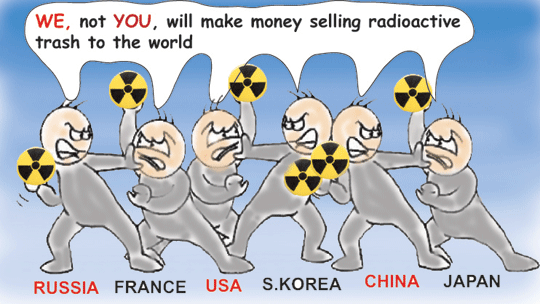 Pretoria has already signed non-binding inter-government agreements for nuclear power support from several countries including France, China and South Korea.
South Africa’s President Jacob Zuma said this week the nuclear plan was at an “advanced stage” and the procurement process should be completed by March.
Following meetings between Zuma and Russian President Vladimir Putin last year, the Russian atomic agency Rosatom said it had agreed a $10 billion contract to build power stations.
However, the DoE denied an agreement had been reached, raising public suspicion in South Africa of backroom dealmaking – an accusation often levelled against the ruling African National Congress under Zuma’s tenure.
The nuclear deal is of huge concern given South Africa’s history of endemic corruption,” said Andrew Feinstein, a former ANC lawmaker and now executive director of Corruption Watch UK.
Feinstein is the author of a book about alleged widespread graft in a $4.8 billion arms deal during the late-1990s.
“I fear that the corruption in this deal might dwarf the arms deal,” he said.
Chronic shortages, mounting debt…….A 2013 study by the University of Cape Town’s Energy Research Centre found more nuclear power was not needed and would not be cost-effective, based on an estimated installed cost of $7 000 per kilowatt.
The DoE has estimated the build would cost $4 200 per kilowatt. Energy experts say this is optimistic and the calculations are based on out-of-date assumptions……..http://www.moneyweb.co.za/news/south-africa/nuclear-power-plan-stirs-fears-of-secrecy-and-graft/
Sendai nuclear station restarted because economics are ‘more important’ than human life
The real reasons for the restart. The decision to restart the reactor at Sendai is probably based upon the “dismal science:” economics. It seems that financial considerations and worries about the health of the national and local economies triumphed over safety concerns.
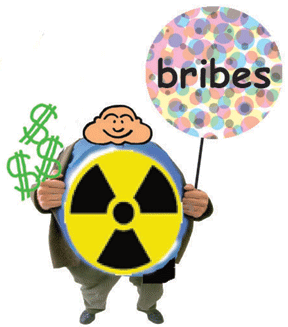 The prefecture and the nearest city are financially dependent on nuclear energy.
Satsumasendai city receives more than $12 million in grants annually from the nuclear industry, which it uses to pay for its public and educational facilities, receiving about $270 million over the years.
There are also questions of transparency in the dealings of local government authorities with Kyushu Electric Power.
Economics was considered more important than human life: That is why the Sendai nuclear power plant was able to restart.
Why was the Sendai nuclear power plant restarted? http://thebulletin.org/why-was-sendai-nuclear-power-plant-restarted8644 Tadahiro Katsuta 13 Aug 15 Two of Japan’s reactors—Units 1 and 2 of the Kyushu Electric Power Company’s Sendai nuclear power plant—have just restarted, and Unit 1 should begin generating electricity on August 14. Like all other Japanese nuclear power plants, Sendai was shut down after the events at Fukushima Daiichi in 2011, in which an earthquake, a tsunami, egregious design mistakes, and a poor safety culture combined to form “a cascade of stupid errors” that led to a triple meltdown.This is the first restart of any of Japan’s 43 operable commercial reactors since Fukushima, and it is happening despite many unresolved questions concerning nuclear safety regulations. When it comes to safety, the Sendai nuclear power plant is definitely not at the head of the class: The utility owning the power plant was given a pass despite a very problematic history. (At one point, a regulatory commissioner called the plan to restart Sendai “wishful thinking”.)
There is certainly no nationwide re-emergence of nuclear power in Japan. Indeed, there have been vocal public protests against the Sendai restart. One of the protestors even included a former prime minister of Japan.
So, why is it happening? What are the ostensible reasons for a restart? Were they valid?
A three-pointed rationalization. The justification for a restart was based upon three key points: the type of reactors to be used at Sendai were considered inherently “safer;” the chance of a similar natural disaster(s) was considered to be minimal; and the concerns of the local communities were dismissed as inconsequential.
Let us look at each of these items in turn. Continue reading
Politics, Safety, Money – all factors working against Japan’s supposed nuclear power revival
Japan’s return to nuclear meets with fear and loathing, CNBC, Nyshka Chandran | @NyshkaC 11 Aug 15, “………..Tuesday’s restart has far-reaching consequences for Japan’s politics and economy. Here are the key issues:
The move is highly controversial among citizens, with regular opinion polls revealing that a clear majority of the population want Japan to end nuclear power………”This is absolutely the worst possible timing given public opinion is significantly moving away from Abe: There is already backlash against his security bills and last week’s Hiroshima commemoration didn’t go well for him either,” James Brown, assistant professor at Temple University in Tokyo, told CNBC, referring to new legislation that would end Japan’s pacifist constitution.
“If we start to see some connection between nuclear issues and the collective self-defense concept behind the security bills, i.e. a connection between civilian and military nuclear usage, that’s particularly dangerous for Abe’s popularity.”
Despite public disapproval, the government will be able to implement its nuclear policies due to the lack of a strong political opposition, Brown explained.
Safety
Kyushu’s Sendai reactor was commissioned around 30 years ago, raising doubts whether the unit may be too old to withstand future disasters, such as the large earthquakes common across Japan.
“They are on the edge, seeing as most reactors above 40 years of age are considered to be aging,” Daniel Aldrich, professor of political science and co-director of the Center for Resilience Studies at Northeastern University in Boston, told CNBC.
The country has embraced stricter guidelines and new technology for the entire nuclear industry since the 2011 tragedy, but according to Aldrich, “the question is, for Japan to extend the life and licensing of these aging reactors, can they convince the population that these reactors are safe?”
The Sendai reactor is also located near an active volcano……..
Money…….“In the longer term, Japan’s population will be in decline, they will be more efficient in energy usage, and overall gas demand should slow. The government is also going big on renewable energy, which should also lower demand.”………”Marginal operating expenses are low but the longer-term costs are incredibly high. Regulatory standards have increased, so nuclear operators need to install more equipment, which means higher costs,” Brown added.http://www.cnbc.com/2015/08/10/japans-return-to-nuclear-meets-with-fear-and-loathing.html
1 This Month
23-25 October – on Zoom – World BEYOND War’s annual global conferenc

To see nuclear-related stories in greater depth and intensity – go to https://nuclearinformation.wordpress.com

Say No to NASA’s Reckless Nuclear Reactor on the Moon
Say No to NASA’s Reckless Nuclear Reactor on the Moon
-
Archives
- October 2026 (160)
- September 2026 (339)
- August 2026 (330)
- July 2026 (355)
- June 2026 (287)
- May 2026 (306)
- April 2026 (356)
- March 2026 (251)
- February 2026 (267)
- January 2026 (308)
- December 2025 (358)
- November 2025 (359)
-
Categories
- 1
- 1 NUCLEAR ISSUES
- business and costs
- climate change
- culture and arts
- ENERGY
- environment
- health
- history
- indigenous issues
- Legal
- marketing of nuclear
- media
- opposition to nuclear
- PERSONAL STORIES
- politics
- politics international
- Religion and ethics
- safety
- secrets,lies and civil liberties
- spinbuster
- technology
- Uranium
- wastes
- weapons and war
- Women
- 2 WORLD
- ACTION
- AFRICA
- Atrocities
- AUSTRALIA
- Christina's notes
- Christina's themes
- culture and arts
- Events
- Fuk 2022
- Fuk 2023
- Fukushima 2017
- Fukushima 2018
- fukushima 2019
- Fukushima 2020
- Fukushima 2021
- general
- global warming
- Humour (God we need it)
- Nuclear
- RARE EARTHS
- Reference
- resources – print
- Resources -audiovicual
- Weekly Newsletter
- World
- World Nuclear
- YouTube
-
RSS
Entries RSS
Comments RSS

