South Africa fires key nuclear negotiator

 Joemat-Pettersson fires point man on nuclear BY CAROL PATON, Business Day, 15 SEPTEMBER 2015, THE key figure in the government’s bid to secure a 9.6GW nuclear energy programme, nuclear physicist Senti Thobejane, has been fired by Energy Minister Tina Joemat-Pettersson, raising new questions on the future of the project.
Mr Thobejane, who was nuclear adviser to Ms Joemat-Pettersson, also advised President Jacob Zuma, which, with his knowledge and skills, placed him in a unique position to broker the large nuclear procurement, of which Mr Zuma has been an enthusiastic supporter.
He was the key figure in discussions with vendor countries and played a central role in the Cabinet’s energy security sub-committee, which is led by Mr Zuma himself.
His sudden departure comes as the Treasury is finally getting to grips with the feasibility of the nuclear procurement, which until recently had been kept under wraps by the Department of Energy. The department has repeatedly assured Parliament and the public that the procurement of 9.6GW of nuclear energy was affordable and viable. However, it has refused to make public the studies which it says support this.
The reasons for the termination of Mr Thobejane’s contract are not publicly known. ……..aside from Mr Thobejane’s departure there are other signs that the programme may be losing momentum. Six weeks ago Ms Joemat-Pettersson denied that the government had ever said it would build 9.6GW of nuclear power, describing the number as “a thumb-suck”………
In reply to questions submitted by Democratic Alliance MP David Maynier, Finance Minister Nhlanhla Nene said on Monday that the Treasury was still in the process of assessing both the financial costs and economic effects of the nuclear build programme.
“This work is currently not finalised yet as there is an interactive process under way with the Department of Energy on the scale of the programme and possible financing scenarios that have a bearing on the modelling work and its results. The recommendations from this work are expected to be submitted to the Cabinet as soon as the work is completed,” said Mr Nene. http://www.bdlive.co.za/business/energy/2015/09/15/joemat-pettersson-fires-point-man-on-nuclear
USA’s Nuclear Regulatory Commission might back quack pro nuclear ‘science’ on ionising radiation!
 How might the commissioners of the NRC decide the issue? Like the Atomic Energy Commission which it grew out of, the NRC is an unabashed booster of nuclear technology and long devoted to drastically downplaying the dangers of radioactivity.
A strong public stand – many negative comments – over their deciding that ‘radioactivity is good for you’ could make all the difference.
Petition: ‘Protect children from radiation exposure!‘ (Change.org)
Comment online: The NRC has a set a deadline of 19th November for people to comment on the proposed change. The public can send comments to the US Government’s regulations website.
Is radiation good for you? The US Nuclear Regulatory Commission could decide it is http://extrasensoryprecepts.blogspot.com.au/2015/09/is-radiation-good-for-you-us-nuclear.html,  The Ecologist | Sep 10, 2015 | Karl Grossman
In the wake of the Manhattan Project, the US crash program during World War II to build atomic bombs and the spin-offs of that program – led by nuclear power plants – there was a belief, for a time, that there was a certain ‘threshold’ below which radioactivity wasn’t dangerous.
But as the years went by it became clear there was no threshold – that any amount of radiation could injure and kill, that there was no ‘safe’ dose. Low levels of radioactivity didn’t cause people to immediately sicken or die. But, it was found, after a ‘latency’ or ‘incubation’ period of several years, the exposure could then result in illness and death.
Thus, starting in the 1950s, the ‘Linear No-Threshold’ standard was adopted by the governments of the US and other countries and international agencies.
The LNT standard has presented a major problem for those involved in developing nuclear technology Continue reading
Japan: call by former Prime Minister Koizumi for a national anti nuclear movement

 Koizumi calls for national movement to lead fight against nuclear power,September 13, 2015 HE ASAHI SHIMBUN by Shinichi Sekine and Takashi Funakoshi
Although he has no plans to return to national politics, former Prime Minister Junichiro Koizumi tells the electorate not to lose hope in the campaign against nuclear power. In an exclusive interview with The Asahi Shimbun in Tokyo, Koizumi called for a national movement to steer Japan away from nuclear plants. “We should patiently continue to make efforts toward such a movement,” he said on Sept. 9. “It is worth our efforts.”
In the first interview Koizumi, 73, has granted to a media outlet since he stopped down as prime minister in September 2006, the theme was nuclear power. The former prime minister denounced the Abe administration for pushing to rely on nuclear energy despite the 2011 Fukushima disaster, calling the recent restart of a nuclear power station “wrong.”
“Japan will be all right even if all its nuclear power plants are abandoned right now,” he said.
While in office from 2001 to 2006, Koizumi, of the Liberal Democratic Party, had promoted nuclear power generation in line with previous governments’ policy. Koizumi, however, had a dramatic change of heart in the wake of the triple meltdown at the Fukushima No. 1 nuclear power plant in March 2011, pointing to the potential danger of nuclear plants.
Last year, he actively campaigned in the Tokyo gubernatorial election for former Prime Minister Morihiro Hosokawa on a primarily anti-nuclear platform. Hosokawa placed third in the race, behind winner Yoichi Masuzoe, who was backed by the ruling LDP.
Koizumi said the costs of bolstering the safety of nuclear power stations in quake-prone Japan would prove massive, citing powerful temblors in recent years such as the 2007 Niigata Chuetsu-oki Earthquake and 2011 Great East Japan Earthquake.
“Nuclear power plants are not safe,” he said. “If additional precautions are taken (to help prepare nuclear facilities for a giant quake), it will cost a huge amount of money.”
The former prime minister also hit back at the government’s argument that continuing with nuclear power will be a step in the right direction in terms of addressing global warming, given it does not emit carbon dioxide while generating electricity.
“Nuclear power is not clean at all,” he said. “It is obvious that nuclear power also generates ‘nuclear waste’ (highly radioactive waste), which is more dangerous than carbon dioxide (that is spewed by thermal power plants).”
Koizumi criticized Prime Minister Shinzo Abe for “being influenced by promoters of nuclear power” and pressing ahead with the restart of a nuclear power plant……… http://ajw.asahi.com/article/0311disaster/fukushima/AJ201509130042
French govt uses amendment to impose nuclear waste dump without parliament vote
The CIGEO project, managed by l’Agence nationale pour la gestion des déchets radioactifs (ANDRA), aims to bury nuclear waste 500 meters under the village of Bure. The wastes consist of 80,000 cubic meters of high-level, long-lived waste produced by French nuclear facilities. The project was estimated to cost 16.5 billion euros in 2005, but an estimate done in 2009 set the figure at 36 billion euros. The final cost is unknowable. For several years, anti-nuclear activists and residents have opposed what they call a “nuclear garbage dump.”
So how did nuclear waste find its way into a bill with 400 articles related to economic growth?

 Executive Privilege Invoked for Approving French Nuclear Waste Site http://nf2045.blogspot.jp/2015/09/executive-privilege-invoked-for.html
For many years, the French nuclear establishment has been struggling to overcome public opposition and legislative obstacles to its plans to bury high-level, long-lived nuclear waste in the rural village of Bure. During the summer of 2015, the socialist government of Francois Hollande took the desperate measure of tacking the issue onto an omnibus bill called the loi Macron, which is supposed to be concerned only with growth, equality and economic opportunity.
Just about anything could be subjectively judged to promote economic growth, so the government took an expansive view and included whatever it wanted under a very flexible definition of matters which favor “growth, equality and economic opportunity.” Once the nuclear waste project was in the Macron Bill, the government then took advantage of an executive privilege called Article 49.3.
About Article 49.3 Continue reading
USA Republicans fail in the Senate to kill the Iran nuclear deal
 US Senate Democrats block effort by Republicans to kill Iran nuclear deal, ABC Nws 11 Sept 15 US president Barack Obama has achieved perhaps the greatest foreign policy victory of his six years in office, with a Republican-backed effort to kill the Iran nuclear agreement being narrowly blocked in the US Senate.
Forty Democrats and two independents voted to block a resolution disapproving of the pact in the 100-member chamber, one more than the minimum needed to keep it from advancing.
“This vote is a victory for diplomacy, for American national security, and for the safety and security of the world,” Mr Obama said in a statement after a vote he termed “an historic step forward”.
But Senate Republicans insisted the fight w was not over……….
Under a law Mr Obama signed in May, Congress has until September 17 to pass a resolution disapproving of the international agreement.
If such a resolution were to pass, and survive Mr Obama’s promised veto, it would bar the president from waiving many US sanctions on Tehran, a key component of the nuclear deal.
But there was no sign any votes would change, and Senate Democratic leader Harry Reid bluntly responded: “This matter is over with.”……….The defeat came despite an intense $US40 million lobbying campaign against the agreement, largely by conservative pro-Israel groups. http://www.abc.net.au/news/2015-09-11/attempt-to-kill-iran-nuclear-agreement-narrowly-blocked/6768560
Former Republican presidential candidate Michele Bachmann wants USA to bomb Iran
 Bachmann Calls For US To Bomb Iran’s Nuclear Hardware, The DC, 10 Sept 15 WASHINGTON — Former congresswoman and 2012 Republican presidential candidate Michele Bachmann called on the U.S. to bomb Iran’s nuclear hardware, which she said would “get the attention of these thugs in the Middle East.”
Bachmann, who spent part of her career on the House Intelligence Committee, spoke with The Daily Caller Wednesday while waiting for the rally against the Iran deal to begin. As the sun beat down on the crowd, Bachmann was resolute in her stance that the U.S. should seriously consider bombing Iran to stop their nuclear ambitions.
“As we stand here today, you can end this nuclear program today. All you do is deliver bombs on the nuclear hardware,” Bachmann told TheDC. “We’re not talking about bombing shopping centers and killing innocent kids in Iran. We’re talking about taking out weapons of death. That’s the nuclear hardware.”…….
Bachmann also wants the U.S. to pump more weapons into Israel and give them bunker-busting bombs and more access to United States aircraft carriers in case the Israelis want to launch a strike……. http://dailycaller.com/2015/09/10/bachmann-calls-for-us-to-bomb-irans-nuclear-hardware/#ixzz3lVWHVy8w
Outrageous decision of USA’s Nuclear Regulatory Commission (NRC) to cancel research on cancer-nuclear links
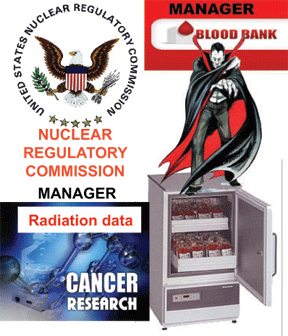 Vital cancer study canceled: NRC will hide the truth about nuclear reactor risks Beyond Nuclear today decried the outrageous decision by the U.S. Nuclear Regulatory Commission (NRC) to cancel a study that would have examined cancer incidence and mortalities and the connection to U.S. nuclear facilities.
“Study after study in Europe has shown a clear rise in childhood leukemia around operating nuclear power facilities, yet the NRC has decided to hide this vital information from the American public,” said Cindy Folkers, radiation and health specialist at Beyond Nuclear.
The study, initiated in 2009 and carried out under the auspices of the National Academy of Sciences (NAS), had completed Phase 1 and was looking at seven pilot nuclear sites around the country, a project that was estimated to cost $8 million.
“An $8 million price tag for the next phase of this study is a drop in the bucket for an agency with a $1 billion annual operating budget,” added Folkers. The NRC identified the “significant amount of time and resources needed and the agency’s current budget constraints” as its excuse for terminating the study.
Folkers noted that, in reality, nuclear industry manipulation, rather than budget constraints, could be behind the NRC’s sudden decision to abandon the NAS study.
In documents obtained by Beyond Nuclear it was revealed that NRC staff had been approached by the president of U.S. National Council on Radiation Protection and Measurements (NCRP), John Boice, offering a cheaper, faster and less sensitive study design to replace the NAS study, although the NRC has not yet agreed to accept the NCRP bid.
Read the full press release and feel free to circulate. http://www.beyondnuclear.org/home/2015/9/8/vital-cancer-study-canceled-nrc-will-hide-the-truth-about-nu.html
UK nuclear lobby is seeking a blank cheque from the governmnet
So where is the British flight into ‘nuclear power is cheap somewhere’ fantasy leading us? Well, to nationalisation, of course
 What the pro-nuclear lobby now wants is for limitless sums of money to be siphoned off from public spending on education, health and whatever else and spent on building nuclear power stations. The money will be notionally borrowed, a contract that will be concocted that will claim that the electricity consumer will pay the money back at a later date, and the balance will be paid for by, well, less schools, hospitals etc. Meanwhile a story will be manufactured about how all of this is cheap.
The state will end up giving the whole project a blank cheque so that the disastrous construction process can be bankrolled entirely from a bottomless pit of state finances.
 The notion that nuclear is cheaper somewhere else is a myth http://realfeed-intariffs.blogspot.co.uk/2015/09/the-notion-that-nuclear-is-cheaper.html by Dr David Toke The British attitude to the notion that nuclear power is not cheap after all is a bit like a child who first hears that Father Christmas does not, after all, exist. Disbelief, and in this case a belief that if only Father Christmas is nationalised, then it will still be true. The psychologists call this cognitive dissonance, in other words if a fact is uncomfortable to you, you believe that the fact is wrong.
France heading towards a nuclear industry phaseout?
 France tilting toward nuclear phase-out, DW 10 Sep 15 As the traditionally strong French nuclear power industry continues to be plagued by technical and financial difficulties, the government has sought to cut nuclear power in favor of renewables. French Environment Minister Segolene Royal sparked rebuke Tuesday (08.09.2015) by tying shutdown of the country’s oldest nuclear plant to the opening of an EPR reactor that has been delayed for six years already………last year, Areva recorded a loss of 5 billion euros. The group hasn’t sold a single power plant in the last seven years, and the Fukushima disaster looks to have had further impacts on demand for new reactors.
Third-generation nuclear reactors – so-called European Pressurized Reactors (EPR) – were initially considered a secure technology for the future and the flagship of the French nuclear industry. But even they have been fraught with problems.
Despite Royal’s recent statement, recently passed legislation on renewable energy in France may be the most telling sign that the winds of change appear to be blowing – toward a nuclear phase-out.
Technology of the future turns sour
Operational start of the Olkiluoto 3 EPR in Finland has been delayed from 2009 to 2018, and the Flamanville 3 reactor in France from 2012 to 2018. Construction costs for Flamanville 3 have exploded, from 3.3 to more than 10 billion euros. Two EPR reactors at the Hinkley Point nuclear facility in England have also been the focus of controversy, as construction costs are much higher than initially projected. Financing for completing the project has still not been secured.
There is also the prospect of major safety issues. In mid-April it became known that there were weak points in the steel vessel that surrounds the reactor at the French Flamanville plant, which could lead to cracking under pressure.
The French Nuclear Safety Agency (ASN) called the situation “very serious,” and has demanded a comprehensive report by October.
If the regulating authority judges the vessel unsafe, it would be a disaster for Areva. Replacing it would take several years and result in additional costs in the hundreds of millions of euros, experts say.
Yannick Rousselet, a nuclear energy expert at Greenpeace, says further delays would deal a death blow to the EPR project. Aside from the two European reactors, no EPR installation has been successfully completed – there are just two projects in China.
“Only a few years ago, Areva told us that worldwide it would be finalizing two to three reactors per year,” Rousselet said. “The reality today is that the EPR as an industrial project is dead.”
EDF steps in to save AREVA. The French state owns 86.5 percent of Areva and 84.5 percent of EPR, which is the world’s second-largest electricity provider and a major nuclear power producer.
In an emergency meeting with President Francois Holland in June, it was agreed that EDF should buy in to Areva’s reactor business.
“Without these measures, Areva wouldn’t survive the year,” said Mycle Schneider, editor of the World Nuclear Industry status report.
And according to Schneider, help for Areva doesn’t spell an end French nuclear power’s problems.
EDF is considerably larger than Areva, and has an annual turnover of 70 billion euros. But Schneider points out its also has 37.5 billion euros of debt. Schneider sees this mountain of debt as a central problem.
According to the Paris audit office, the company faces an additional 50 billion euros in costs for dismantling and disposal of nuclear waste.
From nuclear to renewables?
As nuclear energy faces these problems, winds of change appear to be blowing through the French energy system.
Marc Bussieras, head of EDF’s economic strategy department, is open to energy production without nuclear. EDF’s priority is a cost-effective strategy, he told DW.
“Today in France, there are economic reasons in favor of installing renewable energy capacity,” Bussieras said.
Marc Bussieras, head of strategy at EDF, said at a DW panel renewables make economic sense
The French government is seeking to promote an energy transition through new legislation, which is also hoped to create jobs. The law, adopted in July 2015, states that the share of nuclear power in France’s energy mix should be reduced from 75 percent today to 50 percent by 2025. The shortfall in power supply should primarily be covered by wind and solar.
According to a study commissioned by the national environmental agency (ADEME), a complete phase-out of nuclear power and switch to 100 percent renewable energy should be possibly – and economically viable – by 2050…….
Schneider sees other opportunities for the nuclear industry. “The future lies in the huge market for demolition and nuclear waste management,” Schneider said. “New constructions will remain the exception.” http://www.dw.com/en/france-tilting-toward-nuclear-phase-out/a-18692209
No accountability for the $billions being spent on Oak Ridge Uranium Processing Facility.
BUSTED! UPF bomb plant to break the bank at $11 Billion, UPF Update. Orepa.org 10 Sep 15Nuclear Regulatory Commission prevents hearing on Fermi nuclear plant
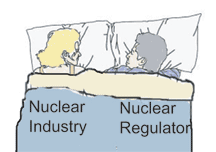 Nuclear regulators halt plans for Fermi 2 hearing BY TOM HENRY BLADE STAFF WRITER
http://www.toledoblade.com/Energy/2015/09/09/Nuclear-regulators-halt-plans-for-Fermi-2-hearing.html#Ge8j5KJYItT4iPTj.99 NEWPORT, Mich. — Anti-nuclear activists trying to stop DTE Energy’s Fermi 2 nuclear plant from getting a 20-year license extension were dealt a setback Tuesday when the U.S. Nuclear Regulatory Commission killed their plans for a special hearing about the plant’s continued operation.
The agency’s commissioners overruled a decision by the NRC’s Atomic Safety and Licensing Board to grant a hearing on three issues, or contentions, as regulators call them.
The plant’s operating license expires March 20, 2025.
Three environmental groups — Don’t Waste Michigan, Citizens Environment Alliance of Southwestern Ontario, and Beyond Nuclear — filed a request for a hearing with four proposed contentions challenging DTE’s application.Another environmental group, Citizens Resistance at Fermi 2, also known as CRAFT, filed a separate hearing request with fourteen proposed contentions.
Requests for the hearing were opposed by DTE and the NRC’s staff.
The NRC said its rules for allowing hearings on such contentions “are designed to ensure that only focused, well-supported issues are admitted for hearing.”
The coalition of groups said it plans to appeal the NRC’s decision in federal court.
The agency’s licensing board had granted a hearing on safety and environmental contentions regarding the common transmission line corridor shared by Fermi 2 and the proposed new Fermi 3 reactor.
Activists warned of a “domino effect” if either of those reactors or their high-level radioactive waste storage pools released radiation. Contact Tom Henry at: thenry@theblade.com, 419-724-6079, or via Twitter @ecowriterohio.
Despite Sendai restart, the outlook for Japan’s #nuclear industry is poor
 Japan nuclear power outlook bleak despite first reactor restart, Yahoo News, 1 Sept 15, By Kentaro Hamada and Aaron Sheldrick TOKYO (Reuters) – The number of Japanese nuclear reactors likely to restart in the next few years has halved, hit by legal challenges and worries about meeting tougher safety standards imposed in the wake of the Fukushima disaster, a Reuters analysis shows…….
analysis shows that of the other 42 operable reactors remaining in the country, just seven are likely to be turned on in the next few years, down from the 14 predicted in a similar survey last year.
The findings are based on reactor inspection data from industry watchdog the Nuclear Regulation Authority, court rulings and interviews with local authorities, utilities and energy experts. They also show that nine reactors are unlikely to ever restart and that the fate of the remaining 26 looks uncertain.
“Four-and-a-half years after the events started unfolding at Fukushima Daiichi, the Japanese government, the nuclear utilities and the NRA have not succeeded in overcoming complete planning insecurity for investors. The outlook for restarts is as cloudy as ever,” said Mycle Schneider, an independent energy consultant in Paris…….
LEGAL WOES
Legal challenges from local residents have hit all atomic plants, with the country’s most nuclear-reliant utility Kansai Electric Power issued with court rulings preventing the restart of four reactors despite two of them already receiving NRA approval to switch on.
Kansai has appealed the judgments but the court cases may take years to resolve if the rulings are not overturned on the first appeal.
Tougher safety standards and stricter implementation of rules since Fukushima have also been hitting restarts. Japan Atomic Power has been battling a regulatory ruling that one of its reactors sits above an active fault, meaning it must be decommissioned.
And highlighting the pitfalls of rebooting the industry, Kyushu Electric was forced to slow the ramp up of power from its Sendai No. 1 reactor after it restarted around mid-August due to problems with pumping equipment. Engineers warn that firing up reactors that have been offline for prolonged periods could be fraught with such troubles……..http://news.yahoo.com/japan-nuclear-power-outlook-bleak-despite-first-reactor-013149457–finance.html
German govt to change nuclear liability law – to make utilities pay up for nuclear exit costs
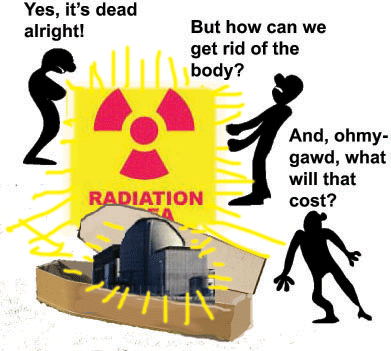 Germany proposes changes to nuclear liability law- draft law http://www.reuters.com/article/2015/09/02/germany-nuclear-idUSB4N10101R20150902 BERLIN, SEPT 2 The German government has proposed changes to a law to prevent German utilities from evading the payment of billions of euros needed to fund the country’s nuclear exit, according to a copy of the draft law seen by Reuters.
The document says that utilities will be liable for the costs of shutting down power plants and disposing of nuclear waste even if they give up control of subsidiary companies or spin-offs.
A spokesperson for the economy ministry said the draft law was currently being discussed by government departments.
Under current corporate laws, companies are liable for spun off units for five years, but there has been concern utilities might break up to avoid paying for the dismantling of Germany’s nuclear plants, the last of which will be shut for good in 2022. (Reporting byGernot Heller; Writing by Caroline Copley; Editing by Madeline Chambers)
Michigan residents urged to submit comments on Canada’s nuclear waste dump plan – Congressman Dan Kildee –
 Congressman Dan Kildee Urges Michiganders to Submit Comments on Canadian Plan to Bury Nuclear Waste on the Shores of the Great Lakes August 19, 2015 Current 90-Day Comment Period ‘Critical Opportunity’ for Citizens to Have Voices Heard and Stop Plan, Kildee Says
Congressman Dan Kildee (MI-05) today announced a new community initiative today to protect the Great Lakes and encourage Michigan residents to get involved to stop a Canadian plan to bury nuclear waste less than a mile from Lake Huron.
Currently, Canada has opened a 90-day comment period seeking comments from both U.S. and Canadian citizens on the proposed plan. Today Congressman Kildee, joined by Michigan Senate Democratic Leader Jim Ananich and concerned citizens, announced a new write-in campaign to the Canadian Minister of the Environment to ensure that Michiganders’ voices are heard on this important issue that threatens our Great Lakes. Instructions on how to submit public comments are below.
“We must protect the Great Lakes from harm, including from the threat of Canadian nuclear waste,” Congressman Kildee said. “Burying nuclear waste less than a mile from Lake Huron just doesn’t make sense and is too much of a risk to take, especially considering nuclear material remains radioactive for thousands of years. There is growing opposition to this plan, both in the U.S. and Canada, and now Michiganders have a chance to be heard and express their views too. I encourage all Michigan residents to speak up and submit comments to Canadian officials during this open comment period to demonstrate that Michigan stands united against this threat to our Great Lakes.”
Today’s announcement in Flint is the latest effort by Congressman Kildee in recent weeks to raise awareness about the potential Canadian plan and stop the burying of nuclear waste so close to the Great Lakes. Last week, along with Senators Debbie Stabenow and Gary Peters, Congressman Kildee announced new legislation to invoke the Boundary Waters Treaty of 1909 and mandate that a new study be conducted to examine the proposal’s risks………
To date, 168 municipalities – in both the U.S. and Canada – have passed resolutions opposing the plan, including Flint, Mich., Bay County, Mich.; Toronto, Ontario; Chicago, Ill.; Wayne County, Mich.; Milwaukee, Wisc.; Essex County, Ontario; and Rochester County, New York. The Michigan State Senate also has passed a resolution opposing the Canadian nuclear waste storage site.
To submit their comments, Michigan residents must write to the Canadian Environmental Assessment Agency by September 1, 2015. Comments can be submitted by mail or email.
Anyone who would like to submit comments by mail should send them to: Canadian Environmental Assessment Agency; 22nd Floor, 160 Elgin Street, Ottawa ON K1A 0H3
Anyone who would like to submit comments by email should send them to:ceaa.conditions.acee@ceaa-acee.gc.ca http://dankildee.house.gov/congressman-dan-kildee-urges-michiganders-to-submit-comments-on-canadian-plan-to-bury-nuclear-waste-on-the-shores-of-the-great-lakes/
Dr Ian Fairlie on US Nuclear Regulatory Commission (NRC): Consultation on radiation standards
 US Nuclear Regulatory Commission (NRC): Consultation. Dr Ian Fairlie Consultant on Radioactivity in the Environment LONDON United Kingdom www.ianfairlie.org, 28 Aug 15,

Introduction On June 26 2015, the US Nuclear Regulatory Commission (NRC) stated it was seeking public comments by September 8, on petitions stating that the Linear No Threshold theory of radiation’s effects was not a valid basis for setting radiation standards and that the hormesis model should be used instead.
In more detail, the NRC has received three petitions for rulemaking requesting that the NRC amend its “Standards for Protection Against Radiation” regulations and change the basis of those regulations from the Linear No-Threshold (LNT) model of radiation protection to the hormesis model. (See the Appendix for details of the petitions.) The LNT model assumes that biological damage from radiation is linearly related to exposure and is always harmful, ie without a threshold.
The hormesis model assumes that exposures to low radiation levels is beneficial and protects the human body against deleterious effects of high levels of radiation. The NRC has stated it is examining these petitions to determine whether they should be considered in rulemaking and is requesting public comments.
US environmental groups are concerned that, if the NRC agreed with the petitions, it would introduce rules to weaken radiation protection standards at US nuclear facilities. On the other hand, according to two NRC staffers (Brock and Sherbini, 2012), the NRC apparently pays attention to the evidence on risks of low levels of radiation………
No evidence below 100 mSv? It is necessary at this point to directly address the argument often raised by hormesis advocates – that there is little evidence of effects below 100 mSv.
This is incorrect.Older evidence exists -see http://www.ianfairlie.org/news/a-100-msv-threshold-forradiation-effects/for a list of studies and the newer evidence, as we have just seen, clearly shows this fact as well. B. Radiobiological Evidence Current radiobiological theory is consistent with a linear dose-response relationship down to low doses (ie below ~10 mSv). The radiobiological rationale for linearity comes from the stochastic nature of energy deposition of ionising radiation. It was explained by 15 of the world’s most eminent radiation biologists and epidemiologists in a famous article (Brenner et al, 2003) as follows: “1. Direct epidemiological evidence demonstrates that an organ dose of 10 mGy of diagnostic x-rays is associated with an increase in cancer risk………..
The Importance of LNT in Radiation Protection Regardless of dissenting views on LNT, the reality is that most concepts used in radiation protection today are fundamentally based on the LNT theory. For example, LNT underpins the concepts of absorbed dose, effective dose, committed dose, and the use of dose coefficients (ie Sv per Bq of a radionuclide). It also allows radiation doses (i) to be averaged within an organ or tissue, (ii) to be added from different organs, and (iii) to be added over time.
LNT also permits annual dose limits; optimization -ie comparison of practices; radiation risk assessment at low and very low doses; individual dosimetry with passive detectors; collective dose, and dose registers over long periods of time. 9 In fact, the LNT underpins all legal regulations in radiation protection in the US and in the rest of the world.
Indeed, if the LNT were not used, it’s hard to imagine our current radiation protection systems existing at all. However this statement should not be misconstrued to mean that the LNT is used just because it’s convenient: the LNT is used because the scientific evidence for it is comprehensive, cogent and compelling……..
Conclusions
(i) the debate The validity or otherwise of LNT and hormesis have been the subject of hundreds of scientific articles and debates over several decades. Unfortunately, much of the literature on hormesis or adaptive response is based on faulty science or on misconceptions, or on misinterpretations, or on all three.
 This is particularly the case with several US and UK journalists who write with confidence on how radiation risks are exaggerated. Their knowledge and experience of radiogenic risks are limited to say the least, but these journalists, almost on a weekly basis, misinform and mislead the public about radiation risks, so the existence of the US petitions is perhaps unsurprising.
However real scientists are increasingly standing up and opposing the poor science used by hormesis advocates. Very recently, four Swiss scientists from the Institute of Social and Preventive Medicine at the University of Bern; the Swiss Tropical and Public Health Institute, Basel and the University of Basel published a study which revealed that exposure to high rates of background radiation resulted in increased cancer risks to children (Spycher et al, 2015). http://ehp.niehs.nih.gov/1408548/
In other words, the petitions appear to be based on preconceptions, or even ideology, rather than the scientific evidence which points in the opposite direction. The petitions should not be used by the NRC to justify weakening regulatory standards at US nuclear facilities. A question remains whether the NRC should have accepted the petitions for review. Presumably the NRC has discretion not to review or to refer back spurious, mischievous, or ill-founded petitions.
1 This Month
23-25 October – on Zoom – World BEYOND War’s annual global conferenc

To see nuclear-related stories in greater depth and intensity – go to https://nuclearinformation.wordpress.com

Say No to NASA’s Reckless Nuclear Reactor on the Moon
Say No to NASA’s Reckless Nuclear Reactor on the Moon
-
Archives
- October 2026 (160)
- September 2026 (339)
- August 2026 (330)
- July 2026 (355)
- June 2026 (287)
- May 2026 (306)
- April 2026 (356)
- March 2026 (251)
- February 2026 (267)
- January 2026 (308)
- December 2025 (358)
- November 2025 (359)
-
Categories
- 1
- 1 NUCLEAR ISSUES
- business and costs
- climate change
- culture and arts
- ENERGY
- environment
- health
- history
- indigenous issues
- Legal
- marketing of nuclear
- media
- opposition to nuclear
- PERSONAL STORIES
- politics
- politics international
- Religion and ethics
- safety
- secrets,lies and civil liberties
- spinbuster
- technology
- Uranium
- wastes
- weapons and war
- Women
- 2 WORLD
- ACTION
- AFRICA
- Atrocities
- AUSTRALIA
- Christina's notes
- Christina's themes
- culture and arts
- Events
- Fuk 2022
- Fuk 2023
- Fukushima 2017
- Fukushima 2018
- fukushima 2019
- Fukushima 2020
- Fukushima 2021
- general
- global warming
- Humour (God we need it)
- Nuclear
- RARE EARTHS
- Reference
- resources – print
- Resources -audiovicual
- Weekly Newsletter
- World
- World Nuclear
- YouTube
-
RSS
Entries RSS
Comments RSS

