 Only China wants to invest in Britain’s new £2bn Hinkley Point nuclear plant because no one else thinks it will work, EDF admits Investors put off by problems facing nuclear reactors under construction in France and Finland Geert De Clercq Wednesday 23 September 2015 Delays and cost overruns at two nuclear reactors under construction in France and Finland have made potential investors wary of joining a consortium led by France’s EDF for a similar project in Britain, EDF’s chief executive has admitted…….http://www.independent.co.uk/news/business/only-china-wants-to-invest-in-britains-new-2bn-hinkley-point-nuclear-plant-because-no-one-else-10513752.html
September 25, 2015
Posted by Christina Macpherson |
business and costs, politics, UK |
Leave a comment
 German support for renewables still high, low for nuclear and
  coal http://reneweconomy.com.au/2015/german-support-for-renewables-still-high-low-for-nuclear-and-coal-26906 By Craig
Morris on 24 September 2015 Energy Transition
A recent survey conducted among the German public finds continuing support for the Energiewende. Furthermore, only a third said the cost was too high. Craig Morris says a closer look also reveals that people who already have systems close by are less likely to oppose them. The average German household currently pays 18 euros per month for the renewable energy surcharge. A survey conducted in August by TNS Emnid for renewable energy organization AEE finds that only 31 percent of the participants believe that is too much, compared to 57 percent who believe that amount is acceptable and six percent who think more needs to be paid. Overall, a whopping 93 percent of those surveyed said that further growth of renewables was “important” or “very important.”
The survey also included a question about the acceptability of specific electricity generation systems. While 68 percent support renewable energy systems in general, only seven percent like coal plants – and only four percent nuclear. Note that in all cases, acceptance increased when people already had experience living close to such plants.
Acceptance of solar power plants was the greatest at 77 percent, compared to only 59 percent for wind turbines. But notice the huge discrepancy: a far higher number (72 percent) of people who have experienced wind farms nearby support the technology.
In contrast, support for biogas units was the lowest at a mere 39 percent, rising only to 53 percent among those who already have experience or live close by to those units. This low level of support is one reason for why the government has clamped down on bioenergy in general; the other reason is cost.
Finally, the survey asked what people expect of the Energiewende. The top answer was “making the future safer for our children and grandchildren” at 77 percent, followed by “”protecting the climate” at 73 percent. In contrast, only 33 percent believe the energy transition will “lower costs for consumers in the long term.”
Questions about energy democracy – “citizens can take part in energy supply” and “more competition with power corporations” – revealed middling expectations at 57 and 50 percent, respectively. Note, however, that the question was not why people supported the Energiewende, but what outcome they expected it to produce.
Similar questions were asked in a survey from September 2013, which also found exactly 93 percent in support for the growth of renewables. Likewise, support for the various technologies has only shifted slightly, as have the expectations, which had the exact same order (with slightly different numbers) two years ago. In other words, over the past two years, support for the Energiewende has hardly changed.
September 25, 2015
Posted by Christina Macpherson |
Germany, politics |
Leave a comment
 In Courting Chinese Companies, Britain to Help Fund Planned Nuclear Plant NYT, By STANLEY REED SEPT. 20, 2015 LONDON — The British government said on Monday that it would provide 2 billion pounds, or about $3.1 billion, in state aid for a nuclear power station planned for Hinkley Point in southwest England.
The announcement of financial support — which was made by George Osborne, the chancellor of the Exchequer, on a visit to China — appeared to be a confidence-building measure aimed at wrapping up a deal, years in gestation, to build Britain’s first nuclear plant since the mid-1990s.
“They are edging toward trying to sign a deal, but it is taking a long time,” said Antony Froggatt, a nuclear analyst at Chatham House, a London research organization.
The British government said that it expected EDF, the French state-controlled utility leading the project, to make a final decision later this year to go ahead with the plant. If EDF moves forward, it will be supported by two Chinese companies, China General Nuclear Corporation and China National Nuclear Corporation, the government said. Mr. Osborne has been courting Chinese companies to help finance the new Hinkley Point station, which will cost at least £16 billion…….
In trying to build nuclear plants, Britain is bucking the trend in the West. ……
The British government is not only offering financing to help with the construction but has guaranteed EDF a much higher price for the electricity it generates than current market rates. The government also says that it may increase financial support for the plant as the project progresses. Last year, the European Union approved Britain’s use of state aid to finance the plant……Still, Britain’s effort to build nuclear plants has proceeded at what seems a glacial pace. The Hinkley Point project is already several years behind its original schedule.
Centrica, a British utility, walked away from an option to take a 20 percent stake in Hinkley Point and another nuclear plant, citing frustration over delay and costs. http://www.nytimes.com/2015/09/21/business/energy-environment/britain-says-it-will-aid-planned-nuclear-plant.html?_r=1
September 25, 2015
Posted by Christina Macpherson |
politics, politics international, UK |
Leave a comment
WT, By – Associated Press – Thursday, September 24, 2015 BRATTLEBORO, Vt. (AP) – The company that owns the Vermont Yankee nuclear power plant has dropped its fight against the state’s 30-day written notice requirement.
Entergy Nuclear said Wednesday it is withdrawing its license amendment request to the Nuclear Regulatory Commission to eliminate a requirement that it notify the state when it plans to make withdrawals from the Vermont Yankee decommissioning trust fund…..
The Shumlin administration says the advance notice is necessary for a meaningful review of trust fund spending.
Officials say the state may ask for hearings each time Entergy asks for money from the fund. http://www.washingtontimes.com/news/2015/sep/24/entergy-nuclear-withdraws-license-amendment-reques/
September 25, 2015
Posted by Christina Macpherson |
business and costs, politics, USA |
Leave a comment
 Meet the Private Corporations Building Our Nuclear Arsenal, Privatizing our nuclear arsenal development is not only dangerous, but incredibly inefficient, The Nation By Richard Krushnic andJonathan Alan King, 22 Sept 15 “……..THE NUCLEAR LOBBYISTS Federal tax dollars expended on nuclear weapons maintenance and development are a significant component of the federal budget. Although difficult to pin down precisely, the sums run into the hundreds of billions of dollars. In 2005, the Government Accountability Office reported that even the Pentagon had no firm numbers when it came to how much the nuclear mission costs, nor is there a standalone nuclear weapons budget of any sort, so overall costs must be estimated. Analyzing the budgets of the Pentagon and the Department of Energy’s National Nuclear Security Administration, as well as information gleaned from Congressional testimony, the Center for Nonproliferation Studies suggests that, from 2010-2018, the United States will spend at least $179 billion to maintain the current nuclear triad of missiles, bombers, and submarines, with their associated nuclear weaponry, while beginning the process of developing their next-generation replacements. The Congressional Budget Office projects the cost of nuclear forces for 2015-2024 at $348 billion, or $35 billion annually, of which the Pentagon will spend $227 billion and the Department of Energy $121 billion.
In fact, the price for maintaining and developing the nuclear arsenal is actually far greater than either of those estimates. While those numbers include most of the direct costs of nuclear weapons and strategic launching systems like missiles and submarines, as well as the majority of the costs for the military personnel responsible for maintaining, operating, and executing the missions, they don’t include many other expenses, including the decommissioning process and nuclear-waste disposal issues involved in “retiring” weapons. Nor do they include the pensions and healthcare costs that will go with retiring their human operators.
In 2012, a report from a high-level committee chaired by former Vice Chairman of the Joint Chiefs of Staff General James Cartwright concluded that “no sensible argument has been put forward for using nuclear weapons to solve any of the major 21st century problems we face [including] threats posed by rogue states, failed states, proliferation, regional conflicts, terrorism, cyber warfare, organized crime, drug trafficking, conflict-driven mass migration of refugees, epidemics, or climate change. In fact, nuclear weapons have on balance arguably become more a part of the problem than any solution.”
Not surprisingly, for the roster of corporations involved in the US nuclear programs, this matters little. They, in fact, maintain elaborate lobbying operations in support of their continuing nuclear weapons contracts. In a 2012 study for the Center for International Policy, “Bombs vs. Budgets: Inside the Nuclear Weapons Lobby,” William Hartung and Christine Anderson reported that, for the elections of that year, the top 14 contractors gave nearly $3 million directly to Congressional legislators. Not surprisingly, half that sum went to members of the four key committees or subcommittees that oversee spending for nuclear arms.
In 2015, the defense industry mobilized a small army of at least 718 lobbyists and doled out more than $67 million dollars pressuring Congress for increased weapons spending generally. Among the largest contributors were corporationswith significant nuclear weapons contracts, including Lockheed Martin, Boeing, and General Dynamics. Such pro-nuclear lobbying is augmented by contributions and pressure from missile and aircraft companies that are primarily non-nuclear. Some of the systems they produce, however, are potentially dual-use (conventional and nuclear), which means that a robust nuclear weapons program increases their potential market.
The continuing pressure of Congressional Republicans for cuts in domestic social programs are a crucial mechanism that ensures federal tax dollars will be available for lucrative military contracts. In terms of quality of life (and death), this means that underestimating the influence of the nuclear weapons industry is singularly dangerous. For the $35 billion or more the US taxpayer will put into such weaponry annually to support the narrow interests of a modest number of companies, the payback is fear of an apocalyptic future. After all, unlike almost all other corporate lobbies, the nuclear weapons lobby (and so your tax dollars) put life on Earth at risk of rapid extinction, either following the direct destruction of a nuclear holocaust or a radical reduction in sunlight reaching the Earth’s surface that would come from the sort of nuclear winter that would follow almost any nuclear exchange. At the moment, the corporate-nuclear complex is hidden in our midst, its budgets and funds shielded from public scrutiny, its project hardly noticed. It’s a formula for disaster. http://www.thenation.com/article/meet-the-private-corporations-building-our-nuclear-arsenal/
September 23, 2015
Posted by Christina Macpherson |
politics, USA, weapons and war |
Leave a comment
Enformatble 22 Sep 15 Officials from the South Carolina Office of Regulatory Staff will conduct a review of the Base Load Review Act, the legal mechanism which allowed South Carolina Electric & Gas (SCE&G) to increase rate-payers bills by 27.7% through a series of annual rate increases to collect funds to pay for the construction of two new nuclear reactors at the V.C. Summer nuclear power plant. The construction of the new reactors has been continually hindered by cost overruns and construction delays and is currently at least three years behind the original construction schedule.
The review will consider whether the Base Load Review Act is the best method for utilities to collect funds for large projects like the construction of nuclear power plants. The Base Load Review Act allows utilities to charge ratepayers for certain costs while the project is under construction, as opposed to the utilities using their own resources or loans to pay for construction costs and recovering fees from consumers only after the facility is producing power.
As a part of the review, the Office of Regulatory Staff will compare the costs of building the new nuclear reactors under the Base Load Review Act against the costs of building them under traditional financing methods. When completed the review will be presented to the Public Service Commission, but no timetable for its completion has been released yet.
Consumers and organizations like the AARP and the South Carolina Small Business Chamber of Commerce have been calling for a review saying that the rate increases are putting an unfair burden on rate payers with the greatest impacts being on the low-income families and the elderly. Critics of the Base Load Review Act say that it shifts the risk for the project onto consumers, who are forced to pay for a facility even if it never is put into operation….. http://enformable.com/2015/09/south-carolina-to-conduct-analysis-of-base-load-review-act/?utm_source=feedburner&utm_medium=email&utm_campaign=Feed%3A+Enformable+%28Enformable%29
September 23, 2015
Posted by Christina Macpherson |
politics, USA |
Leave a comment
Ah, you say, but surely new nuclear is the answer? No chance. The new nuclear reactor at Hinkley Point in Somerset was supposed to open in 2017. Now that has been pushed back to 2024 while its estimated cost is skyrocketing to £24bn and beyond.
If it is ever built, Hinkley will be by far the most expensive nuclear plant ever. And they are planning more. Future generations will not thank this government for loading them with high and ever-rising electricity prices to pay for their ridiculous new toys.
Undeterred by their nonsensical energy policy, the Conservatives now want to slash the support mechanism for roof-top solar, known as the feed-in tariff, by up to 87%.
Solar industry is being slashed and burned by the Tories http://www.theguardian.com/business/economics-blog/2015/sep/09/solar-industry-is-being-slashed-and-burned-by-the-tories
Ashley Seager The government’s claim to be leading a solar revolution is a bad joke when it is instead pursuing ideological warfare against ‘green crap’ The government wasted no time after the election in killing the country’s onshore wind power sector and is now taking its wrecking ball to the solar industry, despite the call from the energy and climate change secretary, Amber Rudd, only months ago for a “solar revolution”.
 Her claim, repeated this week, that this is the greenest government ever, is a bad joke. The problem is that the Tories’ actions, far from pushing down electricity prices, will push them up. They are playing politics with our money. Why? Because they are culling cheap forms of renewable power, the costs of which are falling rapidly, in favour of ruinously expensive nuclear power, never-likely-to-happen fracking and schemes like the overpriced Swansea tidal lagoon, all of which will suck more money out of our wallets than onshore wind or solar ever could.
The reasons are purely political. The Conservatives perceive they lost rural votes to Ukip in the election because of the latter’s opposition to wind and solar farms.
Rudd and George Osborne have developed a narrative of expensive renewables requiring subsidies that are no longer affordable. Nonsense – the support going to solar and onshore wind has been in sharp decline for years, as the sectors have slashed costs to a competitive level. By contrast, the government’s preferred choices, particularly nuclear power, are horribly expensive and require far higher subsidies than wind or solar. Continue reading →
September 21, 2015
Posted by Christina Macpherson |
politics, UK |
Leave a comment
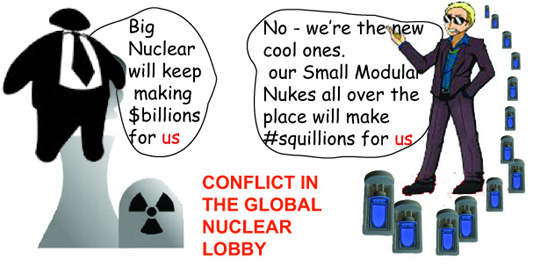
 UK’s most aggressive nuclear lobby is pushing for Small Modular Nuclear Reactors and Thorium Reactors. They’ve even got themselves classed as a Charity!!! So, is the veiled co-operation between the old Big nuclear camp, and the new geewhiz Little nuclear camp now wearing thin in Britain?
Pro-nuclear environmentalists in call to scrap Hinkley C plans
Three leading experts urge government to end nuclear project saying delays will create panicked scramble back to fossil fuels, Guardian, Terry Macalister, 19 Sept 15 Three leading environmentalists who broke ranks to give their support to a new generation of nuclear plants have now urged the government to scrap plans for Hinkley Point C.
The call comes as George Osborne and Amber Rudd, the secretary of state for energy and climate change, head off to China, where they will discuss Beijing’s proposed investment in the new nuclear plant in Somerset.
George Monbiot, Mark Lynas and Chris Goodall say the soaring cost and delays to the Hinkley project leave ministers with no option but to pour the estimated £24.5bn worth of investment into other low-carbon technologies
“Hinkley C bears all the distinguishing features of a white elephant: overpriced, overcomplicated and overdue. The delay that was announced recently should be the final straw. The government should kill the project,” they write in a comment piece for the Guardian.
“The new delay should not surprise anyone who’s aware of the technological issues,” said Tony Roulstone, who runs the masters programme in nuclear engineering at Cambridge University. He argues that the plan for Hinkley C is like “building a cathedral within a cathedral”. It is, he concludes, “unconstructable”………
EDF, the French energy group, promoting Hinkley, has already won a generous financial aid package from the government through its “contract for difference” mechanism but has yet to sign the definitive deal it needs with Beijing investors.
This is expected to happen when the Chinese premier visits the UK next month, leaving EDF in a position to finally give the green light to the first nuclear plant to be built in the UK for 20 years.
But the energy company and its French engineering partner, Areva, have been beset by problems, leaving a growing number of former supporters from the world of energy and the City to question the viability of the whole project…….http://www.theguardian.com/environment/2015/sep/18/nuclear-environmentalists-scrap-hinkley-c-plans
September 19, 2015
Posted by Christina Macpherson |
business and costs, politics, UK |
Leave a comment
 Utility must pay 2013 nuclear tax, Belgian court rules, World Nuclear News, 8 September 2015 Belgium’s Constitutional Court has rejected Electrabel’s appeal against the legality of the nuclear tax contribution imposed by the government for 2013. The company maintains that the level of tax does not reflect deteriorating market conditions in which it operates.
In 2008, the Belgian government announced that the country’s nuclear power plant operators would have to make a one-off payment of €250 million ($338 million). However, in 2009 it said it would postpone its planned nuclear phaseout but would charge nuclear operators an annual tax of €215 to €245 million ($245-280 million) over the period 2010-2014. In 2012, the government passed laws doubling the level of tax…..http://www.world-nuclear-news.org/C-Utility-must-pay-2013-nuclear-tax-Belgian-court-rules-1809154.html
September 19, 2015
Posted by Christina Macpherson |
EUROPE, politics |
Leave a comment
Last bid to kill Iran nuclear deal blocked in Senate WASHINGTON | BY PATRICIA ZENGERLE U.S. Senate Democrats on Thursday blocked legislation meant to kill the Iran nuclear deal for a third time, securing perhaps the greatest foreign policy win of President Barack Obama’s six years in office and clearing the way to implement the accord.
By a 56-42 vote, the Republican-majority Senate fell short of the 60 votes needed to advance in the 100-member chamber.
Despite an intense and expensive lobbying effort against it, all but four of Obama’s fellow Democrats backed the nuclear pact between the United States, five other world powers and Tehran announced in July.
With no more Senate votes this week, the result ensured Congress will not pass a resolution of disapproval that would have crippled the deal by eliminating Obama’s ability to waive many sanctions.
A resolution would have had to pass both the Senate and House of Representatives by midnight Thursday, and survive Obama’s veto, to be enacted………http://www.reuters.com/article/2015/09/17/us-iran-nuclear-congress-idUSKCN0RF2VX20150917
September 18, 2015
Posted by Christina Macpherson |
politics, USA |
Leave a comment
Japan set to pass security bills despite widespread protests, Japan Times , 18 Sept 15
Critics say the bills could herald the biggest shift in Japan’s defence policy in half a century, and tens of thousands have taken to the streets in anger Japan is expected to pass controversial security bills on Friday that critics say could herald the biggest shift in its defence policy for half a century, despite public anger that has seen tens of thousands protest.
The bills are expected to be passed in the upper house controlled by prime minister Shinzo Abe’s ruling coalition after days of fraught debates that at times descended into scuffles, tears and tantrums.
Opposition lawmakers tried every delaying tactic at their disposal, even resorting to physically blocking a vote in a special committee, but it now looks like all of their options have been exhausted.
The controversial laws have seen tens of thousands take to the streets in almost daily rallies for the past few weeks, in a show of public anger on a scale rarely seen in Japan.
Opponents argue the new laws – which would allow the tightly restricted military to intervene overseas to defend its allies – violate Japan’s pacifist constitution and could see the country dragged into American wars in far-flung parts of the globe…….
there are growing signs the campaign has taken a political toll – opinion polls show the vast majority of the public is against the bills, and Abe’s once sky-high approval rating is dropping.
Protesters, including a Nobel-Prize winner, popular musicians and other prominent figures, fear the changes could fundamentally alter Japan’s character as a pacifist nation.
“Japanese are often seen as modest and humble, but it’s not the case this time,” said Ryoko Ikeda, a 36-year-old mother at one of the daily rallies against the bills held near parliament for the past weeks.
“It is our children and future generations who pay the price.”
Keiko Nagao, in her 40s, added: “A pacifist image is Japan’s treasure and if we lose it, it will be a big loss for our country.”
Security experts said the bills would also force a reevaluation of Japan’s place on the world stage.
“The bills are a psychological message to the world that an era in which Japan should not be involved in conflicts because of its exclusively defence-oriented policy is over,” said Hideshi Takesada, a professor at Takushoku University in Tokyo. http://www.theguardian.com/world/2015/sep/17/japan-to-pass-security-bills-despite-protests?CMP=twt_gu
September 18, 2015
Posted by Christina Macpherson |
Japan, politics, weapons and war |
Leave a comment
Social sciences and humanities faculties to close in Japan after ministerial decree https://www.timeshighereducation.co.uk/news/social-sciences-and-humanities-faculties-close-japan-after-ministerial-decree Seventeen universities are to close liberal arts and social science courses September 14 2015 BY JACK GROVE
Many social sciences and humanities faculties in Japan are to close after universities were ordered to “serve areas that better meet society’s needs”.
Of the 60 national universities that offer courses in these disciplines, 26 have confirmed that they will either close or scale back their relevant faculties at the behest of Japan’s government.
It follows a letter from education minister Hakuban Shimomura sent to all of Japan’s 86 national universities, which called on them to take “active steps to abolish [social science and humanities] organisations or to convert them to serve areas that better meet society’s needs”.
The ministerial decree has been denounced by one university president as “anti-intellectual”, while the universities of Tokyo and Kyoto, regarded as the country’s most prestigious, have said that they will not comply with the request.
However, 17 national universities will stop recruiting students to humanities and social science courses – including law and economics, according to a survey of university presidents by The Yomiuri Shimbun newspaper, which was reported by the blog Social Science Space.
It reports that the Science Council of Japan put out a statement late last month that expressed its “profound concern over the potentially grave impact that such an administrative directive implies for the future of the HSS [humanities and social sciences] in Japan”.
The call to close the liberal arts and social science faculties are believed to be part of wider efforts by prime minister Shinzo Abe to promote what he has called “more practical vocational education that better anticipates the needs of society”.
However, it is likely to be connected with ongoing financial pressures on Japanese universities, linked to a low birth rate and falling numbers of students, which have led to many institutions running at less than 50 per cent of capacity.
September 18, 2015
Posted by Christina Macpherson |
civil liberties, politics |
Leave a comment
Ending subsidies, that amount to almost a quarter of the sale price in some cases, would hugely reduce carbon emissions, new research reveals
Coal subsidies are costing US and Australian taxpayers billions of dollars a year, according to a new report.
The research examined the subsidies given to coal production in the US’s largest coal field, the Powder River Basin, and found they totalled $2.9bn (£1.9bn) a year. This equates to $8 per tonne, almost 25% of the sale price.
Ending the subsidies would lead to cuts in coal use equivalent to shutting up to 32 coal-fired power stations, the researchers found, leading to a large reduction in carbon emissions.
The report also analysed Australia’s exporting of coal for power stations in Asia and found these came to $1.3bn a year, or $4 a tonne. Ending these subsidies would cut demand by up to 7%, a smaller impact than in the US because coal users could buy supplies from other countries.
“The fossil fuel industry has gamed energy market consumers, with numerous subsidies evident over the long term,” said Tim Buckley, at the Institute forEnergy Economics and Financial Analysis, who worked on the report. “Any discussion of cost competitiveness of renewable energy and energy efficiency needs to take into account the decades of extensive subsidies evident for the coal industry and that, in many cases, remain in place today.”
Luke Sussams, senior researcher at Carbon Tracker Initiative, also part of the research team, said: “Policy makers concerned about climate change and a level playing field in energy markets should look to take coordinated action to remove the distortions to production these subsidies create.”
The subsidies given to coal companies included tax breaks, cheap leases, government-funded infrastructure including railways and ports and allowing inadequate funding of clean-up operation after mining ends.
The G20 nations pledged to end fossil fuel subsidies in 2009, but little action has been taken. However, falling oil and coal prices in the last year have seen some countries starting to reduce subsidies.
A recent study by the International Monetary Fund (IMF) took into account not just direct subsidies but also the cost to nations of the damage caused by air pollution and global warming. It estimated coal, oil and gas were being subsidised by $5.3trn a year, more than the total health spending of all the world’s governments. Much of the cost is due to the illness and death caused by air pollution.
“Eliminating coal subsidies in the Powder River Basin and throughout the world, is an obvious, no-regrets climate strategy,” said Doug Koplow, of Earth Track and another member of the research team.
The new report, called Assessing Thermal Coal Production Subsidies, was produced by the Carbon Tracker Initiative, Energy Transition Advisors, the Institute for Energy Economics and Financial Analysis and Earth Track.
September 18, 2015
Posted by Christina Macpherson |
AUSTRALIA, business and costs, climate change, politics, USA |
Leave a comment
Britain’s nuclear plans: the Corbyn factor https://www.opendemocracy.net/paul-rogers/britains-nuclear-plans-corbyn-factor
In the debate about replacing the Trident nuclear system, there is space for options that link British to international experience. Jeremy Corbyn, the new leader of Britain’s Labour Party, has long been opposed to the country’s possession of nuclear weapons. But he has also made it clear that this personal commitment does not extend to forcing this policy on the party he now heads. What he does want is an open debate and to convince others of the value of his views.
The replacement of the country’s Trident nuclear system is now being discussed (see “Britain’s defence policy: the path to change“, 7 May 2015). If this were to go ahead and a similar system put in place, the development and lifetime costs will approach £100 billion. Almost everyone in the Conservative government and parliamentary party, and many Labour MPs themselves, believe that a replacement should be built and that Britain should remain a nuclear-weapons power. Yet there is a substantial minority across the electorate that agrees with Corbyn. This view has gained far more traction since it was adopted by the Scottish National Party, a shift prompted not least by the persistent campaigning of nuclear disarmers north of the border, including the Faslane 365 initative. Yet political polarisation means it will be difficult to realise Corbyn’s aims.
The pro-Trident position has an uncompromising military rationale. It entails keeping a ballistic-missile submarine on station and ready to launch at all times – what is called “continuous at-sea deterrence” (CASD). In turn this requires maintaining four submarines, in order to allow one available for round-the-clock patrol, as well as substantial naval back-up. The latter includes what is euphemistically called “deterrence support”, an element that isn’t much talked about in polite circles.
The reason why is that deterrence support is onerous. There is a certain assumption that a Vanguard-class Trident-armed missile-submarine can disappear from its base at Faslane in western Scotland and go on secret patrol almost independently of the rest of the system. The reality is different: there is a continual need to protect Faslane, the Clyde estuary and the seas close to Scotland. Moreover, it is usual practice to have on patrol an attack-submarine, such as one of the new Astute-class boats (nuclear-powered but not nuclear-armed) between the general region of the Trident submarine’s area of operation and the perceived direction of threat. That, of course, means having several such attack-submarines available, which demands a substantial commitment.
The anti-Trident argument tends to the view that Britain’s nuclear weapons are little more than an historical anachronism (see “Britain’s nuclear endgame“, 28 September 2012). The ability to kill 5 million or more people in forty minutes may represent an inkling of great-power status, or a delusion of post-imperialgrandeur (of a kind shared with France). In practice, though, sufficient numbers of people still stick to the old thinking that the choice can be other than “all or nothing”. Corbyn’s supporters may need to recognise this.
A two-stage strategy
An earlier column in this series pointed to one way forward (see “Two steps to zero“, 17 July 2008). This was to scale down Britain’s nuclear forces to a background capability, involving the following steps:
* Cancel the plans to replace the current Vanguard-class boats and a new generation of nuclear warheads
* Reduce warhead numbers from around the current 160 to 30 (an 80% reduction); then have modified warheads available to deploy, if this were ever thought necessary, with cruise-missiles on attack-submarines, such as the new Astute-class (which can already deploy such missiles with conventional warheads)
* Phase out the entire Trident system as soon as this much-reduced force is available
* Adopt an openly stated policy of “no first use” of nuclear weapons and aspire to the elimination of nuclear weapons in Britain when international progress allows.
This would essentially be a residual force. If embraced, it could be less than a decade or so before the very idea of maintaining nuclear forces might be dropped, with Britain then joining the ranks of the 186 member-states of theUnited Nations out of 195 which do not possess nuclear weapons.
What is often forgotten here, including by anti-nuclear activists, is that several countries have given up nuclear weapons on their territory. South Africa actually developed its own small arsenal and then dismantled it. Furthermore, a number of states have in the past decided against developing their own nuclear arsenals after active consideration; they include Argentina, Brazil, Sweden and Switzerland, and probably also South Korea and Taiwan.
At the level of elite power, British nuclear weapons are a symbolic indication of standing in the world. The habit is so strong that it would be easier to give them up in two stages: a radically scaled down and far cheaper force that could then be allowed to wither away.
Whether that becomes an option depends very much on domestic party politics. But the point about revisiting Britain’s nuclear-weapons policy is that the starting-point does not have to be a rigid “for” or “against”. The option just outlined is just one among several. Their very existence means that the debatenow getting underway can be much better informed and less hidebound by increasingly meaningless issues of imaginary great-power status
September 18, 2015
Posted by Christina Macpherson |
politics, UK, weapons and war |
Leave a comment
How Charles Koch Prevents Clean Energy Businesses From Succeeding, TruthOut 02 September 2015 By Matthew Kasper, Republic Report | News Analysis Last week, President Obama correctly singled out the Koch brothers – Charles and David – and the Koch-funded network for standing in the way of America’s clean energy Continue reading →
September 18, 2015
Posted by Christina Macpherson |
business and costs, climate change, politics, USA |
Leave a comment





 US and Australian taxpayers pay billions a year to fund coal – report, http://www.theguardian.com/environment/2015/sep/16/us-australian-taxpayers-pay-billions-fund-coal