USA Republican Senators out to wreck Iran nuclear deal
Congressional review of Iran nuclear deal is threatened by GOP amendments LA Times, By PAUL RICHTER AND LISA MASCARO contact the reporters A bipartisan bill for Congress to review any nuclear agreement with Iran faced new danger Thursday as Republican senators sought to force votes on controversial amendments that leaders had hoped to avoid.
Senate Republican and Democratic leaders have worked all week to shield the bill from politically sensitive changes that are likely to drive away some Democratic supporters and sink its chances for passage.
Presidential campaign politics have complicated the process. One such amendment, from Sen. Marco Rubio (R-Fla.), a presidential candidate, would require Iran to recognize Israel’s right to exist, something all senators would like to see, but that Iran is unlikely to do. The issue was not on the table during more than 10 years of negotiations over Iran’s nuclear program.
But Republican senators pressed hard for their proposals……http://www.latimes.com/nation/la-na-iran-congress-20150501-story.html
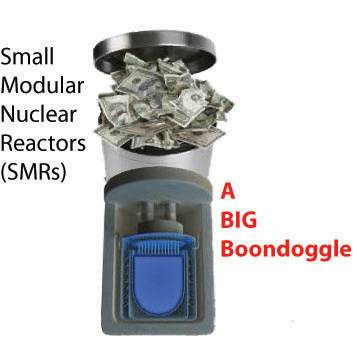
Maine: democracy under threat – in the push for Small Modular Nuclear reactors
LePage Plan to Change Nuclear Power Rules Meets Resistance MPBN News, By Alanna Durkin, The Associated Press, 29 Apr 15
AUGUSTA, Maine – Republican Gov. Paul LePage’s proposal aimed at making it easier to bring small nuclear power plants to Maine is meeting fierce resistance because it would strip voters of their power to sign off on new plants.
Currently, Maine voters must approve the construction of any nuclear power plant. But LePage wants to remove that requirement for plants that generate 500 or fewer megawatts…….anti-nuclear activists said that removing voters’ right to decide whether Maine should build more potentially dangerous plants is wrong.
The state’s only nuclear power plant, Maine Yankee, closed in 1997.http://news.mpbn.net/post/lepage-plan-change-nuclear-power-rules-meets-resistance
Sweden accelerates its closure of its uneconomic nuclear industry
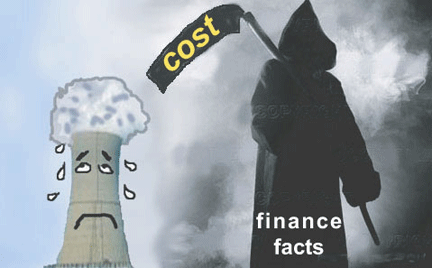 Sweden to speed up nuclear reactors closure The Local, 28 Apr 2015 Sweden’s state-owned energy group Vattenfall on Tuesday said it planned to shut down two nuclear reactors in 2018 and 2010, up to seven years earlier than expected. Vattenfall said reactors 1 and 2 at the Ringhals plant in south-west Sweden were too costly to keep in production until 2025 as previously planned.
“Ringhals 1 and 2 may be closed down between the years 2018 and 2020 instead of, as previously announced, around 2025,” Vattenfall said in a statement.
“The reason is declining profitability and increased costs,” it said……The Swedish group has been struggling to improve profits for several years, suffering from weak demand and plunging electricity prices………http://www.thelocal.se/20150428/sweden-speeds-up-nuclear-reactors-closure
Clean energy set to beat nuclear in Japan
Japan Sees Clean Energy Edging Out Nuclear Power in 2030, Bloomberg, Chisaki Watanabe and Emi Urabe 28 Apr 15 Clean energy sources will supply as much as 24 percent of Japan’s electricity in 15 years, while atomic power will account for as much as 22 percent, according to a draft report from the Ministry of Economy, Trade and Industry on what Japan’s electricity mix should look like by 2030……
If all 24 nuclear reactors currently under review for a restart by the country’s nuclear watchdog are allowed to switch back on, they would still not be able to generate more than 16 percent of Japan’s power, Greenpeace estimates. At least 10 more reactor units need to resume operations to reach the government’s target for nuclear, the group said.
Such a mass-scale restart is unlikely, according to Shaun Burnie, a nuclear specialist at Greenpeace Germany.
“The scale of the challenges facing the nuclear industry are such that generation from reactors is likely to collapse during the coming decade,” Burnie said in the statement. “Many reactors will never restart, and most reactors over the coming years will be too old to operate.”…..http://www.bloomberg.com/news/articles/2015-04-28/japan-expects-renewable-energy-to-edge-out-nuclear-power-by-2030
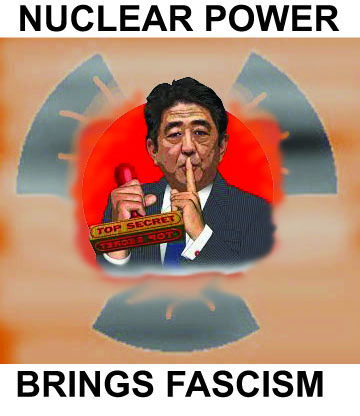
Prime Minister Shinzo Abe muzzling critics in Japan’s media
 Effort by Japan to Stifle News Media Is Working, NYT By MARTIN FACKLER APRIL 26, 2015 TOKYO — It was an unexpected act of protest that shook Japan’s carefully managed media world: Shigeaki Koga, a regular television commentator and fierce critic of the political establishment, abruptly departed from the scripted conversation during a live TV news program to announce that this would be his last day on the show because, as he put it, network executives had succumbed to political pressure for his removal.
“I have suffered intense bashing by the prime minister’s office,” Mr. Koga told his visibly flabbergasted host late last month, saying he had been removed as commentator because of critical statements he had made about Prime Minister Shinzo Abe. Later in the program, Mr. Koga held up a sign that read “I am not Abe,” a play on the slogan of solidarity for journalists slain in January at a French satirical newspaper.
The outburst created a public firestorm, and not only because of the spectacle of Mr. Koga, a dour-faced former top government official, seemingly throwing away his career as a television commentator in front of millions of viewers. His angry show of defiance also focused national attention on the right-leaning government’s increased strong-arming of the news media to reduce critical coverage.
Mr. Abe’s efforts have had a chilling effect on coverage at a time when he is pushing ahead with a conservative agenda to dismantle the nation’s postwar pacifist consensus and put forth more positive portrayals of Japan’s World War II-era behavior. Experts warn that muzzling the press makes it easier for the government to make big changes that might not enjoy broad popular support, such as rewriting the pacifist Constitution, or even restarting the nation’s stalled nuclear industry.
“The Abe government is showing an obsession with the media that verges on paranoia,” said Keigo Takeda, a former editor in chief at Newsweek Japan who is now a respected freelance journalist. “I have never seen this level of efforts to micromanage specific newspapers and TV programs.”…..http://www.nytimes.com/2015/04/27/world/asia/in-japan-bid-to-stifle-media-is-working.html?smid=tw-share&_r=1
False claim that Hillary Clinton had the power to veto Russia uranium sale deal
No ‘Veto Power’ for Clinton on Uranium Deal, — Eugene Kiely, Fact Check, April 28, 2015
The author of “Clinton Cash” falsely claimed Hillary Clinton as Secretary of State had “veto power” and “could have stopped” Russia from buying a company with extensive uranium mining operations in the U.S. In fact, only the president has such power.
At the time of the sale, Clinton was a member of the Committee on Foreign Investments in the United States, which is required by law to investigate all U.S. transactions that involve a company owned or controlled by a foreign government. Federal guidelines say any one of nine voting members of the committee can object to such a foreign transaction, but the final decision then rests with the president.
“Only the President has the authority to suspend or prohibit a covered transaction,” the guidelines say.
Through a spokeswoman, author Peter Schweizer told us he meant that Clinton could have forced the issue to the president’s desk. But that’s not what he said when he appeared on “Fox News Sunday,” where he discussed the uranium deal and his upcoming book to be released on May 5.
Schweizer’s book — “Clinton Cash: The Untold Story of How and Why Foreign Governments and Businesses Helped Make Bill and Hillary Rich” — focuses on foreign donations to the Clinton Foundation, a nonprofit created by former President Bill Clinton. In his book, Schweizer, a former fellow at the right-leaning Hoover Institution, seeks to link some of those donations to the official actions taken by Clinton when she was Secretary of State…….
Schweizer is wrong when he says that Clinton had “veto power” and “could have stopped the deal.” At best, she could have forced the president to make a decision.
The committee, which is known by its acronym CFIUS, can approve a sale, but it cannot stop a sale.
- Even the president cannot prohibit a transaction without “credible evidence” that the “foreign interest exercising control might take action that threatens to impair the national security,” according to the regulation……..
The Clinton campaign told the Times that generally these matters did not reach the secretary’s level, so she may not have been involved at all. According to the Times, Jose Fernandez, a former assistant secretary of state, represented the department on the committee. He told the Times: “Mrs. Clinton never intervened with me on any C.F.I.U.S. matter.”
Schweizer raises legitimate questions about the Clinton Foundation and its donations. He simply goes too far when he says Clinton had “veto power” and “could have stopped” the uranium deal.http://www.factcheck.org/2015/04/no-veto-power-for-clinton-on-uranium-deal/
Nuclear industry embarks on a public advertising campaign
 Nuclear power industry hopes for a new era, Standard Times James Osborne, Apr 25, 2015“…….With high-profile advocates like former Environmental Protection Agency administrator Christie Whitman on board, the industry is embarking on a very public campaign arguing nuclear must be part of any national energy plan. To accomplish that, it wants to examine amending power and licensing regulations to encourage nuclear and speed up construction.
the industry will face opposition. Nuclear remains a divisive issue among environmentalists. Some support it as a proven means to cut carbon emissions out of the nation’s power supply.
But there are many see its potential contamination risks as just too great to make it sensible……..http://www.gosanangelo.com/news/state/nuclearpowerda_54975979
Maine’s Governor wants to remove voters’ rights on decisions on small nuclear reactors
 LePage’s plan to negate rule on nuclear power plants could be radioactive. Observers wonder why his attention to the issue begins with an attempt to disempower Maine voters. 26 Apr. BY BILL NEMITZ COLUMNIST bnemitz@pressherald.com | @BillNemitz Consider yourselves warned, fellow citizens. Gov. Paul LePage is fiddling around with Maine’s nuclear hot button.
“We anticipated this might provoke a conversation,” noted Patrick Woodcock, director of the Governor’s Energy Office, in an interview on Friday.
Under LePage’s new plan, scheduled for a hearing Wednesday at 1 p.m. before the Legislature’s Energy, Utilities and Technology Committee, voters would no longer have a say on the creation of nuclear power plants with generating capacities of 500 megawatts or less.
(Just so you know, the Fukushima Daiichi Nuclear Power Plant’s Unit 1 reactor – one of three destroyed by Japan’s apocalyptic tsunami in 2011 – had a generating capacity of 460 megawatts.)
Let’s back up a little.
Considering the complexity and controversy bound to greet any talk of dusting off nuclear generation in Maine, why start with a bill that effectively tells voters they’re being cut out of the process?
Or, as longtime anti-nuclear activist Ray Shadis of Edgecomb put it on Friday, “You don’t start a conversation by throwing a hand grenade in the room.”
Shadis, who currently represents the lone remaining intervenor in the proposed relicensing of New Hampshire’s Seabrook nuclear plant, sees this week’s hearing as “the kind of rudeness we’ve come to expect from Gov. LePage.”
He also thinks the governor is dreaming if he thinks small modular reactors – the brainchildren of a new generation of nuclear engineers working mostly out of the Massachusetts Institute of Technology – can attract the investment capital needed to put them on the energy radar here in Maine or anywhere else, for that matter.
“The most rabid anti-nuclear crowd are the investors in the market,” Shadis noted. “It takes a long time to realize any return at all. And the entirety of what you invest can turn from an asset to a liability overnight. Why bother risking your money? So they don’t.”
Thus, he said, LePage’s bill at best “is impractical, it’s silly. Out there in the energy world, where people are really trading on this stuff, it will make Maine the laughingstock. It will make us look like patsies.”
Sudden conversion of climate denialist US Senator as he jumps on pro nuclear bandwagon
 The Senate’s Top Climate Denier Redefines Chutzpah http://thinkprogress.org/climate/2015/04/24/3650610/americas-top-climate-denier-now-agrees-top-climate-scientist/ BY JOE ROMM APRIL 24, 2015 THE TRADITIONAL DEFINITION OF CHUTZPAH INVOLVES A GUY WHO KILLS HIS PARENTS, THEN PLEADS FOR MERCY BECAUSE HE IS NOW AN ORPHAN. THE MODERN DEFINITION OF CHUTZPAH INVOLVES … SEN. JAMES INHOFE (R-OK).
The chair of the Senate Environment and Public Works Committee has an Earth Day (!) op-ed arguing we should embrace carbon-free nuclear power because of the threat posed by global warming. You remember Inhofe, the guy who called global warming a hoax, the guy who for over a decade has trashed climate scientists, such as James Hansen, whom he called in 2006 a “NASA scientist and alarmist.”
Apparently, however, Inhofe no longer sees Hansen as radioactive. He writes, without a trace of irony:
How cool is it that Inhofe is now apparently on board with top climatologist Hansen on the urgent need “to avoid dangerous climate change” by accelerated deployment of zero-carbon technologies? Presumably he’ll soon be on board with Hansen’s call for a high and rising carbon dioxide fee (returned to the public as a dividend), and a World War II scale effort to return CO2 levels back to 350 parts per million from their current level of 400 ppm (and rising 2+ ppm a year).
As an aside, what’s holding nuclear power back is its exorbitant price. Indeed, just this week a panel of experts unanimously agreed that nukes have all but priced themselves out of the market. Perhaps Inhofe should have supported the climate bill that came out of the House of Representatives in 2009, since its carbon pricing mechanism would have been nuclear power’s best chance at a resurgence.
As for Inhofe’s bromancing of Hansen, I suspect it is unrequited, but then they say politics does make for strange bedfellows. Or at least for new definitions of chutzpah.
Nuclear lobby pushing for corporate welfare and exports, through the Export-Import Bank

“Taxpayers should not be in the business of subsidizing risky loans or giving money to big businesses and foreign countries,” said Levi Russell, spokesman for Americans for Prosperity, a Tea Party-aligned group that, along with dozens of other conservative groups, is urging Congress to let Ex-Im expire.
Ex-Im fight goes nuclear, The Hill, 22 Apr 15 The nuclear power sector is emerging as one of the most vocal proponents of the Export-Import Bank, as debate intensifies over whether to reauthorize the increasingly controversial institution.
The Nuclear Energy Institute (NEI) is leading the charge to demonstrate to lawmakers that closing the bank would threaten the billions of dollars in economic activity and tens of thousands of jobs that come from exporting U.S. nuclear power technology and products.
The nuclear industry is also proving to be a top player among the big business groups that are doing the bulk of the lobbying on Ex-Im, which provides financing for U.S. companies to sell products and services to foreign customers.
Exports are essential to the nuclear industry, because a new reactor has not come online in the United States in nearly two decades and only five are under construction…….
The global market represents an important bounty for the U.S. industry. Continue reading
Flamanville nuclear safety problem – a knockout blow for UK’s EPR reactor project?
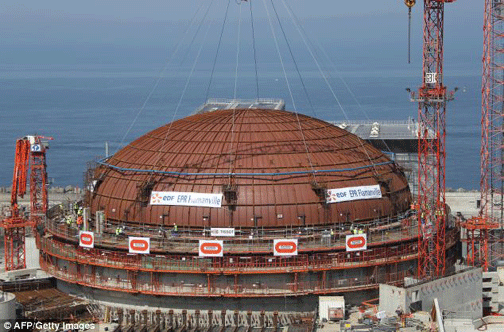 France’s nuclear calamity has UK worried, The Local, 21 Apr 2015 France’s world renowned prowess in the nuclear industry is being seriously undermined by its efforts to build a flagship nuclear reactor which is fast becoming a costly calamity. The future of the Flamanville 3 project appears to hang in the balance after yet another major setback that has London worried.
It was supposed to showcase the expertise of France’s nuclear energy industry to the world and is key to the UK’s own nuclear strategy. But after being beset by hold-ups and snags – the latest and potentially most serious one coming last week, the flagship project to build a new state of the art nuclear reactor, France is getting a reputation for all the wrong reasons and London has been left looking on nervously.
In 2005 the French government proudly gave the green light for construction to begin on the first third-generation nuclear reactor at Flamanville in Normandy on the north coast, a site environmentalists say is threatened by flooding.The third-generation “European Pressurized Reactor” (EPR), built by EDF and Areva, was supposed to be in operation by 2012 and is meant to be one of the safest reactors in the world, and the most energy efficient. It was commissioned as part of France’s nuclear renaissance programme that will see the country’s aging nuclear plants replaced over time.
However Flamanville 3, as it is known, is unlikely to start producing power anytime soon after being hampered by a litany of problems and incidents, including the death of a construction worker in 2011 (see below).
The latest setback came last week when it was revealed that “a very serious fault” had been detected in the steel of the “pressure vessel” – a key component of the reactor, meaning another delay of at least a year was likely. “It is a serious fault, even a very serious fault, because it involves a crucial part of the nuclear reactor,” said Pierre-Franck Chevet, head of France’s nuclear safety agency (ASN).
That “fault” means construction is unlikely to be completed before 2018 and more worryingly, the budget, initially set at €3.3 billion, is now estimated at more than €9 billion and counting.
In short Flamanville has become France’s own “nuclear catastrophe” as it was described in one of the many critical articles in the French press. Tests will need to be carried out on the steel vessel but if after these tests the vessel still does not meet necessary safety standards, it will need to be changed.
“That’s a very difficult operation in terms of costs and time,” said the ASN’s Chevet. The steel vessels weigh around 425 tonnes and stand around 11 metres high so building a new one would take considerable time and come at a huge cost.Changing the vessel would be a major headache given all the construction work that would need to be undone.
Some in the business of nuclear safety have even suggested that if the steel vessel needs replacing then the whole project could be scrapped. That will have authorities in the UK sweating as the same steel has been used to build two vessels destined for the planned EPR nuclear reactors at Hinkley Point in the UK.…….
“This is clearly the knock-out blow for the EPR reactor,” said Yannick Rousselet from Greenpeace. “What foreign client would want to purchase a reactor of this type, if even France itself is not able to complete the construction?
“The bill from the EPR reactor will be so high that it won’t end up showcasing what to do, but exactly the opposite,” said Rousselet. “This is a huge blow to the know-how of the French nuclear industry.”
Greenpeace has called for work at Flamanville to be called off.
“It must be stopped immediately so there is no more wasting of public funds on this industrial nightmare,” said Rousselet, who added that France should be concentrating resources on finding renewable energy solutions……..http://www.thelocal.fr/20150421/flamanville-frances-own-nuclear-nightmare
UK’s £14bn Hinkley project – future now in doubt, as faults found in identical French project
 UK nuclear strategy faces meltdown as faults are found in identical French project The faults could also scare off the Chinese state investors who are supposed to cover part of the cost of the £14bn Hinkley project Independent JOHN LICHFIELD
  PARIS Friday 17 April 2015 A “very serious” fault has been discovered in a French nuclear power station which is at the heart of David Cameron’s strategy to “keep the lights on” in Britain in the next decade.
The future of two nuclear reactors planned for Hinkley Point in Somerset has been thrown into doubt by the discovery of a potentially catastrophic mistake in the construction of an identical EPR power plant in Normandy.
“It is a serious fault, even a very serious fault, because it involves a crucial part of the nuclear reactor,” said Pierre-Franck Chevet, head of France’s nuclear safety inspectorate.
A second investigation has been ordered into the quality of the steel used to make a 50ft-high safety casing, or “pressure vessel”, which encloses the groundbreaking new reactor at Flamanville, near Cherbourg. If the steel proves to be defective, the completion of the prototype EPR plant – already behind schedule and nearly three times over budget – could be delayed for several years.
Mr Chevet also revealed that the same manufacturing techniques had been used in the steel for the identical safety casings destined for Hinkley Point, which “have already been manufactured”.
The fault could undermine the already fragile finances of the French state-owned nuclear construction company Areva, which is supposed to build two EPR reactors at Hinkley by 2023 and a third at Sizewell in Suffolk. It could also scare off the Chinese state investors who are supposed to cover part of the cost of the £14bn Hinkley project, intended to supply six per cent of Britain’s energy needs for six decades.
A final “investment” decision for Hinkley, several times delayed, is now expected in June. The French Prime Minister Manuel Valls called a crisis meeting on 17 April to discuss the threat posed by the fault to France’s nuclear construction industry – the largest in the world.
Mark Hackett, a councillor in Manchester who chairs Nuclear Free Local Authorities, said: “This is a devastating blow to proponents of new-build nuclear power stations in the UK. It is likely to scare off the Chinese backers. If I was a betting man, I would now bet that Hinkley Point will never be built.”
Yannick Rousselet, of Greenpeace France, said the latest problems to beset the prototype power station in Normandy are “clearly the coup de grâce for the EPR idea”. He asked: “What foreign client would want to buy this reactor when France itself is not capable of completing its construction?”
Apart from Britain, the United States and China are in the process of buying versions of the new generation of European Pressurised Reactor (EPR) – supposedly safer and more efficient – from France. Both Areva and Eléctricité de France (EDF), the French energy giant which will own and operate Hinkley Point, have refused to comment in detail………
Sources in the French nuclear industry told the newspaper Le Parisien yesterday that dismantling the faulty pressure vessel and ordering and manufacturing a new one could take several years. “If the weakness of the steel is proved, I don’t hold out much hope for the survival of the EPR project,” a former senior nuclear safety official told Le Parisien………..http://www.independent.co.uk/news/uk/home-news/uk-nuclear-strategy-faces-meltdown-as-faults-are-found-in-identical-french-project-10186163.html
France’s State owned nuclear company AREVA now a costly burden
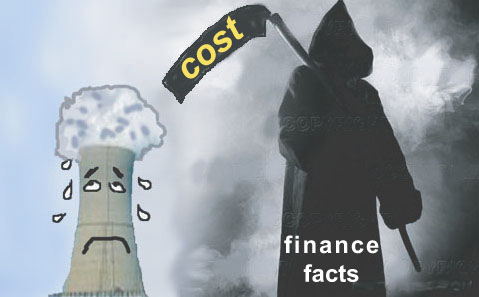 Areva Is Costing France Plenty The company thought it had a winning nuclear reactor technology http://www.bloomberg.com/news/articles/2015-04-16/france-s-areva-falters-in-reactor-business-leaks-cash Nuclear plants supply almost three-fourths of France’s electricity, and they boast a near-spotless safety record and some of the cheapest electric rates in Europe. In 2001 the government created a state-owned company, Areva, to export French reactors and nuclear know-how to the rest of the world. Those ambitions are now in tatters, offering an object lesson in the dangers of French dirigiste industrial policy.
Areva, along with competing reactor builders Westinghouse Electric and General Electric, was hit hard when orders dried up after the 2011 Fukushima accident in Japan. Cheap shale gas and development of renewable energy have compounded those woes. But “you can’t really blame Areva’s plight on Fukushima,” says Steve Kidd, a British nuclear consultant and former executive of the World Nuclear Association, a London-based trade group.
$5.1b
Areva’s loss in 2014, on sales of $8.9 billionFrench authorities reported on April 7 that flaws were found in some of the steel used in the reactor vessel of an EPR being built in Normandy. That reactor is five years behind schedule, and its price tag has ballooned from $3.5 billion to $9.3 billion. Areva also is facing an investigation of its 2007 acquisition of Uramin, a Canadian uranium mining company. In 2011, Areva wrote off almost all of the $2.5 billion purchase price after concluding that the ore deposits were of negligible value. The government’s chief auditor, who faulted management for inadequate oversight and possible “dissimulation,” asked prosecutors to look into the Uramin purchase.
The next step for Areva may be a tieup with EDF, its top customer—an idea that horrified the utility’s investors, who dumped the stock after Energy Minister Ségolène Royal suggested it in March. Other government officials have suggested that Areva might work with EDF on engineering and maintenance, stopping short of a full merger.
The company still makes money supplying fuel and reprocessing waste for nuclear plant owners. It’s already clear, though, that Areva won’t be selling many new reactors. North American and European utilities stopped ordering them after the Fukushima accident, and the EPR’s problems have cast a pall over the company’s prospects in China, which now accounts for more than half of the new reactors expected to come online by 2030. Thanks to past collaboration with Areva and other Western suppliers, the Chinese have developed the technology they need to build their own reactors, says Steve Thomas, a professor at the University of Greenwich in England who studies the industry. The reactors built by Areva and Westinghouse “are just too expensive for the Chinese,” he says.
The French government’s 80 percent ownership of Areva helped mask its problems, consultant Kidd says. “Everyone was laughing” at the company’s projections for reactor sales, he says. “Everyone in the know could tell the chickens were going to come home to roost. I don’t think that would have happened in a private business.”
—With Francois de Beaupuy and Tara Patel
The bottom line: Areva’s bid to be the globally dominant maker of reactors was undone by cost overruns and strategic blunders.
Nuclear power would be a ‘last resort’ for earthquake prone Indonesia: safer options preferred
Nuclear power a ‘last resort’, says VP The Jakarta Post, Jakarta | National | Tue, April 14 2015 Vice President Jusuf Kalla insists nuclear energy is a last resort for Indonesia, saying the country has alternative options more in line with the country’s geologic and sociological conditions for addressing the looming energy crisis.
“Nuclear is suitable only in Java, and this is a last resort. The sophisticated technology developed by Japan in building its nuclear energy [was not even foolproof], as its plant also leaked”, he said, in an apparent reference to the Fukushima nuclear meltdown in 2011. Such risk is very high for Indonesia, which would not be able to handle it extra cautiously,” he said in a seminar on energy diversification here on Tuesday…….He added it was difficult to build a nuclear power plant in the country because it would elicit strong protests from the public and environmentalists. – See more at: http://www.thejakartapost.com/news/2015/04/14/nuclear-power-a-last-resort-says-vp.html#sthash.1NRm8NuU.dpuf
– See more at: http://www.thejakartapost.com/news/2015/04/14/nuclear-power-a-last-resort-says-vp.html#sthash.1NRm8NuU.dpuf– See more at: http://www.thejakartapost.com/news/2015/04/14/nuclear-power-a-last-resort-says-vp.html#sthash.1NRm8NuU.dpuf
US Senate gives Congress a voice in Iran nuclear negotiations
Senate Panel Passes Bill on Iran Nuclear Deal; Obama Indicates He’ll Sign It, NYT By JONATHAN WEISMAN and PETER BAKER APRIL 14, 2015 WASHINGTON — The Senate Foreign Relations Committee unanimously approved legislation granting Congress a voice in negotiations on the Iran nuclear accord, sending the once-controversial legislation to the full Senate after President Obama withdrew his opposition rather than face a bipartisan rebuke.
”We’re involved here. We have to be involved here. Only Congress can change or permanently modify the sanctions regime,” said Senator Benjamin L. Cardin of Maryland, the committee’s ranking Democrat, who served as a bridge between the White House and Republicans as they negotiated changes in the days before Tuesday’s vote…………..
1 This Month

22 June – Virtual Event –Climate Change: New Data, New Debate

Monday, June 22, 2026 2:30 p.m. – 3:15 p.m. CT
YouTube. Register here
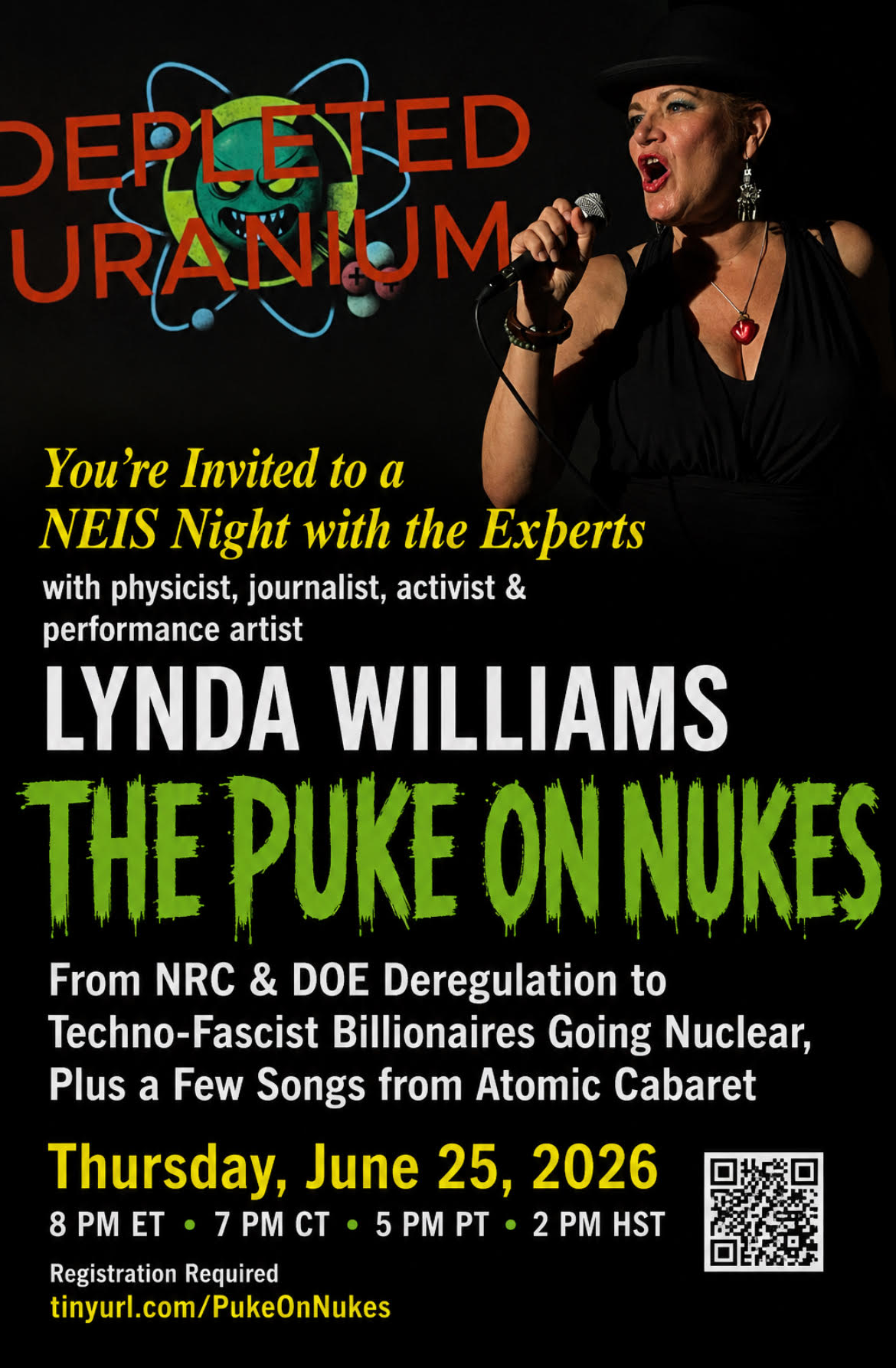
25 June- THE PUKE ON NUKES
Thursday, June 25, 2026
7pm Central Time (8pm ET, 6pm MT, 5pm PT) UTC – 5
From NRC & DOE Deregulation to Techno-Fascist Billionaires Going Nuclear, Plus a Few Songs from Atomic Cabaret REGISTER
26 June – Radiation Trainwreck at the NRC / Join the Protect Better Campaign – https://us02web.zoom.us/meeting/register/4ZlZ5_qLSHGiLSCg8FF6Bg#/registration
1st July – Webinar Waste of Space: The Environmental Harm of Military and Civil Space Activity st July, 7 pm

Report Launch Online: We are seeing an increasing exploitation of space for military and commercial purposes. This must change.

Protect Sazan Island from the Trump family! https://secure.avaaz.org/campaign/en/protect_sazan_island_from_the_trump_family_loc/?bqFCVab&v=174511&cl=22707147157&_checksum=5e9dde668860e8231c33699735e16a1fbf22ab2cb01da50c999fe8732b9775ef&utm_source=email&utm_medium=blast_email&utm_campaign=174511


Cuba Is Not a Failed State – It Is a Besieged State
PETITION: “Global Appeal to Endorse Palestinian Right of Return of Refugees”
To see nuclear-related stories in greater depth and intensity – go to https://nuclearinformation.wordpress.com
-
Archives
- June 2026 (227)
- May 2026 (306)
- April 2026 (356)
- March 2026 (251)
- February 2026 (268)
- January 2026 (308)
- December 2025 (358)
- November 2025 (359)
- October 2025 (376)
- September 2025 (257)
- August 2025 (319)
- July 2025 (230)
-
Categories
- 1
- 1 NUCLEAR ISSUES
- business and costs
- climate change
- culture and arts
- ENERGY
- environment
- health
- history
- indigenous issues
- Legal
- marketing of nuclear
- media
- opposition to nuclear
- PERSONAL STORIES
- politics
- politics international
- Religion and ethics
- safety
- secrets,lies and civil liberties
- spinbuster
- technology
- Uranium
- wastes
- weapons and war
- Women
- 2 WORLD
- ACTION
- AFRICA
- Atrocities
- AUSTRALIA
- Christina's notes
- Christina's themes
- culture and arts
- Events
- Fuk 2022
- Fuk 2023
- Fukushima 2017
- Fukushima 2018
- fukushima 2019
- Fukushima 2020
- Fukushima 2021
- general
- global warming
- Humour (God we need it)
- Nuclear
- RARE EARTHS
- Reference
- resources – print
- Resources -audiovicual
- Weekly Newsletter
- World
- World Nuclear
- YouTube
-
RSS
Entries RSS
Comments RSS
 nuclear-news