UK’s Bakers’ union rejects new nuclear reactors, calls for socialist Green New Deal
Bakers’ union rejects new nuclear reactors, calls for socialist Green New
Deal. Tens of thousands of energy jobs could be created with a socialist
Green New Deal without the need of new nuclear reactors, the bakers’
union said today. Delegates from the Bakers, Food and Allied Workers Union
(BFAWU) passed a motion calling for the democratic public ownership of all
forms of energy. They condemned the loss of skilled jobs in North Sea
industry and Grangemouth oil refinery, saying they have “no faith” in
private firms to tackle the climate crisis “nor do we accept that nuclear
power is a clean form of energy production.”
Morning Star 16th June 2025
https://morningstaronline.co.uk/article/bakers-union-rejects-new-nuclear-reactors-calls-socialist-green-new-deal
Labour’s £14bn ‘fixation’ with new nuclear power ‘won’t cut bills or help climate’
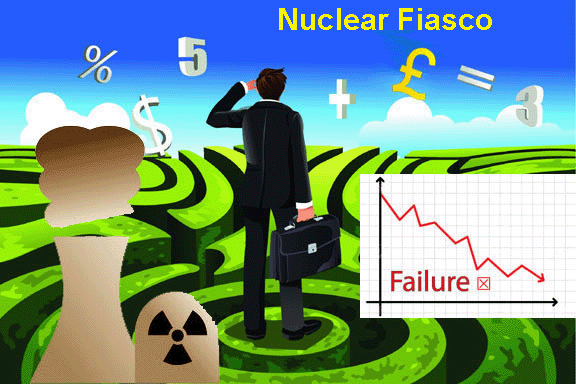
It’s almost like a mass psychosis because if they really investigated properly what the best use of public funds would be, nuclear wouldn’t get a look-in.”
“It’s almost like a mass psychosis because if they really investigated properly what the best use of public funds would be, nuclear wouldn’t get a look-in.”
The UK Government last week announced a new ‘golden age’ of nuclear but academics and campaigners warn it will be a costly energy fail.
Dan Vevers Sunday Mail Chief Reporter, Daily Record, 15 Jun 2025
Labour’s £14billion “fixation” with new nuclear power will be a costly flop and do nothing to lower Scots’ bills or hit climate targets, experts have warned.
It comes after Keir Starmer’s goverment last week announced a “golden age” of nuclear energy with a £14.2billion investment to finally build the delayed Sizewell C plant in Suffolk which it claimed will create 10,000 jobs.
Ministers say the move is vital to prevent future blackouts and to help the shift to a low carbon economy.
Now campaigners and academics warned nuclear energy is too expensive and plants take too long to build to make any dent in net zero efforts or prevent future blackouts.
And they said the result of “inevitable” cost overruns on nuclear projects would lead to a “nuclear tax” on consumer bills.
It follows pressure on the SNP to end its block on nuclear projects, with Labour saying it could open Scotland up to small modular reactors (SMR) if it wins at Holyrood next year.
But Pete Roche, an Edinburgh energy consultant and anti-nuclear campaigner, said: “It’s too late for nuclear. It takes too long to build.
“We’re trying to tackle a climate crisis here, we need to be fast – the faster, the better.
“You can insulate people’s homes and put up wind farms quite quickly in comparison to how long it takes to build a nuclear power station.
“And the worry is when you’re putting all your eggs in the nuclear basket, the money is getting diverted, civil servants’ attention is getting diverted.
“We’re not focused enough on getting the energy transition based on renewables off the ground.
“It’s a fixation and the UK is not on its own. There’s all sorts of talk in other countries of building nuclear power stations again.
“It’s almost like a mass psychosis because if they really investigated properly what the best use of public funds would be, nuclear wouldn’t get a look-in.”
Dr Paul Dorfman, of the Bennett Institute at the University of Sussex, said more than £20billion had now been committed to Sizewell C but the final bill could easily be double that and likely more.
He told the Sunday Mail: “The vast majority of that money comes from public subsidy – in other words, the public will have to pay for all the inevitable over-costs and overruns, which is basically a nuclear tax.”
Dr Dorfman continued: “In Scotland, given the country’s vast renewable power capacity, one wonders what would be the reason to burden Scotland with new nuclear.
“New nuclear builds, wherever they’re built, are always vastly over cost and over time.
“Hinkley Point C [in Somerset] is already 90 per cent over budget and seven years late, with at least seven years of construction remaining.
“And the form of reactor that is doomed to be constructed at Sizewell C is the same reactor being built at Hinkley C.”
He added: “It is possible to sustain a reliable power system by expanding renewables on all levels, whether that’s solar, wind, geothermal, hydrogen, storage and all the rest of it…
“But nuclear risks eating all of the cake.
“The time lost may prove catastrophic, because according to the UK Government, it takes up to 17 years to build just one nuclear power plant.
“Meanwhile all SMRs are in the design phase.
“In terms of the climate, we are running out of time now.” And because of the time it takes to build a nuclear station, he declared: “Nuclear cannot keep the lights on.”
Tor Justad, chair of Highlands Against Nuclear Power (HANP), highlighted the continuing issues related to the old Dounreay plant which shut down in 1985 around radioactive waste.
He said: “For me, investing in nuclear makes no sense, whether economically or in terms of safety or benefit to the wider community.
“We don’t need these massive white elephants which always end up costing twice what they started with and take twice the length of time to build than they predicted.
“And this argument about base load doesn’t take into account the storage possibilities for renewables that we’re developing at a rapid pace, including here in the Highlands.
“We can store electricity now in ways that we never could do ten years ago, and that will continue to improve.”
He added Labour’s pro-nuclear stance is “a real danger” in Scotland…………………………. https://www.dailyrecord.co.uk/news/politics/labours-14bn-fixation-new-nuclear-35393729
Trump’s Nuclear Plan Faces Major Hurdles
By Felicity Bradstock – Jun 14, 2025
- Trump aims to boost U.S. nuclear energy capacity from 100GW to 400GW by 2050, mandating quicker licensing and new reactor construction.
- Nearly all U.S. uranium is imported—especially from Russia—posing a major obstacle given recent bans and tariffs.
- With minimal enrichment capacity and mining, companies like Centrus stress the need for urgent public-private investment to meet demand.
The U.S. President recently announced plans to quadruple the U.S. nuclear
capacity by 2050. However, several challenges must be overcome to meet this
target. Firstly, building a new nuclear plant can take a decade or more,
meaning that operators would have to apply for permits for new projects now
to get them up and running in the coming decades.
In addition, the U.S.
continues to rely heavily on Russia for its Uranium, despite having
introduced heavy sanctions on the country’s energy sector in response to
its 2022 invasion of Ukraine. The U.S. would need to seek an alternative
supply of enriched uranium, or significantly increase its domestic
production, to fuel its power plants.
Oil Price 14th June 2025, https://oilprice.com/Energy/Energy-General/Trumps-Nuclear-Plan-Faces-Major-Hurdles.html
Sizewell C and Britain’s nuclear renaissance

Is ‘the most announced nuclear power station in history’ finally about to get off the ground?
14 June 25, https://theweek.com/politics/sizewell-c-and-britains-nuclear-renaissance
After years of setbacks, Britain has finally ended the uncertainty “over the future of its nuclear industry”, said the FT. Chancellor Rachel Reeves has pledged a game-changing £11.5 billion of new state funding for the Sizewell C nuclear plant in Suffolk – in addition to a £2.7 billion commitment previously made in the autumn Budget.
Although Reeves has had to make tough decisions on day-to-day departmental budgets in the Spending Review, she was able “to find the extra billions for Sizewell C through a change to her fiscal rules”, which has made £113 billion available for extra capital spending across government, funded by borrowing. In two further nuclear-boosting moves, Rolls-Royce has been chosen as preferred bidder to build Britain’s first “small modular nuclear reactors”; and more than £2.5 billion is being invested in “the nascent technology of nuclear fusion“.
“Sizewell C must be the most announced nuclear power station in history,” said Nils Pratley in The Guardian. “It feels as if every energy secretary in the last half-decade, facing up to the reality that most of the existing nuclear fleet will be going offline by the early 2030s, has endorsed the Suffolk plant.” The difference this time is that Ed Miliband‘s promise of “a golden age for clean energy abundance” is being backed by “serious government money”.
The move is a recognition that we cannot rely on the private sector alone to finance and build nuclear projects, as the last project attempted – at Hinkley Point C in Somerset, which is heavily delayed and over budget – has shown. Sizewell C is effectively “a replica of Hinkley”, and both projects are being built jointly by the UK government and EDF, the French government-owned energy company. But the hope is that lessons have been learnt and that it can be built a lot more cheaply. “The game now is about rounding up private-sector investors to play a supporting financing role.”
“Rinse and repeat” is one way of looking at things, said Eleanor Steafel in The Daily Telegraph. But it rather overlooks the fact that Hinkley Point has been “beset with problems” from the moment that EDF broke ground there in 2017 – and is currently £28 billion over budget, and counting. Indeed, the biggest hole in this week’s announcement is the government’s reluctance to spell out how much Sizewell C is expected to cost, let alone how much consumers will be paying for the electricity it eventually generates, said Alistair Osborne in The Times. The promise of Sizewell is that it may one day bring us “baseload power”, complementing wind and solar. But taxpayers have a right to know “if the costs of delivering it will be radioactive”.
UK Nuclear power is not a done deal.
Sophie Bolt, CND General Secretary, CND 13th June 2025 https://cnduk.org/nuclear-power-is-not-a-done-deal/
This week has seen the Government’s latest attempt to foist a nuclear future on Britain. But despite its increased promised financial support, the nuclear issue is clearly not a done deal, writes Vice President Dr Ian Fairlie.
The media’s response to the Government’s nuclear push has been decidedly unenthusiastic as can be seen from the selection below of UK newspaper comments. Most are cool or unenthusiastic: some are downright critical.
“Sizewell C nuclear cost doubled to £40bn – UK govt to shoulder half upfront cost, will ultimately be paid for by households and businesses via electricity bills.” https://www.telegraph.co.uk/business/2025/06/11/cost-of-milibands-nuclear-plant-doubles-to-more-than-40bn/
“£14bn investment in a new mega nuclear power station, Sizewell C, is not being classified as a financial asset. So all £14bn of the finance will be added to the value of national debt, rather than the zero net figure. This is what would have happened under the old fiscal definitions, so what on earth was the point of Reeves’s controversial fiscal-rule change? In serious practical terms, it means there is £14bn less to invest in other projects – which is the opposite of what the fiscal rule change was supposed to achieve. In other words Reeves’s changes to the fiscal rules now seem totally pointless – because if investing in a cutting-edge power plant does not create a valuable and sellable financial asset, then goodness alone knows what would.”
https://www.itv.com/news/2025-06-10/peston-why-arent-treasury-and-reeves-investing-more
“The government has commissioned just three SMR reactors, none expected before 2035. Rolls Royce said in 2015 that to make building a modular factory worthwhile, you would need an order book of 50 to 70.”
https://www.thetimes.com/comment/columnists/article/spending-review-miliband-nuclear-reeves-grpp5l8d5
“GB Energy handed £2.5bn bill for funding small modular reactors. Financing nuclear projects will leave state-owned company less cash for backing wind and solar technology.”
https://www.ft.com/content/a8e3a775-33c9-4ad6-b01a-bfb212dfdcbe
“Imagine this – one morning you’ll be strolling down to the park to give the dog some exercise, and ka-boom! The roof’s blown off the local baby nuke, and glowing hot radioactive ash is showering the surrounding streets. A small armageddon, but an armageddon all the same. Widespread use of nuclear power is the kind of thing that, among other things, such as leaving a toxic legacy for thousands of years and an upsurge in deformities and cancers, could end political careers.”
https://www.independent.co.uk/voices/ed-miliband-sizewell-c-nuclear-power-energy-b2767052.html
“The Scottish Government has a long-standing objection to nuclear power mainly on environmental grounds. Those objections are not daft – to this day, governments around the world are vexed by the question of how to dispose safely of highly dangerous radioactive waste. Accidents at nuclear power plants can be catastrophic. More immediately, building new nuclear capacity is also infamously expensive and costs are prone to rise, often astronomically.”https://www.heraldscotland.com/politics/viewpoint/25232597.scotland-blindly-follow-england-nuclear-power-path/
Will the Government really push ahead with its new nuclear proposals given this chorus of doubts? It’s a moot point. It would surprise no-one if we were to see quiet retrenchments or delays….much like we are seeing with another Government mega-project – HS2.
More to the point, we need to address the whopping elephant in the room here which is …why is the Government pressing ahead with these unpopular ill-advised proposals? In fact, the previous Sunak government admitted the real reasons for supporting nuclear….the military ones. That is, the MOD’s perceived needs to maintain nuclear technology and know-how for its nuclear weapons programme – both for the warheads and the submarine reactors.
We think this Government should own up to these reasons and stop pretending that its civil nuclear proposals are about satisfying our energy needs. They, most decidedly, are not. If the Government were to retire its ageing nuclear weapons, it would also free up its way to intelligent energy policies as well. A two-fold bonus for Britain.
Bankrupting the UK with Uranium Fuelled Nukiller

The following is an extract from Richard Murphy’s blog on the insanity of the nuclear boondoggle
Marianne Birkby, Radiation Free Lakeland, 13th June 2025, https://radiationfreelakeland.substack.com/p/bankrupting-the-uk-with-uranium-fuelled
A look at the National Grid Live right now shows that nuclear is providing 3.09 GW of electricity while wind is providing 15.94 GW and solar 4.12 GW and yet our chancellor chooses to put taxpayers money not into the free fuel of solar and wind but into the planetary destroying, uranium fuelled, nukiller.
“And let’s be clear that some of this capital expenditure also makes no sense at all. For example, one of the biggest items of expenditure will be on nuclear power stations, where supposedly at least £30 billion is to be spent, although everybody in reality knows that this will turn into a sum of well in excess of £100 billion, given the cost overruns that always occur in nuclear power budgets.
Starmer has claimed that the government has now decided that Sizewell C will be built. But as everyone in Suffolk knows, that decision was made long ago because the whole of East Suffolk has already been scarred with building works to facilitate the Sizewell C programme.
So what Stamer is saying is complete nonsense. What this so-called spending review admits is that there is no prospect of finding any foreign funding for Sizewell C, which was this government’s quite absurd hope. It has therefore, to fund this white elephant itself.
This power station and the others to which the government has committed will cost at least £1,500 per household in the UK, and that might at best result in power for 6 million households.
However, the actual cost of this energy is the highest that we can produce, and that is before taking into account decommissioning costs. Those at Sellafield now amount to £136 billion, and no one thinks that this is the total sum involved. And now Reeves actually wants more investment at Sellafield, which is only going to make things worse, but is part of her plan to apparently make us a nuclear superpower. So, if you want to know what leaving a debt for future generations to pay really looks like, building Sizewell C and other power stations is all that you need to do to ensure that this outcome will become a reality.
In contrast to all this emphasis upon nuclear power, there was none at all on renewable energy in this statement. There was a mention of £2.5 billion for carbon capture and storage, but that is another white elephant.
There was no commitment to renewable energy, to battery technology, or even things as basic as insulating houses and fitting proper triple glazing, although a nod perhaps to the last was included without any mention of the sums involved being made.
What is clear is that Starmer and Reeves would rather lumber generations to come with the cost of nuclear power rather than invest in renewable energy now, when that is the lowest cost of energy that we have available to us.”
Full article can be read here
Refresher On The Rules For Discussing Israeli Wars
Caitlin Johnstone, Jun 13, 2025, https://www.caitlinjohnst.one/p/refresher-on-the-rules-for-discussing?utm_source=post-email-title&publication_id=82124&post_id=165865670&utm_campaign=email-post-title&isFreemail=true&r=1ise1&triedRedirect=true&utm_medium=email
Okay it’s been a few months since the last war Israel started, so now that Iran’s on the chopping block let’s go over the rules once again.
Rule 1: Israel is never the aggressor. If Israel attacks someone it’s either a response to an aggression that happened in the past, or a preemptive attack to thwart an imminent aggression in the future.
Rule 2: History automatically restarts at the date of the last act of aggression against Israel. If someone attacks Israel it was completely unprovoked, because nothing happened before the attack on Israel.
Rule 3: Anything bad that Israel does is justified by Rule 2. This is true even if it does things that would be considered completely unjustifiable if it were done by a nation like Russia or China.
Rule 4: Israel has a right to defend itself, but nobody else does.
Rule 5: Israel never bombs civilians, it bombs Bad Guys. If shocking numbers of civilians die it’s because they were actually Bad Guys, or because Bad Guys killed them, or because a Bad Guy stood too close to them. If none of those reasons apply then it’s for some other mysterious reason we are still waiting for the IDF to investigate.
Rule 6: Criticizing anything Israel does means you hate Jewish people. There is no other possible reason for anyone to oppose acts of mass military slaughter besides a seething, obsessive hatred for a small Abrahamic faith.
Rule 7: Nothing Israel does is ever as bad as the hateful criticisms described in Rule 6. Criticisms of Israel’s actions are always worse than Israel’s actions themselves, because those critics hate Jews and wish to commit another Holocaust. Preventing this must consume 100 percent of our political energy and attention.
Rule 8: Israelis are only ever the victims and never the victimizers. If Israelis kill Iranians, it’s because the Iranians hate Jews. If Iranians kill Israelis, it’s because the Iranians hate Jews. Israel is an innocent little lamb that just wants to mind its own business in peace.
Rule 9: The fact that Israel is literally always in a state of war with its neighbors and with displaced indigenous populations must be interpreted as proof that Rule 8 is true instead of proof that Rule 8 is ridiculous nonsense.
Rule 10: The lives of people in Muslim nations are much, much less important to us than western lives or Israeli lives. Nobody is allowed to think too hard about why this might be.
Rule 11: The media always tell the truth about Israel and its various conflicts. If you doubt this then you are likely in violation of Rule 6.
Rule 12: Unsubstantiated claims which portray Israel’s enemies in a negative light may be reported as factual news stories without any fact checking or qualifications, while extensively evidenced records of Israeli criminality must be reported on with extreme skepticism and doubtful qualifiers like “Iran claims”, “Hezbollah says” or “according to the Hamas-run health ministry”. This is important to do because otherwise you might get accused of being a propagandist.
Rule 13: Israel must continue to exist in its current iteration no matter what it costs or how many people need to die. There is no need to present any logically or morally grounded reasons why this is the case. If you dispute this then you are likely in violation of Rule 6.
Rule 14: The US government has never lied about anything ever, and is always on the right side of every conflict.
Rule 15: Israel is the last bastion of freedom and democracy in the middle east and therefore must be defended, no matter how many journalists it has to assassinate, no matter how many press institutions it needs to shut down, no matter how many protests its supporters need to dismantle, no matter how much free speech it needs to eliminate, no matter how many civil rights its western backers need to erase, and no matter how many elections its lobbyists need to buy.
Group of Australian MP’s Call for AUKUS Inquiry

Crossbench MPs from the House of Representatives and Senate have written to Deputy Prime Minister and Defence Minister Richard Marles, calling for an urgent parliamentary inquiry into AUKUS.
In April, the UK Parliament’s Defence Committee announced an inquiry into the AUKUS arrangements, and this week the US defence department announced they were undertaking a rapid review of AUKUS.
AUKUS represents Australia’s largest defence investment in decades and is central to our defence and foreign affairs strategy.
Australians are concerned to know more about the strategic and financial implications of this policy which has been jointly adopted by major party governments without significant parliamentary scrutiny.
A full and formal parliamentary inquiry is therefore both important and timely.
Quotes from letter to Deputy Prime Minister, Richard Marles
Allegra Spender, Independent MP for Wentworth
AUKUS is the centrepiece of our defence and foreign policy strategy, but it’s been adopted by the major parties with very poor public engagement. AUKUS will shape Australia’s future for decades with enormous implications both financially, economically, and strategically, but in discussions at the community level, there are consistent questions and concerns that have not been addressed. AUKUS won’t work without wider community interrogation and engagement, and a parliamentary inquiry is the first step to building that.
We also need a more open discussion of the challenges facing AUKUS. Most urgently, the US Navy is currently short of attack submarines and there is a very clear risk that the US President at the time will not be able to certify that the Virginia class submarines can be transferred to Australia without undermining US Navy capability: a requirement of the current enabling legislation. We must publicly face those risks and actively manage them including identifying viable alternatives.
Helen Haines, Independent MP for Indi
In light of the reviews of AUKUS by our two partner nations and the consequential nature of the agreement, it important for our Parliament to apply the same level of scrutiny.
Andrew Wilkie, Independent MP for Clark
More than ever an Australian Inquiry into AUKUS is needed, and President Trump’s caution about the deal gives Australia a great chance to reset. Nuclear subs were always the wrong technology for Australia’s future submarine needs given the shallow littoral and offshore waters in our region, not to mention the ridiculous cost and impractical timeframe.
Nicolette Boele, Independent MP for Bradfield
Any time Parliament commits to spend $368 billion, we should at least have a full parliamentary inquiry. The case for an inquiry on AUKUS is even stronger given the rules of global co-operation have dramatically changed since it was signed.
AUKUS now risks our defence — because we don’t know if these submarines will ever arrive. It risks our budget — because we may waste $368 billion in taxpayer’s money. And it risks our Australian values, which we do not import from the United States.
Sophie Scamps, Independent MP for Mackellar
Circumstances have changed significantly since the AUKUS deal was first announced and it’s only reasonable it be reviewed in the current context.
This is the largest investment in our defence capability in decades, other parties are conducting their own reviews, and the Australian community largely supports a parliamentary inquiry – it’s high time the Government responds.
Senator Jacqui Lambie
We’ve poured billions into AUKUS with nothing to show for it but broken promises and cancelled defence programs. It’s a $368 billion blank cheque to the US and UK with zero guarantee of real capability for decades.
Australians deserve better and it’s time for a full parliamentary inquiry into this dud deal.
Senator David Pocock
With the UK and now the US reviewing AUKUS, Australia is now the only country not actively considering whether the agreement in its current form best serves our national interest. Given the scale and cost of this deal, a transparent review is not just sensible, it’s overdue.
Kate Chaney, Independent MP for Curtin
AUKUS is a monumental strategic commitment with far-reaching implications for our economy, sovereignty, and security posture, yet it continues to unfold with minimal public transparency and virtually no parliamentary accountability. Australians want to understand whether this is the best use of our resources and the right path for our security.
Survey Results Show Tremendous Dissatisfaction with Nuclear Waste Project and Proponent.
We the Nuclear Free North 12 June 25
| Dryden – A not-for-profit organization that tracks a nuclear waste burial project proposed for northwestern Ontario has released the results of a recent survey gauging public attitudes towards the Nuclear Waste Management Organization and its project. We the Nuclear Free North‘s survey results show an overwhelmingly negative response to the NWMO’s project and communications. |
An invitation to complete the survey was distributed by email and through social media on a wide variety of sites. Over 300 responses were received in the ten-day survey period. Just under 60% of respondents were from northern Ontario (northwestern and northeastern), 36% were from the rest of Canada, and the remainder international or unknown. Respondents include nuclear industry employees, Indigenous people, residents of Ignace and members of Wabigoon Lake Ojibway Nation, and residents from across northern Ontario and across Canada.
Overwhelmingly, respondents expressed a negative view of NWMO operations:
- 94% were not confident that the NWMO’s safety culture would keep Canadians safe.
- A very large majority found that NWMO communications were not transparent or honest.
- 93% were not confident in the NWMO’s ability to implement the safe, long-term management of nuclear fuel waste.
- 94% were not confident that NWMO’s work aligned with Reconciliation or Indigenous Knowledge.
- 96% were not comfortable with the nuclear industry being in charge of the NWMO
- 92% did not believe that the siting process was fair or gained the necessary consent
Every year the Nuclear Waste Management Organization (NWMO) releases their annual report and a five year “implementation plan” which – according to the NWMO – sets out what the nuclear waste corporation will be doing over the coming years. The NWMO also invites feedback through a survey. WTNFN has heard from many that they are reluctant to provide the NWMO with their personal information, and they are uncertain how the NWMO will use their responses. Providing an alternative means for Canadians to express their views motivated the deployment of an alternate survey.
“We think it’s important to hear the views and responses of Canadians to the NWMO’s plans and proposal to transport, process, bury and then abandon the high-level nuclear fuel waste from all Canadian reactors at the NWMO’s selected site in the heart of Treaty #3 territory in northwestern Ontario”, explained Brennain Lloyd, project coordinator with Northwatch and a volunteer with We the Nuclear Free North.
Lloyd explained that potential respondents were invited to take five minutes and complete the simple survey, with the assurance that their personal information would be used only to verify responses and would not be shared with the Nuclear Waste Management Organization or government, or any other parties.
The results of the survey have been reported by We the Nuclear Free North to the federal Minister of Energy and Natural Resources and the Minister of the Environment and Climate Change, along with a letter summarizing key messages from the survey results and providing backgrounders on the NWMO project, site selection and public and Indigenous opposition. A copy of the survey report has also been provided to the NWMO.
In writing to the federal Ministers, the group also conveyed that throughout the NWMO’s lengthy siting processes there have been many expressions of opposition to and rejection of the NWMO’s siting process and their project.
“These expressions have come in many forms, including resolutions passed by Grand Council Treaty #3 just weeks before the NWMO announced the selection of the Revell site – in the heart of Treaty #3 territory – in November 2024. More recently, Eagle Lake First Nation has initiated legal action against the NWMO’s site selection. Earlier resolutions have been passed by Nishnawbe Aski Nation, Anishnabek Nation, and many First Nations and municipalities” commented Wendy O’Connor, a volunteer with Nuclear Free Thunder Bay and We the Nuclear Free North.
The group has requested to meet with the Minister of Energy and Natural Resources and the Minister of Environment and Climate Change and will be seeking meetings with Members of Parliament who represent northeastern and northwestern Ontario ridings throughout the summer break.
Scotland to prioritise renewable energy over nuclear power
The Scottish government will focus on renewable energy not nuclear power,
a government minister has said following confirmation of significant
funding for nuclear power plants in England. Scotland has an effective ban
on new nuclear facilities because the SNP has a long-standing commitment to
block projects through devolved planning powers. Acting Energy Secretary
Gillian Martin told BBC Scotland News they would “capitalise on renewable
energy capacity” rather than “expensive new nuclear”. Scottish Secretary
Ian Murray said a Scottish Labour government in Holyrood would reverse the
SNP’s block on nuclear power stations being built.
BBC 10th June 2025,
https://www.bbc.co.uk/news/articles/ckgr82vqdvzo
Great British Energy’s budget has been nuked

Nils Pratley 12 June 25,
https://www.theguardian.com/business/nils-pratley-on-finance/2025/jun/11/great-british-energys-budget-has-been-nuked
Ed Miliband’s vehicle for investing in renewables lost 30% of its pot to small modular nuclear reactors in the spending review
GB Energy’s promised £8.3bn budget raided to pay for small nuclear reactors
There was a weirdness in the government’s welcome announcement this week that Rolls-Royce SMR had been selected as preferred bidder to build the UK’s first small modular nuclear reactors, and that £2.5bn of public money would be thrown behind the project. The government body backing the project was something called Great British Energy – Nuclear.
This, it turned out, was the new name for Great British Nuclear, the unit set up in 2023 by the last government to oversee delivery of the nuclear programme. But why risk confusion with Great British Energy, Ed Miliband’s publicly owned company for investing, we thought, in renewables projects such as wind, solar and hydro with a side-mission to ensure that lots of the kit is manufactured in the UK?
The confusion, it seems, was deliberate. The chancellor’s spending review revealed that every penny of the £2.5bn for SMRs is coming from GB Energy’s £8.3bn budget. That is 30% of the pot to SMRs in one gulp.
One could argue, as Labour folk did, that nuclear and renewables are all part of the same low-carbon clean energy mix, so they go hand in hand and were always intended to do so. It’s true that past descriptions of GB Energy’s role have sometimes mentioned nuclear, but never as the headline act. It was never spelled out, for example, that the entirety of public support for SMRs would come from GB Energy’s budget, which would be a relevant fact to mention if you were worried that the Tories had set up Great British Nuclear but not given it funding. It rather looks as if GB Energy’s budget has been nuked by the Treasury.
“Labour will capitalise Great British Energy with £8.3bn over the next parliament,” said the manifesto and, strictly speaking, that pledge is still being honoured. It’s just that GB Energy will be directing almost a third of its allocation to the nuclear body that we had previously regarded as a separate unit.
But it does make GB Energy a strange beast if it is now the main government vehicle for investing in SMRs, a cutting-edge technology that tends to involve permanently big numbers and follow-on rounds of funding. GB Energy’s initial adventures, note, have been low-key and local – funding for installing solar panels on schools and hospitals, for example. Worthy stuff, but a million miles away from the development of next-generation nuclear technology.
GB Energy will be expanding into new and exciting areas later this year, say Labour insiders. We’ll see what that brings. The company’s core mission seems to be a work in progress.
GB Energy’s promised £8.3bn budget raided to pay for small nuclear reactors
Rachel Reeves has effectively cut £2.5bn from the government’s national
energy company by sharing the £8.3bn it was promised with a separate
nuclear power body set up by the Conservatives. The Labour manifesto had
pledged the full amount to Great British Energy to invest in clean power
projects. However, the chancellor’s spending review said the company
would share this funding with a separate body tasked with spearheading
Britain’s nuclear renaissance. The Treasury’s spending plans said the
“two allied publicly owned companies with a shared mission” would spend
the £8.3bn on “homegrown clean power” including £2.5bn to help the UK
develop a new generation of small modular nuclear reactors.
Guardian 11th June 2025, https://www.theguardian.com/business/2025/jun/11/gb-energy-83bn-of-funding-raided-to-pay-for-small-nuclear-reactors
It’s austerity from Reeves
There is no strategy apparent in it at all except to make the UK a defence industry superpower, which was what Rachel Reeve says she wishes to do, as if confirming the military-industrial complex has finally defeated democracy.
the whole of East Suffolk has already been scarred with building works to facilitate the Sizewell C programme
What this so-called spending review admits is that there is no prospect of finding any foreign funding for Sizewell C, which was this government’s quite absurd hope. It has therefore, to fund this white elephant itself.
This power station and the others to which the government has committed will cost at least £1,500 per household in the UK, and that might at best result in power for 6 million households.
However, the actual cost of this energy is the highest that we can produce, and that is before taking into account decommissioning costs. Those at Sellafield now amount to £136 billion, and no one thinks that this is the total sum involved.
Reeves is delivering austerity for the UK, unless you’re wealthy, when it’s still bonanza time.
June 11 2025 https://www.taxresearch.org.uk/Blog/2025/06/11/its-austerity-from-reeves/
It has to be said that Spending Reviews are like New Year’s resolutions. They seem like a good idea at the time. Then they are quietly forgotten. I have a very strong feeling that Rachel Reeves will hope that this is what will happen with today’s spending review.
The big news here is quite simple. Reeves decided that if she changed the fiscal rules so that she could borrow more for investment, she could appear to be a big spender, whilst at the same time trying to meet her current fiscal rule that desperately attempts to make current year government spending match current year tax revenue.
To put this in context, what this means is that while she has supposedly promised around £113 billion of additional capital expenditure in the spending review. Much of it is going to take place in the dim and distant future when she will be long gone from the Treasury and probably as an MP, given Labour’s current state of political fortunes.
And just to contextualise this £113 billion, the Tories had planned to spend £90 billion . What she’s adding is only £23 billion. That might be called the square root of didley squat in the grand scheme of things, when the government spends well over £1,000 billion a year.
Elsewhere, the reality is that there will be cuts in real government spending. Austerity is, in other words, continuing despite what Reeves had to say.
……………….. There is also good reason why all the announcements about capital expenditure came out early and in advance of this spending review. They were the only good news. Everything else is something that Rachel Reeves does not really want to talk about.
And let’s be clear that some of this capital expenditure also makes no sense at all. For example, one of the biggest items of expenditure will be on nuclear power stations, where supposedly at least £30 billion is to be spent, although everybody in reality knows that this will turn into a sum of well in excess of £100 billion, given the cost overruns that always occur in nuclear power budgets.
Starmer has claimed that the government has now decided that Sizewell C will be built. But as everyone in Suffolk knows, that decision was made long ago because the whole of East Suffolk has already been scarred with building works to facilitate the Sizewell C programme.
So what Stamer is saying is complete nonsense. What this so-called spending review admits is that there is no prospect of finding any foreign funding for Sizewell C, which was this government’s quite absurd hope. It has therefore, to fund this white elephant itself.
And now Reeves actually wants more investment at Sellafield, which is only going to make things worse, but is part of her plan to apparently make us a nuclear superpower. So, if you want to know what leaving a debt for future generations to pay really looks like, building Sizewell C and other power stations is all that you need to do to ensure that this outcome will become a reality.
In contrast to all this emphasis upon nuclear power, there was none at all on renewable energy in this statement. There was a mention of £2.5 billion for carbon capture and storage, but that is another white elephant.
There was no commitment to renewable energy, to battery technology, or even things as basic as insulating houses and fitting proper triple glazing, although a nod perhaps to the last was included without any mention of the sums involved being made.
What is clear is that Starmer and Reeves would rather lumber generations to come with the cost of nuclear power rather than invest in renewable energy now, when that is the lowest cost of energy that we have available to us.
And let’s also be clear about the significance of this £113 billion worth of investment, which is supposedly going to transform our future, which is supposedly going to transform our fortunes over the next 10 years, most of it, by simply funding projects that others are refusing to undertake.
Over the same 10-year period, the UK government will, in current prices, subsidise pensions through income tax, national insurance, and corporation tax relief by about £700 billion. The vast majority of the benefit of which will go to the top 10% or so of the UK population because they are the people who own the vast majority of UK pension wealth.
At the same time and at current prices, the UK government will spend approximately £95 billion subsidising the untaxed income of those who save in ISAs, who are, again, in the vast majority of cases, the wealthiest people in the UK because by definition they own the savings that are held in those accounts.
In other words, over the 10 year period during which the government has said it is willing to spend around £40 billion a year to buy up existing housing stocks so that it might be used as social housing, thereby providing maybe 130,000 new houses in total, which does little to solve the problem of 1.3 million people being on council house waiting lists, they are going to spend approximately 20 times that amount subsidizing the tax-free incomes and increase in wealth of those who are already amongst the wealthiest in this country.
If you want to understand where the focus of Labour’s priorities are, then this contrast explains them.
This government has absolutely no vision for the future.
At the same time, and when Labour is desperate to increase its poll ratings to ensure that it can fight off Reform and others, it is planning to cut most types of government spending.
No one will see the benefits of increased defence spending in their pockets. There is none.
No one will sense the benefit of increased NHS spending because the amounts being committed are insufficient to keep up with growing demand for NHS services, as is well known, based upon past patterns of health economic performance.
And on child benefit, the big issue was ducked. There was no mention of ending the two-child benefit cap. Free breakfasts are meant to do instead.
Everywhere else, there would appear to be cuts. The government might claim otherwise, arguing over the odd decimal point of a percentage here or there, and that there are real cash increases, which is totally misleading because of inflation, but that is what the reality will feel like. Austerity is definitely Rachel Reeves’ game.
Meanwhile, we know that taxes have risen.
We know that businesses are suffering because of national insurance hikes, falls in demand, and the fallout from Trump.
And we know that children are living in poverty and their parents are suffering massive stress and have no idea whether there is anyone who really cares about them. No wonder they fall for the false promises of Nigel Farage.
Economically, this spending review was a sham. It confirms decisions already taken. It is an exercise in financial shuffling. It creates little added value in the economy. It addresses no fundamental policy need. It does not tackle inequality. It does not solve the problems of most people in the UK.
There is no strategy apparent in it at all except to make the UK a defence industry superpower, which was what Rachel Reeve says she wishes to do, as if confirming the military-industrial complex has finally defeated democracy.
Rachel Rees might be presenting it to the world with her usual Rictus smile, but the reality is that she has now been to the House of Commons dispatch box on three occasions since becoming Chancellor to deliver major economic policy proposals. And every time she has done so, she has made a complete and utter mess of the job. To be blunt, not only has she not delivered; her strategies are actually making things worse.
Today’s spending review falls fairly and squarely into that category. It answers no known questions.
It preserves the status quo on behalf of the wealthy middle-class elite who wish to maintain their prosperity at cost of everyone else.
This is the politics of failure.
Rachel Reeves’ time in office is now, I think, decidedly limited and if she goes, so will Starmer.
There is no other way in which Labour might now get out of the mess that they are in, but the problem is they’ve already got rid of any other talent that they once possessed. We really are in a total mess.
The Spring Statement Combines Austerity with Dangerous Military Spending
“In effect, a rising military budget and a nuclear waste is being paid for by sick and disabled people.”
, https://labouroutlook.org/2025/06/12/the-spring-statement-combines-austerity-with-dangerous-military-spending/
by Michael Burke
The Chancellor has delivered a Spring Statement for the medium-term where the big winners were arms’ manufacturers and the builders of nuclear power stations, both of which specialise in cost overruns. But the economy will not get the public investment it needs and once again the most vulnerable are being attacked.
As a result, which is admitted in the detail of the Statement, spending on services and social support will not be rising in line with needs. They will cut further by over £6bn. More than half of that will come from welfare cuts. The Universal Credit health element will be cut for new claimants by 50% and then frozen.
The overall package will increase spending and investment in total. Some will want to welcome it as a result. But economic policy should be judged in comparison to what the economy requires to support it and to lift living standards. The Spring Statement does not do any of that.
It is quite right that investment is crucial to the future growth of the economy. Investment properly understood means expanding the means of production, the basis for future prosperity.
But the Chancellor has applied the term to a variety of areas which are not investment at all. These include military spending, subsidies to nuclear power builders and others which add up to more than half the investment total. The consequence is that the increase in actual investment which can add to the means of production will add up to much less than 1% of GDP over the next 5 years. It will not shift the dial on growth or prosperity at all.
Military spending, creating weapons, missiles and armaments, cannot add to the means of production – only to the means of destruction. If they are ever used at all, they can only destroy lives, as well as cities, transport and factories which are part of our shared prosperity.
n a different way, nuclear spending is also hugely wasteful. It is one of the most expensive energy sources of all, even typically huge budget over-runs, and unknown clean-up costs, even if nothing goes disastrously wrong.
This is a huge, missed opportunity. Spending on services and welfare will be cut again, while most of the investment total does not fit the bill and will not add to prosperity or lift living standards at all. In effect, a rising military budget and a nuclear waste is being paid for by sick and disabled people.
It is morally, politically and economically wrong.
China banned from investing in Sizewell C, energy secretary Ed Miliband vows
China will be blocked from investing in the new Sizewell C power station,
the energy secretary has said. It comes as the chancellor announced plans
to pump billions of pounds into Britain’s nuclear energy sector, putting
£14.2bn towards the new plant’s construction. Asked whether China would
be able to invest in the new power station in Suffolk, Ed Miliband told BBC
Radio 4’s Today programme: “No.”
Independent 10th June 2025,
https://www.independent.co.uk/news/uk/politics/sizewell-c-nuclear-plant-china-investment-ed-miliband-b2767038.html
1 This Month
26 September – International Day for the Total Elimination of Nuclear Weapons





PLEASE OPPOSE HR 8255 AND S.3639 – bills would accelerate satellite deployment, with no environmental review or safeguards – https://ncstd5li.quorum.us/campaign/169331/
To see nuclear-related stories in greater depth and intensity – go to https://nuclearinformation.wordpress.com
-
Archives
- September 2026 (305)
- August 2026 (330)
- July 2026 (355)
- June 2026 (287)
- May 2026 (306)
- April 2026 (356)
- March 2026 (251)
- February 2026 (267)
- January 2026 (308)
- December 2025 (358)
- November 2025 (359)
- October 2025 (375)
-
Categories
- 1
- 1 NUCLEAR ISSUES
- business and costs
- climate change
- culture and arts
- ENERGY
- environment
- health
- history
- indigenous issues
- Legal
- marketing of nuclear
- media
- opposition to nuclear
- PERSONAL STORIES
- politics
- politics international
- Religion and ethics
- safety
- secrets,lies and civil liberties
- spinbuster
- technology
- Uranium
- wastes
- weapons and war
- Women
- 2 WORLD
- ACTION
- AFRICA
- Atrocities
- AUSTRALIA
- Christina's notes
- Christina's themes
- culture and arts
- Events
- Fuk 2022
- Fuk 2023
- Fukushima 2017
- Fukushima 2018
- fukushima 2019
- Fukushima 2020
- Fukushima 2021
- general
- global warming
- Humour (God we need it)
- Nuclear
- RARE EARTHS
- Reference
- resources – print
- Resources -audiovicual
- Weekly Newsletter
- World
- World Nuclear
- YouTube
-
RSS
Entries RSS
Comments RSS

